
Dr. John Reynolds joins the Royal Society of Canada
Written by: Mahdi Dialden, News Writer
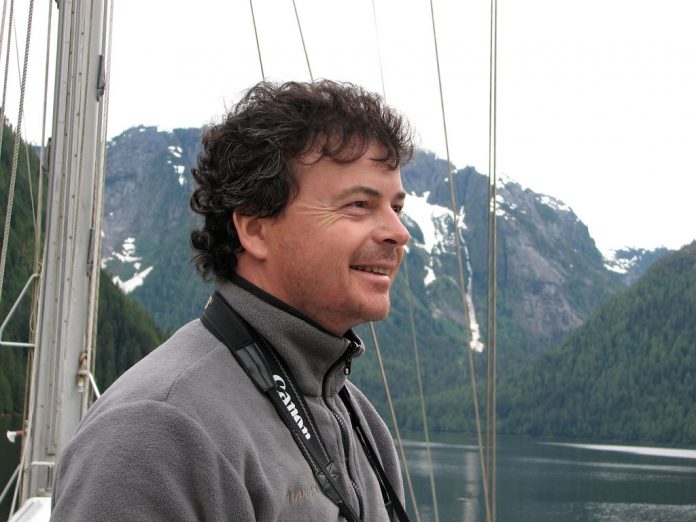
SFU biology professor, Dr. John Reynolds has been inducted into the Royal Society of Canada which honours researchers for their achievements in their respective fields.
“It’s a nice recognition when I think of some wonderful Canadian scientists who are a part of it” said Dr. Reynolds. “It’s nice to join them in that way.”
One of his many involvements in conservation biology is as chair on the Committee on the Status of Endangered Wildlife in Canada (COSEWIC), which is “a federally appointed body of scientists from across the country who are responsible for assessing the status of the species of plants and animals for potential protection under our federal species at risk act.”
Dr. Reynolds is currently leading two major research projects, the first focusing on life histories and extinction risks. The project will attempt “to understand what makes some species vulnerable to extinction and not others.” He said that in some cases, such as habitat destruction, it’s clear why certain species would be more prone to extinction. However, for other species, “it’s not so obvious.” Dr. Reynolds added, “In fisheries, for example, some species can sustain heavy fishing and some can’t. And so I’m interested in the biology that underpins the response of species to the pressures that humans are putting on them.”
Dr. Reynolds is also leading a salmon conservation project, which looks at salmon and their effects on the ecosystem around them. “Salmon are connected to so many other components of ecosystems. Lots of things eat them and when they spawn and die, their carcasses can help fertilize forests.” This study gave Dr. Reynolds the ability to go to any stream in the Central Coast region, and by looking at the plants on the streams and the forest, allowed him to predict how many salmon had come back from the ocean to the streams at the end of the season to spawn, based on the plant composition.
When asked about choosing his field, Dr. Reynolds stated that “In every step of the way, I’ve just been doing the thing that I love. In a sense, I’d never really had a choice because my choice was made for me, by my passion for the outdoors.”
Looper moth outbreak in pacific northwest expected to continue for another year
Written by: Karissa Ketter, News Writer
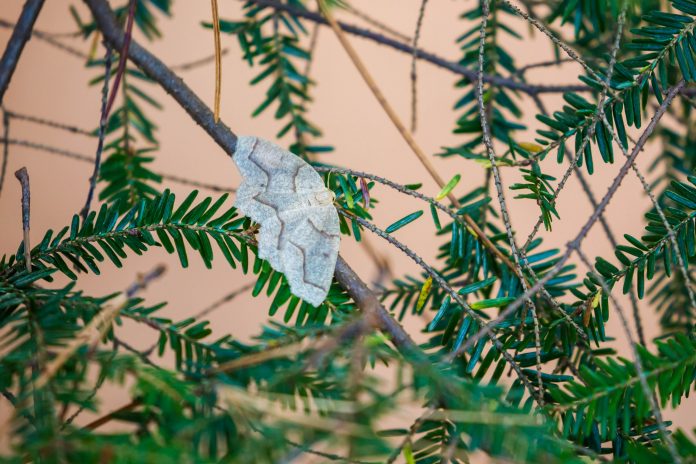
Over the past few weeks, moths have been swarming Metro Vancouver. Native to North America, these insects are known as western hemlock loopers and phantom loopers, according to Dr. Gerhard Gries, professor of evolutionary biology and ecology at SFU.
It has only been in recent months that those in the pacific northwest have noticed the moths crowding their homes, but as Dr. Gries states, “Outbreaks [can] last for two or three years,” and occur every 10–12 years. According to the District of North Vancouver, “we are currently in year two” of the outbreak.
The outbreak of moths is not a new issue to North America. According to Natural Resources Canada, between 1910 and 1975 hemlock looper moths have “caused timber losses estimated at 12 million cubic meters in Newfoundland and 24 million cubic meters in Quebec.”
In an interview with The Peak, Dr. Gries noted that the surplus of moths “may be caused by a combination of two factors: really warm summers that stress the trees and [ . . . ] a mild winter that allow[s] eggs to survive.” He added that “there is no definitive answer” to why their species has seen a jump in population but ecologists can continue to “speculate on this.”
Dr. Gries stated that the moths have the potential to affect our ecosystems in numerous ways. The huge populations of larvae are “[defoliating] the trees” — which means that as they feed, they strip the trees of their leaves. Dr. Gries said that when “the defoliation is severe, then the trees may die.” He added that local parks and green spaces will notice defoliated and weakened trees due to larvae damage. However, the District of North Vancouver noted that “it will require years of decay before trees become structurally weaker.”
Dr. Gries discussed some positive effects of forest defoliation on the forest floors. As the moths are feeding on the foliage of the trees, they are opening up with the forest canopy, allowing more light to reach the forest floor — this “encourages regeneration to happen.” This is spurred on by the larvae’s preference for feeding on older trees, leaving space for new trees and foliage to grow in their place.
This process is aided by the larvae’s feces, which becomes a natural fertilizer that further encourages the growth of new foliage.
The government of British Columbia has outlined the ongoing short-term and long-term strategies to anticipate and “predict levels of defoliation.” This includes conducting egg sampling in the fall that an outbreak is predicted to anticipate the amount of defoliation that will occur that summer.
“There are no practical measures we can take” to control the moth populations at this time, according to the District of North Vancouver. While the moths can be overwhelming in some areas, they are asking that those affected have patience.
If a large tree on your property has died and become hazardous, there is a service that can be used to report it. For more information on reporting tree issues, visit their website.
What Grinds Our Gears: Stop bombarding me with “Looking for class group chat” posts

by Carter Hemion, Peak Associate
Switching to online classes has been a big transition, but some things never change. The first weeks of every class are filled with the same barrage of notifications as ever: the dreaded “looking for a class group chat” posts.
They’re everywhere, from the SFU Facebook groups to Reddit, from Canvas discussions to Zoom tutorials, and anywhere SFU students can be found online. For weeks, the bottom of every Zoom call is a jack-in-the-box, the words “add me!” and “group chat?” springing out at random moments, as though mass spamming over lecture slides is helpful.
It’s never just one person asking; they come in troves, asking on the same platform for the same class, over and over without bothering to check the identical post from the day before. From the moment someone asks for a Facebook group chat in a tutorial, I know we’re doomed to have confused interjections about it for the rest of the afternoon. I’m getting exhausted with every platform I’m on sending me emails and of my phone buzzing when someone new decides they want a class group chat.
We need a designated space for students to discuss classwork and studying, like a Canvas discussion page in the course, for when these conversations don’t occur in the classroom. It’s time for the search for group chats to end.
Dr. David Chariandy’s works show that both fiction and nonfiction are vital to understanding racism
By: Molly Lorette, Peak Associate
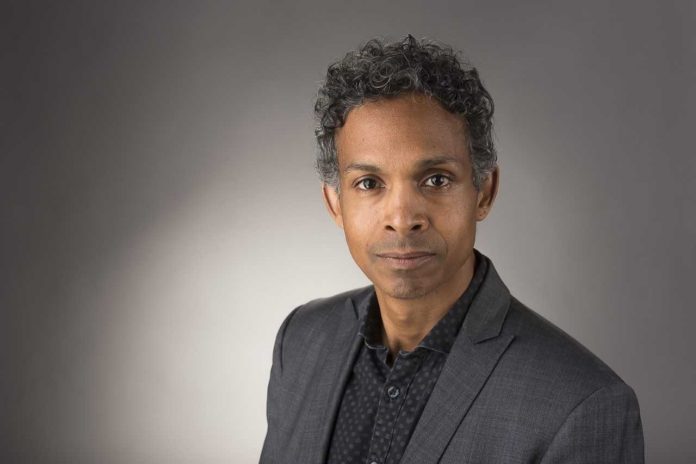
On August 20, SFU’s own Dr. David Chariandy, an English professor, was featured in USA Today’s “100 Black novelists and fiction writers you should read.”
The list is prefaced with the notion that, “Nonfiction books on race have resonated with readers across the country [ever] since the outcry spurred by George Floyd’s death in May and the killing of Breonna Taylor in March – both Black, both dead at the hands of police.” The article goes on to explain the importance of reading fiction written by Black authors, in addition to nonfiction books about systemic racism, as a way to better understand Black perspectives and experiences.
Indeed, Dr. Chariandy’s multiple award-winning works are breathtakingly touching and utilize his own intersectional experience. Through recent events occurring throughout the world, we have seen the profound ways in which empathy proves itself to be a force to be reckoned with. In this regard, stories like the ones crafted by Dr. Chariandy are integrally important in educating others in the ways in which racism is integrated within society, particularly Canada.
By now, I should hope that many of us have examined ourselves critically, and recognized the falsities behind the concept of Canada as a post-racist society. Still, it seems as though it’s undeniable that this notion continues to plague Canada today, and has led to a distinct problem in accountability. Personally, I can’t count the times I have heard movements like Black Lives Matter being referred to as a strictly American issue. Dr. Chariandy breaks this notion down flawlessly.
In 2017, Dr. Chariandy released Brother, a novel about two Black children growing up in Scarborough, Ontario, and explores questions of masculinity, family, race, and identity. During an interview with The Writers Trust of Canada regarding Brother, Dr. Chariandy says, “[It was] a way of working through the vulnerability I felt growing up and the possibility that life would take an ugly turn.”
His most recent novel, on the other hand, I’ve Been Meaning to Tell You: A Letter to My Daughter is a reflective work of nonfiction that Dr. Chariandy was compelled to write following a personal act of racism, and the Quebec City mosque shooting in 2017 as both events left him with a loss of words to comfort his daughter with.
Stories, whether fiction or nonfiction, depicting the lives of intersectional individuals in familiar spaces are vital in truly understanding the world around us. Unfortunately, we are vastly limited in the way in which we interact with our world, and thus have no way of truly understanding another’s life experience. However, literature has proven to bridge such a gap and make these lived experiences more tangible.
While SFU has a long way to go, I am extremely happy that we have individuals, like Dr. Chariandy, who bring their experiences and expertise to students as well as readers. While sharing personal experiences and stories is understandably difficult, its value is truly priceless, especially in today’s climate.
Vancouver air quality improves due to change in winds
Written by: Karissa Ketter, News Writer
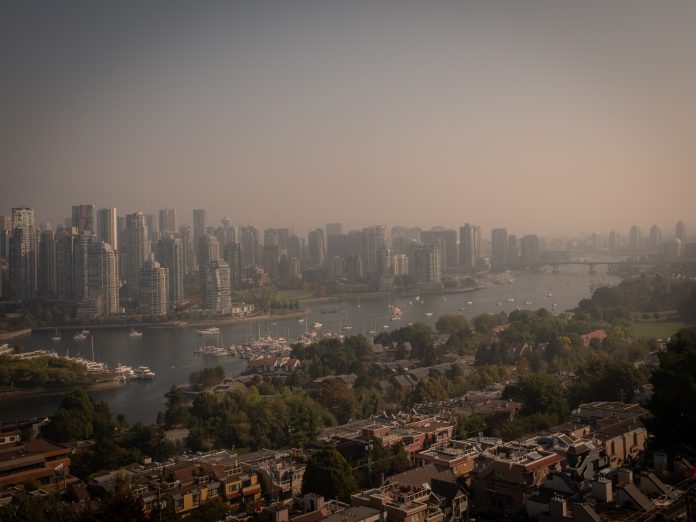
After repeated air quality warnings in Metro Vancouver, air quality has improved since the initial wave of smoke in early September, and the Air Quality Index has returned to normal levels. SFU health science professor Dr. Ryan Allen stated in an interview with The Peak that Vancouver’s air quality has increased due to the change in winds and “weather that came off the Pacific Ocean and pushed the smoke to our east.”
While the intense smoke has subsided in Vancouver, Dr. Allen said that forest fire outbreaks, which result in extremely poor air quality, “will become more common as our climate becomes warmer and drier” due to climate change. Air quality declined again Wednesday morning, due to smoke from California. However, “it’s not expected to be nearly as bad as earlier in September.”
Air quality is determined by the “amount and type of pollution that is emitted,” but other factors such as “wind, the stability of the atmosphere, and topography” can affect air quality. Dr. Allen noted that in recent summers, it has been common for Vancouver’s air quality to worsen due to surrounding forest fires. The fires that impacted Vancouver’s air quality this year from Washington and Oregon were spread to Vancouver by strong “winds that pushed the smoke north into Metro Vancouver and the BC interior.”
Air pollution is a combination of tiny particles, called fine particulate matter, and is an “important cause of health effects.” Forest fire smoke “produces a lot of particulate matter,” and with prolonged exposure can increase the risk of negative respiratory symptoms, such as shortness of breath.
While fires spanned the United States’ west coast, a smaller scale fire in New Westminster contributed to Metro Vancouver’s poor air quality. Dr. Allen noted that the “characteristics of the smoke from structure fires can vary quite a bit depending on what materials are being burned.”
However, localized and brief events, such as the New Westminster fire, aren’t as much of a concern for public health, according to Dr. Allen. Instead, he stated that forest fire smoke poses more of a threat, because it “can affect very large numbers of people.”
Forest fires that result in extreme worsening air quality are likely to affect those with pre-existing respiratory or cardiovascular health conditions. This would include those with asthma, chronic lung disease, and cardiovascular disease.
Dr. Allen noted that the non-medical masks those are wearing due to COVID-19 “may also provide some protection against particle pollution,” as long as the masks are a “good fit against the face and are made of reasonably thick material.”
My SSP renewed for three more years

Written by: Serena Bains, Staff Writer
Originally launched in August 2018, the mental health application was created in partnership with the Simon Fraser Student Society (SFSS) to address the mental health needs of students outside of office hours, off campus, and on short notice. The app surpassed the initial targets set and was renewed as a result.
Since My SSP’s launch “over 14,400 hours of clinical support were provided for more than 2,800 students,” according to Braden McMillan on SFU News. 70% of the clinical support provided occurred outside of regular office hours.
The application has four features: a news feed of tweets from Health & Counselling Services, an explore page of articles regarding how to manage one’s health, assessments for depression, anxiety, drug, and alcohol use, and text and call functions for students to speak to a clinical counsellor. The assessments do not diagnose students, rather they recommend that a student use the call function if necessary. Each feature is available in six different languages, with additional languages by request.
Students are also able to request counsellors according to their religious or gender preferences. The future iterations of the application are planned to include services specifically tailored to Black students and members of the LGBTQ2+ community.
Meet the student complaining on Rate My Professors following a self-induced bad semester

By: Devana Petrovic, Staff Writer
Some students choose to send their professor an email once in a while, or perhaps they may even pop into office hours at some point during the semester when they feel lost. But not me. No, I’m not like other students.
You see, when I find something to complain about, I don’t look for solutions in the midst of it happening. I wait until I’ve let every single minor inconvenience throughout the semester simmer, and then when it’s too late for anyone to help me, I turn into an anonymous Rate My Professors reviewer and release my wrath.
Yes, that’s right. I’m the one that gives a one-star review on a 4.5 star professor (that high score is practically always undeserved, if you ask me. Which I know you do.) I am that ounce of doubt in the nervous first year’s eyes when looking up their future professor. At the end of every semester, I hide behind my computer screen like a gremlin, with pages upon pages of notes — not class notes, silly, but pages of complaints — hunching into my keyboard as I project everything that’s ever irritated me in the slightest onto the internet forever.
“This prof is a Grinch! He wears an ugly green sweater to lecture everyday, and it doesn’t even match his shoes. Most unorganized prof at SFU >:( 1/10 never taking a course with this joke again,” I’ll eloquently say.
Why put it on the internet, you may ask? Why not fill out a feedback form or just talk to your professor?
That’s a stupid question.
But regardless, I find that leaving a permanent mark on my professor’s reputation, like a tattoo, if you will, shows remarkable courage. It takes real guts to leave a public proclamation of your subjective anger on a site meant to help other students with their course selection.
Some people ask for help and email their professor assignment questions like some measly child. That couldn’t be me. If I don’t understand assignment guidelines, that’s just not my fault.
The 500 unopened emails on my SFU account don’t prove a thing about my work habits. I’ll have you know that I am physically present at every lecture. What more can even be expected of me? Sure, I sit angrily cross-armed with my earbuds in throughout the entirety of my muted two-hour Zoom class, but that’s only because of the professor’s poor communication. And there’s a slight possibility that I haven’t even looked at any of the readings, but that’s also just because the lectures probably have nothing to do with the readings. No, I’m convinced they definitely don’t.
So there you have it. If you’ve had the professors I’ve had, you would understand why I do what I do. Am I ashamed of myself? Absolutely not. Will I continue to word vomit irrational, harmful, often horribly rude and uncalled for complaints on Rate My Professors? Till the day I die.
Where is the fourth floor of the AQ?
By: Molly Lorette, Peak Associate
Have you ever stepped into the elevator on your way to a tutorial on the fifth floor of the AQ and noticed that the buttons conveniently jump from three to five? Have you noticed that the few elevators that do go to the fourth floor of this building only ever spit you out outside? Have you ever stopped to wonder why that is?
Think about it! AQ? Academic Quadrangle? Does anyone actually know what the heck a Quadrangle actually is? AQ. A Q. Abolish Quickly. Abolish what, you ask? Here at The Peak, we are trying to uncover the exact same thing.
The total number of floors in the AQ is six. What happens if you take that number and multiply it by 111 (1:11, the same number I always see when I check the microwave clock to cook my soup for lunch?) 666! A quick search on the ever dependable Wikipedia will tell you that the number 666 is the number of the Antichrist. Clearly, Simon Fraser is hiding something nefarious! Clearly, those who pull the strings behind the scenes are attempting to raise the Antichrist!
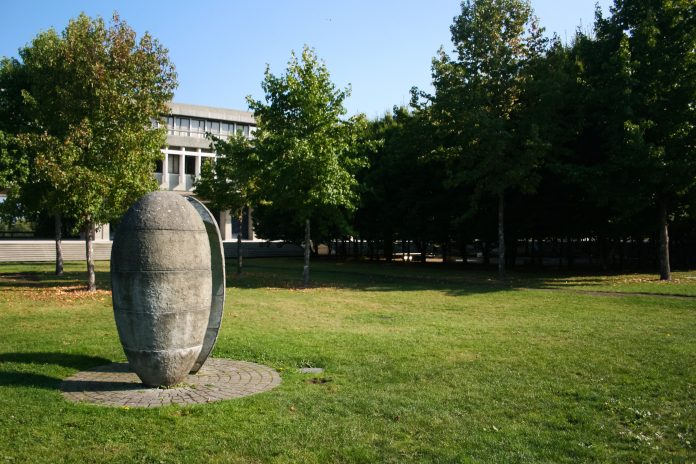
The gardens in the AQ are very conveniently placed, serving as the so-called “fourth floor.” Ever notice how strange the art pieces are? Think about those hedges and how they all surround a pyramid. Think about the hill, shaped like what? A triangle! A triangle has three sides, and how many digits are there in the number 666?
WAKE UP, SHEEPLE!
To me, it’s totally clear what’s going on with this secret fourth floor. They want to hide it from us for a reason. Clearly, our tuition money has been going on to build a cleverly hidden lair for the academic cult to meet and hold their satanic rituals in order to raise up the Antichrist once and for all — right under our noses, as well!
Still don’t believe me? Look no further than the most famous art piece in the AQ gardens: The Avocado. What does The Avocado mean in the big picture? Haven’t they always said that avocados are the cause of all millennials going into debt with their precious avocado toast? Add the allure of a late-night rendezvous at this infamous location and the eventual overtaking of veganism avocados threaten us with, and it turns out we are too late to stop this cult. The Cult of the Avocado has already begun to take over the world as we know it, dear SFU scholars. It may be too late.


