Home Blog Page 378

Award-winning film Goodnight Goodnight showcases the talents of SFU alumnus

0
Photo courtesy of Mackenzie Reid Rostad

By: Meera Eragoda, Arts & Culture Editor

Watching Mackenzie Reid Rostad’s Goodnight Goodnight made me wonder if we’ve constructed artificial lights to try and satiate the call of something deep within us for a star-filled sky. The experimental film, which explores light pollution, love, and hydroelectricity, recently premiered at Visions du Réel in Nyon, Switzerland and won Best Canadian Short and Medium-Length Film at the Montreal International Documentary Festival.

Written and directed by SFU BFA grad Reid Rostad, with music by Rosie Long Decter and sound design by Alex Lane, the film features meditative shots overlaid with interviews and Reid Rostad’s own narration. It investigates patterns between human constructions like subways and natural phenomena like constellations, and gives rise to the question of how we find meaning in a world anchored by our own creations.

The film, described as a love letter, has no explicitly stated narrative but is meant to motivate us to interrogate our relationship with place and time. I had the chance to speak with Reid Rostad and asked about this and other details of the film. He elaborated that he hoped the film could “challenge some of the assumptions we have concerning time, space, and their continuity.

“Space and place tend to collapse when we look at everything that makes their existence possible. Spaces, such as a metro station in Montréal and a hydro-electric dam in northern Québec do not exist independent of the other.”

Place, he said, is different from space and “[a]s with love [ . . . ] we’ll never understand it until we’re able to untangle ourselves from our notions of space and time and the market imperatives which act on them.”

I asked Reid Rostad more about love and pollution and if he learned anything about either from making the film. He explained that “both love and light pollution are essentially photographed the same way — highlighting the absence of someone or something.

“This idea of feeling love only in its absence is very immature [ . . . ] Throughout the film, I’m kind of poking fun at this idea, which I embody, as it can be rather pathetic.” He went on to explain that the film presents an “unknown other” which mirrors narratives of unrequited love that consumers are fed. He added, “I don’t think we’ll have much luck preventing light pollution or solving much of anything if we’re not able to free ourselves from love as lack.”

A striking aspect of the film was Reid Rostad’s use of lingering shots and the way the framing illuminated the cold beauty of industry. It brought to mind a memory of visiting a friend in Lloydminster and being captivated by the lights of the oil refineries twinkling vividly against the dark night sky as we drove by. It sticks with me, perhaps because of the contradiction of finding beauty in something so destructive. 

The film seemed a little reminiscent of Anthropocene: The Human Epoch (2018) and when I asked Reid Rostad about it, he revealed that one of his favourite filmmakers is Anthropocene co-director Jennifer Baichwal. Her opening shot in Manufactured Landscapes is directly referenced in one of the closing shots of Goodnight Goodnight. He said, “The mode and sensitivity of Manufactured Landscapes is something that has very much informed my work and interest in cinema at large.”

As Reid Rostad is forging ahead in the film industry, I was curious if he had any advice for SFU film students or students in general. He obliged. “You’re studying because you’re a student. When you graduate, condemned to the real world, you’ll lose this title and everything that came with it. You may well be starting at zero. It’s important to be patient with yourself and not lose sight of why you chose to study and practice art. Take time (as in years) to reflect on what that means to you, as it probably wasn’t for the degree.

“A final and more pointed word for film students. Motion pictures are almost as old as the city you’re studying them in. You probably can’t afford to live there, so there isn’t much point in reconstructing it elsewhere.”

As a history major and gender studies minor, I’ll leave it to film students to decode his advice.

Though there currently aren’t any plans for Goodnight Goodnight to be screened in Vancouver, if it is in the future, it’s worth watching for an exploration of the world — constructed and not. Or at the very least, a meditative experience filled with strangely beautiful shots.

Vancouver is a performative capitalist city

0
Economic disparity shouldn’t be a part of this city. Screenshot courtesy of City of Vancouver

by Mina Garlick, SFU Student

Vancouver has recently started a campaign called the “Vancouver Plan” to encourage positive change for issues in the city. These efforts feel like a step in the right direction, but the city should be doing more than simply posting videos and updating their website. These online platforms are performative — simply appeasing the masses instead of addressing the root cause of the issues and admitting that there is a need for entire systemic change. As a student affected by the city’s lack of action, I want to see Vancouver’s current elected officials show us that they care by tackling the root cause of systemic issues: capitalism. 

Before I delve into the city’s issues, I need to highlight what is working. Programs such as public libraries, funding surrounding art, and community centres all are influenced by socialist methods. These socialist methods allow citizens to have a space where all can have easy access to books, fitness, collaboration, and much more. With universal access to these, it allows everyone a fair chance to meet their goals. I have yet to see a success in Vancouver that did not use socialist standards in its making. 

Now that I have highlighted what is working, we need to see what is not working: racial and economic disparities. Both of these issues meld into capitalism. Racism, or any form of discrimination based on characteristics out of one’s control, helps perpetuate capitalism. Many young BIPOC I know from Vancouver have struggled financially more than their members of white communities — even if both parties have excellent experience and performance. This reality shows us that in this city capitalism will affect our BIPOC population more heavily due to disparities out of their control. 

Regarding economic disparities, for capitalists to exist they need to ride on the shoulders of wage workers who bring in large profits for capitalists. Such large sums would not be possible if wage workers were paid equally to CEOs. Capitalists in Vancouver, and any political groups or organizations supported by them, will benefit from this current system. This is not fair for the rest of us and, as stated in the Vancouver Plan, we need to thrive for equality. To be true to this plan, Vancouver must take action on this.

These struggles within our city cannot cease to exist under the reins of capitalism. As mentioned before, capitalism relies on the dehumanization, exploitation, and economic inequality of working class people and marginalized groups. With this economic state, there is no pure way for more democratic practices to bloom while human rights decrease at the cost of capitalist expansion.

In addition, if the city my fellow students and I reside in is a profit-over-people economic state, we will not be prioritized. I’m a student wanting to work in the environmental planning sector of local governance. Though, job security is not as present because under capitalism there is no social mobility for the working class. Where does this leave me and other students who are merely aspiring for stability in this system? It leaves us in fear that something as simple as wanting financial stability in our field will not be an attainable goal.

In Vancouver, I hope to see capitalism dismantled because it harms those most vulnerable to its pitfalls. Hopefully we can see a shift towards other economic and governing systems, such as socialism, to ensure the needs of all people are met. Real system change is much better than perpetuating falsehoods with a supposed “plan.”

The perfect stocking stuffers for your loved one going through a quarter-life crisis

0
PHOTO: Jon Tyson / Unsplash

By: Kyla Dowling, Peak Associate

As the snow falls, we too fall under the weight of the self-awareness of Christmas and its exploitative, capitalistic nature hidden behind a happy bearded man in red. Are you crying into your overpriced emotional support holiday throw pillow already? Sure, it says “Merry & Bright”, but you’re neither. That’s alright — being a self-aware adult around Christmastime just promises gifts you’ll actually need instead of ones that spark any real joy while your parents are still half-assedly pretending Santa is real (even though you’re 21, mom.) Who knows what Santa might bring you? Here are some possibilities!

  1. Hand sanitizer that smells like the booze you had a bad experience with in middle school

Remember the first time you ever drank in the eighth grade? It was Emily’s birthday party. You told your parents it was a sleepover so they’d let you go, but really it was a bunch of messy fourteen-year-olds and Emily’s mom, who said she was there to “supervise” but definitely drank more than all of you combined because she’s a “cool momma”? Sweet memories. This hand sanitizer that might save you from getting COVID-19 smells exactly like the Everclear you drank that night, threw up all over her brother’s shoes, and then blamed it on Aiden. Have fun being reminded of that multiple times a day while you fight the virus.

2. Christmas-shaped pot cookies

Oh look! There’s a box of cookies, shaped like snowmen and stockings and ornaments. That’s cute, I guess, but on the bottom of the box there’s the classic label that brings joy to your heart: that tiny red hexagon that says “THC” on it. Santa knows you so well. Take a little bite of one, if you want, but make sure it’s a small piece — “Frosty the Snowman” is actually terrifying when you’re greening out. Most importantly, make sure you hide the box. Otherwise, your family is bound to try and snack on it. It’s definitely not fun when your mom sneaks a few too many and ruins Christmas by eating the entire turkey before dinner and then crying because she swears the Rudolph figurine on the mantle looked at her funny. 

3. A chocolate shaped like Jeff Bezos’ heart

Always wanted to eat the rich? Not actually capable of doing so because a) that’s cannibalism, and b) his soulless eyes scare you more than flying on airplanes right now? If you’re lucky, one of your stocking stuffers might be a chocolate sculpture of Jeff Bezos’ heart. Not only is it an exact replication at the same size as his, it also has salted caramel as blood and real gold flakes lining the aorta. Eating the rich has never been so delicious! If you don’t get this in your stocking, it’s available on Amazon for $399 plus tax. And if you have Amazon Prime, you might be eligible for free shipping!

It won’t be a happy holiday unless we all do our part

0
Staying inside is the best way to prepare for the holiday season. PHOTO: Jonathan Borba / Unsplash

by Devana Petrovic, Staff Writer

The holidays are just around the corner, and while I’m sure everyone is just itching to dive into festivities after this shitshow of a year, it’s important that we keep a grasp on the current state of the world. Before going forward with those holiday parties or attending any form of large gathering, remember that following safety regulations for COVID-19 needs to be everyone’s priority this year. Otherwise, another lockdown may ruin our chances of having a “holly jolly” holiday season. 

BC’s recent surge in COVID-19 cases has been frustrating for many especially when we had flattened the curve significantly in the summer. Personally, it has been difficult to spend all my time at home without being able to see many of my closest friends. It’s even more difficult when others are acting like there isn’t a global pandemic. But, these are safety measures that are put in place to protect everyone’s health. As unfair as it may feel, all we can do now is join the fight against the virus by following the instructions given to us by health professionals. 

I can understand extenuating circumstances in which one may not entirely be able to stay home, such as people who require support outside their household, those with sick family members outside of town, or individual attendance of religious facilities. However, even in those instances, it is expected that the bare minimum of wearing masks and social distancing is at least followed.

I have no understanding for those who have chosen to party and intentionally disregard health regulations. Back in August, BC saw a rise in cases specifically due to outbreaks at parties, all of which are completely unessential during this time and only pose a serious health risk. To be completely direct, partying in these times is selfish and not worth it. 

It would be a shame if this year’s holiday season was jeopardized by another lockdown, especially considering the volume of annual traditions and events that have been either cancelled or hindered in some way this year by COVID-19. Frankly, it has been a stressful and boring year for everyone in the world, and having something close to a normal holiday is much needed. 

For some, this may be the only opportunity to see their family. For others, the holidays include the practice of annual sacred religious and cultural traditions. So, I don’t think it would be a stretch to say that the holiday season is very important to many, and going against regulations puts this opportunity at great risk.

We’ve flattened the curve before and we can certainly do it again. By keeping up to date with the latest regulations, staying home as much as we can, and wearing our masks when we need to be out, lowering the number of COVID-19 cases before the holiday season is something we should strive to do. We all need a little compassion for one another right now, and what better way to show it than to ensure everyone can safely enjoy that much loved ‘holiday cheer’ this year?

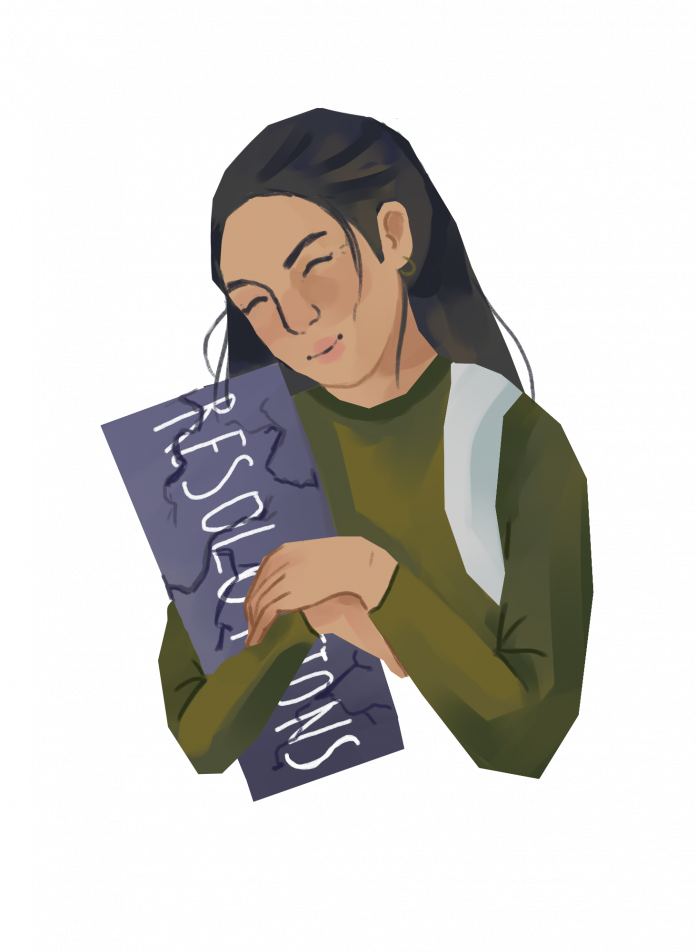
Top Ten failed 2020 New Year’s resolutions

0
Very calm, very cool. Nothing wrong here. Illustration: Siloam Yeung / The Peak

By: Juztin Bello, Copy Editor

  1. Travel more to ~find yourself~

People with a “this is going to be my year” mentality seek travel to ~discover themselves~, acquire ~hip lingo that definitely isn’t appropriation and misuse of a language~, and to ~flex on social media~. Spoiler alert, this was nobody’s year. I’m sure a lot of people were expecting 2020 to be their Eat, Pray, Love year — but instead, everyone found themselves having a Cry, Beg, Sit on your hand ‘til it’s numb and then masturbate with it so it feels like someone else’s hand” year. The closest any people came to travelling this year was the astral projecting and dissociation triggered by the mounds of stress 2020 brought. But hey, at least that kind of travel doesn’t cost actual dollarsjust your soul. 

2. Fall in love (but with like . . . another person) 

Rihanna may have said “We found love in a hopeless place,” but she never considered how hard it’d be to find love when you’re in a hopeless place and also hopeless. Because of 2020’s onslaught of inconsistent lockdowns, the only touch some of you have felt is the touch of reality when your favourite bar closed down. Consider yourselves lucky, though. For a whole year y’all had a valid excuse for why you’re single instead of making up lies to disguise your tired, one-note personalities. And honestly, just for one second think about the Grindr gays. You thought it was hard out there for us to have any sort of connection before? We can’t even ask “host?” anymore without being fearful of contracting another disease. Now we have to be physically distant on top of already being emotionally distant. 

3. Be less of a shitty person

Admittedly this one is kind of hard if you’re just a shitty person naturally. I won’t fault you for that. And while this entry is sort of an all-encompassing reality because, let’s face it, everyone can be kind of shitty here and there, the fact that COVID is still a thing proves just how shitty we all actually are. Shitty at following instructions, shitty at helping others, and, frankly, shitty at helping ourselves. Also, I can tell you for damn sure at least 47.2% of America failed this one — their efforts to not be shitty were trumped by their inability/unwillingness to change. Better luck next year (if we make it til then), ya shitheads! 

4. Cry less

Aight, I’ll let all of you off easy this time. Just take a second to know for a fact that this is about you. Go back to blasting your “sad bitch hour” playlist in peace and move on to the next one. You’re welcome. 

5. Volunteer

In a year where we can barely help ourselves, the sentiment of helping others has gone as ignored as warnings to wear a mask indoors. Based on the current state of the world, the only volunteering any of us are going to be doing soon is for the first annual Hunger Games, where Bezos and the other 1% are going to bet on us for sport. Just pray that you’re bland enough to get caught up in a non-consequential love triangle and you’ll somehow survive. Well, you’ll survive, but your reputation that appeals to the bookworms thinking “I’m not like most girls” sitting cross-legged in their quilts won’t.

6. Avoid wasting money on vices (alcohol, weed, hentai, etc.)

You know, I’ll give 2020 credit for helping me avoid spending $100 at the club every weekend. That hasn’t stopped me (or any of you, I imagine) from continuing to drink vodka sodas in mass amounts every weekend or donning your masks to hit up your local dispensaries on a weekly basis. I’m sure in the long-run it’s better that most of us are getting blackout at home instead of blackout on Granville; but, honestly, at what cost? Having this money but missing out on experiencing “WAP” or all of Good News by Megan Thee Stallion at the club? That’s some WAP. (Wasted-ass potential.)

7. Make more of an effort to see your friends

I’ll be frank: texting is boring as fuck. If I get a text and all it says is “hey” the likelihood of me responding is the same as Lhindseigh from your high school posting in support of Black Lives Matter instead of sharing old photos of her in Bali with “take me back . . .” written on them. I can imagine if you share this sentiment, maintaining distant relationships has been rough. But worry not, there’s now a solution! And not like, Zoom or getting over your unwillingness to text back. No, you could just say “fuck it all” and discreetly host a gathering wtih your 25 closest friends. If people ask, just say you’re hosting a wedding ceremony for you and “good times” since weddings seem to be getting the pass right now. After your friends become the epicentre of another wave, however, “good times” will file for divorce. 

8. Get better at remembering important dates

Remember when summer break was strictly July and August, and you’d lose track of time because the days would just blend together? Now take that, make it an entire year, and you’ve got 2020. The only dates you may have ended up remembering are the birthdays of people whose birthday was in the middle of a lockdown, since I’m sure they incessantly posted about their “birthday month” to make up for the fact they couldn’t host a party for a bunch of people who don’t even like them. But you’re in luck; you’re about to remember when Christmas is because that one girl whose entire personality is based on a consumerist, religiously charged holiday is about to start her “_ days ‘til Christmas” countdown on her Instagram Story. At least that’s something . . . right?

9. Hit the weights more

Perhaps one of the most popular resolutions, improving one’s fitness is a goal that perfectly resembles society’s reaction towards COVID restrictions this year: a huge commitment at the start, only to gradually ease up until you eventually stop caring. Now people might blame the gyms closing down as the reason for this resolution’s failure. But let’s get real: none of you Bradstopher or Chadson types actually went to the gym when it was open; you maybe went once or twice just to Snap 50 girls with the caption “rise and grind.” I’ll give people credit, though: with the declining economy, political tensions, and daily heartbreaking news, everyone has learned how to be a little more flexible. I’m sure after carrying the weight of this year on your shoulders and the burden of other people’s carelessness, those muscles will be coming in, too! 

10. Try something new

This year, did you end up doing the same shit you do every year? Like criticize the choices of other people in a humorous/satirical way as a means for overcompensating for your crude takes? And feel like people don’t actually respect you because you stick with one comedic styling that works for you? Did you make a rash decision again out of nowhere because doing things suddenly is the only way you can feel satisfied with a decision you made? Or are you still feeling stuck somewhere, like staying with the same job because you’re scared of moving on from a place, but also hate being complacent and blame being “comfortable” for why you choose to make less than you think you should? If you felt called out, you shouldn’t, because this one’s about me.

At least we had good music: Best albums of 2020

1
Some of this year's best albums

By: Winona Young, Peak Associate, Emma Jean, Staff Writer, Kim Regala, Peak Associate, Madeleine Chan, Opinions Editor, Meera Eragoda, Arts & Culture Editor

Peaceful as Hell by Black Dresses

Courtesy of Blacksquares Records

How do you find peace in a destructive world? In the case of Toronto-based artists Devi McCallion and Ada Rook, you find peace by creating techno music that is disorienting, discordant, and vulnerable. Ever since the pair began making music in 2017, the PC music scene has never been the same. Sonically, it’s clear that McCallion and Rook draw from a wide variety of musical influences — Auto-Tune, pop, glitch-pop, techno, screamo, indie, emo, and guttural anguish. But what stands out most about Black Dresses is that they are not afraid to make music that is more noise than harmony, and that they are living proof that trans women can stand at the forefront of cutting edge music. Peaceful as Hell is the duo’s third and final album, and it is as menacing as it is catchy and painfully honest. It ruminates on yearning, love,  being hopeful and hopeless, deep-seated fear, isolation, self-destruction, and of course, wanting to be cute and well-adjusted. Peaceful as Hell stands out as an album from 2020 that won’t fade out in music history. — Winona Young

You and Your Friends by Peach Pit

Courtesy of Columbia Records

If you’ve had even the slightest exposure to Vancouver’s local music scene, then you have definitely heard of Peach Pit. Some fan favourites include “Tommy’s Party” from their 2018 release of Being So Normal, and their hit single “Seventeen.” I had heard about the band plenty, but it wasn’t until this year that I finally got into them. In April, they released You and Your Friends, a collection of post-break up tunes so perfectly and conveniently timed (I’m looking at you, broken-up couples lost to the hot-iron strike of the pandemic). I remember listening to “Shampoo Bottles” for the first time, a song that alludes to the physical aftermath of a relationship that has ended. Despite never having lived with a significant other, I could resonate with the sentiments of reminiscing through mundane objects that hold remnants of your past together. Peach Pit takes you through the many perspectives of post-romance, yet does so in less-heartbreaking ways through their soft and vibrant surf rock sound. This album was my much needed pastel-coloured escape all throughout the summer, and for that it definitely deserves all the recognition. — Kim Regala

Show Pony by Orville Peck

Courtesy of Royal Mountain Records

With the deep warble of a 1950s cowboy, the instrumentation of an alt-rocker, and an undefeated aesthetic that combines queer camp with the Wild West, Orville Peck is a throwback to the folk storytelling tradition of country music; a refreshing antidote to the girls-beer-trucks-fest that constitutes most radio-friendly country today. 

The Canadian country-crossover artist hit the scene with his 2019 debut Pony and this six-track follow-up album builds on his repertoire. Each track encapsulates a different sound: “No Glory in the West” is a cryptic meditation where Peck’s low, buttery voice shines; “Legends Never Die” enlists Shania Twain as the album gets its closest to pop-country; “Summertime” brings gorgeous ambient instrumentation and a melody that wouldn’t feel out of place on a Lana Del Rey album. 

A stand-out from the album is a country staple cover performed through a queer lens, giving it a goosebump-inducing reinvention. “Fancy,” previously performed by the likes of Reba McEntire and told from the perspective of a young sex worker, brings a bolder, rawer side to Peck’s voice paired with spell-binding, slow burn instrumentation. 

Orville Peck’s boundary-pushing music is like little else on the music landscape today; get excited to giddy-up and see where this cowboy takes things next. — Emma Jean

Rainbow Boy by Keiynan Lonsdale

Independent artist and actor Keiynan Lonsdale released their first album this past May, and I cannot praise it enough. 14 tracks and a rich 49 minutes, it’s wonderfully expressive and feels like a slow unfurling of a cocoon. Some of my favourite bops include “Gay Street Fighter,” a queer anthem, “Rhythm & Music,” which is infectiously danceable, and “Rainbow Dragon.” The latter offers a scathing critique of the world’s injustices and the actor’s public perception with enraged lyrics like “This world’s on fire / But your desires make you think it’s fine.” In the penultimate interlude “One Man,” they sing an impassioned plea, tackling western individualism with the words: “If this world could just look in the mirror / It would see there’s a bigger plan / We’re so much more than one man.” 

The songs simultaneously have such a seething “fuck you, this is me” vibe and a wholesome “love yourself and the world around you” vibe. I would generally call its genre alt pop, containing elements of rap, doo-wop, and “spiritual” sounding instruments like chimes and harps. It hits emotional and rhythmic highs and lows and ends with an explosion of self-love and acceptance that you can hear through your speakers, and feel in your heart. — Madeleine Chan

Fetch the Bolt Cutters by Fiona Apple

Courtesy of Epic Records

Piano, screaming, dogs. Fiona Apple’s newest album has all this and more. I started listening out of skepticism after Pitchfork gave it a perfect rating but I was soon captivated. There’s an unbridled energy and a fuck-you edge to many of the songs. Apple plays around with tempos, beats, and sounds — literally banging on pots and pans or recording her dogs barking. It’s undeniable that Apple can sing but she is not trying for a polished, refined sound on the album, going between deep, growling vocals to ethereal ones, quiet to loud, adding in shaky breathing, spoken word, and chanting lyrics like mantras: “I need to run up that hill / I will I will I will.”

On “Heavy Balloon” Apple sings, “I spread like strawberries / I climb like peas and beans / I’ve been sucking it in so long / that I’m bursting at the seams.” Apple refuses to be held back and this album shows it. It’s experimental, raw, electrifying, flowing and explosive. It’s the perfect feminist rage album and Apple is making no apologies for it. She is “pissed off, funny, and warm” and I am here for it. — Meera Eragoda

Punisher by Phoebe Bridgers

Courtesy of Dead Oceans

So far, 2020 has forced us to stare down the unblinking abyss of life. But singer-songwriter Phoebe Bridgers stared right back at the abyss, wide-eyed, and screamed herself hoarse for good measure in her album outro. Punisher stands as a testament to how unflinching Bridgers is in the face of pain, heart-ache, and peace. This album is her second release and proves she is a strong force in indie music who is not planning on stopping. Bridgers returned to music with her trademark ghostly vocals; she sounds almost hoarse and paper thin at times but proves to have incredible depth. Paired with her heart-wrenching lyrics (“I’m gonna kill you/ if you don’t beat me to it”), Bridgers accomplished what so few can do: she created compelling and distinct songs about sadness with varying shades of complex emotion that pair with each song. From disappointment about well-meaning but destructive lovers (“Moon Song”), or resenting an absentee father who beg for forgiveness (“Kyoto”), or even the slow resignation about the end of humankind altogether (“I Know the End”), Bridgers writes poignant and rich songs which speak not only to her vulnerability as a songwriter but how powerful she is at her craft. — Winona Young

“I can’t wait for this year to end!” says student who thinks the pandemic will randomly stop because of an arbitrary date

0
PHOTO: Gudrun Wai-Gunnarsson / The Peak

By: Kyla Dowling, Peak Associate

In a few brief weeks, it will be 2021, and we all know what that means. The minute the clock strikes midnight on New Years’ Eve — but like, specifically midnight where I am because the world is centred around me — peace and balance will be restored to the world. It’ll be like when Avatar Aang defeated the Firelord. (He was totally a Libra by the way.) 

“But Kyla,” you ask me, “how will this work? How will we regain peace and balance when there’s a global pandemic, murder hornets, white supremacists, and — the worst of all — The Lorax isn’t available on Canadian Netflix?” Do not worry, my sweet fledgling. Take a deep breath. Forget your ties to the pathetic mortal world and ascend with me to a higher plane of thinking. You know those galaxy brain memes? I have surpassed the galaxy brain. I am God. 

Here’s what will happen: COVID-19 will cease to exist; all those afflicted will be in full health, and people will burn their masks in the streets because masks totally aren’t helpful for any other illness. Climate change? Nah. The polar bears will be chillin’. Racism will be eradicated — because that was exclusively a 2020 problem and will be solved as soon as we flip a page in our calendars. Duh. We will roam our purified earth as eternal vegans whose foundation actually matches our skin tones, probably. Veganism is the end-all solution to the global health crisis, right? Don’t worry, whoever swaps the world over for the new year will worry about the details. World Peace ! 🙂

You might be thinking that the new year isn’t enough to bring peace and balance again. Don’t you worry your pretty little head about it — you need to start thinking more like the politicians giving promises but doing nothing to catalyze them. Homophobia? Gone. Gender-neutral bathrooms? Everywhere. Anyone with a Cancer placement in their big three? Imprisoned. The prison system? Eradicated, besides the previous point. Joe Biden? No longer a bigoted predator and is set to assume office at 12:01 on January 1, 2021. Donald Trump? Golfing with his ol’ pal Ivan the Terrible, hopefully. 

We don’t have to put any work into wearing a mask or educating our racist families. Soon, this cursed year of 2020 will come to an end. All we have to do is wait.

Holiday season jeopardized by the dreaded Disney Adults buying all the Disney merchandise

0
PHOTO: Gudrun Wai-Gunnarsson / The Peak

By: Alex Masse, Peak Associate

The toy stores open during this pandemic — endangering workers just so some kid can play with Lego for five minutes then lose interest — found their Disney sections utterly gutted by a different plague: Disney Adults. 

Following the sweep of anything remotely Disney-esque, parents were left wandering countless aisles, looking for anything with Elsa’s face on it for their children’s gifts. As the neck of the last Cinderella Barbie snapped, so too did the Karens and Sharons in the store. A lunchbox with Woody’s face on it was carried away by a woman in torn clothes while she mumbled the words to “You Got A Friend in Me” to herself.

An adult that likes Disney morphs into a Disney Adult when their fondness for the franchise overrides natural instincts regarding social norms and self-preservation. 

A Disney poster in your room? That’s fine. 

A Little Mermaid tattoo? Chase your bliss! 

Spending your child’s college fund on vintage Mickey memorabilia? Yeah, you’re pushing it. 

Risking your asthmatic partner’s life just to go to Disney World right now because of your withdrawal symptoms from churros? That’s a Disney Adult. 

Disney Adults present themselves as benign, if a bit saccharine but at the end of the day, you don’t matter to them. They don’t matter to themselves. All they care for is their Mouse God. 

While reporting on a Walmart hit particularly hard by a swarm of Disney Adults, I actually encountered one named Marina in the wild. She was Disneybounding as Snow White and taking singular bites out of every single apple in the store. For those who don’t know, Disneybounding is essentially modeling outfits off characters in a more subtle style than cosplaying.

Please don’t ask me why I know this. 

Marina explained that this was the first year Disney had experienced financial loss in decades, despite owning basically half of all media and churning out toys every second. This terrified her. All the Disney Adults rallied together in hopes of turning profits around. 

“I’m more into the old stuff,” she told me. “Like, 70s or earlier. But I’m putting taste aside for the sake of a good deed. I even bought a Star Wars Funko Pop!” 

I knew someone who collected vintage Mickey Mouses (is the plural Mickey Mice? Mouseses? Meese?) — well, whatever the case, those things are terrifying

I explained that every company is losing money right now, and that Disney’s monopoly would easily bounce back once this pandemic ended. Why not support local businesses? 

Before I could go on, Marina assured me that her devotion would be rewarded, if she just wished upon a star. Gross.

To which I admitted that, yeah, these were bound to be vintage and valuable someday. 

“Oh, for sure, but I’m talking about the day I get my citizenship,” Marina told me. 

I asked what she was talking about. 

“It’s inevitable. One day, Disney will have enough power for its parks to become independent and expand into proper empires. Those of us who help Disney the most will get Disneyland citizenship and be permanent residents in the Happiest Place on Earth. My husband and I have been at it for years. The rest of you, well . . . ” She chuckled.

I waited for some sign she was joking. It didn’t come.

Marina took my silence as awe. “You know, if you want, I’ll put in a good word with the Mouse.” 

I told her she could do whatever she pleased. Then, because I needed to get the hell out of there, I asked her about Mickey Waffles. Specifically, what the difference was between a Mickey Waffle, a renowned Disney Parks delicacy, and a regular waffle in the shape of Mickey Mouse. 

Her eyes glazed over. I made my escape. 

Gets ‘em every time. 

Four unique BIPOC businesses to support this holiday season

0
Give your friends and family gifts that are conscientiously sourced.

By: Yelin Gemma Lee, Peak Associate

Mumgry

Mumgry is a Black-owned business that sells nutritious and ethically sourced nut butters. Their target audience is moms, and their goal is to take the stress out of nutritional snacks during every stage of motherhood. But you know who is also super snacky all the time and struggling to nourish themselves? Me. Students. Trust me when I say, their pistachio chocolate almond butter is the perfect consolation after a good stress cry over your impossible workload. 

If you don’t feel like ordering online, you can find Mumgry’s products for sale at Old Crow Coffee. Everyone that works at Old Crow is an absolute gem, especially Steph — the powerhouse queer Asian owner. They also carry lots of other BIPOC-owned pantry goodies as well so it’s worth a gifting visit — also their vegan grilled chez is to die for.

Decolonizing Daughters

Found in New Westminster, this business is owned and operated by two Indigenous women. Everything in their shop “is handmade; from the products themselves to cutting the logos out. Everything is made with intention, love, and in ceremony.” Sounds pretty sweet, right? They specialize in affordable medicinal wellness products including candles, massage bars, lotions, roll-ons, bath teas, and more. They also sell some gorgeous handmade jewelry and offer a gift wrapping option — so your busy ass drowning in finals for most of December won’t have to do it the night before, like you do with most things.

kyth + kyn

This shop is Chinese-owned and focused on modern Chinese herbal medicine to take care of your family and friends. What better time to give gifts that protect your loved ones with herbal products that aid in optimizing health? kyth + kyn prides itself in “using only premium and organic quality herbs without harmful pesticides [ . . . ] [and] are lovingly handcrafted by a Holistic Nutritionist and Traditional Chinese Medicine Doctor in Vancouver, BC.” They carry herbal soup and tea blends, as well as convenient bundles perfect for gifting. 

Spirit Bear Coffee

The simplest gift to give is coffee. Many of us rely on this coffee bean nectar to the point where we are always running out and having to get more. Why not support Indigenous-owned Spirit Bear Coffee based in Port Coquitlam? They have a strong environmental mission focus, supporting and collaborating actively with social initiatives such as Ocean Alliance, Raincoast Conservation Foundation, and several more. They have a wide variety of coffees and compostable coffee pods available, as well as office bundles which I don’t think are too shabby of an idea for that coffee addict in your life working from home. My personal favorite blend is Thunderbird: Dark French Roast, although I have yet to try all of the blends they offer.

Students raise concerns regarding reconciliation and transparency at Aboriginal Steering Committee meeting

0
PHOTO: Gudrun Wai-Gunnarsson / The Peak

Written by: Karissa Ketter, News Writer 

The Aboriginal Steering Committee (ASC) meeting was held over Zoom on November 12, 2020 to update the ASC on the First Peoples’ Gathering House project — which aims to provide a space for Indigenous students, staff, and faculty. SFU previously faced concerns from students regarding the lack of Indigenous student consultation for the Gathering House. The ASC was a closed meeting, and as a result, students were blocked from entering — this raised questions about reconciliation efforts from students who hoped to stand in solidarity with Indigenous students and also concerns regarding transparency from administration. There are three Indigenous students who sit on the ASC committee and were the only students allowed to attend.

Questions about the intent of SFU’s reconciliation efforts have been voiced by First Nations Student Association (FNSA) members Zachery Pelletier, Kali Stierle, and Astrid Wilson. Pelletier and Stierle were two of the FNSA representatives at the meeting, but Wilson was one of many students barred from entering. In an interview with The Peak, Stierle noted that “if the work [SFU is] doing is for Indigenous students then there should be Indigenous student voices represented.”

The SFSS’ VP Student Services Matthew Provost also attended the meeting as a guest as he “usually goes to those meetings because [he was] sitting in the FNSA seat prior to being on the SFSS Board.” He noted his concerns around the decisions regarding who is put on the committee and questioned why a non-Indigenous administrator “gets a spot over an Indigenous student who’s being directly impacted by the choices that are coming out.” 

Stierle reflected on an encounter she had with administration, where upon voicing the concerns of the ASC, administration allegedly disagreed with them and stated that they maintained proper reconciliation efforts. She explained that “an ongoing issue with [SFU’s] consultation process is that they aren’t including Indigenous student voices.” Stierle added, “We weren’t able to properly voice our concerns, we really were just like a footnote to their agenda. But this is an ongoing process.” 

Provost noted that “ultimately, SFU has taken on the responsibility to do reconciliation. If they want to do reconciliation, then they have to do it in a good way or else it’s meaningless — it doesn’t mean anything, at least to us.” He went on to say, “In my opinion, it doesn’t do anything for myself if it’s not done with good intentions or with the right people involved or their excluding voices.” 

Tiffany Akins, SFU Director of Media Relations & Public Affairs, said in an email statement to The Peak that the terms of reference for the committee explain why the committee will only allow three students to be present. She noted that “the First Nations Student Association will nominate two students, one undergraduate and one graduate student if possible, to the steering committee for one-year terms.” 

These reference terms mandate how many student voices will be recognized on the council. According to Akins, the “the committee serves as a vehicle for communication across faculties and other units and facilitates liaising with the Indigenous community representatives.”

The BIPOC Committee’s At-Large Representative Marie Haddad noted that she attempted to join the meeting as a “silent protest, just being there and supporting Indigenous students” and expressed that showing support “is so essential when it comes to student presence [ . . . ] Especially since there were so many governing bodies in the meeting and only three students, which is such an overpowering dynamic.” 

Haddad hoped to create a supportive environment for Indigenous students to ensure they felt heard. However, she was also removed from the meeting. “When I first got the ‘host kicked you out’ notification I was actually really taken aback.” To Haddad, it shows that being “pushed out as [an ally and] saying we don’t need ally work here” is significant. 

Wilson believes that if SFU is “that scared to hear from Indigenous students and allies then [ . . . ] there’s something wrong on their end, there’s nothing wrong on our end.”

Another concern for the FNSA members was the lack of preparation time they received for the meeting. According to Pelletier, they received the agenda the night before. He noted that this caused an issue by stating: “We represent our membership and if we can’t be given that time to speak to our membership we can’t properly reflect their concerns and voices at these committees.” Provost agreed that it indicates that their opinions are not being valued and their time isn’t respected. 

The chat feature during the meeting was initially disabled — which was an accessibility and communication barrier. To Provost, “it’s just a way to ensure that there’s a power dynamic there, that they’re setting so that students don’t have the ability, or have the option, to participate properly in those spaces.” He concluded that “that’s not a safe space for Indigenous students.” Provost stated that he received an email stating his concerns would have to be directed to at the time Vice-President, Academic and Provost pro tem Jonathan Driver and Interim Director, Office for Aboriginal Peoples Ron Johnston as they requested that they disable the chat.

Stierle noted that after herself, Pelletier, and Provost asked for the chat to be enabled multiple times, it eventually was. “It was something that could have been done from the beginning. There was no real reason to keep the chat diabled besides the fact that they were scared of what we were going to say,” said Stierle.  

Provost reiterated the sentiment given in his statement, and he “would like to see an apology and also an acknowledgment — a statement acknowledging that there has been harm caused by not including [more] Indigenous student voices and excluding keystone community members at SFU from attending these events.”

Provost also noted that the consultation around the First Peoples’ Gathering House “is not adequate” and he would like to see at least one FNSA member be appointed to sit on that committee. From his recollection, SFU conducted one meeting in the Indigenous Student Centre for consultation on the project. Beyond that, Provost has noted they only send updates where he would like to see continued consultation. 

In response to student concerns, President Joy Johnson released the following statement to The Peak

“SFU must acknowledge our role in the harm that has been done to Indigenous peoples through education and research. I am committed to reconciliation as one of my three priorities during my presidency. SFU’s Indigenous faculty, staff, and students are leaders in integrating Indigenous knowledge, methodologies, and learning practices at SFU. The university needs to support and extend that work, which is why the ARC Report was commissioned and delivered in 2019 and $9 million allocated to support its 34 Calls to Action.

I encourage you to visit SFU’s Reconciliation website to read the report and stay informed of how we are implementing the report. Connecting with SFU’s Indigenous community members is important to me.”

The Peak also reached out to Jonathan Driver — who was Vice-President, Academic and Provost pro tem at the time of writing — in regards to student concerns, however he declined to comment, given that Johnson had already provided a statement. 

The FNSA has released a detailed statement outlining the Calls to Action they would like to see from SFU.