Home Blog Page 329

Need to Know, Need to Go: July 19–25

0
Illustration of a blue calendar, with "Need to Know, Need to Go" written on top
Arts & Culture events to catch around the city. Image courtesy of Brianna Quan

By: Charlene Aviles, Peak Associate

That Which Sustains Us | Ongoing | $10 for adults; free for Indigenous attendees | Museum of Vancouver

The Museum of Vancouver presents That Which Sustains Us, an exhibit that examines the importance of sustainability and the preservation of local forests. Accompanying the exhibit is a playlist of videos — featuring the opening ceremony, mushroom-based dye, and more — all available for streaming on YouTube. Masks are recommended and tickets are available through MyZoneTickets or at the front desk. 

Bard in the Valley’s (BIV) Summer Shakespeare Festival | June 30–July 24 | $0–35 | Douglas Park, Eco Dairy, and Township 7 Winery

The annual BIV Festival is back with live performances of their parody of Shakespeare’s plays, The Complete Works of William Shakespeare Abridged. Ticket prices vary by location. For more details, visit BIV’s website. In addition to tickets, attendees can order a Well Seasoned picnic pack on their website and redeem free delivery using the coupon code Bard21.

Virtual Natsu Matsuri (Summer Festival) | July 9–11, 16–18, 23–25 | FREE | Online

Interested in Japanese culture? The Powell Street Festival Society and Japan Market Vancouver present the virtual Summer Festival, where participants can order from Japanese-Canadian vendors for delivery or pickup. For week three, participants can view products from featured vendors, such as Itchyichi and Opaque, on Japan Market’s Facebook event page.

Anti-Asian Racism’s Impact on Chinatown Tourism | July 22 from 9:00 to 10:00 a.m. | FREE with registration | YouTube Live

In a session hosted by Wanderful and moderated by Justine Yu, participants will reflect on experiences of anti-Asian racism throughout Chinatowns in North America. The panelists — Chloe Chan, Anna Heuang, Judy Lam Maxwell, and Cynthia Yee — will discuss Chinatowns’ tourism industry during the COVID-19 pandemic. Seats can be reserved via Eventbrite. The event will be live captioned.

Feeding Our Neighbours – Virtual Night of Comedy Fundraiser | July 22 from 7 to 9:30 p.m. | $14.44 | Online

In response to increased food insecurity during the COVID-19 pandemic, the Charitable Impact Foundation and the Greater Vancouver Board of Trade present “Feeding Our Neighbours.” Emceed by actress Sophia Johnson, this fundraiser will feature comedians Graham Clark, Ivan Decker, Debra DiGiovanni, and Jean Paul. The proceeds will be donated to A Better Life Foundation, the Greater Vancouver Food Bank, and the Potluck Cafe Society. Tickets are available through Eventbrite.

Dale Talde’s “Asian-American” cookbook is more profound than meets the eye

1
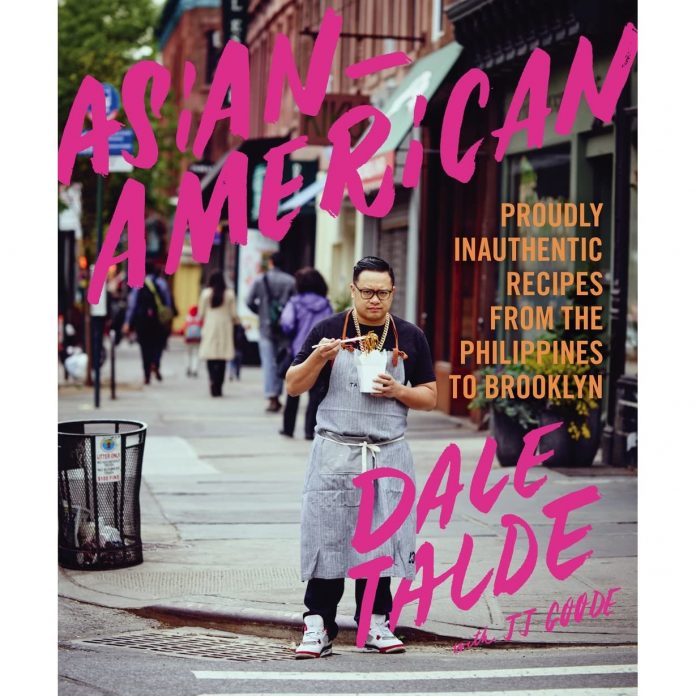
Talde poses with a Chinese takeout box on the cover of his book. Courtesy of Grand Central Publishing

By: Sara Wong, Arts & Culture Editor

What does it mean to be “proudly inauthentic?” Dale Talde’s cookbook, Asian-American: Proudly Inauthentic Recipes from the Philippines to Brooklyn, will give you a pretty good idea. Co-authored by JJ Goode, recipes like buttered toast ramen, kung pao chicken wings, and pretzel pork and chive dumplings jump off the page. Talde’s food celebrates mainly East/Southeast Asian and “Western” flavours with the creativity and flair one would expect from a Top Chef alum.

Top Chef was actually the reason I picked up a copy of this book. In the most recent season, Talde appeared as a guest judge throughout the competition, including in a challenge centred around recipe development. His name stuck with me as I was browsing through the cookbook section of my local library.

Despite Talde’s numerous accolades, his recipes are extremely approachable. He encourages readers to take shortcuts depending on their comfort level in the kitchen. Being a novice cook, I appreciated his suggestion to buy from Popeyes to complete his fried chicken and waffle recipe. Furthermore, the instructions are all straightforward. I was the most relaxed I’d ever been while preparing a meal.  

As I continued flipping through the pages of Asian-American, I found myself constantly wandering towards the fridge. This book made me want to spend more time in the kitchen, replicating more of Talde’s experimental, umami-packed dishes so I could share new food memories with my parents.

Between the recipes, Talde details his experiences being born and raised in Chicago with his Filipinx family. Although I couldn’t directly relate, his words about transitioning between spaces resonated with me. 

I’m a third generation Chinese-Canadian and have always been proud of my identity. However, the divisiveness of North American society often meant people saw me as only one or the other. When I went out for dim sum or shopped at T&T, I was Chinese; when I wore UGG boots or ordered an iced chai latte at Starbucks, I was Canadian (and also a basic bitch). Talde’s work was a much-needed show of solidarity for me. Here was someone else who embraced East and Southeast Asian-American lifestyles wholeheartedly, raising a middle finger to conventional perceptions of culture. Finally, I felt like my perspective was being recognized and validated.

In the official description of Asian-American, the last line promises the book’s contents will “remind you that you’re home.” When I first read that phrase, I cast it aside as merely marketing material. Turns out, it represents the effect of Talde’s work quite accurately.

The disastrous consequences of Hot Girl Summer

0
PHOTO: Anna Demianenko / Unsplash

By: A concerned ecologist

Look, I get it.

You’ve had the whole lockdown to work on your “glow up,” and now that vaccines are rolling out and restrictions are easing, you’re diving headfirst into your “Hot Girl Summer.” But now it’s almost 40 fucking degrees, and the sun doesn’t set until nearly 9:30. I’m begging you; please stop.

I have work early tomorrow morning, and I need to sleep, but all I can do is lie here in despair as I bake in these temperatures and curse the wakeful sunlight. Surely I’m not alone in my suffering. The lower mainland is a densely populated area, and all of us are recommended seven or more hours of sleep per night — which is very hard to do when you keep cranking up the heat like that. You’ve perfected your smolder, and it’s melting us and our thermometers alike.

I agree, your style is fantastic. Those bold choices of cut and colour, the way you’ve decided to wear your hair, and those new pieces of jewelry— stunning! All of them! You’re glowing bright enough to put the sun to shame, and it’s a gigantic problem. Just yesterday I saw a sunflower blooming in June! This is not supposed to happen for another month. You’re throwing the ecosystem way off. Think of the impact this will have on nature. It’ll be chaos. There’ll be an excess of flowers, the bugs won’t know what to do, and the bees will probably make too much honey.

These temperatures are way too hot, and we are simply not prepared to deal with it. It’ll be like the forest fire season of a few years ago, but with smoky eyeliner instead of actual smoke clogging the air. Just a disaster, overall. Next thing you know, you’ll be drawing in hunky firefighters from all over the province, all very concerned about forest safety. And what a conundrum that will cause! The shortage of available firefighters will throw the calendar industry into complete disarray, and they may even need to resort to publishing lewd photos from the firefighters’ neglected counterparts; paramedics. Sexy paramedic calendars. Charming, I’m sure, but it doesn’t quite hit the same.

I understand how difficult lockdown has been, and how excited we may all be to really own our place in the world, but please— think of the consequences. We’ve already lost the frosted tips to this heat, and I fear for what’s next.

SFU launches COVID-19 rapid screening pilot project

0

Written by: Jaymee Salisi, News Writer

On June 8, 2021, SFU launched a COVID-19 rapid screening pilot project to operate on Tuesdays and Fridays for eight weeks. Taking place on the Burnaby campus, the pilot is open to students living in residence and varsity athletes from invited teams. These groups were chosen for being contained within the SFU community and having regular access to the screening sites.

Using a nasal swab, the screening process provides participants with results in about 15 minutes. The pilot is meant to give extra protection to students living with a higher risk of contracting COVID-19. It will also determine the likelihood of the university opening up the screening system to more people in the SFU community.

In an interview with The Peak, director of Health & Counselling Services Martin Mroz said, “There have been no cases detected since the start of the pilot. This is not surprising, as the cases in BC have dropped a fair bit as well.”

The screening pilot is designed to proactively detect the virus in potential asymptomatic COVID-19 carriers. “There are still variants out there and there are still folks who have not been vaccinated, including children.

“Getting screened is one easy step people can take to prevent the further spread of COVID-19. If folks screen positive, they will receive options to get support.”

Mroz said participation in the pilot program has been low. “It seems people’s perceptions of COVID-19 as a risk to themselves and others changes quickly, as the provincial vaccination program has been progressing.”

According to the vaccination coverage updates on the government of Canada website, 66% of BC’s total population have received the first dose of the COVID-19 vaccine, and 27% of the total population is fully vaccinated as of July 5.

The BCCDC reports COVID-19 cases dropping from a weekly average of 857 new cases throughout the month of June, to 35 new cases by the first week of July.

The website for the COVID-19 rapid screening pilot project says the program “will determine the feasibility of a wider screening approach for SFU in the future.” 

Mroz said SFU’s COVID-19 management team hopes wider screening will not be necessary when campus reopens in the fall. 

Step four of BC’s Restart Plan projects that, by September 7, 2021, over 70% of those 18+ will be vaccinated with the first dose of the COVID-19 vaccine. In addition, COVID-19 case counts and hospitalizations are expected to lessen over time. 

More information about SFU’s rapid screening pilot program can be found on their website.

Self-deprecating humour isn’t funny

0
Use your words to build yourself up instead of tearing yourself down. ILLUSTRATION: Sabrina Kedzior / The Peak

By: Jacob Mattie, Peak Associate 

It’s shockingly common to hear people say, “Of course, but I’m me, so [insert self-destructive behaviour]” or, “Oh, haha, no, I’m not smart or talented enough to do that.” 

To start: what the fuck? In a conversation, it is difficult to respond to a line like that. 

“Haha, yes, indeed you are the worst.” This is a weird dynamic that makes me feel like my high school bullies, something I’d rather avoid if possible. Alternatively, it’s pretty hard to argue with you, the foremost expert on yourself, about who you are. Would I be calling you a liar to disagree?

Clearly, the solution is for you to stop putting yourself down. It doesn’t do any good. 

Having flaws is fine. Taking ownership of them is even better it means you’re aware of them and makes you easier to be around. The problem is when you use them to highlight your personality. There are plenty of things you’re good at, and no, being good at being bad is not one of them. 

Is it a way of trying to soften an inevitable failure? Because, despite what many people pretend, failure is really common. Not only are we students who, by definition, learn skills through practice, experimentation, and failure, but the act of failure itself shows we are pushing ourselves to try new things and get out of our comfort zone. 

If self-deprecation is a habit from past (or current) trauma, then you have my most sincere sympathies. I implore you to look deep within yourself, grab fistfuls of the spite that may have calcified onto your being, and lather it onto your every achievement, building a monument of pride invulnerable to the attacks of those who might try to belittle you. You should not have to defend yourself against your own attacks. 

Give it time. It takes practice. 

When you next find yourself in a situation where you are unsure of yourself, or when fear, anxiety, and depression (among others) start tearing at your thoughts, take a moment, and give yourself words from which you can build. Don’t feel the need to put yourself down. Instead, try phrases like “[self-destructive behaviour] is something I struggle with,” “[some skill] is something I’ve never felt inclined to practice,” or even “I’m still working on it.” I’d much rather cheer you on your path to improvement than argue with you about it.

Re-envisioning public space should not stop after the pandemic

0
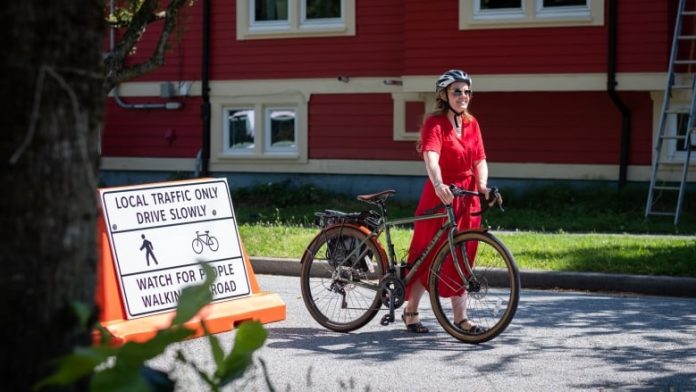
The City should be creating and incentivizing alternative methods of transport. PHOTO: City of Vancouver

By: Meera Eragoda, Editor-in-Chief

A century ago, the balance of who occupied the streets tipped toward pedestrians and non-car users. Then, the booming auto industry led campaigns to criminalize things like jaywalking, pushing pedestrians increasingly onto narrow spaces on the periphery of the road. 

We have a taste of what a pedestrian-leaning street feels like now that some streets in residential areas of the City of Vancouver are deemed Slow Streets. These are car-restricted streets made for pedestrians, cyclists, and rollerbladers. But as we’re slowly coming out of the pandemic, the roads are getting busier with cars. While Slow Streets are still around, our past history shows that car supremacy will likely return.

If we want these streets to remain inclusive of more than cars, we should not let them slip through our fingers. A major barrier to having this reimagining of public space stick around is that people don’t know how they’re meant to be used. In the beginning of the pandemic, people were more comfortable walking on the roads, but whenever I’m on a Slow Street now, people tend to default to cars and stay on the sidewalks. 

It wasn’t until reading the City’s website where it explicitly states these streets are for “walking, cycling, and rolling [and] make it easier to exercise and access businesses in your local neighbourhood,” that I realized I was still allowed to actually walk on these roads. The City needs a better education campaign to let both car and non-car users know how to use these streets properly and what each party’s rights are.

The information is on their website, sure. But how many people regularly go to their municipality’s website? Meanwhile, because the City takes their recycling campaign seriously, I’ve seen plenty of ads on Instagram of how to recycle properly. If the City is so serious about going green, they should make cities more friendly to methods of transport other than cars. Using social media to educate people on how to make streets inclusive of more than cars is one way. 

Another way to de-centre cars (and not through punitive measures like parking fees) is by creating and incentivizing alternative methods of transportation. Vancouver already has quite a decent network of protected bike lanes and designated bike paths off car-busy roads, but these are vastly lacking in cities like Burnaby, that also have green goals. These alternative travel methods should also be accessible with cities making it easy to obtain access to low-cost bikes, rollerblades, and the like.

The City also needs to prioritize more than its privileged members. Throughout this pandemic, while opening up public spaces for recreation and local businesses, it has and continues to wage a war on the unhoused who rely on outdoor spaces for survival. They’ve closed up parks, thrown out belongings, and refused to open up bathrooms. This isn’t just exclusive to the City of Vancouver either; municipalities all over BC have prioritized affluent members and demonized those who need the most support.

Our use of the streets is political. Cities, like everything else, have been designed by and for able-bodied cis white men. Taking up public space is difficult for anyone who’s not an able-bodied cis white man, and it becomes particularly dangerous for Black and Indigenous people, especially those who face compounding oppressions. Our infrastructure needs to change, not only to de-centre cars and implement more than recreational spaces for privileged people, but to provide safe spaces for those who need it and involve communities in public space decisions. They need to take issues like Indigenous rights to the land, ableism, racism, and classism (just to name a few) seriously.

The pandemic has shown us there are creative, safe ways to use streets that don’t just centre cars. When we look back at this time, hopefully we won’t have to remember the reign of pedestrians and cyclists as fleeting. And in the future, hopefully we’ll also see a more equitable design of space that does more than prioritize the recreation of the already privileged.

SFU Student Updates: July 12–18

0
"Student Updates" text in SFU red
You’ve already made it farther through the article than 97% of the student population. ILLUSTRATION: Siloam Yeung / The Peak

By: Carter Hemion, Staff Writer


Key Updates


Welcoming services at all campuses

In order to properly address our concerns about institutional issues at SFU, students will now be welcomed to each campus at every entrance. No more will students worry about systemic oppression, inaccessibility in academia, or this institution discriminating against them! Students must now feel welcome at SFU — no really, you are obligated to, it’s in our paperwork now — and this will be financed by the next tuition increase to ensure optimal happiness on campus.


All washrooms closed for equity

Due to the pandemic, the SFU Burnaby campus closed accessible washroom stalls and single stall washrooms for social distancing. In order to serve all diverse student needs equitably, all campus washrooms will be closed. We recommend students make their own arrangements to not use washrooms during course hours. We have ensured that closures will not cause undue harm to the quality of education. This change will ensure cooperation with equity, diversity, and inclusion policies for student satisfaction and better address student needs. 


Announcements


New writer-in-residence announced

Starting in Fall 2021, Geoffrey Kempe will be joining SFU Library as a writer-in-residence. He is a contemporary poet with a specialty in Medieval literature. When asked for an introductory statement, he said, “I gyue thankes to SFU librarie. Ful egre I was to accepte the duetee with honour. Whan I first bigynne, I woulde love the oportunyte to hyryth the voys of euery studiaunt.” Share your modern translation for a chance to win a $2 Amazon gift card!


New phone hold music added

In order to better serve our community, new additions have been made to SFU’s catalogue of hold music. We understand that hold waits may be longer than usual as we serve our students during this challenging time. New additions include “unravel” by TK from Ling tosite sigure, “Come Get Her” by Rae Sremmurd, and “Shark Dance Party” by Pinkfong.


What’s new and coming soon


Wildlife Yoga series

SFU Health & Counselling Services (HCS) is running Wildlife Yoga on the second and fourth Tuesdays of July and August from 12 p.m. to 2 p.m. This will be a pilot program for reintroducing in-person health services. In the sessions, held outdoors on the Burnaby campus, students will do yoga with local animals like raccoons, deer, coyotes, and more. Decompress with some furry friends, reconnect with other students, and try to get through it with all limbs intact! SFU doctors will not be available to assess potential injuries. Waiver of liability will be required before participation.


Employment and volunteer opportunities


Animal wrangler

Due to unforeseen circumstances, SFU Burnaby is hiring a new animal wrangler. Duties include catching and monitoring animals on campus, including raccoons, deer, coyotes, bears, and cougars. (No, not those kinds of cougars. I know. I was disappointed too.) No prior training necessary. Must be able to lift up to 60 kg and run 80 km/h if necessary. Rock climbing experience is an asset. Contact HCS for details.


Non-union welcomer

All campuses are hiring welcomers. This is a non-union, contract position with an undisclosed weekly stipend. Welcomers will not receive benefits, but will receive an SFU-branded mask. Get ready to show your campus spirit by welcoming all guests to campus this fall. Think you have the positive energy to ignore all injustices with a smile? Send your cover letter, resume, and soul to [email protected].


Connecting with student services


New service hours

In order to best serve students and faculty, new adjustments to service hours will go into place on July 12. All faculty will be unavailable for lunch from 12:28 p.m. to 1:34 p.m. Monday through Friday. Times are subject to change. See times below for reference:

Monday 9:32 a.m.–3:58 p.m.
Tuesday 9:26 a.m.–4:02 p.m.
Wednesday 10:02 a.m.–4:27 p.m.
Thursday 12:27 p.m.–1:35 p.m.
Friday 11:14 a.m.–3:24 p.m.

Dutch court orders Shell to reduce carbon emissions by 45% by 2030

0
PHOTO: Jethro Carullo / Unsplash

by Harvin Bhathal, Peak Associate

In a landmark case, Royal Dutch Shell, more commonly known as Shell, was ordered by a court in The Hague to reduce their carbon emissions by 45% by 2030. The case was brought forth by the Dutch branch of international environmental organization Friends of the Earth and over 17,000 individual co-plaintiffs.

Shell’s arguments in the court proceedings included new carbon emission targets that were set in February 2021 for the corporation to transition its business to net-zero by 2050. This included a 68% reduction by 2023, 20% by 2030, and 45% by 2035. However, the plaintiff’s lawyers argued the corporation had been aware of the environmental impacts of the fossil fuel industry for decades and the new targets were still insufficient.

The 45% reduction in emissions is in accordance with the 2030 target agreed upon by climate scientists through the Intergovernmental Panel on Climate Change (IPCC), as well as energy analysts from the International Energy Agency (IEA)

While Shell did not break any laws, the court established that “an imminent violation of the reduction obligation” would occur, and that the corporation’s policies and ambitions “largely amount to rather intangible, undefined, and non-binding plans for the long-term.”

If a 45% reduction in emissions is achieved by 2030, and net-zero by 2050, then the impacts of human-caused climate change can be limited to a global 1.5 C increase in temperature.

According to Panmao Zhai, co-chair of IPCC Working Group I, limiting the global temperature increase is significant because “we are already seeing the consequences of 1 C of global warming through more extreme weather, rising sea levels, and diminishing Arctic sea ice, among other changes.” 

In an interview with The Peak, Thomas Budd, PhD Candidate and member of SFU’s Energy and Material Research Group (EMRG), said,  “Even though individual societies and private corporations may still seek to achieve stronger climate targets,” the 45% and net-zero targets are “fundamentally important.”

Shell has vowed to appeal the court’s ruling, but the court has also said their decision must be immediately implemented and not suspended pending an appeal. In previous climate action lawsuits in the Netherlands, there is precedent of losing appeals; the Dutch government lost multiple appeals in a case where the Dutch Supreme Court ruled the government had an obligation to protect the rights of their citizens regarding the climate crisis.

“In general, I can foresee that this question concerning a court’s role in ordering climate action on private corporations could be brought to courts and courts of appeal all over the world as more claims against fossil fuel companies are made,” said Budd.

In a LinkedIn post titled “The spirit of Shell will rise to the challenge,” Shell CEO Ben van Beurden wrote, “I still feel disappointed that Shell is being singled out by a ruling that I believe does not help reduce global CO2 emissions.” 

According to the court proceedings, Shell argued that “the energy transition required for achieving [this goal] demands a concerted effort of society as a whole.” The plaintiffs also agreed with the statement. 

The court “acknowledge[d] that Shell cannot solve this global problem on its own. However, this does not absolve Shell of its individual partial responsibility to do its part regarding the emissions of the Shell group, which it can control and influence.”

Shell’s arguments were rejected on the basis that corporations have legal obligations to address the climate crisis through “the best available science” on climate change.

In addition, van Beurden added that corporations “need bold, clear, and consistent government policies and regulations.”

“For the time being, the most effective way to reduce global emissions is for governments to implement compulsory decarbonization policies of increasing stringency in their jurisdictions,” said Budd.

Rachel Kennerley, an international climate campaigner at Friends of the Earth, said, “If van Beurden was as serious about this as he claims, he’d stop dismissing his company’s role in driving this devastating situation and would use the court ruling as an intervention to do the right thing, rather than appealing it with all of Shell’s corporate might.”

In terms of what Shell reducing their carbon emissions by 45% will look like, van Beurden pointed to the corporation’s Energy Transition Strategy published in April 2019. This includes decarbonization investments such as “electric vehicle charging, hydrogen, power from wind and solar energy, and biofuels.”

Budd noted, “It is also important to consider that this could also raise the cost of energy Shell is able to provide relative to other fossil fuel providers, causing an economic feedback effect where fuel users could partially shift away from Shell and buy other higher emitting and cheaper sources of energy from elsewhere.” 

This was a part of Shell’s counter-arguments, which van Beurden alluded to on Linkedin. He stated, “Demand for fuel would not change.”

However, the court found that “other companies will have to respect human rights” and “make a contribution” in mitigating the climate crisis as well.

According to Budd, “[T]he most significant outcome of this ruling will likely be that environmental organizations all over the world will feel embolden[ed] to bring their own lawsuits against corporations which supply fossil fuels.”

Although he noted that “other jurisdictions have different legal systems and rules” than The Hague, “if the court ruling against Shell can be replicated in other jurisdictions and applied to more fossil fuel companies around the globe, legal action against individual fossil fuel corporations can potentially grow to become a more potent tool for climate action.”

Friends of the Earth and over 17,000 individual co-plaintiffs made history by taking one of the world’s most powerful and environmentally destructive corporations to court and winning. As Budd noted, this case has the potential to set a precedent for future cases against the fossil fuel industry and accelerate the transition to more sustainable and renewable forms of energy consumption.


Need to Know, Need to Go: July 12–18

0
Illustration of a blue calendar, with "Need to Know, Need to Go" written on top
Arts & Culture events to catch around the city. Image courtesy of Brianna Quan

By: Charlene Aviles, Peak Associate

Trailblazing: Women in Canada Since 1867 | June 24–September 12 | FREE with registration | Museum of Surrey

The Museum of Surrey’s latest exhibit celebrates the accomplishments of trailblazing women like Hide Hyodo Shimizu, an advocate for interned Japanese-Canadians’ educational rights, Lady Stanley, a hockey player in the first documented female hockey game, and more. Attendees can call 604-592-6956 to book their visit. During the one-hour self-guided tour, attendees must wear masks. 

Meet, Greet, and Eat: Game Day: Among Us | July 13 from 1:30 to 2:30 p.m. | FREE with registration | Online

Need a study break? In the upcoming installment of the Meet, Greet, and Eat series, the SFU Creative Collective and the Global Student Centre are hosting a session of Among Us. All students are welcome to participate. Students can register through WebSurvey.

Welcome to Emojiland (Youll Never Leave) | July 15 at 4 p.m. | FREE with registration | Zoom

Through a collaboration with the Vancouver Art Gallery, University of Michigan associate professor Joan Kee will host a Zoom session celebrating World Emoji Day (July 17). She will discuss how contemporary art and emojis intersect. The event will be available in English and Mandarin. Tickets are available through Zoom.

Conversation with Cindy Mochizuki and Henry Tsang | July 17 from 7 to 8 p.m. | FREE | Facebook Live and YouTube 

This discussion highlights the Surrey Art Gallery’s current exhibitions, Cindy Mochizuki: Autumn Strawberry and Henry Tsang: Hastings Park. The two featured artists will detail the experiences of Japanese-Canadians in internment camps. Participants can join the event through Facebook Live or YouTube.

The Welcome Blind Tiger Comedy classes | Dates and times vary | FREE with registration | Online and in person

With the goal of uplifting marginalized communities, Blind Tiger Comedy’s Welcome initiative offers free classes to people in BC who are often underrepresented in comedy. This includes those who self-identify as Black, Indigenous, a person of colour, genderfluid, non-binary, and/or transgender. A full list of Blind Tiger’s classes, which take place either at their Fresh Air space in East Vancouver or on Zoom, can be viewed online. To indicate you are registering for a class as part of the Welcome event, simply fill out the form on Blind Tiger’s website.

What Grinds Our Gears: Paying for printing

0
SFU should offer free printing for how expensive tuition is. ILLUSTRATION: Alyssa Marie Umbal / The Peak

By: Victoria Belway, SFU Student

I transferred to SFU in Fall 2020 from Douglas College, and this semester I had my first in-person class at SFU. It was exciting to have my first real-life university experience, until I discovered some flaws with SFU’s servicesparticularly, the cost of printing. 

My professor asked that we print something and bring it to class. I don’t have a printer at home, so I had to go to the library. At Douglas, students were given 240 pages of free printing each semester. I figured SFU would have a similar service, considering how much more expensive the tuition and student fees are, but we have to pay for every single page! Although it’s just a few cents each time, it adds unnecessary stress. Many students work and take out loans, yet struggle to pay pricey tuition. When students are going into debt to go to school, it is insulting that we have to pay extra to submit work or participate fully in class. 

Lack of access to printing puts working students at a disadvantage. They must take the time to go to the library to print, when they are already busy, then pay extra for pages they are required to bring to class. Students should be given at least 100 pages per semester for assignments, so they are not paying more just to submit their work. SFU needs to consider how the cost of printing affects students financially and emotionally.