
Home Blog Page 308

Poets+ is the future of Vancouver’s poetry scene

0
Portrait shot collage of, from left to right, Tawahum Bige, Tin Lorica, Jillian Christmas, and Justin Percival
Remember these artists; they’re going places. PHOTO: Arts Council of New Westminster

By: Alex Masse, Peak Associate

Released on January 14, Poets+ is the creative brainchild of the Arts Council of New Westminster, Fifth Chord Studios, and Tawahum Bige, the project’s curator. It’s a one hour showcase of emerging poets of colour that takes on “themes of identity, oppression, and reconciliation.” True to form, the event held a land acknowledgement in its video description, honouring the unceded traditional territories of the Coast Salish peoples of the QayQayt (qiqéyt) Nation, as well as all Coast Salish Nations. 

“I wanted to highlight BIPOC artists in the scene that not only are brilliant poets, but do so much more beyond that whether comedy, music, community advocacy and to give them the space to exemplify it,” Bige said.

Four poets performed back-to-back, sharing a variety of stories in a spectrum of styles. The piece opens with works from Justin Percival, a Nisga’a poet, who was born and raised in Vancouver but considers himself a visitor to the land. His poems touch on living in Vancouver, addiction, and hope. His style is rhythmic and driven, his natural flow undoubtedly a product of his background as hip-hop artist EnigmaDaPoet. As the grandson of a residential school survivor, Percival is personally connected to the themes of oppression and reconciliation, and his poetic repertoire holds memorable intensity. 

Up next is Tin Lorica, a queer Filipinx comedian who’s brought laughter all over the local scene, co-hosting comedy shows and even featuring on a Just For Laughs stand-up compilation album. They’re no stranger to poetry, having released a chapbook, Soft Armour, in 2020. In Poets+, their vivid imagery and cool flow paints pictures of diaspora, familial trauma, mother tongues, mental health, and — at one point — “the mistake of hooking up with a white boy.”

Third on the roster is Tawahum Bige. As a Two-Spirit Łutselkʼe Dene, Plains Cree poet, spoken word artist, and hip-hop musician, they’ve taken on stage and page alike. Bige shared music and poetry, including their debut single, “Shedding,” a hip-hop track with an energized flow and lyrics that snapshot both righteous emotion and beautiful, anti-colonial imagery. Bige’s words are born from life experiences, be that going through the court system as a land protector or growing up Indigenous in a colonized land. 

The showcase closes with Jillian Christmas, a queer creative facilitator and award-winning poet. Her body of work covered intimacy, healing, mental health, living as a woman of colour, and the racism she and others — family and strangers alike — have dealt with. She also brought some music to the stage, a one-woman symphony of a ukulele and drum kit. Christmas’ poetry is a lush, full-body experience, and some of the work showcased can be enjoyed in print in her poetry collection, The Gospel of Breaking

The whole piece is worth watching, and shows just how much can fall under the umbrella of what poetry is. Bige claims a major inspiration for Poets+ was to break down barriers between art forms. Poets+ may be just the beginning. 

“I hope it makes a big splash into the local scene and encourages more work like this! And truthfully, the intersections of poetry with other art forms is always an interest of mine and so it was really wondrous to get to move my own creative ethic forward,” Bige said. 

Poets+ is a beautiful look at the future of poetry in the Lower Mainland and the potential it has to uplift diverse voices and perspectives, because they have plenty to give and a beautiful way of doing so. It’s a medley of talent and names to keep an eye on.

View Poets+ on the Arts Council of New Westminster’s YouTube channel.
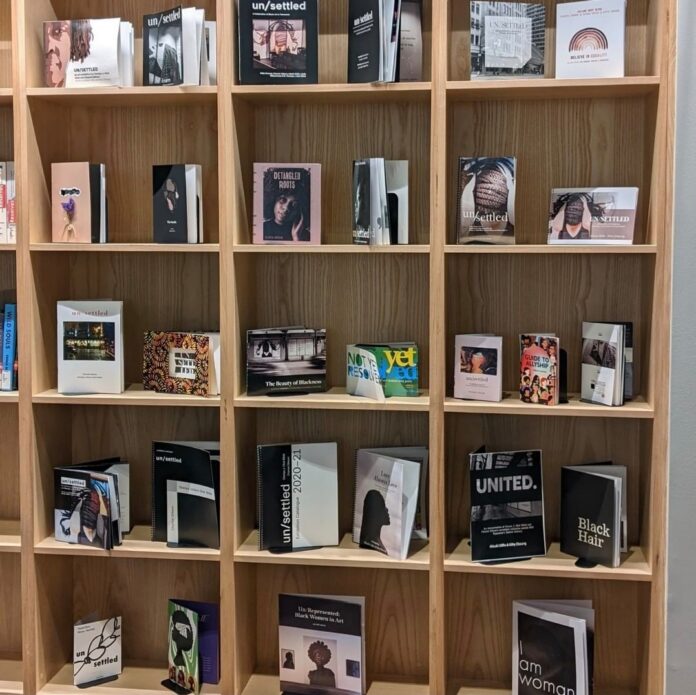
un/settled exhibit prompts students to create thought-provoking book display on Black artistry and solidarity

0
A tall, wooden bookcase filled with self-published books.
These books were made during a publishing class. Photo: @sfupublishing via Instagram

By: Sara Wong, Arts & Culture Editor

un/settled was a 240 foot installation celebrating Black womanhood, produced by Chantal Gibson and Dr. Otoniya J. Okot Bitek at the SFU Belzberg Library. Although it is no longer on display, the impact it had was profound. Inside the library, a book exhibit created by Fall 2021 publishing students showed work “based on, or in conversation with, un/settled.” 

“It’s a proposition for someone who wants to reflect on what it means to be unsettled. Because we should all be unsettled,” explained Dr. Okot Bitek in The Lyre. Using a variety of mediums, from poetry to guidebooks, the print and digital books class (PUB 331) aimed to further dialogue on Blackness in public space. 

As Peak contributor Linda Kanyamuna said about un/settled, “It’s important to recognize the urgency of solidarity in the scope of racial justice, and that standing in solidarity for Black lives is a communal effort.” And like Gibson noted in The Lyre, “The facelessness of the portraits created space [ . . . ] for others to identify with and find their own meaning in the work.”

In an interview with The Peak, some of the PUB 331 students discussed their book designs and what they took away from this assignment.

Rowina ChanThe Guide to Allyship

“Designing The Guide to Allyship was my response in sharing a how-to on becoming a compassionate and empathetic friend, family member, coworker, and so forth,” Chan explained. “The concept of community was something that resonated with me.”

Her pocket guide features open-source text about supporting communities of colour, which was created by Jamaican American writer and designer Amélie Lamont. It also includes illustrations by Latinx digital artist Pablo Stanley, which are accentuated by the die-cut cover. This feature allowed Chan to play with the interactiveness of her book, which was meant to reach a wide audience.

The die cuts were done by hand in order to stay on budget — a decision that made production challenging, yet satisfying at the same time. “My professor [ . . . ] was very generous and patient in offering her Cricut to do the die cuts, and it was truly a rewarding learning experience for both of us when it was our first time experimenting with the machine,” Chan said.

The Guide to Allyship would not have come to fruition without the incredible help of the teaching team, Mauve Pagé and Erin Chan,” she continued. “The technicalities with file formatting and design layout for printing are something I will carry with me for future projects.”

Melissa Ho — SFU Library resource book

Did you know SFU libraries are open to the general public as well as students? After discovering this, Ho decided the concept of her book would be to highlight the services these libraries offered, especially as they work to amplify BIPOC voices.

“Through interviews with Leanna Jantzi, head librarian of SFU Fraser Library, and Megan Sorenson, librarian for SFU publishing, I got to better understand the role of SFU in communities and how libraries have shifted from being exclusive places for the privileged to what they are today,” she said. 

“Growing up, buying new books was tough for my family due to financial reasons,” Ho added. “I wish I’d known the SFU Library was open to the public before I attended SFU, because I would’ve flipped through all the design books you couldn’t find at public libraries.”

Due to “personal matters regarding mental health,” Ho produced a digital book instead. “Pagé was extremely compassionate and understanding to accept my book beyond the due date,” Ho said. Though she did not get to print, the extra time allowed her to produce something she was genuinely proud of.

Alyssa LalaniDetangled Roots

“The concept of my publication was to embody the beauty of Black hair in an art book while educating readers on issues of hair-based discrimination,” Lalani said. “I was especially inspired after reading Linda Kanyamuna’s article in The Peak.”

Lalani’s work combines scribbly line art illustrations and expressive typography to represent natural hair. Though the design is quirky, a great deal of thought went into each element. For instance, the typeface — VTC Bayard — draws inspiration from 1963 March on Washington for Jobs and Freedom signs. This connects to the book’s theme of unravelling discrimination’s roots.

“The class went beyond mere graphic design principles and forced you to think about the story you are trying to tell,” Lalani said. “Mauve Pagé is an extremely talented book designer and I learned a lot from being in her class and having her critique my work.”

Knowing her project would be on display challenged Lalani to do something new with the book’s materiality. She ended up using coptic stitching for the binding, which added texture and mirrored Gibson’s technique of braiding thread in un/settled. “It was a little surreal seeing my book on the SFU publishing Instagram. I remember thinking to myself ‘wow, I really made that and it’s out in the world now,’” said Lalani.

Stefanie Pengun/settled poetry book

Wanting to directly honour the source material, Peng opted to create a poetry book with Dr. Okot Bitek’s work. “I’m not a Black woman, so I wanted to use the words written by a Black woman to convey the message of un/settled rather than using my own,” Peng said. Aside from highlighting Dr. Okot Bitek’s poetry, the book features greyscale photographs of nature and Black skin “to emphasize and spotlight the idea of Blackness.”

Peng also emphasized how personal these projects were. “This work had more meaning and weight than anything I’d ever worked on in school. It was simultaneously great and pressuring,” she said. During the process of designing her book, Peng sought to answer a variety of question prompts such as, “Why do I want it to look or feel this way?” and “What is its place in this world?” To her, it was important that what she showcased was evocative.

“Having my work up in the library for everyone to see in connection to the un/settled exhibit makes my work feel tangible and important, like the messages I weaved into it have some direction to go,” she said.

Caffeine should be used with caution

0
An illustration of a student holding a cup of coffee. They are wearing large glasses, and the image is layered with some transparency, giving the illusion of being overcaffeinated.
This is your sign to quit. ILLUSTRATION: Nazmus Sakib / The Peak

By: Maya Beninteso, Peak Associate

So . . . you consume too much caffeine. Though not entirely a surprise — caffeine is addictive by nature and central to the student lifestyle — I am nonetheless about to roast your habit. You have bean warned.

Caffeine is found in some of your favourite beverages: coffee, tea, energy drinks, and pop, which are designed and marketed (boo capitalism) to keep you coming back for more. Someone’s profiting off your caffeine dependence and — spoiler alert — it’s not you.

There is an irrefutable culture that exists amongst students and the overall workforce that promotes and reinforces the consumption of caffeine. I believe this student culture of consuming caffeine is, in part, due to academia’s grind culture. The need to keep up with constant, high-pressure academic rigor has resulted in the normalization of stimulant use. I, too, admit to having fallen victim to consuming copious amounts of caffeine — it’s necessary to sustain the vigorous studying sessions demanded by grind culture. I’ve even come to be on a first name basis with the baristas at my local Starbucks. Though the coffeeshop rapport is nice, the caffeine addiction is a problem.

Caffeine reliance has been normalized to the point where it’s easy to forget that caffeine is a psychoactive substance — it’s literally a drug, and is the world’s most widely consumed one at that. Like with any other substance, this means that you can develop a dependence (both physiological and psychological) to caffeine if consumed regularly — even in small amounts.

Psychological dependence can be found in the subtle shift in language from “I could go for a coffee right now” to “I need coffee this fucking instant.” If the risk of dependent cravings aren’t reason enough to motivate you to distance yourself from caffeine, consider the symptoms of physiological dependence: headaches, fatigue, tremors, and more. Sounds pleasant, right? These symptoms are most prevalent and severe when an individual goes into caffeine withdrawal, which usually occurs 12–24 hours after last consuming caffeine. It’s better to withdraw yourself from your caffeine consumption before the caffeine starts to consume you.

The two known strategies to reduce caffeine consumption are in weaning or in a hard cutoff. Weaning entails slowly reducing caffeine intake — try drinking tea instead of coffee, or adding more space between your coffee breaks. The hard cutoff method is recognized to be a tough switch, but if you choose this method, I encourage you to try it over the weekend lest it ruin your work week. If you’re already rebelling against the culture of hyperproductivity though — might as well go full send and ride out your withdrawal symptoms during work hours.

Is this article going to be single-handedly responsible for you going cold-turkey on caffeinated beverages? Likely not. Beyond the impacts associated with the 10 trillion kilograms of coffee we produce yearly, coffee dates, tea time, and caffeinated beverages remain a staple for many of us. But I do hope this stimulating article will persuade you to, at least, chill out on the caffeine consumption — for both your own sake and that of the environment.

Around the table: Chinese and Vietnamese Lunar New Year treats

0
From left to right, illustrations of bánh tét, poon choi, and jian dui against a bright red background
Traditional foods for ringing in the New Year. Gudrun Wai-Gunnarsson / The Peak with illustrations courtesy of Alyssa Umbal

By: Nancy La, News Editor and Sara Wong, Arts & Culture Editor

Bánh Tét

Growing up in Vietnam, there is no Lunar New Year without some bánh tét in my house. My parents usually have them up on the altar as offerings for our ancestors before we consume them. I distinctly remember getting into trouble for being impatient and plucking bánh tét off the offering plate when I was a child. My memories of Vietnam are blurry, but all it takes is one bite of bánh tét to transport me back to my childhood home in Saigon.

Inside these long, grass-coloured cylinders lies what I believe to be the best savoury combination of flavours and textures. Fragrant glutinous rice, dyed green from the wrapping of banana leaves, envelopes a soft layer of mung bean paste. In the centre is a thick cut of pork belly and, occasionally, salted egg yolks. The mung bean paste melts perfectly with the fat from the pork belly, and the glutinous rice ensures the fatty flavours don’t get too overwhelming on the tongue. Thick slices of bánh tét are served with a side of củ cải, crunchy pickled radish. 

I would recommend taking it up a notch by pan frying the bánh tét slices so the glutinous rice can crisp up and some of the pork belly fat can render out. — NL

Poon choi

My family comes from an interesting mix of Vietnamese and Cantonese background, and I’m always reminded of my roots whenever we have poon choi on our table during New Year dinner. Poon choi literally translates to “dishes on a platter,” and is supposed to signify wealth and prosperity with its luxurious ingredients. It is served communal style in a wooden platter in Hong Kong and the Canton region, but nowadays metal platters are more commonly seen in Asian diasporas. 

Poon choi consists of various elements such as sea cucumber, abalone, taro root, mushrooms, fish maw, and, controversially, fat choy (that’s right, the same fat choy in the greeting “gung hei fat choy” you commonly hear). All of these elements are cooked separately, then arranged on the platter and simmered slowly in a thick broth. Usually, the more expensive meats, such as pork, abalone, and sea cucumbers are placed on top. Vegetables, such as taro root and radish, are placed on the bottom because they are not seen as “expensive.” But because they are at the bottom, they absorb so much flavour from the pork and various meats that they become little umami bombs. My sisters and I usually fight over the stewed taro because it’s so flavourful and creamy; I attribute this to why my chopsticks skills are on another level. — NL

Jian dui

When it comes to Lunar New Year, my grandma goes all out. Even in these past couple years, she’s prepared extravagant feasts (it was the most elaborate takeout scheme I’ve seen in my life). There are definitely some dishes I could do without, but as long as there’s a tray of jian dui at the end of the meal, I’m content. 

Jian dui, often referred to as “sesame balls,” are Chinese pastries made with glutinous rice flour. The filling can vary, but my family always uses red bean paste. The sticky dough balls are rolled in white sesame seeds then deep fried to crispy, golden perfection. 

In pre-pandemic times, the women on my mom’s side of the family would gather in my grandma’s kitchen and prepare dozens of these treats, so I always had access to straight-out-of-the-wok jian dui. The nutty aroma of sesame, permeating the house as more and more deep-frying occurred, signified how special the occasion was. There’s nothing better than fresh jian dui, with their slightly crunchy exteriors and warm, chewy centres cushioning sweet, gooey globs of red bean. I’ve shamelessly used the biaojie (older cousin) card to get dibs on the first batch.

For the third year in a row, my family will be celebrating Lunar New Year in separate households. While disappointing, I’m comforted by the fact that my grandma’s cooking can bring us together in spirit. — SW

The Peak’s January Player of the Month

0
A photo of SFU track runner Alison Andrews-Paul with her arms crossed posing in front of the camera.
A positive attitude and living in the moment powers this SFU runner to new heights. PHOTO: Jacob Hall / SFU Athletics

By: Tamanna T., Staff Writer

Program: Master of Public Health in the Faculty of Health Sciences
Hometown: Ohope Beach, New Zealand
Fun Fact: Her dad was her coach growing up

Alison Andrews-Paul is The Peak’s player of the month after being ranked number one in NCAA Division II competition. She had a winning time of 02.08.61 in the 800m during her first meet of the season. In an interview for The Peak, Andrews-Paul discussed her passion for track and field, her interests, and her journey from Baylor University in Texas to SFU.

As a competitive child, running was Andrews-Paul’s favourite way to release stress. And once she started, she never stopped. 

“I have been training competitively since high school, but I have always run, so it’s kind of been a part of being me for as long as I can remember.” 

The junior runner mentioned her father, a former track and field athlete, has been a guiding force in her journey in addition to early competition success. Her mom, a track and field fan, has also been incredibly supportive and proud. Andrews-Paul shared a laugh remembering a time when her mom showed a client back home in New Zealand a video of one of her races.

When making the switch from Baylor University to SFU, Andrews-Paul was quickly motivated by SFU’s academics and track and field rankings. She also was impressed by head coach Britt Towsend’s personal accolades, who remained popular among the alumni of the program.

“To me, it said this is a place where people want to stay and keep running.” 

The middle-distance runner began her career in indoor track at SFU in 2019. She was sidelined after dealing with some health issues the year prior and trying to get familiarized with a new school. Despite the track season being cancelled due to COVID-19, Andrews-Paul kept a positive outlook on the situation and took advantage of the opportunity to train through the different circumstances

“If you’re enjoying the everyday, just don’t worry about the rest, it’ll happen or it won’t, and that has to be okay either way.” 

When speaking on her early success this year, Andrews-Paul explained it wasn’t always smooth sailing. Nagging health issues and injuries in addition to challenging moments forced her to question whether competing was worth it. She asked herself, “Do I still love this? Because it is really hard.” 

Ultimately, her passion for the sport outweighed the decision. “I still love going out the door for a run and going to practice with my teammates. No matter the outcome of success or failure, I want to do this because it is a really enjoyable part of my day.”

To keep busy before a game, Andrews-Paul makes a point of  keeping track of her bag as a stress mechanism to keep her mind on something she can control rather than worrying about the race in front of her.

“I am ready, I trust myself to do well — there is no point in stressing about it now.”

Andrews-Paul is excited to get back on the track after missing out on two seasons and is looking forward to seeing how her other teammates will do. This year, she has made it her priority to focus less on the numbers and more on the daily experience. 

“I want to run faster, [but] a big thing I wanted to do this year was be the best teammate I could — and I am sticking to that. Just focusing on the everyday enjoyment has worked for me.”   

SFU will be on the road for two meets against Washington State University on February 4 and 5.

Club Profile: SFU Jazz Band

0
You don’t need to be a student in the School for Contemporary Arts to join. PHOTO: SFU Jazz Band

By: Hilary Tsui, SFU Student and SFU Jazz Band member

The SFU Jazz Band is made up of jazz enthusiasts (or “band nerds”) and provides students with an opportunity to socialize, play jazz, and share memes, among other things. Though the actual date is unknown, members believe the club was formed in the 1970’s — far before any of its current members were born. 

In an interview with The Peak, SFU Jazz Band president Niko Kulka said, “Often, our members played jazz in high school, realized they enjoyed that very much, and want to keep that up in post-secondary.” 

Anyone is welcome to join the band, regardless of instrument and skill level. This year, the club boasts a number of flautists, clarinetists, trumpeters, trombonists, saxophonists, guitarists, pianists, and drummers. 

Additionally, people from any faculty are welcome as well, and the 2021–22 executive team is a great example of this. There are students of all years studying in the faculties of arts and social sciences; applied sciences, communication, art, and technology, and science. 

Despite the COVID-19 pandemic preventing the band from gathering together and rehearsing, the club has still been active over the past one and a half years. While COVID-19 limited their activities, the executive team was able to organize socials online and in-person, with their last social being an in-person Super Smash Bros. tournament. Niko is cautiously optimistic about being able to rehearse in the Spring semester, however, he recognizes the risk this can bring. “Our priority will always be safety,” he said. 

At the end of a typical, non-remote semester, the SFU Jazz Band generally holds a jazz night in collaboration SFU Vocal Jazz, where they perform the pieces they learned over the semester to family, friends, and faculty. Previously, the SFU Jazz Band has also played at SFU and community events. These include faculty Christmas events, SFU’s Balding for Dollars fundraiser, SFU’s Terry Fox Run fundraiser, United Way book sales, and the former Club Ilia. 

Pre-pandemic, rehearsals were held in the Forum Chambers in the Maggie Benston Centre on Mondays from 5:30 p.m. to 8:30 p.m. Members paid $10 a semester to help keep the band running, with dues going to instrument maintenance, rentals, and music score purchases. While much of their time was spent playing jazz, these rehearsals held a lot more significance than being simply a band. 

“I was a scared and lonely freshman,” vice-president Efe Erhan said. “The jazz band provided [ . . . ] new friends, a weekly activity that got me out of the house, and an opportunity to keep playing music.” 

Jordan Ehrenholz, a former rehearsal leader, looked back at the jazz band with fondness. “The Jazz Band was always a fun way to spend Monday nights for me. I always enjoyed and jumped on the opportunity to take saxophone solos and work on my confidence and improvisation,” he said. 

He also loved learning about and playing different music genres. Being in the Jazz Band not only helped Jordan learn how to be expressive and be a better saxophonist; he left with a newfound knowledge of music band management. “I learned how to start and manage bands big and small in the SFU Jazz Band, a skill set which I use today and will continue to use in the future.” 

For Tony, it was “the opportunities it gave [him] to meet so many different people.” Former Jazz Band librarian Dylan Dodd shared a similar sentiment and said, “For me, it’s not the club that matters so much as the diverse group of people in it.” 

Whether or not the club will be able to rehearse this semester, the executive team aims to host at least one social/event. A movie night featuring La La Land is in the works so be sure to check out the SFU Jazz Band’s social media for updates. Additionally, general club socials are not the only thing happening this semester. 

For more information about the SFU Jazz Band and how to join, you can contact them on Instagram at @sfu_jazz or by emailing them at [email protected].

Zain Haq and Save Old Growth block Trans-Canada Highway to protect old growth trees

0
Two protestors holding a banner that says “Save Old Growth” with a police officer standing in the background, along with a police car.
Environmental protestors face arrests and prison time for their activism. PHOTO: Courtesy of Save Old Growth.

By: Yelin Gemma Lee, News Writer

Activists from Save Old Growth blocked traffic on the Trans-Canada Highway on January 10, 2022. According to their press release, their sole demand is for old-growth logging to cease immediately in the province of BC. This protest has continued several times a week, leading to a total of 28 arrests as of January 20, and is part of a three-pronged campaign. 

The Peak spoke to SFU student and co-founder of Save Old Growth, Zain Haq, to learn more about the campaign.

“For the past 30 years, not just the government and the media, but even the climate movement have been using euphemisms to talk about the climate emergency,” said Haq. “We’re trying to cause drama and tension in society and we’re trying to make a fuss so that the government can start taking this seriously.”

Haq explained the historical precedence of Insulate Britain and Freedom Riders show non-violent disruption of the public social space is needed when dealing with entrenched power, such as the government. Non-violent civil disobedience is a public, “conscientious breach of the law” where the main goal is to disrupt the status quo and pressure for change in laws or governance of a state. 

He said Save Old Growth follows these campaign strategies of making a minor demand of the province, hoping the win will galvanize the movement. Save Old Growth’s only demand is to halt all old-growth logging in BC. 

“If we can’t get this win, we can’t get any win,” said Haq. “It’s on a provincial level and it’s something that the party has promised itself, so it’s one of the first things that the party should be able to do. And if they can’t do that then they don’t have any intention to do anything in the future.”

On their party platform, the BC NDP promised to “implement recommendations of the Old Growth Strategic Review to protect further old-growth stands — in addition to the 353,000 hectares [they] protected.”

Save Old Growth has developed a strategic three-tier plan stretching over a course of several months including information sessions and non-violence training. Haq said in February and early March they will be off the roads to do province-wide recruitment of potentially hundreds of activists willing to get arrested multiple times and return to blocking the Trans-Canada Highway at multiple points across the province.

“We’re dealing with entrenched power to an extent that the government is facilitating what is inevitably going to be mass starvation when we go over 2 degrees and the collapse of civilization [ . . . ] We have to really raise the stakes a lot higher,” said Haq.

Haq was arrested twice at the Fairy Creek Blockade and saw the initial enthusiasm and energy cease over time as activists got burnt out. He said although over a thousand arrests were made, the efforts at Fairy Creek have not resulted in legislative change. 

“What’s going on at Fairy Creek is a defence but if you’re always defending, we’ll never be able to win and we need to go on the offence,” said Haq. “Because it’s been in the woods, it’s been isolated — it’s been contained. What we’re doing is we’re going around that and we’re trying to make it so that it’s not contained anymore and it’s out in the open in the eyes of the public.”

Haq confirmed he is going to prison for two weeks on February 15 for violating the Trans Mountain pipeline injunction. He said once a large number of people start getting arrested, it becomes a massive reputational, economic, and judiciary cost to the government. 

“Once the fear goes away and people start getting arrested and going to prison in large numbers, there’s a tipping point beyond which the state cannot have more arrests,” said Haq. “I will be one of the few people who have been to prison in the climate movement in Vancouver [ . . . ] and it’s a process of starting to tell people that it’s not the end of the world. The end of the world is the end of the world.”

For more information on Save Old Growth check out their website and social media accounts.

Horoscopes: January 31–February 6

0
An illustration of a girl with long flowing hair. Astrological signs and stars shine around her.
ILLUSTRATION: Marissa Ouyang / The Peak

By: Marco Ovies, Features Editor and cosmological animal whisperer

ARIES: 

How does it feel to always be first on every single horoscope? Everyone looks at your horoscope and you don’t have to waste any time searching for your sign. Just like the majestic raccoon, you love to get all the attention and will combust if anyone ignores you for a second. 


TAURUS:

Similar to the hardy squirrel, you like to hoard snacks for long periods of time. Instead of collecting nuts though,  you just keep stuffing your pockets with as much dried cereal as you can find in the Dining Halls. But as the squirrel’s stowed nut grows into a beautiful tree, so does your stash change with the splendor of time — into mold. It’s mold. You nasty. 


GEMINI:

Fuck off, Gemini you don’t get an animal this week.


CANCER:

This week you’re feeling a little bit needier than usual, just like the seagull that follows me around on campus. I dropped a piece of my poké one time — please — leave me alone.


LEO:

Did you know you’re not allowed to have pets in your dorm? Well Leo, you’re the cat someone thought was a good idea to smuggle in anyway. Online learning has you feeling like a Burmese trapped in a 5×5 room and that’s why you’ve been literally clawing at the walls lately. Also — your room totally smells like a litterbox. Do your laundry, man. 


VIRGO:

You’re a songbird this week because you bring music into people’s lives. Not good music though. Just because there are pianos all across campus does not mean you need to play them. 


LIBRA:

Just like bedbugs, you’ve been hopping between beds every night since the semester started. We’re in a pandemic for god’s sake, keep it in your pants and a minimum distance of six feet away.


SCORPIO:

Scorpions and snakes go great together, so this week I am assigning you the snake. There are no snakes that live on campus, you say? Well just walk into any business class and you’ll find plenty (I recognize this is a cheap shot Beedie students and I don’t apologize).


SAGITTARIUS:

Did you ever wonder why there are bird stickers on all the windows on SFU Burnaby? That’s to prevent the chickadees from flying into windows. This week you are that humble chickadee, and just as that chickadee cannot see windows, you cannot (or refuse to) see the red flags in your 3:00 a.m. Tinder match.


CAPRICORN:

You’re a rat this week, Capricorn. But not just any rat, specifically that one rat that was found in the UBC Dining Hall. All you wanted was some love, attention, and a little snack. But instead, the video of you being flung across the room with a pair of tongs is all over the news. Don’t worry, SFU will welcome you in with all the other rejected rats we have. 


AQUARIUS:

There’s this one dog that walks around campus holding a stuffed animal in its mouth while it walks. Just like that one dog, you light up the room when you walk in. But don’t let all that attention get to your head, you haven’t got much else working for you up there. 


PISCES:

You may think you’re the goldfish from the AQ pond this week because you’re the fish sign, and you’re partly right. But it’s important to note that you’re not the actual goldfish from the AQ pond, instead, you’re the (now soggy) goldfish cracker I dropped into it running away from that fucking seagull.

Linda Kanyamuna shares why content creation brings her joy

0
Linda, a Black-Filipinx woman, sits in a red chair, legs crossed, with brick and concrete walls behind her. One arm is draped over the back of the chair as she stares straight at the camera.
Kanyamuna, aka Blasianspiderman. PHOTO: Gudrun Wai-Gunnarsson / The Peak

By: Charlene Aviles, Staff Writer

SFU student Linda Kanyamuna is a pro when it comes to content creation. As SFU Surge’s podcast host and SFU Women in Engineering’s marketing director, she’s dedicated to community outreach. Her passions outside SFU are no different. In an interview with The Peak, Kanyamuna discussed her recently launched YouTube channel, Blasianspiderman, and how it’s inspired by her love for family, culture, and content creation. 

Since childhood, Kanyamuna has been interested in filming videos. She explained she and her sister often recorded in their spare time.

“None of it was for YouTube or anything [ . . . ] It was just for the means of documenting life and just making memories. Ever since I got my hands on a resource to record, it’s always been a big part of my life,” said Kanyamuna.

Her creativity isn’t limited to filming. She’s taken on projects from modelling to acting, and her family has always supported her work. Her interest in vlogging re-sparked after receiving a gift from her mom.

“My mom bought me this phone a few years ago just so I can start making videos for YouTube,” said Kanyamuna. “So now my friends are telling me, ‘Oh, you’re fulfilling her dream.’” 

With over 2,000 followers on Instagram, Kanyamuna figured her videos would reach an existing audience. She described YouTube as “another extension for me to connect with people.”

Kanyamuna plans to collaborate with other content creators and upload more travel vlogs. Once it’s safe to travel, she hopes to fly to Zambia and Southeast Asia. She explained YouTube would also help her connect with her family in the Philippines.

“I have a lot of family all over the world [ . . . ] So I’m trying to find ways for them to be part of my world,” she said. “I’m excited for more of my family and their communities to be a part of mine, especially because YouTube is way more accessible video-wise.”

Kanyamuna is equally passionate about expanding Black and Filipino representation in the media. She recognized the power creative outlets have in inspiring others to express themselves.

“What representation means to me is inclusion and being able to have everybody be a part of something,” Kanyamuna said. “Having Black representation in media or content creation prompts others who are maybe hesitant to create and put themselves out there, [because they] see themselves represented in someone else’s content or work. That is a domino effect for representation. Representation is a domino effect for inspiring other people to see themselves and express themselves in the way that they do. 

“I love bringing people together and showcasing other people’s passions and work, because I know it intertwines with their mind,” said Kanyamuna. 

To stay updated with Kanyamuna’s vlogs, follow her on Instagram, @blasianspiderman, and subscribe on YouTube, Blasianspiderman.

Council debates Student Union Building closure on January 19

0
SFU Stadium with red seating
PHOTO: Krystal Chan / The Peak

By: Yelin Gemma Lee, News Writer

Council discuss SFSS response to surges in COVID-19 cases

The SFSS executive Council briefed the non-executive Council on their meetings regarding the COVID-19 cases in BC. SFSS president Gabe Liosis mentioned executives have had to make some decisions over the winter break according to the changing COVID-19 numbers and restrictions declared by the provincial health officer (PHO) since the last Council meeting in December 2021. 

Some of these decisions included: 

  • Cancelled all indoor events on-campus until January 18, 2022
  • December 29: SFSS registered to receive rapid tests for staff and membership through the Government of Canada and are awaiting a response
  • January 7: Re-activated COVID-19 safety plan now mandated again by the PHO
  • January 7: COVID-19 student survey scheduled to released to membership for feedback on how students feel about returning to campus amidst Omicron on January 24 for in-person learning and teaching
  • January 10–11: SUB remodelled for reduced capacity

Matthew Provost, vice-president external and community affairs said the survey was to hear back from students on how they feel about the return to campus with the rise of the new variant — a consideration that was not taken by the university. 

“The SFSS executive does not believe SFU is taking appropriate measures to protect our community members [ . . . ] We knew that this was urgent regarding the ongoing conversation which we’ve seen through the holiday season,” said Provost. “I want to preface that these ongoing discussions and considerations have been made with intention of community care, to limit exposure and transmission among our membership and staff, as well as the SFU community.”

Liosis brought a motion to Council on behalf of the executive committee and their recommendations to originally close the SUB until February 15. The closure is to be reassessed during the February 16 council meeting. This motion was amended by Provost to end on February 18 to accommodate for a smoother transition of the decisions made at the February 16 meeting. 

Provost said it’s better to close on their own proactive plans rather than being forced to close due to exposures in the SUB. “In the event that we cannot meet our staffing requirement, we cannot make staff come in if they feel it is unsafe,” explained Provost.  There is a  minimum of six staff required to operate the SUB. 

“We can decide to take the step of opening the building and essentially saying to our staff, ‘you’re going to get the virus anyway and you just have to deal with that,’ or we could be proactive and foster an environment where our staff know that we have their best health at heart,” said Liosis. 

Math representative Ben Tischler voiced concern for closing the SUB in the Council meeting. “There’s quite a significant concern that closing it will cause much more crowding in other spaces on campus. Some that were mentioned were AQ and WMC,” he said. 

This main motion discussion lasted a duration of three hours and included several motions to amend. The motion carried with 32 in favour, nine opposed, and none abstaining. 

Two 30-minutes in camera sessions were included in the three hour long debate. These sessions are private and not open for public viewing, including to The Peak

“This decision was not made easily but made with the thoughtful intention to protect the safety of our staff and students,” said Dela Cruz. “We are also able to be leaders as students and set an example to SFU that we are putting safety first, which is something they have not done with their recent decisions and the move to in-person classes.” 

Vacant acting positions in Council filled 

Non-executive councillors were nominated and appointed into vacant acting positions in Council. This included the vice-president internal and organizational development position left vacant by Corbett Gilersleve moving to acting president with Liosis’ resignation active January 24.

Political science representative Abhishek Parmar nominated environmental science representative Chloe Homenukes to take the now-vacant position of acting vice-president internal from Jan 24–April 30. Homenukes had many council members speak in her favour and the motion was unanimously carried. Parmar nominated himself to fill the vacant position of acting vice-chair of council and this motion was also unanimously carried.