Home Blog Page 302

Joy Johnson: undercover student

0
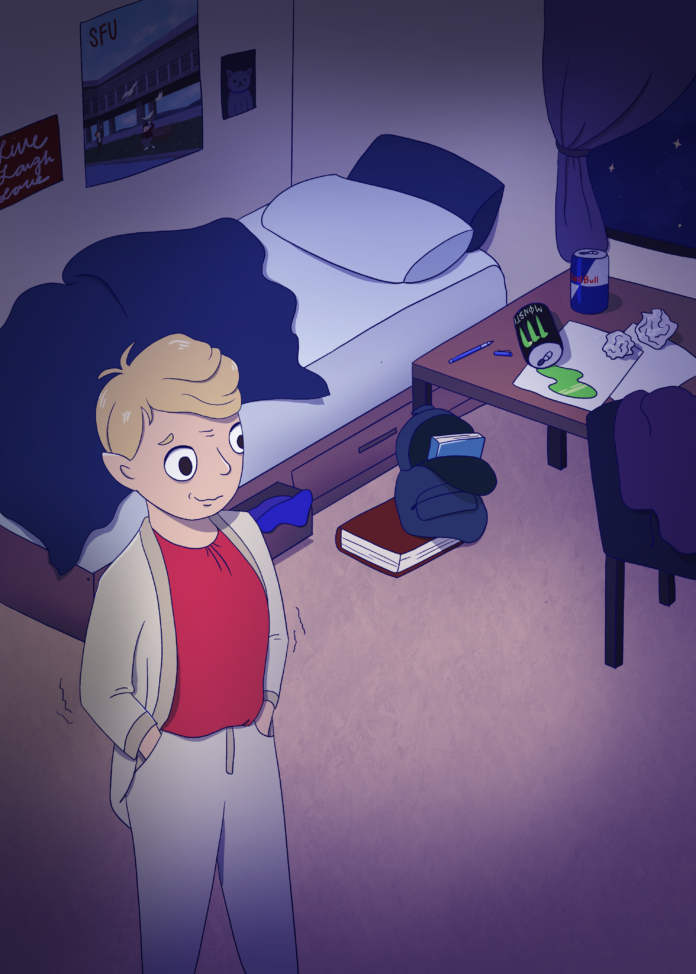
Joy Johnson shakily standing in a dorm
Joy: trying her best. ILLUSTRATION: Maple Sukontasukkul / The Peak

By: Sara Brinkac, Humour Editor

In the Fall 2021 semester, SFU president and vice-chancellor Joy Johnson undertook a disastrous “undercover student” marketing campaign. Originally, the campaign plan was that she spend a month as an undergraduate student while keeping a journal of her positive experiences in order to share quotes on bus benches across Canada. The outcome however, was much different. What SFU marketing expected to be a triumphant success quickly lost focus — after just 17 days the campaign degraded into what some might consider a psychological disaster parallel to the Stanford Prison Experiment

This failure prompted SFU marketing to destroy any trace of the campaign as they feared it didn’t align with the university’s “engaged” image. However, thanks to an anonymous source who believes the SFU community should be aware of this campaign, The Peak was able to acquire president Johnson’s journal entries and dutifully present them as follows below.


Day 1

Hi everyone, 

I’m truly excited to begin a wonderful student experience this Fall semester and share it with our supportive SFU community. An undergraduate degree is an impactful time in one’s life and I am delighted to be able to relive this experience at such a dedicated university. To the faculty, staff, and now, my fellow students, I look forward to an enriching and engaged month. 

Sincerely,

Joy Johnson

Pronouns: she, her, hers

President, Vice-Chancellor and undercover student


Day 4

Hi all,

I apologize for the delay in updates, I had some challenging technical issues regarding Canvas and Zoom. But thanks to our wonderfully comprehensive IT services I am back online and excited to begin classes. I am currently taking two in-person classes, one hybrid, and one online in order to truly experience the wonderful options for learning our institution offers!

Joy Johnson

Pronouns: she, her, hers

President, Vice-Chancellor, Student


Day 5

I have had such an enriching time with fellow undergrads learning about the different topics our students care about! It is kind of funny how a university who strives to be a leading voice in environmentalism and social change has millions of dollars invested in fossil fuels . . . I know of course, SFU made a three year divestment plan, but . . .  still.

Joy Johnson

Pronouns: she, her, hers

Student


Day 8

Sorry again for the delay in communication. Someone I was sitting next to in class kept coughing and I just had to go get a COVID-19 test. I get that there’s supposed to be this fancy ventilation system in place but — honestly — I don’t know if I trust it.

— Joy Johnson 

She/her


Day 9

I’ve noticed the parking rates here are a little on the expensive side. It shouldn’t cost more to park at a place where I’m supposed to be getting an education than it does at Stanley Park, should it?

— Joy


Day 11

Found the most delightful little coffee shop off the mountain to study at! It’s so nice to just get out sometimes, I feel like I need that more. The shop’s pretty expensive though so I just buy a brewed tea every three hours lol.

— JJ


Day 14

Literally just got told by Health and Counselling that I should try “sleeping more” for my anxiety. When I said that didn’t seem to help they looked me in the eye and said “maybe it’s not working because you don’t want it to work.” WHAT!?


Day 16

I WOULD LOVE AN EXPLANATION AS TO HOOWWW SFU PLANS TO JUSTIFY THEIR TUITION INCREASES NEXT YEAR BECAUSE THIS IS TURNING OUT TO BE ONE OVERPRICED PIECE OF PAPER!!!!


Day 17

Editor’s Note: It was on Day 17 President Johnson’s “undercover student” campaign ceased due to ethical concerns expressed by the SFU psychological research community. Her last communication confused SFU faculty and researchers alike, prompting their immediate action and her subsequent dropping of classes (tuition was not refunded). President Johnson’s final entry is as follows:

lol idk man SFU is sus as fuckk


Comics

0

Horoscopes: February 7–11

0
An illustration of a girl with long flowing hair. Astrological signs and stars shine around her.
ILLUSTRATION: Marissa Ouyang / The Peak

By: Hannah Kazemi, SFU Student, Future-Seer

Aries

Change is in your future! Consider ordering a bowl instead of a burrito the next time you’re at Chicotle (formerly Chipotle). Or, follow Chicotle’s suit and switch a consonant in your name out with a “C” because a K-pop artist likes you. But don’t just do it on your social media — fully and legally commit. Variety is the spice of life, and yours has been awfully bland lately.


Taurus

To unlock your horoscope for this week, please include the following information in the caption of your next Instagram photo dump: the name of your first pet, your mother’s maiden name, and the last four digits of your credit card (ideally the one with the highest limit). 


Gemini

You’ve been manifesting money in your bank account, but now it’s time to start manifesting an actual job. You can’t rely on cosmic-based currency forever, Gemini. 


Cancer

Wordle is the only thing holding you together right now. You can get that 2/6 tomorrow — I believe in you.


Leo

You’ve been on yet another “social media cleanse” and now have no idea what is going on. That’s okay, ignorance is the key to bliss babe and you’re doing a great job. Keep it up <3


Virgo

We’re a month into the semester and you’re already two months behind. Get it together quick or another emotional breakdown is set to come your way. Nobody wants that. Literally nobody.


Libra

Unleash your creativity this week. Grab a friend (or a hot stranger from Hinge), some paints, and a bottle of your favourite rosé. It’s time to let your creative side Bob Ross its way to freedom!


Scorpio

The Duolingo bird is coming to haunt you, Scorpio. It knows about that Spanish lesson you never finished and it’s getting angrier. Finish the lesson quickly or emotionally prepare for a demonic owl to appear in every single one of your dreams this week.


Sagittarius

Mercury’s in retrograde (whatever that means), and it’s time to hone your communication skills (whatever that means). I suggest picking a random person in class and throwing your worst jokes out there. What do you have to lose?  


Capricorn

You’ve been doing so well recently, Capricorn. It’s almost like you’ve learned what self-care is! Remember how good it feels to have nothing to stress about? Do as Dua Lipa says and “Don’t Start Now!”


Aquarius

I hear a lot of whining about the dirty laundry in your room but not a lot of doing the dirty laundry in your room. It’s time to stop eating so much cheese with that whine and start making a to-do list — before I make the Duolingo bird haunt you.


Pisces

Expect the unexpected, Pisces. Pregame all your conversations this week with petty responses ahead of time. This way you won’t have to replay your conversational regrets in your head while trying to sleep three days later.

Learn more about SFU’s Media and Maker Commons, a collaborative, hands-on learning environment

0
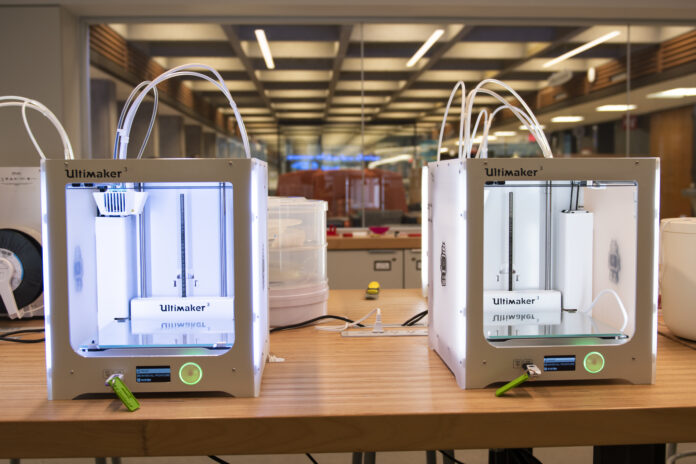
Two 3D printers on a worktable, backlit by fluorescent lighting
From high tech to hand tools, MMC can help you create to your heart’s content. PHOTO: Sarah Kushneryk / The Peak

By: Rastko Koprivica, SFU Student

If you’re looking to try 3D printing, video and audio recording, laser cutting and engraving, or machine embroidery, there’s a place on campus that may interest you — the Media and Maker Commons. Located in SFU’s W.A.C. Bennett library, university members from all disciplines can come to learn, create, and discover through the use of both cutting-edge and traditional technologies.

The Media and Maker Commons (MMC) had its grand opening in January 2020. According to Mikael Kriz, makerspace librarian, “The SFU Library developed the space as part of our mission to encourage innovation and entrepreneurship and help to prepare students for academic and professional success. When the MMC was developed, a lot of attention was paid to making it as open and friendly as possible to encourage people of all skill levels and backgrounds to come in and use the space and facilities.”

The space has five 3D printers, a 3D scanner, a laser cutter and engraver, various hand tools (including soldering irons and a rotary tool), an embroidery machine, and a sewing machine. It also has audio and visual facilities, such as a video studio with an HD camera, studio lights, and an optional lightboard. You can do anything from making your computerized models come to life as tangible objects to becoming a fashion designer to recording a podcast.

“We have seen some unbelievable projects in our short time working here,” Kriz said. He went on to describe one group who created an automated cat feeder not long after MMC opened. Other examples included topographical maps using the laser cutter and tabletop game pieces made with the 3D printer. 

As for classes offered in the Makerspace, there are a few. TEKX101 (Introduction to 3D Printing and Laser Scanning Technologies) is a quantitative/breadth-science course that makes a good elective if you’re interested in computer aided design. There are also various student groups and clubs that organize workshops in the MMC. Last semester, SFU Surge hosted a 3D printing training event, and SFU Mechanical Keyboards Club held a keyboard cable tutorial.

Looking to get started on your next creative project with the help of the MMC? To do so, you will need to complete a brief safety orientation and training on Canvas to handle Maker Tools. “When you arrive for your first appointment, we have facilitators that will help continue your training with some in-person instruction, so you don’t need any prior experience to use the equipment. Our Audio and Video studios do not require safety training, but we do have basic online training people can opt to use before their appointment,” Kriz noted.  

The audio and video studios can be reserved through the library’s room reservation service,  linked on their website. Kriz adds he “also wanted to stress that [they] really do encourage all current SFU students, faculty, and staff to come to the MMC to learn, explore, and develop new ways of thinking along with creating fantastic products and innovations regardless of your skill level or prior experience. [They] are more than happy to help people learn new technologies or to help facilitate an assignment or project.”

SFSS and community partners launch community fridge

0
student wearing a backpack walking toward a fridge with stars in their eyes
Maple Sukontasukkul / The Peak

By: Yelin Gemma Lee, News Writer

On December 2, 2021, SFU’s first community fridge was launched. In the spirit of mutual aid, Simon Fraser Student Society (SFSS) partnered with various community groups to address student food insecurity. According to a press release by SFSS, the fridge is based on a “take something, leave something” principle: fresh, canned, and pre-cooked food donations are accepted and made openly accessible to students. Initially located in the Student Union Building, the fridge has now moved to a new location in Maggie Benson Centre Room 50, opposite the entrance to Document Solutions Burnaby. 

The Peak reached out to SFSS vice-president external and community affairs Matthew Provost to learn more about this initiative. 

“We wanted to ensure that students have low barrier access to food because we know

that financial need for undergraduate students is a concern and has been one for quite some time,” said Provost. “It is important to note that we need to ensure our services encompass accessibility and equity as well.”

Provost said one of the ways to ensure this service is accessible to all is by assuring students there will be no policing around the community fridge. Students can access the fridge without an ID and there is no explanation required. He said those in need of these services could face stigmatizations, and gatekeeping does not ensure an accessible resource.

“Food insecurity is a huge problem, especially for marginalized students,” said Provost. “To be policing equitable resources leaves out a majority of our student population who may not feel comfortable accessing the Community Fridge. This leaves out BIPOC folks who may feel uncomfortable to reach out if there was regular supervision of this program.” 

Provost added COVID-19 has increased the barriers students experience around not only food security, but housing and job security as well.

“With the pandemic, students have been forced to make decisions either to buy groceries, pay rent, or continue to pay tuition that is rising at unreasonable rates. It is important to consider many of these points because they are all intertwined at various capacities,” said Provost. 

Provost credited Tara Flynn, civic and community engagement coordinator at SFU Office of Community Engagement and Embark Sustainability Society (ESS) for taking a large role in making this project happen. He said Flynn and ESS have done most of the behind-the-scenes work maintaining the fridge (such as drop-offs and pickups of food) with the help of volunteers. 

The Peak reached out to Flynn for an interview but did not receive a response by the publication deadline. 

In the SFSS press release, both Flynn and Provost emphasized the support and contributions of many community partners including Burnaby Primary Care Network, Food Mesh, Burnaby Neighbourhood House, and SFU Ancillary Services. “The ethos of this fridge is one of mutual aid,” Flynn said in the press release. 

“I believe we all have a responsibility to support our community members in need and that this type of support is done with an open heart and open mind,” said Provost. 

For more information, visit the Office of Community Engagement website

Students walkout of classes in protest of in-person learning

0
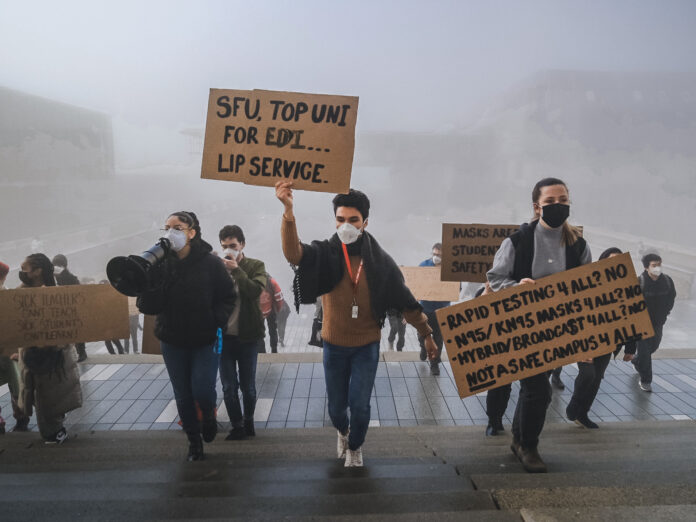
Students walking up Convocation Mall staircase with signs
The walkout took place from W.A.C. Bennett Library to Strand Hall. PHOTO: Sherry Young / SFU Student Walkout

By: Gurleen Aujla, Peak Associate

On January 24, 2022, dozens of students, staff, and faculty participated in a walkout to protest SFU’s decision to return to in-person instruction. This was the first day students were going back to campus following a temporary two-week remote learning period at the beginning of the semester. 

The Peak was present at the walkout, which featured speeches, chants, and a march from W.A.C. Bennett Library to Strand Hall. They chanted “COVID greed has got to go!” and “We’re not your guinea pigs!” A speaker said, “As an SFU employee, I am going to walkout after this and not come back until it is safe.” The event was also live-streamed

The Peak interviewed SFU Student Walkout, the organizers of the event. They wished to remain anonymous, but stated they are “a decentralized movement” consisting of SFU students and workers “from departments, faculties, and programs in support of [a] safe learning environment.” 

Their demands include an extension of remote learning until it is deemed safe to return in-person, as well as permanent hybrid learning options. 

The group is calling for free N95 masks and rapid testing to be made available on all campuses, alongside an extension of tuition and course withdrawal deadlines. In addition, they are demanding that SFU consult with student and labour unions.

SFU’s return to campus was met with opposition from various student groups. On January 17, SFU Disability and Neurodiversity Alliance (SFU DNA) published a statement with 13 calls to action on the decision to return to campus. On January 24, the Simon Fraser Student Society and Teaching Support Staff Union released a joint letter calling SFU’s plan “unsafe, inadequate, and inequitable.” 

The walkout comes on the heels of an online petition with over 4,700 signatures in support of continuing remote learning for the Spring semester. “The decision of removing back to fully in-person teaching under such a clear rapid increasing of Omicron cases is very irresponsible for all students, faculty members, and any other university workers,” said one comment. 

Another comment stated, “We just want to feel like our very valid anxieties are acknowledged and responded to! Please go remote for a few more weeks. It is so ableist to assume that Omicron is mild on everyone.” 

The walkout organizers told The Peak, “SFU is the largest post-secondary institution in BC to not extend their online learning. 

“They are unwilling to listen to students, have ignored multiple student surveys and responses, and furthermore have made this decision without consulting student, faculty, and labour unions.”

When asked why they chose a walkout to express their demands, the organizers said, “SFU has ignored all other ways students and staff have tried to voice their opinions [ . . . ] ignoring our walkout would show that SFU is unwilling to listen to and don’t actually care for our student body.”

The organizers wanted to emphasize “SFU’s actions and attempts to pit the mental health of students who have difficulty with online learning and the students who are anxious about the pandemic against each other are reckless.” 

The Peak contacted vice-president academic and provost, Catherine Dauvergne for a statement. 

“There is a unique and irreplaceable value to in-person learning,” said Dauvergne. “We recognize the anxiety and concerns that people are experiencing from the pandemic [ . . . ] We know that there are a wide range of opinions and preferences amongst our community.” 

She emphasized, “The majority of in-person classroom and learning settings are not considered close-contact environments [ . . . ] Since returning to in-person activities in the fall, Public Health has not reported any transmission of COVID-19 in learning settings on an SFU campus.”

At the time of writing, none of the SFU campuses offer COVID-19 testing for its students, staff, and faculty.

Dauvergne encourages students to reach out for available resources, such as academic concessions and the Centre for Accessible Learning. Academic concessions are granted when “unexpected situations or circumstances” impact a students’ ability to participate in their courses. Typical instructor-granted concessions include extensions, deferred exams, alternative assignments, or grade re-weighting. 

The Centre for Accessible Learning provides academic accommodations for students with documented disabilities to ensure “fair access to learning opportunities as a result of factors such as learning disabilities, chronic health or mental health disabilities, and conflicts with religious holidays.” These accommodations differ from concessions and refer to SFU’s “legal duty to provide reasonable accommodations.”

“We have strengthened supports for students feeling anxiety and we encourage all students in need of support to reach out,” said Dauvergne.

The Peak previously covered the call from post-secondary unions for a safe return to campus and the students behind the petitions for an online or hybrid semester. Updates and information on SFU’s return to campus decision can be found on their website.

Monday Music: Songs to soothe your soul this romantic season

0
"Monday Music" in giant yellow block letters with a red background
Monday Music: your weekly themed playlist. Image courtesy of The Peak.

By: Tamanna T., Staff Writer

Pining after someone, lamenting over the loss of a love-at-first-sight, or wanting to dance with your partner in the kitchen with dim lights? These tracks will perfectly accompany whichever of these moods you’re in this Valentine’s season.

“I Wanna Be Your Man” by Yukon Blonde

Image courtesy of Yukon Blonde

Yukon Blonde has been around since the 2010s, but their new music is stealing hearts left and right. “I Wanna Be Your Man” starts off very guitar-heavy. As the song proceeds, it produces a vibe that perfectly captures the idea of crushing on your best friend, beginning with a flirtatious tone and ending with the meaningful chorus.

“A Drop In The Ocean” by Ron Pope

Image courtesy of Ron Pope

This is probably one of the most heartfelt songs I have ever heard. No matter how many times I listen, it never fails to make me cry about my eighth grade crush. Pope’s melodic voice will have you entranced and the lyrics will break your heart with every stanza. This song is guaranteed to make you reminisce over “the one that got away” and will be an instant obsession the moment you press play.

“Snakehold” by Sebastian Gaskin

Image courtesy of Sebastian Gaskin

The track begins with Gaskin’s soulful voice, which will blow you away with its intensity in the first few seconds. The sultry vocals mix perfectly with the upbeat music and produce a melody worth dancing to. “Snakehold” rises in pitch near the chorus, and you can’t help but get hooked to the song and play it on repeat. It embodies the assurance of being in love with someone and trusting them to take care of your heart.

“Shut Up and Kiss Me” by Echosmith

Image courtesy of Echosmith

Echosmith fell off the radar after producing their epic 2013 song “Cool Kids,” but this all-sibling band will make you go down memory lane again (in the best possible way). This cheery and passionate song screams boldly falling in love and wearing your heart on your sleeve. You can dance to this track, or you can choose to make out with your (potential) partner and live out a real-life rom-com like you always wanted.

“I think I’m In Love” by Kat Dahlia

Image courtesy of Vested in Culture

Sassy but incredibly sweet, Dahlia’s voice is not what you would initially expect when thinking of romantic music, but it just works. This song is the culmination of falling in love, but with an attitude. The chorus resonates with me; its message about finding someone wonderful after experiencing heartbreak has stuck with me over the years. The lyrics put heavy emphasis on the “honeymoon phase” of a relationship, where everything seems lovely and rosey, and the melody reflects the beauty of love perfectly.

Students discuss professor accommodations for remote learning

0
Rotundra at West Mall Centre
PHOTO: Gudrun Wai-Gunnarsson / The Peak

By: Michelle Young, Copy Editor

On January 20, executive member of the Disability and Neurodiversity Alliance (DNA) Vivan Ly started a Facebook thread to learn about hybrid options for classes. It reported some professors moved their classes online after seeking permission from SFU, and asked whether hybrid or remote learning would be a possibility for students who wanted it. 

Students anonymously shared their experiences. While there were many reports of professors providing hybrid and remote accommodations, others suggested there was less flexibility within their departments. 

“One of my professors said she does not think she is allowed to record in-person lectures (department rules) so as to discourage lack of participation. There are over 100 people in the class and it’s a writing class where participation isn’t really necessary,” wrote one student. Others stated their courses were required to be fully in-person. 

According to SFU, requests from staff and faculty to work from home will be approved “on a case-by-case basis” by their supervisor. 

Another student alleged the School of Communication has “explicitly told their professors to not encourage hybrid.” The Peak reached out to Carman Neustaedter, dean of the faculty of Communication, Art and Technology for comment but did not receive a response by the publication deadline. 

There were also reports of the department of psychology allowing hybrid learning as an exception. The Peak reached out to Peter Hall, dean of the faculty of Arts and Social Sciences for more information. 

“The Faculty of Arts and Social Sciences, including the department of psychology, neither prohibits nor encourages delivery by ‘hybrid’ means, defined as the addition of remote delivery to an in-person course. Some instructors may decide to add remote delivery to an in-person course but their decision is based on several factors, including the nature of the course material, the type of student engagement expected, and the availability and reliability of classroom [Audio Visual] technology. Workload considerations are also relevant to the instructor’s decision, and we do not expect instructors to work unpaid hours.

“At the same time, we know that instructors of in-person courses are doing everything they can to support students, by for example, recording and uploading lectures, and posting notes to Canvas. In this regard, the Faculty of Arts and Social Sciences is funding technical support for instructors and a note-taking program.”

The Peak reached out to vice-president academic and provost Catherine Dauvergne for clarification on university-wide hybrid policies. 

“Instructors were asked at the beginning of this term to consider what they can do to ensure continuity and meet the educational goals of their courses should they become sick for a short period of time [ . . . ] A hybrid option is not always appropriate though, nor do all SFU learning spaces have this technology. Another option could be recordings, where it would not add significantly to instructor workload and where it makes sense for the course content, but there are also other ways to be flexible as well.” 

On an individual level, Dauvergne said students can refer to SFU’s services for academic concessions or additional support. Academic concessions “are normally given at the discretion of individual instructors,” and refer to unexpected circumstances that require a student to miss a class or “being unable to complete graded work or exams.”

The Peak also reached out to various sources to clarify the approval process to move a course remote, but did not receive response. 

In response to in-person learning, DNA released a statement calling on SFU to “change the policy of in-person teaching to provide a mix of in-person, online, and hybrid classes,” and support professors in doing so, among other demands. 

Contract Worker Justice critical of SFU’s new social procurement guide

0
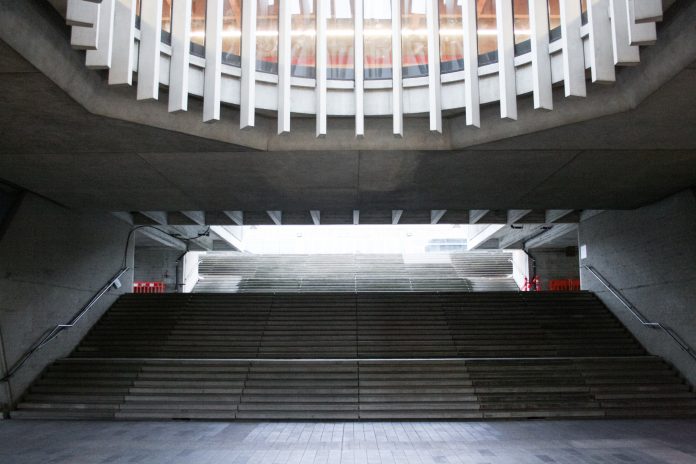
SFU AQ outdoor staircase
PHOTO: Gudrun Wai-Gunnarsson

By: Karissa Ketter, News Writer 

SFU has developed a new social procurement guide designed to “drive positive social change throughout their procurement activities,” according to their website. Social procurement involves SFU purchasing ethical goods and contracting services to influence the well-being of the community. 

“The purpose of social procurement is to expand purchasing practices to create positive impacts on the economy and for people in our communities,” said Mary Aylesworth, director of financial operations, in an interview with The Peak

The new guide encourages acquiring goods and services through small businesses. Social Procurement: Amplifying You Purchasing Dollars for a Better World, can be applied to all post-secondary institutions. It aims to provide more resources and funding to improve the social conditions of local communities.  

In a statement to The Peak, the Contract Worker Justice (CWJ) campaign at SFU expressed concerns. They said, “This kind of initiative is welcome for some kinds of procurement but is not appropriate as a way to resolve the employment issues affecting contracted food service and cleaning services. SFU historically has not included sufficient socially progressive principles when putting out a call for bids on contracts for food and cleaning services.”

CWJ has been pressuring SFU to stop business with third-party companies who hire SFU’s food and service workers. Not hiring workers in-house allows SFU to hire cheap labour without offering job benefits, living wages, or job security. 

They recently published a report outlining the poor working conditions of the food and cleaning service workers at SFU where they found “contracting out has created an environment in which the university evades meaningful accountability to the workers.”

The CWJ statement noted “contracting-out food and cleaning services at SFU makes it much more difficult for the university to achieve the goals in this procurement guide since they give the decision-making power up to a company who needs to make money in order to stay in business.

“This means part of the money that SFU spends on these services, that could go directly to improving wages and working conditions of workers, ends up going towards the profits of the companies who end up employing these workers.”

CWJ is calling on SFU to hire their food and cleaning service workers directly, “rather than hope a contractor will meet the principles outlined in this guide.”

When asked about SFU’s outsourcing of food and cleaning service workers, Aylesworth said, “SFU has been focused on the social aspects of sustainable procurement and the services provided by the university for a very long time. We have also been a progressive and innovative leader in working with contracted providers. The new guide is yet another tool at our disposal as we work to remain a leader with respect to fair and progressive working conditions.”

As the new guide is being implemented, SFU is currently updating policies and procedures. They have created a Social and Indigenous Procurement Working Group dedicated to reaching out to sectors in the local markets and promoting their program, according to Aylesworth.

Aylesworth noted “social procurement at SFU predates this guide and so it’s not so much about changing practices, but about expanding our practices to ensure that we are providing more value beyond SFU.”

This guide is an initiative created by the BC Collaboration for Social Infrastructure (BCCSI) and is available to all Canadian post-secondary institutions through the Canadian Association of University Business Officers

To stay updated on the Contract Worker Justice campaign, interested parties can follow them on social media or their website

A comprehensive guide to the RAs fight for workers rights

0
A group of people gathered around Cornerstone at SFU Burnaby campus holding yellow signs that say “Research is work”
A large crowd gathered to celebrate the research assistants unionizing in 2019. PHOTO: Gudrun Wai-Gunnarson / The Peak

By: Kelly Chia, Staff Writer

Editors note: The article has been updated to reflect that some RAs are recognized as workers as of last Spring.

In 2014, graduate students approached the Teaching Support Staff Union (TSSU) to unionize research assistants (RAs). The TSSU made the decision to fight for the rights of RAs, giving every individual more protection under the umbrella of a collective. 

From 2018–19, the TSSU built a union drive at the grassroots level, leading to 924 RAs being signed on as union members. Then, on November 15, 2019, SFU signed an agreement to recognize TSSU members as bargaining agents on the behalf of RAs — and RAs as members of the union. This was meant to be the turning point for RAs in the fight to achieve proper working conditions comparable to every other SFU employee. 

Over two years later, SFU still hasn’t provided a contract for all RAs. Instead, SFU doesn’t classify RAs as workers. This means they are not guaranteed job protection, consistent pay, health and dental benefits, or even safe working conditions. The TSSU has criticized SFU for backtracking and delaying consultations to provide all RAs with a safe and secure working environment. 

What it’s like to work as an RA at SFU


SFU categorizes many RAs as non-workers, placing them in precarious work conditions. Though they are paid through the SFU payroll system, are given work direction by SFU employees, and follow university policies, RAs are not officially considered employees. By not being classified as workers, RAs “can be subject to unpaid overtime, harassment, and arbitrary dismissal without the benefits afforded workers under provincial and federal law or the protection that comes with being a member of a union.”

On the TSSU website, RAs testify anonymously to not being paid consistently. “I didn’t get paid for the entirety of my contract on this project, and only finally received a single lump-sum payment several months after the project ended,” wrote one RA. Many other RAs expressed similar sentiments, saying they go multiple weeks with little or no payment. 

Some RAs were even disciplined for refusing work in unsafe spaces. Noticing a contractor had left a high-pressured gas cylinder behind in the laboratory, one RA wrote they evacuated the area. “[It] could potentially fall over resulting in a projectile that would blow through foot thick concrete walls, certainly killing anyone in its path,” they said. “Although they agreed the situation was unsafe, safety personnel stayed silent while management berated me for reporting the incident.” The RA wrote they were then told they would be banned from working in the space, should they write another report. 

One RA was surprised to find they had the benefit of tuition deferment as a Teaching Assistant (TA), but not as an RA. “I had just moved across the country to do a PhD and paying off ever-increasing tuition over the course of the semester significantly limited my financial burden,” they wrote.  

The Peak spoke with the chief steward of the TSSU, Amal Vincent, to talk about their campaign and current working conditions.

“Hundreds of RAs currently have to pay the International Student Health Fee (ISHF) out of their pocket, while unionized TAs and TMs [tutor markers] have that paid by SFU as part of their contract. This amounts to at least $900 annually,” Vincent said. 

In SFU’s proposal, only select RAs would receive extended health and dental plans, such as those who work more than 20 hours a week and work for more than four months. This proposal would exclude all student RAs. Even if those select RAs qualify, the package is “bare bones” according to the TSSU website. Vincent added if a RA needed expensive drugs or had pre-existing conditions, they would have to pay for it on their own. “We’ve talked to RAs who are paying thousands of dollars every year for things that would be covered and are living in poverty because of this.”


Bargaining with SFU

In a joint communication statement released on November 19, 2019, SFU and TSSU “agreed to make all eligible RAs employees of the University by May 2020.” SFU and TSSU were supposed to meet every 30 days so SFU can present who is characterized as an “Included Person” in their bargaining. Then, they would begin collective bargaining on May 1, 2020. 

Since signing this Voluntary Recognition Agreement, Vincent says it’s been difficult to communicate with SFU’s bargaining team. “SFU is completely dysfunctional,” he explained. Allegedly, SFU Administration has tried to redefine who can be included in the TSSU as an RA, claiming “work-study and scholarship RAs should be barred from representation by the TSSU” in a meeting. This comes even as they are recognized in the Voluntary Recognition Agreement in the appendix as “individuals who receive compensation from grants as scholarship” and “work-study student employees.” 

SFU Administration has consistently delayed bargaining. Their first session was on March 23, 2021, eleven months after the agreed date. 15 months after signing the agreement, a TSSU spokesperson wrote that the SFU Administration presented a sparse two-page proposal “centred on a narrow definition of research work” that could easily exclude arts and social sciences research by definition. In this meeting, the proposal said existing rights from the SFU/TSSU Collective Agreement would apply to RAs, like “human rights and harassment protection, health and safety protections, grievance procedures, childcare fund, intellectual property protections, tuition deferment.” 

“They constantly use the pandemic as an excuse to delay. Their bargaining team continually proposes rights below the minimum standards of the Employment Standards Act and has even tried to go back on agreed terms,” Vincent alleged, referring to August 12 and 18, 2021 bargaining sessions. The collective agreement between employers and unions must either meet or exceed the Act.

Prior to these sessions, the TSSU said there were “three months of delays by SFU Administration.” Troublingly, the new negotiator in these meetings tried to rescind what had already been agreed on in previous meetings. 

Vincent wrote in the August 23 bargaining update TSSU and SFU had already agreed in previous meetings that the number of hours of work, schedule of work, and work location should be included in letters of employment. “We were told that these things were administratively burdensome and that it was ‘hugely problematic to embed hours of work in the employment agreement,’” he wrote. 

The TSSU claims SFU has also proposed RAs are “at-will employees who can be terminated without cause at any point during the life of their contract.” Current proposals for RA wages and benefits are a minimum wage of $17 an hour, which doesn’t meet the living wage of $20.52 an hour for Metro Vancouver. There is no increase planned for the duration of the contract, and there are no benefits for RAs who are students. “They offered an extra 7% ($1.19/hr) in place of benefits, leaves, and vacation,” wrote a TSSU Spokesperson on the November 10 bargaining update

The compensation and benefits RAs have been offered are nowhere near comparable to what TAs receive as SFU employees. TSSU says their requests to include RAs have been ignored over and over throughout their bargaining process. “Bargaining is a reflection of priorities: president Johnson and SFU Administration have made their priorities clear,” Vincent said. “They throw away countless dollars on frivolous and insincere communication plans and external consultants, but will pinch every penny when it comes to research workers.” 

Vincent referred to a web page where the Equity, Diversity and Inclusion department of SFU claims “we all have a role to play in creating an equitable and inclusive environment.” This is performative when SFU hasn’t made much progress with TSSU in creating a safe, secure work environment for RAs. Vincent is also critical of SFU’s decision to hire Deloitte, a private consulting firm with controversial business decisions. 

“Throughout the bargaining process, SFU Administration has demonstrated its continued intent to exploit the RAs and have ignored the needs and struggles of RAs at SFU.” 

SFU gave an email statement to The Peak acknowledging the length of time it has taken to create an equitable work contract. “We would have liked things to have moved along quicker than it has, but it has taken longer than anticipated for many reasons, including the diversity of the work research assistants perform, as well as disagreements at the bargaining table.” 

SFU is referring to the TSSU pointing to a difference on the scope of the Voluntary Recognition Agreement during their January 6 meeting. While SFU has stated that “the last group of Research Assistants (RAs) were transferred to be SFU employees,” only a minority of RAs have been converted to workers according to TSSU.

“Both parties met with the arbitrator on January 18, 2022 to discuss how to manage and resolve their differences. At the meeting, TSSU indicated they wished to proceed to arbitration to resolve the matter, therefore, arbitration has been scheduled for July 11–14 and August 15–18.” Arbitration is where a dispute is sent to an arbitrator so they can make the final decision on the dispute.

Ways to Support TSSU

Right now, the TSSU’s biggest goals are to fight for all RAs to be included in the union, and for RAs to receive benefits and wages comparable to what TAs receive. On their bargaining updates page, TSSU has included instructions on how to get involved. This includes signing their petition, sharing their posts on social media, encouraging RAs to share their stories, and emailing [email protected] to get involved with their campaign. 

TSSU will continue to fight for RAs and will not rest till SFU lives up to its word. We won’t stop till all RAs are recognized as members of TSSU and have a Collective Agreement. TSSU will continue to escalate through our members’ organizing and you will see more actions from us in the upcoming weeks.”