Home Blog Page 251

Food for Thought: Dried Fish

0
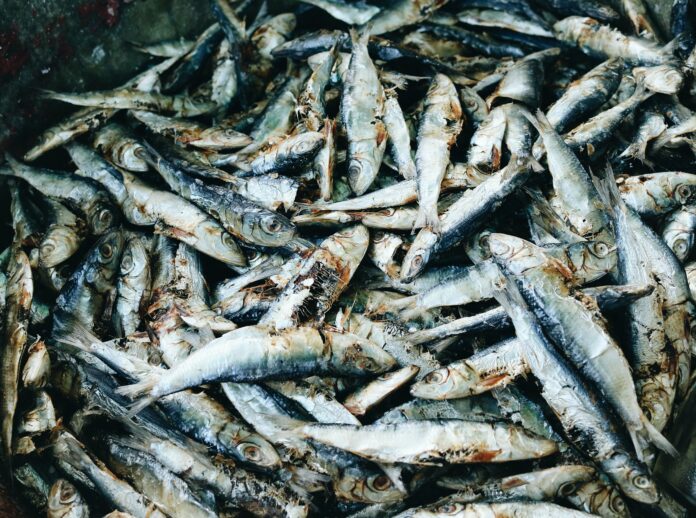
Birds-eye view of a pile of dried fish
Fried fish is a staple food in Malawi, East Africa. Zeshalyn Capindo / Unsplash

By: Nercya Kalino, Staff Writer

Growing up in Malawi, East Africa, dried fish wasn’t my favourite. Now, as an adult, I have grown a nostalgic longing for it — I even miss the smell of it. There is something about dried, fried, roasted, and stewed fish that takes me back to my childhood days. I remember sitting by the burning charcoal with my mom constantly calling out from the kitchen if I was watching the pot. It took a while for me to distinguish between different types of fish, methods of cooking, and the variety of flavour profiles. Whether it is small, long, and curled fish or darkened fish from the sun, they all have a traditional way to cook them to amplify the taste preserved from the drying process. 

I love small dried fish made from usipa, which resemble sardines. Its pungency reminds me of my childhood when I would squirm at the lifeless creature on the plate. The fish would be piled on one side of the plate with other traditional foods such as nsima and bean stew. Reflecting on my childhood dishes, it is curiously not the fancier meals my mother cooked, but rather the food I neglected eating as a child that I miss the most.

I trust my mother’s hands when it comes to preparing dried fish as its handling requires a higher level of experience. Historically, we have used trays to lay fish in the sun with the number of days depending on the fish type. These methods have since evolved to fish farmers using solar power in greenhouses to make the drying process healthier and more efficient. I also appreciate dried fish because of the fish farmers who rely on the process of dried fish and marketing for profit. In Malawi, fish farmers will dry fish to prolong the selling period.

Dried fish varies in price due to its size and rarity depending on the season, but for the most part, dried fish is affordable. Dried fish is more of a traditional dish rather than a snack, depending on the type. The smell of these fish (kampango, kapenta, and usipa) is distinct to lovers of fish and is the heart of Malawian food culture. In Malawi, chambo is quite popular with tourists as this type of fish is tender, tastes great fried, stewed, and roasted — it never disappoints. 

Dried fish is also present in other cultures of African descent. The simultaneous intersection and diversity of ingredients and preparation methods across cultures is something I have come to appreciate. In Malawian culture and among other south eastern countries, they normally cook dried fish such as kapenta by soaking and gutting the tiny fish that you fry with little oil. In western African cultures, they use dried fish as part of a larger stew consisting of meat and vegetables such as banga.

Dried fish is a distant memory now, as I only get to eat it when I visit home. Back at home, buying fish is also a culturally immersive experience. Some of the fish used is accessible here as well, but to prepare and cook it in the same way is a challenge. Regardless, I would definitely like to learn how to cook it from my mother someday.

Dried fish falls on the side of food experiences that I believe tourists are not super keen on exploring, but I think there is so much to appreciate in the taste, cultural importance and labour behind dried fish. If given the opportunity, would you give it a try?


Introducing Colour Tongues, Vancouver-based indie rock band

0
Colourful and neon gradient illustration of feminine features underneath a helmet
Colour Tongues’ sound mixes dream pop and indie rock in their new LP. Colour Tongues

By: Kimia Mansouri, SFU Student

The four-piece indie rock band, Colour Tongues, preemptively celebrated the May 19 release of their album, Midnight Island, with a live show at Fox Cabaret on May 11. Based out of Vancouver, the band consists of James Challis (lead singer and guitarist), Dan Lavergne (bass player), David Taylor (drummer), and Graeme Meekison (lead guitarist). The band got together in 2017 and released their EP, Almost East, in 2018. Since then, they have performed all over Canada.

Listening to Colour Tongues is like an immersive experience where you can feel the beats and the pop melody. The rhythm helps you escape your earthly troubles for a few minutes. Their music reminds me of bands like The Night Cafe, my bloody valentine, and Rare Monk. Colour Tongues is indie rock meeting dream pop, so there is a fair amount of reverb on the guitars but great clarity when it comes to the guitar solos. The sonics overtake the lyrics, so whether you’re listening to them live in a venue or through your earbuds at your desk, you feel compelled to move your body to the sounds. 

You can expect catchy tunes, great melodies, and an early 2000s dream-pop theme from Midnight Island. The instrumentals overshadow the lyrics to a point where it can be difficult to know what the singer is saying if you don’t already know the lyrics. Their full-house show at the Fox Cabaret was an interactive and groovy experience for people who are ready to move their bodies to a wall of music. The high energy stage presence of the members was matched by equally electric energy from the audience. Amidst the audience, I couldn’t help but bop my head to their music which radiated fiery rock ’n’ roll spirit. 

Produced by Matt Di Pomponio, Midnight Island, which has been three years in the making, is a seven-track album about the stages of relationships; first love attempts to save the relationship, heartbreak, and self-reflection. The title of the song with the same name as the album is inspired by “the fear of wanting to fall for someone only to be [weakened] by the doubt of truly giving yourself over to them.” The album speaks to the youth in us and reminds us of the possibilities ahead. 

“By the end of the album, we want you to feel like you did before the world got too big, and to recognize that you can get back there,” said Challis in the press release.

One more interesting thing about this album is the cover, which was inspired by the 90s video game, Metroid. Growing up, Challis and his friends thought the powerful hero of the game was a man but was later revealed to be a woman. The album artwork reveals feminine facial features in colourful gradients. 

While you’re listening to Midnight Island on streaming platforms, the band is preparing for a tour in Ontario starting on May 24 in Toronto, followed by stops in Hamilton, Guelph, Kingston, and Oshawa.

Nicole Bizovie and the Dovbush Dancers

0
A young Ukrainian dancer is pictured in her colourful traditional dance costume in front of the Vancouver Ukraine Cultural Centre building
Nicole Bizovie in front of The Ukraine Cultural Centre. Tallulah Photography / @tallulah_photo / tallulahphoto.com

By: Yelin Gemma Lee, Arts & Culture Editor

For many of us, dance means marvelling at the beauty of performances as an audience member or moving your body at the club. But for SFU health science student Nicole Bizovie, dance has kept her connected to Ukrainian culture and community all throughout her life. 

Bizovie has been going to the Association of United Ukrainian Canadians (AUUC Vancouver) at the Ukraine Cultural Centre since she was just three years old. Growing up in the Dovbush School of Dance, she officially joined the Dovbush Dancers at age 14. Bizovie explained to The Peak that dancing and being a part of AUUC Vancouver keeps her rooted in her Ukrainian culture. 

Bizovie said the elements of this dance — like costumes and choreography, “pertain to particular regions throughout Ukraine. So you learn about the history of your culture through dance which is an interesting way to learn about it,” said Bizovie. “Just being around people in your community really connects you with it.”

The Dovbush Dancers were on a performing hiatus throughout COVID-19, with dance Zoom calls twice a week when their in-person rehearsals would normally be. Though things weren’t the same throughout these socially distanced rehearsals, Bizovie expressed pride and gratitude to be able to remain connected. 

“A lot of the Ukrainian dance studios in the Lower Mainland didn’t operate throughout COVID-19. So we were one of the only ones who were actively practicing,” said Bizovie. 

Since then, the Dovbush Dancers have been back to in-person rehearsals and recently did their first performance closing for Ukrainian designer, Tetyana Golota, at Vancouver Fashion Week. As the Dovbush Dancers operate out of the Ukrainian Cultural Centre, they’ve been working together to help host numerous fundraisers for the Russia-Ukraine war

Some of these include medical supply and cash donation drives in partnership with Maple Hope Foundation and Ukrainian Patriot, perogy sales, and a craft and bake sale. Bizovie said they also have a large fundraising event coming up on June 11 called “Big Bands for Ukraine” in partnership with the Polish community. Bizovie, who supports administration at the cultural centre, said they have been receiving a lot of love and support during this difficult time for her community.

“The community in Vancouver has been extremely supportive [ . . . ] The amount of support I get weekly from strangers offering their services, offering to volunteer, looking to help in any way. It’s been super overwhelming and amazing.”

Bizovie said AUUC Vancouver, or the “Hall,” continues to be a safe space for her with therapeutic mental effects. Watching older clips of their performances, I was taken aback by the joy and hope exuding from the dancers and with each dance delicately spinning out an enchanting story. 

“I always think of the Hall as a second home, because it really is. I’m there three times a week, sometimes more, and I’ve been doing that forever and ever my whole life,” said Bizovie. “It’s always been a kind of escape for me. Whatever’s going on in my life, good or bad, school, friends, anything — it doesn’t matter as soon as I get into the hall. As soon as I go to the hall for dance, my mind is blank. I’m just existing.” 

To learn more about the Dovbush Dancers, check out their Instagram or website. To learn more about and obtain tickets to the upcoming fundraiser “Big Bands for Ukraine,” visit their Eventbrite link.

SFU students and staff co-host symposium to discuss Scarborough Charter

0
The photo is of four Black panellists engaging in conversation onstage. Behind them is a screen that reads Scarborough charter. The screen also has another panelist joining in virtually.
They discussed the responsibility universities have to create accessible spaces for Black knowledge and community. PHOTO: Chloë Arneson / The Peak

By: Chloe Arneson, News Writer

On May 14, 2022 SFU and UBC co-hosted a symposium titled, Community Making and Black Flourishing Through the Scarborough Charter. The discussion was part of a two-day event to discuss the Scarborough National Charter on Anti-Black Racism and Black Inclusion in Canadian Higher Education. 

The forum sought to discuss the recent signing of the Scarborough Charter, a pledge signed by over 50 universities and colleges across Canada to promote Black representation in academia and fight anti-Black racism within higher education. The charter was signed in November 2021. By signing, UBC and SFU signified “commitments to move from rhetoric to meaningful concrete action to address anti-Black racism and to promote Black inclusion.” 

Dr. Malinda Smith, professor of political science at University of Calgary, said, “The charter emerged in the aftermath of a moment of racial reckoning.” This came “after decades of Black activism and advocacy,” she added.

The charter’s action plan hopes to facilitate new anti-racism initiatives in governance, research, teaching and learning, and community engagement at the postsecondary level. Some of these actions include “reviewing and revising dispute resolution processes,” creating accessible spaces for Black students, and reducing gaps in Black representation across academia. Some of their recommendations suggest creating accessible spaces for “Black belonging, knowledge development and sharing.” Additionally, ensuring a position exists in senior administration dedicated to addressing and combating racism. This includes offering anti-Black racism education for all students, staff, and faculty. 

The charter notes the responsibility higher education institutions have “in constructing the bodies of knowledge about historically groups and acknowledging the ethical responsibility to [ . . . ] support community capacity building.”

The event featured four panels made up of Black students, activists, scholars, and university administrators from both UBC and SFU. After a land acknowledgment and warm welcoming from Afro-Indigenous councillor Orene Askew, UBC president Santa Ono, and SFU president Joy Johnson joined virtually for welcoming remarks.

In her opening statement, Johnson said, “SFU signed the charter, we made the commitment, and now we’re grateful to embark on the journey of creating real systemic change.”

Dr. June Francis, special advisor to the president on anti-racism at SFU, explained there will need to be a significant amount of energy, prioritization, money, and resources dedicated to combating anti-Black racism. 

“I think the fundamental issue [ . . . ] is the level to which these institutions were constructed to explicitly exclude us, to explicitly support white supremacy, to explicitly put up structures and barriers that we somehow negotiated around this. We’re here not because they invited us in through the door, but we crawled in through any hole because that’s who we are,” said Francis. She believed when institutions signed the charter, they “haven’t really thought about how much they’ll have to blow it up and transform it.”

Tiara Cash, one of the panelists at the event, said, “Institutional racism is insidious, it’s the type of racism that is meant to make you tired.” This sentiment was echoed throughout the event. 

Binta Sesay is an equity and inclusion assistant at UBC who spoke on her experience as a Black student at UBC. “There’s a lot of listening, but just surface listening. Not listening to change,” said Sesay. One of the barriers Sesay has noticed is “the process of implementation [ . . . ] from a foundation of white supremacy.” Universities tell students they hear them and will make changes, but according to Sesay no action is made. During this process students get exhausted which results in students giving up.

“This is us telling the university what we need,” she continued. According to Sesay, if the decision makers at post-secondary institutions listened to what they are asking for, “it is enough to make the change we want to see. This is us expressing how fed up we are, but also expressing the unsung heroes that kept us open to these conversations and holding on.”

The full video recording of this event can be found on UBC’s website.

SFSS passes Palestinian Issues Policy

0
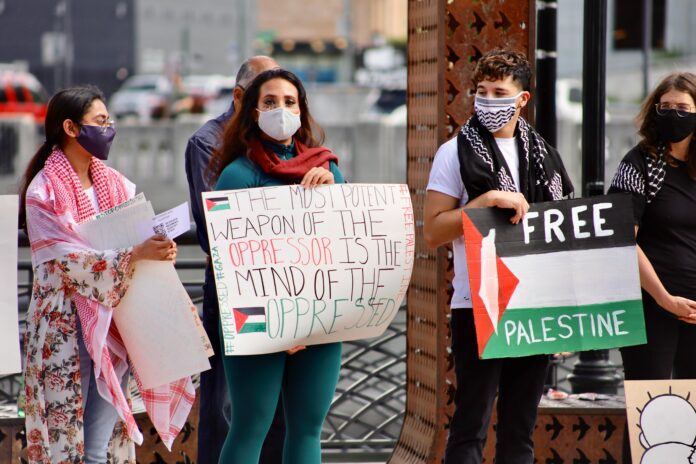
Protestors are standing holding signs that read “Free Palestine” and “The most potent weapon of the oppressor is the mind of the oppressed.” An individual in all blue is staring at the camera, while those around them are looking in their direction.
Student activists share their responses to the new policy passed by the SFSS. Image courtesy of Manny Becerra / Unsplash.

By: Olivia Visser, Staff Writer

On April 20, 2022, the Simon Fraser Student Society (SFSS) council passed a Palestinain Issues Policy with a unanimous vote. 

The Palestinian Issues Policy was suggested by the SFSS Free Palestine Working Group in response to the SFSS statement on the Israeli Colonization of Palestine. 

The policy establishes systemic advocacy for Palestinians by denouncing the war crimes carried out against Palestine by the state of Israel. It also allows for the consolidation of SFSS resources to lobby the Canadian government for further action.

In an interview with The Peak, student organizer and Free Palestine Working Group member Parsa Alirezaei, and Free Palestine Working Group member Tuleen Awad discussed the importance of this policy. 

Awad and Alirezaei said because of the Israeli occupation of Palestine, Palestinian students are “constantly met with collective punishment and incarceration.” 

According to Alirezaei and Awad, SFU has been complicit in Israeli settler-colonial practices and noted that such practices would not be possible without the “support of other settler colonies’ institutions. 

“Academic institutions, by their very nature, are part of an apparatus built to legitimize certain ideas that maintain the power structures of the status quo. This is constantly in conflict with their propensity for critical investigation and insistence on building a better world. By not supporting Palestinians, institutions like SFU risk betraying their socially conscious façade,” said Alirezaei and Awad. 

Previous vice-president equity and sustainability Marie Haddad echoed similar intentions in the SFSS press release, stating solidarity with Palestinians is “essential to improve the conditions of Palestinian students within membership and Palestinians in the occupied territories who are drastically being impacted and silenced.”

According to their press release, the SFSS has previously passed issues policies to clarify their “approach to social justice” regarding “financial, socio-political, and academic advocacy.” Past initiatives include policies on climate justice, Indigenous inclusion and reconciliation, and Black History Month. 

When asked about the importance of taking an official standpoint, current SFSS vice-president equity and sustainability Rea Chatterjee said, “70 universities have already passed these motions in solidarity.” SFU members must “understand that we are part of a larger movement.”

Establishing an official policy in support of Palestinians creates a safer space for conversations that have not always been protected on an institutional level. Alirezaei and Awad mentioned that “Canadian institutions, students, staff, and faculty are often targets of smear campaigns conducted by the Israel lobby. Canadian universities have often been complicit and rarely provide the necessary protection that their own members require.” 

Locally and abroad, smear campaigns are a tactic used to control public opinion by damaging someone’s reputation. Palestinian Canadian writer Dr. Khaled Barakat was the victim of a smear campaign in April following an article published by the National Post.

The SFSS noted in their press release, “This policy serves as a framework to not only normalize and center Palestinian discourse and struggle but will serve as a catalyst for further actions that SFSS and many other student unions are able to take going forward.”

Activists recognize the policy is only one part of a global movement to support the plight of Palestinians. When asked about further action that SFU should take, Alirezaei and Awad said, “Cut off all ties with Israeli institutions and institutions complicit in upholding Israeli apartheid; and as stated previously, support students, staff, and faculty when they speak out against Israeli actions.” 

Chatterjee said, “SFU can hold itself accountable to it’s commitments to decolonization by actively speaking out against the injustices that Palestinian students, staff and faculty face as well as publicly denounce Israeli acts of terror.” 

Alirezaei and Awad encouraged students to join local movements supporting Palestinians, and pressure institutional powers to take supportive action. 

“There are so many ways to become involved, Chatterjee commented, citing Samidoun and Students for Justice in Palestine among other organizations. “The student base is huge and willing and we can truly mobilize so we become a part of this larger movement.”

BC students rally to demand tuition freeze

0
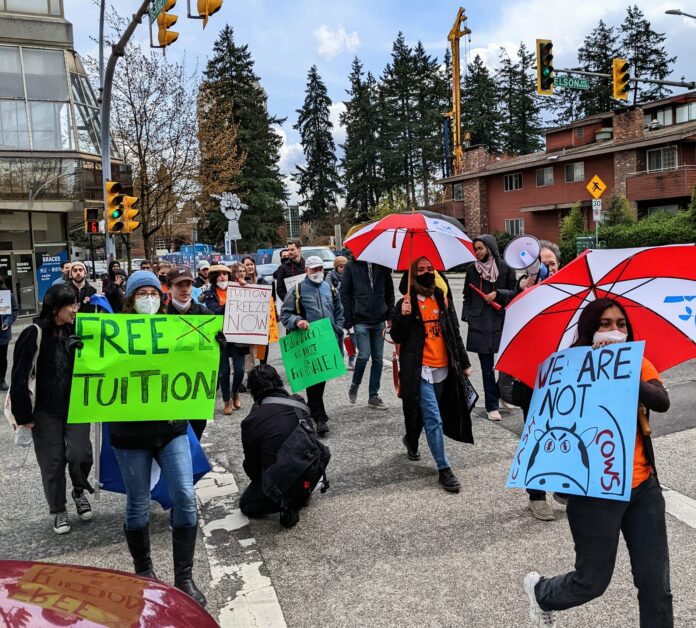
Numerous protestors are seen crossing the street. Most are holding signs that read “Free Tuition” and “We Are Not Cash Cows.” Others hold umbrellas while one individual is holding a megaphone.
Sude Guvendik discusses the toll tuition increases have on international students. Image courtesy of Sima Jamali.

By: Chloë Arneson, News Writer

On April 14, 2022, students and workers from UBC, UVIC, and SFU participated in a rally to put a stop to tuition increases. The protest, organized by Tuition Freeze Now (TFN), started outside Metrotown skytrain station and proceeded to the Minister of Advanced Education and Skills Training’s office on Nelson Avenue in Deer Lake, Burnaby.

According to TFN’s press release, the group’s main concern is that BC universities have become “a place for the rich, and not the working class.” 

The Peak spoke to Sude Guvendik, president of the International Students Advocacy Group, to learn more about the campaign. The group is part of the larger coalition that organized the rally. The coalition includes the SFSS, SFU350, SFU Disability and Neurodiversity Alliance, and groups from UBC and UVIC. 

“[We want to] urge the provincial government to take swift action to stop the exploitative systems of higher education,” said Guvendik. 

The campaign hopes to achieve a tuition freeze and create a commission to investigate the possibility of free post-secondary education for all BC students, according to their press release

TFN’s press release stated students are struggling financially to keep up with increasing tuition. Teaching support staff union chief steward Amal Vincent explained in the press release tuition has increased by 2% for domestic students and 4% for international students. Fees for undergraduate students have increased over 200% over the past twenty years, making it three times more expensive than it was in the 1990s. 

“As tuition increases the campus community changes. The most marginalized students are excluded and on top of the list are international students,” Guvendik said. 

Guvendik explained students are “dealing with mental health issues because of financial burdens and fear of being kicked out of school because of not being able to pay tuition.” 

Several students spoke at the rally. “It was amazing seeing all of these students unite against injustice,” Guvendik said. “We’re uniting in our struggles saying we need to do something about this.

“As a student here, tuition is more than just a number. It affects the everyday lives of students, especially international students [ . . . ] It’s so hard to make ends meet when you’re an international student working part-time,” said Guvendik.

For international students in Canada that are looking to work part-time, there is a work limit of 20 hours per week during regular school semesters. International students can work full-time throughout scheduled breaks between semesters. 

SFU undergraduate student Rea Chatterjee stated in the press release that with the cost of living in Metro Vancouver on the rise, “basic expenses such as housing and food make it nearly impossible for students to save money and start planning for life after university.”

They further noted, “Governments and post-secondary educational institutions have a responsibility to provide the public with quality education without having to break our backs to afford it.”

SFU vice-president academic and provost Catherine Dauvergne said in an email statement to The Peak, “We recognize the increasing cost pressures that everyone is facing with inflation and the rising costs of housing [ . . . ] We encourage SFU students who need support to contact the Financial Aid and Awards Office to discuss available options.”

Dauvergne noted, “Student affordability is an ongoing priority for SFU and something we continue to address in partnership with student groups and our government partners.”

Tuition Freeze Now plans to attend the 2022 BC Budget Consultation to advocate for the need to fund accessible education. “We are not cash cows and we refuse to be cash cows,” Guvendik stated.

To find out more about TFN’s campaign, visit their website.

Teaching Support Staff Union rallies for research assistant rights

0
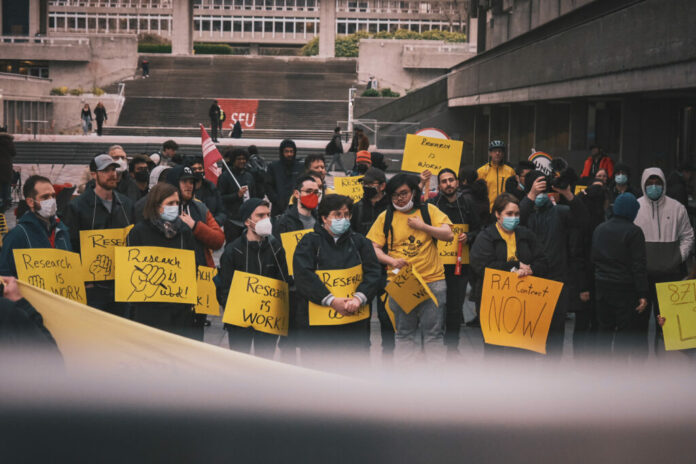
A crowd of people can be seen at SFU Convocation Mall. They’re holding yellow signs that read “Research is Work” and “RA Contract Now”.
Day 873 of SFU’s delay in bargaining. Image courtesy of Sherry Young.

By: Jaymee Salisi, Promotions Coordinator

On April 4, 2022 SFU’s Teaching Support Staff Union (TSSU) held a rally at Convocation Mall protesting the university’s continued delays to fulfill a union contract with their research assistants (RAs).

In November 2019, SFU signed an agreement to “voluntarily recognize RAs as members of TSSU.” This would require the university to recognize RAs as employees and provide them with full worker’s benefits. The university has delayed bargaining with the TSSU for 873 days as of November 15, 2019, causing RAs to continue to work without a collective agreement. 

The RAs are asking SFU administration to “fulfill their agreement without any more delays.” They are asking for the collective agreement to include:

  • “Benefits and wages comparable to those of SFU teaching staff
  • Health and dental coverage
  • Respect for the critical contributions of RA labour
  • Maintaining the broad definition of an SFU RA to uphold inclusivity”

In an interview with The Peak, contract committee chair and chief steward of the TSSU, Amal Vincent, spoke on the union’s experience on bargaining for RAs’ rights with SFU.

In the Voluntary Recognition Agreement signed in November 2019, SFU administration agreed to include all RAs in the union. According to Vincent, after the agreement was signed, a senior SFU human resources employee openly disagreed with including work-study RAs and RAs on scholarship in SFU’s collective agreement with the TSSU.

“Since then, SFU administration has violated all the terms of the agreement,” he said.

According to Vincent, the university administration “continues to exclude a large portion of RAs from the union.”

SFU initially acted on their agreement in good faith in the beginning of the bargaining process, Vincent said. However, he soon observed a lack of reliability from the administration. “When [SFU administration does] meet with us, they come unprepared and don’t follow up on any promised actions,” according to Vincent,

Unlike unionized teaching assistants and tutor-markers, RAs who are international students currently have to pay the International Student Health Fee (ISHF) which amounts to an annual cost of $900. According to Vincent, after paying these student fees most graduate student RAs are left with around $1,200 per month.

In addition, Vincent said SFU has “denied all student RAs and the vast majority of other RAs sick leave” which violates the recent provincial legislation.

The university’s delay in action continues to affect the health and finances of their RAs. Vincent said RAs resort to paying thousands of dollars out of pocket each year for extended health and dental benefits that are normally covered by employers. As a result, some RAs “are living in poverty because of this,” he said.

“We’ve seen pay stubs that show as little as one dollar per hour at SFU — way below minimum wage — and others that pay more reasonable wages.”

RA payment is inconsistent, said Vincent. He compared SFU RAs’ $17 per hour compensation with minimal benefits to that of UBC’s lowest RA rate of $22.03 per hour.

He added UBC also offers their RAs various benefits such as paid breaks, 100% employer paid extended health and dental, and 15 days of sick leave annually. For RAs with a contract of a year or more, they receive a pension plan, disability benefits, and life insurance.

 “[RAs] are the backbone of the research programs at SFU,” Vincent said.

They are involved in various tasks according to Vincet, including “running experiments, maintaining lab equipment, collecting data in the field, researching, writing literature reviews, writing and publishing papers.”

In an email statement to The Peak, SFU’s vice-president research and internal Dugan O’Neil said, “SFU values and appreciates our research assistant staff and the university remains committed to reaching a fair agreement as quickly as possible.”

According to O’Neil, “In November 2019 we agreed to recognize TSSU as the appropriate bargaining unit for Research Assistants. This was not a collective agreement, just a recognition.”

He noted the TSSU and SFU met with an arbitrator in January 2022 to discuss their differences and to look for an agreement between the two parties. Arbitration is a private procedure, alternative to court, wherein parties bring a dispute and a binding decision is made. O’Neil reported TSSU wanted to proceed with arbitration. “The university is required to follow the rules and guidelines of the bargaining process and must now wait for the scheduled arbitration this summer, which TSSU requested, before things can move forward,” said O’Neil.  

“The process for negotiating a first collective agreement is complex. The last group of Research Assistants (RAs) were transferred to be SFU employees in Spring 2021. While we would have liked things to have moved along more quickly to finalize their bargaining agreement, it has taken longer than anticipated for many reasons, including the diversity of the work research assistants perform, as well as disagreements at the bargaining table,” said O’Neil.

The TSSU plans to continue organizing on-campus events throughout the summer semester to push SFU administration to uphold their end of the agreement and ensure “all RAs are recognized as members of TSSU, and have a collective agreement that provides living wages and benefits for [all RAs].”

The TSSU encourages SFU students to attend their rallies and invite the larger SFU community to support the cause.

Students can learn more about the TSSU and their bargaining efforts with SFU administration here.

Political Corner: Lower the voting age already!

0
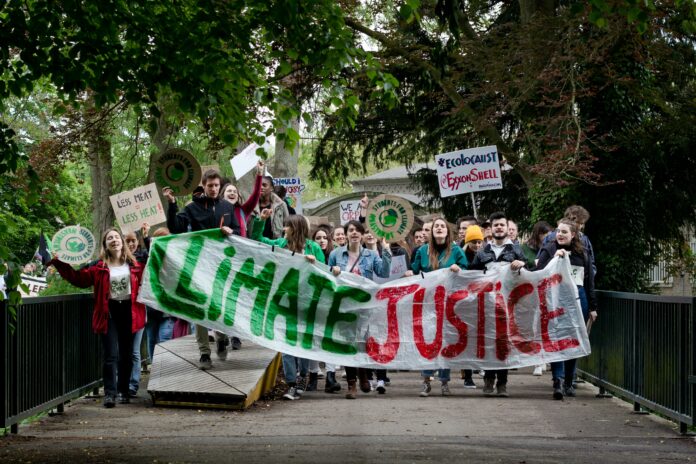
A banner reading “climate justice” at a youth climate rally
Young people deserve a say in the issues that affect them. PHOTO: Vincent M.A. Janssen / Pexels

By Olivia Visser, Staff Writer

What gives someone the right to vote? Or, what gives us the right to deny others the privilege? The case for restricting the voting age to 18 and up lies in the belief that adolescents lack the judgment required for voting decisions; this couldn’t be further from the truth. Young people are valuable members of society, and should be given the same legal voting rights as adults. 

It’s not that young Canadians are apathetic about politics. A nationwide youth survey of Canadians aged 10 to 24 found that 88% of participants had thought about who they would vote for in the previous election. A pervasive myth, one respondent suggests, is that older generations consider young Canadians too immature, careless, or deluded to engage in the political process. But that same respondent reminds us that “every generation has people that are all of those things.”

If the voting age depends on someone’s involvement in society, then 16 year olds should definitely have the right to vote. Many adolescents have “adult responsibilities” like caretaking, working, and paying bills. Moreover, young people (and their children) will be around the longest to experience the effects of policy-making. A recent study published in Science found children born in 2020 will experience a “two to seven fold” increase in extreme climate events, compared with those born in 1960. Shouldn’t youth have a say in policies that will impact their futures? 

Research by the Center for Information and Research on Civic Learning and Engagement found that young citizens are passionate about social issues, and largely hold different views from previous generations. Climate change is one of the leading issues driving youth political involvement, yet adolescents still aren’t allowed to express their beliefs by voting. Instead, we see young activists driving social change. The School Strike for Climate movement was likely the largest climate protest in history, and it was led by student activists. How’s that for political engagement?

We also know that political involvement in younger age groups leads to future involvement. Scholar Mark N. Franklin argued that “voting is a habit” and “people learn the habit of voting, or not, based on experience in their first few elections.” When Austria lowered its federal voting age, the rate of first-time voters was much higher among 16–17 year olds, compared with 1820 year olds.

The movement to change the federal voting age from 18 to 16 is growing rapidly across the country. In December 2021, a group of young Canadians took the government to court. They argued the voting age restriction violates their Charter rights, which include the right to vote. The Canadian Senate is also discussing the issue. Recently, the NDP launched a bill to lower the voting age. MP Jagmeet Singh said he feels that democracy is threatened as reasoning to grant youth the right to vote.

We’ve already seen successful campaigns to lift voting restrictions for women, Indigenous people, and Asian Canadians. Young people, with their unique perspectives, should be the next bloc of Canadian voters to join the franchise.

Un-learning Islamophobia with Dr. Anver Emon

0
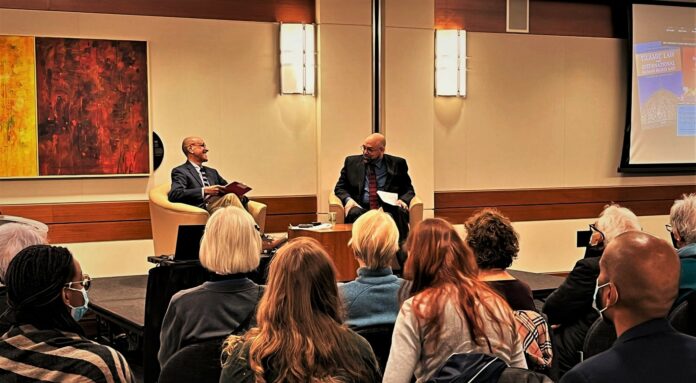
Dr. Anver Emon is seen sitting on stage with Dr. Amyn Sajoo. The two are engaged in conversation as people sit in the audience listening. Behind the stage are paintings and lights.
Dr. Emon is a professor of law and history at University of Toronto. Image courtesy of Nabila Hussein

By: Karissa Ketter, News Editor

The second installment of SFU’s Onstage Speaker 2022 series was hosted on May 14. Dr. Anver Emon, University of Toronto law and history professor, looked at some harmful Muslim sterotypes in Canada and spoke about Islamic law in his discussion. The conversation was led by SFU professor of International Studies Dr. Amyn Sajoo.

SFU’s vice-president academic and provost, Catherine Dauvergne opened the event by noting, “The conversation around Islamophobia is one of the most important conversations for western societies to enter into.

“The inability or unwillingness of western decision makers and law makers to begin to deeply understand Islam — and therefore be able to confront and truly address Islamophobia — is one of the most serious and important issues we face in the law.” 

According to Emon, in Canada, Islamic law — sharia — is “treated as a foreign, as threatening, as an ‘other.’ Not unlike an immigrant from the Global South, sharia as a legal system is treated as an existential threat.

“Every state regulates religion — it’s just an issue of degree,” said Emon. He explained it’s difficult to know what states do in the name of religion. For example, in Saudi Arabia, life insurance is not considered halal — or compatible with sharia law. Emon explains this is because insurance is “payments now for an eventuality down the road,” otherwise known as gambling or speculation. 

However, the central bank in Saudi Arabia does sell commercial insurance to corporations. Meaning the state is not regulating the sales of insurance despite its violation of sharia.

Sajoo asked Emon about the western narratives of dhimmi rules. Sajoo noted the western interpretation of dhimmi rules is that there is “inherent inferiority” of non-Muslims, which “makes them permanent outsiders.” He suggested this is a misconception.

Emon added, “We’re not really talking about religion or religious freedom. What we’re talking about is the management and regulation of a permanent ‘other’ in our domestic sphere.”

Similarily to the discussion of minorities is the understanding and status of women in Islam. Sajoo said, “The dominant portrayal of women is that women are second class citizens, and they are oppressed.

“The Quran has an entire chapter dedicated to the status of women. It proclaims the moral equality of women very explicitly,” said Sajoo. He added, the gender divide cannot be directly attributed to Islamic theology, but rather social practice.

Emon pointed to a common link between laws around the world. “When we think about the historical tradition of Islamic law, we have to recognize it’s got a lot of patriarchy in it,” he said. “But, we can also say a lot of legal traditions around the world are super patriarchal. 

“Patriarchy, like racism and bigotry, are embedded in our legal systems.”

The event was co-hosted by SFU Morris J. Wosk Centre for Dialogue and Ismaili Centres Canada.

Tymofiy Mylovanov discusses the war in Ukraine

0
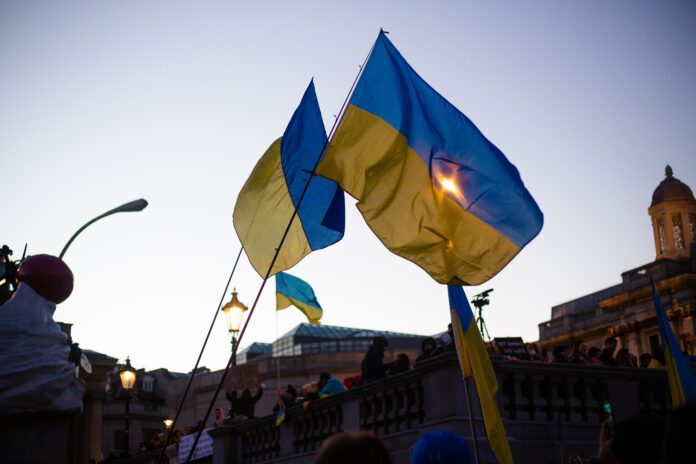
Two Ukrainian flags are being lifted into the sky.
With propaganda on both sides, Mylovanov calls this “informational warfare.” Image courtesy of Karollyne Hubert / Unsplash

By: Olivia Visser, Staff Writer

On May 10, the SFU Economics Research Seminar series hosted Tymofiy Mylovanov for the seminar titled, Military and Economic Aspects of the War in Ukraine. Mylovanov is president of the Kyiv School of Economics, associate professor at the University of Pittsburgh, and advisor to the Zelensky administration. 

Much of the conversation revolved around information and its truthfulness. Mylovanov described the current situation in Ukraine as a “wars of symbols” that are “won by communication as much as kinetic warfare.” He shared that from personal experience, “there are aspects [of war] you cannot study.

“It’s really difficult to explain what the war is unless you wake up and there is a missile next to you,” he said.

Mylovanov pointed to three forms of evidence to contextualize information that he trusts: “Eyewitness accounts, video evidence, and media coverage.” 

On the other hand, he suggested data is something to be aware of. “I don’t trust data, and it’s really strange for me as an academic that I don’t trust data,” Mylovanov said. 

When asked how to discern truthful information while living abroad, he said data can be okay to use — when combined with the appropriate context.

According to Mylovanov, the important factor is connections to the source of information. “So, the key is to find a friend or someone who is in Ukraine, or has been in Ukraine, or knows someone from Ukraine” who can help add context to your understanding of events. Mylovanov added, “I cannot trust anything I know in war, and the only thing I can trust is what I have experienced personally or what someone who has experience told me.” 

In terms of propaganda, he described the situation as informational warfare. “It’s important to be clear on the questions you want to know answers to. If you really discipline yourself about the questions you want to get the answers to, then the propaganda approach is not very effective.” He suggested asking specific questions helps tackle propaganda because their answers are harder to skew. For example, the questions, “Who started the war?” and “Are there atrocities in Bucha?” are easier to answer than “Can Russia win?”

Mylovanov concluded his seminar by speaking to Russia’s dwindling international support. “Russia in the longer run has lost a lot of agency, unfortunately for the Russian people, and Ukraine has gained a lot of agency but the price is huge. But I guess this is the price if you want to be an independent nation from a vast imperialistic neighbor.” 

This seminar was originally planned for May 3, but Mylovanov was forced to reschedule due to an airstrike warning in Kyiv.

A recording of the seminar can be viewed on the SFU economics’ event page for further information.