Home Blog Page 233

What it’s like recruiting players: An off-season of a coach

0
Photo of a soccer coach explaining something with his coaching board
The recruiting process can take anywhere from months to years. PHOTO: Nyugen Thu Hoai / Unsplash

By: Simran Sarai, Sports Writer

The Peak often asks athletes about how they made their way to SFU and what their recruitment journey was like. This time, we decided to sit down with Brit Townsend, head coach of the SFU men’s and women’s cross country and track and field program, to find out what the recruitment process is like from the coach’s side.

How long do you spend looking at potential recruits?

It really depends on their performance. Some take a lot longer to convince and to recruit. They reach out to us or we reach out to them. Some of them have a lot of opportunities from other schools, a lot of offers we have to compete with. Others come on as a walk-on. Some come on as we’ve recruited them and they’re scholarship athletes. It can be long or it can be short.

What’s the longest time period you’ve spent looking at recruits?

It can take a couple of years of watching people’s progress [ . . . ] We have some limitations on when we can contact people with the National Collegiate Athletic Association (NCAA). But that doesn’t mean we can’t watch them, and that doesn’t mean we can’t follow their performances and see how they’re progressing, which is what we do.

What are some of the considerations of being the only Canadian NCAA school when recruiting athletes? Are there any barriers you might find or any special considerations?

I actually think it’s a huge benefit. We can offer a student-athlete the benefit of a Canadian education, way of life, culture, and the opportunities and experience of competing in the NCAA against the top schools. In our sport, we compete a lot against Division I schools, so they get that opportunity as well, which is pretty special. They can be closer to home and in an environment that they’re familiar with. A lot of people have said that they want to combine the NCAA experience with a Canadian education.

When you’re reaching out to potential recruits, what does that process look like? What are some of the steps you might have to take as a coach?

It differs. They contact us, we follow up, [and] we give them a lot of information about the NCAA and about SFU. We stay in contact with them. If they’re a top recruit, we invite them out for a visit at the university, we tour them, and we have them meet with an academic advisor. Sometimes they come out for a competition. 

We had several people come out and we took them for lunch and a tour of the university during the Canadian National Championships, which were in Langley [ . . . ] Our sport is very different because we have a lot of different event areas that we look at [ . . . ] sprints, hurdles, distance runners, people that can double in cross country, [and] jumpers and throwers. It is really broad, and my assistant coaches help me identify potential athletes in those different event areas.

How does scholarship allocation work?

Scholarships are based on performance and I make the decision. If they’re in other event areas, I look to my assistants to give me some guidance as to how much they would fit into their event area and how productive they would be. It’s all based on performance. In track and field, it’s a little easier than in some of the other sports. You’re basically going, okay, you run that fast or jump that high, where does that fit in with the Greater Northwest Athletic Conference or with the NCAA? It’s pretty easy for us to make those decisions.

Professor investigates chemical compounds to control honey bee parasites

0
The photo is of a bee hive where multiple honey bees are entering and exiting a beekeeper box.
Varroa mites can infect and collapse entire colonies. PHOTO: Damien Tupinier / Unsplash

By: Charlene Aviles, Peak Associate

Bees play a crucial role in agriculture, especially in pollinating crops. SFU chemistry professor Dr. Erika Plettner has been researching chemical compounds to control varroa mites, which are parasites that threaten honey bee colonies. 

The Peak interviewed Plettner to learn more about her research.

“The varroa mite only attacks honey bees [ . . . ] but some of the viral diseases and other pathogens that honey bees might carry, can spread,” said Plettner.

Plettner added, “The injuries that the mites do to the bees don’t heal, and they can be the entry point for secondary infections and diseases. And this can really lead to a sudden collapse of the colony and a loss of the colony.”

Plettner explained without enough pollinators to pollinate crops, farmers import beehives and bees. Imported beehives are a temporary solution to offset the lack of pollinators. However, it is a costly and time-consuming option for beekeepers, which leaves many crops unpollinated in the meantime.

To address the varroa mite problem, Plettner and her team have been testing chemical compounds to control the mite population. They compared the chemical compounds’ effectiveness to a control group. She added this is a timely concern, considering beekeepers usually treat their hives for mites in the fall.

“What you really want in this case is that you want the compound to really work well on the mites but without having really acute effects on the bees. This is what the therapeutic ratio is, and this is true for any medicine,” said Plettner. She explained the therapeutic ratio as having a high effect on the area you’re trying to treat but a low effect on the host of the disease. In this case — a strong effect on varroa mites while leaving honey bees unaffected. 

Plettner hopes the research would provide beekeepers with more options for treatments against varroa mites. She highlighted the importance of rotating between different treatments to prevent the varroa mites from developing immunity.

Plettner explained using the same compound would cause the mites to develop a resistance — causing the therapeutic ratio to become smaller. “At some deep level every compound will have what is known as a sort of ‘background effect’ or ‘non-lethal effect’ that could in the long term be a problem,” said Plettner.

The team is currently in a trial phase of the study and is continuing to “assess the efficacy of this treatment.”

Food for Thought: Adobo

0
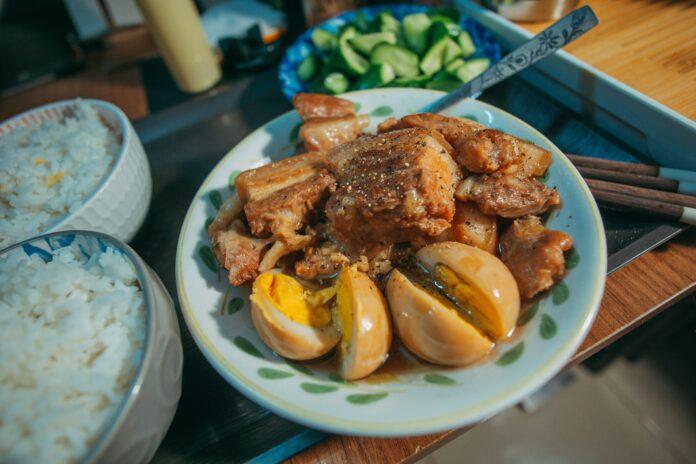
Plate of pork adobo
PHOTO: Adobo / FOX

By: Charlene Aviles, Peak Associate

Growing up, I wasn’t as connected to my Filipino roots as I am now. I didn’t grow up speaking Ilocano or Tagalog, and had visited the Philippines only a few times. But my parents and grandma wanted to pass on the culture to me, and their main way was through food.

Finding authentic Filipino food was always a challenge, but my family always tried their best to replicate authentic flavours you’d find back in the province they grew up in. Adobo, a classic dish found throughout the Philippines, is one that frequents our kitchen and my belly, even now. Not only do its recipes call for accessible ingredients, its cozy and familiar taste makes everyone feel at home. If you haven’t tried Filipino food before, this is a great place to start!

Adobo is a Filipino dish cooked in a vinegar and garlic marinade. It’s cooked with different proteins, depending on which region you’re from. In Cavite’s banana flowers adobo (adobong puso ng saging), they incorporate shrimp. While in Ilonggo regions, they have a vegetarian version with water spinach (apan-apan adobabo). 

Adobo’s Spanish roots trace back to the early 1600s and the name “adobo” comes from the Spanish wordadobar,” which means marinade. Despite adobo existing in Filipino culture before Spanish colonization, no one seems to know the dish’s traditional name before the Spanish label. While they have the same name, the Filipino version has a vinegar base, unlike the Spanish adobo sauce with its spicy ingredients, such as chili peppers.

Because of the Philippines’ hot tropical weather, Filipinos traditionally preserved their food with vinegar and salt. As Chinese traders brought soy sauce to the country, more Filipinos started incorporating it in their adobo recipes.

As a child, my grandmother would always make us her famous chicken adobo for lunch. As soon as I smelled the aromas of vinegar and soy sauce in the kitchen, I knew she was making her signature dish. Whether we’re on vacation or at home, the taste of her chicken adobo makes everyone feel comforted. The bold flavours, like the acidic vinegar and the tangy soy sauce, pops in your mouth. Her cooking is hard to replicate, so sometimes relatives will call her asking for the recipe, and she’ll share it — if we promise to keep it a family secret. 

How to cook your own chicken adobo, according to All Recipes:

Ingredients:

  • 2 tablespoons vegetable oil
  • 3 pound chicken
  • 1 large onion, sliced
  • 2 tablespoons minced garlic
  • ⅔ cup soy sauce
  • ⅓ cup white vinegar
  • 1 tablespoon garlic powder
  • 2 teaspoons black pepper
  • 1 bay leaf

Recipe:

  1. Heat the oil in a pan over medium heat. Cook chicken until golden brown and set aside.
  2. Cook onion and garlic thoroughly in the pan. 
  3. Add soy sauce, vinegar, garlic powder, black pepper, and bay leaf.
  4. Add chicken back to the pan on high heat. Bring to a boil. 
  5. Reduce heat to medium and simmer while cover until cooked. 

Book launch explores barriers of racialized students

0
The image is of two students sitting in front of a computer. They are in the middle of a conversation and working collaboratively.
The book contains a collection of art, poems, spoken word, and academic papers. PHOTO: Desola Lanre-Ologun / Unsplash

By: Pranjali J Mann, News Writer

On August 30, SFU and Fernwood Publishing hosted a panel discussion and book launch of Academic Well-being of Racialized Students. The event was held in collaboration with Vancouver Status of Women and the Racialized Students Academic Network. 

Edited by Dr. Benita Bunjun, the book is a “collection [with] academic chapters, spoken word, and art by 15 contributors.” The book discusses how racialized students, who have historically been excluded from academic spaces, navigate colonial structures of education. The panel featured three contributors, Vanessa Mitchell, Zain/Mason Meghji, and Nathalie Lozano-Neira.  

The event opened with Dorothy Christian, SFU associate director Indigenous initiatives, giving a land acknowledgement and explained her contribution in the book includes a chapter on her academic writing process. She said, “We are in a process of change and transformation. And this is what I see this book as. This is a tool that gives faculty and department chairs and fellow graduate students on how it was all navigated, the system, in order for us to get through it.”

Bunjun defined the book as a compilation of works “from those that dare to create hybridized transformative spaces of good relations, knowledge creation, and community-building.” 

Bunjun said academic well-being refers to the capacity institutions will implement policies and services “that promote the mental, physical and intellectual wellness of students.”

Bunjun described the issues racialized students face due to existing systems. She quoted, “Due to the lack of diversity of racialized critical scholars, we find ourselves gravitating towards the few that exist. We are troubled by having to demand more from already marginalized faculty who themselves experience racism within their departments and classrooms.”

In another chapter of the book, Mitchell highlights that claiming injustice to be a thing of the past is a “continued narrative rooted in colonization.” She mentioned the chapter touches upon various key themes in collective Indigenous history; including repercussions of the Indian Act, terminology in academia, navigating community relations, and students’ trauma and harm. 

Contributor and panelist Meghji quoted a poetry excerpt from the book: “The beautiful thing about being surrounded by brown people is that when they ask me where I’m from, I feel more at home than I have ever felt.” 

Neira spoke on how academia holds the expectation of separating identity from work, because it is otherwise viewed as “biased.”

She closed the contribution to the panel, by quoting her work in the book, “rather than adapting our ways of being, thinking and working to fit white academia, we must continue questioning, critiquing and creating discomfort in the systems and people — who for years studied us and claimed expert of our experiences.” 

No Normal: We need to stop calling people weird as an insult

0
hand holding a fidget spinner
Everyone is different, but we're taught to hide it. PHOTO: charlesdeluvio / Unsplash

By: Olivia Visser, Opinions Editor

Growing up, there was one insult that I remember receiving often: weirdo. Being called weird might not strike everyone as the most insidious remark, but it’s a term that alienates groups for not fitting into the social standard we know as normality.

There’s no such thing as normal, and I couldn’t agree more. Everyone’s got something that differentiates them from the rest, yet somehow we’re still taught to suppress our individuality. If you were ever told to just “be yourself” growing up, you probably realized that’s easier said than done. When tactics like shame and humiliation are still commonly used by teachers to manage students, it’s no wonder young people are so preoccupied with the idea of fitting in.

As an undiagnosed autistic child, I was frowned upon by peers for missing a lot of social cues. Making silly noises, being hyper, and talking about the same thing repetitively were behaviours I showcased frequently. At some point, I became aware of the fact that most of my classmates were laughing at me, not with me. I was labelled as weird and this label came with stigma. Faced with the choice of pretending to be someone else or shutting myself in, I picked the latter.

Conformity is a coming of age phenomenon that affects many school aged kids, but it continues into adulthood. I assume this is why so many people poke fun at “weird” individuals: because they themselves want to conform or feel they have to. We see people make fun of adults for “childish” interests or less common mannerisms. People who avoid eye contact, fidget, or have speech impediments, are judged as “difficult” or odd. In reality, these people may be neurodivergent, shy, or just different. No matter how you look at it, calling people “weird” as an insult is harmful. It suggests that upholding the status quo trumps individuality and self-expression. This mentality is why so many neurodivergent people have years of unlearning to do when it comes to accepting their differences.

Society’s current age of social media encourages conformity. It’s becoming increasingly difficult for people to be themselves without worrying about the judgmental eyes of their peers. What was once a clique of bullies in elementary school is now anonymous faces on an app with millions of users, and this isn’t without consequences. One analysis of 16 studies found a strong correlation between the amount of time spent on social media and symptoms of depression. Social media might not be inherently harmful, but our cultural obsession with upholding a perfect image is.

There’s nothing wrong with being different. Framing inevitable differences as character flaws is harmful to everybody, because I truly believe there is no such thing as “normal.” Those who single out other people’s differences are probably dealing with some internalized conflict themselves. Nobody is normal, so is anyone really weird?

Social Upgrade: Vancouver’s social culture desperately needs a revamp

0
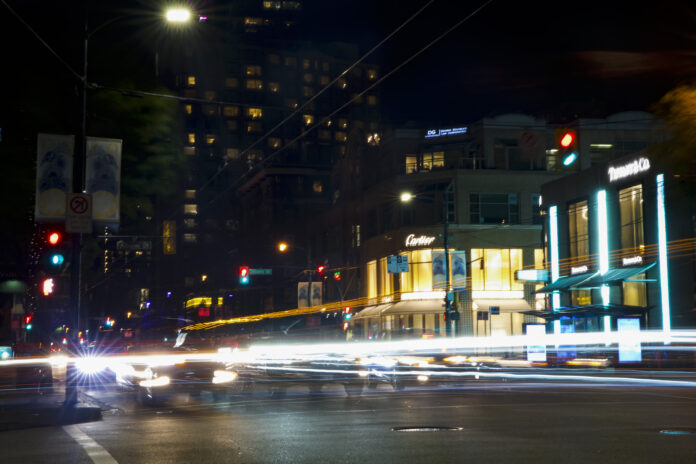
vancouver cityscape at night
Diversifying our social options helps everyone. PHOTO: Victor Tran / The Peak

By: Hannah Kazemi, Staff Writer

We need to change the way we socialize in Vancouver. Vancouver’s social scene isn’t approachable for many people, and no one should be excluded from the fun just because they want to partake in a more relaxed way.

Not everyone wants to spend their entire night at a club or bar, but if you want to go somewhere else after 9:00 p.m., you’re out of luck as everywhere else is closed. People have no choice but to choose the least grimey club on Granville Street to grab a drink at, and spend the rest of their night elbowing their way to the bar. This might be appealing to some, but it’s known to be a pain for those who aren’t into that type of social scene. Spaces like clubs and bars are usually uncomfortable and unsafe environments for non-drinkers, disabled folk, women, people of colour, or queer and trans folk who experience harassment in these settings.

Many casual hangouts in Seoul are open late or 24/7, and you can find a variety of options from karaoke rooms, to night markets. Attractions like these are a relaxed way to spend the evening without relying on alcohol for your fun. There are also lots of restaurants, services, shops, and public bathhouses in Seoul that are open till late, and the city is bursting with people walking around — creating a safer environment.

In Vancouver, cafés tend to close early — like 5:00 p.m. or earlier. In Europe, though, cafés are open at later hours and provide an alternative to late-night socializing. Vancouver doesn’t have anything quite like the places found in many European cities, but there are a couple spots in the city that are a bit more innovative in the way that they invite people to socialize. The Keefer Yard in Chinatown is one example — they provide table service and mini golf.

What is it about Vancouver that inspires such a hardcore party culture? Is it the city’s design, or our cultural lack of interest in other modes of socializing? What about catching up with a friend over coffee after work, or casual late-night food? I’ve asked so many people these questions and not a single one of them has given me an answer, but the consensus seems to be that Vancouver just needs to do better.

Especially during COVID-19, all these things make being social in Vancouver very difficult, and often unenjoyable. Going to clubs, bars, and busy restaurants don’t allow for casual modes of socialization, which deters people from going out in the first place. This also fuels Vancouver’s “No Fun City” reputation. This type of socializing does appeal to some Vancouverites, but not all. Vancouver needs to seriously reassess its social culture and the way people are encouraged to come together.

Len Pierre delivers seminar calling for Indigenous cultural safety in higher education

0
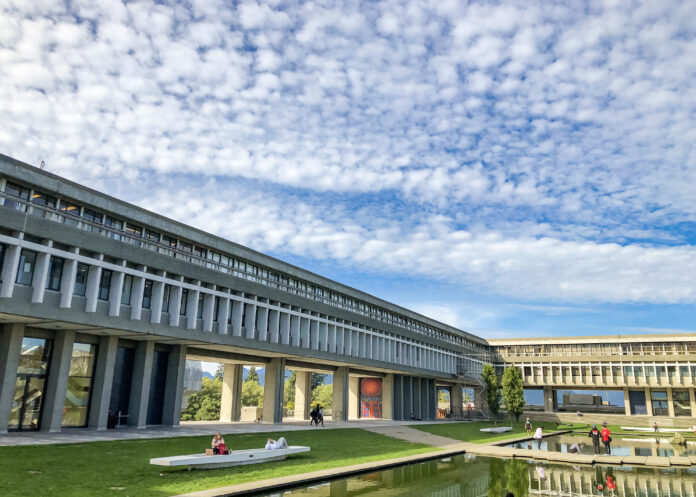
The photo is of the SFU Burnaby campus. The Academic Quadrangle and the reflection pond can be seen.
Pierre noted education systems are inherently colonial. PHOTO: Allyson Klassen / The Peak

By: Chloë Arneson, News Writer

On June 20, in honour of National Indigenous Peoples month, SFU Vancouver hosted a virtual seminar to discuss the importance of implementing Indigenous cultural safety in higher education. The Decolonizing Education and Institutionalising Indigenous Cultural Safety workshop was hosted by Len Pierre, who is Coast Salish, and a TEDx speaker.

His presentation acknowledged many of the institutions he works with are eager to race through the process of decolonization without acknowledging the need for cultural safety. Institutions “need to be culturally safer before we get to the places of decolonial work. If we don’t uncover where we can embed cultural safety first, we run the risk of a misinformed work population and the work will ultimately become superficial,” Pierre said. 

Cultural safety involves trauma-informed, community-driven engagement that creates more ethical ways for institutions to engage with Indigenous people and communities by prioritizing Indigenous peoples’ needs. Pierre noted, “Cultural safety is an outcome based on a respectful engagement that recognizes and strives to address power imbalances inherent in western systems [ . . . ] It results in an environment free of racism and discrimination where people feel safe when receiving services.”

According to Pierre, the process of decolonization involves more than the acknowledgement and removal of active harm caused to Indigenous communities. He added Indigenous values and belief systems have the potential to mitigate the social and environmental harms caused by the impacts of colonial systems. “We have a lot to offer,” Pierre said.

The event was open to all SFU staff and faculty, who were encouraged to share their views on the subject matter as well as their personal experiences with Indigenous cultural safety in the workplace. Participants also had the opportunity to talk with one another in breakout rooms, where some discussed the cultural safety improvements they were hoping to see at SFU.

Pierre said the way education systems inherently uphold colonial systems. “We cannot talk about decolonizing the academy or Indigenous cultural safety and humility without talking about colonialism,” he said. 

Pierre cautioned against the belief that anti-Indigenous racism is a result of a series of isolated events, noting that “we socialized Canadian citizens into being anti-Indigenous.” Pierre explained the root cause of anti-Indigenous sentiments in Canada were the racist narratives delivered in public schools when residential schools were actively operating.

The Canadian government has outlined their plan for responding to the Truth and Reconciliation Commission’s calls to action surrounding education for reconciliation. This includes calling upon governments to “provide the necessary funding to post-secondary institutions to educate teachers on how to integrate Indigenous knowledge and teaching methods into classrooms.” Out of the 94 calls to action, 13 are complete, with around 60 in progress

To end the session, Pierre encouraged participants to apply the concepts presented in their lives. He suggested actions such as taking implicit association testing, learning about local land and territories, and implementing Indigenous-focused equity strategies. Addressing many of the participants who hope to improve their allyship and Indigenous advocacy, Pierre said, “We can blow it out of the park if we want to, and we should where the opportunity aligns and our ethics are aligned, and Indigenous people are involved.”

To learn more about cultural safety education, Len Pierre’s TEDx talks are available on the TEDx website.

The Inside Scoop

0
Drawing of a character eating a slice of pie with numbers in it.
It’s all fun and games until the football and wrestling questions get asked. ILLUSTRATION: Maple Sukontasukkul / The Peak

By: Isabella Urbani, Sports Editor

Q1: What does the term “and one” apply to in basketball?

  1. Extra time added to the game
  2. What the referee says when a player makes a three
  3. When a player gets fouled in the act of shooting, makes the basket, and gets to shoot their awarded foul shot (100% answered correctly)
  4. What the coach says when they want to make a substitution in the game

Answer: C 

Q2: If a cross country runner said they got a PB in their race, what did they do?

  1. They were disqualified from the race
  2. They failed to finish the race
  3. They recorded their best time in that race category (100% answered correctly)
  4. They beat the record held in that race category

Answer: C 

Q3: In football, how long does the quarterback have on the clock to throw the ball?

  1. 30 seconds  (40%)
  2. 25 seconds (40% answered correctly)
  3. 15 seconds 
  4. 45 seconds (20%)

Answer: B 

Q4: Which two sports have offside rules?

  1. Softball and hockey
  2. Soccer and golf
  3. Lacrosse and tennis 
  4. Hockey and soccer (100% answered correctly) 

Answer: D 

Q5: You just made a bogey, what did you do?

  1. Hit one shot extra than what was expected for the hole (80% answered correctly)
  2. Hit one shot less than what was expected for the hole (20%)
  3. You decided to use one free skip to pass over the hole
  4. You hit the ball too many times for the hole and received a penalty

Answer: A 

Q6: How many balls does the pitcher need to throw in softball to walk a player?

  1. Four (60% answered correctly)
  2. Three (40%)
  3. One
  4. Two

Answer: A 

Q7: If a swimmer has a negative split in their race, they . . . 

  1. Finished the race with the fastest time
  2. Finished slower than their average time
  3. Made an error in the pool which added a five-second penalty to their finished time
  4. Finished the race faster in the second half than the first (100% answered correctly)

Answer: D

Q8: A changeover just occurred in a track race, what happened?

  1. The baton was passed (60% answered correctly)
  2. A runner switched lanes
  3. A new runner moved into first place (40%)
  4. The race is in its last 100 m

Answer: A 

Q9: What is the term in wrestling (which acts like the mercy rule) called?

  1. Full count (40%)
  2. Technical fall (40% answered correctly) 
  3. Deuce
  4. Pinfall (20%)

Answer: B 

Volleyball’s average score: 6.8 / 9 points (75.5%) (B)

Fundamental Rights: Freedom from religion is just as important as freedom of religion

0
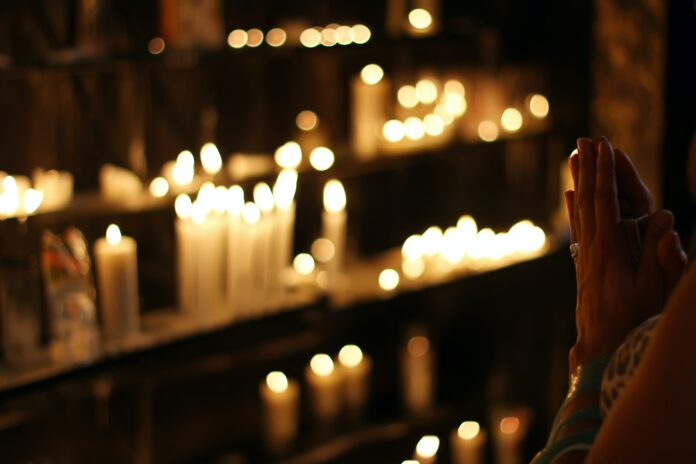
candlelit prayer
We need to value freedom and reject imposition. Rodolfo Clix / Pexels

By: Cristina Liao, SFU Student
Edited by: Luke Faulks

The overturning of Roe v. Wade is a seismic shift. People around the world have protested this decision as an encroachment against bodily autonomy. It’s a decision that only makes sense if viewed through a Chrisitan lens. The end of Roe is a warning to western democracies: freedom from religion is just as important as freedom of religion.

The decision is wrong because it takes the religious beliefs of just six people and applies them to a country of over 325 million people. The Court, a political body that’s 78% Catholic, should have no right to impose its dogma on a country that’s just 21% Catholic.

The same religious mismatch applies to Congress. Pew Research Centre found that the legislature has “always been overwhelmingly Christian” while only about 20–32% of Americans feel it is important for a president to have “strong religious belief.” A religious Congress that passes its laws onto a population is unfair to whose who don’t practise Christianity.

Just as it’s important to have freedom from religion, it is also important to have the freedom to practise one’s religion that differs from a majority. Now that Roe v. Wade has officially been overturned, some Americans are having trouble seeing the space for their beliefs in the Court’s ruling. Everyone has the right to practice any religion. However, being Christian, Catholic, Muslim, or of any other religious persuasion does not in any way excuse discriminatory policymaking.

Politicians cannot hide behind the words “Christian values” to excuse their actions. In part because it’s deeply undemocratic, and in part, because those same politicians would rebel against different faiths legislating according to their own beliefs. The imposition of Islamic Sharia in western countries is generally a canard, but has generated pushback against immigrants from Muslim-majority countries.

Religious policymaking isn’t just happening in the US. In 2018, Québec legislator François Legault articulated a desire to prevent provincial employees from wearing religious symbols. Where this supposedly secular law comes undone is in Legault’s insistence that the cross transcends religiosity, and therefore cannot be banned alongside the religious items of other faiths. Flashing forward to 2021, and Québec’s top court chose to uphold most of the law. It’s another example of a religious few, in this case, Catholics, imposing religious order on the whole of a citizenry.

As the ACLU states, “The First Amendment to the US Constitution says that everyone in the United States has the right to practice his or her own religion, or no religion at all.” Politicians can be Christian, even openly Christian. Regardless of their faith, they should not be creating laws based on a religion that a large proportion of the population they’re influencing do not practice.

In a free and democratic society, citizens should be free to practise any religion of their choosing. However, it’s important that citizens have freedom from religious demagoguery. We need the freedom to marry the people we want to in flagrant violation of religious teaching. We need the freedom to criticise religious projects when they abuse the rights of others. We need freedom from religion.

Exercising Agency: Quiet quitting is a sign we need to address workplace inequality

0
A red and white sign that says for hire
Our cost of living is rising much faster than our wages. Clem Onojeghuo / Unsplash

By: Olivia Visser, Opinions Editor

Recently, news companies and political commentators have latched onto the idea of “quiet quitting” — the practice of only putting in the minimum amount of work required for a job. This can involve avoiding working extra hours or tasks that aren’t in a job description. In every case, quiet quitting highlights the collective burnout experienced by minimum wage workers. Instead of seeing this trend as a symptom of a larger problem with capitalism’s current conditions, conservatives are using it as a scapegoat to uphold toxic work culture mentalities.

What critics call quiet quitting is simply workers setting boundaries that should already exist. The fact that people solely following their job description gets its own defamatory title is a sign something is seriously wrong with North America’s capitalistic work culture. We’re currently living through a crisis of increasing productivity alongside decreasing wages. Our work culture is unsustainable, which is why so many Canadians are working two jobs, or simply checking out emotionally. I can’t blame them.

In order to understand why quiet quitting isn’t just “slacking off,” we need to examine what makes people want to do so in the first place. People working minimum wage jobs are tired of being overworked for wages that don’t cover their basic necessities. Since housing and rental prices are rising much faster than wages, the working class is starting to feel helpless about their material well-being. Minimum wage workers make up 8.8% of our labour force, and they account for a large portion of essential workers. Why should they put maximum effort into jobs with corporations that don’t respect them or their right to a living wage?

People have been asking for a $15 minimum wage for years, but we’re past that point. The average house in Vancouver is now $1.2 million, compared to $180,000 in 1981. Adjusted to match today’s dollar, that equals $486,652. Our wages aren’t catching up to the rising cost of living, as seen by the fact that a third of the province is renting their home. Corporations get away with underpaying workers because of the outdated belief that low paying jobs are unskilled labour, typically since they require different skill sets than jobs in trades or academia. This mentality undermines the colossal impact that underpaid essential workers have on our economy, as highlighted by the COVID-19 pandemic.

There’s no such thing as unskilled labour, just different labour. The problematic myth of unskilled labour allows companies to deem certain jobs as “minimum wage” jobs, and take advantage of employees who already have limited work options. Students and immigrants make up most low paying jobs in Canada due to access barriers.

Society is watching the consequences of late-stage capitalism unravel in front of us. Somehow, we still just can’t make ourselves care enough. Our government needs to swiftly enact living wage legislation and enforce stronger regulations for workplace conditions. Employees should also understand their rights and continue unionizing wherever possible. Labour unions have the ability to stabilize economies and protect fair working conditions through employee-funded mutual aid. It’s time things actually change before class disparities continue to rise, and buying basic necessities becomes impossible.