Home Blog Page 1396

Beck to the future

0

By Adam Ovenell-Carter

There’s no doubt what the biggest story has been this NFL offseason: Peyton Manning’s release from the Indianapolis Colts. Alone, it warrants coverage, but play a little six-degrees-of-separation, and an interesting SFU twist pops up.

Poised to select Andrew Luck with the first overall draft pick in the April draft, the Colts have released Manning to free agency, where one of the front-runners to land him is the Washington Redskins. Naturally, if Manning ends up in D.C., he’d automatically become the starting quarterback, usurping the incumbent John Beck. John Beck played his college football at Bringham Young University, where he was backed up by a man by the name of Jason Beck (no relation), also known as SFU’s brand new offensive coordinator.

Fun and games aside, Jason Beck is poised to make a serious mark on the SFU program.

Beck comes to SFU with high praise, and a college pedigree few can match. After graduating from the BYU program, he joined the school’s coaching staff. He later moved on to join LSU’s football staff, where he was part of a Tigers program whose offense set 10 school records and averaged 38.6 points per game.

He’s spent the last three seasons as the quarterbacks coach at Weber State College, where he again had tremendous success. Under his tutelage, quarterback Cameron Higgins became the Big Sky Conference’s all-time leader in touchdowns with 98 and is easily Weber State’s all-time passing leader, with 12,252 yards.

“Where he played, where he coached, his pedigree is just dramatically different,” said head coach Dave Johnson. However, it almost goes without saying that his college lineage is not the sole reason he was brought on to steady a developing program — even if he is just four ‘degrees’ away from the legendary Peyton Manning.

“He has a unique combination of youth and character that we’ve been missing,” added Johnson. “I interviewed countless guys [for the position], but he stood out.

“He’s eaten some humble pie in his days, especially being beaten out for the starting job at BYU. We preach character to our players, and he has a ton of it.”

The Clan’s transition to the NCAA ranks hasn’t exactly been a smooth one; most notable are the team’s two conference wins in as many seasons since joining the GNAC. The players, like their tenure in the NCAA, are still young, and always developing, and Johnson believes Beck can still relate.

“We do have two years of experience through our lineup, but we’re still young. He’s still young enough to be able to relate to the players, and he brings a youthful perspective and energy that’ll come in handy as I get greyer,” laughed Johnson.

Perhaps the biggest selling point for Johnson was Beck’s knowledge of the passing game. While the Clan’s Bo Palmer-led running game was a sight to see, their aerial game last year was “anemic”, according to Johnson, and that’s a pretty fair description.

“We played five games where our quarterbacks threw for less than 100 yards, and you just can’t win in this league when that happens. We brought [Beck] on board to bring a much-needed balance to our offence.”

That sentiment was echoed by Beck himself.

“We’ll keep playing to our strengths,” added Beck, “Obviously our run game is just that, but we definitely want to become more balanced, and more unpredictable.”

Beck, who arrived at SFU just in time to start spring training, already has a strong grasp on where the Clan are now, and what he needs to do to get them where they need to be.

“My experience as a player and as a coach, has really prepared me for this opportunity. I think we have the pieces in place to have a chance to win every game, but it’s not just going to come to us,” he said.

“We’re going to have to work for it.”

Beck’s past certainly bodes well for the Clan’s future, even if it does take some time to iron out the kinks.

“We’ve made such great strides the past year, and we don’t want to have to take
any steps back,” said Johnson. “Bringing in Jason Beck is definitely a step forward.”

Clan softball struggles after sizzling start

0

By Adam Ovenell-Carter

A week after running their record to an impressive 8–1, the Clan softball team has struggled to keep that momentum rolling since. The team dropped three of their next four, while impressive rains postponed two others, dropping the Clan’s record to 9–4.

That’s still an impressive mark, but after their scorching start, it is leaving much to be desired.

The lone win in that stretch came against Montana State University Billings in the second of four straight games against the Yellowjackets. After dropping the first half of the first doubleheader, the Clan came back to earn the split, but barely.

It was no doubt a pitcher’s duel, especially early on. SFU’s number-two pitcher Kelsie Hawkins, and MSUB counterpart Annaleisha Parsley kept their respective opposition scoreless through the first three innings. The Clan would open the scoring in the fourth, but would immediately give the lead right to the Jackets in the top of the fifth. It took until late in the sixth for the Clan to respond, setting the stage for a fantastic finish and the Clan’s only win of the series.

Senior shortstop Leah Riske came up to the plate in the bottom of the seventh, and belted a walk-off solo home run to earn the victory.

“The first game was bit disappointing,” said Riske.  “We came back after being down and then let them take back the lead. The second game we talked about coming away with a win and we did that.”

It was a very solid effort from the Clan in game two, but one that was, unfortunately not built upon over the next two contests. Sloppy play cost the Clan, and they were outscored 24–8 in consecutive losses (including an 18–6 drubbing).

Clan ace Cara Lukawesky kept the Yellowjackets at bay for a while in the third matchup between the two teams, but she couldn’t couldn’t keep it scoreless forever. MSUB connected for three runnings in the third inning, and that was all they needed to win (though it wouldn’t be all they’d take). Lukawesky had little run support, and the Clan dropped the contest 6–2. The lack of offence, coupled with a few bad errors, did the team in, but the defeat pales in comparison to the two team’s next contest.

The aforementioned 18–6 loss was a product of more messy play, as four Clan errors turned into eight unearned runs for the Jackets. Those alone would’ve been enough to best the Clan’s six, but
the MSUB bats were hot, scoring 10 earned runs as well. Such a blowout loss is a tough pill for anyone to swallow, but it’s no doubt a wakeup call for a team that was riding high just a week ago.

“We just have to get our heads [back] in the game a little bit more and be more focused,” said junior outfielder Trisha Bouchard. “We have to go back to the basics and go from there.”

They may have hit a rough patch, but they have the personnel and the mindset, and they have a coach who, just coming off his 500th career victory, has the experience to right the ship.

Clan season finally comes to a close

0

By Adam Ovenell-Carter

“Rage, rage against the dying of the light,” wrote Dylan Thomas in 1951.

Although the women’s season finally came to an end in a 74–70 loss against Alaska Anchorage, the Clan fought defeat to the very end. They came back from two deficits of at least 18 points, but they couldn’t find a way to beat the eighth-ranked Seawolves.

In spite of the defeat, the Clan remain positive about their effort, and their season past, as well as next year’s.

“I thought we showed a lot of resiliency,” said head coach Bruce Langford post-game, “especially being down 18 twice and coming back against a top 10 team that’s deep and very physical.”

The Clan actually out-performed the Seawolves in every statistic, save for the one that shows up on the scoreboard.

“We had a couple of missed opportunities that ultimately hurt us,” said Langford of his team’s final undoing. The team was typically clutch late in the game, but the heroics fell just short. Really though, coming off a victory in their first-ever NCAA playoff game, there’s little to be upset about the 2011–2012 season.

“We returned a lot of players this year and had some new kids come in that showed a lot of improvement,” continued Langford. Building off a strong returning corps was a blessing for the Clan, as they didn’t have to waste much time getting familiar with each other. Nayo Raincock-Ekunwe and Kristina Collins, two players who earned a lot of well-deserved attention (both from the opposition and the media) only strengthened their already-dangerous chemistry, and the duo became on of the most potent threats in the GNAC. Other players, like Carla Wyman or Chelsea Reist, or even freshman Erin Chambers developed into a strong secondary-scoring group for the Clan, and the team’s bench players were more-than-capable replacements. Really, the only knock on the team is a lack of consistency, something they know full well they need to address moving forward.

“Next year, we need to work on being more consistent,” said a succinct Langford. “We always need to get stronger and more skilled,” he added, but consistency was at the top of the list. Just as this year was one full of returners though, next season will be much the same. The only graduating senior is Anna Carolsfeld, which leaves the team — and its chemistry — largely intact.

That will no doubt help the Clan improve on all they need to — from the big things like consistency to the much more nitty-gritty — but there’s more than enough time for that. Right now, it’s about the season that was, as it was one of the most impressive seasons a Clan team has put forth since SFU joined the NCAA.

Of course, no one on the roster was happy to see their season draw to a close, but they didn’t wilt away when they were down; they fought until time simply ran out.

“The team needs to feel pretty proud about how they played [against Alaska Anchorage]. I’m so proud of them,” said Langford, and for good reason.

“Do not go gentle into that good night,” wrote Thomas. The Clan certainly didn’t.

Manning easily tops list of 2012 free agents

0

By Adam Ovenell-Carter

10. Sione Pouha was an absolute force last year at the defensive tackle position, so much so that he was named to Sports Illustrated’s All-Pro team. He’s the only defensive lineman on this list, and he’d be higher if he weren’t 33-years-old. As one of the better run-stoppers in the league, he’ll improve whatever defense he ends up with, and would likely jump at the chance to part ways with the imploding Jets.

9. Brandon Carr is one of few cornerbacks on the market, and as the game continues its trend toward a passing one, quality defensive backs are growing more and more valuable. He may not be the best CB around, but with so many star quarterbacks in the NFL, having someone who can slow them down is critical. Carr had four interceptions on an iffy Chiefs team last year, and he’s still young at just 25.

8. Matt Flynn has only started two games in his NFL career, but did you watch them? He’s the best quarterback available not named Peyton Manning, and he’s been able to study under one of the league’s best in Aaron Rodgers. Of course, wherever he ends up won’t have the same kind of receiving corps he did with the Packers, but at 26, he still has the raw talent to improve a number of teams.

7. Stephen Tulloch starred at the middle linebacker position for the upstart Lions last year. He racked up 111 tackles (finishing well within the top 20), and was third among linebackers in interceptions. He’ll likely cost the Lions too much money to keep, but those teams who can afford the 27-year-old (like the Eagles, who desperately need a viable MLB) will be getting a heck of a player.

6. Carlos Rogers is another defensive back, and he really came into his own with the 49ers this past season. He was a good player with the Redskins in years past, but he always had trouble actually intercepting the ball. He figured that out, finishing second in the league with six picks. At 30, his age might turn some teams away, but he has more than enough talent and experience.

5. Vincent Jackson is finally hitting the free agent market after many contract disputes with the Chargers, and he’s no doubt determined to show the world he’s been underpaid his whole career. He’s a two-time pro-bowler, and his athletic abilities are just freakish. He’s unquestionably the best receiver on the market.

4. Carl Nicks was part of the offensive line that let Drew Brees throw for over 5,000 yards and set all kinds of records. That, and the fact he’s still only just 26, will attract a lot of teams, but he has had a few weight issues in his career, which could scare some off. If he can keep his weight down, he’ll end up a great signing for whoever lands him.

3. Cortland Finnegan is perhaps best known for getting punched in the face by Houston’s Andre Johnson, but that speaks to his style of play, too. He’s one of the biggest pests in the game, more than capable of getting under the opposition’s skin. He can back up his brash nature, and is one of the best corners in the league today. Again, in a passing league, he’ll be highly sought after.

2. Mario Williams is simply a phenomenal talent. The former first overall pick didn’t necessarily lose his job in Houston, but with Peyton Manning (likely) leaving the division and young Connor Barwin easily outplaying his contract, the defensive end became slightly more expendable. He’ll earn a pretty penny wherever he ends up, but don’t be surprised to see him take less money somewhere that gives him a chance to win (like New England).

1. Peyton Manning’s position at the top of this list hardly warrants any explanation, but can’t you just imagine each suitor’s sales pitch? Arizona: “Hey Peyton, we have Larry Fitzgerald!” Or Miami: “Hi Peyton, we live in Miami!” Or the Jets: “Hey there Manning, we have Jenn Sterger! Just don’t send her a picture of
your junk.”

SFSS candidates announced

0

The candidates for this year’s Simon Fraser Student Society were announced this week. Four current board members will be running in the upcoming general election, as well as several first-time nominees, and a new slate of seven hopefuls, calling themselves Renew SFU.

The presidential race will be one of the most hotly contested of the six executive positions, with four nominees in the running. Lorenz Yeung, current member services officer, Arry Dhillon, current at-large representative, Kayode Fatoba, and Renew SFU candidate Ashleigh Kolla will all be vying for the top position.

The position of treasurer only has two candidates: Michael McDonell from Renew SFU and current external relations officer Kevin Zhang.

Current president Jeff McCann will be running again, this time for university relations officer against Aleks Besan from Renew SFU.

The positions of member services officer and internal relations officer will both be votes of acclamation, with only one candidate running for each, Humza Khan and Renew SFU candidate Craig Pavelich, respectively.

The election will be held online from March 20 to 22.

Update: As of March 7, Arry Dhillon has withdrawn his nomination for president.

SUB is the future of SFU

0

By Jeff McCann

We have spent the better part of this term of office talking about student space. We know we don’t have enough of this, that, or the other thing. So then what do undergraduate students care about? I believe it to be a massive mix of things, meaning SFU needs lots of different spaces to meet students’ needs. We know we need a SUB, we know students want a SUB, we’ve had surveys and consultations to double check and triple check, yet there are suddenly reservations.

It seems like two concerns exist about Build SFU: first,some are surprised that the SFSS has ever talked about a SUB, and second is the price tag.

The surprise bit has much to do with the word ‘consultation,’ which is a meaningless word after being thrown around recklessly at forum meetings.

So let’s talk about consultation. Have you ever noticed that the second floor of the library is always packed? How about the worn down couches at the top of the stairs near C9001? I don’t know who sits there but they are always full. And those couches are brutal; we all know this but we just chalk it up to another thing that sucks about SFU.

Did I need to launch a massive survey to tell me that those worn down ugly couches are always being used? Or that the dance clubs are practicing in the cafeteria, or that the second floor is always packed, or that it sucks to watch a game from the grassy hill? No. I just showed up and looked around. But in 2011 and 2012 we did two massive surveys, with email exposure and lucrative prizes to make sure students were consulted. Not to mention 40 hours a week of consultation in the Think Tank from now and for the next five years through the design and building phases that will continue to occur.

As a matter of fact, since 2006, the undergraduate student body as a whole has been consulted.  Does that mean you? Maybe not. You may have ignored the last email survey in 2011, or didn’t stop to talk to somebody with a clipboard in 2009. You may have been at a different post-secondary school in 2007, or maybe even in high school in 2006. So, consultation has happened. It has been rigorous and we are at the end of stage one which means it is time for this question to be on the ballot.

The price tag is the second thing people have talked about. Buildings cost money. Some students have asked me if I considered asking the alumni for money. Do you think I would rather this building be free or student funded? Free, of course! We have considered every possible access to funding but it just isn’t out there. If it is out there, we will happily accept it and it will go directly to the principal (rather than interest), meaning students will pay less. In the grand scheme of your $30,000 education would you rather not be frustrated daily with the lack of facilities? We simply cannot count on a handout from our parents anymore, so instead we’re moving out and paying rent.

The Build SFU proposal will hit the ground running because we have the shell of the building to work with.  We can save money by having both the SUB and stadium in the same location, and everybody wins. We have a new place for orientation, for concerts, or other student events.  It’s sustainable in an inventive way by recycling a building, and it will be LEED Gold certified. It will have all the student space we need, and it will be a bright and open extracurricular hub for campus.

So I propose we change the conversation away from that other stuff and make it really simple for everybody. If you think that the next 10 generations of students should suffer doing five laps of the library to find a place to sit, then vote ‘no’.

If, when you came to SFU, you wished there was more study space, meeting rooms, lounge space, food options, dance studios, safe spaces, and some real community at SFU, vote ‘yes’.

That’s all it comes down to. You may feel one way or another about consultation, or the price tag, or that it snowed last week, but that has absolutely nothing to do with voting ‘yes’ for more student space, or ‘no’ for a forever lame SFU.

I say vote yes to the student union building, and yes to reinventing the campus community.

A long, bumpy road to democracy

0

By Gustavo Destro

For those of us living in a country such as Canada, with guarantees of civil liberties, freedom, and a liberal democratic process, the idea of life in a place with few freedoms and no ability to choose our leaders is alien to most. Because of this, events such as the Arab Spring come with a sense of inevitability, as though such struggles for democracy should exist wherever despotism is in power, and that it is simply a matter of time before the whole world becomes democratic like Canada. After all, who would choose to live under an undemocratic regime when they could fight for more rights and freedoms?

The reality is that such assumptions are too shortsighted, for no other reason than that the perfect system for one country may be incompatible in another, let alone wanted by its people. Even the idea of our Canadian system, where a party with a majority has almost absolute power on a country’s governance, is thought to not have enough accountability to our neighbors to the south.

The problem becomes more complicated when one takes into account the state of democracies around the world. As I wrote in my last column, the number of full democracies — free, non-corrupt systems that follow any ‘western’ liberal democratic model — are diminishing, all the while, the number of authoritarian regimes is on the rise. What makes the idea of a fully democratic world even more far-fetched is the fact that many of these authoritarian governments are doing just fine.

In Saudi Arabia, democratization is but a pipe dream, not only because the ruling family is so entrenched into government, but also because much of the population do not wish to see change. The economy is running well, people are mostly happy, and many feel there is no need for change. Though there are sections of the population calling for it — mostly women and religious minorities — the strength of the al-Saud family makes it so the changes come from the top, rather than create instability at the grassroots level.

Even in a nation such as Russia (which is apparently yearning for change), change is just as unlikely to come anytime soon. Putting aside the fact that elections in Russia are not free or fair according to many independent election watchers, the grim reality is that any opposition to Vladimir Putin’s United Russia is too disorganized and poorly funded to mount a meaningful challenge. More importantly, for as many people who take to the streets against Putin, there are likely just as many -— if not more — who would not like to see him go; these are not only the oligarchs and the rich businessmen, but many ordinary Russians who remember the chaos of the early ‘90s when Russia attempted to become fully democratic and almost slid into civil war. For them, stability – economic or otherwise – may be more important than the ability to choose who sits inside the Kremlin walls.

Democratization is not an easy process. Tunisia had it easy, Egypt and Libya are struggling to establish it, and Syrians are learning the hard way how difficult it is to rid one’s country of a tyrant. Absolute power not only corrupts, it addicts, and those in power will do whatever they need to in order to stay there.

Schools Building Schools levy unfairly maligned

0

By Lauren McCarthy

In last week’s issue of The Peak¸ regular contributor Cedric Chen wrote an opinions piece discussing an unnamed SFU club’s upcoming campaign to receive student levy funding. It is clear to anyone following the upcoming election that this unnamed group is, in fact, Schools Building Schools. While we typically enjoy Chen’s insight on SFU issues, his recent article does not display his usual tact and contains misinformation that requires clarification.

Schools Building Schools (SBS) is a federally registered organization founded by SFU students and alumni who are passionate about global change and youth empowerment through technical education. SBS is asking for full time students to contribute $1 per semester ($0.50 for part time students) in the way of a student-fee levy, to provide infrastructure for vocational schools in Uganda that are desperately needed for current and future students to meet their educational potential.

Our first point of contention is in regards to Chen’s claim that we will be imposing this levy “whether [students] like it or not.” In the past three months, 30-plus Schools Building Schools volunteers at SFU have collected almost 2,000 student signatures supporting the levy being brought to referendum. The support and words of affirmation that we have received from the diverse group of students that we spoke with was overwhelmingly positive. In addition we received a favourable vote from 20 out of 23 forum members (a combination of departmental student unions and SFSS board representatives). Furthermore, on March 20 to 22 all students will have the opportunity to vote and determine whether or not this motion is one that is supported by the majority of the SFU student body. If the referendum does pass with a majority vote, and the levy is added to student fees, all students will have the option of opting out and having their $1 or $.50 refunded.

The misleading portion of Chen’s article was his statement that the aforementioned opt out clause had been rejected by Schools Building Schools and by the SFSS forum. This is not accurate. In fact, the motion to add the clause to the referendum question was made and passed by the student forum. Chen attended and voted in favour of the measure himself. It is also worth noting that Chen was one of two sponsors of the opt-out vote motion. As it stands there is a second part to the referendum question, asking students to vote on whether or not an opt-out clause should be instituted. The official wording of the levy question and opt out option is available on the SFSS elections website.

The final point worth addressing from Chen’s letter is his concern that the causes of many organizations bring no benefit to SFU or the SFU community. We contest the notion that SFU would not be benefitting from this initiative and recommend to students that it is imperative to look beyond ourselves and, as President Petter has suggested, “engage the world.” This initiative provides SFU with the opportunity to go beyond student politics and make an investment in education that will undoubtedly contribute to the fight against cyclical poverty.

Through this initiative we are directly engaging with communities beyond our borders, which we argue is in fact adding value to the SFU community. We are asking you, the students of SFU, to think globally and act locally to empower underprivileged youth through technical education.

Again, this is a decision to be made entirely by the students of SFU. Our only request is that members of the student body vote online from March 20 to 22 to support initiatives consistent with their own values, and not someone else’s.

Ideology discourse empty, distracting

0

By Kelly Thoreson


In last week’s opinions piece [“The SUB is a scam”, February 27], author Joel Warren refers to the current SFSS board as “self-interested and ideologically-aligned”. This is not the first time that the phrase ‘ideological’ has been thrown around as a dirty word at SFU. ‘Ideological’ was an attack extensively used against the current SFSS board during the recent lockout of their staff, and it has also been fuel in the past for those that opposed organizations like SFPIRG or The Peak.

The issue of the lockout, and now the SUB, are good examples to illustrate that we are an ideologically divided campus. There is, as Warren would put it, the ‘progressive-minded’ on the one side, and what I would like to call the ‘fiscally-minded’ on the other — otherwise known as the political left and right, respectively. This divide is likely fostered by the tension between the ‘radical campus’ academic departments that remain at SFU and the inclusion of more ‘practical’ departments — such as business. Then there is also the majority of SFU students who fall somewhere in the middle (and even more that don’t follow the issues of student politics).

At SFU, if you appear to be so much as leaning towards one of these political mindsets, then you run the risk of alienating the other end of the spectrum and welcoming attacks of being branded as ‘ideological’. CJSF, the campus radio station, for instance rebranded its Peak advertisements from “Your social justice + indie music station” to “Your arts & culture + experimental music station” after then-arts editor Clinton Hallahan published an editorial about how the words “social justice” were alienating due to their political implications. Similarly, Ryan Beedie (of Beedie School of Business) started an alternative campus publication during his undergraduate career to allegedly counter The Peak’s then-alignment with the political left.

‘Ideological’, to me, is an empty attack. All it means is that you recognize that your beliefs are different from someone else’s — because ideology only becomes a problem when there are disagreements. It does not signify anything inherently wrong with a person or organization, just their difference. Plus, ideology is fluid. For instance, the SFSS’s ideological leaning is likely to change with each election and turnover of board members. The issue, I suppose, comes from when an organization is supposed to represent you and your beliefs.

Furthermore, I think that it is unfair to somehow blame the current board for being “ideologically-aligned”, as Warren has. We all had an opportunity to run in the elections last March, and we were all provided the opportunity to vote. Regardless of whether the current board is actually “ideologically-aligned” or not, we put those people into power; if you want a more diverse board, then you should elect one. This idea follows for all campus organizations: The Peak, SFPIRG, and CJSF — among others — all have an elected board of directors that students can get involved with, and all clubs and DSUs have elected leadership positions as well.

As Warren has argued, more people involved in decision-making might naturally create more diversity in student politics. However, it also might not, and it could even be detrimental to decision-making to have so many ‘cooks in the kitchen’. Instead, I think that it would be much more effective to encourage more students to get involved with on-campus organizations in order to create a larger and more diverse pool of candidates to choose from come election time.

If doing the actual grunt-work of running a campus organization doesn’t appeal to you, there are still other options. Student politics is no different from any other politics, and in a democracy, it is difficult to please everybody. However, you still have your voice. If the SFSS board, or any other organization you pay student fees into, isn’t representing you, then you should let them know in a way that is constructive. Go to their office, write an editorial in The Peak, and attend meetings — do anything. Just, please, do not throw the word ‘ideological’ around like it actually means something.

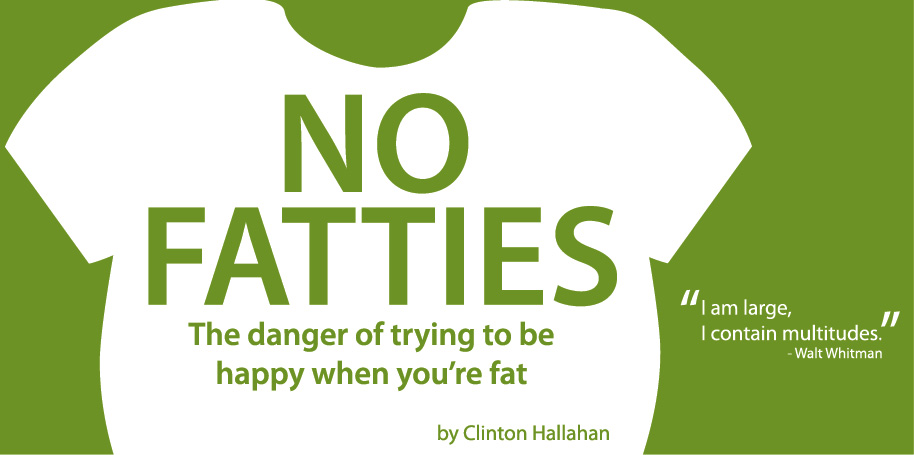
The danger of trying to be happy when you’re fat

26

By Clinton Hallahan

Living obese is like a couple of ambulances screeching by, sirens on fire. Those ambulances don’t affect you presently, but knowing that their rush is to tend to multiple casualties brings that passive foreboding, that palpable feeling that something has gone quite wrong. Like any prolonged health problem, the foreboding doesn’t really catch up to you until that ambulance is ordered on your behalf.

This is where my conflict comes in reading Ljudmila Petrovic’s article recently published in The Peak [“Fat happiness: Is it wrong to be fat?”, February 20]. That article focused on Kalamity Hildebrandt, a sufferer of the slings and arrows of a culture that values a human life so long as the body containing it fits certain parameters. While it is undeniable that the psychological damage conquered by Hildebrandt far eclipses my own, I know a thing or two about the receiving end of one of the last casual discriminations sponsored by people today. Her conviction and dedication to what she calls “fat politics”, however, is something I cannot identify with, as it would be an act of hypocrisy as I do everything I can to exit their ranks. It’s a hypocrisy that could well enhance the lives of those that embrace it.

As universal equality marches forward, the normal start to squirm a bit. When women got the vote, when the slaves were freed, and when civil rights was racing into existence, it’s not a stretch to imagine the psychological state of the previously “normal”, the people (invariably white men) who just had their superiority dismantled. “Who am I better than now?” was surely a common topic of inward conversation. With a new lack of socially acceptable targets comes the search for green pastures.

Luckily, nobody really sweats about coming down on fat people. Make a crack or disparagement about a person of colour, creed, or sex in mixed company and chances are that somebody is going to say something, or at least feel some righteous indignation. Not with fat people. Fat people are guiltless fodder, even for other fat people. Everybody likes feeling superior, and the fat have that nice padding to insulate them from feelings.

This is the social fabric that led to the vilification of the uncanny that Hildebrandt and I experienced in our earliest years. Her parents deviated from mine, in that mine figured a growth spurt and active adolescence would sort things out. Hers decided diet pills were the answer, putting them in league with her tormentors. This is second only to an acquaintance of mine whose parents looked the other way on a nasty cocaine habit because it made her skinny, and my heart feels for both of them. My heart sympathizes for that special moment, too, where the lion’s share of verbal and overt discrimination gives way to a quiet preference that never includes us, with that cutting “no fat chicks” adage that isn’t as gender specific as it looks. My heart is with these women, and everyone that dealt with fat discrimination in youth. But where in my heart is my brain?

My brain can’t subscribe. It is, in fact, a little chapped at the insinuation that there is a civil rights argument to be made for fat people like myself (“like myself”, a chorus that will run through this as I attempt to bait authority, a pudgy Richard Pryor standing in judgement of his own). Far be it for me to paint myself as a temporarily embarrassed skinny person, but I can’t put myself in a political struggle that co-opts the language and struggle of women and other minorities. Because the truth is, fat politics is consolation for a population with more in common with cigarette smokers fighting prohibition laws than with any suffrage movement.

Fat politics is consolation for a population with more in common with cigarette smokers fighting prohibition laws than with any suffrage movement.

Hildebrandt points to the unfair language of “epidemic”, describing the rise in obesity as troubling but gradual, not explosive. Similarly, the language adopted by Dr. Scott Lear, the much repeated refrain of “giv[ing] people the education and the tools with which they can make healthy life choices,” are fingers shoved in the ears of the overweight to drown out the klaxons of their own hastened mortality. Soft-pedalling the danger of obesity with a semantic argument or politicizing the lack of basic nutritional common sense is excuse-making of the highest order.

I’m not a fat person because of a lack of nutritional knowledge. I know constant snacking and large meals will keep me overweight. It’s not my mother’s fault I asked for seconds and her kindness granted it. It is the ingrained personality of the glutton, one alive and well in me. Even as I make the first real, successful strides of my life to exit the world of the fat, that gluttony is there, a drooling devil on my shoulder, trying to convince me that the pleasure felt by . . . anything, really, can’t last and can’t be repeated.

That thought pattern created the Super Size at McDonalds; have pleasure now because it might not happen later, damn the consequences and the logic. It’s an adorable lack of self-confidence in your ability to create pleasure at a later date. If it’s available now, eat it all. Where is the instant gratification of moderation?

While that same gluttony under control has served me well in other areas of my life (that hunger translates rather nicely into the areas of knowledge and relationships), it highlights the main difference between a fat person and an actual oppressed group: there are immediate health benefits to exiting the demographic.

There are citations to be made about the health risk factors of being in a recognized minority or group traditionally thought of as oppressed, but your risk of heart attack doesn’t plummet if you just stop being gay, an impossibility in itself. You can’t stop being a person of colour, and if you could, your cholesterol wouldn’t hit the skids if you did. You can, however, ‘stop’ being fat, and the benefits to doing so are many.

The carrying of excess weight is a documented, obvious health risk. To argue against the “medicalization” of the language surrounding the condition borders on delusional. The medicalization of obesity exists because it is a medical problem. To say otherwise is to fly in the face of decades of medical science, and is shockingly irresponsible.

Buy a sandwich. Not a hamburger, and not with a bunch of bacon on it. Some lean meat and a bunch of vegetables. Eat half. Throw the other half away. Do this for every meal for six months. You just lost weight. It’s not your glands, and it’s not your metabolism. It’s not medicalized to the point of shame, and it’s not conforming to what GQ has decided is the ideal man. It is a good caloric intake, and it’s putting yourself in a position to not die early, and to not spend those twilight years on a Rascal, beeping a horn at the able-bodied to accommodate your useless knees. It’s a person I don’t want to be, and that I refuse to be. So I throw that half a sandwich in the garbage because that moment of gratification isn’t worth years of disability, poor health, and being a strain on our system of medicine.

The first pieces I wrote for The Peak were part of a column called “Big man on campus”. They were a humour-filled look at the life and trials of fat people in a culture where a visible ribcage that can be played like a xylophone is a desirable trait. The pain of being ‘other’, and the pain of being ‘normal’ wasn’t lost on me then. It wasn’t lost on me when my parents were having conversations about whether they would be the ones planning my funeral. And it’s not lost on me that a brave section of our kind have decided to reject expectations and love themselves. It’s beyond commendable, and something I struggle with every day. But the rhetoric that placates the voices in their heads and the voices in the heads of others that suggests the health risk is minimal has to be nipped in the budw with as much prejudice as the voices that would keep us down and scared and ugly.