Home Blog Page 1207

Kids game their way to emotional health

0

Web-Troubled kid-CHEN

Brainwave-sensing technology and a tablet game app may help children living in poverty to relax and focus enough to learn in school, thanks to research led by SFU professor Alissa Antle and her team at the School of Interactive Art and Technology.

The idea came to Antle while she was speaking with a counselor at a NGO-funded school in Pokhara, Nepal. She realised that her previously designed bio-feedback systems could potentially be adapted to create games which would enable Nepali children to practice self-regulation.

The goal of the technology is to support the children’s’ ability to learn, as many are coming from high-stress situations, such as households with domestic violence and extreme poverty. “It will prepare them to get ready to learn some basic literacy,” Antle said.

A child logs in to the game by touching a photo of their face. The technology picks up brainwaves, sensing when that child is relaxed, focused, or anxious. When children are relaxed or focused, the games respond and they win challenges, gaining tokens.

“The challenge was to get the kids to do what I wanted them to do with their bodies, [for example] relax, without them knowing anything about computers or being able to read instructions,” Antle said. “We needed a system with zero barrier to entry.”

The three games which will be field tested this fall were designed to be culturally relevant to the children.

One game involves blowing on a pinwheel. “When you blow, it relaxes you, and the neuro-feedback loop makes the pinwheel spin,” explained Antle. Another game asks kids to relax, causing a paraglide to land. It will land if the child relaxes, otherwise it is sent back up into the mountains on thermals.

Teachers will be able to monitor the children’s progress. “It usually takes six to eight weeks of 10 minutes a day to see noticeable effects,” Antle said.

She continued, “Anecdotally, we noticed that [working with a previous system] not only were children more able to calm themselves, but as a caregiver, you could remind them of images in the game and this helped them to settle down.”

Antle and the researchers are entering the “usability testing” phase. They will be testing the games with children with Attention Deficit Hyperactivity Disorder (ADHD) in Surrey and starting a parallel project to develop new culturally relevant games for these children.

“The approach may be suitable for millions and millions of kids,” Antle said. “My goal would be to hand it out to groups who could roll it out all over the world. Child soldiers in Africa, children with ADHD in Canada. Hopefully, it’s a tool that could help lots of kids.”

The ballot box versus the street

0

From Turkey to the Ukraine to Thailand, 2013 was the year of the protester. In each of these cases, mass street protests were rallied against their respective governments with the opposition demanding reorientations in policy.

In our societal milieu, we are often inspired and entranced by these bold expressions of civil society. But we must be careful not to automatically place halos on the protesters, and weigh the downsides of mass street protests against the purported abuses of their establishment opponents.

Our cultural repertoire tends to accentuate admirable examples of mass protest. We tend to immediately associate protesting with either opponents of authoritarian regimes, like the students of Tiananmen Square, or with decidedly progressive currents in democratic societies, like the US Civil Rights movement.

Civil society is an important factor in keeping governments in check between elections, but we must keep in mind that the facets of civil society most able to organize and mobilize are not necessarily truly representative of the people. The level of engagement needed to devote days of one’s life to congregating in political centres is high, and not an opportunity available to all citizens.

Using long-term disruption of public and private spaces to extract concessions from an elected agency is not okay.

On the other hand, when available, the ballot box can be a great political equalizer, giving voice to segments of society that are only mildly political, unwilling to actively engage in the more taxing burdens of participatory democracy.

In each of the aforementioned mass anti-government protests that emerged in 2013, however, protests were organized against governments that came to power in (relatively) clean elections on the backs of constituencies from their respective societies’ periphery.

In Turkey, after decades of political repression, Islamists have worked their way into power by appealing to the traditional values of peripheral Anatolian interior. In Ukraine, Yanukovich’s pro-Russian policies have gained traction with the aspirations of the country’s less developed east. And in Thailand, populist social welfare rhetoric gave the ruling Pheu Thai the support of the rural and impoverished north.

Yet for protesters in Taksim, the Euromaidan and Bangkok, the governments they challenged were not dictatorial specters, but the products of the political periphery found outside the confines of their cosmopolitan centres.

And while it may be perfectly fine to voice opinion, it is not okay to use the long-term disruption of public and private spaces as a weapon to extract concessions on the part of an elected agency — a tactic employed in all three cases.

When there does not exist an accessible way to change government direction at the ballot box, it is understandable that we look to assertive forms of participatory democracy — like the illegal occupation of public spaces — as an acceptable (and even admirable) way of challenging injustices of the status quo.

But we cannot automatically transfer the halos we don on those forces to those who coerce the products of the ballot box.

Less than paradise

0

This reading break, I was lucky enough to have the chance to fly south to Puerto Vallarta, Mexico. A classic, right? American and Canadian tourists have been escaping their native winters for years by fleeing to warmer climates, chasing tropical dreams.

I had never taken part in this great migration before, and was excited to join the hunt for the typical Corona commercial. And when I got there, it was beautiful: golden sand beaches, 28 degrees, not a single cloud in the sky. Perfect.

The glimmers of the Mexican culture I saw were beautiful: women forgoing strollers and instead carrying their children in their arms, tiny dogs — most of them chihuahuas — the rough cobblestone streets and ascending apartment buildings, accessible sometimes only by steep, winding staircases.

If you go to the Wikipedia page for Puerto Vallarta, you’ll learn that it’s termed a “Mexican balneario resort city.” Following the link to “balneario,” you find that the word is a term for a “Latin American seaside resort town [. . .] characterized by being flooded by masses of tourists during the summer seasons.”

Flooded. Masses. I knew that Vallarta was a tourist town, but I have never before experienced a place that was so proficient in tourism.

And we tourists were everywhere. Ordering ceviche tostadas in beach restaurants on the Malecon boardwalk. Bartering ineffectively in the tequila shops. Capturing that elusive Corona commercial moment on the beach. Speaking the few canned phrases, in horribly accented Spanish, learned for the occasion: “¡Hola!” “¿Como esta?” “¡Una cerveza, por favor!” “¡Gracias!” and the all-important “No, gracias.”

I can’t count the number of times I said that ultimate phrase over the five days I spent in Puerto Vallarta. Because the curious, albeit unsurprising thing was that much of the city seemed to have adapted to profit from and envelope those sunburnt, English-speaking visitors.

Along the Malecon, there was a sea of vendors and promotional workers, inviting you in for a free margarita, for “the best tacos in the city,” to take a look at the trinkets they were selling for “the best prices.” We went to a bar that had a live donkey in it that you could ride for a few pesos; the only music they seemed to play was 60s American classics. A writhing mass of aging American tourists swayed drunkenly to the songs of their youth.

In the flea market neighbourhood — blocks and blocks of small shops packed with knickknacks — you could find stereotypical Mexican wares, blankets, silver jewellery, leather bags, and brightly painted pottery. You could also find these objects disjointedly Americanized: painted skull figurines with NFL team logos spanning their craniums.

As tourists in the city, as easy to spot as if we were wearing bullseyes, we were constantly being asked to buy: jewellery from a suitcase, hats from a precariously balanced stack, meat on a stick. Walking past those flea market stores, we were beckoned to come in insistently. On the street, taxis would slow down and flicker their lights, calling at us to come for a ride.

My disillusionment can be boiled down to one moment. One night, as I hesitated in front of the door to an ATM, a small Mexican boy ran up and put his hand on the handle, speaking and looking up at me expectantly. He couldn’t have been more than seven years old, only reaching my sternum but still managing to be an imposing figure, and he held the door shut in front of me. I apologized in my broken Spanish for not understanding, and he responded, “Dinero.”

“Money.” Clear enough.

Fuck it, group of single men still calling it a “guys night out”

0

BURNABY — Despite seeing each other regularly and having no reason not to spend time together whenever they want, a group of continually single buddies are still calling their Friday outings to the bar a “guys night out”.

According to Stan Patrick, a 25-year old intern at a startup company, he and his friends still often refer to their plans as a “guys night out” even after years of not having any steady girlfriends or females in their group.

“We normally hang out, go to the bar a couple times a week and I don’t think there’s ever been women involved in any of these outings or attempting to stop them,” Patrick explained, “but occasionally we just have to have a ‘boys night’, you know what I mean?”

The group of six guys, who all met in high school and haven’t progressed much since that time, believe that calling it a “guys night out” really helps them feel as if going out together is a break from their routine activities.

“It almost makes it seem like we’ve been working all week at nine to five jobs and coming home to our wives and families for the rest of the week and this is our one night ‘out’,” Patrick explained. “In reality, other than Jonesie who has soccer practice on Thursdays, I’ll be seeing them every night before ‘guys night’ any way.”

While “guys night out” has no discernible difference from any other night in the lives of the group referred to by themselves — and only themselves — as “the boys”, they maintain a strict code of conduct.

“We have a few rules on ‘guys night’ . . . no inviting ladies, no hitting on ladies, no talking to ladies and most importantly no talking about ladies,” group loudmouth Gary Gumbs told The Peak. “This is guys night and we’re going to talk about guys, like guys like to do!”

Although the group is fervent about these rules, they say they will break them if any woman ever expresses even the slightest interest in joining them.

“I mean, sure it’s guys night out but if any women wanted to come along we’d be cool with it as long as they went along with what we wanna do,” Gumbs explained chuckling along with his pals, “or she could choose what we do, I mean we don’t even have to go out if she doesn’t want to . . . we could just stay home and talk, that’d be a wild night!”

For now though, “the boys” say their traditional “guys night out” will continue and they have no plans on changing the name.

“Fuck it, it’s called ‘guys night out’, I don’t care if it’s the same as what we do every night,” Gumbs explained. “I look forward to every week and never miss it. Do you hear what I’m saying? I’ve never had anything else to do on a Friday night for the past seven years . . . at least let me call it ‘guys night out’.”

Netflix: A new level of consumerism

2

WEB-netflix-Mark burnham

A few days ago, I spent my night watching movies on Netflix with my girlfriend. We scrolled through its virtual library, indecisive and frustrated. The “good” movies we’ve already seen two or three times. We found ourselves in the depths of the C-list movies, and after about an hour of bickering over which obscure movie to take a chance on, we re-watched Transformers for the third time.

Transformers is an entertaining movie and all, but when it comes to Netflix, I seem to continually find myself obligated to either settle on a movie I’m not entirely sure I want to watch or rewatch one I’ve already seen.

The way we have grown to use Netflix reveals some deep seated social issues. The ignorance and irresponsibility of mass consumers have shaped the program into a tool for creating binge-watching addicts.

On the technical side of things, Netflix is the best medium of its kind. It’s convenient, affordable, straightforward and simple. There is no doubt it deserves to be as popular as it is. Its nature, though, of giving complete power to the consumer, is problematic.

The over-consumption of movies redefines the purpose of a film, and creates a less fulfilling experience.

The free access to over 3,000 movies and complete television series has led to viewers who feel like they literally cannot stop watching. I’ve heard many stories of friends who let entire weekends be consumed by watching a television series from start to finish without even leaving their homes. 

Many cannot seem to handle the sort of control and freedom Netflix provides; they just don’t know where to draw the line and say when they’ve had enough.

The over-consumption of movies has begun to redefine the purpose of a film as well as create a less fulfilling experience. Movies have turned into a tool of procrastination and a way to fill the void of our boredom and laziness. In the past, with DVD rentals, one or two movies a week was enough; now, two or three movies are watched in one sitting.

Since we have the capability, we jump from one movie right to the next, and we don’t allow ourselves to critically analyze or appreciate the quality of an individual film. It does not really matter if the film is thought provoking, wildly entertaining, or of good quality; Netflix invites us to watch a movie just for the sake of watching something.

It can be a movie you’ve already watched, or simply a recognizable title — as long as a movie looks mildly entertaining, it’s good enough to be added to the six hour movie marathon you have “unintentionally” started to avoid doing anything productive.

The Internet gives us access to a ridiculous amount of content, and Netflix is just one of the many tools we as consumers use to abuse this access. In an ideal world, we would learn to use this tool simply as a means to enjoy many films. Instead, we use it to rot away our time and destroy the value of a movie.

Canucks’ season not lost . . . yet

0

Many NHL teams might be apt to complain that the Olympic break interrupts the momentum they have during the season. The Canucks are not one of them.

The only momentum the Canucks have had lately is that of a downward spiral, with each game more painful to watch than the last. With a seven-game losing streak and only four wins since Dec. 29, losing has become expected. Any bandwagon fan can point out these facts and tell you how much this team stinks.

But things might not be as dire as they seem. In the case of standings, although the Canucks have removed themselves from the playoffs, they’re still just one point behind the last place team in the playoffs, despite an abysmal start to 2014.

Although many of the teams fighting for a playoff spot alongside the Canucks have games in hand, the fact is that they are not going win every single one of them. Chances are some of them are going to have a weak last quarter of the season. The Canucks will be right back in the race if they start winning some games.

Another factor that is easy to overlook is the multitude of injured Canucks. With Henrik Sedin, Mike Santorelli, Kevin Bieksa, and Chris Tanev out, and with players like Hamhuis and Richardson missing games, the team has been hurting. Even the depth took a hit with depth defencemen Yannick Weber and Andrew Alberts missing multiple games.

The Olympics will provide a chance for many of these players to heal, or at least miss fewer games. Even those playing in Sochi can expect less ice time than under Tortorella, as players like Canadian Olympian Dan Hamhuis won’t have to carry the defence on a team of all-stars.

Overall, if this team makes the playoffs, they will be better because of the adversity they faced. Instead of coasting to the playoffs with a guaranteed division title, they really have to work for it this time around. If some momentum is gained now, it is possible that they will carry it into the playoffs, assuming they make them.

Although some blame the Canucks recent woes on Tortorella, and despite complaints that he works them too hard, his attitude is exactly what the Canucks need for a good playoff push.

With all that positivity, however, they still need to win some games. It is no longer guaranteed that the Canucks will make the playoffs. But this Olympic break gives the Canucks a much needed opportunity to reset, with their playoff hopes still very much alive.

Orwellian nightmare

0

WEB-google glass-flickr-Wilbert Baan copyFrom the first mention of Google Glass, it seemed inevitable that this state-of-the-art technology would eventually be used as a surveillance tool for law enforcement officials to further infringe on our privacy. That’s why it comes as no surprise that the NYPD recently purchased a few pairs of the cutting-edge specs to test their efficiency in the field.

Government law enforcement officials who walk around with computerized glasses capable of recording, facial recognition, and access to a myriad of federal databases — does this not sound like a dystopian fantasy straight out of an Orwellian nightmare?

In The Peak’s fifth issue this semester, Adam Van der Zwan wrote an insightful piece on the legal implications of Google Glass. Although the legal implications are unnerving, the potential for infringement on privacy and equality is a scary threat to the current state of civil freedoms.

What frightens me most about Glass in the hands of law enforcement officials is the ability to identify a face, and match it with records stored in a database. With the extensive GPS and cyber-data collections officials have access to, they would essentially have a person’s whole life story laid out on a pane of glass.

There seem to be no limitations on how far officials will go to protect us from ourselves.

This means profiling based on where we have been, what we’ve searched on the Internet, and what kinds of photos we’re tagged in. This will only serve to encourage police profiling.

Tactics like “Stop-and-Frisk,” popular in recent New York history, in which officers stop individuals on the street and pat them down simply because they look suspicious, are bound to become more popular.

Apart from racial profiling, Google Glass and similar technologies invite a new kind of profiling: one relient on digitized history. Google Glass’s recording capabilities are another obvious potential privacy infringement. Consider how much can be recorded when everyone is wearing recording devices on their faces.

Of course, this could potentially work in favour of the general public: law enforcement officials will be under just as much surveillance as the rest of us. In any police encounters we could request Glass footage of the event from an officer’s point of view, and have video evidence of exactly what happened. But this one positive hardly outweighs the negatives.

Consider facial recognition capabilities. At this point in time, Google Glass lacks the ability to recognize faces, but it is not a stretch to imagine that this feature will be possible in the future.

The government have proved that they’re willing to spy through any means, as we’ve seen recently with our own Communications Security Establishment Canada (CSEC) using airport wifi to do so, or America’s National Security Agency (NSA) collecting user data from smartphone apps like Angry Birds. There seem to be no limitations on how far officials will go to protect us from ourselves.

Beyond Google Glass’s potential legal problems, we need to worry more about its use as a surveillance tool. It is bound to infringe on our privacy, alienate us into compliance and remove a few more of our civil liberties.

Satellite Signals

0

WEB - Satellite Signals
Woodward’s

The Olympic Games are a time of global celebration and, inevitably, with celebration comes spending. Jules Boykoff of Pacific University, a former member of the US Olympic soccer team, spoke on Feb. 14 at the Djavad Mowafaghian World Art Centre about “celebration capitalism.”

Celebration capitalism, a theory coined by Boykoff, refers to the economic state that emerges during a time of exhilaration and extravagance. Boykoff analyzed manifestations of celebration capitalism in the political contexts of the most recent Olympic Games — Vancouver 2010, London 2012 and Sochi 2014.


Surrey

On Feb. 11, PhD student Sieun Lee facilitated a Philosophers’ Café on depression, or what he referred to as “the ‘common cold’ of mental disorders.” This interactive session was held at the City Centre Library (just across the street from the SFU Surrey Campus).

The informal discussion addressed the causes and appropriate methods and techniques with which conscientious members of society should be addressing the “Epidemic of Depression.”


Vancouver

Coinciding with Valentine’s week, SFU’s Centre for the Comparative Studies of Muslim Societies and Cultures hosted a lecture, as part of the Spring Colloquium Series, titled “Rumi’s Religion of Humanity: Why Love Matters for Justice.”

On Feb. 13, Hossein Houshmand addressed the role of love “as the physician of our many illnesses,” through the perspective of renowned 13th-century poet, theologian and mystic, Jalaluddin Rumi. Houshmand argued that “if the society is to be stable ‘for the right reasons,’ its basic principles must be embraced with love and compassion.”

You’ve got chutzpah

0

BODYTRAFFIC GreenBride1 group red flecks

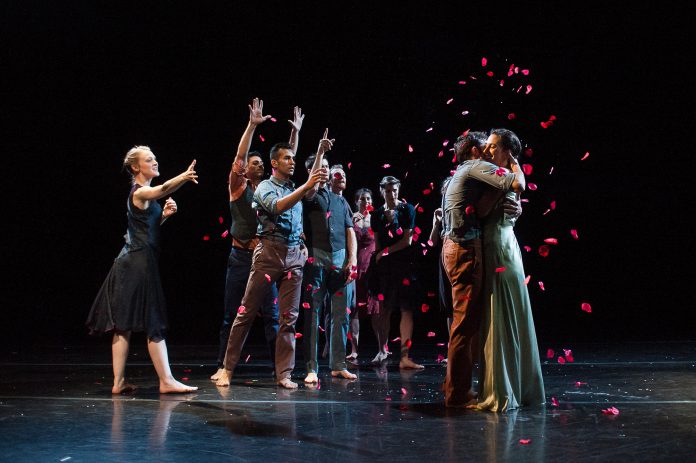
Body/Traffic is a LA-based dance company with a unique philosophy and supportive work environment. As co-director Tina Finkelman Berkett explains, “We’re 10 individuals who love what we’re doing and we want to share our work in a passionate, generous way.”

They will be sharing this work with Vancouver as part of the Chutzpah Festival, presenting three pieces, including a world premiere and two Canadian premieres.

Berkett said that Body/Traffic is “absolutely thrilled” to be back at the Chutzpah Festival after their performance two years ago. Appropriately, all of the works they are bringing this year are by Jewish choreographers. “All of the works have a very different style and feel; each has a distinctive choreographic voice,” said Berkett. “The audience gets to see three very different faces of our company.”

Barak Marshall’s piece is gestural and influenced by dance theatre, described Berkett, and it has a comical mood. Hofesh Shechter’s work is more grounded, athletic and physical, with an internal focus and emotional maturity. The final work, by Richard Siegal, is an homage to American jazz music. It’s light, upbeat, and fun with challenging musicality for the dancers.

This variety in one evening can be difficult for the dancers but Berkett said, “We love it. It’s challenging, we love a good challenge.” There is an added layer of responsibility for Berkett as her relationship with the work is unique: “Being the director, I’m responsible for the show in a different way, so there’s a different attachment to the work — I see things from behind the scenes and there’s a whole backstory with the choreographers — it’s very rich.”

BODYTRAFFIC GreenBride4 bride lifted

The philosophy of the company is to create an environment where dancers are supported and can thrive. “At Body/Traffic,” said Berkett, “we’re really trying to make a breeding ground to make work. We have the most open and loving environment as possible; we’re a tight knit family. It makes a difference when you trust the people in the room, and respect them. We have a common focus and goal, and you can see it on stage — it’s reflected in the work.” Their teamwork and mutual trust makes their work stronger, which is felt by the audience.

Before founding Body/Traffic, Berkett danced with Aszure Barton & Artists and she spoke very fondly of her time there: “Aszure had a tremendous impact on me both personally and professionally. She taught me about integrity, artistry, professionalism, and etiquette in the dance world.” Those are principles that have become the foundation of what Body/Traffic is all about.

“I learned that it was very important to be attentive in rehearsal, to be a tool to the choreographer and allow yourself to facilitate the process,” said Berkett. “It’s important to be respectful and patient with a choreographer, you have to have faith in their decision and that they are doing what is best for the art. It takes a mature dancer to do that.” She passes this knowledge on to the dancers of Body/Traffic, and this attitude of respect and trust is fundamental to their work ethic.

“I hope what we’re doing is curating a sense of what’s going on in contemporary dance today,” said Berkett. It seems that they are succeeding with this performance, as they are presenting the works of three world-renowned contemporary choreographers.

Body/Traffic will perform at the Norman & Annette Rothstein Theatre as part of the Chutzpah Festival Feb. 22 to 24. For more information visit chutzpahfestival.com.

Manhattan and Monopoly: the American press, as told by Muntadas and Bananas

0

bananas

Why are people leaving the Vancouver Art Gallery pondering the same things as those who recently watched Woody Allen’s 1971 film, Bananas? Probably because the stinging satire of the American press in Bananas takes the same critical approach to the mass-media as Antoni Muntadas in his exhibit Entre/Between, recently featured at the Vancouver Art Gallery.

Despite the fact that the press and media industries are not typically considered traditional art forms, the commodification of these industries has, arguably, more extensive effects than the commercialization of any other industry.

Muntadas and Allen take drastically different approaches to addressing the issue at hand, but both shed light on the gruesome effects of commodification of media industries.


What’s personal is public, and what’s public is personal

Muntadas’ “Personal/Public” installation featured a wall with two television screens and a chair in front of them. The first screen, labelled ‘Personal Public’, screens real-time surveillance footage of the viewer viewing the exhibit; the second screen, labelled ‘Public Personal’, shows a live local news station, complete with infomercials.

This installation reflects the paradoxical development of entertainment television: frivolous details of personal lives become public, and public ideas — fed to us through television — are internalized as an aspect of our personal lives, perpetuating a shallow, entertainment-based lifestyle.

This trend is evident in the closing scene of Bananas, as Howard Cosell, on ABC’s Wide World of Sports, commentates the consummation of Fielding Mellish and Nancy’s wedding. The details of their personal lives are public, aired on ABC and viewed by the public — evidently, more intriguing than the civil war that is still taking place in San Marcos.

Reina_personal_public

The media naturalizes indifference to atrocities committed around the world

“On Translation,” one of Muntadas’ film displays, featured three screens: one screen showed magnified footage of applauding hands, the sound of cheering and clapping filling the room. Another showed an audience in theatre seats, applauding and cheering, with brief interruptions of clips of the Colombian civil war and other clips of violence, corruption and inequality.

Viewers are meant to reflect on the gruesomeness with which the media desensitizes atrocities across the globe, conditioning us to passively accept violence and inequality.

Nothing depicts this phenomenon better than the opening scene in Bananas. Again, commentator Howard Cosell helps us out: “Would you people let me through — this is American television, let me through,” he demands, making his way through a rioting crowd to the dying dictator who has just been shot; he mumbles his last few words into the microphone held by a smiling Howard Cosell.


Everything is Framed 

Framing is best demonstrated in a courtroom scene from Bananas, during which a witness testifies for Fielding Mellish against the state.

Witness: I’m sorry to disappoint you, but I’ve known Fielding Mellish for years and he’s a warm, wonderful human being.

Fielding Mellish: Uh, would the clerk read that statement back please?

Court Clerk: I’ve known Fielding Mellish for years and he’s a rotten, conniving, dishonest little rat. 

Fielding Mellish: Ok, I just wanted to make sure you were getting it. 

Judge: You’re out of order!


The message in this scene is clear: the media frames facts to resonate with its agenda, and those who fight it are simply out of order.

In Muntadas’ “Drastic Carpet,” a visual carpet of news items, headlines, and advertisements is projected on the floor, demonstrating the use of framing as a public manipulation tool.

The headlines in the slideshow are a sequence of advertisements, primarily from the 70s and 80s, promoting a range of products, all using a similar marketing technique: average and ordinary is bad, and the only way to avoid being average and ordinary is to purchase this product.

The advertisements and headlines frame the public as consumers, so the public begins to portray themselves as consumers.

This is the reality of media industries as we know them: issues of cultural and political significance are replaced with violent atrocities and frivolous details. Commodification of cultural industries at its finest.