Home Blog Page 1204

Music to your ears

0

WEB-mark nazemi-Pamr copy

A new study by an SFU PhD student has found that women suffering from chronic pain have increased sensitivity to specific frequencies and therefore might respond differently to sounds and music — a discovery which opens up new options for treatment through acoustic therapy.

During a study on the therapeutic use of music for chronic pain (CP) patients, lead researcher Mark Nazemi discovered that chronic pain patients were more sensitive to sounds than the control group. Even more notable was the fact that women experienced this pain more significantly than the male participants.

“Not only did we find this through the data set that we collected using a software that we designed, but also reinforced by the results of the qualitative questionnaires in which female CP patients reported greater sensitivity to everyday environmental sounds,” explained Nazemi.

“For example, [women] tend to listen to music at speech level versus listening to [it] loud, they prefer listening to speakers rather than use headphones, so they have this kind of phobia in terms of wanting to be farther away from sound source.”

A student in SFU’s School of Interactive Arts and Technology (SIAT), Nazemi first became interested in the topic while working on other health related projects. “I noticed that in the field of music therapy they weren’t really looking at the frequency content in music, and they would just generalize the type of music that would have therapeutic qualities example, ‘play some classical music’ or ‘let’s play some jazz,’” related Nazemi.

quotes1They have this kind of phobia in terms of wanting to be farther away from sound source.”

– Mark Nazemi, lead researcher

The problem he noticed, based on existing research, was that chronic pain patients tend to be in a hypersensitive state, so environmental factors can be more damaging than previously thought. Therefore, there is a real need for greater awareness of the effects of sound on chronic pain patients. “Let’s say if there is a construction site, being able to shut the windows can actually help them feel less pain at home,” said Nazemi.

Building on this research, Nazemi is now looking to develop an interactive sound system for therapy, which could help those suffering from chronic pain. He is doing so by creating a database of “comfortable sounds,” which mainly includes nature sounds, such as birds, the ocean, and even the sound of wind.

Nazemi and his team hope that by compiling these sounds, they can potentially provide patients in medical waiting rooms and similar stressful or uncomfortable environments with “soundwalks” to help lower anxiety and stress while they are waiting.

Said Nazemi, “If patients are really affected by listening to these recordings, if their anxiety levels are reduced, then I would actually want to make this into an actual system that we could implement in clinics and hospitals around the world.”

Family hit hard with 12 year-old’s Coke addiction

0

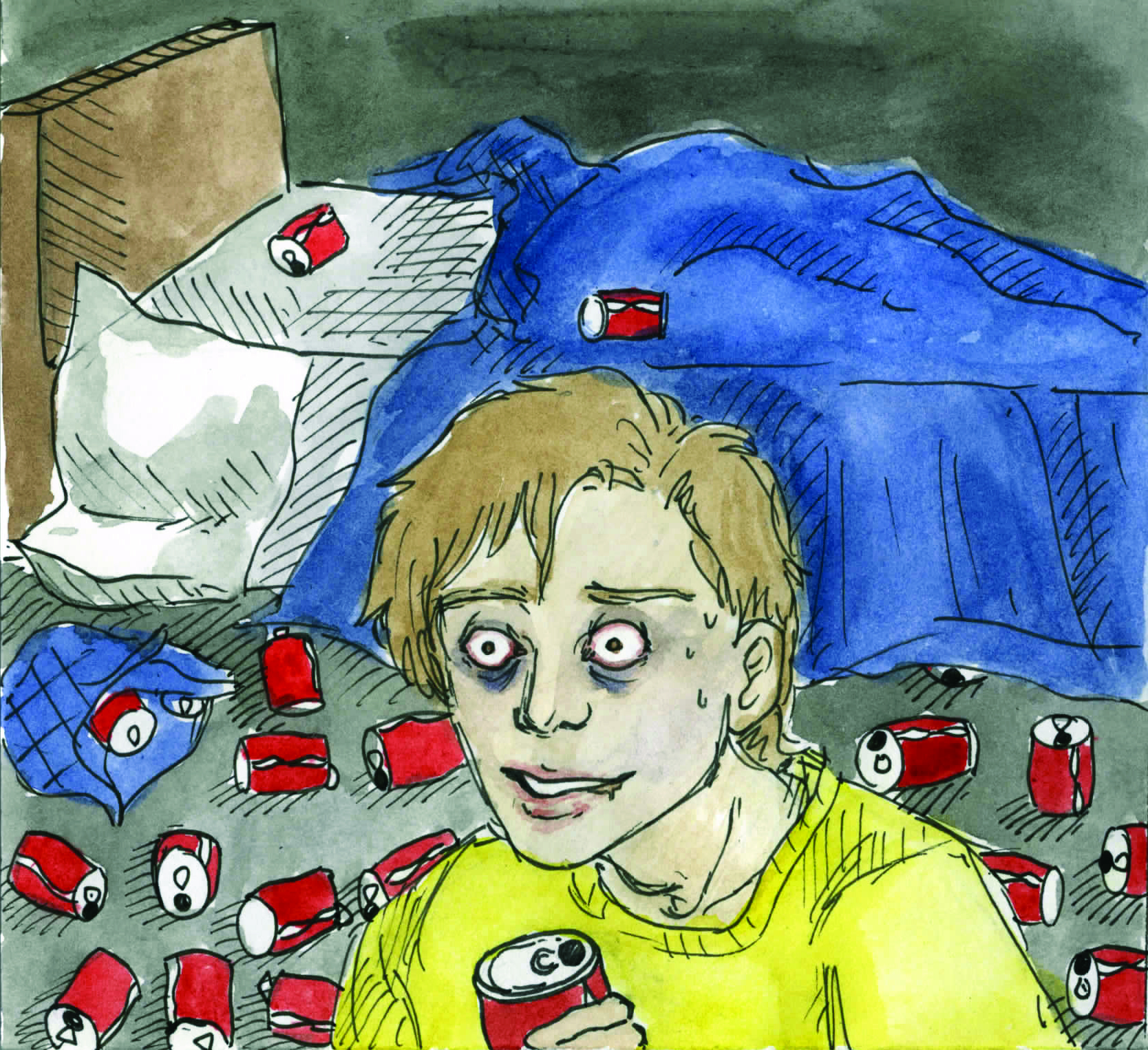
BURNABY —The Gonzales family has had a lot of tough breaks since arriving in Canada including a lack of jobs, repossessions and a house fire earlier in the year. However, nothing compares to their 12 year-old son’s two can-a-day Coke habit.

Bobby Gonzales, who started drinking Coke at the young age of five, was found to have two cavities. He has already previously had one filling. He often has a hard time paying attention in class. His room is untidy with a few cans of coke scattered across the room. These are symptoms common in heavy Coke use.

“His teeth are falling out, his teacher says he talks too much, I just don’t know what to do,” said Flores, the mother of the household, while holding back tears, “He’s out of control!”

The Gonzales’ dentist, Dr David Wong, though calmer, was equally grim in his words saying, “If he doesn’t get help, I don’t see a scenario that he won’t get another cavity,” and that Bobby “will have to probably have at least four fillings for the rest of his life,” to the audible gasps of the dental hygienists in the room.

When he is not allowed to have a Coke, he will pull drastic stunts such as pout or say moderately hurtful things. Sometimes he will even state statistics that sugar “is not that bad for you.”

“Come on man, what is so bad about Coke? If I want to drink it, I should be able to drink it,” justified Bobby, while sipping some Coke. “Besides everyone is doing it.”

Indeed, he is correct: Coke drinking has become an epidemic, not only reaching school children, but people of all ages. Drinking of sugary substances has not been this high since the Pepsidemic of the mid-90s. However, Dr. Cooper, a soft drink treatment specialist, says it is much worse now.

“In the 90s you had the edgy youth, what we would now call hipsters, drinking Pepsi during the height of the Pepsidemic, maybe a few schoolchildren would have the odd can,”  Cooper explained.

“But now, everyone from lil’ Sue in kindergarten to your grandmother are drinking Coke. I have not seen anything like it in all my years.”

Many addicts are in denial, not realizing the seriousness of their addictions, claiming that “it’s just a drink” or that they “only have one once in a blue moon.” Former addict Sean Howard knows this all too well.

“At first, it was a Coke after work, then it became two, then it became three. My wife and children no longer recognized me. I was a wreck,” said Howard, a rough looking man, with not quite white teeth. “Before long, I lost my wife, my job, my home . . .  everything to Coca-Cola.”

It was not an easy road to recovery for Seam Howard, a former lumberjack. “I tried cold turkey but it wasn’t working, when I’d go to a restaurant, I’d slip up and order a Coke. It wasn’t until my doctor suggested I try heroin that I fully kicked the habit. I haven’t touched a can of Coke since.”

Lacking funds for “food,” new restaurant opens as specialty “Breatharian” establishment

0

VANCOUVER — Capitalizing on the ever increasing number of specialty restaurants in the city, a new restaurant opened last week which is expected to take the city by storm by really setting its menu apart.

While Vancouver prides itself on its abundance of trendy vegan and vegetarian eateries, places that cater to specific diets, almost all of them have something that could appeal to anyone. The hippest new place in town, The Windbag, however, is expected to appeal to almost no one which could just make the next big sensation in local cuisine.

According to the owner, Alexander Conacher, The Windbag is a “breatharian” restaurant that caters to the lifestyle of those who shun all conventional foods and even water, believing humans can live and thrive on air and sunlight alone.

“Biting, chewing, swallowing; all the shallow mechanisms of eating only distract us from savouring the sweet taste of  the universe,” Conacher told The Peak. “But even breatharians should still have a place where they can go out, socialize, and have a good time.”

While food and drinks are not served at The Windbag, all the essential amenities of the breatharian  lifestyle are present.

The lighting is designed to be as close as possible to natural sunlight, in order to stimulate photosynthesis and tables are spread out so when patrons take their seats they aren’t accidentally breathing in their neighbours’ “meals.”

“We can serve hundreds of people a night because we don’t need to waste time cooking,” Conacher raved, happy to put in as little work as possible. “And all the money that we save on unnecessary plates and cutlery, we put into our state of the art air conditioning system. We even offer a full buffet; just pay at the front and we’ll setup a fan beside your table.”

“So, if you’re ever downtown and you’re looking for a nibble of fresh air, or you’re feeling “green” and just want a “light” snack, drop by at the place with the best “atmosphere” around!” Conacher said in promotion of The Windbag. “And if you don’t finish your meal, we’ll wrap it up in a balloon and you can enjoy your meal at home!”

Trans*phobia exists in the trans* community

1

“Trans*phobia,” derived from “homophobia,” refers to the aversion to trans* people. This is rather common among cis (non-trans*) people, but it also exists within the trans* community. It occurs when trans*normative people, those who appear cis and believe that other trans* people ought to as well, discriminate against people who do not wish to appear cis.

This is a manifestation of internalized cisnormativity, or the belief that cis people are more normal than trans* people, which ultimately harms all trans* people by suggesting that one’s gender is debatable.

I do not think that trans*nor-mative people are, in most cases, actively trying to oppress non-normative people. Often, appearing cis (or “passing”) is a matter of personal safety, as being visibly trans* makes one vulnerable to abuse. If several trans* people go out together and some are visibly trans*, it may jeopardize the safety of everyone in the group.

A violent trans*phobic person might not care if someone is visibly trans* because it reflects their gender, only that they are not cis. However, this does not excuse trans*normative people from discriminatory behavior.

I have most often seen this discrimination in the form of refusing to use gender-neutral pronouns, like the singular “they.” Choosing “he” or “she” to refer to someone who does not identify as such assumes that everyone must fit into the gender binary, even against their will. This is especially harmful because refusing to use someone’s preferred pronouns may trigger dysphoria, the disorder that living as one’s actual, rather than designated, gender (or “transitioning”) treats. It is akin to what trans*normative people suffer at the hands of cis people when they refuse to use their preferred pronouns.

History has taught us liberation of some at the expense of others is still oppression.

I have heard people protest that the singular “they” is grammatically-incorrect. I imagine these same people would be incensed if they saw other neutral pronouns, like “ze/hir,” that non-normative trans* people have had to create simply to communicate comfortably.

As mentioned in my previous article, English itself works against trans* people generally, and therefore it is unfair to claim that grammar is a good reason to cause dysphoria. Those who use neutral pronouns are attempting to work around a language that is designed to exclude them.

People often justify refusing to respect a non-normative person’s pronouns on the grounds that the person has not had a medical transition, like hormone replacement therapy or surgery. This is simply not defensible. There are many personal reasons why one may not transition in this way, like, for instance, not being able to come out as trans*, which is inevitable when undergoing drastic physical changes.

Oppression within the trans* community creates obstacles on the path to liberation. I hesitated to write this article because I have been told it will open up the community to attacks from cis opponents. This has been a tactic used by the ruling class against the organized oppressed throughout history and across a range of struggles, and has sometimes been effective, as seen in the homophobic lesbian/feminist divide in the 1970s.

However, history has also taught us that liberation of some at the expense of others is still oppression. This oppression is a reflection of cisnormativity, an insistence that presenting as trans* is bad even if it reflects one’s gender, even if passing as male or female would cause dysphoria. This attitude is harmful even for those who want to appear cis, as it perpetuates trans*phobic attitudes within and without the community.

When we speak of liberation, we must speak of liberation for all. We must imagine a world in which no gender is privileged over another.

Contact Sport

0

CMYK-bench-Leah Bjornson

Even if you don’t follow or care about professional football, you’ve probably heard of the full-blown scandal enveloping the Miami Dolphins that has pushed the crystal-ball soothsayer ship and fawning that generally composes the 24/7 sports news cycle onto the backburner for past two weeks.

You may have heard the racially and sexually explicit transcripts of voicemails Richie Incognito allegedly left fellow offensive lineman Jonathan Martin in nauseating detail. A polarizing firestorm has since erupted over what is considered normative locker room banter and culture, where some players denounced and belittled Martin, who is of mixed heritage, for “ratting out” a fellow teammate, whilst embracing Incognito, a Caucasian man, as an honorary “brother.”

After Martin walked out of the Dolphins facility and checked himself into an unspecified South Floridian hospital seeking treatment for emotional distress, his replacement Tyson Clabo perfectly summarized the sneering, juvenile mentality that doubtlessly extends beyond Miami’s locker room when he excoriated Martin for failing to “stand up and be a man.” If you don’t get the gist of that statement, he was nonplussed that Martin failed to address the situation by delivering a fist to Incognito’s face.

The liberal white-collar media has used broad brush strokes to paint complex interpersonal dynamics, which themselves are influenced by prevailing social trends, beliefs and expectations. Jason Whitlock of ESPN, who doubtlessly meant well in an article on November 8 entitled “Martin walked into twisted world,” repeatedly compares the Dolphin’s locker room to a prison facility and identifies Incognito as some sort of sadistic cell-block leader cut out of The Shawshank Redemption.

“The Dolphins don’t have the kind of environment to support someone with Martin’s background,” writes Whitlock. “It takes intelligence and common sense to connect with and manage Martin. Those attributes appear to be in short supply in Miami.” He bases his thesis, that Martin is an incredibly intelligent, well-bred and soft-spoken John Coffey-esque gentle giant solely on Martin having graduated from Stanford, which appears to be the rallying point of most of the second-year lineman’s supporters. Of course, if he graduated from an Ivy League school, he has to be far more well-adjusted than the other thugs in the Miami locker room — right?

The liberal scribes may not be too far off-the-mark, but as always with cases like these, both sides are far too quick to utilise broad labels to depict the behaviour and characteristics of the opposing group. It is unlikely that Martin, given the response of his teammates, will return to Miami’s locker room. He’s been described, variably, in a myriad of emasculating terms — “pussy, selfish, a little girl,” etcetera.

Meanwhile, Martin’s detractors are almost to a man denounced as “thugs,” “gang-bangers,” “socially backward” and “uneducated primitives.” If there’s a middle ground to be had in all of this, it’s difficult to find underneath the hail of arrows being volleyed by both sides.

It is difficult for us to empathize with victims because to be a victim is considered a self-admission of weakness.

So what do we learn from all of this? In a venerable display of showmanship, a number of former players in the media have nodded their heads sagely in insistence that the locker room culture around the NFL has to change. Michael Irvin, a Hall of Fame wide receiver who won three Super Bowls with Dallas in the 90s, threw his hat into the ring, insisting that he never would have allowed something like this to happen in his locker room.

In an interview last week with the Cleveland Browns Daily, Irvin recounted an event on a chartered team flight where former defensive lineman Charles Haley — who was later diagnosed with bipolar disorder — bullied and physically threatened a team staffer. Such behaviour was not out of the norm for Haley at the time. Irvin described in pulse-pounding detail how he stood up to the larger Haley and insisted he step down.

Irvin failed to mention however, how, some years later, he again attempted to exercise seniority while waiting in line for a haircut at the Cowboys facility and, in the ensuing argument, stabbed former teammate Everett McIver in the neck with a pair of scissors.

This is not to say that Irvin’s original point is invalid, far from it. The desire to change a locker room culture seeded on macho displays of exaggerated masculinity that serve little to no purpose is a noble goal; but it is not a modern day invention. It is founded on so much more than sociological trends driven by rap music and glorification of the gang-banger lifestyle, as supposed by the many two-cent behavioural psychologists who populate the mediasphere — whom I count myself among, of course.

But consider that up until Martin stormed out of the team’s cafeteria, the word “bully” or any of its derivatives was hardly a pressing concern in the world of sports — indeed, it barely existed. Homonyms or softer terms were more commonly heard, embraced and even canonized within the cultures of teams: rookie initiations, or rites of passage. According to Miami defensive lineman Cameron Wake, “I don’t want to call it hazing. I mean, that’s rite of passage in this league. It’s a group of elite men. It’s a fraternity, it’s a brotherhood. It’s a lot of things. And there’s a membership. You have to pay your dues to get certain privileges.”

Bullying is, of course, not simply limited to the NFL. It pervades the locker rooms of all sports at every level, and flowers out into the world of workspaces, schools and offices. It is symptomatic of a broader cultural disease, one that idealises and deifies power and its attainment with a certain sense of modern nobility. In this context, the bully is an individual of greater power and social standing. The bullied individual, the victim, is therefore weaker and subservient.

It is, however, an individual inability to empathize with that all-too-common weakness that enables bullies and further empowers them, even as lives may be irrevocably ruined as a result of their actions.

In a society that values strength as leadership, it is often the most boisterous and vocal individuals who are capable of commanding and holding the attention of others around them. Richie Incognito is one such individual for the Dolphins. Despite a slew of on and off-the-field issues that saw him bounce from franchise to franchise, Incognito’s overwhelming popularity within the Miami locker room may be rooted in part to his domineering and forceful personality, which was captured a multitude of times on HBO’s Hard Knocks. His capability to express himself and dominate other individuals on the team, potentially espousing the bully-victim relationship, allowed him to allegedly torment Martin.

In an excellent piece for Slate, Emily Bazelon and Josh Levin dive into how Incognito’s strong level of play absolved him of his sins in the eyes of the Miami Dolphins’ management, and how his forceful personality attracted the admiration of teammates. So much so that they were either unwilling to disagree with his alleged actions towards Martin, or unwilling to rock the boat themselves, “the implication was that if Martin couldn’t hack it in the Dolphins locker room, he was the one who needed help.” The Dolphins closed ranks around Incognito because in their eyes he was a leader. Jonathan Martin, however, was just a guy, and therefore utterly expendable.

I have never played for a professional or collegiate team, nor have I been privy to the locker room shenanigans that go on within, so it’s impossible for me to relate to what is and isn’t acceptable in terms of behaviour and convention. Boundaries vary from team to team based on personnel and personalities, and it is a self-righteous task for any of us with little experience in anything other than a white-collar work environment to harumph at the locker room actions of professional athletes.

But, as it goes with the general issue of bullying (physical or psychological), it remains difficult for us to empathize with victims because to be a victim is considered a self-admission of weakness, a condition only magnified in professional athletes whose job descriptions involve active, aggressive physical violence.

It is all too simple for Tyson Clabo to quizzically ponder why a Martin wouldn’t deck an Incognito, because he himself was not placed in the situation. Instead, Clabo is explaining how he would have acted in the situation Martin was in, without all of the other sources of pressure bearing down on him. He is pontificating on an immediate and emotionally volatile situation while bestowed the benefit of distance and absence of an imminent physical threat.

Football players aren’t seen as ‘bullied’ in this hyper-macho environment. They are ‘inducted.’

It’s easy for us to denigrate the victim of bullying or abuse because we feel that if placed in their situation, we would do better. Call it the gut reaction you have when someone enters a dimly lit basement in a horror movie.

The individual ideal of a person — well-adjusted, confident, physically fit, attractive, intelligent — is a dictum we each strive towards and fantasize ourselves to have, at least in part, achieved. Of course, it is nigh impossible to check all those boxes, and self-criticisms may always exist, but these are weaknesses that are actual and tangible. Individuals who do check all these boxes (or at least appear to) are empowered by the remainder of society. Politics runs on this: the development of cults of personality. Attractive and positive qualities are magnified while those minor blemishes are excused or forgiven without question because we cannot allow ourselves to believe that they exist.

The weak who are victimized by the strong are, therefore, incapable of fulfilling all of our fantasized tenets. It is difficult to empathise with their plight because with that empathy comes the understanding that anybody can be a victim. This realisation is hard to indulge because we like to think that we are not personally weak enough to be dominated.

This is why we find it hard to empathize with victims of bullying and abuse, and why we as a society tend to look for reasons to blame them for their own victimization. Believing that these victims are at fault for being harassed because they are ‘not tough enough’ is preferable to the idea that they were dominated by someone — and that the same thing could happen to us.

Athletes, whether male or female, are driven by the innate desire to be the dominant individual, engendering a (gender nonspecific) machismo that makes it even harder to relate to those ‘weak’ individuals capable of being bullied. Hazing is rampant within the culture of sports because of the self-propagating nature of it — a belief that team unity and individual acceptance into the group is dependent on kowtowing to the absurd requests of elder statesman.

This is what Cameron Wake was getting at. Those individuals aren’t seen as ‘bullied’ in this hyper-macho environment. They are ‘inducted.’ And that means sometimes they have to pick up the tab for team dinners (which may run into the tens of thousands), carry pads, stand on tables and sing on command and/or accept torrents of physical, verbal and emotional abuse. All in the name of T-E-A-M.

It is this skepticism and reduction of the victim’s experience that makes our culture one in which it is all too easy to be a bully. It’s the societal painting of the victim as weak, the thorough and systematic emasculation by a society that empowers abusers to ply their trade. Until we fix this, the likelihood of change of any sort is slim to none.

Health magazines aren’t healthy

1

Nov 18 2013 copy_BenBuckley_002“Superfoods for Weight Loss,” reads one Self magazine headline. “Moves to Resize Your Butt and Thighs,” reads another. “Great news — you don’t have to skip the pie this Thanksgiving,” exclaims Women’s Health as they excitedly share the recipe of “the best-ever low-cal pumpkin pie recipe.” Thanks, Women’s Health, but I wasn’t going to skip it. And I’m not going for the low-cal pumpkin pie, as I will bet my student loans that it’s not the “best-ever.”

Everyone’s body is different, yet they have in common the constant call to change them, they are constantly being bombarded with magazine articles and advertisements that tell us to how to change. The part of this that irks me the most of it is done in the name of “health.”

Health is good, we can all agree on this. But these headlines all have the unhealthy fundamental assumptions that skinny equals healthy, that everyone is on a diet, and that if one is not doing either of these, they don’t have the self-control or innovativeness to cut the calories and “work out like a supermodel” (Self’s words, not mine).

These magazines are constantly perpetrating a link between enjoying food and feeling guilt about it. “Go ahead,” they croon, “have that chocolate.” Yet these throw-caution-in-the-wind sentiments are only ever an introduction to an article about how to burn the most calories.

Anybody who has ever been on a diet or has, for whatever reason, had dietary restrictions has realized what a large part food plays in our social and cultural interactions. Yet women are told they should constantly count their calories, obsess about what they eat, and isolate themselves through diets.

Women’s health comes in all shapes, all sizes, all lifestyles, and all women.

The assumption is that all women want to lose weight, that all women are of a certain socio-economic status guaranteeing them choice of what they eat, that all women have the time and the money for pilates or a gym membership, that all women are able-bodied, and both capable and willing to follow these tips.

How does a single mother working two jobs make the Kraft Dinner from the food bank “low cal”? What about self-identified women who feel uncomfortable working out in discriminatory studios and gyms? It seems that “health” only addresses a very slim — so to speak — demographic of women.

It comes as no surprise either that our society’s obsession with a specific brand of health manifests itself in individuals in a fairly recent increase in orthorexia nervosa — literally translating into “fixation on righteous eating.”

“Orthorexia starts out as an innocent attempt to eat more healthfully, but orthorexics become fixated on . . . what and how much to eat, and how to deal with ‘slip-ups,’” according to the National Eating Disorders Association. “Eventually food choices become so restrictive, in both variety and calories, that health suffers — an ironic twist for a person so completely dedicated to healthy eating.”

Not all bodies are healthy when they are thin and women do not need any more guilt-mongering and judgment about what we do with our bodies. We do not need magazines to define what health is, because I guarantee we know ourselves better than Self does. Women’s health comes in all shapes, all sizes, all lifestyles, and all women.  When the meaning of “health” is stretched to the point that these magazines take it, we’ve gone too far.

As for the article about “pretty post-workout hair,” pick your battles, Self.

Hit-and-runners need to take responsibility

0

WEB-hitandrun-greyloch-flickr copyLike most, reading “hit and run” in the news makes me stop in my tracks. In early November, upon a double take on such a headline, I read alongside these first ugly words, “wheelchair.” It’s always hard to imagine what goes through someone’s head when they commit such an act, but the invovement of someone so vulnerable is truly terrible.

A 19 year-old Surrey man was hit by a car for the second time in his life, on Tuesday, November 5. Due to his brittle bone disease that requires his use of a power wheelchair, he suffered 5 broken bones after being hit and thrown from his wheelchair. The remorseless driver fled the scene, while the man ended up in the hospital.

Hit and runs are a taboo subject, something people would rather not talk or think about. It’s obviously something both society and the law oppose, yet it still happens much too frequently. Maybe the problem lies with driver attitudes. Pedestrians are often disregarded, or regarded with disdain by those driving their large and powerful vehicles. Drivers are often too impatient to wait for someone to move down a street or cross a road.

However, impatience is no rational excuse. It is completely acceptable for a pedestrian, in this case a wheelchair user, to travel on the side of the road if there is no sidewalk, or a sidewalk unfit for a power wheelchair. As a wheelchair user myself, I know how tricky navigating sidewalks in the lower mainland can be, and how inconvenient it can be to travel where there are none.

I can’t begin to imagine how awful the driver must feel in a hit and run accident. It’s one thing to hit another vehicle on the road, to cause damage to someone else’s property, or scare them in the process. But this person hit another human being with his vehicle. The person was in control, and suddenly lost it, inflicting incomprehensible hurt and injury to someone who never meant to have any interaction with him or her.

A wheelchair makes the situation all the worse. People automatically feel differently towards someone in a wheelchair, whether they mean to or not. That’s a part of our life we wheelchair users grow to accept. Any driver with humane qualities at all would feel even worse for hurting someone who already struggles extra hard in life, adding more hardship to that which they already endure.

In the moment of such an event, fear would be overwhelming. A driver would panic, no matter who they are or what circumstances caused the accident. In an almost out-of-body experience, undoubtedly the natural instinct would be to flee. There would be overwhelming emotions over hitting someone, especially someone who obviously won’t recover, or possibly survive, with the same ease as others.

As a society, we are being conditioned to take less and less responsibility for our actions. How long would it take you to own up to your illegal and morally wrongful actions? Would it take a drive around the block, or a day to realize what really happened? Would you not own up at all?

We’ll see where this driver’s moral compass takes him or her.

Rebellious teen has nose pierced despite no objections from parents

0

YOUR REGION — In a dramatic show of her free spirit, “can’t be tamed” attitude, a 16 year-old girl in your area has decided to go through with piercing her nose even after her parents told her it was okay.

“I don’t care if they’re totally cool with it, I fucking did it anyways,” explained Janis Hopperman, whose parents have also posed no problem with her using the occasional swear word. “And you know what? I’m going to go to that concert downtown tomorrow night even after they agreed to drive me there.”

Friends of Hopperman are not surprised in the least by her gutsy decision to go through with the piercing even with her parents’ consent, and say she’s always acting out within the boundaries.

“She’s such a rebel,” fawned schoolmate Alexis Brill who said she couldn’t even imagine piercing her nose if her parents were supportive of it. “I wouldn’t be surprised if she gets a tattoo that her parents agree is appropriate next . . . she’s just that much of a loose-cannon.”

According to Hopperman’s parents they’re happy to allow her to make her own decisions as long as she continues to get good grades and stay out of trouble.

“Yeah, my parents tried to tell me that I could only get my nose pierced if I made the honour roll,” Hopperman said with a snide grin. “So I just like, worked really hard, made them proud and then got this piercing, like, you know fuckin’ whatever.”

Way-too-early Stanley Cup predictions

0

The 2013-2014 National Hockey League season is now past the quarter mark, and contenders for this year’s Stanley Cup finals have begun to emerge. It’s still too early to predict a winner, but one thing is for certain: the Edmonton Oilers won’t be winning the Cup this year.

So who is going to be crowned NHL champion?  The preseason darling in the media was the Pittsburgh Penguins, but Marc Andre Fleury has been known to crumble in the postseason. Add in back up Tomas Vokoun’s blood clots and Pittsburgh’s goaltending situation gets a whole lot murkier.

The defending champs, the Chicago Blackhawks, are another hot choice. What people are forgetting is how much last year’s Cup-winning hero Dave Bolland, since traded to the Toronto Maple Leafs, meant to the Blackhawks. The feisty center killed penalties and shut down opposing top lines; Bolland was built for playoff hockey. The Hawks have the talent, but does power forward Bryan Bickell offer enough grit to carry the Blackhawks through the grind and replace Bolland? Only time will tell.

Then there are this year’s two surprise teams: the Colorado Avalanche and Anaheim Ducks.  Head coach Patrick Roy has his young Avalanche squad playing well beyond its years, but they’ll slow down soon and the team is too inexperienced when it comes to playoff hockey.  Captain Gabriel Landeskog only turns 21 on Nov. 23 and has yet to get a taste of playoff hockey. The Avalanche are definitely on the upswing, but aren’t all the way there quite yet.

Anaheim has a core group of players that have tasted hockey glory in Ryan Getzlaf and Corey Perry. The main concern is depth, or lack thereof. The Ducks have a great top six, but their bottom six leaves much to be desired. The Stanley Cup is won with the grinders as much as it is won with the superstars, and Anaheim does not boast a strong third or fourth line.

The early picks to represent the Eastern and Western conference in the finals? The Boston Bruins and St Louis Blues, with St Louis eventually winning it all.

Boston made the finals last year behind the strong play of goaltender Tuukka Rask but general manager Peter Chiarelli actually improved his squad by adding veterans Loui Eriksson and Jarome Iginla.  Add in strong blue line play from youngster Torey Krug and the Bruins have another championship-calibre squad on their hands.

St Louis on the other hand is seemingly built for playoff hockey. They have a playoff series-stealing-calibre goaltender in Jaroslav Halak, who did just that for Montreal in 2010. They boast the NHL’s leading goal scorer, so far, in Alexander Steen, who’s a big body with a ton of skill.  They have budding superstar defenseman Alex Pietrangelo and a ton of depth up and down their roster.

If recent playoffs have taught us anything, it’s that depth is the key to postseason success, and St Louis has that in spades. With veteran Brenden Morrow leading young guns TJ Oshie and Vladimir Tarasenko, the Blues have tremendous upside.

The National Hockey League boasts incredible parity among its teams, so it may turn out that the next league champion isn’t even mentioned here. But that is what makes the NHL so great; nothing is set in stone, definitely not a Stanley Cup prediction made in mid-November.

The b-sides of Vancouver

0

CMYK-Moon Glow Cabaret 331 East Georgia 1960s

When Vancouver Was Awesome first made its way onto my desk, a couple of questions immediately formed: 1) Are they implying that Vancouver is no longer awesome, that we have done something to it to make it no longer as great as it once was? And,  2) why is it that no other city has ever had to try so hard to prove its awesomeness?

The coffee table book — part historical account, part celebratory tome — is authored by Lani Russwurm, writer and regular contributor for the blog by the similar name, Vancouver Is Awesome. In a forward, VIA founder Bob Kronbauer recounts the driving force of the blog, and its subsequent offshoot, Vancouver Was Awesome: “The rules were simple . . . only post stories about what makes Vancouver awesome.”

The manageable 159-page account is separated into three chapters, distinguished by particular moments of historical importance in Vancouver: “The Wild Old West: 1910 and Earlier,” “Terminal City: 1911 – 1939,” and “Modern Times: 1940 – 1972.”

Though framed by Vancouver’s vivacious but short timeline, the photographs and stories are a mixed grab-bag, or, as described by Russwurm, “a mix-tape approach to history.” Defining historical events, like the arrival of George Vancouver, are bookended by “B-sides,” like “The Wreck of the Beaver,” a tugboat that was grounded, and eventually sunk, by its drunk crew in 1888. The British Columbia Archives, City of Vancouver Archives, and CBC — among other notable organizations — have helped supply archival material to accompany the stories, bringing history to life on each page.

What Vancouver Was Awesome does well is create accessible, bite-size content for those who think 150 years is too short for an awesome history to emerge.

The second chapter does a particularly good job of illuminating the little-known and short-lived jazz age of Vancouver, creating a narrative that starts with the implementation of prohibition in 1917 and runs into a detailed account of the Patricia Cabaret’s boasting of “Real Jazz Band Music.”

The following pages feature black and white photos of Jelly Roll Morton and Ada “Bricktop” Smith. Jelly Roll played at the Patricia on occasion, and later returned to form the house-band for Patty Sullivan’s club on 768 Granville Street; and Ada spent two years performing in Vancouver before establishing, with the help of Cole Porter, the famous Chez Bricktop in Paris.

The book is peppered with such accounts of celebrity, but is not bogged down by it; these details — from Charlie Chaplin’s visit to the Orpheum Theatre in 1911 to Hunter S. Thompson’s appeal to write for the Vancouver Sun in 1958 — illustrate a city drawing the world into its own slowly-forming identity — one that is still in the works.

It is not a comprehensive history, but what Vancouver Was Awesome does well is create accessible, bite-size content for those who think 150 years is too short for an awesome history to emerge. Russwurm is aware of the metropolitan city’s controversial past, and does a good job of noting the kind of subtleties long ignored by history books: the long-time establishment of Musqueam and Squamish communities, the razing of Hogan’s Alley (Vancouver’s black neighbourhood) by the construction of the Georgia Viaduct, and the efforts of workers on the On to Ottawa Trek with the theme of “Work and Wages.”

The book, visually and narratively mapped like a patchwork of emerging moments, mimics the very city it represents: richly diverse, eclectic, contradictory, and determined — it is a box of forgotten photographs under your grandfather’s bed, a postcard tucked away in a dusty memoir. In an age of rapid gentrification and rising real-estate prices, Vancouver Was Awesome asks us to grapple with what we had and what we might have done instead; it defiantly proclaims awesomeness, then and now, despite the naysayers.

And that’s pretty awesome.