Home Blog Page 1198

Student athletes deserve pay

1

WEB-football-Vaikunthe Banerjee

Does the name Andrew Wiggins ring a bell? If not, it should.

He is the new main attraction in NCAA college basketball, and he is Canadian. Last month, not only was he featured on the cover of Sports Illustrated alongside Kansas legends Wilt Chamberlain and Danny Manning, but he was also the lead story for ESPN The Magazine’s college hoops preview, and had a photo shoot with GQ Magazine.

Due to NCAA regulations, he has done all of this advertising without earning any compensation in return.

Recently, there has been some discussion regarding whether or not college athletes should be paid while they are in school. A common argument is, “They’re already getting a scholarship! That’s more than anybody else!”

However, a scholarship doesn’t necessarily equal cash in a player’s pocket. Let’s look at how much a scholarship is actually worth.

Without athletes, we wouldn’t have millions of fans buying tickets for games.

On average, a full Division 1 scholarship is $25,000 per year. That’s $100,000 over four years. This may seem like a lot of money, but it really only covers the basics. It covers thousands of dollars in university fees, tuition, housing, a meal-plan, and multiple hundred-dollar textbooks.

Contrary to what naysayers believe, being a student-athlete is a full-time job. Being a NCAA student athlete myself, on a typical day, I will wake up before classes, get to the gym at 6:15 a.m., practice from 7:00 to 9:00 a.m., try to get an extra weight or conditioning session in two to three times a week, go to class, have individual sessions with my coaches, watch films of practices or games and then study for my classes. On top of this, I work.

However, once the season starts up, I can’t have a job anymore. Every two weeks, we are on the road from Wednesday until Sunday. Sometimes we are gone for two straight weeks if we make playoffs. The professors let us do our work from the road, but my job isn’t going to pay me just because I was playing basketball on a road trip.

Even though the athletes make no money, the NCAA basketball tournaments, or “March Madness,” have become a huge business. As Forbes’ Chris Smith wrote, CBS and Turner Broadcasting make more than $1 billion off these student games — due in part to 30-second advertisement spots costing $700,000 during the Final Four.

Athletic conferences, as well, receive millions of dollars in payouts from the NCAA when their teams advance deep into the tournament. Same goes for the coaches of the final squads standing. The NCAA, as a whole, makes approximately $6 billion annually.

Contrary to what naysayers believe, being a student-athlete is a full-time job.

People should ask themselves, who generates this excitement? The players. And they are not allowed to receive anything from the billion dollars they generate every year while they risk career-ending injuries every time they step onto the court, field, or rink.

Why shouldn’t collegiate student athletes be paid? The billions of dollars that collegiate athletics generates would be non-existent without them, on the field or on the court, performing and entertaining millions of college sports fans. Without athletes, we wouldn’t have millions of fans buying tickets for games, or people buying sports gear, jerseys, and video games, usually bearing the likenesses, and often the autographs of their favorite college players.

We should re-evaluate the system as a whole. The main purpose to play NCAA sports used to be to get a good education. Now, elite prospects like Andrew Wiggins go to school for one year and make the jump to the NBA. What if an amateur league existed in which the players would get compensated, alongside the NCAA league, in which students could play college sports without missing on an education?

Until then, college athletes are just like all other hard working people, who should receive a fair day’s pay for a fair day’s work.

Dave Johnson relieved of duties

1

WEB-Dave Johnson- Bai Yin

The year 2013 was supposed to be the season it all came together for the Clan football team. Despite a promising 2–0 start to the campaign, the team laboured to a 3–7 record; on Tuesday, SFU Athletics announced they were letting head coach Dave Johnson go, as well as members of his coaching staff, including defensive coordinator, James Colzie III.

Johnson spent seven years at the helm of the football program, but struggled to find wins. In those seven seasons, Johnson compiled an 18–46 record overall, including a 12–29 record since joining the National Collegiate Athletic Association in 2009.

“After carefully reviewing all aspects of our football program, we have decided it is time to seek a new leader for Clan football that will achieve the goals we have set for the program,” said Milt Richards, SFU’s senior director of athletics and recreation in a press release.

“I want to thank coach Johnson, his family and his entire staff for all of their hard work. We all wish him and his family the best as they begin the next chapter of their life,” he finished.

Looking at wins alone, the move may not come as a complete surprise, but Johnson was a players’ coach who managed to keep the locker room in good spirits despite the on-field struggles. His players, who were informed of his dismissal via email, were shocked, and were vocal in their opinions of the matter.

“Clearly someone isn’t thinking about the program when he fired all the coaches,” said Dylan Roper, a defensive end who finished his Clan career this season. Roper wasn’t alone in his sentiments.

“They fired the whole coaching staff? You gotta be kidding me smfh,” tweeted running back Chris Tolbert, who finished third in the Great Northwest Athletic Conference in rushing.

In another tweet, the Great Northwest Athletic Conference (GNAC) newcomer of the year added, “Honestly don’t even know the AD [Milt Richards] but he obviously doesn’t care about us or this program either.”

Tolbert, along with quarterback Ryan Stanford, were among a slew of newcomers who were poised to lead the Clan offense that last season led the GNAC. But injuries to Stanford and superstar wide receiver Lemar Durant derailed the Clan’s early season momentum, and Johnson was unable to find a way to get it back as SFU stumbled toward the season’s finish line.

Colzie III, meanwhile, was brought in to fix a defense that had perennially been at the basement of the GNAC rankings. However, the Clan’s defense also stumbled after a hot start, and finished second last in the conference, giving up over 425 yards a game.

Four years removed from their first foray into the NCAA, the Clan was expected to make significant steps forward. They had finally begun to attract star players on both sides of the ball, and were coming off a breakout year where they upset a number of teams. But in a year that had so much promise — and was even highlighted by nine players earning all-conference honours — it was Johnson and his staff’s inability to deliver that, fair or not, ultimately cost them their jobs.

Sweet Symphony

0

WEB-m soccer-Adam Ovenell-Carter

The SFU men’s soccer team took to the pitch on Friday, in near-freezing Denver, CO weather to face off against the University of California-San Diego Tritons. The winner of the game was to be crowned the NCAA Div. II West Region champion, and would punch their ticket to the final three rounds of the tournament.

Trailing 1–0 late, three minutes from a heartbreaking end to their season, the SFU men’s soccer team orchestrated a comeback in the dying minutes to eke out a win — and a trip to the Elite Eight.

The Clan entered the game with 69 goals on the year, leading the entire NCAA Div. II. But the Tritons, who had scored just 27 goals on the season, potted the game’s first goal. In the 26th minute, Triton Alessandro Canale fired a shot past SFU keeper Brandon Watson, forcing the Clan to play catch-up for the rest of the game.

SFU’s attack came in waves, outshooting UCSD by a 2–1 margin, but the Clan couldn’t find the back of the net. As time ticked away, it looked like the Sweet 16 would be the end of the road for the Clan. But in the 87th minute, Jovan Blagojevic fired home a ball off a throw-in to knot the game at one apiece.

Blagojevic is making a name for himself by scoring big goals. Earlier this month, he scored a double overtime goal to clinch the Clan’s spot in the tournament and win the Great Northwest Athletic Conference. This goal saved the Clan’s season — but he wasn’t the only hero on the night.

After 90 minutes of regulation ran down, the two teams were headed for Golden Goal overtime. The two 10-minute halves were representative of the game as a whole: the Clan got most of the shots, but couldn’t bury their opponent. After 110 minutes of play, the West Region champion would be determined by penalty kicks.

The shootout wasn’t for the faint of heart. The teams traded goals, posts, and saves, and after the first five shooters, everything was even at three goals apiece. In the sudden-death sixth round, UCSD’s Will Plesko pushed his shot wide left, setting the stage for SFU’s Jules Chopin to clinch the win for the Clan.

Chopin stepped up to the proverbial podium, and fired a shot low to the left corner that got behind Triton keeper Josh Cohen. And just like that, the Clan, off the foot of Chopin, had advanced to the Elite Eight, and were crowned West Region champions for the second straight year.

SFU has had its fair share of dramatic victories this year. From Blagojevic’s goal against Seattle Pacific to win the conference, to Basso’s own double overtime goal in the round of 32, and now this, the Clan are playing memorable soccer. But, the biggest moments of the season are still to come.

Alleviating fear through education

0

Coming out three years ago was one of the most terrifying yet satisfying experiences of my life. The ability to express one’s identity with confidence and joy to the world is what I consider the ultimate freedom for an individual. Living in a city like Vancouver — usually regarded as a liberal and gay-friendly metropolis — it is not difficult to feel safe and recognized most of the time, in the same ways that I imagine a heterosexual person does.

Growing up however, I moved around a lot due to my Dad’s career. A couple of years into elementary school, the Spice Girls dominated the pop charts, and became an important topic of conversation on the playground. Seeing the young boy fighting with the girls over who got to play which Spice Girl had my homeroom teacher worried. I vividly remember my father that evening insisting that my girly toys be removed from the storage box. This was the first time I had ever felt like my Dad was ashamed of me.

The idea that a teen’s identity issues can be dealt with through song is not accurate.

By high school, I was used to feeling like the outsider; the days were rare when I was not attacked verbally or found my locker decorated with homophobic slurs. Fear kept me closeted throughout my teens.

Not once during my childhood did I read any books or watch any television programs that showed anyone other than straight people being treated fairly in a classroom setting. Being unable to see anyone like myself represented in my education of the world led me to fear that there was no one else like me.

Acting to the best of my abilities like the other kids ensured some level of security. Moving away from the small town that I grew up in for university provided me access to the community I needed to establish my identity as a gay man.

Even though the media landscape directed at youths today offers representation of teens identifying outside of heterosexuality, these images are not cohesive with the actual experiences of youth in elementary and high schools across the country. The idea that a teen’s identity issues can be dealt with through song, or that a young gay teen can go from a bullied, closeted kid, to an emblem of the LGBT community, is not an accurate vision of men and women who must decode and place themselves within the straight world.

In high school, the days were rare when I was not attacked verbally.

Instead of encouraging the ideal that waiting through grade school in fear is the solution to youth identity problems, one solution should be including comprehensive gender education programs in elementary schools. These would focus on preventing homophobic, transphobic, and heterosexist oppression at younger ages, thereby instilling a sense of pride in identities in the same ways that heterosexuality is honoured.

Efforts of such education have been made in BC with the passing of policy 5.45 in Burnaby in 2011, which provides legislation to combat homophobia and heterosexism in schools through increased knowledge of those defining outside of the heterosexual norm.

However, starting education at an earlier age of those who are not heterosexual would likely reduce the discrimination caused by silencing questioning youth.

Vancouver may offer a safe environment to an extent in presenting oneself as a gay person, but fear remains in many situations, which do not incite the same trepidation for heterosexuals. Non-heterosexual people must survey their settings prior to holding a partner’s hand or stealing a kiss. Fear could be eliminated entirely if these were actions we were accustomed to seeing all people as free to perform, whether in liberal Vancouver or a small-town in Alberta.

The true meaning of Christmas

0

Ben Buckley

“Christmas time is here/Happiness and cheer/Fun for all, the children call/Their favourite time of year.”  So begins the beloved classic A Charlie Brown Christmas. This 1965 cartoon, in which Charlie Brown tries to find the true meaning of Christmas, bears watching by the current generation, despite the near 50-year gap.

Charlie Brown’s depression and aggravation is exactly what one would expect from our over-commercialization and secularization of Christmas. The Christmas shopping season now starts in October, with Santa Claus taking up space on the shelves next to witches and werewolves. Santa, himself, now arrives in shopping malls in November, for whom parents stand in line for hours to give their children a chance to voice their lists of demands.

Hundreds of thousands of dollars are spent in order to purchase the newest amusement, only for it to quickly be forgotten. The commercial spirit has infected this holiday to the point that fights regularly break out over final items in stores.

The word “Christmas” itself is too often substituted. I’m not alone in being told at work that “Merry Christmas” must be replaced with the generalized, inoffensive “Happy Holidays.” This seems harmless on the surface, but we are, in fact, eliminating the very reason for the season.

Christmas used to be about hope for more to existence than a world full of problems.

We can recover the joy of Christmas only by going back to its roots. As Linus so poignantly tells us, the holiday’s true meaning cannot be found in material goods. The true joy of Christmas is in the gift of a baby, born in a manger in a cave in a tiny little town. It is the celebration of Jesus. It was not the giant event that it is today, with lights, fireworks, and parades; there was simply the cries of a newborn baby.

No matter if you believe Jesus was truely Christ, the first Christmas was about hope, something our world still needs. It was about hope that there is more to existence than a world full of problems. Hope that despite all the evil in the world, good will one day triumph. Hope for redemption, justice, and true happiness.

Instead of making a list of demands this Christmas, let’s focus on giving.  It is the joy of giving, not the joy of accumulating stuff that will provide a momentary boost of happiness. I cannot remember who got me what for Christmas last year, or even what I got them, but I do remember how happy people were receiving gifts, just as the early Christians were surely filled with joy remembering the gift of their saviour.

So, focus not on material goods, nor candy, nor fancy light displays, but rather on the idea behind the simple gift given two millennia ago. And have a Merry Christmas.

Buying your own water

1

Every single year, Nestlé Waters Canada bottles 265 million litres of water from aquifer supplies underneath Hope, British Columbia. That’s enough water to keep a family of four thirst-free for, oh, about 70,000 years.

They sell this water to us in grocery stores and coffee shops, and they do it remarkably well — according to Statistics Canada, in 2008, three out of 10 Canadian households used bottled water as their main source of H2O. So how much does this big-name corporation shell out for the privilege of plundering our most basic of resources?

Nothing. Not one penny.

Sure, they pay their employees and their taxes, but otherwise, the multinational corporation isn’t charged a single cent for access to these aquifers. It gets worse: they’re not even breaking the law. Unlike the rest of Canada, BC has absolutely zero government regulations on the use of groundwater. This is due to the BC Water Act, passed over a century ago, which specifies no obligation to pay for or keep track of these withdrawals.

Nestlé, along with the myriad other corporate giants making six figure salaries in the bottled water market, are taking full advantage of this opportunity. It’s not hard to see why: in our increasingly urbanized and polluted world, safe water is becoming more and more of a precious resource. The bottle water business is, as a result, becoming more and more profitable.

However, it hasn’t been all peaches and cream for team Nestlé. Just last month, the company made national headlines after bowing to pressure from activist groups in Ontario to accept new terms on their renewed ownership of a large well in Hillsburgh, Ontario.

Basically, they were outraged that their new rules included a mandate that, in the event of a drought, the company’s access to the aquifer will be restricted. “It’s unfair,” Nestlé spokesperson John Challinor told reporters. “But it is what it is.”

“We want to have the whole universe, the whole of the Earth, owned.” — Michael Walker

Given that grassroots environmentalists were able to take down the corporate Goliath just four provinces East, it’s a shame that we in BC have been comparably quiet on the topic of Nestlé slowly draining our province of its natural resources. The Ministry of Environment has claimed that policy changes are on the way, with vague references to a Water Sustainability Act to be implemented next year.

But these half-hearted promises are hardly enough to satisfy engaged, socially conscious British Columbians who see Nestlé’s actions for what they are: another in a seemingly endless string of corporate attempts to privatize the most basic of our human rights.

This neoliberal business strategy is expressed perfectly in the views of Michael Walker, the self-proclaimed libertarian founder of the right wing BC think tank, the Fraser Institute: “We want to have the whole universe, the whole of the Earth, owned.” In the opinion of Walker and companies like Nestlé, anything can, and should, be privatized. There’s nothing in the world, not even water, that doesn’t befit a price tag.

I shouldn’t have to tell you why this is problematic. I shouldn’t have to cite the same tired statistics: that overseas transportation of bottled water contributes to greenhouse gas emissions; that studies conducted in Toronto have shown that only half of water bottles consumed are being properly recycled; that bottled water plants are inspected much less frequently than municipal water sources, and are therefore more susceptible to potentially dangerous contaminants.

What we should be focusing on now is making our voices heard: telling big corporations like Nestlé that we’re not interested in them stealing and selling our own water back to us. Water should be a human right, not a commodity. We all deserve to be able to drink however much we like, without having to pull out our wallets to do so.

Due to popularity of Movember, entire Gregorian Calendar changed to reflect hair-growth

0

TORONTO — Thanks to the overwhelming popularity of the recently instated month of Movember, massive reforms are on the way to ensure that the rest of the calendar keeps up with the current renaissance of growing silly hair styles.

According to a press release from the International Calendar Committee, in order to maintain consistency with the newly replaced ‘November,’ the remaining 11 months of the Gregorian Calendar will have their names changed to reflect other forms of hair growth.

“Everyone seems to get so excited by Movember and we just wanted to bring some of that enthusiasm to our other months,” explained ICC president Bill Franklin in a press conference this week. “Now instead of people having to feel sad about the end of Movember, they can forget about it and immediately start growing their Decemburns.”

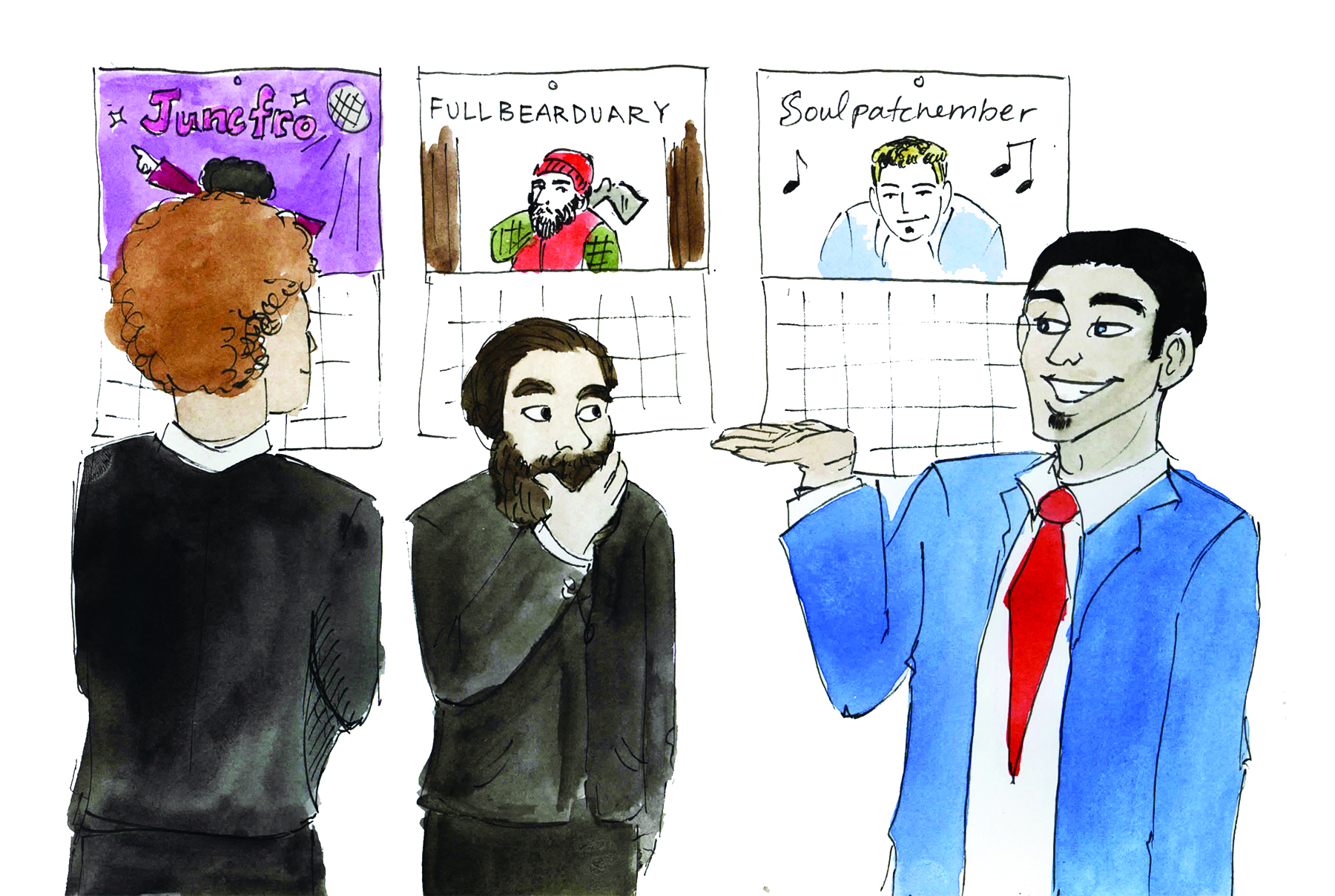
Although they are still in the planning stages, the new Gregorian calendar has been rumoured to also include the thrilling new months of Fullbearduary, Junefrow and Soulpatchember.

“I think this will be a great opportunity to get people to identify with some of our less popular months,” Franklin told reporters. “I mean the ‘Movember’ label instantly skyrocketed those 30 days to the top . . . who’s to say the same thing can’t happen to ‘Marchonchops’?”

Although the news of the new calendar has been very well received by the public, eager to have more legitimate reasons for not shaving, the process is moving very slowly due to a number of debates raging at the ICC.

According to sources close to the ICC there have been a number of quarrels between committee members over the naming of the months including a very heated argument over the new name of the twelfth month.

“I’d probably hold off a little on those Decembeards, this calendar is still a long way from completion,” explained committee member, John Samos, before being interrupted by another member insisting that it was “Decembrow . . . hold off on your Decembrow!”

Samos was then overheard screaming at the man about how “no one’s going to want to grow out their brow that close to Christmas” and then arguing with another man about how “Decemburns was too derivative of Marchonchops, not to mention Chinstrapril!”

Members of the ICC have also said that several other months are still being finalized as they have found it very difficult to come up with eleven different hairstyles that kind-of sound like months.

“It seemed easy at first, we came up with Soulpatchtember in a couple minutes, but a lot of them are really tricky,” explained ICC vice-president, Hal Krakow. “I mean, why does every goddamn month start with ‘j’?”

Krakow explained that the original intention was to have every month in the new calendar’s name reflect a different form of facial hair but the idea was deemed “too difficult” after the month of “Goateectober” was a legitimate candidate to replace October.

“I think going away from just facial hair might have been a huge mistake,” Krakow said regretting ever taking a job at the ICC, which he’s not even sure is a real thing anymore, “Now it seems like everything is up for grabs to be changed, recently I’ve been hearing people say we should just eliminate the month of July because no form of hair growth fits nicely with it, isn’t that crazy?”

This lack of respect for the current calendar was not met with resistance by everyone though, although some suspect that the fervent supporters of a lengthen ‘Junefrow’ are receiving kickbacks from hair salons who make a great deal of money from their “perm” sales.

“I’m just saying, what if ‘Junefrow’ was 62 days?” argued ICC president Franklin. “I mean, who knows the difference between June and July anyway? It’s like Nebraska and Iowa, what’s the point of separating them?”

While the ICC is struggling to deal with all their problems, they maintain that the new calendar will be instated eventually and that they haven’t lost sight of the big picture.

“Really, just like Movember this whole thing is just about doing something good for charity,” Franklin said, in a brief moment of calm. “We really believe that this calendar could help put an end to Malaria . . . I mean, world hunger? What is this for again? Prostate cancer? What the hell is that? And what does it have to do with moustaches?”

SFU hockey loses first of the season

0

The SFU men’s hockey team took to the road over the Nov. 15 weekend for back-to-back games against the Eastern Washington University Eagles and Selkirk Saints. The latter was a marquee matchup between two of the BCIHL’s best teams, but SFU could not afford to look past the Eagles. And they didn’t: SFU dismantled EWU 7–1, but showed fatigue against Selkirk, falling 9–5.

The first period of the Eagles’ game was quite even. SFU got on the board first with an Aaron Enns tally, but EWU responded just over a minute later when Uriah Machuga evened things up.

Then SFU opened the floodgates in the second period. After Nick Sandor gave his team the lead 2:38 into the frame, SFU potted four more goals in just over four minutes, ending opposing goaltender Jason Greenwell’s night prematurely. This game was essentially over after 40 minutes, but Taylor Piller added a late powerplay goal in the third for good measure.

The story was quite different when the Clan hit the ice against the Saints. Selkirk came out flying, controlling the boards and winning battles for the puck all night.

Saints Cody Fidgett and Beau Taylor gave Selkirk and early two-goal lead off of two quick shots that found their way past Clan netminder Andrew Parent. Taylor Piller’s goal would keep SFU within striking distance before Fidgett restored the Saints two-goal lead as he cashed in off of a SFU turnover at their own blue line.

Graham Smerek then muscled home SFU’s second goal, and Jono Ceci displayed all sorts of patience in finding the trailing Nick Sandor on an odd-man rush to tie the game at three.  Sandor’s goal would result in SFU chasing their second goalie in as many nights, as backup Chris Hurry replaced James Prigione.

Unfortunately for SFU, Saints’ head coach Jeff Dubois’ move of pulling his netminder seemed to spark the home side. The second period highlighted Selkirk’s speed and determination, as they out-muscled and out-skated the Clan for three goals in the period to gain a commanding 6–3 lead. SFU could not muster much offense as they had difficulty navigating through the neutral zone, and were forced to dump the puck in and chase it around.

In the third, Cody Fidgett registered his fifth point of the night in style, skating end to end and right around the Clan’s defense, eventually finding a wide open Thomas Hardy in front for the easy tap in. Each team would add two more goals in the frame, but SFU had their great early season start halted by a 9–5 loss, their first of the season.

Graeme Gordon is the unquestioned number one goalie for the Clan, and forward Trevor Milner had been a fixture on the top line much of the season, so it was curious to see both out of the lineup for the Saints game. SFU boasts a deep squad so, regardless of personnel, surrendering nine goals will not sit well with the Burnaby side.

The Clan is back in action next weekend with a home-and-home against the surprising Trinity Western Spartans. TWU sits above SFU in the standings with two more points, but the Spartans having played four more games, so next week’s contests could go a long way in determining SFU’s spot in the standings.

The advertisers are [not] always right

0

corporations_in_our_heads-artwork_by_dafne_blanco-ar-785x0

Despite having adblock software on our computers, recording television to then fast forward through commercials, and muting the radio when the adverts come on, we are still bombarded daily with marketing propaganda.

Every day we see transit advertising, billboards, flyers, posters, adverts in the paper, and sidewalk signs — and that’s just walking down the street. In the 1970s, the average person was exposed to an estimated 500 marketing messages daily; by 2000, that number had risen to approximately 5,000 per day.

Artistic and managing director of Theater for Living, David Diamond, believes that these corporate messages are invading our psyche, which “affects the way we make really profound decisions about how to be, who to aspire to be, our definitions of success and failure, our relationship with ourselves and others, our relationship to the planet, all kinds of things.” Diamond has developed a process project using theatre to explore these messages: Corporations in our Heads.

With no actors, no script, and no play, there is only a Joker, a maestro of sorts for the event, “Everything comes from audience involvement,” explains Diamond. He starts out the evening by explaining the event, the general purpose of the project, and then asks for stories from the audience where the messages of corporations affected or influenced their decisions.

“They are not big stories, but the ones that seem inconsequential,” says Diamond, stressing that the event isn’t trying to psychoanalyse the storyteller, but use these stories as an entry point to theatrically open up these ideas.

quotes1[Corporate messages] affect the way we make really profound decisions about how to be.”

David Diamond, artistic director of Theatre for Living

In a previous project about global warming, Thetre for Living had a similar event and a woman told a story about standing in the grocery store picking out tomatoes. Should she buy the lovely hot house ones, all perfectly round and plump, or the local organic ones with minor bruises and flaws?

The technique used is based on Augusto Boal’s The Cop in the Head theatre game. Boal developed a method called Theatre of the Oppressed where the audience become active participants in the outcome of the theatrical event. In Cops, individuals explore internal voices, fears, and oppressions rather than focus on external oppressors.

Diamond has used The Cop in the Head as a jumping off point for Corporations in our Heads, but also incorporates Forum Theatre techniques where audience members can stop the action, replace an existing person on stage, and change the message. Diamond explains that it is a way of opening up serious topics, learning and figuring out how we internalize these messages.

During the tour, Diamond is visiting 22 communities throughout BC and Alberta. “I’m imaging the messages will be different, and the event will change dramatically from community to community.”

One of the final nights of the tour in Vancouver is in partnership with the Simon Fraser Public Interest Research Group (SFPIRG), which seems like an ideal on-campus partnership.

“One of the things that we like about [Theatre for Living’s] work is that it gives participants a chance to engage in an experiential process,” says Shahaa Kakar, the Media and Outreach Coordinator for SFPIRG. “It’s exciting to see this kind of live process unfold because it connects with where people are actually at right now and that includes and builds from our lived experiences.”

There is no illusion that these conflicts will be solved in two and a half hours, but Diamond believes identifying and understanding the source is the first step to changing the behaviour: “As an activist, there is an error of tricking ourselves into thinking structural change needs to happen. But it is patterns of behaviour that create structure, and if we only engage in structural change, we will just recreate the same structure.”

Capturing North Korea

0

WEB-flag

David Guttenfelder, a photographer for the Associated Press, has sparked what might be one of the most illuminating glimpses into everyday North Korean society.

Guttenfelder, cell phone in-hand, has been uploading photos of real-time Pyongyang straight from his phone to his Instagram account, while on an assignment in the Democratic People’s Republic of Korea (DPRK). Prior to January 2013, all visitors and tourists were prohibited from any type of cell phone use — upon arrival into the country, all cellular devices were initially confiscated at customs, making it nearly impossible for foreigners to have any contact with the outside world while in North Korea.

This, however, has changed. The bigwigs of the Democratic Republic recently changed their policy on cell phone use in the country, enacting a relatively lax policy for visitors to the country with cell phones. They even flipped on a visitor-only 3G network that is allegedly not state-run or filtered in any way. This service is, predictably, inacessible for the North Korean population.

This has made it easier than ever for visitors to utilize social media platforms while in North Korea. Through his simple, untreated photos of North Korean streets, statues and homes, Guttenfelder has begun to expose the nature of everyday life in Pyongyang, the North Korean capital, through the use of his iPhone.

The freedom to use cell phone photography in North Korea offers us an absolutely unprecedented view of the nation.

Through the global platform of social media, Guttenfelder has been able to reveal images such as dismal, dark mornings in Pyongyang after widespread power shortages; candid photos of the North Korean police force going skating at a local ice rink; and, most shockingly, daycare centres playing military propaganda cartoons.

What the photographer is ultimately doing, with the help of Instagram, is painting a more detailed image of North Korea, one that challenges our usual conceptions of the nation as a repressed, industrial wasteland. Amid the snapshots of indistinct concrete and empty shopfronts, there are also images of vibrancy and humanity: colourful folk dances, rollerblading children and a marriage.

The fact that Guttenfelder is also able to “check in,” or tag his location on Instagram, is helping create a more defined and attuned image of what was once the blank slate of our North Korean map. Though many areas of North Korea have been identified by such services as Google Maps, many corners of the nation remain shrouded in mystery. By uploading photos of everyday Pyongyang and surrounding areas, Guttenfelder is opening not only his Instagram followers, but also the rest of the world, to a new perspective of North Korea.

What really gets me, though, is how Guttenfelder has used such a simple and ubiquitous tool to this great an effect. It seems so effortless — many people in the Western world, myself included, use Instagram on a daily basis. The fact that Guttenfelder is able to expose the daily minutiae of arguably the most repressed authoritarian regime in the modern world through a free iPhone application is nothing short of mind-boggling.

One question remains, though. Why? Why is the North Korean government — no stranger to repression, both political and social — allowing visitors to the nation to do this? Why is the notorious Party of the DPRK, enforcers of state-run internet as well as highly state-controlled tours of the country for foreigners, allowing Guttenfelder and others to come into the country and document everyday life for the world to see?

The Party is obviously aware of what Guttenfelder is doing. They have eyes and ears all over the country. Why, then, is no one coming forward and stopping him? Though the vantage point of visitors to the DPRK remains limited, the freedom to use cell phone photography in the country offers us an absolutely unprecedented view of the nation. So, what gives?

Amid the snapshots of indistinct concrete and empty shopfronts, there are also images of vibrancy and humanity.

In my eyes, there is only one explanation as to why the North Korean Party, with its intense media regulations on both domestic and foreign media content, would allow for everyday life in the capital to be released into the world via social media: they must be getting something out of it. What “it” is, we have no way of knowing — still, it seems naïve to suggest that the DPRK government is offering this personal agency to tourists for selfless reasons.

This real-time Instagram exposure of North Korea is beginning to paint a more detailed and defined picture of the nation and its inhabitants.

Though I am more than a bit skeptical as to the motive behind it all, one thing is for sure: things are slowly, but surely, changing in North Korea. Though these snapshots may not be enough to spark a full-scale uprising, I am excited to see the inevitable changes they bring about on a national and global level. Just look at the Arab spring — these days, an iPhone is more than enough to start a revolution.