Home Blog Page 1189

Tippy Top 10 List: John Tortorella

0

Tippy Top 10 Ways John Tortorella is Planning to Spend His Suspension


10. Quality time with family, berating them to “play some fucking defense”

9. With Rodman in rehab, become best friends with Kim Jong Un

8. Commit numerous crimes and laugh incredulously at arrest warrants

7. Take over as Richard Sherman’s media relations advisor full-time

6. Create a Facebook account and poke Jannik Hansen 50 times

5. Start a fight club, but talk about it

4. Take up cooking, but then realize that Gordon Ramsay already exists

3. Come up with new nicknames for Dale Weise . . . Weisey, Weiser, okay done.

2. Finally hang-out in visitor’s locker room in peace

1. Suspension? They told me this was a 15-day vacation!

Manhattan and Monopoly: Woody Allen and the commodification of art

1

woody-allen-2

“In Beverly Hills … they don’t throw their garbage away. They make it into television shows.”

This is a classic ‘Woodyism,’ embodying the perpetual commodification of art and commercial artists in Woody Allen’s films.

What is a Woodyism, you may ask? It’s that witty one-liner delivered by the neurotic, intellectual director that, beneath its comic relief, provides critical insight into underlying existential, political, and artistic themes. These one–liners which characterize the work of Woody Allen are a reflection of why his films are, with a few exceptions, consistently lower grossing in North America than Europe. Manhattan and Monopoly will explore the commodification of art through Woody’s films.

Despite his controversial personal life, the man has an incredible talent for diversity:  Interiors and Hannah and Her Sisters leave audiences paralyzed by the realistic depiction of the crumbling lives of a dysfunctional family; Annie Hall and Midnight in Paris are lauded as nervous, sentimental romances; and Sleeper, Everything You Always Wanted to Know About Sex*But Were Too Afraid to Ask, and What’s Up, Tiger Lily? stand out as seemingly odd and erotic compared to the rest.

Sex and comedy sound like a combination that would go over well in Hollywood, so why are these films traditionally less popular in North America than Europe? North American industries of art and culture epitomize one recurring Woody Allen theme: the reduction of various art forms to mere commodities that can be bought, sold, and monopolized. North Americans have become so naturalized to feel–good dramas and nationalist action films that character–based dialogue, driven by witty commentary, critical questions, and moral crises, do not resonate with a vast North American audience.

But commodification of the film industry stretches far beyond a few missed Woodyisms. Another thing we learn from Woody Allen films is that art comes in many forms, all of which are becoming increasingly commodified in their own right. So, what is the significance of this phenomenon?

North American industries of art and culture epitomize one recurring Woody Allen theme: the reduction of various art forms to mere commodities

Art is more than pleasure and entertainment. Indeed, it can be that too, but a film is more than a couple of hours of visual pleasure and emotional commentary, an album is more than an hour of auditory ecstasy, an academic journal is more than 30 pages of enlightenment, and a painting is more than an abstract world of colours and illusions; art reflects, creates, and maintains culture.

When commodified, art is no longer a valid means of cultural expression; it no longer represents the everyday struggles of the average North American, rather a glorified, unrealistic portrayal of life that reflects the values, beliefs, and behaviours of an elite few.

The analogous relationship between contemporary culture and commodification of the arts is an issue of deep significance.

In the following weeks, with the inspiration, ideas, and insight of Woody Allen, I will explore the perplexities of this relationship through the contrast of sell-out culture industries and noncommercial raw art — from media and film, to graffiti walls and bathroom stalls, I will divulge why the commodification of the arts is more pertinent now than ever before.


Join the Club: Pool Hustlers Club

0

JOIN THE CLUB is a feature that highlights SFU’s lesser known clubs and non-existent organizations. This week we highlight . . .

The Pool Hustlers Club


The SFU Pool Hustlers Club is a fun and relaxed place where SFU students can come learn to play pool without any pressure. Unlike the Billiards Club, you won’t find a bunch of pool experts or “sharks” who you can’t compete with. In fact, none of our current members are really that good at all.

Newcomers of any sub-par skill level are welcome to come join and play a game or two. It doesn’t matter if you’ve never picked up a cue (or is it a stick? I always forget . . . haha). We’re all beginners here. Who knows, you’ll probably even beat us in the first couple of games.

Now, another difference between us and that stuffy old “Billiards Club” is that if, after a couple of games, you start feeling pretty confident and you want to throw a couple of bucks down on a game, we’re totally cool with it. Our only expectation is that if you win, you give your opponent a chance to go double-or-nothing, that’s just common courtesy.

So, if you’re looking for a little more informal place to practice your pool skills and aren’t going to be a tight-ass with your money, come join the SFU Pool Hustlers Club. We won’t judge you: all amateurs, first-timers, rubes, suckers and stooges are welcome!

Spiders twerk hard for the hunnies

0

twerkingspiders_RachelleTjahyana

Pop stars and teenage girls no longer have a monopoly on twerking — male black widows have joined their ranks.

Research in animal communication at SFU has led to the discovery of the importance of vibratory signals to the black widow courting process. The male must gently shake his thorax, or abdomen, to alert the female that he is, indeed, a potential mate and not her next meal.

Courting a female black widow is no easy task. They are approximately twice the size of the males and have immediate predatory reactions to anything that approaches them. Unfortunately for the males, their size puts them right into the females’ prey category.

SFU biology professor, Gerhard Gries, and graduate students Samantha Vibert and Catherine Scott have determined how the female spiders differentiate between prey and prospective mates who land on their web.

Gries explains that the female’s web is not only for catching prey — it has a second function. “The web is the dance floor for the males,” Gries said. They come to the web in response to a chemical signal, a pheromone, that the female releases onto the silken strands as she spins her web. He explains that this pheromone is essentially advertising to all males: “I’m a virgin female, if you’re interested in being my mate, respond to this chemical message.”

Once a male spider lands on the female’s web, the vibrations of his movements will indicate whether he is a suitor or a victim. Male vibrations are significantly more subtle than the percussive vibrations of a struggling fly, for instance, and therefore do not trigger a predatory response in the female.

Gries uses the analogy of a first date to show the precariousness of the situation. The male can’t afford to “get off on the wrong foot” with the female. If the male makes a misstep, not only is his date over, he will inevitably become her dinner.

The professor and his fellow researchers put this to the test. Using a sophisticated playback device with an attached rod that makes contact with the web, they played their recordings of male spider signals and of struggling prey at opposite amplitudes.

If played at its regular amplitude, the fly’s vibratory signal would elicit a predatory response from the female, but if played at a lower amplitude (like the male spider’s signal), it would not. In contrast, if the male spider’s signal was played at the same high amplitude as the fly’s, the female would rush out in search of prey.

According to Gries, this demonstrates that “the amplitude of the vibrations, or the displacement of the strands, they tell her [the female spider], ‘Okay it’s prey, I’ll rush out to have a meal, or, it’s a male that wants to court me.’”

Reflecting on his findings, Gries says, “It’s quite fascinating to see that such a seemingly small [thing] makes all the difference in the world.”

Inside Inside Llewyn Davis

0

inside_llewyn_davis

Llewyn Davis is an asshole. His friends know it, his manager knows it, and the orange tabby cat that follows him around knows it. Llewyn, played beautifully by newcomer Oscar Isaac, knows it too — and deep down, he knows it’s the reason he can’t find success as a folk singer in New York’s early 60s Greenwich Village scene. As the big-shot record producer Bud Grossman tells him in the film’s third act, there’s no money in what he does. He just can’t connect with people.

Like the best of Joel and Ethan Coen’s films, Inside Llewyn Davis is a cactus: prickly on the outside, gooey on the inside. There’s no plot, save for Llewyn’s attempts to keep track of a friend’s cat — the film simply summarizes a week in the singer’s life, as he plays gigs for the café crowd, pays for an abortion, surfs couches across Manhattan, and takes a pilgrimage to Chicago in zero below weather.

The Coens deny us any overarching themes or story arcs; characters disappear for days at a time, and several — including Justin Timberlake’s cheerful Jim — duck out halfway through the film, never to return. This isn’t their story. Like it or not, we’re with Llewyn for the long haul, and it’s a credit to Isaac that the cantankerous, cynical folkie never grates.

Though Llewyn’s story is full of poetic nuances and moments of gravity, it’s easy to see the film as a self-indulgent mess of historical revisionism and aimless melancholia. But the Coen’s Joycean approach to filmic narrative — if you can even call it that — paints a broader and more complex picture of the titular character than we might’ve found in a more conventional flick.

Inside Llewyn Davis is a cactus: prickly on the outside, gooey on the inside.

This isn’t to suggest that the film is a boring, intellectualized pile of mush. Quite the opposite, actually: Inside Llewyn Davis is beautifully shot and edited, and its songs — most of which are old standards, save for the charming original “Please Mr. Kennedy” — are remarkably well performed. The acting is great across the board, but Carey Mulligan and John Goodman are in particularly fine form here, as Llewyn’s former flame and a heroin-addled jazz musician, respectively.

Maybe the best thing about Inside Llewyn Davis is that its titular vagrant isn’t great — he’s good, maybe even very good, but not great. Priding himself on his authenticity, Llewyn cringes at the thought of recording a novelty track. He’s a genuine songster, and the industry chews him up and spits him out — Grossman tells him he’s got the chops to sing backup, but not to make it as a leading man. He’s probably right. The Coens don’t shy away from the dark side of being an artist, and the film is all the more powerful for it.

In the final scene, Llewyn leaves a café after a show to confront a shadowy man in an alley, while a young Bob Dylan plays a gig in the background. By the end, he’s lying face down in a gutter, like a character out of a Dylan song. For Llewyn, fame is at arms’ length — all around him, but just out of reach.

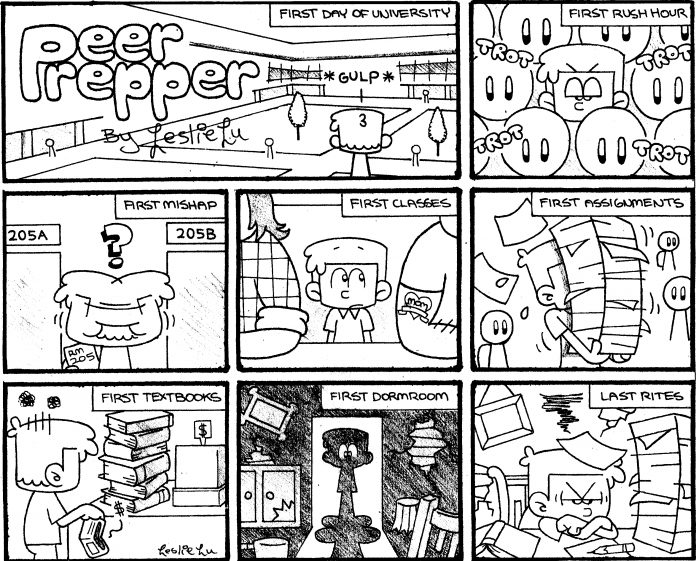
Peer Prepper #1

0

Storytelling app bridges language gap

0

scribjab_RachelleTjahyana

A new iPad app called ScribJab, developed by two researchers at SFU, will allow children to write and share stories in multiple languages.

With a grant from Heritage Canada and technical assistance from SFU Creative Services, education professors Kelleen Toohey and Diane Dagenais have created an interactive multilingual story-telling app and website to encourage language learning and to build writing skills. Both formats are free for users.

“The point of this was to encourage children to write stories and to enjoy them,” Toohey explained.

ScribJab was officially launched at SFU on Jan. 14, when the developers and child authors celebrated the 30 books published to date.

To publish a story, children must first log on with a teacher or parent, then write a story in English or French, draw pictures, or record audio. From there, the story can be translated into another language.

Although ScribJab was originally designed for ages 10-13, younger children, older students, and adults can also use it. “Some teachers have been using ScribJab with teenagers who are learning French,” Dagenais said.

“There are a lot of multilingual and bilingual resources for teachers,” said Dagenais. “But there was nothing that we could see that was for kids to use.”

This research celebrates the fact that children may speak languages other than English and French at home, and allows them to connect with family members by writing stories and translating them into their mother tongue.

The idea first developed during a classroom project Toohey was involved with several years ago. The teacher she worked with noticed that the grandparents of Punjabi children were not attending reading time because they didn’t speak English.

“The kids and the teacher decided they would interview grandparents and get stories, and write them and translate them, so that they could go in the kindergarten and read the stories to little kids,” Toohey described. “They were so beautiful — the stories that the kids wrote — I felt like it was really important we found a wider distribution for them.”

Toohey and Dagenais would also like to see Aboriginal children using the app and writing stories in Aboriginal languages.

Although the researchers have yet to review the statistics on app downloads to date, they hope it will soon gain an international following. This will give children and older users the opportunity to share their stories with people all over the world.

Clan avenge early season loss

0

After falling to Embry Riddle University earlier in the season, the Clan were able to get revenge when SFU hosted their first dual of the new year, and topped ERU 25–24.

Seniors Skylor Davis and Sukhan Chahal opened for the Clan, and garnered a quick 12–0 lead for the Clan after earning six team points each.

“We had a similar performance two weeks ago when we faced this team on the road,” said head coach Justin Abdou, after the match. “We started strong with Skylor and Sukhan, but the middle guys struggled to get things going similar to last time.”

It looked like the Clan were stuck in that funk after three straight losses from Dillon Hume, Brendan Seppala and Josh Punzo; SFU was suddenly down 16–12, but senior Brock Lamb would get things back on track. An 11–6 victory for Lamb gave the Clan four team points, tying the match at 16 apiece. And after freshman Reid Watkins surrendered four points in an 11–2 loss, Josh Kim rebounded with a three-point win to keep the Clan on pace.

“Josh really pulled through tonight for us,” said Abdou. “We lost points in that match last time and he made an excellent effort to get that win in  . . . when he was extremely tired.”

Another six-point win for the Clan at 285-pounds would seal the victory for the Clan, continuing their strong season. SFU will be back on the mats on January 31 when they hit the road to take on the San Francisco Gators.

Super Bowl break down

0

Two number one seeds from each conference meeting in the Super Bowl doesn’t happen very often, but this year’s matchup not only features the two best teams in pro football, it also pits the Denver Broncos’ number one offense against the Seattle Seahawks’ number one defense.  The National Football League could not have asked for a better Super Bowl matchup.

There are fascinating matchups all over the field, from Seahawks’ quarterback Russell Wilson versus the Broncos’ secondary, to Denver’s running game going up against the immovable force that is Seattle’s front seven.

Every clichéd ‘game within the game’ itself will be instrumental in deciding which team wins the Vince Lombardi Trophy, but the matchup that will have the most influence, unquestionably, will be Peyton Manning and his plethora of receivers going head to head with Seattle’s secondary, commonly referred to as the Legion of Boom.

Denver’s offense is a nightmare for defensive coordinators to plan against because of the incredible athleticism pass-catchers Demaryius Thomas, Eric Decker, and Julius Thomas possess. Add Wes Welker into the mix and with no disrespect to Marvin Harrison or Reggie Wayne — two of the all-time greats — this is the best receiving corps Manning has ever had at his disposal.

That said, Seahawks’ defensive coordinator Dan Quinn has the athletes to matchup with the Broncos’ offense.  Richard Sherman, however boastful he may be, is the most athletic corner in the game and he will be tasked with keeping Demaryius Thomas in check.

Safety Kam Chancellor is 10 pounds away from being a linebacker, so he can get physical with Julius Thomas. Free safety Earl Thomas will be all over the field at Met Life Stadium come game day and unheralded corner Byron Maxwell has been solid in filling in for suspended starter and CFL alumni Brandon Browner.

Since Quinn likes to run man-to-man coverage, this game will come down to whether or not Denver can successfully run its controversial, yet incredibly effective, pick plays. These plays require two receivers crisscrossing so one receiver can effectively run interference against the other receiver’s defender. Seattle’s physicality at the corner back position make this strategy the one to keep an eye on during the game.

The question of who has the upper hand in this game within a game is another matter, and one that is incredibly difficult to answer. Seattle’s physicality may allow their corners to get their hands on the Broncos’ receivers before the wideouts can run their pick routes, or the Seahawks can sit back in zone and switch who they’re covering.

The main factor is that Seattle is capable of doing each, and doing each well, giving them a slight advantage in this matchup, despite the NFL being a pass happy league.

Add in potentially bad weather that may adversely affect the Broncos’ passing game and Seattle has the chance to suffocate the greatest offense in NFL history. Also, combine the return of dynamic Seahawks wide receiver Percy Harvin with Seattle’s staunch run game and it’s hard not to choose the Seahawks to win this game.

But, the Broncos have arguably the greatest quarterback of all time in Peyton Manning, so the only thing for certain is that this years’ Super Bowl will be one of the best in recent memory.

University student just not that stressed out

0

BURNABY — Thor Svenson, a current 3rd year SFU student, is concerned that he isn’t stressed out enough and has registered a formal complaint against SFU for failing to provide him with a basic horrific post-secondary experience.

“People say university is so stressful. I heard stories about people who spent every waking hour stressed out and unhappy about their grades and waning social lives” Svenson explained, shaking his head. “But I’m just not feeling it, I’m totally fine.”

According to Svenson’s account, university life is just not what he had expected. Now in his third year, he claims that he still has never had to spend an entire night eagerly sucking back caffeine while typing frantically to finish a 20-page research paper that was due the next day.

He also has stated that he hasn’t had to turn down even a single week of the best parties ever to study for a midterm. In fact he complains that he has too much time on his hands and is completely relaxed and at ease at all times.

“I have an A average and I have all my evenings free . . . I’ve had so much time to kill that I’ve even started learning to play the saxophone and I’m taking salsa dancing lessons,” he said before pausing to let a single tear roll slowly down his cheek.

“I guess . . . I guess I just expected more from university. I was looking forward to being stressed to the point that my hands would become so slick with perspiration that my pencil would slip out of my hand and clatter to the floor,” he continued solemnly. “I was looking forward to not eating or sleeping for two days because of the finals I have coming up, but it was not to be.”

Svenson then sniffed and wiped a final tear from his eyes and said, “Oh well, I guess I’ll just transfer to UBC.”