Home Blog Page 1170

Woohoo, boohoo

0

Woohoo: Jimmy Fallon

Now, I’ve given Fallon his fair share of flack over the years. As Tracy Morgan once famously complained, he pretty much ruined every SNL sketch he was in by laughing uncontrollably at every joke. The only difference now is that giggle fits and character breaks actually make for entertaining late night talk show antics. Imagine that!

As soon as Fallon found his way into the Late Night slot, it became plainly obvious that this is where he was meant to be: his magnetic energy and baby-faced charm is a perfect fit for talk show interviews, cutesy monologues, and insta-viral Justin Timberlake sketches. It’s this same quality that makes him an infinitely better host than Jay Leno.

Fallon is no Johnny Carson, that’s for sure, but after a couple weeks in the chair, The Tonight Show is already the funniest (and most watchable) it’s been in years, and we’ve got Jimmy Fallon to thank for that.

Boohoo: Jimmy Kimmel

Seriously, Jimmy Kimmel? Grilling Rob Ford on his many media screw-ups while he’s a guest on your show is pretty much the dictionary definition of shooting fish in a barrell. After 11 years on the late night circuit, you’d think Kimmel would have something better up his sleeve. But no! He spent 45 minutes ridiculing a man who does more than a good enough job of ridiculing himself — not unlike his infamous Kanye West sketch, which was about as clever.

To top it off, Kimmel pretty much broke the Internet when he posted a fake viral video of a girl twerking her way into a living room table, sucking all the fun out of home video hijinks forever and ensuring that no media outlet — or any of his viewers — will ever trust him again. And the countless other video pranks that he’s pulled have never been as funny or “edgy” as he thinks they are.

Way to go, Jimmy Kimmel. Kanye was right: Sarah Silverman is funnier than you.

Cave-dweller surprisingly well informed

0

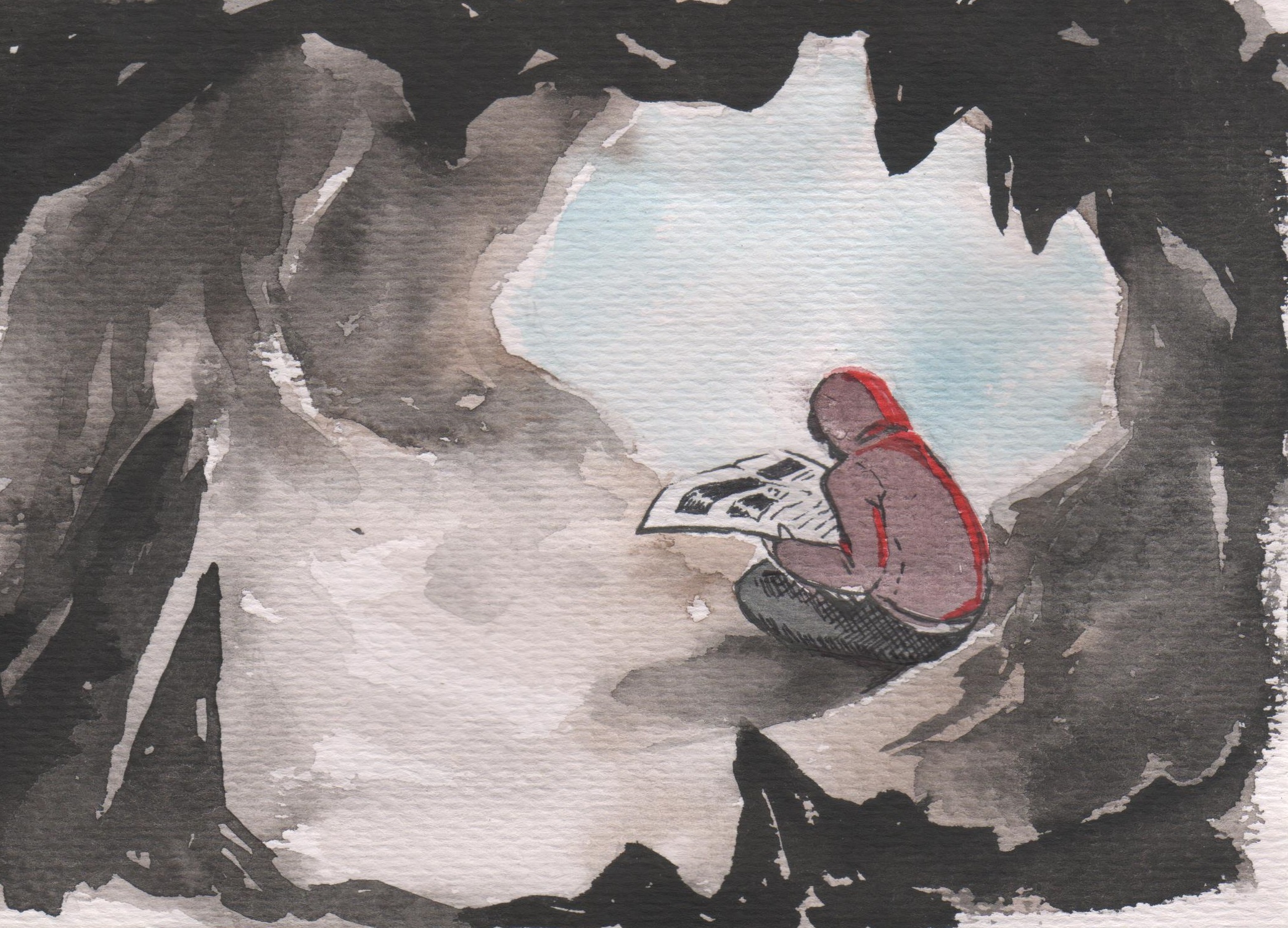
COQUITLAM —  Although he currently resides in a cave a few miles away from civilization, a local man claims that he is still very much on top of all major news and is actually quite well informed.

Thomas Gormley, a 55-year old retiree says he is upset by the almost non-stop condescension he receives when it comes to current issues just because he chooses to live in a cave.

“It’s ridiculous, everyone always thinks that just because I live in a cave I won’t understand their discussions on things like sports or politics but that’s completely untrue,” Gormley told The Peak. “I actually know a lot more than most people even as a cave-dweller.”

Gormley explained that his cave was hooked up with wifi and a cable connection and that he actually spends most of his time researching and absorbing current affairs.
“There’s not much else to do when you live in a cave,” Gormley said. “I’m pretty much always just reading news and trying to avoid bats.”

“There’s not much else to do when you live in a cave, I pretty much just read news and try to avoid bats.”

– Thomas Gormley

While Gormley says he understands where some of the misconceptions about his lifestyle come from, he believes that the stigma against cave-folk like himself needs to stop.

“Yeah, I get it, caves aren’t very modern or hip places to live and I understand that most don’t come equipped with internet connections but still, you are allowed to leave where you live occasionally,” he stated. “If you live in an apartment I’ll accept that you may have knowledge beyond white walls and lighting fixtures.”

“Just because your primary address is a cave, there’s nothing stopping you from going into the city every now and then and picking up a newspaper,” he continued.

“People just want to label you though, I mean, I was born in a barn so I get a lot of shit for that too . . . but just like with the cave thing, it was an orderly barn that made me into a very neat and anal person, which is actually what most barn-babies are like!”

Gormley admits that the chances of stereotypes against people like himself going away entirely is very unlikely but he remains adamant about changing society’s perceptions.

“I just want people to have more accurate prejudices,” he said in conclusion. “Instead of just labeling me as uniformed, think a little more and label me as mentally insane, I mean I live in a cave for godsake and all you want to tell me is that I won’t know who Putin is? That’s ridiculous.”

Tippy Top Ten: Luongo Trade

0

Here are the Tippy Top Ten Silver Linings in the Roberto Luongo Trade…

10. Without @strombone1, Daniel Sedin’s Pinterest will finally get the attention it deserves

9. Discounted Luongo bobbleheads are finally affordable to the working man

8. With slight alterations, Luongo #1 jersey can easily be transformed into a Messier #11 jersey

7. Luongo’s team poker-night can be replaced by a more fun “Wii bowling-night”

6. Cap room should allow Canucks to sign a couple more Sedins   

5. New addition Markstrom will bring in much needed Scandinavian flavour

4. He promised he’d still Skype us at least once a week

3. Probably won’t have to worry about any more Stanley Cup riots

2. There’s one less soul-patch in Vancouver     

1. Hey, at least fan-favourite Mike Gillis is still here  

Shaming Belle Knox: a societal low point

0

WEB-Belleknox-courtesy of XOjane.com

A guy finds out a college peer is a porn star. He tells his fraternity; the news goes viral. Within a couple days, the entire campus knows; a month later, multiple newspaper articles, some national, about her have cropped up. The young woman’s life is changed. She’s glared at and talked about. She’s no longer just another student at Duke University, she is defined by her work as a porn star.

This was the reality for Belle Knox, the actress who first revealed her story anonymously and recently revealed her stage name.

Beyond insulting her, peers of Knox demanded she drop out, or that the university expel her. They equated a person’s profession with their right to attain education.

Civilization has not progressed as much as we would like to think if a culture as enlightened as students at a prestigious American university can, and have, reduced themselves to hate-filled, trash-talking animals at the idea of a porn star studying towards a degree. This isn’t far from using racism or sexism to justify denying the right to an education.

To pay for their education, a person can do whatever they want. Many might be tempted to say that Knox has no one else to blame but herself, but this woman is being shamed for an inherently wrong sexual paradigm that our culture as a whole is responsible for perpetuating.

Millions of people buy into the porn industry, supplying the demand for porn sites and videos. So, why does one’s recreational voyeurism inspire no sense of guilt or depravity, while knowing someone who actually works in the industry provokes an onslaught of acrid name-calling and belligerent threats? Why are the performers criminalized while the ardent customers walk free?

People think they know Knox or “her kind” because they hastily flatten her into just another faceless stereotype. There is a good chance that the vast majority of her insulters have never had a conversation with the woman. There is a difference between prejudice and immorality, and one’s personal moral compass should not dictate another person’s decisions and actions.

Knox is not, as she alleges her peers called her, “a slut who needs to learn the consequences of her actions,” or “a little girl who does not understand her actions.” She’s not stupid, crazy, sick, or naive.

She’s simply an individual with a life, hopes and dreams. She’s an undergraduate of women’s studies and sociology, with aspirations to be a lawyer. No matter how much her peers want it to, working as a porn star does not define her as a person.

So you want to be a travel writer?

0

robin-esrock2012

The Peak caught up with seasoned travel writer and Burnaby resident Robin Esrock about his new book, wanderlust, and his upcoming “Adventure Travel Journalism Bootcamp” to take place on March 15 at SFU Vancouver.

The Peak: During your career as a travel writer you’ve hosted the National Geographic series Word Travels and visited more than 100 countries, including unusual destinations like Chernobyl and Papua New Guinea. After adventures like those, what made you want to write The Great Canadian Bucket List — an entire book about Canada?

Robin Esrock: People I met travelling were always asking me about the best things to do back in Canada. In my haste to explore the rest of the world, I’d forgotten about my adopted home. The book would be a fun exercise, not only to discover the best experiences in the country, but also to allow me, an immigrant, to really understand what makes Canada unique. Since The Great Canadian Bucket List quickly became a bestseller, it seems I was not alone.

P: Young Canadians who dream of travel typically set their sights outside their own borders to regions like Southeast Asia and Australia. Do you think Canada rivals these destinations?

Esrock: Canada is effectively 13 countries in one. Each province is unique, with activities and destinations you won’t find anywhere else in the world. I wasn’t sure what I would find, but by the time I was done, I realized there are few nations that can compete with the sheer amount of experiences Canada has to offer.  We might not have the beaches of Thailand, but walk on powder-white Grand Beach overlooking Lake Winnipeg, and you’d think you slipped down a wormhole to Southeast Asia.

esrock-edgewalk

P: How long did the research for The Great Canadian Bucket List take? Did you personally do each of the 115 activities listed in the book?

Esrock: I spent 18 months travelling to every province and territory, usually more than once, and also gathered experiences from previous adventures over the years. Weather, budget, timing and other factors came into play, so in the end I managed to personally tick off 104 of the 115 experiences. I didn’t want to write a dry guidebook, so I pushed all the practical info, with videos, maps and galleries to [the website]. The book is more of a journey, full of characters, observations and quirky trivia.

P: Canadian food doesn’t have much of an international reputation. Did you taste anything on your travels that was uniquely Canadian?

Esrock: The book features uniquely Canadian dishes like beavertails, poutine, and brewis. I tried smoked seal recently, which wasn’t too bad (although wasn’t too great either). You don’t get any more Canadian than the Sour Toe cocktail. It’s a drink served in a Dawson City bar with a real severed human toe. Seriously.

esrock-kayak

P: You credit a car accident with the motivation — and the cash — to start your travels. Any tips for students on how to save money to fund their travels?

Esrock: I received $20,000 for a broken kneecap. When I tell people I cashed in an insurance cheque to travel they assume it was a lot more than that. My budget was $35 a day, and I managed to travel to 24 countries over 12 months. To see the world on limited cash, avoid expensive countries (Australia, Western Europe, Chile) and focus on places like Central America, India, Southeast Asia, Turkey, Eastern Europe. You can live well for $10 a day in India.

Another option is working holiday visas. Lots of Canadians go to the UK and Australia, but you can also get visas to work in places like Latvia, Denmark and Costa Rica.

P: What can aspiring travel writers expect to learn from the “Adventure Travel Journalism Bootcamp?”

Esrock: There will be three working journalists spilling the beans on the reality of the print, broadcast, photography, blogging and social media travel industry. Together with Darryl Leniuk and Jeff Topham, we’ll talk about developing your niche, generating ideas, pitching editors, producing publishable content, press trips, and how to build a sustainable career.  It’s a vast subject that requires far more than an afternoon, but our bootcamp will definitely provide some real-world context for a very dreamy profession.  It’s a tough business to get into, but the perks are tremendous.


Need some inspiration to start planning that summer 2014 Canada road trip? Here’s a one-of-a-kind experience for each province and territory, as mentioned in Robin Esrock’s The Great Canadian Bucket List.  For more ideas and details, visit canadianbucketlist.com.


BC: Snorkel among thousands of spawning salmon in the Campbell River. The best time of year to do this is in August.

Alberta: Play paleontologist while looking for T. rex fossils in Dinosaur Provincial Park. Tours and opportunities to join an excavation are available June to September.

Saskatchewan: Horseback ride along one of the last surviving bison herds in North America at Prince Albert National Park.

Manitoba: Believe it or not, this prairie province is home to one of Canada’s best beaches — Grand Beach. There may not be any palm trees, but the sand is as white and powdery soft as any beach in Thailand.

Ontario: Conquer your fear of heights once and for all by leaning off the edge of the CN Tower — while hooked to a harness, of course.

Quebec: Indulge in the ultimate Canadian foodie experience — a plate of foie gras poutine.

New Brunswick: Get an adrenaline rush by zip-lining across a waterfall at Grand Falls.

Nova Scotia: Enjoy a history lesson and a cold beer at the same time on a tour of the Alexander Keith’s brewery in Halifax.

PEI: Learn how to use a traditional wooden lobster trap then eat what you catch cooked on a boat in the Charlottetown harbour.

Newfoundland: Spend the night in a lighthouse on Quirpon Island and enjoy views of icebergs and migrating whales.

Yukon: Try to strike it rich by learning to pan for gold near Dawson City.

Northwest Territories: Gaze up in awe at the Northern Lights in Yellowknife, one of the best places in the world to witness Mother Nature’s light show.

Nunavut: Get ahead on your schoolwork by reading a textbook outdoors at 2am in the Land of the Midnight Sun.

False start

0

Bright eyed, bushy tailed, and more excited than ever, I entered into my first semester at SFU last fall. “You’ll just be a number to them,” I was told about transitioning to university. But that seemed fair because, to me, “they” represented an elusive and faceless entity.

I was eager to begin my post-secondary career, and I couldn’t have imagined that my health had the potential to derail my entire semester. I found myself trying to navigate a system with which I was wholly unfamiliar, desperately trying, between fevered T-3 naps, to be excused from my midterms and assignments.

My illness started as a cold that just hung on. A month or so into being sick, I decided that it might be something to check out with my doctor. When I did, “Infectious mononucleosis” wasn’t something I was expecting to hear. All I knew of “mono” was that it could put people out of commission for months on end and that it was heavily stigmatized as the “kissing disease.”

I braced myself for the jokes and the sneers. The reactions I got from people didn’t disappoint: a knowing look and then something like “I can guess how that happened.” The reality of the situation is that I could have gotten mono by drinking out of the wrong cup, but that’s never the first assumption.

I couldn’t have imagined that my health had the potential to derail my entire semester.

Instead of the months of illness I feared, I was only intensely sick for about three weeks. Those three weeks just happened to coincide with most of my midterms and assignments. The day it hit me the worst, in fact, was the day of my first exam at SFU. I emailed my prof and then, with no response, I decided to go to student services to figure out what the correct procedure was for absence due to illness.

I found it difficult to get the information I needed and I had no idea what resources were available to me. I didn’t know that there was an official certificate of illness, or that you could withdraw from courses under extenuating circumstances with no academic penalty. I felt beaten by the system and nearly ready to give up, preparing myself to accept failing grades across the board.

At my worst, my family encouraged me to drop out so I could just focus on getting better. While that option would have alleviated any immediate pressures, I found myself in panic over the thought of wasting all of the time, effort and money I had put into school so far. Dropping out of my first semester would have felt like a false start. Though the situation was beyond my control, I would have felt like I had failed.

It was the incredible understanding and support that my professors showed me that convinced me I could salvage my semester. I received personalized emails and was offered generous accommodations that inspired me to dive right back into my schooling. I had the chance to submit assignments later and take exams later or with different weighting. As I recovered, I managed to make up everything that I had missed.

After the experience, I felt SFU might not be the large unfeeling institution I had previously thought it to be. The caring individuals that I encountered during that time and ever since have shifted my perspective entirely.

Return to the wild

0

Bears_3727_WEB

Sometimes, on the bus ride up to SFU, you see a coyote, bear, or deer looking awfully shocked that another bus is coming up the mountain. You barely look up from the readings you had an entire week with, and seconds later when you try to glance up again because you just saw a bear, it’s gone.

But what if there wasn’t time to brush off this sort of encounter with nature? What if bears, coyotes, and deer casually roamed amongst us all the time?

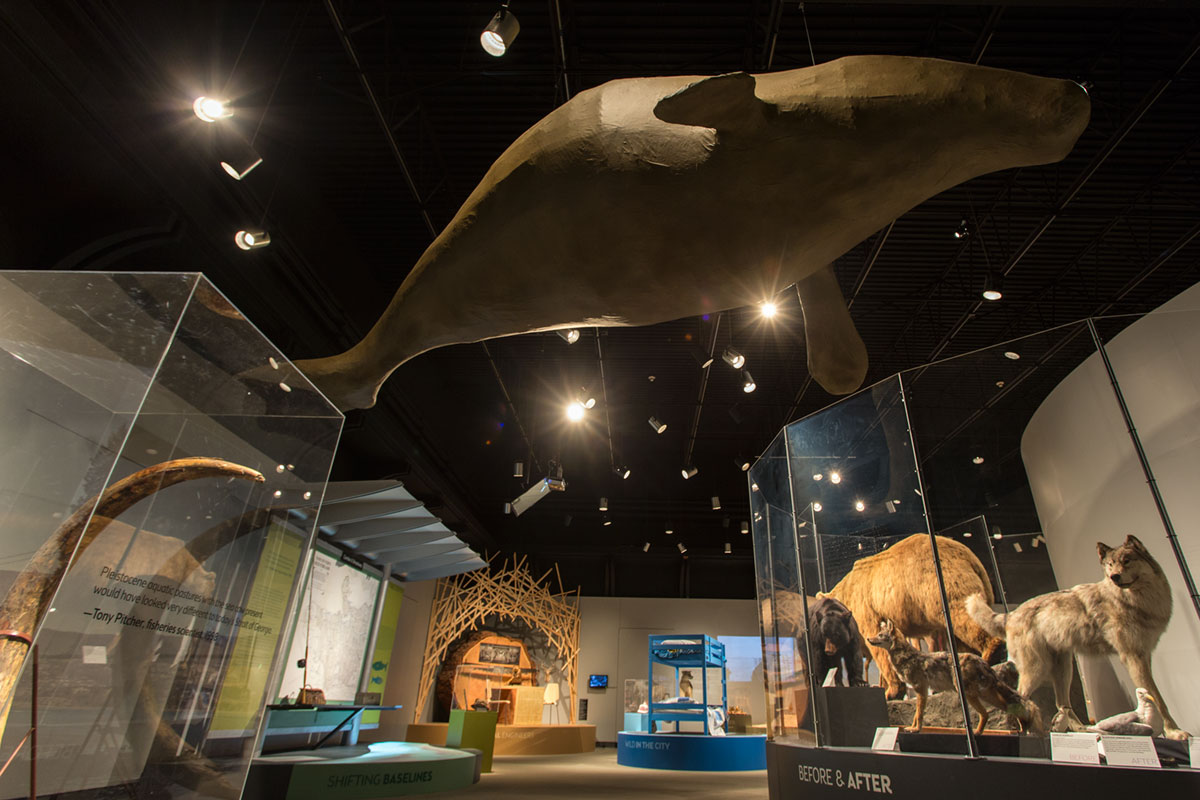
Because of intense urban expansion, Vancouver is in the process of purging itself of all natural wildlife. With its most recent exhibition, Rewilding Vancouver, the Museum of Vancouver is hosting the first major museum show in Canada to explore what an urban center would feel like through the lens of historical ecology.

Through the exhibit, curator J.B. MacKinnon explores “the incredibly abundant natural world of the past and how that might inspire us to rewild the world.” Rewilding Vancouver quite literally places nature right in the middle of the bustling city and its quaint neighbourhoods.

BigOnes_3647_WEB

The exhibit comprises 12 tableaus, each pictured as “a shop front window display designed to tell a story — [it’s] a familiar scene from Vancouver, but with nature bursting through in challenging ways. It’s like a classic natural history museum — there are a lot of taxidermies — but more playful, with wild nature and human culture all mixed together,” says MacKinnon.

These displays are accompanied by videos, 3D models, and soundscapes which really bring the wilderness to the audience, challenging viewers to imagine whether or not the sound of howling wolves would be natural in the midst of city traffic.

Several installations require a moment of contemplation and perspective; one depicts a dining room with a stuffed beaver on the table. The exhibit aims to spark discussion about what it means to live in one of the world’s “greenest cities.”

Sure, we have bike-lanes and energy-efficient buildings, but MacKinnon believes Vancouverites are so interested in being green because of our access to nature; we’re surrounded by snow-capped mountains and greenery, which should not be forgotten.

SeaCow_3771_WEB

“I think of the theme of this exhibition as three ‘R’s: remember, reconnect, rewild. We need to remember nature as it was in order to set a higher bar for what nature could be in the future. We need to reconnect to nature in order to make it meaningful and valuable in our lives. And finally, we need to realize that we really can make a wilder city,” says MacKinnon.

Rewilding Vancouver urges viewers to consider what used to be familiar and how that has changed. For instance, Vancouver’s waters used to be filled with the hauntingly beautiful sounds of hundreds of whales.

MacKinnon says, “If you aren’t aware that whales lived here in the past, then the absence of the whales seems normal. When you are aware, then the absence of whales will seem abnormal — and you might start asking whether we could bring them back and how.”

Wildlife certainly does come back in the experience of Rewilding Vancouver. As you walk through, your perception of what is natural to Vancouver shifts. Ravens, coyotes, and black-tailed deer begin to settle into the city’s infrastructure; leaving the exhibit, you pass projections which ask what it would be like if streams were running through our neighbourhoods.

New season marks a new wave for Whitecaps

0

Vancouver Whitecaps FC has finally embarked on its fourth season in Major League Soccer (MLS), after enduring a whirlwind of an offseason.

An inevitable change in head coach saw Carl Robinson take the helm. So far, Robinson has rebuilt his squad with a wealth of youth, local talent, and experienced signings to come away from pre-season with an impressive 4–1–1 record.

The new boss promises an attacking brand of football with lots of speed up front in 2014. Darren Mattocks, Kekuta Manneh, and Erik Hurtado have already proven to be potent on offence, with contributions to wins over San Jose and Portmore during the Rose City invitational competition.

The new coach is already reaping the rewards of multiple signings from a variety of national backgrounds as well. On January 27, Iranian international Steven Beitashour filled the first void in the squad at the right back position following the departure of Y.P Lee. The 27-year old has made 87 appearances in MLS thus far, including a full 90 minutes played in the 2012 All-Star match that was won against Chelsea.

Jordan Harvey, meanwhile, has scored goals at will from the left back position in preseason. Fans could see the American, who joined the Caps in 2011, exchange duties with homegrown defender Sam Adekugbe, who was strong in his home debut at the end of the 2013 season. Robinson will also be glad to deploy his 3rd overall MLS Super Draft pick, centre back Christian Dean, who is known for his size, strength, and strong left foot.

In net, recently signed Paolo Tornaghi comes in to replace Joe Cannon. The 25-year old started his career with the Inter Milan youth academy and represented Italy at every level from U-16 to U-20.

While the Caps have not found a true replacement for departed superstar Camilo, it should be noted that they are now a stronger goal scoring threat from midfield. The Whitecaps lineup has been bolstered by some South American flair after picking up the Uruguayan duo of Sebastián Fernández and Nicolás Mezquida.

Fernández won the 2013 Peruvian Primera División championship with Universitario de Deportes as a striker/midfielder. Mezquida represented Uruguay at the 2009 U-17 World Cup where he was first spotted by Carl Robinson. Both players have already found the back of the net in pre-season.

To top things off, Vancouver has acquired Argentine Young Designated player Matias Laba from Toronto FC on loan. The 22-year old defending midfielder has made 88 appearances in the Primera Division of Argentina, and after just 16 appearances for Toronto was named #21 in the leagues top 24 players under 24 list.

Through tumultuous change, what remains is the presence of established veterans in virtually all positions on the pitch: Andy O’Brien and Jay Demerit in defence, Nigel Reo Coker in midfield, and Kenny Miller up front. Fans will witness the most explosive, gritty, and determined side yet, with every player motivated to silence the skeptics.

Hirsch: remembering a Canadian legend

0

Hirsch

Would you want someone to tell your story after you’re gone? And if so, who could be trusted with this task?

Alon Nashman and Paul Thompson took on the responsibility of bringing the life of John Hirsch to the stage, paying tribute to this Canadian theatre legend. After an enormously successful premiere at the Stratford Shakespeare Festival in 2012, Hirsch has made its way west to the Firehall Arts Centre.

If you weren’t aware of John Hirsch prior to seeing this play, you will certainly know him by the end of it. Nashman plays himself and Hirsch among other characters in this riveting 90-minute performance. Coming in through the back door and walking down the aisle to the stage as he casually addresses the audience, Nashman makes it clear that this is an unconventional show, fitting for an unconventional man.

A Holocaust survivor who was orphaned at age 13, Hirsch was a Hungarian refugee who landed in Canada in 1947. He ended up in Winnipeg, and quickly became involved in the world of theatre, co-creating the Manitoba Theatre Centre.

His fierce determination and strong opinions drove him to succeed as he became a major player in the formative years of the Canada Council, served as artistic director of the Stratford Shakespeare Festival, became the head of CBC Drama, and directed on and off Broadway as well as at Lincoln Centre.

Heavily researched and delicately constructed, Hirsch does not run chronologically, but jumps from his time in Hungary, to the CBC, to Stratford, and to New York. Along the way, Nashman interjects with his own narration, songs, and comments pulling us in and out of the action. While this may sound awkward, it works very well and allows for the play to develop effortlessly while adding some much needed comic relief.

Heavily researched and delicately constructed, Hirsch does not run chronologically.

My favourite scene involves Nashman and Hirsch getting into a fight about the way Nashman is telling Hirsch’s story, after which Hirsch storms out of the theatre. “The star of the show just walked out on me,” says Nashman, excusing himself, and from the hall we hear him arguing with Hirsch.

Keeping these roles straight can’t be a small feat for Nashman, but he never falters, and his Hirsch accent and demeanours are flawless. The relationship these two had seems fraught with tension and, as Nashman explains, their first encounter with each other did not go smoothly.

Nashman first met Hirsch when he played Caliban in a production of The Tempest which Hirsch was directing at the Stratford Shakespeare Festival. Their rehearsals included constructive criticisms such as: “That Sorcerer part was good, but the rest was shit.”

Hirsch is portrayed as an uncompromising, harsh man, but at the same time we get the sense that he deserved respect and could afford to be a bit crass.

Nashman’s performance is a triumph as he presents a nuanced, emotional portrait of this theatrical giant. I left the theatre feeling as though Hirsch was in the room, and I am sure he is somewhere cursing Nashman and Thompson, shouting corrections, and feeling proud of his life’s achievements.

Album reviews: The Perms, Fantasy Prom, and Sprïng

0
The_Aberdeen_EP_front_cover
The Perms – Aberdeen EP

By Tessa Perkins

Having been a fan of The Perms since 2010’s inventive pop-rock album, Keeps You Up When You’re Down, and continuing to follow their music with 2012’s Sofia Nights, I’m glad they’ve released a few songs for us to enjoy while they work on their next full-length album. The Aberdeen EP is four songs of catchy, energetic pop-rock goodness that will leave you wanting more.

An alt-rock trio from Winnipeg, The Perms, made up of Shane Smith (bass/vocals), Chad Smith (guitar/vocals), and John Huver (drums), formed in 1998. They’ve released five full-length albums and this EP proves they continue to mature and evolve.

With a stirring, punk-rock vibe and fast-paced, energetic guitar and drums, “It’s Mania” has an apt title as the song feverishly propels forward. The edgier sound of this track is a nice contrast to some of their other songs.

Sounding a bit like Weezer or Blink-182, the band delivers an anthemic, emotional head-nodder with “Aberdeen.” Beginning slowly, the song builds into something that I can picture a crowd jumping up and down to. Similarly, “The Parent Thing” is an aggressive drum-heavy track full of building melodies and strong lyrics.

“Walk Away” is the most radio-friendly, with its balanced melody and relatable lyrics: “I’m not ok, walk away.” The Aberdeen EP is just a taste of what The Perms have to offer, but it demonstrates their ability to write consistently catchy songs with strong melodies that are not your average pop/rock fare. Their sound is distinct, and they deserve a listen.

swirl

Fantasy Prom – Swirl

By Jacey Gibb

When it comes to the shoegaze genre, people seem to either love or hate it. Admittedly, this genre and I have had our differences over the years (and it’s still near the bottom on my list of favourites), but then acts like Fantasy Prom come along and cause me to feel instantly guilty for not being more open-minded.

The most recent in a string of singles/EPs that started last September, Swirl stands out as Fantasy Prom’s best release yet. The five-track album starts out loud and heavy with “Like I Care” (previously released as a single) and “Ugly Turn,” a potent duo that will have you cranking the volume, lowering it because you don’t want to disturb anyone else, and then ultimately deciding to leave it blasting. Neither of the tracks shy away from Fantasy Prom’s obvious influences like My Bloody Valentine, but this doesn’t make the songs any less genuine or amazing.

The momentum built up by the first shorter tracks wobbles substantively at the halfway mark with “Swirl.” When the album is named after one of its tracks, the listener is usually on alert for something special — which sadly isn’t the case. A three-minute repeat static fest that would have served better as a short intermission, it’s the only track I found myself skipping over on a regular basis.

The last two songs on the EP, “Vulnerable” and “Sparks Made Us,” embody the perfect shoegaze characteristics in a perfect balance, with longer running times and just the right amount of heaviness.

At just over 20 minutes, the EP does what it’s supposed to do: gives people a taste of what Fantasy Prom has to offer and leaves them clambering for the next offering. If you find yourself enjoying Swirl, definitely check out some of their previous releases on Bandcamp.

spring5

Sprïng – Celebrations

By Jacey Gibb

Vancouver is an elephant graveyard of sorts when it comes to musical groups. But the high mortality rate for bands is by no means a concern; in fact, the ever-shifting community is to thank for some of the most prominent, creative band lineups currently dominating the scene.

Such is the story of Sprïng, with two of their four members coming from dearly departed noise-rockers the SSRIs. Our time to grieve is over people; there’s new music to gorge upon.

To say Celebrations is eclectic would be both an understatement and a cop-out. It’s a total genre-bender, with freak-out rock tracks immediately followed by sleepy summer numbers. For a more upbeat track, check out “Secrets” or “Pax Calx”; if you’re interested in something mellow, “Paradise” or “Loretta” have you covered.

The diverse sounds of the album come largely from the way it was recorded — the band has an in-home studio, meaning they could get as serious/silly as they wanted and experiment with whatever was on hand.

The gamble doesn’t always pay off though, as some tracks like “Show Don’t…” miss the mark completely, coming across more like instrumentals from a horror film than something you’d find on a rock album like Celebrations. Then again, maybe that’s the point?

It’s not the easiest listen the first time through, but Celebrations is a mighty fine debut and will undoubtedly help music fans Sprïng into the warming weather outside.