Home Blog Page 1166

Tippy Top Ten: St. Patrick’s Day

0

Here are the Tippy Top Ten Signs Your St. Patrick’s Day Party Sucked…


10. Green beer didn’t have any dye in it

9. Leprechaun only gave out one wish each

8. Celtic dancing was based entirely on Rajon Rondo moves

7. There was a potato chip famine

6. Playlist was exclusively from Adam Clayton solo albums

5. Guests fondly reminisced about Bloody Sunday  

4. Confused Ireland with Iceland

3. Bunk-ass shamrock was all seeds and stems

2. There were only 15 fights before 8 o’clock

1. You remember it

Questionable Information: Apple

0
The average “Mac Genius” only has an Apple IQ of 103.

”Great energy,” “good vibes” at Surrey open house

0

WEB-surrey open house-Anderson Wang

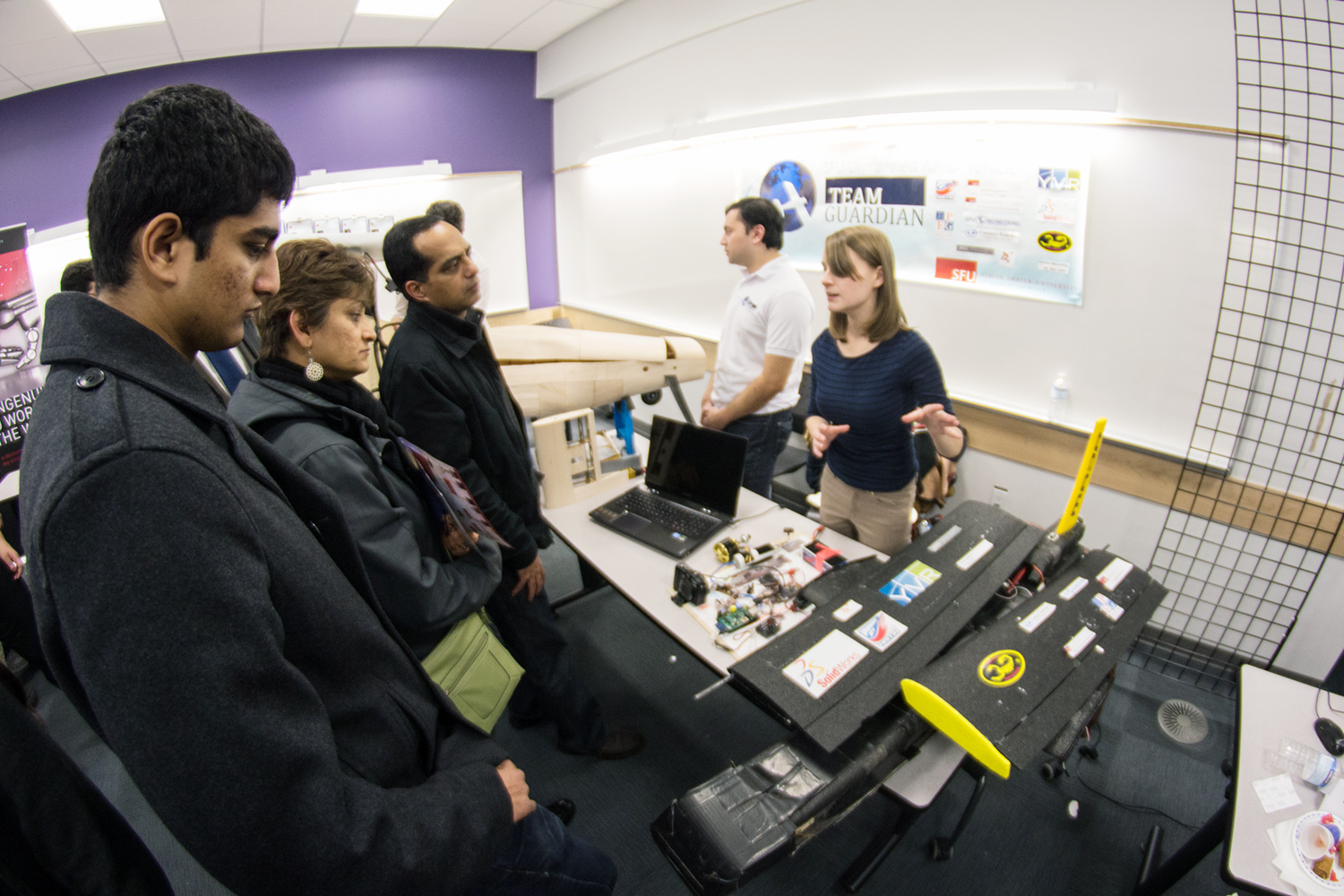
SFU Surrey opened its doors on Mar. 6 to showcase some of SFU’s most prestigious programs and research projects; the event also featured entertainment and ethnic foods from around the globe.

The annual open house was a crowd-pleaser for both the young and old, attracting approximately 3,000 guests, including prospective students, parents, alumni, and community members.

Over 60 exhibits and interactive displays were sprawled across the second and third floors of the campus, and for the very first time in the event’s history there was representation of each of SFU’s faculties. According to SFU Surrey’s associate director of marketing and external affairs, Matthew Grant, this year’s open house celebrated the diversity of the entire university, making it an SFU-wide event held at the Surrey campus.

Rachel Nelson, SFU Surrey’s community relations and engagement coordinator told The Peak, “This year… all of it was amazing. I’m always pleasantly surprised by the vibrancy and the energy [ . . . ] [The event] just creates a really good vibe at the campus.” Nelson felt that the various displays and entertainment were especially engaging and successful this year.

The various exhibits and presentations were fascinating, unique, and radiated enthusiasm. Sea creature touch pools, a literary character photobooth, virtual simulations, a robotic lawn mower, and a distracted driving obstacle course were just a few of the notable displays.

SFU Surrey’s executive director, Stephen Dooley, had only positive words for his very first open house experience: “What I really liked about it was just the great energy, the sense of community, and for me I learned a lot by going around to all the different displays that were on [ . . . ] it was a really good way to learn about what’s going on at the university.” President Andrew Petter also graced the stage, welcoming the entire community to SFU Surrey.

The SFU community shone throughout the entire event, particularly on the centre stage, which featured a renowned SFU piper, highland dancers, a steel drum show, Sri Lankan dancers, singer and songwriter Gio Levy, a bhangra team, and SFU student and R&B artist Alisha Pillay, among others.

Grant expressed his appreciation for the partnership between SFU and the greater community, exemplified by the success of the open house: “When it comes to open houses, I’ve been involved in a lot of them. It’s only been over the last couple of years that we’ve been able to put together an event that embraces SFU’s vision and mission when it comes to engaging the world.”

FCAT conference challenges “The Machine”

0

WEB-2013 SFU FCAT-FCAT

What is “The Machine” and how does it affect our day-to-day lives? SFU undergraduates tackled this question using various creative approaches at the Faculty of Communication, Art and Technology’s (FCAT) fourth annual Undergraduate Conference, held on Mar. 5 at the Goldcorp Centre for the Arts.

Open to students from the School of Contemporary Arts (SCA), Communications (CMNS), and Interactive Arts and Technology (SIAT), the conference showcased papers, installations, and performances based on the theme of “The Machine.”

Undergraduate students had unlicensed freedom to submit a proposal based on their interpretation of what “The Machine” could mean, as long as it was based on academic research. The submissions were subcategorized into three genres: Security, Patterns, and Reflection.

SFU President Andrew Petter and vice president, academic and provost Jon Driver both made appearances at the conference. Driver spoke of the event as an “experience of refined and genuine” presentations. He also discussed the “distinguishing features of SFU,” which, as “innovative education, cutting edge research and community outreach,” are utilized in building significant knowledge and insight for the students.

Driver also took the opportunity to congratulate the participating students directly for “all they have achieved and all they will achieve.”

Many presenters had notable and interesting concepts, which intrigued their peers, instructors, and any curious attendees. SIAT students Justin Chan, Jong Won I’m, Kateryna Jones, Bobby Soetarto and Bianca Zhu created an Interactive Projectional Environment which challenged the way people view their surrounding environment.

They used “‘The Machine’ that we use everyday — the computer — to encourage people to acknowledge their environment and consider the implications of high technology in our world.

Two other SIAT students, Lam Kwan and David Yang Li, presented “an advanced mind-controlled robot called IRobo.” IRobo aims to aid the disabled, helping them to “experience a richer life and be a part of the community again.” Furthermore, the project “explores the idea of an advanced mind-controlled robot that allows the user to live in an idealized form.”

By contrasting the positive and negative aspects of such a device through their video, the team explored the ideas that arise from frequent use and control of machines and technology.

SCA student Alex Stursberg created a two-part sculptural work entitled “The Political Economy of Painting,” which “considers the relationship of art-making and labour, while reflecting on manufacturing, industry, and the economics of art.” Stursberg said that, as an art assistant, he sees this “other end of the creation process” after the painting is finished.

The “waste material” used in the structure, such as paint tubes, represented the other end of the industry. By comparing the labour structure, he scrutinized this machine as being a societal representation. As the forces of labour shift, as the way with which society relates to work changes, so does the machine we fit into.

Beth Padfield, program coordinator,  was excited by the day’s interdisciplinary efforts. She mentioned this conference as a way of getting different faculties together, working for similar interests, and developing a fascination for technology and society.

In the end, Padfield felt the conference’s greatest success was the collaboration of creativity and critical thinking, all because it “got [the students] in the same room so they can start talking to one another.”

Students duke it out in Three Minute Thesis finals

0
3 min thesis
Last year’s winner of the 3MT, Mike Henrey, wrote his thesis on gecko-inspired robots.

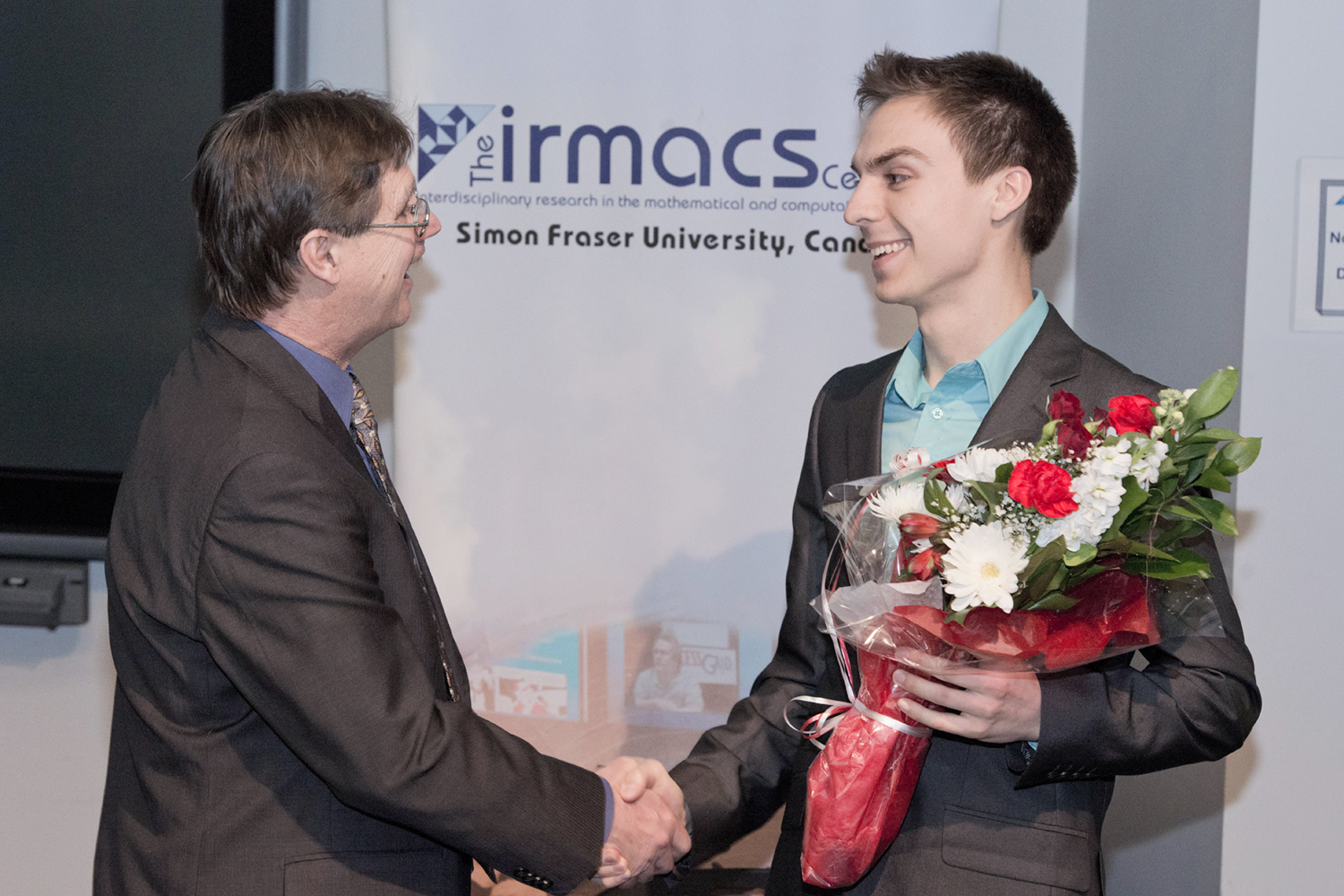
In just three short, action-packed minutes, SFU grad students were challenged to present the sum of their graduate work — no easy task. The SFU Three Minute Thesis Finals were held last Monday, March 10 in the SFU theatre.

The Three Minute Thesis (3MT) is a competition in which graduate students, from any program, prepare and present competing theses in a maximum of three minutes. Although it originated at the University of Queensland in 2008, at least 60 universities across the world have participated, with SFU being the fourth Canadian university to hold a 3MT competition.

The winner as picked by the judges, including SFU President Andrew Petter, will go on to represent SFU at the Western Regional 3MT Competition held in Calgary. First place also received a $1,000 prize, with second place earning $500 and third place receiving recognition.

One victor was chosen by the crowd (the People’s Choice winner) and was awarded $250.

Thirteen contestants entered the final round of the competition. It opened with Kimberly White, a Canadian geography student, who presented a thesis on how natural disturbances — specifically pine beetle infestations and wildfires — affect the lives of birds. She presented evidence that, after a wildfire, the bird population increases, at least in the short term. This is due possibly to increased exposure of insects after wildfires.


Though 3MT originated at the University of Queensland, at least 60 universities across the world have participated.


The contestants presented a diverse array of subjects, with topics ranging from biological studies to social issues. For instance, archaeology grad, Camina Manychief, presented on the possible benefits of cradleboards — a traditional device for helping mothers care for their babies — to the Blackfoot identity.

One thesis, by Vanessa Kong, on the importance of designing better public washrooms, suggested increased security in not only female washrooms, but male and unisex washrooms, so as not to discriminate.

Although contestants were limited to three minutes for their initial presentations, they were able to answer any questions related to their theses afterwards. However, the question period was not evaluated by the judges.

Some of the best questions came from fellow competitors. After Dominic Tresevan did a presentation on the difficulty of undergraduate programs, specifically STEM (Science, Technology, Engineering and Mathematics) faculties, Pradeep Reddy Ramana, a fellow presenter, questioned whether dropout rates were related to economic status.

In the end, final presenter Aviva Finkelstein, won first place for her thesis on portable x-ray fluorescence (pXRF) analysis —— the only “100% non-destructive” and cost effective way to determine the origin of artifacts. Used on human bones, it could help native families locate their ancestors.

“This method has yet to be tested on human remains, and that’s where my research comes in,” she explained. “I have had some promising results,” she added, remarking on the machine’s accuracy.

Allison Cornell and Bekka Brodie, both American biologists, took home second and third place, respectively, with Pradeep Reddy Ramana taking home the People’s Choice award.

Debatable Tweets

0

Hot Topic for the presidential candidates

Q:What is your position on the 10 per cent annual increase in international student fees?


Alexander: So we want to charge kids who don’t come from here more money. I’m not exactly against that. I think we should make it cheaper for people who are local, because they don’t have to pay for like airplanes and stuff. If you’re an international student and you can afford to fly here, you can pay 10 per cent more.


Brandon: This is a huge disconnect between the university and the student body and that needs to be fixed, especially considering that international students already pay three or four times more than domestic students pay. It’s kind of outrageous to hear that students who have already signed up to go to school here are now randomly going to be [signed up] to be paying more money over the next few years.


Chardaye:
I oppose increases to international student tuition so much so that I am doing something about it. So I made an announcement to the board, I attended a meeting with the vice-president, finance Pat Hibbits, I contacted the international students club, the international students group, I called people with the intent of forming a working group and there is now a grass-roots campaign that is being formed with SFSS advocacy.


Top Tweets 

Screen shot 2014-03-14 at 2.10.06 PM


Screen shot 2014-03-14 at 2.09.44 PM


Screen shot 2014-03-14 at 2.11.40 PM


Screen shot 2014-03-14 at 2.09.28 PM

Screen shot 2014-03-14 at 2.10.57 PM


Screen shot 2014-03-14 at 2.09.57 PM


Screen shot 2014-03-14 at 3.48.37 PM


Screen shot 2014-03-14 at 3.48.44 PM


Screen shot 2014-03-14 at 3.48.51 PM


Screen shot 2014-03-14 at 3.49.10 PM


Screen shot 2014-03-14 at 3.49.29 PM


Screen shot 2014-03-14 at 3.50.10 PM


Screen shot 2014-03-14 at 3.50.34 PM


Screen shot 2014-03-14 at 3.50.46 PM


Screen shot 2014-03-14 at 3.50.54 PM


Screen shot 2014-03-14 at 2.10.48 PM 


YWIB celebrates International Women’s Day

0

WEB-2010 YWIB-Jeremy Lim

SFU’s own Young Women in Business (YWIB) club held their fourth annual International Women’s Day conference at the Century Plaza Hotel in Downtown Vancouver. Attendees joined with women around the world in spirit to celebrate all that they have achieved and will achieve.

Beginning in 1911, the main goal of International Women’s Day has been to empower, encourage, and inspire. As designated by the United Nations, the day also examines political and human rights, and the current struggles faced by women internationally.

With powerful speakers, non-profit organizations and local entrepreneurs in attendance, the atmosphere at the conference was nothing short of inspirational.

From its early morning start, the event carried a simple and understated beauty. White tables filled the ballroom, accented with pastel dip-dyed flowers. YWIB explained that they strive to portray a sense of class and business professionalism, along with a welcoming atmosphere that instantly invites you into the YWIB SFU family.

The event was hosted by Lien Yeung of CBC radio, who kept things professional yet lighthearted. The keynote speakers for the day were co-creative directors of Dare Vancouver, Addie Gillespie and Mia Thomsett, “bully doctor” and life coach Dr. Valerie Mason-John, and the founder of Beauty Night Society, Caroline MacGillivray.

There was also a panel discussion made up of Jill Earthy (Canadian Youth Business Foundation), Suzanne Siemens (Lunapads), Paulina Cameron (YWIB; Canadian Youth Business Foundation), Jennifer Maloney (Yulu PR), and Chantelle Krish (YWCA Metro Vancouver).


Each speaker shared her definition of success, and often her path to finding it. 


This year, the event and all of the speakers focused on a theme of “Defining Success.” As the day progressed, it became clear that each woman in the room had her own unique definition of the statement, while also appreciating “success”, as defined by her peers. Along with career advice and personal anecdotes, each speaker shared her definition of success and often her path to finding it.

Mason-John captivated the audience with her personal struggle to finally acknowledge success in her own life. She said, “Once upon a time, I would have thought success was having the perfect body.” But after fighting eating disorders, she came to the realization that beauty is not the definition of success, and that true success is “being who you truly want to be.”

She warned that, “if you treat yourself badly, it is an open invitation for others to do likewise.”

Jill Earthy spoke of her personal definition of success as five distinct categories: “Work, community, family, friends and self. Success in fulfillment, not necessarily balance, in each of these categories.” Paulina Cameron, co- founder of YWIB, believes that success can be had in “surrounding yourself with people who know who you are and reflect your moral compass and principles.”

Leading the YWIB executive committee for this event was Sasha Rudenko, the IWD Chair, and her IWD organizing committee. After the event, she described the mood, saying, “Everybody was happy and inspired, and that was my real goal. It wasn’t [about] the amount of people. [ . . . ] The feeling I wanted to get was the inspiration and the empowerment to pursue whatever you want to do. It certainly met my expectations, exceeded them.”

Rudenko offered her own personal definition of success: “Success to me is being content within yourself. If you feel happy with what you’re doing in life, that’s what makes you successful.”

All in all, this year’s International Women’s Day conference proved why it is a highlight of the YWIB year, attracting students and community members alike, for a day of inspiration and a celebration of all that hardworking women can achieve.


Women’s soccer finds its new coach

0

WEB-Annie Hamel - Greg Ehlers

SFU women’s soccer has hired Annie Hamel as the second head coach in team history, after Shelley Howieson left the position earlier this year for a new role with SFU Athletics.

Hamel comes from across the continent to join the Clan, having spent the last five years as an assistant coach — three of which she served as assistant head coach — at St. Leo’s University in Florida, another NCAA Div. II school.

“For the last three years, I was taking on a really big responsibility. I’ve learned everything I needed to learn as an assistant, so it’s been an easy transition to step into the head coaching role,” says Hamel.

It’s been a long road back to Canada for the Quebec native, who began her coaching career as an assistant coach at the University of Maine in 2004, after graduating from the Div. I school.

Now she’s back in her home country, coaching Canada’s only NCAA women’s soccer team, albeit one that has struggled mightily since its first year in the American league.

“I know what it takes to win in this league, and quite frankly, we’re not there,” Hamel says. “But we’re going to get there. I’m 100 per cent confident in that, and so are the kids. It’s going to be difficult, and a lot of hours, but we’re going to build one day at a time.

“Pretty much everything is changing. The way we function, the way we operate. I’ve asked the girls for a bigger commitment, and they’ve responded very well. We’re doing things differently from top to bottom.”

Part of the change starts with recruiting. Hamel says she’s a bit behind the eight ball having joined the Clan just a week ago, and might not have the time to go globetrotting to bring in talent from other countries. Despite that, she says there’s plenty of untapped potential in SFU’s backyard.

“There is a lot of talent in British Columbia,” she says. “Whether or not we’ve been able to attract those kids in the past is another story, but I’m not going to shy away from anyone. If I see a player I like, I’m going to go after her.

“We have a unique experience here. No one else offers a Canadian education with an American playing experience,” she adds. “We should be able to get the best talent. I know I’m going to try.”

With an injection of future talent, Hamel is confident the Clan can right the ship that’s run aground over the last few seasons.

“Yea, we were at the bottom [of the GNAC],” she says. “But the gap isn’t that great. It’s not going to be easy to close it, but I’m confident our turnaround will be quick. We might not win the conference next year, but we’ll put ourselves a step in the direction towards that.”

Social Conservatism is a sham

1

bill SB 1062 celebration

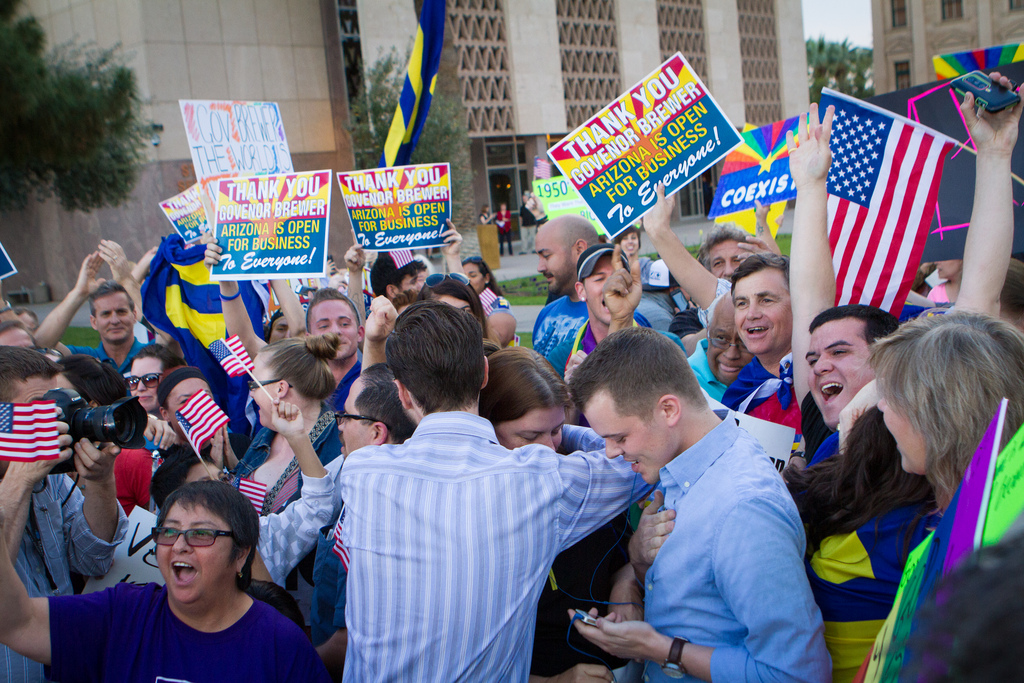
When the anti-LGBTQ legislation American Republicans championed in Arizona and Kansas, bill SB 1062, was rightfully rescinded, they quickly went on the offence. Bereft of allies due to their self-righteous “us against the world” mentality, these conservative thinkers lashed out against the Obama administration and social Liberals who they perceive as equally fascistic and morally decadent. Not onboard with their Judeo-Christian utopia/ America? Then you despise freedom itself.

The Arizona bill was “never about ‘discrimination’,” claimed Matt Barber for CNSNews.com — “it’s about liberty.” The liberty for Christian businesses to “[decline] their God-given time and talent to create goods and services that require they violate deeply held — and constitutionally protected — religious beliefs.” This is the crux of the argument. These people aren’t racists or homophobes, but they should be allowed their bigotry because freedom is messy, and this is ‘Murrica, man!

This willy-nilly mis-association of religious “morals” and political ideology was thrown in starker relief when CPAC, a Conservative super-conference, initially granted a booth to American Atheists (AA) before withdrawing it hours after being attacked by other members. But why? AA is a group that advocates reduced government, debt reduction and business friendly pay-as-you-go economic policies. They’re Conservatives. So why the complaints? Why did Brent Bozell, President of the Conservative Media Research Centre, label the invitation extended to AA “an attack on conservative principles [. . .and] God himself”?

What would Conservatives do if atheist business owners began rejecting their business?

David Silverman, President of American Atheists, explained in an interview with CNN that he wanted to question the ridiculous notion that political Conservatism ought to be tied to religion. “The Christian Right should be angry that we are going in to enlighten Conservatives,” he crowed. Apart from smugness, he broke no Commandments. Did God really like Atlas Shrugged? Surely he has better things to do than huff at CPAC’s inclusion of atheists?

Freedom of religious expression is an absolute — it enshrines an individual’s right to be. However, guaranteeing space to express one’s individuality through art, expression or sexuality is equally valid. Protesting that Christianity is under attack is the Religious Right’s newest deconstructive effort at being allowed to palatably legislate their archaism.

Legislative protection of bigotry and divisive individual politics is what this is, and it’s not healthy for society. If we embrace such anarchism, then what’s the impetus to build nations? Or offer government subsidized housing? Or tax rebates for small businesses? Legislative iniquities breed a corrosive environment. Conservatives such as those behind SB 1062 love to bandy ideas like forcing Christians to serve homosexual couples is equivalent to forcing an African-American owned photocopying business to print KKK fliers. But these Conservative-backed bills aren’t about protecting individual rights to expression or freedom. They protect Hate.

Religious faith carries no weight in constructing political policy, nor does ensuring religious freedoms mandate entrenchment of anti-social mandates. What would Conservatives do if atheist business owners began rejecting their business? What if we allowed ultra-orthodox Muslim cab drivers to refuse to serve single, unescorted women? Social conservatism is a flatly obnoxious sham that pantomimes individual beliefs as universal virtues.

Religion is a deeply profound interpersonal connection with God. It belongs in the private sphere. Let’s keep it there.

Stop Putin now

0

Shortly after the Olympics were held in Sochi, Russia, Russian military forces invaded the small peninsula of Crimea, a southern region of the Ukraine, without any authorization or impetus beyond sheer hubris and opportunism.

Since the Olympics, the spotlight directed at Russian President Vladimir Putin has grown much brighter on the international stage. He helped broker a peace deal with Syria, which only further entrenched the violent Assad regime, and has also orchestrated the most corrupt and expensive Winter Olympics, well, ever. With these actions escalating to a foreign invasion, the West’s response has to be proportionate to Putin’s brazen actions.

    Of course, this pattern is not entirely new. Putin, a former member of the KGB, has slowly but surely tightened his grip on power over the once-dilapidated former USSR. The result has been a somewhat stable Russian economy, built on an oligarchy and funded by oil from Gazprom, which has given Putin the room to convince the stalwart electorate of his legitimacy (although, the validity of the most recent elections are certainly in question).

If opportunities continue to knock, there is nothing to stop Putin from subjecting the Russian population to harsh injustices.

These developments have further enshrined his power and now, bolstered by such firm support, he has decided to take it to the next level: unauthorized, illegal invasions of other sovereign nations.

    The United States, perhaps the only legitimate force able to coerce Russia, has made an effort to affirm a strong posture in opposition to the invasion. They have discussed punishing economic sanctions, which would also impact a huge swathe of the EU, and some are calling for Western nations to refuse attendance at 2014’s G8 summit to be staged in Sochi, Russia.

These moves, which are quite similar to the weightless proclamations issued to Syria, reek of weak-kneed diplomacy and political theatre. Putin is a realist and an opportunist. Losing Crimea was a sore spot for Russians in 1992, and if they reclaim the small peninsula, it is yet another big political win for Vladimir Putin.

    Now, no one is asking for a war or armed conflict against Putin’s regime. If Iraq, Afghanistan, and Libya have proven anything, it is that intervention only leads to more civil strife and struggle. But we are dealing with an individual who has wilfully imprisoned contrarian journalists, marginalized LGBTQ groups, and has a litany of Human Rights Watch accusations. Now Putin has infringed upon the sovereignty of another nation and some are standing around either defending or validating such a decision.

    The Russian administration is operating in the real world, where power and money are motivating factors. The Western democracies, proponents of global justice and the proliferation of liberty, are standing at podiums and shuffling their feet. If opportunities continue to knock, there is nothing to stop Putin from continuing to abuse his citizenry, imprisoning people at his own will, and subjecting the Russian population to harsh injustices.

    If we are to stand by our principles as free nations helping others in need, we have to act in the real world with rigorous diplomacy and a show of force. A famous quote from Theodore Roosevelt could not be more relevant here: we need to “speak softly and carry a big stick.”