Home Blog Page 1149

Tippy Top Ten: Summer Classes

0

Here are the Tippy Top Ten Reasons Professors Hate Teaching Summer Classes…


10. Outdoor lectures no longer effective punishment

9. No chance to do any extracurricular firefly catching

8. Have to work with only burnout, skateboarder TAs

7. Can’t have barbecues without inviting entire class

6. Had plans

5. Shakespeare can’t compare with the Spiderman movie

4. Students clearly thinking about MLB regular season instead of lectures

3. Struggling with air conditioner takes valuable time away from struggling with Powerpoint

2. Elbow patches look ridiculous without sleeves

1. Beach-bod going to waste on a bunch of nerds

Mental Alopecia #2

0

SFU faculty push to unionize

0

CMYK-Facutly union-Flickr-Alejandro Maija Greene

The SFU Faculty Association (SFUFA) is pursuing certification, which would make the SFUFA a bargaining unit recognized by the BC Labour Relations Board. This move follows in the footsteps of the University of Victoria, whose faculty association voted to unionize on January 24.

According to SFUFA president, Neil Abramson, the SFU administration currently allows the SFUFA to bargain on behalf of professors. However, that power is dependant on SFU administration and could be revoked.

“The issue about where you get your power from is that if your power comes from the university administration and they might get seriously pissed off at you, they could withdraw that [power],” said Abramson. “Whereas if you’re a union, you’re recognized by the Labour Relations Board.”

However, he is careful to point out that the push for certification is not due to a strained relationship with administration, or animosity, as was the case with UVic: “We have a very positive relationship with our administration, and we’ve had the whole time I’ve been involved, which is about 17 years now.”

Abramson added, “We’re not doing it because we’re unhappy about what the administration is doing; we’re doing it because our administration just doesn’t have the horsepower to help us.”

However, he does lay some blame on the Public Sector Employers’ Council (PSEC), the provincial regulatory body in labour relations.

Abramson noted that he was initially against certification and had tried to negotiate interest arbitration — in which an arbitrator can pick a compromise between the two sides — rather than having to choose a side, as SFU currently must. Allegedly, SFU administration was willing to accept, but PSEC proposed conditions that were unfavorable.

“We’re doing it because our administration just doesn’t have the horsepower to help us.”

– Neil Abramson, SFUFA President

“All of administration supported us [. . .] about interest arbitration but they had to confirm with PSEC whether that was a possibility or not and they said yeah [. . .] but one of the factors has to be that they absolutely can’t go any higher than what PSEC has dictated,” said Abramson.

He added, “Our lawyers said don’t take that because that’s even worse than what you got now.”

In a statement released online, SFU vice-president, academic and provost Jonathan Driver said that SFU administration has taken a neutral position on certification. “The relationship with SFUFA has been one of cooperation and mutual respect and, regardless of the outcome of this process, the administration remains committed to ensuring it remains so,” stated Driver. However, he said certification “would put the relationship on a different legal footing.”

Said Abramson, “Nothing is likely to change except we will have some extra places [where] we can talk to [the administration] and ask them to listen to us.”

Unionization was first brought up in a SFUFA meeting last spring, and now it appears that most faculty are behind certification. In an electronic poll over Christmas, 45 per cent of faculty voiced their opinions on the issue, as compared to the 35 per cent estimated to respond. However, Abramson believes that 10 to 15 per cent of faculty could be against unionization.

Although the SFUFA were initially planning to vote in the fall, they have decided to do so sooner. Abramson is hoping to be certified by June, with a vote by the end of the month, but the vote itself is up to Labour Relations. “We’ll see what happens,” he concluded.

National parks should be WiFi-free zones

0


WEB Cell phone park-Flickr-MTSOfan

As warm weather and sunny skies appear, more campers and hikers prepare for weekends away from the daily grind. However, by the end of the summer, as many as 50 national parks could be WiFi enabled.

According to Andrew Campbell, director of visitor experience with Parks Canada, the inclusion of WiFi in parks is meant to attract youth as well as help adults stay connected with work and social life while away. The project promises to only include the installation of WiFi around campgrounds and information centers. Regardless, WiFi in national parks is a step in the wrong direction that comprises a major reason city folk flock to the great outdoors: to escape the Internet.

In their efforts to sustain a peaceful and enjoyable atmosphere, Parks Canada has forgotten their own mandate which is to “protect and present nationally significant examples of Canada’s natural and cultural heritage” (The Parks Canada Charter). WiFi capabilities endanger the environment they have set out to protect. Nothing about tablets and smartphones exemplifies Canada’s natural heritage, nor should it represent our cultural heritage.

By installing a virtual way out of the woods, many people will succumb to the temptation of Facebook, email, and Netflix.

Staying plugged into the city life while away will hinder the experience of campers and vacation seekers. Being in the woods with no reception forces campers to relax and families to spend time together. By installing a way out, many people will succumb to the temptation of Facebook, email, and Netflix. National parks would no longer be places of refuge for those who wish to be temporarily disconnected from the outside world.

Campbell claims that younger generations will feel more compelled to make the trip out of the city to experience the campgrounds if they feel they can continue to communicate with friends back home. But by letting web connectivity control the enjoyment of the youth, part of the purpose of making such a trip is defeated.

Parks Canada needs to focus on their primary commitment to Canadian citizens: the protection of our wilderness and historic sites. It seems as if they have lost focus, becoming too tangled up in the modern world. The time and money spent on this counterproductive project could be better spent on conservation and maintenance of national sites.

Ultimately, Parks Canada is pursuing a contradictory project. It is not aligned with the mandate that the organization has prided themselves on in the past, and should be reconsidered before investing excessively in the installation of WiFi on campgrounds.

Parks Canada, acknowledge and respect the negative outpour of frequent and seasonal campers. Making campgrounds web-accessible hardly acts in the best interest of Canadians and our parks.

Former SFU employee pleads guilty to fraud

0

WEB-Greedy Saidi-Flickr-Andreas
Siamak Saidi, former SFU director of finance, has pleaded guilty to the charge of fraud against SFU.

He was charged with defrauding the university of over $800,000 and, after one year in custody, has been sentenced to four more. In addition to his four-year sentence, Saidi has been ordered to pay a restitution of $50,000 to the university.

The money was funnelled out of the Faculty of Science. An internal audit showed that over the two years Saidi spent in his position, he processed over 500 false invoices from companies of which he was a director. His actions were discovered by a new manager only after he had left the job.

Saidi has also pleaded guilty to another count of fraud of against the Cultus Lake Park Board of which he is now a former employee. Records show that he siphoned approximately $10,500 in HST funds from the board.

Saidi’s lawyer, Larry Gold, told CBC, “The crimes that he plead guilty, they were serious, they involved a lot of money and a fair amount of planning.” Gold also said of Saidi, “He’s a man in his middle 50’s who hasn’t really got a lot to look forward to when he comes out.”


Staff raise concerns over toxic mould

1

WEB-Mould-2

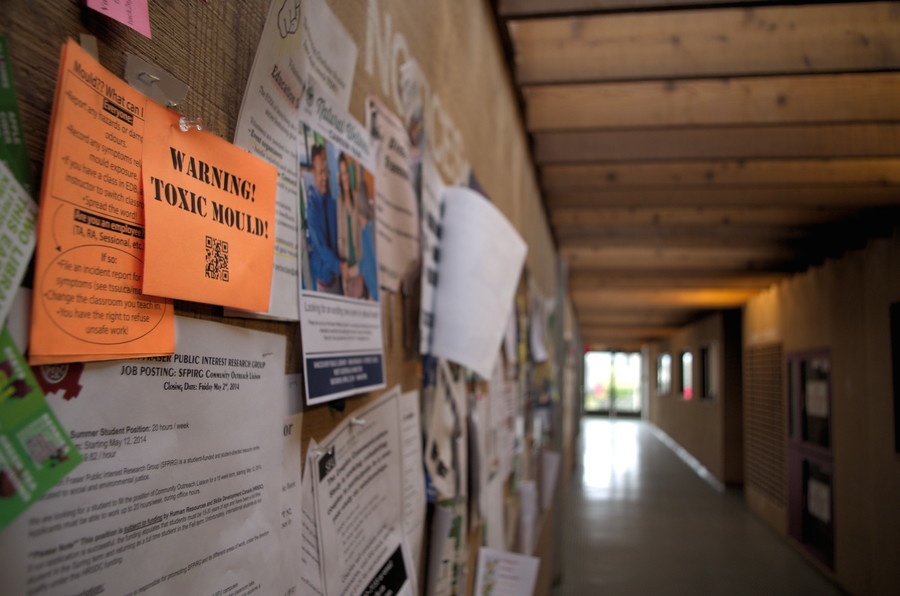
Close on the heels of the Graduate Student Society’s (GSS) deferred maintenance campaign, which strove to create awareness around SFU Burnaby’s aging infrastructure, the Teaching and Support Staff Union (TSSU) is calling attention to potentially hazardous toxic mould in Burnaby’s education building.

The University held a town hall meeting on the issue on March 17 and the TSSU held an event on May 5 to discuss the possible health concerns for staff and students working in the area, and what action should be taken by the university. According to TSSU spokesperson Melissa Roth, the TSSU’s recent event was a great success. “We spoke to more than 200 people easily from every group on campus, [and] totally covered the education building in posters [. . .] detailing symptoms of exposure.”

Roth has spoken publicly on the issue, and articulated concerns at the town hall meeting that the health of staff has already been seriously affected by the mould. As reported the Burnaby Newsleader, Roth provided an anecdote of another SFU union member who said that they had worked in the education building for 20 years, and had experienced symptoms of exposure to toxic mould for much of that time.

In an official release, Roth criticized the breakdown of communication and lack of action from the university on the issue. “Even though some of our members have reported adverse health effects from working in the education building during this time, the union has not received any official communications in 1.5 years as to the extent of the problem.

She continued, “We are disappointed but determined to solve this problem to ensure that our workers have a safe work environment in the future.”

According to Terry Waterhouse, SFU’s chief safety officer, the mould problem is indicative of moisture seeping into the 40-year old building, a fact that the university discovered over the past two years.

Waterhouse, who spoke to the Burnaby Newsleader, said that the water damage has affected the structure of the building along with creating the mould and affecting indoor air quality. The extent of the problem will not be known until June, when assessments have been completed. However, work to fix the problem began approximately a year ago.

Waterhouse also refuted the TSSU’s claims of poor communication, saying that the university has “communicated broadly” with users of the building, disseminated information about the work being done, and held a town hall meeting in March.

The university receives $2.2 million annually from the provincial government for maintenance, although required yearly maintenance costs are estimated at $20 million. In 2011, the university’s Five Year Capital Plan reported that 53 per cent of the campus’ buildings are in poor condition, while another 27 per cent are ranked fair.

TSN needs to stop neglecting the NHL

0

Mr. Ovechkin...The Stanley Cup Playoffs are Calling

If you’ve read many of my articles, you’ve probably deduced that I am a hockey guy.

That being said, since the Canucks season ended, I have been catching markedly fewer games despite the playoff action. However, one of the games I decided to watch was the Anaheim-Dallas game six, an elimination game (although it may have had something to do with fact that my favourite goalie Roberto Luongo was on the TSN panel).

Much to my chagrin, though, the Toronto Raptors game was on the main TSN network, ahead of NHL playoff hockey. The Anaheim-Dallas game was left to TSN2, and also was put behind the Telus Cup, a minor league hockey tournament, while waiting for it to finish in triple overtime.

First of all, I would have to imagine that anyone in Canada, except maybe Toronto or the GTA, would prefer to watch the NHL playoffs over the NBA, no matter how much a Toronto-based sports network wants us to believe that the Raptors are Canada’s main team.

I realize the game showed was Anaheim and Dallas, two of the bigger teams in the league. But at the end of the day, any hockey beats basketball, at least here in Canada.

Even if putting the NBA over the NHL was a valid choice, I would rather cheer for any team but Toronto, perhaps Memphis or Oklahoma, former home teams that moved from Vancouver and Seattle. You can put this down to my Toronto-phobia, but this does not seem limited to me.

If no one wants to watch the Telus Cup in person, I cannot imagine any TV audience.

Most people outside of Toronto surely share my opinion, in line with the attitude that spurred TSN’s mocking nickname ― the “Toronto Sports Network” ― for its heavily Toronto-biased reporting.

Second, it is silly that the Telus Cup bumped the game on their second network. TSN seems to believe NHL playoff hockey is barely worthy of being on their secondary channel.

I feel bad when I say this, because the Telus Cup is for kids. For kids to get that kind of exposure is kind of awesome; all the power to these players. But at the same time, the arena was empty. If no one wants to watch it in person, I cannot imagine any TV audience watching the event.

I cannot be the only one who wants to watch playoff hockey. I would imagine I was not the only fan disappointed to see the NHL playoffs neglected in favour of not one but two other programs.
At least now that the Raptors are out, hopefully, TSN will provide some better playoff coverage.

Weekly List: The 10 Best Batman Stories

0
Note: The Weekly List is a new feature for The Peak where we count down the Top 10 of anything and everything. Check back for a new list every week.

10. Year Zero

3195605-4856054162-Batma

2013–present | Written by Scott Snyder and James Tynion IV | Illustrated by Greg Capullo and Rafael Albuquerque

This one comes in at the bottom of this list simply because we’re still waiting for the final chapter in this trilogy that has been showing us the origins of the Dark Knight in the New 52, an ongoing relaunch of DC Comics which began in 2011. It is a great retelling of Batman’s origin story, as he slowly develops into the character we’ve known for years.

9. Gotham by Gaslight

batman-gotham-by-gaslight-048

1989 | Written by Brian Augustyn | Illustrated by Mike Mignola

The first of the Elseworlds comics, Gotham by Gaslight reimagines Batman in 1889, where he does battle with Jack the Ripper even as Bruce Wayne is accused of being the infamous serial killer. Its success launched an entire sub-genre of DC Comics in which the characters exist in entirely alternate worlds. A must read if you’re a fan of the steampunk genre, or Mike Mignola’s work with Hellboy.

8. A Death in the Family

Death-In-the-Family

1988–1989 | Written by Jim Starlin | Illustrated by Jim Aparo

This arc remains a significant milestone in the world of comics, featuring the death of Jason Todd, Robin #2, at the hands of the Joker. For the first time, we see Batman willing to cross the line set by his moral code and end the threat of the Joker once and for all. This death affected Batman for years, and even in the modern comic series, Jason’s death is considered a moment in Batman’s life almost as the death of his parents.

7. Requiem for Damien

GalleryChar_1900x900_DamianWayne_52ab7536d3f7a0.28359128

2013 | Written by Paul Cornell, Peter Tomasi, Judd Winick | Illustrated by Scott McDaniel, Patrick Gleason, Guillem March

If the death of Jason Todd affected Batman over the course of several years, one can only imagine how much the death of the most recent Robin affected him, as that Boy Wonder was none other than Damien Wayne — his own son. This story arc gives us an insight into the suffering of both the hero Batman and the man Bruce Wayne; it shows him going through the stages of grief as he struggles to deal with the loss, not only of another partner, but of his child. This arc reminds us that, behind the mask and utility belt, Batman is a human being.

6. Arkham Asylum: A Serious House on Serious Earth

batman-arkham-asylum-wallpaper-322

1989 | Written by Grant Morrison | Illustrated by Dave McKean

Fans of the 2009 video game Batman: Arkham Asylum will recognize this comic even if they’ve never read it, as it was used as a primary source for the game. It’s a psychological thriller, made all the creepier by Dave McKean’s distinctive art style. The Joker takes the staff of the titular asylum hostage and runs Batman through a gauntlet of his foes, all in an effort to show that Batman is just as crazy as they all are. In the novel’s famous conclusion, the Joker tells Batman that there’s always room for him in Arkham.

5. Batman: The Killing Joke

ha-ha

1988 | Written by Alan Moore | Illustrated by Brian Bolland

Considered by many to be one of the best Joker stories out there, The Killing Joke is the closest thing we’ve ever gotten to a Joker origin story, though the character has suggested he prefers his past to be “multiple choice”. The Joker kidnaps and tortures Commissioner Gordon, in an attempt to show that anyone can go mad after a bad day. This story really hit home the concept that Batman and Joker are two sides of the same coin, born out of tragedy, and that the difference between them is much smaller than either one realizes.

4. Death of the Family

2871519-batman_17_pg_021

2012–2013 | Written by Scott Snyder, Adam Glass, Kyle Higgins, John Layman, Scott Lobdell, Ann Nocenti, Gail Simone, Peter Tomasi, James Tynion IV | Illustrated by Greg Capullo, Eddy Barrows, Ed Benes, Brett Booth, Fernando Dagnino, Jason Fabok, Patrick Gleason, Jock, Timothy Green, Rafa Sandoval

One of the many Batman stories that crosses between multiple comic series, Death of the Family highlights the return of the Joker to the New 52 a year after his departure, as he systematically torments the members of the Bat-Family in an effort to eliminate all of Batman’s partnerships — which he sees as a weakness. In addition to Joker’s return, this story also showed that, despite his friendships and partnerships, Batman’s greatest weakness remains his inability to trust those around him.

3. Tales of the Multiverse: Batman–Vampire

batman-crimson_mist_pgokae

1991, 1994, 1999 | Written by Doug Moench | Illustrated by Kelley Jones

My personal favourite Elseworlds story, this unique arc imagines Batman turned into a vampire in order to combat Dracula, who has come to Gotham in search of new feeding grounds. Though Batman has often struggled with his moral code regarding killing, this collection adds another dimension to that struggle, as he must fight his desire to feed even as he continues to serve as Gotham’s protector.

2. Batman: Knightfall

1627460-dcul_7__005

1993–1994 | Written by Chuck Dixon, Jo Duffy, Alan Grant, Dennis O’Neil, Doug Moench | Illustrated by Jim Aparo, Jim Balent, Eduardo Barreto, Bret Blevins, Norm Breyfogle, Vincent Giarrano, Tom Grummett, Klaus Janson, Barry Kitson, Mike Manley, Graham Nolan, Sal Velluto, Mike Vosburg, Ron Wagner

The introduction of the superstrong genius Bane was one of the most shocking events in the world of comic books, especially coming after the death of Superman only a year before. Everyone knows Bane as the supervillain who broke Batman’s spine, but many do not realize that he also orchestrated the breaking of his spirit, burning him out by forcing him to battle most of the villains in his rogues gallery before ambushing him at Wayne Manor. In the aftermath of these events, Batman takes a year to recover, while a reckless protegé takes his place.

1. The Dark Knight Returns

Batman-The-Dark-Knight

1986 | Written by Frank Miller | Illustrated by Frank Miller and Klaus Janson

In addition to being a major influence on both Tim Burton’s and Christopher Nolan’s Batman movies — as well as being arguably the best-written Batman arc — The Dark Knight Returns has often been credited with saving the character, as DC was considering cancelling Batman during the 1980s. The story focuses on a retired Batman at the age of 55 returning to save Gotham, which has become overrun by gangs in his absence. Several scenes from the film The Dark Knight Rises were pulled straight out of the pages of this comic, showing just how long its impact has lasted.

DOXA is full of secrets and lies

0

DOXA fest

“Documentary in Canada is in an embattled moment,” explains Dorothy Woodend, director of programming for DOXA, Vancouver’s documentary film festival. There was a time when National Film Board (NFB) short films were played before Hollywood blockbusters at the local cinema, but it is a time most likely forgotten. For Woodend, the decline of Canadian film and documentary is detrimental to the country; “It feels so insidious,” she said, describing the gradual crumble of the support for Canadian film institutions such as NFB.

This year DOXA presents the world premiere of Shameless Propaganda, an NFB film about, well, the NFB. For its 75th anniversary, the film documents the work of this important Canadian institution, including profiling one of its most important leaders, John Grierson.

“[Shameless Propaganda] is a real celebration of Canadian and B films,” said Woodend. “You forget how left-leaning and radical the NFB once was, under Grierson.” She describes the film as humorous in many parts, affectionate, and presenting Canada in a way we can all be proud of, reminding us why these kinds of organizations are important: “It’s about what Canada really is.”

The current “systematic dismantling of ideology” is such a shame because Canada has been a leader in the art of documentary films. “Other countries look to the NFB,” explained Woodend, “they set a precedent for documentary practice.” With these institutions receiving less and less funding, it’s harder to access Canadian films. “That’s why it’s so important for DOXA to show as much Canadian film as possible,” said Woodend.

 “You forget how left-leaning and radical the NFB once was, under Grierson.” – Dorothy Woodend, Director of Programming

While Canadian film in general is struggling, DOXA is getting bigger each year, with over 1,200 submissions this year and a program of over 100 films. “We look very hard for Canadian films,” explained Woodend, “and we want to include as much Canadian and local content as we can.” This year’s closing night film is Vancouver filmmaker Brent Hodge’s A Brony Tale, a film about the male fans of My Little Pony. Woodend said it’s very nice to be able to close the festival with something Canadian and more importantly local.

One broad theme of this year’s festival is Secrets and Lies. Inspired by the recent news of Edward Snowden and the many references to surveillance culture, Woodend said this theme went in many directions from there as all kinds of films were submitted.

The selections to be featured at the festival include John Lundberg, Mark Piklington, Roland Denning and Kypros Kyprianou’s Mirage Men, a film about the FBI infiltrating a UFO community. Woodend also highly recommends Anna Odell’s The Reunion which she said is “a bit wild” and deals with high school revenge.

Selecting all the films for this festival is not an easy task, and the volunteer screening committee spends many hours watching all kinds of documentaries. The open call for submissions each October allows almost anyone to submit their film with a low cost entry fee of $15. The goal is to always keep the barriers to accessibility very small and Woodend said it’s nice to be able to discover talented emerging filmmakers. “You want to discover their first films,” she said.

Over the years, much has changed at the festival, including the way the committee watches each submission. “When I first started at DOXA, we received all the submissions as VHS tapes,” said Woodend. “This year almost every film was sent as an online screener,” but she said this major shift to online has only happened over the past six months. Processes must be constantly reinvented with the technology changing rapidly.

Canada’s largest documentary festival, HotDocs, just concluded in Toronto; Woodend explained that DOXA is different in many ways. “DOXA is not an industry festival,” she said, so people aren’t trying to buy and sell films. It’s also much smaller than HotDocs and is an audience driven festival. “Vancouver is not Toronto,” said Woodend, “the industry and audience is much smaller, but that doesn’t mean it’s any less valuable.”

When filmmakers come to DOXA, the goal is more about appreciating film with the audiences and networking with the other filmmakers, rather than pitching their own films. The humble DOXA always tries to maintain the ethos of its origins: a documentary festival with a focus on social justice and grassroots activism that promotes local and national films.

DOXA runs May 2 to 11. For more information, visit doxafestival.ca.  

SFU Burnaby road construction enters Phase 2

0

WEB-Road Work

As construction began on the second half of Phase 1 of SFU’s 2014 Roadway Improvement Project, the plan to replace SFU Burnaby’s 50-year old roads also moved into its second phase on April 28. 

Initially estimated to begin in May or June, construction on Phase 2 officially began on Thursday, May 1. This phase, which will overlap with the last half of Phase 1 and first half of Phase 3, will see major reconstruction on Gaglardi Way from the intersection of South Campus Rd northbound to the three-way intersection at University Drive. Construction will therefore involve traffic underneath the transportation center.

Director of parking services, David Agosti, does not anticipate major inconveniences to students. “Phase 2 is just sort of uncomfortable pieces rather than major changes,” he said.

This phase will also involve University Drive from the three-way stop at Arts Road westward to the intersection of West Campus Road, near Residences. Construction on these areas is expected to last until the end of August.

The project was implemented to tackle the growing issue of poor road conditions on SFU’s Burnaby campus; the roads have not been replaced since the university first opened in 1965. Furthermore, the university hopes the improvements will create better pedestrian and cyclist access to campus, make navigation around campus easier, and allow for future development on the west side of campus.

“Phase 2 is just sort of uncomfortable pieces rather than major changes.”

– David Agosti, director, parking services

Phase 1 of the Roadway Improvement Project saw the closure of northbound Gaglardi Way up until South Campus Road, with traffic redirected along University Drive East. According to Agosti, “Everything has been fine. We don’t have any lost buses or anything along those lines. Everything has been happening as anticipated.”

One of the greatest successes of Phase 1, according to Agosti, was the ability to reroute the buses to leave campus via their normal route, despite closing off the residence bus loop. “That made life a lot easier for a lot of the students in residence,” he said.

In order to minimize congestion and traffic complications, Phase 2 will occur in a series of “sub-phases.” Parking services expects there to be at least a half-dozen of these sub-phases, during which one section of the road will be worked on at a time. 

This phase should not involve any road closures or significant traffic pattern changes. However, there will likely be single lane traffic, gravel roadways, and the closure of certain access points.

“The down campus buses for a period of a week or two may use that other bus stop adjacent to the library rather than the one adjacent to the island,” said Agosti. However, students will be most affected when Phase 1 ends and or Phase 3 starts.

“When Phase 3 starts, [the residence] bus stop will be out of service because the road will be closed from there down,” said Agosti.

Parking Services expects Phase 1 to end on schedule on July 1, when construction will shift and continue southbound West Campus road all the way to the main Gaglardi intersection for Phase 3. At this time, northbound West Campus road is expected to be open.