
Hunger Pangs (by Phoebe Joy Lim)


The Adventures of Agoraphobia Man: World Defender (by Jacey Gibb)

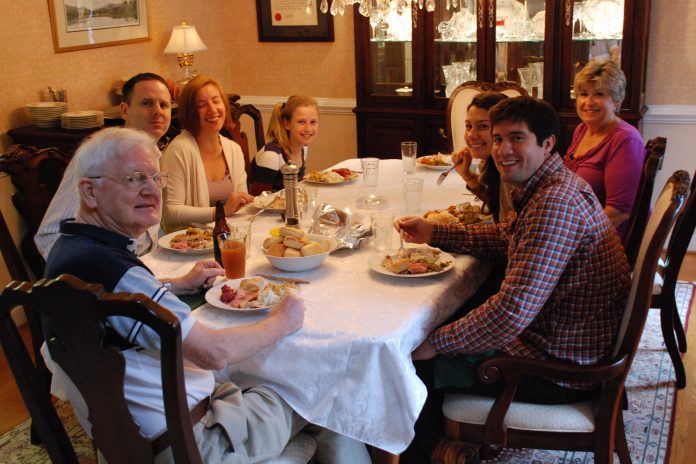
Citing little more than a close geographic proximity and having several genes in common, the Thurstons and their extended family came together on October 13 to argue around a dining room table, punctuated by intermittent periods of eating turkey.
“Everyone’s so busy off doing their own thing,” explained Mr. Thurston, between courses of delicious family gossip, “so it’s really great whenever we can come together and really get under each other’s skin. Yelling at each other over the phone just isn’t the same.
“The great thing about family is that we’ve all known each other for so long that we never run out of skeletons to bring up or things to complain about. We can be as cruel and unforgiving in our table talk as we want without fear people will resent us because, well, we’re family. We’re stuck with each other regardless of what happens.”
The excessive feast — prepared almost entirely by Mrs. Thurston over 12 gruelling hours, who wished to offer her thanks to “no one” for helping — went largely unnoticed as most family members took the opportunity to air grievances they’d been simmering over since April.
Mr. Thurston continued: “We only get together a handful of times throughout the year. Christmas, Easter, Thanksgiving. That’s not a lot of chances to make off-handed comments about who’s raising their kids better, or subtly bring up who makes more money. Holidays are really all about family.”
Thanksgiving — a holiday meant to commemorate early Pilgrims who came to America in the 16th century — is traditionally celebrated in Canada by eating too many buttered up carbs and consuming processed foods to the point of exhaustion, followed by accidentally falling asleep on the couch while everyone makes surface-level small talk.
While having an uncle get blackout drunk during the festivities is also a tradition at Canadian Thanksgivings, the Thurstons opted not to have one this year and simply didn’t invite Uncle Richard.
Though tensions remained high for most of the gluttonous feeding period, family members agreed that the turkey “wasn’t as dry as last year” and that the ritualistic offering would be enough to quell their inevitable self-destruction until the next gathering in December.
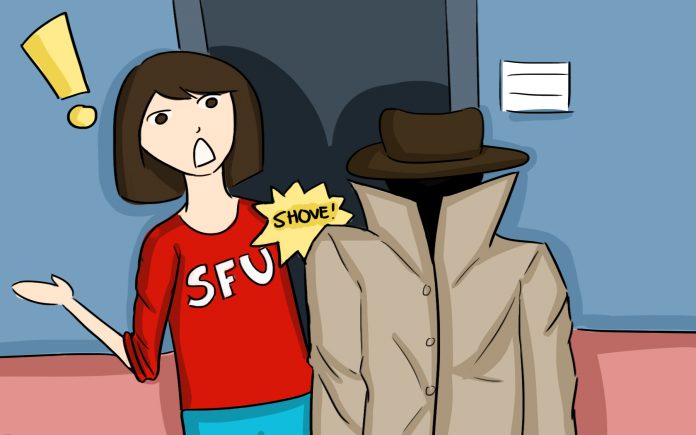
The Shoulder Bump Bandit — an evil, apparently-in-a-rush mastermind who has been terrorizing SFU since September — has struck again.
This is the fourth attack on the SFU populace, and it would seem no one is safe. The latest attack conformed to the pattern seen in the first three, as the Bandit seems to prey entirely on random passersby. He or she walks past the victim in a hallway, stairwell, or classroom and bumps into them, shoulder to shoulder; by the time the victim has looked up, turned, and issued an apology, the Bandit is gone.
The most recent victim, Terrence Chin, bravely came forward to The Peak to share his story — as well as issue a warning:
“I was cruising Tinder and walking at the same time when, all of sudden, my shoulder hit someone else’s. I reeled backwards and turned to apologize excessively, like any normal person would, but whoever bumped into me was gone. No apology. Just gone.”
Though Chin suffered no immediate physical injuries, he believes emotional scarring may be a long-term effect of the incident.
“Anyone reading this, please remember to keep your head up while walking,” encouraged Chin, “No one should have to go through what happened to me. No one.”
Despite frequency and severity of the attacks, university security have no leads and little information to go on.
“We’ve never seen anything like this,” said Don Branch, head of SFU security. “You bump into someone, you both apologize automatically without even thinking about whether it was your fault or theirs. That’s just what you do.”
Eyewitness accounts of the Shoulder Bump Bandit vary, with the suspect between 18 to 54 years of age, male or female, and 5’5” to 6’4”. Based on the information they have, security officers are fairly certain that this is probably “the work of a human . . . or maybe a really smart dog or something.” While the sex and canine-nature of the Bandit remain unknown, all witnesses have confirmed that the Bandit is “super rude.”
Branch also told The Peak that security has reached out to surrounding law enforcement agencies to expand the effort and hopefully bring the Bandit to justice.
“We are aware of this heinous crime and we are taking it very seriously,” said Kathryn Cahtz, a representative for local police. “This is Canada. We, as a country, would fail if people didn’t apologize after bumping into each other or awkwardly stand in front of doorways while we take turns offering to let someone else go through ahead of us. These are the foundations that our nation sits upon.”
Police have also begun contacting universities south of the border for a third-party perspective, theorizing that the Bandit could possibly be an international student and entirely unaware of apologetic Canadian customs. Responses thus far have been unhelpful, though, as any feedback about how to catch someone bumping shoulders without saying sorry has largely been met with, “Are you fucking kidding me?”
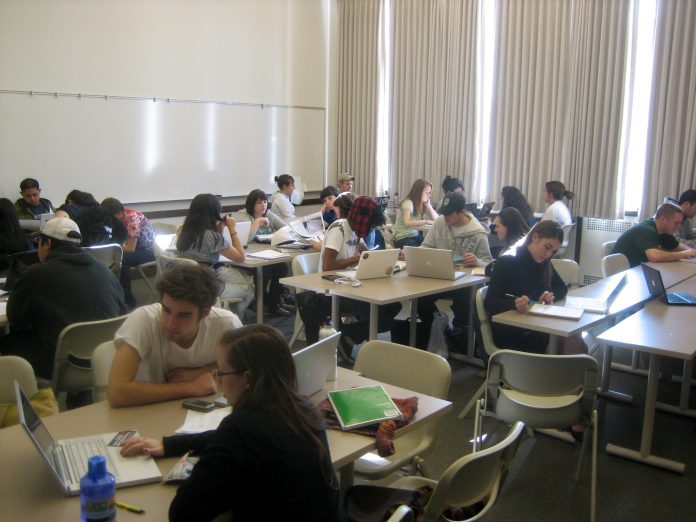
Now, I trust you’ve all looked over the syllabus and the academic honesty outline I posted prior to this class. Any questions? No? Good, then let’s talk about the group project assignment due in November.
I know most of you hate group projects — and why wouldn’t you? Being partnered up with three to four other university students who are as disorganized and busy as you are? It’ll feel like an assignment just trying to find a time when you can all meet for an hour. Don’t worry, though. Someone will inevitably sleep through their alarm, fake sick, or get called into work, so none of that planning will have really mattered.
To give you a bit of flexibility, I will let you pick your own groups so you can decide for yourself who you want disappointing you come the assignment’s deadline. I know we just started the course so you don’t really have a sense of which of your classmates you like/dislike yet, but doesn’t that just make it more exciting?
That person you’ve said one sentence to sitting beside you? Now’s the time to decide if you want to enter in a several months-long pseudo friendship with them. They might seem nice enough, but what if they don’t even have a Gmail account? You’ll try making a Google doc for the project but they won’t be able to access everything properly because they have a Yahoo email or some bizarre shit like that. Who has a Yahoo account in 2014 anyways?
Picking your group members is like Russian Roulette, but it’s worth 15 per cent of your grade — and who doesn’t love Russian Roulette?
There are four components to the assignment. The first will consist of you and everyone else in your group pushing the assignment back to the very farthest reaches of your mind. Let’s be honest here: it’s not due until November, which might as well be next year. Wouldn’t you rather hang out with your friends or do something for enjoyment instead of work on this silly, old assignment? Just relax and forget about it for now.
The second part of the project will involve everyone scrambling to come up with something last-minute. This section will include skimming the secondary reading on the bus on your way to SFU, waiting around for everyone to show up, and gradually losing what remained of your faith in humanity.
The third part of the project will be a powerpoint presentation for the rest of the class. Attention-wise, I know slideshows are the equivalent of shooting holes in a dingy and asking someone to boat across the ocean, but they’re easy to make and even easier to tune out. Your classmates will enjoy the extra time to spend discreetly texting underneath the table.
The last part of your assignment will be an individual essay, three pages, double-spaced.
As people in the 17 to 65 age bracket, it’s crucial that you all learn to work together and thrive in a group setting — even if that kind of consonance is pure fantasy. People rarely get along in these kinds of situations, regardless of whether they’re for academic purposes or in the real world, but that doesn’t mean we’ll stop forcing those values onto you regardless.
But don’t you worry though. I’ll make sure that everyone in your group is marked equally and fairly, no matter how little time and effort some of members contribute.

The umbrellas, for a brief moment, folded. For many, the largest protest in China in 25 years were as good as finished, and citizens and students alike returned to the hustle and bustle of everyday life in Hong Kong. Small groups punctuated city streets and government buildings, but the throes of thousands passionately protesting for change had dissipated. The government had promised talks with pro-democracy leaders, and the promise of change seemed within reach.
But on Friday, that promise broke through — thousands once again flooded Hong Kong’s twilit streets, in response to the government calling off the talks they had promised only days earlier. “Our Hong Kong, ours to save,” they chanted, proving that a protest many had written off had only just begun.
The story of Hong Kong’s fight for universal suffrage bears many resemblances to public demonstrations both recent and historical — the Arab Spring comes to mind, as does China’s own Tiananmen Square demonstrations a quarter century earlier — but it’s also been a protest which could only have occurred in the present day. Using the tools of social media and the internet, a new generation of Hong Kongers are making sure that the world is watching as they fight for the rights they feel entitled to.
We Canadians could learn a thing or two.
***
To understand the protests in Hong Kong, it’s necessary to have a basic understanding of the city’s recent history.
For 150 years, Hong Kong was a British colony. It wasn’t until 1997 that Hong Kong was formally reintegrated into China, and with several caveats: namely, the preservation of the rights and freedoms which are restricted on the mainland, such as freedom of press, freedom of religion, a free market, and a Western-style democratic government.
This ‘one country, two systems’ strategy has since been both one of the most unique and frequently challenged balances of power in the world — Hong Kong’s delicate mix of Western and Eastern cultures is a constant source of anxiety for the Chinese government, who fear that the region’s democratic values will eventually spread to the mainland.
“There’s amazing connections between Hong Kong and Canada. What happens there can have a huge effect on us here.”
When the United Kingdom and the People’s Republic finalized the terms of Hong Kong’s handover, they jointly drafted a new constitution for the region, known as the Basic Law. Among other democratic freedoms, the law promised that Hong Kong residents would eventually be able to elect their own chief executive officer by popular vote. In 2007, a decade after Hong Kong rejoined China, this clause was finally agreed to by the Chinese government: in 2017, they claimed, Hong Kongers would finally be able to vote in their own representative. One person, one vote.
As you may have guessed, there’s a catch. On August 31, the Chinese government clarified the fine print of their previous promise. Before appearing on a ballot, each candidate must first be approved by a group of pro-Beijing loyalists — essentially, the same process through which Hong Kong’s previous leaders have been chosen.
Politically, Hong Kong is split into two groups: pro-Beijing royalists and pro-democracy regionalists. The former currently constitutes the majority of Hong Kong’s electoral committee, which was in charge of electing Hong Kong’s leaders — including incumbent Chief Executive, Leung Chun-ying — without any input from the people. The announcement that the predominantly pro-Beijing committee would play a role in a supposedly ‘democratic’ election was met with serious backlash from pro-democracy activists, most of whom are either professors or students in Hong Kong’s secondary schools and universities.
It doesn’t help that, despite Hong Kong’s status as the world’s third-most prominent financial centre, its population of over seven million has one of the highest levels of income inequality in the world. Many young people in Hong Kong are unable to find work, and stay with their parents well into their 20s.
Given China’s aspirations to become the world’s foremost economic powerhouse — the country is worth 24 times as much as it was during Tiananmen Square — the balance in Hong Kong is exceedingly fragile.
Though smaller demonstrations bloomed intermittently throughout the region in early September, it wasn’t until the arrest and detainment of 17-year old Joshua Wong Chi-fung — a local celebrity and leader of the student activist group Scholarism — that groups of protesters swelled from hundreds to thousands to tens of thousands, blocking streets and flooding business and shopping districts.
By September 26, the protests began in earnest, and the world immediately began to take notice. The use of umbrellas by protesters to block pepper spray and tear gas from riot police inspired a new name for the demonstrations: the Umbrella Revolution.
“Hong Kong students crave change in the form of democratic freedom and universal suffrage.”
The Chinese government’s fears of a politically autonomous Hong Kong are best expressed in an op-ed published by the People’s Daily, a Communist newspaper headquartered on the mainland: it warned that the protests “cannot win people’s hearts and will ultimately fail.” Measures have been taken to restrict internet access on the mainland and in Hong Kong by Chinese officials: Instagram has been blocked in many areas, and posts on Weibo — China’s version of Twitter — have been deleted or blocked at an alarming rate. Any mention of Hong Kong’s protests or electoral reform are strictly forbidden.
In response to increasing political oppression and violent tactics from the Communist party — attacks on protesters by violent pro-Beijing mobs on October 3 reek of government involvement — protesters have maintained a nonviolent, measured approach. Their insistence on cleaning the garbage in Hong Kong’s streets, handing out free water and umbrellas to fellow protesters, and avoiding violent confrontation is unique among large-scale protests; it’s an approach which has endeared spectators worldwide to Hong Kong’s cause.
It’s also arguably the only reason that the protests showed any hope of enacting real change in the past week. Preliminary talks between pro-democracy groups and the Hong Kong government seemed poised to begin, and many were tenuously optimistic that change might actually come. But as of publication date, protests have once again erupted in Hong Kong’s streets — demonstrators are determined to see real progress from their efforts, and the fallout of government talks have only further mobilized Hong Kong’s cause.
***
Hollie Ivany is a Canadian expat living and teaching in Hong Kong with her husband. Through email correspondence, she shared her experience with the protests in the streets of her city.
“It’s been a sea of ups and downs for the movement,” she writes. “Despite challenges and fierce opposition from government, police and some Hong Kong citizens, protesters have mostly remained calm, optimistic and cheerfully defiant.” According to Ivany, the protests have been made up predominantly of students, though she notes “veteran Hong Kong protesters have been largely visible and active [. . .] as well as university professors, youth and church group leaders, former/current government officials, and even some Hong Kong celebrities.”
The student groups at the forefront of the protests — including the Hong Kong Federation of Students and Scholarism, the group led by Joshua Wong — have been campaigning for democratic rights in Hong Kong for years. They’re part of a new guard of Hong Kongers, a generation born into the region’s post-colonial era of expanded rights and freedoms. Unlike those who have come before them, these young people are unafraid to challenge the powers that be on issues of democratic rights, income equality, and increasing cultural tensions; and they’re intent on sharing their message of positive change with the world.
“Students are heavily involved because they are idealistic, passionate, and energetic. They crave change in the form of democratic freedom and universal suffrage,” says Ivany.
“These kids are aware and certain of what they want for Hong Kong — a bright future that resembles the unique and prosperous Hong Kong they have grown up to love, one that they feel is slipping away under China’s iron fist, and one that, despite its charm, has always been riddled with income inequality and other socioeconomic issues that are in major need of fixing. The time is definitely now, especially since the 2017 elections are approaching.”
The protesters and unafraid to challenge the powers that be on issues of democratic rights, income equality, and increasing cultural tensions.
“There’s definitely more willingness among students [in Hong Kong] to get out on the streets,” says Jeremy Brown, an SFU history professor and expert on contemporary China. “Their response shows that it’s not quite working for them, that there is an expectation of democracy, there is hope for democracy in Hong Kong.”
Brown, who has written extensively on the Tiananmen Square demonstrations of 1989, notes that the Hong Kong protests have been a comparative success — there have been relatively few injuries and no known casualties, and students have earned the chance to open a political debate on existing issues in Hong Kong society which would have been inconceivable only a quarter century ago.
When I spoke to Brown, the protests had reached a brief but tense state of calm. “[This break is] good for the students, because they can go rest, and they can say that they’ve actually achieved something, because the chief executive said ‘Okay, we will talk, we will have dialogue,’ and that’s more than they got before. And the whole world has paid attention to it, in part because of social media and because of Twitter and Youtube.”
As of this article’s publication, this promise has not been kept — demonstrators have been denied the chance to engage in an open dialogue with the government, and have retaliated by reconvening in groups around the region’s government buildings. Rested and reinvigorated, it remains to be seen what gains the protests will make the second time around.
***
Given the failure for it’s worth asking: what has been accomplished so far by the Umbrella Revolution?
According to Ivany, the movement has already inspired real, palpable change among Hong Kong’s residents; change that won’t be receding anytime soon. “Hong Kong is different now — its young people have created and experienced something that put a stop to their society and made headlines all over the world. They realize there is power in numbers. ”
Though Hong Kong and Vancouver are separated by over 10,000 kilometres of Pacific Ocean, an invisible thread ties our two cities together. Many SFU students are originally from Hong Kong, and count among its citizens friends and family members; numerous others have connections to expats from Vancouver living and working in the region. Economically, culturally, and otherwise, the ties between Vancouver and Hong Kong are strong, and the effects of the protests have been keenly felt here, in our city.
On Sunday, October 5, I was lucky enough to attend a public demonstration at the Vancouver Art Gallery in support of Hong Kong’s protesters — hundreds of Vancouverites chanted along to cantopop and held up handmade signs, expressing solidarity with Hong Kong’s demonstrators and urging the Chinese government to make concessions.
“The largest group of foreign passport holders in Hong Kong is Canadian,” Brown says. “About 15 per cent of the people in Hong Kong have Canadian passports. There’s amazing connections between Hong Kong and Canada; Vancouver especially. So it matters, it definitely matters — what happens there can have a huge effect on us here.”
The example of Hong Kong’s student protesters is also one Canadian students should be mindful of. For almost two sustained weeks, tens of thousands poured out their of classrooms and homes in a show of unified support for their rights and freedoms, attracting the watchful and sympathetic eyes of the world. On a daily basis, our own freedoms are being challenged: pipelines threaten to run through Burnaby Mountain, tuition fees continue to rise, campuses neglect to protect students against sexual assault, and corporations pollute our environment and deplete our natural resources.
It’s a different battle we fight, to be sure. We should count ourselves lucky that our most basic rights aren’t challenged as they are in Hong Kong. But the example of these students, bravely fighting for the right to universal suffrage and freedom from a corrupt and repressive system, is one we in Canada — especially university students — should be paying close attention to.

While I may not agree with the statement’s wording, it’s difficult to disagree with Justin Trudeau this time around. Canada’s mission in Iraq does need to be about more than simply “whipping out our CF-18’s to show how big they are.” While the defeat of ISIS is an important step to bring about stability in a volatile region, we must not neglect the factors that allowed the terrorist group to gain such a large foothold in the region, chief among these being the suffering of the Iraqi people.
Since the start of Operation Iraqi Freedom in 2003, there have been an estimated 133,000 civilians killed. In addition, there are many reports of numerous civilian deaths as a result of multiple campaigns against the country, going all the way back to the First Gulf War.
Many of these casualties occurred because of air or missile strikes, which were additionally unable to remove Saddam Hussein from power during the ‘90s — an action that required boots on the ground, something no one is currently willing to contribute to the latest conflict.
Furthermore, airstrikes fail to address the causes that led to the rise of ISIS in Iraq. Prior to the ISIS invasion, the situation in Iraq was ripe for the rise of extremism. According to the World Bank, 28 per cent of Iraqis were living below the poverty line before ISIS invaded — a clear sign that many were struggling to survive.
In addition, the escalation of sectarian violence that followed the withdrawal of American forces threatened the safety and security of the Iraqi people and provided fertile ground for ISIS to move in. To date, it is estimated that close to 23,000 civilians have been killed following the final troops departing in December 2011.
Clearly, the democratic government that the West established has failed the Iraqi people, and left many longing for the ‘glory days’ of Saddam Hussein’s rule. With this in mind, it should not come as a surprise that the people are willing to follow any promise to restore stability and prosperity.
A person with an empty stomach will follow anyone who says they will make it full, and in light of this, we must view the rise of ISIS as a symptom rather than the disease. As any doctor will tell you, it is far more important to treat the disease, which is exactly what humanitarian aid to a suffering people will accomplish.
Right now, the Iraqi people are willing to trade their democratic freedoms for their survival and prosperity. We can show them that democracy can work by standing in solidarity with them, and that we are not willing to abandon them to their fate.
The Iraqi people have suffered enough from bombs and missiles falling from the sky. By dropping food and medical supplies, we can ensure that the people are taken care of, and thus eliminate ISIS’ power base by removing their hold over the people.
As Islamic State fighters continue their horrific rampage through Iraq and Syria, raping innocent women, slaughtering religious minorities, and robbing thousands of their right to a secure life, the question should not be if Canada should engage in military combat against these terrorist actions, but should beg of what its first move will be.
In light of the Islamic State’s threats to attack our nation, the Canadian government has dutifully responded with appropriate aggression. On October 3, the Prime Minister set forth a motion in Parliament, outlining Canada’s plan for a combat mission against the Islamic State in Iraq.
According to the motion, Canada will offer up to six CF-18 fighter jets, and will deploy 600 soldiers and 69 military advisors for up to a six-month period, as part of an international coalition led by the United States. It will be Canada’s first airstrike since Libya in 2011.
While the motion has been strongly opposed by the Liberal party and NDP leaders, for supposedly being a hasty action bereft of a clear plan, what these pejorative wimps fail to recognize is that success in the quest to stop ISIS can only be achieved through military strikes.
Yes, we can supply humanitarian aid to Iraqi civilians and pro-democratic reformers, and it is extremely important to do so. But these actions will not, by any means, bring about peace to the region. Peace can only be accomplished through aggressive force, and the longer our nation lays idle while we sip our Tim Hortons, the greater the Islamic threat to Canadian national security.
The true North has a duty to stand on guard for its people — to uphold its prosperous reputation by coalescing with our international partners to see an end to this extremist campaign. In using military force, we would not only proudly represent our nation, but would significantly reduce further Islamic war movements against our country while helping the vulnerable. These outcomes are the mark of a strong, democratic and proud Canada.
Also worth noting is the fact that, in the past, humanitarian aid has not produced the greatest outcomes. During the latest Israeli conflict in August, Hamas seized medicine and food intended for Gaza, administering them to its own people while also selling aid on the black market. Point being, if Canada solely administers humanitarian aid, then the entirety of our efforts may go to waste, as our intentions may slip out of our grasp and fall prey to Islamic State corruption.
The support of Canadian defensive combat has been overwhelming. The Globe and Mail reported on October 3 that the British Parliament strongly affirmed air strikes in Iraq, while an Ipsos-Reid poll revealed that 64 per cent of Canadians would like to see Canada move ahead with military force. Clearly, the Canadian public understands the moral duties and benefits of this mission.
No Mr. Trudeau, we’re not simply “whipping out our CF-18’s to show how big they are,” we’re fighting for a peaceful homeland and for international humanitarian justice, so kindly remove your head from your behind and seek some much needed reason.

(NUW) — During some grand bout of insomnia, I began to ponder my own concept of time; how I perceived it, and why I perceived it in that particular way. Attempting to logically analyze all of this at 4:00 a.m. probably wasn’t the best idea, and only succeeded in keeping me up the rest of the night. But as it turns out, I’m not the first person to be kept awake by questions of how different people perceive time differently.
Anyone who has taken an intro communications class should be familiar with Edward T. Hall and his works concerning monochronic and polychronic concepts of time, in which he identifies Western society as being almost exclusively celebratory and rewarding of a monochronic lifestyle. His theories fit under the umbrella of a wider field of study known as chronemics.
Chronemics studies the way we perceive and structure time, especially as an element of nonverbal communication. Basically, how you associate with time says a lot about you as a person — kind of like how a potential employer will assume you’re irresponsible if you show up to the interview late. Monochronic time refers to a system in which things are done one at a time within a strict schedule. Once the time allotted to one task is done, work will not continue on that task.
The concept of time becomes something that must be managed, as opposed to polychronic time where time becomes more fluid and adaptable.
In a polychronic system, multiple tasks can be performed at once, and rather than a strict schedule, you simply devote as much time as necessary to each task. That way, if you finish a simple task early, you can apply that extra time to a more difficult task later on, or vice versa.
The polychronic concept of time is where we get the term multi-tasking from. For example, some people like to play music while they study or work on an essay, in order to reduce stress and be able to concentrate. These people are naturally more productive under a polychronic time system, as opposed to monochronically inclined people who prefer to work in complete silence.
In his book The Dance of Life: The Other Dimension of Time, Hall wrote, “By scheduling, we compartmentalize; this makes it possible to concentrate on one thing at a time, but it also reduces the context. Since scheduling by its very nature selects what will and will not be perceived and attended, and permits only a limited number of events within a given period, what gets scheduled constitutes a system for setting priorities for both people and functions.”
Put simply, the monochronic system requires you to prioritize what’s more important to you: the people you love, or your schedule. For most, putting aside a simple schedule in order to be there for someone who needs you from time to time takes priority without a doubt, which is why there are no true binary examples within chronemics. No one person is exclusively devoted to either the polychronic or monochronic system. We usually live our lives in a mixture of both, with either one taking precedence based on the situation.
You may be scratching your head, pondering why this matters. Chronemics is important because it isn’t just applied to individuals; entire societies tend to perceive time within these particular systems, and this works in much the same way as it does for individuals. What does change is the adaptable nature of switching between the two systems — people can set priority based off of emotion, but society cannot.
Canada and the United States are seen as monochronic societies, obsessed with schedules. Because of the need to prioritize economic tasks on a grand scale, little regard is paid to the individual. This has gotten better in recent years, with ‘stress’ being a more widely accepted and valid reason to take medical leave, but as a society, we still pay little attention to the needs of the people around us in a non-generalized sense.
To sum it up, the needs of the many outweigh the wants of the few, especially where deadlines are concerned.
Not all societies are like this. Latin American and some Asian societies run on a polychronic system. These societies prioritize tradition and social relationships as opposed to the almighty schedule. Time is dictated by a rural clock of work or community life, and sometimes religious festivities; less focus is paid to the arbitrary division of hours, and more to how long something will take in order for it to be done right.
An employee or business owner is not seen as responsible if they show up for work every day at exactly 9:00 a.m.; instead, they’re expected to maintain a good working relationship with their colleagues and customers. Personal reputation plays a big part in how successful you are professionally, so any misdemeanour or lapse in judgment is taken far more seriously.
As members of a society that values the monochronic system, we have been raised to believe that working hard will result in economic gain, which is good. But by placing priority on work and career schedules, we tend to isolate ourselves from those around us. Hall refers to this as the “anti-human aspect of [monochronic time].” We deny our natures in favour of being pack animals, and alienate ourselves to better focus on time management and extract every cent out of the time we are allotted.
Hall’s essay on polychronic and monochronic time was published in 1984, well before the technological boom of the smartphone — it doesn’t take into account the isolating nature of modern technology, which has been blamed for rising rates of mental illness and suicide. It’s hard to argue that Canada’s focus on monochronic time, or our generation’s dependence on Facebook and text messaging, are exclusively responsible for these issues — however, I can say with confidence, that it’s certainly not helping.
As an individual with a hectic schedule myself, I think it’s important to take time back. Maybe you can’t become polychronic in nature, but you can place a greater priority on maintaining personal relationships face to face, rather than through email or chat logs. In the end, it all becomes about the balance of the personal and professional. Even if you don’t think you need it, those around you might.
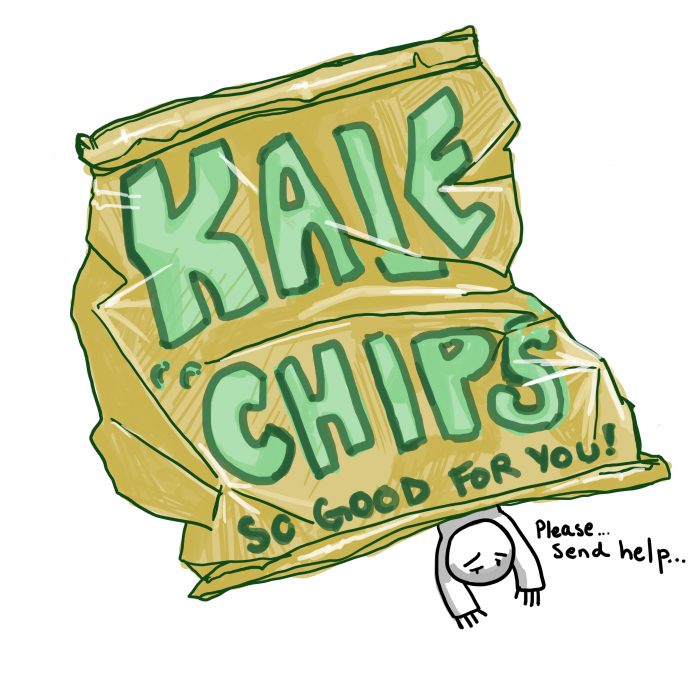
I can no longer go to the supermarket without being haunted by posters promoting certain ‘superfoods’ that will supposedly make me a happier, healthier person. Like many of you, I try to live a healthy lifestyle, but I don’t eat chia seeds, nor do I blend myself a kale smoothie in the morning.
According to the International Food Information Council, consumers are taking steps to improve their diets. While this is great news, I am troubled by the idea that many companies label their products as superfoods to imply that they are better than average fruits and vegetables.
Kale, quinoa, and pomegranate juice are among those that have been transformed into elixirs of life. While all of these foods are irrefutably good for you, suggesting that they are superior to other natural foods is absurd and is purely the result of strategic marketing.
Every couple of years a new food or drink is placed in the spotlight, but labeling these foods as superfoods is problematic. According to the European Food Information Council there is no real regulatory or legal definition of superfood that sets a precedent for using the term in marketing campaigns.
Because of this, companies are able to mislead consumers into believing that natural produce exists on a spectrum where one food is considered superior to another. The idea that everyday fruits and veggies — such as carrots, onions, and apples — are not as healthy as superfoods is deceptive, as they’re truly equal in nutritional value.
Often, people are [more inclined] to spend money if they feel it’s for a health benefit.
Trendy health foods often come with a hefty price tag, but people are willing to shell out the dough if they feel it’s for a health benefit. This is why companies take advantage of the term superfood, as they rely on consumer compulsion to buy products that will enhance their quality of life in one way or another.
One of the largest marketing campaigns that sought to promote a superfood was recently led by juice mega-giant Pom Wonderful. In 2012, an investigation was opened in response to the health claims advertised by the company. As stated by the Fair Trade Commission, advertisements were “making false and unsubstantiated claims that [Pom] products will prevent or treat heart disease, prostate cancer, and erectile dysfunction.”
Pom could not back up their assertions with any sort of scientific research, and that same year, they reported a net worth of around $50 million. That’s quite a lot of juice.
Sadly, pomegranate juice is not the only superfood that has been a bust. The New York Times reported this year that coconut water is now a $400 million industry, but there is no evidence to suggest that coconut water contains any preventive properties or nutrients unattainable in everyday fruits. While the concept of superfoods may be appealing, consumers must be more realistic.
Foods such as quinoa, açaí berries, and dark chocolate are undoubtedly healthy choices that are high in all the vitamins and minerals we need. But to believe that these foods have the ability to change our lives is foolish. Truthfully, health is a fluid concept and consists of so many things other than just diet, including exercise, sleep, and mental wellness, just to name a few. Rather than going broke on superfoods, consumers should attempt to create a balanced diet composed of a variety of natural produce.

Recently, several internet financial observers have attributed the emergence of the social network Ello as a response to Facebook’s strict username policies and ambiguous privacy rules.
A couple of weeks ago, I received an unusual friend request on Facebook from a 10 year old Nigerian boy. After I refused his request, I asked some friends if they had received similar requests, and they explained that it was a scam.
I began to ponder the effectiveness of Facebook’s privacy settings, as this incident happened four months after Facebook changed its default privacy settings from ‘public’ to ‘friends only,’ and included a privacy check-up option, which ensures users that their posts are shared with only friends. However, Facebook still retained the right to sell user information to advertisers, which has been a major source of controversy.
In addition, members of the LGBTQ community were outraged when Facebook shut down user profiles of drag queens and transgender people who did not comply with their user name policy which permits only birth names.
Then Ello stepped in. Contrary to Facebook, Ello’s manifesto states that the user is “not a product,” and promises an ad-free social network along with the use of pseudonyms. Ello is not the anti-Facebook that it presents itself to be, however: I suspect that, sooner or later, it will either begin to charge fees for features, or will backtrack on its manifesto and allow advertisements to permeate the network.
Ello claims to be ad-free, but allows mass-marketing [through brand profile pages].
According to Ello’s website, there will be no charge for users at the basic level, but there will be the option to purchase special features to support the company. The network’s founders argue that this business plan could generate enough money to keep the site ad-free, but I find this unlikely. Like Facebook, Twitter, and Instagram, Ello will soon have to resort to selling ads to maintain itself as it gains popularity.
Social networks must have the money to provide faster and safer services across various platforms. Relying on ad revenues, rather than paid memberships, has historically been the most successful business strategy to garner revenue, as people seem to be more willing to tolerate ads than to fork over money for a membership.
Furthermore, the social network ironically permits advertisers to create brand profile pages; Ello founder Paul Budnitz even has a brand page for his bicycle company. This is a highly hypocritical concept — Ello claims to be ad-free, though it still allows mass-marketing.
The network further harbours a hidden elitism. While Facebook and Twitter allow users to register to use their networks instantly, anyone who wishes to use Ello must request an invite by submitting their email address. The network’s slow, invite-only system has led to so much frustration that users are now purchasing invites on Ebay for over $500, to avoid waiting.
Overall, Ello portrays itself as an exclusive, ‘hipster’ club. Its monochromatic logo and Marxist-like slogans further affirm this secretive, elitist image. I believe that the internet should be an open place, but unfortunately Ello dismisses the idea. For these reasons, I will take this social network off my ‘To Do’ list, while opting for something a little more open and commercial.
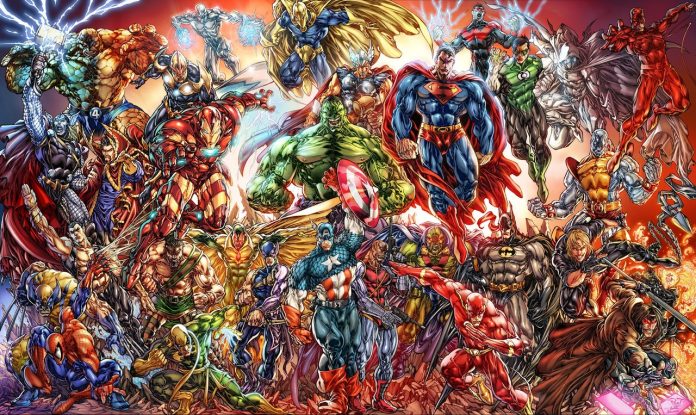
I have a confession to make; I am a comic book nerd, and have been since long before it was cool. While there is a part of me that loves being able to wear my Batman shirt in public without ridicule, and also enjoys the edgier tones of my favourite childhood heroes, it is also clear that the big two publishers — DC and Marvel — have fallen behind the times in one very important way: their representation of minorities in the ranks of their superhero squads.
In case you don’t believe me, think back to the recent Avengers movie. It features a six-person team comprised of five white guys (one of whom does turn green) and a token female in the form of Black Widow. DC’s current version of the Justice League in their New 52 universe features a single hero who isn’t Caucasian — the African-American Cyborg. And this is on a team that has featured multiple aliens (Superman, Martian Manhunter, Hawkman, and Hawkgirl) in its various incarnations.
Even the X-Men, which has the most direct correlation with real world minority issues, features characters that, despite coming from various national, cultural, and religious backgrounds, are mostly white. Even Mystique, a character whose mutation allows her to shapeshift, often appears as a Caucasian.
It seems that many of the characters designed to represent minority groups are little more than tokens, a way for the two companies to show that they are attempting to be diverse in their portrayal of our heroes.
This is problematic, as these characters end up with a minority identification that encompasses their entire character. Though I’ve been reading the entire Earth 2 series up to this point, I don’t know much about their Green Lantern character, as the fact that he is gay and lost his fiancé in the second issue seems to becloud the rest of his persona.
DC and Marvel could learn a lot about strong characters from independent publishers.
To their credit, both DC and Marvel have made efforts to introduce more minorities into the superhero pantheon. Unfortunately, these efforts have been uninspired at best and downright offensive at worst.
Recently, Marvel Comics announced some major changes to two characters that have been around for decades, Thor and Captain America. The new Thor has already made her — that’s right, her — debut in the past week, while Sam Wilson, better known as Falcon, will soon don the suit formerly belonging to Steve Rogers, marking the debut of the African-American Cap. As I said, uninspired, as Marvel’s solution to creating strong minority characters is to simply repackage existing ones.
Though, all things considered, these measures are better than what DC did with the introduction of Simon Baz, the Muslim Green Lantern. Though it was a great idea in principle, DC dropped the ball, turning what could have been an inspiring story into a giant cliché. While Baz’ ring could’ve come to him while he was at prayer, DC writers decided to have the ring choose him while he was being interrogated by federal agents under suspicion of committing domestic terrorism. Ouch.
Point being, DC and Marvel could learn a lot from the independent publishers who seem to do an excellent job of providing strong characters that exist outside of what has become the culturally accepted norm for superheroes. Malibu Comics, for example, provides the superheroes Spectral and Turbo Charge, both of whom are members of the LGBTQ community. There are plenty of original ideas out there, and I sincerely hope the big two open their eyes to these possibilities soon.



