Home Blog Page 1084

SFU Artist in Residence Ricardo Basbaum presents new exhibition

0

The Production of the Artist as a Collective Conversation, an exhibition by Rio de Janeiro-based artist Ricardo Basbaum — the current Audain Visual Artist in Residence — opened at the Audain Gallery at SFU Woodward’s on October 16. The show will transform over the course of its eight-week installation as audience contributions are added.

Basbaum’s conceptual and participatory art practice asks the audience to consider the nature of what constitutes an artistic experience through his ongoing project (since 1994) titled, Would you like to participate in an artistic experience? As part of this ongoing project, for the duration of this show, and for up to a week at a time, members of the public can sign out a large steel object called NBP (New Bases of Personality). This object resembles an eye, but also calls to mind a large cake pan, or some kind of communal urinal. Basbaum tells audiences, “You can do whatever you want with it. Use it as you like, the way you think is best.”

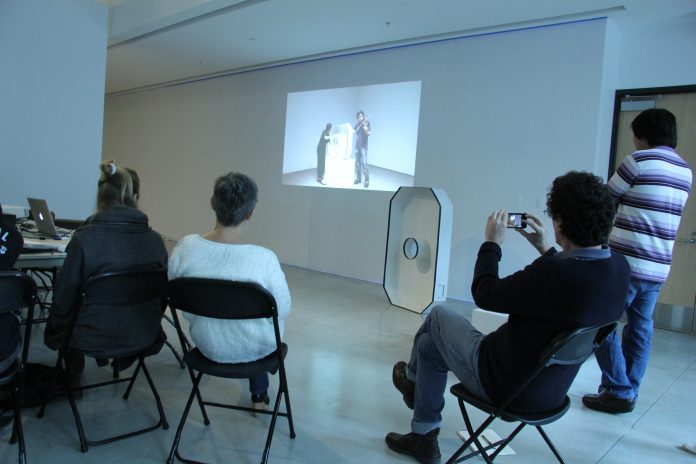
As members of the public interact with the object over the course of the exhibition, they are invited to upload digital documentation to Basbaum’s website (www.nbp.pro.br). These images will be added to one of the two projection loops in the gallery — one video, the other still images — which are currently displaying documentation of a variety NBP experiences over the object’s 20-year lifespan.

I am currently enrolled in the course Basbaum is teaching  alongside SFU faculty member Sabine Bitter as part of his residency. After seeing what seemed like several dozen images of people sticking their heads, arms, and legs through the NBP, or various participants laying down in it like a human yin yang, I was skeptical of how taking selfies with this cumbersome metal object would be the fulcrum of an ‘artistic experience.’

Along with four other students in the class, I took the object, strapped to a handcart, to a Do the Hustle night at the Astoria for dance lessons — our attempt to slightly subvert nature by inviting the object to take part in an artistic experience. Some of my skepticism dissipated as people, with no prior knowledge of the NBP and its history, wanted to dance with it and get their picture taken with it.

Without having seen any of the documentation of the previous participants, people were sticking their appendages through the hole of the object, and one couple insisted on getting their picture taken in the ‘classic’ human yin yang. One could make the argument that, in the age of social media narcissism, the desire to get your picture taken at an event while doing funny things is the norm, but the people who were interacting with the object were also curious about it. They all seemed genuinely excited when we told them that it was part of an art project.

Another participatory element of the exhibition will be a live event which will take place at the end of this month. Collective Conversation will function as a workshop to create a cooperatively written script, which will result in a live reading and a sound document. The recording of this performance will be added to the exhibition, alongside the previously recorded sound pieces and the corresponding scripts that are already available to check out at the gallery.

The Production of the Artist as a Collective Conversation is at the Audain Gallery until December 13. Collective Conversation will take places at the Audain Gallery on October 29. For more information, visit sfu.ca/galleries.


Improv superheroes save the day at Theatresports

0

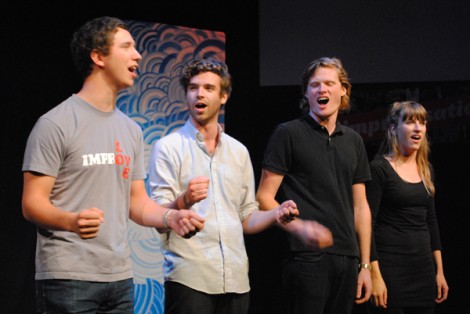
It’s a bird, it’s a plane, it’s Theatresports’ Superhero Show! Each night, the improv masters of Theatresports entertain audiences at The Improv Centre with a different caper involving a unique superhero created from audience suggestions. For example, the night I was there the hero was the Pecker, a bird whose special ability was spaghetti fingers.

The narrator has a bit of control over the action on stage as he asks for the audience to shout suggestions or signals a scene change for the performers. There is also a basic structure and setting to the show — it’s set in Big City, and the narrator asks the audience specific questions in order to create the tale. Other than that, nothing is scripted, and the performers have to make up a hilarious story on the spot, given only a couple of pieces of information.

I was impressed by the performers’ ability to maintain the continuity of the story, especially when they were switching back and forth between characters and settings so often. Some played up to four characters, all of whom had different accents — I suppose the voices help the actors keep things straight for themselves.

Margaret Nyfors did a great Russian accent during scenes where she was doing yoga in the park. She was also great in scenes where a plumber was fixing up her pipes and she offered him a drink from her bathroom liquor cabinet.

Of course, there is always a villain in a superhero story, and this one was so evil that he had a hummingbird for a thumb. The hummingbirds were the Pecker’s mortal enemies, and the climax was a hilarious scene of birdbrained mayhem.

If you have never seen a Vancouver Theatresports League show, it’s time you did. These improv artists are so talented, and no matter what kind of superhero tale they come up with, it is sure to be a memorable experience.

Tara Travis is one woman, six wives

0

Unexpected and character-driven, Tara Travis’ performance in the one-woman show Til Death: The Six Wives of Henry VIII portrays a story that has been heard time and time again. However, Travis and director Ryan Gladstone have created a production that uniquely deviates from the original tale.

The play is set during the Tudor Dynasty, specifically the reign of Henry VIII. Henry became the ruler of England at the age of 17 and married his older brother’s widow, Catherine of Aragon that same year. After tiring of her inability to produce a male heir, he became besotted with Anne Boleyn, who was later executed based on accusations of witchcraft.

Still desperate for a male heir, Henry sought the hand of Jane Seymour, who managed to produce a frail and sickly baby boy before dying in childbirth. Next came Anne of Cleves, a marriage which lasted only six months before being annulled. Shortly after, he married Kathryn Howard, Anne Boleyn’s  cousin, whom he executed due to her adultery. His final wife was Catherine Parr, whom he remained wedded to until his death in 1547.

You may initially be concerned that a one-woman show depicting seven historical figures would be a difficult undertaking, but Travis makes it seem effortless. The play veered away from a standard production and brought the characters to life in such a way that it never felt as if one person on the stage wasn’t enough.

After the show, The Peak spoke with Travis, and she explained how she is able to perform all of the different characters. “I spent a lot of time in rehearsal walking around the room, finding [each of the character’s] gait, the way they breathe, and which body part led first. Over time I found their voices [and in time] their faces became more nuanced.”

This was particularly evident in a scene where each of the six wives began to detail their stories and how they came to marry Henry. Each of the wives had her own voice — ranging in different accents from Northern English to German — and each had different physicalities. For instance, Travis played Anne Boleyn as just a decapitated talking head without a body. Her ability to draw the audience in with her facial expressions — which were incredibly strong, and varied with each character — is to be admired.

This is a show that will resonate with audiences, in part due to a strong performance by one-woman show artist Tara Travis, and also due to Ryan Gladstone’s formidable script, which has a killer ending.

Til Death: The Six Wives of Henry VIII was performed by by Monster Theatre Productions October 10 and 11 at the new Surrey City Hall’s Centre Stage.

Separating the art from the artist

0

I am a fan of the band Teen Suicide, a lo-fi noise-pop band based in Baltimore, Maryland, comprised of two core members, Sam Ray and Eric Livingston. Unfortunately for me, and many other fans of theirs, they never venture to the west coast to play shows. A while ago, I liked their Facebook page hoping that one day I might find out they were coming to Vancouver.

That day came about a week ago when they announced their west coast tour beginning on October 1, including a Vancouver date. Fans living on the west coast, myself included, were thrilled to receive the news that their dream of seeing Teen Suicide was finally going to come true.

However, the post was strange — no venue was listed for any of the 15 advertised shows. As the concert date approached, and no ticket or venue details were released, I became more concerned. Finally, on October 4, three alleged concerts having passed, Teen Suicide posted this status on their Facebook page: “If anyone still believes it, the tour was a lie. Sorry. Our social media strategist fucked up.”  So it was all just a bad joke. 

Naturally, fans were devastated, or simply annoyed, replying with comments like, “You guys are gonna lose your fan base.” Teen Suicide responded by saying, “Our fans are all idiots, and we hate them.” This comment doesn’t stand alone — their whole page is riddled with mean comments directed at fans.

So, should we all hate Teen Suicide and stop listening to their music? There is a difference between liking a band and liking a band’s music, and I’d almost go so far as to applaud Teen Suicide for creating this ‘asshole persona.’

An artist’s actions should not have any bearing on our judgments of their art. To truly appreciate art, we should appreciate the qualities it has in itself, not the qualities of the author — a separate entity. A lot of people in the world of fandom blur this distinction or even throw it out completely. 

It seems intuitively strange to judge art based on the artist. About a year ago when Woody Allen, a celebrated film director, was accused of pedophilia, his work was put into question. It just seems strange to me that we held Allen’s body of work in such high esteem prior to the accusation, and then suddenly, when we find out that he might have molested Dylan Farrow, the general public started to question his cinematography.

Art should be appreciated independently of the artist, and Teen Suicide should perhaps be commended for their meanness, as it can be seen as a way to try to alienate fans — the bad kind of fan, who is infatuated with Teen Suicide as a band as opposed to their music. Teen Suicide doesn’t want people to like them — they want people to like their music.

On the other hand, maybe Teen Suicide is taking their asshole persona too far. It’s possible that their blatant rudeness towards fans is just another marketing strategy. Their disrespectful conduct is so excessively over the top that it’s caricaturesque. They are creating hype for themselves through playing up the whole ‘pretentious artist’ persona. Maybe they’re just trying to be controversial for the sake of controversy. 

I was never a fan of Teen Suicide as individuals, and I can’t say that I respect them as artists, but what I can say is that I’m a fan of Teen Suicide’s music. Although artists can take care to conduct themselves in a professional manner, I maintain that their actions should not have a bearing on your opinion of their creations.

Crazy Smooth explores the concept of partnering with the music

0

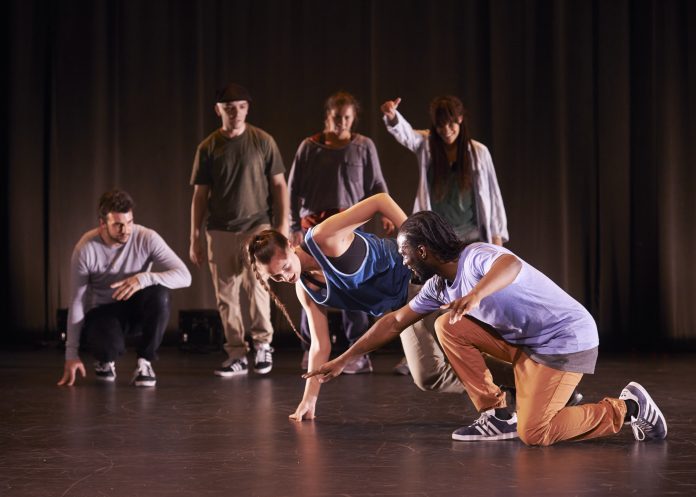
For most dance styles, the basis of choreography is the human body, but as Bboyizm’s choreographer Yvon ‘Crazy Smooth’ Soglo explains, street dance is different. “For a lot of contact improv and contemporary dance, bodies are the base of the movement — their weight and shape. I quickly realized that for us, the rhythm and the music is the base.”

This realization came out of workshops the company did with Sylvain Lafortune, who has a ballet background and a PhD in partnering. Soglo found analyzing the mechanics of partnering fascinating, and has always wanted to go back to these ideas that he had begun exploring a few years ago. “I never got a chance to get deeper and explore that possibility,” said Soglo.

While creating his new show, he brought Lafortune back and worked with his dancers to explore what partnering means for street dance. “I wanted to create something that has the principles of partnering, but for street dancers. I call it ‘rhythmic contact,’” he said, explaining that the music is their partner, as they make contact with the rhythm.

Bboyizm first performed in Vancouver in 2012 with their impressive, energetic show, IZM. They’re back this month with Music Creates Opportunity, and Soglo said the troupe is excited to be back on the west coast.

“When we premiered IZM, it was our first big theatre piece — you get attached.” Soglo explained that this new show is different in a few ways, as his personal choreographic style is always evolving. “IZM was a little bit of a roller coaster. This one is different in the sense that the music is very different and the pacing is very different. There’s more breathing between acts.”

This show marks the first time the company will have live music, and there are also some new street dance styles featured in Music Creates Opportunity. “IZM was 90 per cent bboying and 10 per cent rocking,” said Soglo. This show includes bboying, lots of rocking, house, and pantsula — a South African street dance style which bgirl Melly Mel will perform. “The vocabulary we’re using is from different dance styles. It comes out in a very interesting way,” said Soglo.

“It’s also different because the company has matured a lot, and I’m happy that’s some of the feedback we’ve been getting.” Soglo feels that this show is a natural growth from their previous work. “If you liked IZM, you don’t lose that aesthetic. You just get more, you get into the dancers a bit more.”

The choreographic process for Music Creates Opportunity has been much more collaborative than Soglo is used to. “Ninety-five per cent of IZM was already in my head,” he said. “I always have the dancers as collaborators. It’s important to see that the dancers are comfortable with the movements, but with this show I was letting the dancers have more input than usual.”

He found himself asking the dancers what they thought or felt about the movements, and there was more of a reciprocal creative process. “The dancers were much more involved, and you see that camaraderie; the coming together.” This dynamic is one of the characteristics of street dance in general. “It’s real emotions and real vibes that we’re sharing.”

Bboyizm’s tagline is ‘Dance to express, not to impress,’ and Soglo explained that this personal philosophy of his has become a part of everything he and his company do. “When I see a dancer doing their thing — when the intentions of that person are pure — I think it’s always impressive. It’s easy to be phony and disguise what you’re doing, but to truly do what I feel and express myself from a place of purity and honesty is different — I think it’s more powerful.”

This pure expression that comes from within is what the dancers of Bboyizm strive for, and it shows in their impressive physical feats and dynamic, smooth moves.

BBoyizm is performing Music Creates Opportunity October 21 to 26 at The Cultch and October 28 at the Surrey Arts Centre. For more information, visit thecultch.com.

Lucien Durey’s Thin White Line is a collection of overlooked objects

0

For a year now, the School for the Contemporary Arts office staff have invited current MFA students to exhibit and curate projects in their makeshift gallery space. Because the office allows artists to exhibit their work on location, the context of the space generates a different set of possibilities for the interpretation of each work. The current exhibition, Thin White Line, is a project by second year MFA candidate Lucien Durey.

The Peak: A simple explanation of this show could be to call it a collection of objects you have put on display. Some objects have simply been framed while others have been placed on shelves. Others have been visibly manipulated. How do you decide what to do with each object?

Lucien Durey: What draws me differs from object to object, but generally I’m attracted to things that have the potential to be overlooked. All of the source objects in this exhibition have been overlooked or nearly overlooked in some way: discarded, forgotten or only revealed through careful searching. My interaction with each one is an effort to affirm the discovered aspect — the nearly overlooked. As such, physical alteration is not always an appropriate gesture. It’s often enough to present the object itself within the gallery context, to give it a name or to place it in proximity to like objects with like aspects.

P: As you develop your methodology, working with ‘found’ objects, does your interest lie more in each individual form, or rather in how the works speak to each other as a collection?

LD: I’m interested in the material form of each object as well as how they present collectively. The group enhances the individual works, but each is a distinct element nested within the greater whole. Varying material approaches help the works to maintain a separateness from one another that is contradicted by their close arrangement. Both gestures combine to convey the scope of my survey for objects of this type. I don’t see this exhibition as an installation; I’m only invested in transforming the office space insofar as to co-opt its walls as tools to communicate the inarticulable through a relationship of things.

P: If you were to imagine yourself having an internal dialogue with one of these objects, would there be a certain voice associated with it?

LD: There’s a certain quality in each of these objects that has set them apart for me, but it’s difficult to think of it as a voice that is capable of dialogue. I don’t see the objects as megaphones for previous owners or as containing some kind of ghostly message, even if specific individuals have enriched them somehow. Perhaps the best part of my attraction to them is inarticulable and this is how they assist each other. They are similar objects in that they have engaged my interest in the same inarticulable way. I’m not certain yet what it is that they possess, only that it becomes louder in chorus.

Improv Fest brings comedy troupes to Granville Island

0

From October 6 to 11, the Vancouver International Improv Festival (VIIF) lit up Granville Island. As Marc Rowland, a performer in the festival, said, “It’s a celebration of improvisation from groups across North America and the world.”

The art of improvisation means to create without preparation, and involves high levels of bravery and skill. This festival brings the spontaneity and adventure of improvisation to Vancouver. According to performer, Brent Skagford, “[This fest] bring some of the best acts from all across the country.” He continued, “There’s a great community here in Vancouver, and this festival just helps promote that.” Another artist, Rick Andrews, says that the VIIF is his “favourite festival because of the great energy.”

The first group I saw on October 10 was the Magnet Theatre Tour Co, featuring Rick Andrews, Lewis Kornfeld, and Megan Gray. From New York City, they started the night in front of a packed house. The audience was loud, and the troupe quickly proved to have wonderful timing and chemistry. From the hilarious relations between a butler and a black widow, to an idiot taunting huge birds and zookeepers, the series of skits was lively and detailed. The group had solid transitions, was consistently funny and outrageous, and made sure to tie up all loose ends.

Next was troupe Ferrari McSpeedy, starring Mike Fotis and Joe Bozic from Minneapolis. Demanding major audience participation, we all got very used to screaming ‘Fighting danger! Fighting crime!’ as this troupe did their short skits. They started off strong with a baking-inspired skit, but the performance became confused as the act progressed. The versatile voices of the actors were overwhelmed by their breaking out of character, which became distracting.

Hip.Bang! was up next, featuring local boys Devin Mackenzie and Tom Hill. This performance was extraordinarily fun, with tons of audience participation. Within five minutes, my cheeks began to hurt from smiling too much. Pregnant men, overly sexual scuba divers, and a biology lesson about trees created a crudely hilarious performance. The use of silences made the dialogue funnier, and the extensive fake kissing was a hilarious choice.

The night ended with Easy Action, a Montreal based group starring Brent Skagford and Marc Rowland. Unlike the other shows, Skagford and Rowland created one cohesive storyline in their performance. Their show was brilliant, full of chemistry, slightly disgusting, and extremely well acted. Skagford played a woman in a style reminiscent of comedian Ryan Stiles, creating a hilarious plot with Rowland, whose characterizations were also excellent.

In a short interview, Rowland and Skagford let me in on the life of an improv performer. Rowland is the director of both the Montreal Improv Theatre and the Montreal Improv Festival, and Skagford is the co-creator and co-star of The Bitter End web series, and both are fully engaged in Easy Action.

As Skagford explains, every show starts with “a single suggestion from the audience that inspires [the] show [then] the two of us together try to create a cohesive narrative with relationships, emotion, action, drama, and sex.”

As international performers, Rowland explained the importance of showcasing their work all over Canada, highlighting the importance of festivals like VIIF. In particular, Skagford said they like to “see what the scene is like in other cities, what their style is, and absorb it.”

When asked to describe improv as an art form, Skagford charracterized it as “an incredible adrenaline rush.” He continued, “You have no guarantees. It’s about experiencing that moment, right now, there is something interesting, and if [we] can find that, we can create ourselves a story.” Rowland added that “improv has a lot in common with the world’s great philosophies and religions — life is but breath, which is very much what we try to experience on stage.” They ended the interview by chanting, “SFU, we love you!”

Progressive grade-schooler announces fair trade offerings for Fruit Roll-Up

0
The fair trade movement has spread across Suncrest Elementary, paving the way for more ethical Dunk-a-roo consumption.

In a historic decision that has been generating buzz all around the playground, second-grade student Billy Stanford has made a pledge to honour only 100 per cent fair trade offers for his strawberry Fruit Roll-up.

Although in the past Stanford has been known, around Suncrest Elementary, to partake in far-from-equal exchanges for the snacks his mother packs him, it’s reported that’s all behind him as of this recess.

“I’ve done a lot of growing up and realized it’s just not right to take advantage of those less fortunate than me,” Stanford told The Peak. “I’m consistently getting some of the best lunches of all my friends. I’m talking Pop-tarts, Fruit Gushers, sometimes I even get an entire honest to god chocolate bar [. . .] making fair trades is just the ethical thing to do.”

According to friends of Stanford, he’s not gouging them at all for the Fruit Roll-up. Even though it’s his favourite flavour, he’s reportedly willing to part with it for a reasonable amount of Goldfish crackers, something they say is commendable.

“It’s really amazing for somebody in his position to have a fair trade policy,” explained Dougie Jones, the classmate who got the Fruit Roll-up for only a third of his crackers. “You wouldn’t expect someone who gets McDonald’s brought in monthly to be that generous with his lunches.”

While Jones’ positive feelings about the selfless nature of Stanford’s lunch exchanges have been echoed by a number of his colleagues, others have reacted more cynically. 

“Sure, he says it’s a fair trade, but according to who? Donny and Kevin?” questioned Bryan Sanders, another classmate. “Dougie might think he’s getting a good deal, but that’s still too many Goldfish [. . .] it’s just not sustainable for him long-term.”

While the term ‘fair trade’ may be a contentious issue on the playground, the children have reportedly found some common ground when it comes to what snacks they enjoy trading the most: cheap junk food created and packaged by exploited workers in the Third World.

Nursery rhymes for nihilists

0

Scan 2

The itsy bitsy spider
Went up the waterspout.
Down came the rain and
Washed the spider out.
Out came the sun and dried up all the rain.
And the itsy bitsy spider bitterly repressed the thought
That maybe, just maybe, none of this matters.

Piggie


This little piggy went to market.
This little piggy stayed home.
This little piggy found fulfillment
in an otherwise cruel and pitiless universe.
This little piggy, after tireless decades of searching, found none.
And this little piggy went
“Wee, wee, wee,”
Cursing the inevitable decay of his corporeal form.

Jack and Jill

Jack and Jill went up the hill
To fetch a pail of water.
This, like all other worldly tasks, was just another in
a series of pointless steps towards the emptiness of non-existence.
Faced with this, Jack threw himself down the hill,
hoping desperately to end it all.
And Jill came tumbling after.

Scan

Little Jack Horner
Sat in the corner,
Eating his Christmas pie;
Understanding that true knowledge is,
by definition, impossible
And that our understanding of reality is merely an unending dream from which death
is the only escape,
He said “What a good boy am I!”

Scan 1


Humpty Dumpty
Sat on a wall,
Humpty Dumpty
Realized that, in time,
No one would remember him, and everything he had ever said or done would be lost to the indifferent sands of time.
All the King’s horses
And all the King’s men,
Couldn’t put Humpty’s belief in a benevolent and meaningful existence
Together again.

Clan crushed in Division I matchup

0

After notching their first victory of the season, SFU had a break from conference play. Unfortunately, that break was in the form of a game against a Division I opponent where they were soundly defeated 66-14.

The Clan travelled to Pocatello, ID to face the Idaho State Bengals (ISU) of the Big Sky Conference of Division I FCS, who were 2-3 going into the game. Backup quarterback Tyler Nickel once again had the start.

SFU got off to a seemingly good start with the opening kick return, when running back Earl Anderson managed a 60-yard return to the ISU 33-yard line. However, a holding penalty eliminated much of that yardage — 57 yards to be exact — putting the Clan at their own 10-yard line. This was the start of a long game for SFU.

In their first drive, SFU could only manage five yards. The Bengals punished them swiftly just over a minute later, with ISU running back Xavier Finley rushing 20 yards for a touchdown — the first of many.

The next drive proved slightly more fruitful for the Clan; they notched 34 yards total, 28 of them from a pass to wide receiver Lemar Durant who had 94 yards receiving in the game. This proved to be SFU’s best showing in the half; however, they did not manage to convert for points.

ISU continued their dominance, scoring on their next drive. The Bengals scored a touchdown on all but one of their drives in the first quarter, ending the quarter 21-0.

The second quarter did not treat the Clan much better, with the Bengals scoring three more touchdowns to take a commanding 42-0 lead.

Bright spots emerged for SFU, though, with the Clan holding two Bengal drives to only four plays, as well as achieving two drives with relatively good movement, gaining 22 and 32 yards during each. However, they still could not find their way onto the scoreboard.

SFU managed a better second half, however, eventually putting up some points.

The Clan started the third quarter by holding the Bengals to another four-play drive. Unfortunately ISU came out swinging in their next drive, reaching the goal line. The Bengals fumbled the ball, though, which SFU recovered to prevent a scoring play.

A subsequent fumble by Cole Tudor, however, gave ISU their next touchdown, taking the score to 49-0. For the rest of the quarter, SFU allowed only a field goal, and set themselves up for a solid fourth quarter.

Quarterback Ryan Stanford, who was put into the game after halftime, led a 75-yard drive for the Clan which ended with SFU’s first touchdown: a 25-yard pass to redshirt freshman Justin Buren.

SFU notched another touchdown with another 75 yard drive later in the quarter, fuelled by a 41-yard pass caught by Buren.

ISU responded to both drives with a touchdown of their own, off of 69- and 72-yard rushes by Bengal running back Jakori Ford, before capping the game with a field goal.

Among the highlights of the game for SFU were middle linebacker Jordan Herdman’s team high 17 tackles and Buren’s 92 receiving yards. Stanford also threw a respectable 190 yards, going 16 of 22.