Home Blog Page 1066

Professors get cyberbullied, too

0
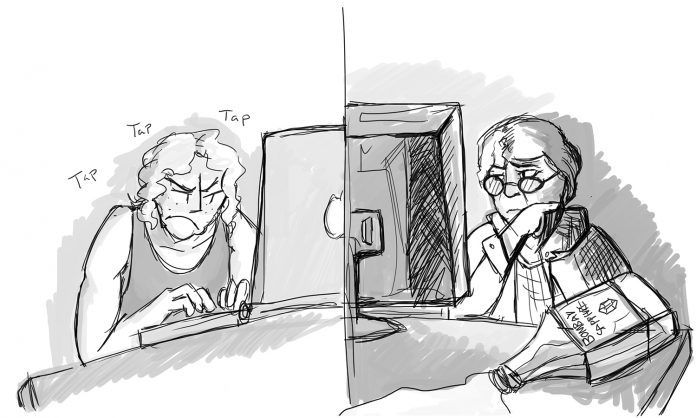
Online platforms like RateMyProfessor are often used to cyberbully professors.

Cyberbullying in our school systems is usually understood as one student projecting their antagonisms upon another student, but what many do not realize is that cyberbullying can also be directed towards professors.

Lida Blizard, a nursing instructor who recently completed her PhD in educational leadership at SFU, conducted a study that looks at the cyberbullying of faculty staff members.

Blizard stated, “This study found that the platforms commonly used by students to target staff members were emails, end of term online evaluations, and faculty calling sites — for example, RateMyProf.”

The study also found that the most common factors behind cyberbullying incidents were a student’s dissatisfaction with grades, a student’s misconduct issues, and assignment difficulty.

The student’s retaliation would usually take the form of derogatory remarks aimed at the faculty member, or a demand for higher grades.

Blizard pointed out that these incidents had a negative impact on faculty members, including difficulty sleeping, depression, anxiety, and fear of the student. Approximately 20 per cent of the staff members who took part in the study had thoughts of retaliation and a lower percent even had thoughts of self-harm.

Blizard explained, “The symptoms and [their] duration are very similar to the symptoms of acute stress disorder and post-traumatic stress disorder.”

Blizard reflected that many students do not realize the harm they might cause by posting hateful comments on sites like RateMyProf or on online course evaluations. In turn, many staff do not realize that their bad experience due to callous comments online is actually cyberbullying.

Furthermore, there are very few resources for faculty to draw upon to manage such conflicts.

Blizard said, “They don’t know what cyberbullying is about, and they don’t have education or training in how to manage such conflicts. Thus, they are left at their own ways to figure it out, which may not necessarily be effective.”

She continued that in order to stop the cyberbullying of professors, there must be support measures put in place at the institution. Cyberbullying needs to be embedded into the curriculum and talked about in classes in order to foster an understanding of the issue. 

“People respond to stress differently. [. . .] I can see how a student frustrated with the academic pressures and faced with poor outcomes might turn to online media as their preferred form of communication, rather than going to meet with their professor and trying to have a conversation about it,” Blizard said.

As the end of semester nears and final projects, essays, and exams loom, Blizard advised that everyone take a deep breathe before writing hurtful comments on online and offline course evaluations. “Consider the recipient on the other side of it, being yourself,” she said.

Art disciplines should incorporate more intelligent opinions

0
No one can doubt the existence of the Higgs Boson particle.

The physical sciences and the arts and social sciences are often dichotomized as fundamentally distinct branches of study with inherently different methods of inquiry. The physical sciences are in the domain of empiricism and objectivity, whilst the arts and social sciences are derived from experience and subjectivity.

Though not entirely unfounded, this demarcation has done harm to the world of public intellectual discourse. Namely, the unfounded opinions laypersons have towards the arts are taken unnecessarily seriously, despite the same not being true for the sciences. 

One’s opinion regarding the arts is often treated as legitimate by virtue of nothing more than the mere fact that such a thought has been ardently articulated by someone. To demonstrate this point, consider the case of an average person hearing news of a new economic recovery plan. It is entirely common to hear such a person claim that the plan is ineffective or non-sensical despite having no formal or informal understanding of the field of macroeconomics.

What is more, such people often expect their opinions to be taken seriously despite having no backing for them. Notice that such arrogance is not at all commonplace in regards to the sciences. If  a new study conducted by CERN gave us reason to doubt the existence of the Higgs Boson particle, the average person would be very uncomfortable voicing an opinion on a matter of which they have little to no understanding. 

The unfounded opinions laypersons have towards the arts are taken unnecessarily seriously.

Ultimately, this is because people recognize that there is an important distinction between having a right to an opinion and that opinion being intelligent. Yet, this is precisely what is forgotten in the domain of the arts and social sciences.

Whether it is political science or economics, gender studies or art, one’s opinion is expected to be taken seriously by others, regardless of their understanding of the material. In essence, intuition regarding highly complex subject matter is arbitrarily privileged in one field but not the other. 

I find that this hypocrisy is rooted in the erroneous assumption that the sciences are fundamentally objective, whilst the arts are fundamentally subjective. Put another way, in the sciences there is always a right answer, whilst in the arts there are no right answers. This stance seems problematic to me for two reasons.

First, it is not at all obvious that such a rigid line exists between the two, as demonstrated by highly mathematical fields in the arts such as economics, and highly philosophical fields in the sciences such as neuroscience. More importantly, there is no logical reason for us to believe that academic rigor should hold any less sway in fields deemed subjective in comparison to those deemed objective. As such, the aforementioned demarcation is at worst inaccurate, and at best irrelevant.     

I want to clarify that I am not arguing for elitism in intellectual engagements. From my perspective, all academic pursuits are bettered within a context of open discussion and debate. Rather, I am arguing that both domains deserve equal respect as challenging fields with no easy answers.

One’s opinion as a layperson should either be considered equally important or equally un-important whilst engaging with the two, and the mere fact that one seems to have an easier answer does not mean it necessarily does.

Society is bettered when citizens take it upon themselves to become educated on the issues and debates of our time. This cannot happen if one field is ignored because it is deemed too challenging, and the other trivialized because it is deemed too easy.

Post-secondary grads score low in math proficiency

0
The worst performers were graduates of teaching programs, which raises concerns about educational departments.

A new study from Statistics Canada revealed that over 20 per cent of Canadian university graduates scored a two or lower on a scale from zero to five measuring mathematical ability.

The study, titled Programme for the International Assessment of Adult Competencies, examined adults aged 25 to 65 of differing education levels on their ability to use math and literacy skills to solve common problems in the workplace.

Individuals who scored two or lower on the scale are described by the study as more likely to struggle in understanding complex mathematical information and in using appropriate problem solving techniques.

The study also indicated lower literacy levels and problem-solving skills than expected for such a highly educated population.

The worst performers were graduates of teaching programs, causing the study’s authors to raise concerns about educational departments. Other students who scored poorly on the math portion were arts and humanities majors. Science students scored much higher and, predictably, math students scored the highest.

Peter Liljedahl, an SFU associate professor in the education department, dismissed worries about teachers’ mathematical abilities.

“The data, over all, is misleading,” he said. “Although it can be argued that all elementary teachers will teach math, and hence need to be good at math, the same is not true of secondary teachers.

“There are many topics for which math is not needed — PE, social studies, French, English, art, etc. These teachers receive their undergraduate degrees in faculties that need little to no math, and then come to us to do a one-year teacher certification program,” explained Liljedahl.

He continued, “These teachers alone account for the percentage of education students said to be bad at math. They have not done math, they do not need math, and they will not teach math.”

Liljedahl asserted that science and math teachers, who require adequate skills in math, undergo the appropriate training.

“As for our secondary science and math teachers, and our elementary teachers, we offer very good courses for them to ensure that they have the necessary mathematics to be effective teachers,” he said.

Daniel Munro, a principal research associate for the Conference Board of Canada, which released a similar study earlier this month, told The Peak that universities cannot be solely to blame for the low numeracy and literacy scores of graduates.

“We should also look back at what’s happening from kindergarten to grade 12, because many universities say they’re doing the best with the students they get,” he explained. “Studies of 15-year-olds show our students have slipped a bit, and some universities say the ‘raw material’ they get is not as good as it used to be.”

To help universities cope with these results, Munro’s report offered the following suggestion: “In general we do very well, but we’d encourage post-secondary institutions to take a look at what they’re doing and maybe integrate more literacy and numeracy and problem-solving into the curriculum.”

There’s no place for fighting in hockey

0
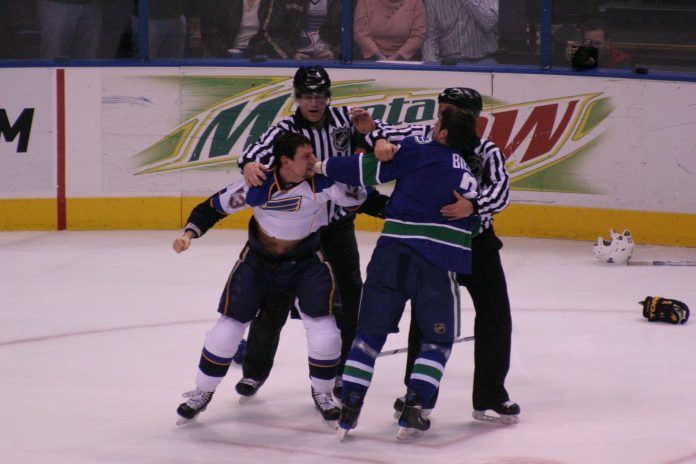
Canucks defenceman Kevin Bieksa engaged in a fight.

Over the past few years, there has been a vast amount of ink spilt over the place that fighting has in the modern game of hockey. This never-ending debate is heating up again, after top prospect Connor McDavid broke his hand during a fight. He’s expected to miss five to six weeks, and his participation in the annual World Junior Championships is now in doubt.

As a kid growing up watching hockey, I used to love fights. I would get all excited when a player like Brad May would square off against the opposing tough guy. But now, it seems wrong to root for a guy to eat punches after all we’ve learned about concussions and head trauma.

The demons it creates for these types of players is no secret as well. In the summer of 2011, noted enforcers Derek Boogaard, Wade Belak, and Rick Rypien all tragically took their own lives.

Even ‘old school’ media personalities and ex-players such as Mike Milbury — who according to hockeyfights.com has participated in 76 NHL-level fights himself — have come out and stated their displeasure over fighting.

The biggest reason that fighting is still around is the mythical ‘code,’ an ambiguous set of rules that is supposed to take the ‘rats’ out of the game. This is what the enforcer’s job is — to police the game, because apparently the referees on the ice can’t do that.

But more often than not, these enforcers end up fighting amongst each other, not really doing any ‘policing.’ I wouldn’t call Shawn Thornton sucker-punching Brooks Orpik policing, I would call it disgusting. Fighting has lost its significance in the game.

Thankfully, the NHL won’t have to go to any drastic measure and ban fighting, because it’s already on the decline. According to hockeyfights.com, in 2011-12 there were a total of 423 games which featured a fight. Last season, that number dropped to 366, a decrease of nearly five per cent.

With the exception of the 2012-13 lockout shortened season, fights have been steadily decreasing since 2008-09, with the percentage of fights per game dropping from 41.38 per cent in 2008-09 to 29.86 per cent last year.

Noted enforcer Shawn Thornton was let go by the Boston Bruins and signed with the Florida Panthers, and tough guy Colton Orr has been buried in the Maple Leafs’ AHL affiliate and has yet to play a single game in the NHL this year. Teams would much rather use a roster spot on a guy who can score goals than on a guy whose only skill is brawn and whose sole purpose is to skate around for eight minutes.

I understand the NHL is in the business of entertainment, and I do get that a lot of people enjoy watching fighting. But fighting has simply lost its importance in the game; it no longer serves a purpose and the cost is too high. It’s time to focus on the skill and speed — the hockey — and not slow it down with knuckle-dragging enforcers.

Meet the Clan: Kelsey Robinson

0
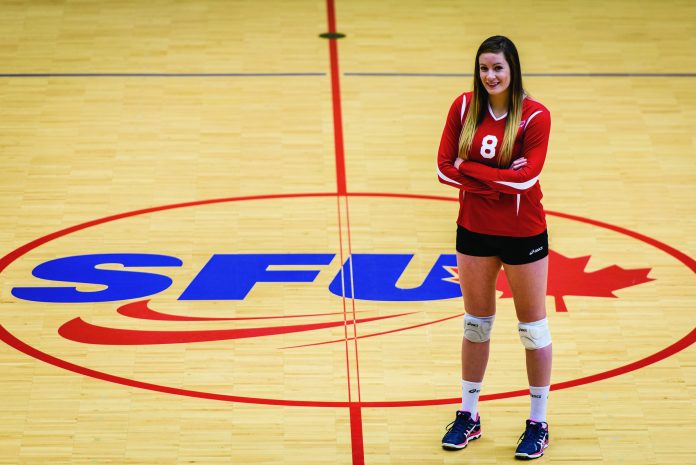
Kelsey Robinson led the volleyball team in kills (offence) and came in second for digs (defence).

Screen Shot 2014-11-21 at 6.36.19 PMSchool can be a grind in and of itself, aside from whatever job, sport, or extracurricular activities you may have. We all complain about the workload — or at least make self-deprecating jokes about how our time management skills have led to numerous all-nighters. But when all’s said and done, university provides us with a pretty clear schedule, and delays our entry into the real world for a few years. It’s really not a bad setup.

After four and a half years of hard work, outside hitter Kelsey Robinson finds herself about to graduate, and facing the unknown.

“Up until this point, I’ve had everything so planned out for me. For the past five years, you know it was, ‘These are the courses you are going to take, this is what time the practice is at,’ everything was so set. Now I’m actually graduating at the end of this semester,” she said.

As the leader in kills (scoring) and second in digs (defence) on the team, and part of the original NCAA recruiting class, Kelsey has seen her share of ups and downs. She played during multiple seasons when the team only achieved one win, but this year, under second-year head coach Gina Schmidt, they finally saw a winning season in the NCAA. Now, she looks back at how those experiences have shaped her.

“In my first few years, volleyball-wise, I learned a lot about myself, just because we didn’t have such a great record, so you really have to search deep, ‘Is this something you really want to do?’ I mean it’s a lot easier to come to practice with a winning record but you really learn a lot about your character when you have to work hard day-in and day-out when you’re not getting those results.”

WEB-Kelsey Robinson-Hamed Yaghoubi ShahirShe added, “In my first year, [I learned] how dedicated and passionate I really was about volleyball. And then [. . .] to end on a really good season, it’s really rewarding to know that all the hard work we put in during the five years I was here really paid off.”

Her experience playing on a struggling team made Kelsey, along with her fellow seniors, well-equipped to lead the team: “Because we had been there when things weren’t so well, we knew how to deal with adversity.”

However, the only reason Kelsey saw the team’s first winning season is because of ‘luck’ — if you can call it that. Normally, a player can only play four years in the NCAA, but she tore her ACL in year three and redshirted. This turned out to be a blessing in disguise, as she returned right after SFU hired a new coach — Schmidt — which is when things started to take a turn for the better for the volleyball team.

“It’s hard to think an injury could be a good thing, but it ended up being the best thing that could have happened, because I got to re-evaluate where I was and rekindle that passion for volleyball, that maybe was missing after two years.

“It was just the best feeling to be able to play again. Even doing stupid drills that before I would have hated doing [. . .] were just so much fun because I was able to do it again.”

Kelsey’s focus wasn’t just on the court, however, but also on her academics — one of her motivating factors for choosing SFU in the first place.

“If we had a huge win, we’d go home and realize that winning a volleyball game doesn’t mean that I don’t have to hand in my paper tomorrow. I’m still a normal student, my prof doesn’t care we won last night.”

Screen Shot 2014-11-21 at 8.03.40 PMIt’s this focus that sets Kelsey up for a bright future. She is applying to medical school, hoping to use what she has learned in her studies to help people: “My drive from the beginning has been to use my science background and knowledge to help people, it puts the two things in life I would want to do together.”


Now, at the end of both her bachelor’s and her volleyball career, is she ready?

“I don’t know if I’ll ever say that I was ready, as I loved it so much [. . .] but it’s probably good to move on when I’m still wanting more than the other way, where you’re ready to be done.”


Let’s throw a 90s teen movie party

0

Let’s do it.  Let’s throw a 90s teen movie party.

This will be our last chance to throw one. Maybe we’re all graduating from high school and going off to college soon; maybe we’re graduating from college and we’ll have to get real jobs and stop getting obliterated every other Tuesday night. Whatever the milestone is, I just know that a 90s teen movie party is the only way to commemorate it.

First, we’ll have to get an absurd amount of alcohol. For whatever reason, this will consume a lot of our initial time and efforts. What, do we only know one person who’s of legal drinking age? That doesn’t even seem probable. There will be a lot of exciting hijinxs and buying alcohol will never look so adventurous again because in reality it isn’t because all you’re doing is buying alcohol but it will be for us because we’re throwing a goddamn 90s teen movie party.

Onto the evening’s guest list: I’m really hoping that word accidentally gets out about our medium-sized get-together and the house is absolutely decimated by the end of the night. I mean, the meteor from Armageddon is going to have a nuclear Jughead attached to it and they’re going to crash into the property, rendering the house a complete wasteland. Then Godzilla is going to stop by just to make an appearance, play some beer pong, and then leave for a different party. The place will be utterly destroyed but that’s okay because there are never any long-lasting consequences when you have a 90s teen movie party.

We also need to invite the girl of one of our dreams. She has a boyfriend who’s probably an asshole —  some jock type that has no redeemable qualities and no discernible IQ, but will likely face some form of poetic justice by the night’s end. I mean, that would never happen in real life. But it will happen tonight.

Maybe one of us will get to kiss romantically in the pool because it’s totally not freezing cold and doesn’t smell like chlorine and it’s not like either of us had our phones with us before spontaneously jumping into the pool fully-clothed. Extemporaneous make out sessions in the pool are only romantic if we’re both fully-clothed. Everyone knows that.

This is going to be the biggest night of our lives, despite still being young enough to not be fully-functioning adults and feeling the need to celebrate big events by trashing a house and playing King’s Cup with people we don’t know and will never see again. Somehow, tonight will be the culmination of everything else. I just know it.

We’re going to make grand gestures in the name of young love that would appear borderline psychotic if performed in the real world. We’re going to drink with a bunch of other 20-year-olds pretending to be much younger than they actually are. We’re going to get a feeling of finality the next morning through voice overs and cliched realizations. We’re going to throw a mother fuckin’ 90s teen movie party.

In a first for mankind…

0
In a first for mankind, the European Space Agency successfully landed the Rosetta shuttle on Kim Kardashian’s ass

Satellite Signals

0
Karen Armstrong gave a talk at SFU Vancouver, hosted by SFU's Centre for Dialogue.

Vancouver

Attendees explored the connection between religion and violence at a lecture and book launch by Karen Armstrong based on her newest work, Fields of Blood: Religion and the History of Violence, on November 17 at The Playhouse.

Hosted by SFU’s Centre for Dialogue and moderated by Vancouver Sun columnist Douglas Todd, Armstrong spoke to the misunderstandings of violence’s connection with particular religious manifestations, and the need to recognize that religion is not the problem.


WEB-woodwardWoodward’s

With NATO operations in southern Afghanistan scheduled to end in December 2014, New York University scholar Barnett R. Rubin led a discussion on November 19 as to what might happen to Afghanistan after NATO forces leave.

Rubin drew on his decades of experience working for both the United Nations and the United States government to present an analysis of how the future of the country might look.

vancouverHarbour Centre

International studies students had the opportunity to mingle with professionals in related fields on November 20 at Crossroads and Connections, the International Studies Student Union’s (ISSA) fourth annual career night.

Students attended a networking skills presentation, after which they signed up for three presentations from an assortment of individuals such as Paola Lashley from Aritzia, Craig Vandermeer from Youth in Development, Gordon Marshall from the Trial and Appellate Council, and SFU professors of political science Robert Hanlon and Alexander Moens.

Board Shorts

0
The IEC will oversee the upcoming election of the SFSS board of directors.

Special General Meeting Agenda

At the SFSS Annual General Meeting on October 22, not every student who wished to vote on the Build SFU motions was able to do so. In light of this, the SFSS board will host a Special General Meeting (SGM) on January 19 to revisit the two Student Union Building motions.

The SGM will also consider two other agenda items which require the membership’s approval: the declaration by the SFSS of an official position on the existence of Greek Life on campus, and a reallocation of funding from the Space Expansion fund to a Degree Completion fund for international undergraduates  who would otherwise be unable to complete their degree due to increasing international undergraduate fees.

The Greek Life question has been an ongoing discussion at SFU, which does not support fraternities or sororities on campus. At a Town Hall held earlier this month, many students in attendance expressed their support for Greek Life. By officially polling the students at an SGM, the SFSS will have a more concrete idea of levels of support to bring to the university administration.

Establishment of Science and Business FSUs

Science and business students voted this week on two referendum questions to establish the Science Undergraduate Society (SUS) and the Business Administration Student Society (BASS) as their respective Faculty Student Unions (FSU).

An FSU represents all students in the faculty, who otherwise would be solely represented by their departmental student union.

A record turnout of 757 business students voted on the BASS question, with 697 yes votes and 60 no votes. Regarding SUS, 833 science students voted, with 768 yes votes and 65 no votes.

“I’m very relieved that students actually care about [this],” said Shadnam Khan, SFSS business representative.

Now that SUS and BASS are official FSUs, the next step is to host elections for executive positions in the spring.

SFU remembers victims of anti-transgender violence

1

SFU held events at the Burnaby campus last week to commemorate International Transgender Day of Remembrance (TDOR).

Held on November 20, TDOR honours transgender and gender non-conforming individuals who have been killed out of anti-transgender hatred or prejudice.

There have been 81 hate crime-related deaths reported around the world this year alone. The TDOR website lists 717 names between the years 1970 and 2012, and it is likely that many more fatal attacks have gone unreported.

The Day of Remembrance was created by Gwendolyn Ann Smith after the death of her friend, transgender woman Rita Hester, who was murdered on November 28, 1998. The Remembering Our Dead web project, which collects names of other victims, as well as a candle-lit vigil are traditions that have carried on to this day.

SFU’s LGBTQ advocacy group, Out On Campus (OOC), brought TDOR to Burnaby campus with a candle-lit display where people could share messages of remembrance or of support to those passing by. The organization also hung profiles of some of the victims in Convocation Mall to help spread awareness and honour those who have died.

They also hosted a workshop on how gender and sex are socially constructed. Those in attendance discussed self-identity, making mistakes with grace, and how to be an ally.

Marlena Boyle of the OOC education team said, “A lot of people were interested in discussions around intersectionality: the ways in which trans identity intersects with racism, intersects with sexism.”

“Pronouns are tricky, especially since it’s not something you can read on a person.”

Marlena Boyle, education team, OOC

Boyle explained that the majority of names displayed in Convo Mall belong to trans women of colour.

“We continue to collect names and add photos, so hopefully next year we will have a more complete display,” said Boyle.

An important topic touched on during the OOC workshop was how to approach using pronouns correctly. “Pronouns are tricky, especially since it’s not something you can read on a person,” they said.

Boyle suggested simply asking someone how they would prefer to be addressed: “You shouldn’t assume [based on appearance] that you should only ask this person; you should ask everyone you meet.”

People can often make mistakes and misgender someone else by accident. “It’s just one of those things with language,” explained Boyle. “You say ‘I’m sorry,’ you make a mental note of it, and you just move on. It’s not a huge deal.”

Another ongoing OOC initiative is the Trans and Gender Diversity Project, which is compiling a guide for trans people on campus to “help them access different facets of university life.” Boyle said that this includes, “everything from how to change gender markers, about policies regarding name changes on campus, [and] transgender washrooms, which is a huge huge issue that I know various groups are looking to change on campus.”

Boyle concluded by mentioning that the OOC office is a safe space for people to come and discuss transgender issues, and they encouraged the SFU community to get informed and to get involved.