Home Blog Page 105

Horoscopes May 27 – June 2

0
An illustration of a girl, stars and astrological signs strewn in her hair.
ILLUSTRATION: Marissa Ouyang / The Peak

By: C Icart, Humour Editor

Aries
March 21–April 1

Mr. Brightside” by The Killers

Listen, who are you trying to kid? You’re gonna show up to the bar insisting you’ll sing a different song, but you won’t. You’re a creature of habit, and the rest of us are just grateful that the song you repeatedly subject us to is at least a good one. 

Taurus
April 20–May 20

Making Love to the Vancouver Canucks” by Ivan Hrvatska

You can spend a glorious two minutes and 16 seconds living in an alternate universe where the Canucks are still in the running to win the Stanley Cup. I mean, where else are you going to wear that $200 jersey you only bought because you wanted to be a part of something? 

Gemini
May 21–June 20

Umbrella” by Rihanna 

In so-called Vancouver, April showers only bring May showers. You’re walking into the bar with your hair dripping even though you spent an hour curling it before. Use your platform to remind everyone they cannot afford to forget their umbrella, ella, ella at home. 

Cancer
June 21–July 22

Tequila” by The Champs

Minimal lyrics and maximal time to show off all the extra dance moves your body only seems to remember when you have . . . wait for it . . . Tequila!

Leo
July 23–August 22

Veggie Dance” by Gracie’s Corner

You spent half your rent buying vegetables at your local farmers market? They’ll probably go bad before you go through all of them? Time to throw it back while singing “I love my veggies!” 

Virgo
August 23–September 22

Not Not Like Us” by Kendrick Lamar

The stars do not care that you think you can rap after a couple Whiteclaws. You cannot. Get away from the mic and make sure you remind your non-Black friends that they still can’t say it. 

Libra
September 23–October 22

Papaoutai” by Stromae 

You just got back from Paris so you’re basically French now right? Go prove it! Don’t forget to obnoxiously explain that the lyrics are not happy despite the upbeat music. Even though the huge hit is over a decade old, I’m sure no one at the bar knows this fun fact. Make sure to repeat it a lot to make extra friends who will be in awe of how cultured you are! 

Scorpio
October 23–November 21

MHMM” by Glorb ft. Sandy Thee Squirrel

A random Sunday at your local dive bar is the perfect time to embody Sandy from SpongeBob. Bonus points if you wear a diving suit while rapping about how “the baddest bitches live in bubbles.”  

Sagittarius
November 22–December 21

Imagine” by John Lennon 

In an era where people are very much still contracting and spreading COVID-19, it’s time to bust out your healing voice and sing “Imagine.” The world wasn’t ready in 2020, but today people love doing things that are ineffective to counter the spread of COVID-19.  

Capricorn
December 22–January 19

Don’t Stop Believin’ by the Glee Cast 

Gather all your friends and sing like it’s the mid-2010s. Reminisce about a time where you were too young to understand that Will Schuster’s behaviour was inappropriate and you thought acappella was this cool new thing! 

Aquarius
January 20–February 18 

Good Luck, Babe!” by Chappell Roan 

Compulsory heterosexuality and knowing when a song is above your vocal abilities are soooo out this summer. Gather all your sapphic friends and you can all get destroyed by those high notes together. 

Pisces
February 19–March 20

Kingsgate Mall Tribute” by Ian Boothby and Vicky Van

This parody to the tune of Adele’s “Skyfall” is sure to be a crowd pleaser. Who doesn’t want to sing about the skunks at this beloved Mount Pleasant shopping destination? 
Explore the “ajeeb” in life with Asian Heritage Month at Morrow

0
PHOTO: Yasmin Hassan / The Peak

By: Yasmin Hassan, Staff Writer

On an unassuming street in Vancouver, I found myself at Morrow, a hidden art studio. I went in on a Wednesday just to check the gallery out, but little did I know, I’d stumbled into the studio mid-rehearsal. Despite the fact that I walked in unannounced and uninvited, I had never felt more welcome in a space. 

Ziyian Kwan, the artistic director for Morrow, Odd Meridian Arts, and producer for ahmm (Asian Heritage Month at Morrow), says ahmm invites rupture, nurture, defiance, and bows in deep reverence, to all things queer. It’s a spirited and gently subversive multidisciplinary affair, including performances, workshops, and a gallery exhibit. A month of creative offerings that cultivate non-linear spaces of past, present, and future heritage.”  

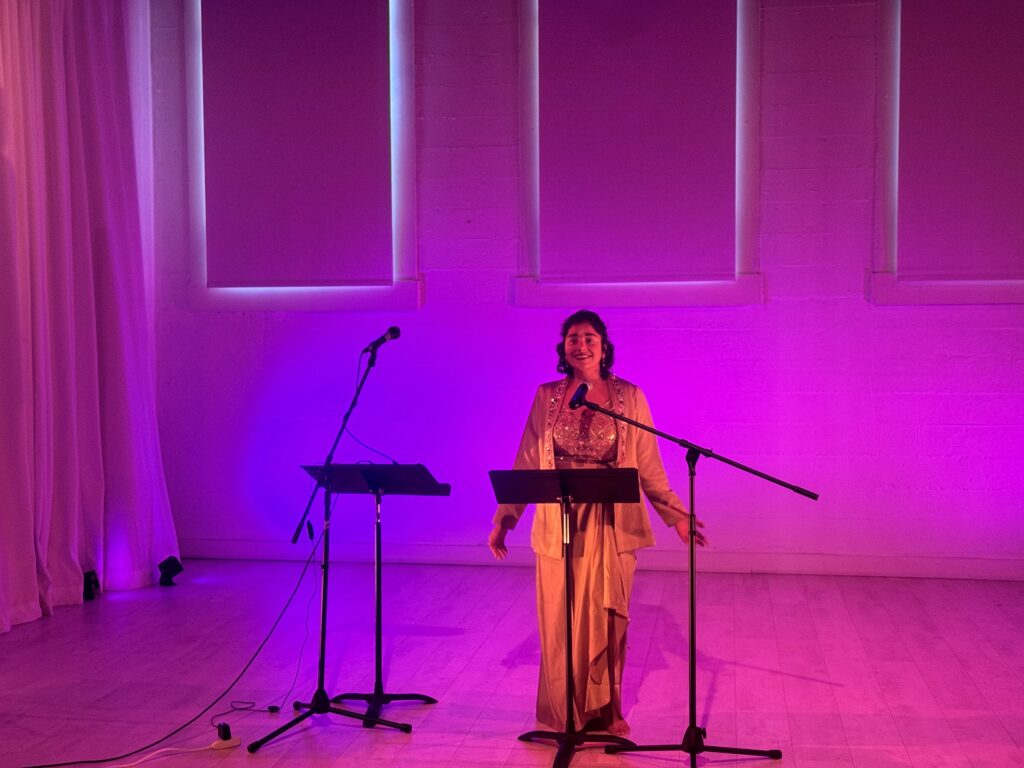
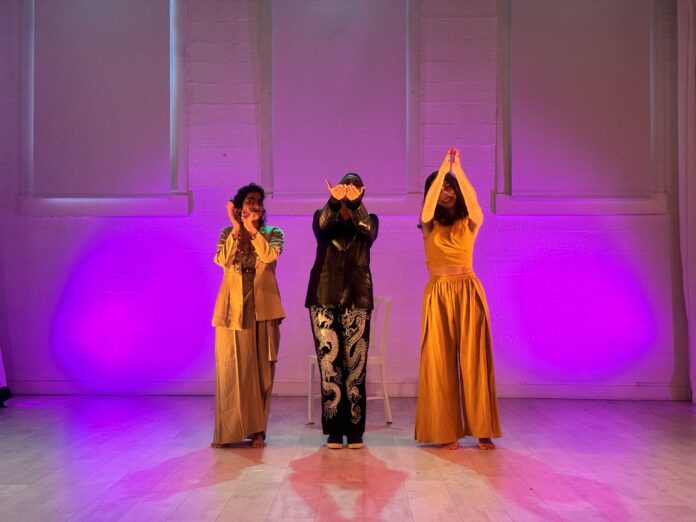
I had the privilege of seeing Ajeeb Ajeeb, a mixture of spoken word, sound, song, and movement, performed by incredible local artists Nhylar, Anjalica Solomon, and Panthea Vatandoost. Nhylar is a queer gender non-conforming storyteller, media artist, and poet born in India who is active in events such as VancouverPride and Queer Arts Festival. Anjalica is a genderfluid Desi musician, songwriter, poet, spoken word artist, and multidisciplinary performer based in Vancouver whose poetic work “seeks to proclaim the possibilities of love and resilience.” Panthea is an Iranian actor, director, creator, and founder of managing artistic director of Medusa Theatre Society, a non-profit devoted to “supporting and producing works that engage with the immigrant and refugee community, with a focus on the Middle East.”

Ajeeb, in Farsi, Urdu, and Hindi, means “strange, odd, familiar, and wonderful,” which perfectly describes the sensations that emanated from this performance; it felt like an exploration of life, a culmination of the experiences of the artists being a part of the Asian diaspora and feeling out of place. 

The show started off with Solomon reading a poem, with the sounds of her voice being loop-peddled by an Rc505 loop station, creating an immersive sonic soundscape. After the opening poem, Nhylar began their segment of the show with a ritual, bridging the ceremony with the performance. The ritual felt like an immersive, interactive experience, making everyone in the space in some way whole and present. 

PHOTO: Yasmin Hassan / The Peak

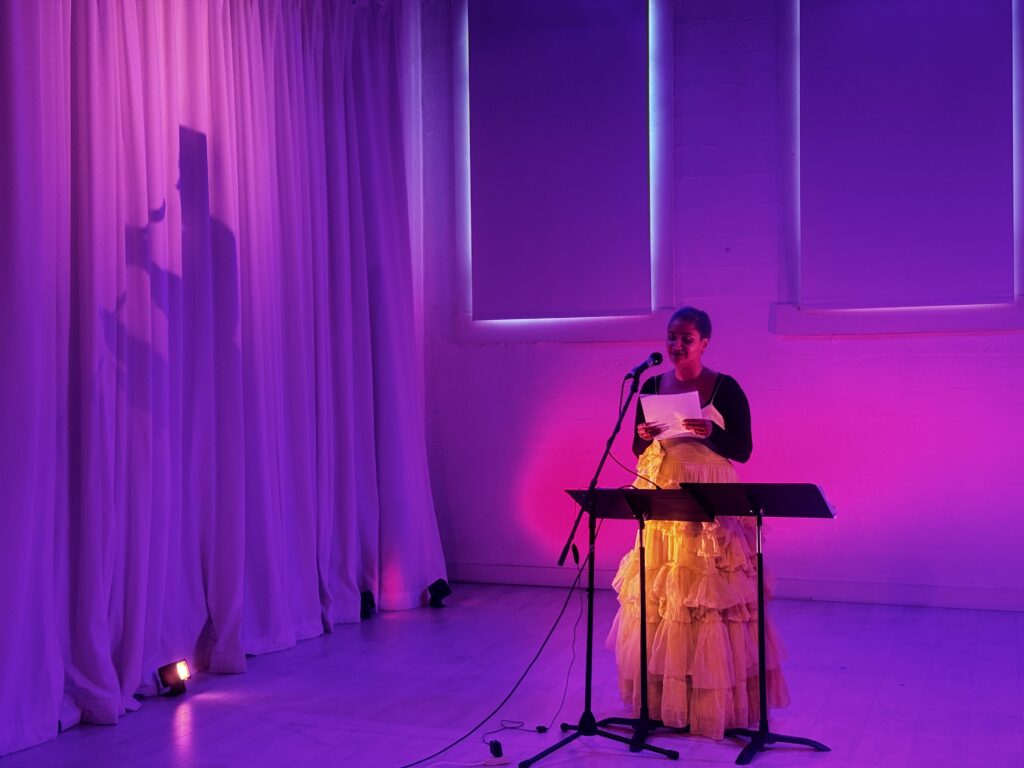
Nhylar, after finishing their beautiful ritual, began reading out their poems. These poems ranged from various themes and experiences like alien and human duality, queer eroticism, appreciating nature, questioning life, grief, and death. I couldn’t help but think that the idea of returning to nature reminded me of pastoral poetry, which I wholeheartedly enjoy. 

PHOTO: Yasmin Hassan / The Peak

Next came Solomon, returning to read her poetry. She opened up with a poem called “Brown Girl Smoking Up,” which stunned me. Her poems touched on being far from home or never being able to return, meeting her mother for the first time, queerness, and climate change. Not only was she reciting her spoken word, but she also sang and used the loop-peddling, which truly drove it home for me; she has an commanding voice! 

PHOTO: Yasmin Hassan / The Peak

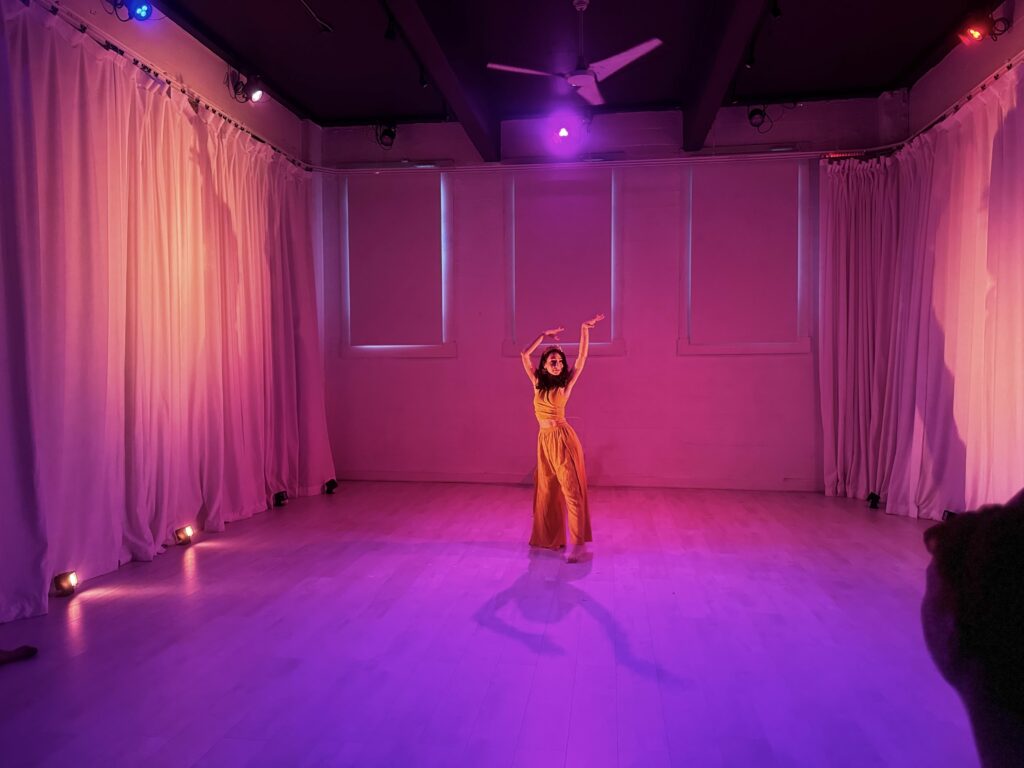
Finally, the last act of the show was from Panthea Vatandoost, who started off by handing out party hats to the audience. Hearing her say, “Welcome to my funeral party!” told me I was in for something amazing. Her performance was less poetry and more a conversation or a phone call with an old friend. As she moved around the room, Vatandoost talked about a range of topics — her grandma’s hands, death and its untimeliness, the idea of having an unfulfilled prophecy and bearing the weight of a legacy, and an endless cycle of indentured servitude. She finished her set with dancing and singing, looking ethereal.

PHOTO: Yasmin Hassan / The Peak

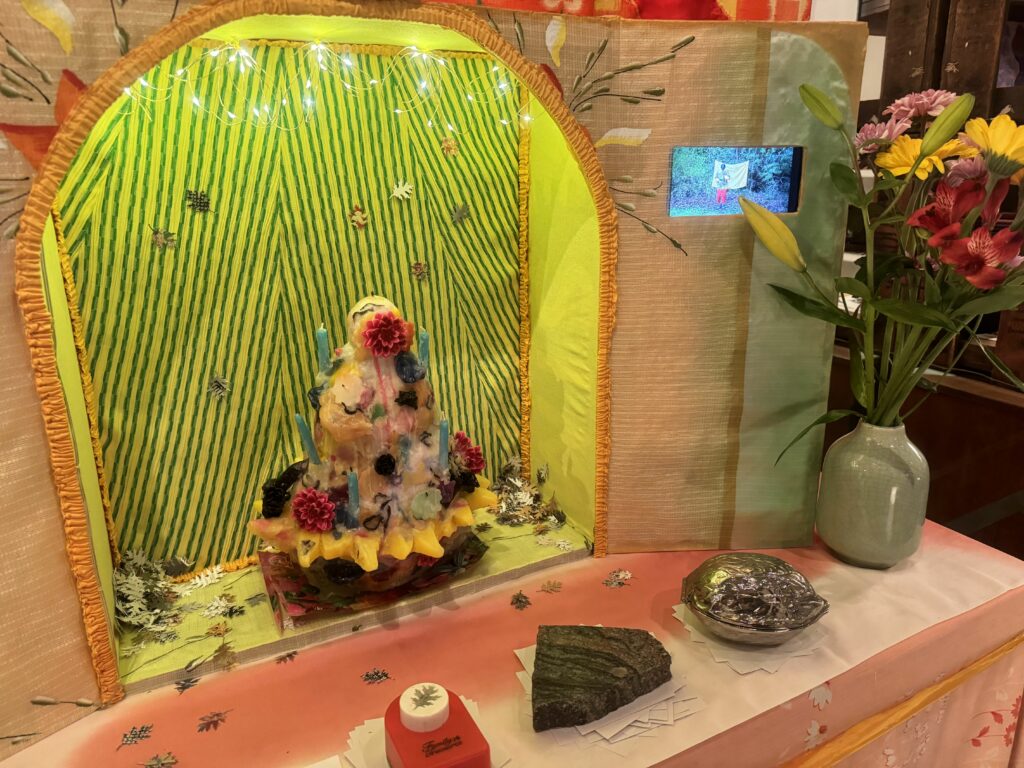
The gallery itself was adorned with beautiful and intricate installations like a tea ceremony table, a shelf for different Asian snacks, a couple of shelves for selling handmade goods (cards, books, keychains, stickers, and more), and one installation that particularly caught my eye. This mixed media installation by Sauha Lee is titled “Your Intentions Walk Towards You,” and it explores “the way she confronts her heritage and ancestry.” The combination of different objects collected over time takes the form of a sort of shrine, with a big mix of melted candle ends sitting in the middle. Beneath lies three intention-holding weights, from which you write an intention down on paper and place it underneath one of the weights. If you have a chance, do not skip out on seeing a show at Morrow. Despite its small, intimate space, Morrow isn’t afraid to explore and expose the ajeeb in and of life!

Building cities for citizens, not vehicles

1
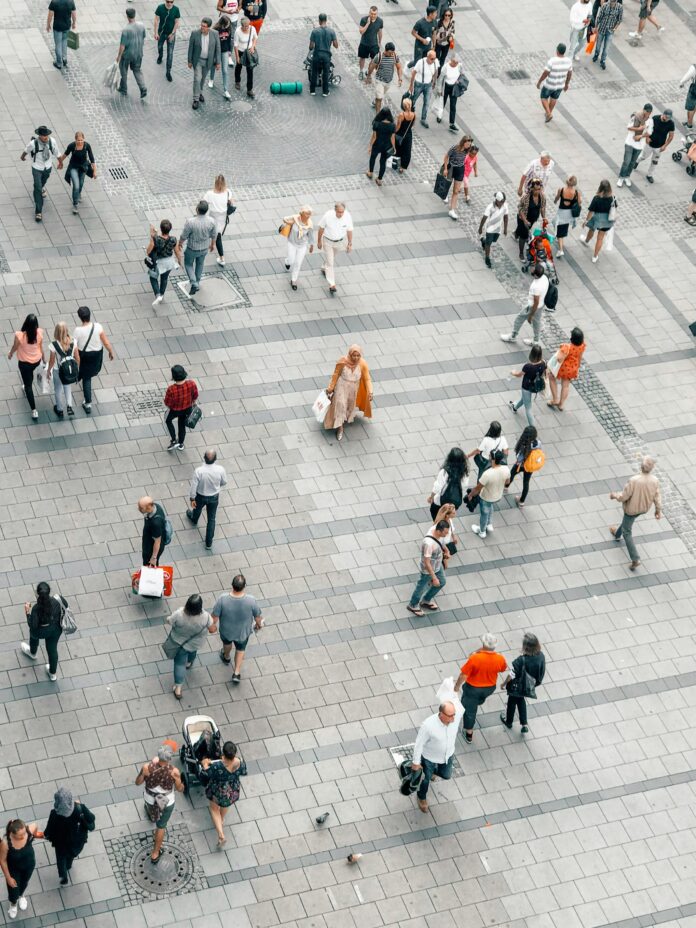
People walking on gray concrete road
Photo: Jan Antonin Kolar / Unsplash

By: Hailey Miller, Staff Writer

Content warning: mentions of death.

Although there are rules in place for all road users, not everyone sharing the road is ensured the same level of safety. Vulnerable road users, those being cyclists, motorists, and pedestrians, are at increased risk of severe or fatal injuries compared to vehicle users. Street safety for them needs to be prioritized. This begins with enhancing measures related to signage, awareness of surroundings, and the implementation of stricter road rules.

Lack of safety for cyclists and pedestrians often leads to accidents that otherwise could have been avoided. The danger of taking to the streets as a pedestrian or cyclist in Metro Vancouver is alarming despite traffic-related fatalities decreasing in the past 20 years. From 2014 to 2020, two cyclists and 51 pedestrians were killed in accidents and about 50% of traffic related injuries or fatalities in 2021 were either cyclists or pedestrians. This year, a cyclist in East Vancouver lost their life from a traffic-related incident

Taking to the streets — whether walking or cycling — no matter what city you’re in, should be a safe and enjoyable experience. Building cities for their citizens rather than cars makes socially closer, safer, and environmentally sustainable neighbourhoods.

When thinking of cyclist cities, cities like Amsterdam come to mind. While different factors have made Amsterdam a cyclist paradise, such as flat terrain and mild weather — none of which can be attributed to Metro Vancouver — an active push of bicycle activism was required. In the ‘60s and ‘70s, groups organized public demonstrations, advocating for safety in the streets, especially for children. The city had to plan for each street to be safe for cycling, making the effort a long-term plan. And, as would be the case for most cities, many residents say they have concerns regarding street safety, as there are still people who disobey the rules, like signage and designated lanes. Still, Amsterdam has reduced traffic-related deaths significantly, 3,300 people died by traffic in 1971, to only 745 people in 2022 in the entire country.

Intuitively, cycling and walking short distances are environmentally friendly alternatives to car driving — biking reduces your CO2  per kilometer by about 75% when compared to single-use vehicles. And it’s not only the environmental benefits that should be considered, walkable cities are good for the economy. New York saw a rise in sales of 172% of local businesses in repurposed areas with pedestrians as a priority.

Taking to the streets — whether walking or cycling — no matter what city you’re in, should be a safe and enjoyable experience.

Building or rebuilding a city to prioritize pedestrians, cyclists, and public transit is an ongoing effort that requires different areas of urbanism to intersect. For example, measures that can be taken to improve street safety include having designated bike lanes that are separate from traffic (and that preferably have a barrier for added protection), better signage and lighting at crosswalks and throughout intersections, and proper flashing lights and signals. 

Public transit should also be included in redevelopment efforts. Taking New York as an example, dedicated bus lanes increased both bus speed and ridership, as well as a decrease in injury crashes. However, rezoning and redevelopment efforts can’t ignore the needs of people with disabilities, emergency vehicles, and the fact that cars are and will continue to be used. People with motor disabilities should be brought to the front in this conversation; designing with accessibility in mind helps both able-bodied and people with disabilities. While there haven’t been many studies about people with disabilities and walkable cities, frequent resting spots, weather-safe bus stops, accessible transit vehicles, and actively listening to requests are a must. Finally, while vehicles might be discouraged in this type of urban redevelopment, emergency vehicles such as ambulances and fire trucks still require an efficient way to move within a city. 

Proper awareness includes awareness of motorists, pedestrians, and cyclists alike. Educating yourself about the importance of safety, the risks of being on the road, and the measures that can be taken to prevent accidents and injuries are all ways that can help improve street safety. Safety gear and equipment such as wearing a helmet, reflective and vibrant clothing, and reflective stickers on bicycles and gear are all measures that cyclists and pedestrians can take to be safer — and more visible — on the streets. 

Vancouver is on the right path, being ranked as the most walkable city in Canada, but there’s still room to improve. Remember to share the road and be conscious of your actions to minimize the chance of accidents. Safer streets need to be prioritized for everyone.

Council Chats: Various committee elections held to kick off the summer semester

0
This is an illustration of a graphic that reads “Council Chats.” The image also has two text boxes to symbolise messages being sent.
ILLUSTRATION: Andrea Choi / The Peak

By: Hannah Fraser, News Writer

On May 15, The Peak attended the bi-weekly Simon Fraser Student Society (SFSS) Council meeting via Zoom. The meeting involved  committee elections and an announcement that Council meetings would be offered hybrid-style for better engagement among councillors. 

Elections for committee positions

Elections were held to appoint councillors to the accessibility committee, equity and sustainability committee, Vancouver campus committee, and an “SFSS restructuring working group. 

While 11 other committee elections were supposed to take place, these elections were postponed to the following meeting as some nominated councillors hadn’t yet completed their mandatory membership forms. The elections that took place automatically assigned councillors onto the committees without a need for voting. There are a certain number of seats available on each committee, and because no extra nominations were called, each seat was filled with no need for a formal election. The elections that took place are as follows:

The accessibility committee monitors how the Student Society Accessibility Fund is spent, recommending changes to policy relating to accessibility. Sam Killawee, vice-president internal and organizational development, nominated Rishu Bagga, vice-president university and academic affairs, to the committee, which Bagga accepted. Bagga then nominated Ariana Shamsuddin, molecular biology and biochemistry representative, to which she accepted. No other nominations were brought forward, so Bagga and Shamsuddin automatically joined the committee. 

The equity and sustainability committee works to “dismantle intersecting forms of systemic oppression” by platforming “historically-excluded students in the community at SFU.” Self-nominations came from Grayson Barke, environmental science representative, Jasleen Dhami, gender, sexuality, and women’s studies representative, and Maryam Niaz, biomedical physiology kinesiology representative. Chloë Arneson, vice-president equity and sustainability, also nominated Bagga. Barke, Dhami, Niaz, and Bagga all automatically joined the committee. 

One representative from each constituency group, such as SFU350, a group representing climate justice issues, and the Simon Fraser Public Interest Research Group (SFPIRG), an independent student society representing social justice issues are also automatically part of this committee. Emmanuel Anthony-Onuigbo, Students of Caribbean and African Ancestry (SOCA) representative, retracted his self-nomination due to automatic membership. Since SOCA is a constituency group, Anthony-Onuigbo was already a member of the committee. 

The Vancouver campus committee focuses on “issues affecting students at the Vancouver Campus,” giving Council “formal recommendations and reports” around campus engagement. Chitransh Motwani, vice-president events and student affairs, Pranay Ratan, data science representative, and Arneson all self-nominated and joined the committee.

Councillors were also nominated for a “working group,” made for the SFSS to “review and modernize its current model to improve the structure of its organization and serve the student body more efficiently.” Meha Sidhu, the business administration representative, and Landy Liu, the chemistry representative, both joined the working group as nominated by Killawee. Shoron Alam, health science representative, self-nominated and also joined the committee.

Independent Jewish Voices calls on BC government to reject IHRA definition of antisemitism

0
a sign is held up in the middle of a protest, reading “our voices will never be silenced” with an image of the Palestinian flag.
PHOTO: Şeyma D. / Pexels

By: Yashita Dhillon, News Writer and Olivia Sherman, News Editor

Independent Jewish Voices Canada (IJV) is urging the BC government to reject the International Holocaust Remembrance Alliance’s (IHRA) definition of antisemitism in its updated anti-racism legislation. IJV is an organization that describes itself as working to reaffirm human rights, who “oppose any attempt by the Israeli government to impose its own solutions on the Palestinians” and “amplify the voices of Canadian Jews in support of justice.” The Peak spoke with Sid Shniad, a founding member of IJV and an executive member of its Vancouver chapter.

The new legislation, which was tabled on April 11, aims to “hold public bodies accountable for addressing systemic racism in policy and programs.” In an open letter, IJV noted the necessity of fighting against antisemitism. However, IJV opposed the inclusion of  IHRA’s definition of antisemitism, specifically its inclusion of Israel. On their website, IJV notes “the fight against antisemitism is undermined when principled opposition to unjust Israeli government policies and practices including those that contravene international law are branded as antisemitic.”

On April 30, the Gaza Ministry reported that over 34,000 Palestinians have been killed by Israel, the highest rate of death in any conflict in the 21ˢᵗ century. Despite numerous calls for a easing of violence and the release of the Israeli civilians still held hostage, Israeli Prime Minister Benjamin Netanyahu rejected a ceasefire, which the International Criminal Court (ICC) and the United Nations consider a genocide of the Palestinian people. 

Despite Netanyahu’s denial of intentional starvation of the Palestinians, shipments of aid have been fractional and nationalists have been caught damaging and destroying aid to Gaza. 

The IHRA gives examples of antisemitism such as, charging “Jews with conspiring to harm humanity” and “calling for, aiding, or justifying the killing or harming of Jews in the name of a radical ideology or an extremist view of religion.” Other examples include Holocaust denial and the usage of conspiracy theories, such as the world Jewish conspiracy that assumes Jewish people control the media, politics, and the economy.  

While IJV “does not object to resisting antisemitism,” IHRA definition of antisemitism includes 11 examples of statements that could be seen as antisemitic, with six of them relating to Israel. Shniad explained how this “emphasizes the issue of Israel, and support for Israel, and shield[s] Israel from criticism.” He said, “It’s a thinly disguised form of defending Israel rather than addressing antisemitism,” Shnaid said. 

“If you want to be a refuge for people, you have to be a refuge for all people.” — Sid Shniad, founding member of IJV

Kenneth Stern, one of the original drafters of the IHRA definition, has also criticized its current use. “Stern has warned explicitly that right-wing Jews who are supporting Israel have weaponized the issue of antisemitism in support of Israel, and he urges governments and institutions not to adopt it for that reason,” Shniad said.

“It’s important to understand the difference between criticism of Israel and criticism of Zionism and antisemitism,” said Shniad. Zionism is a nationalist movement aimed to create a Jewish homeland in Palestine. Both historically and currently, this involves the mass expulsion of Palestinians from their homes, pushing them further into the allocated areas for Palestinians: the Gaza Strip and the West Bank. The largest expulsion was after the creation of Israel in 1948, an event referred to as the Nakba, which is Arabic for “catastrophe.” 

“Israel and its supporters want to make sure they make it difficult, if not impossible, for people to criticize or organize opposition to Israel and what it’s doing and that’s what the IHRA definition is all about,” Shniad said. “I want to feel free to criticize Israel the same way I criticize any other state.” Other definitions, such as the The Jerusalem Declaration On Antisemitism note that “evidence-based criticism of Israel as a state” are not antisemitic.

Agencies like the ICC have condemned Israel’s actions, citing collective punishment of civilians for the actions of the militant group Hamas, and the intention to erase any cultural markings of Palestinian heritage. Shniad added, “Jews have certain legal rights in Israel that Palestinians who are born there do not.

“If you want to be a refuge for people, you have to be a refuge for all people” he said, as Israel is considered an apartheid state by many human rights organizations. 

By challenging the IHRA definition, IJV aims to ensure that the struggle for Palestinian justice is not hindered by mislabeling it as antisemitism. 

Asian businesses to check out this summer

0
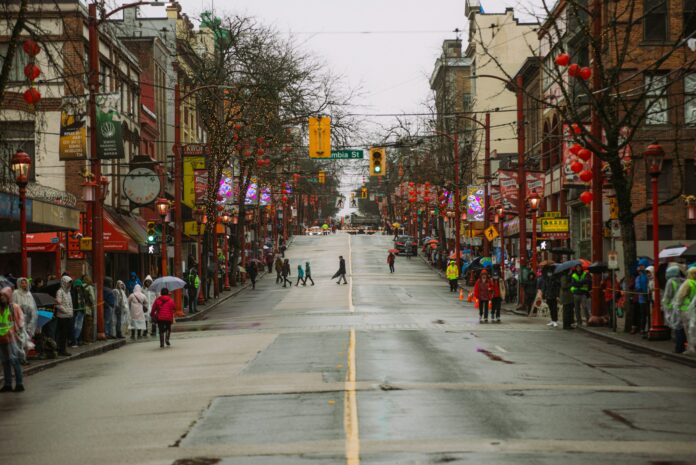
a street in Vancouver’s Chinatown decked out in red paper lanterns and street lights.
PHOTO: Courtesy of Albert Stoynov, Unsplash

By: Izzy Cheung, Arts & Culture Editor

As Asian Heritage Month is nearing its end, we need to remember that even though we celebrate certain cultures during certain months, that doesn’t mean we stop once the month is over. We can help uplift marginalized voices and communities by supporting their endeavours, whether those are small businesses or projects in the arts. Here are some businesses you can help support beyond Asian Heritage Month. 

Centre A 

# 205, 268 Keefer St., Vancouver 
Opening hours: 
Wednesday–Saturday, 12:00 p.m.–6:00 p.m. 

A Chinatown staple, Centre A is your go-to stop to appreciate ornate displays of Asian art. They host both exhibitions and events, along with a reading room filled with donated publications that reflect on Asian history. Their current exhibit, and when you return, we will talk again, is a poignant exploration of migration told through photographs. This exhibit’s final day on display is May 24, so be sure to check it out before it ends. They also recently launched a podcast called Pigeon, Seagull & Crow, which discusses the gallery’s role “within the evolving contemporary art scene in Vancouver and Canada.” 

La Patisserie 

#1405 4771 Mcclelland Rd., Richmond 
Opening hours: 
Monday–Saturday, 10:00 a.m.–6:30 p.m. 
Sundays, 10:00 a.m.–6:00 p.m. 

Come to La Patisserie for sweet, sumptuous desserts. Stick with a simple slice of fruity blueberry cheesecake, or try something unique like a spongy black sesame cake. If you’re a big fan of mango, you’ll love their fresh mango cakes which are covered in thin slices of sweet mango. Grab a rich dessert or pick up some cookies to snack on, and chat with the friendly aunties who will ring in your order. Regardless of your choice, you’ll be sure to enjoy something from La Patisserie! 

Henlong Market 

14351 104 Ave., Surrey 
Opening hours: 
Sunday–Tuesday, 8:00 a.m.–7:00 p.m. 
Wednesday–Saturday, 8:00 a.m.–8:00 p.m. 

This Asian-run market in Surrey boasts a variety of products from Vietnam, Malaysia, Indonesia, Thailand, Hawaii, and the Philippines. Not only do they carry products from these cultures, they also have a short list of corresponding recipes as well. The name comes from the founder’s nickname, but also means “lucky dragon” in Chinese. Henlong isn’t just notable for their wide variety of groceries, however — they also work to give back to their community. In 2015, they made contributions to charities such as the BC Children’s Hospital Foundation and the Canadian Red Cross. They also run scholarship programs.  

Gateway Pizza 

#104 19909 64 Ave., Langley 
Opening hours: 
Mondays,  from 4:00 p.m.–9:30 p.m.
Tuesday–Thursday and Sundays, 11:00 a.m.–9:30 p.m. 
Friday–Saturday, 11:00 a.m.–10:30 p.m. 

9183 148 St., Surrey 
Opening hours: 
Sunday–Thursday, 11:00 a.m.–12:00 a.m. 
Friday–Saturday, 11:00 a.m.–1:00 a.m. 

#101 12877 76 Ave., Surrey 
Opening hours: 
Sunday–Thursday, 11:00 a.m.–12:00 a.m.
Friday–Saturday, 11:00 a.m.–1:00 a.m. 

2777 Gladwin Rd., Abbotsford 
Opening hours: 
Monday–Thursday, 11:00 a.m.–11:00 p.m. 
Friday–Sunday, 11:00 a.m.–12:00 a.m. 

Gateway Pizza is a small franchise with four locations scattered across Surrey, Langley, and Abbotsford. Don’t be fooled by their name — they serve up more than just pizza. Gateway Pizza also offers a large selection of Indian food, as well as their own takes on certain types of pizza. Take your pick from their paneer pakora or raita to start off your meal, then move on to a simple cheese pizza or a more-complex paneer tikka pizza. You can also try their traditional Indian curries or desserts

Creative Corner: Baking in a new country

0
different stages of a cake with strawberries in it being baked (bowl of batter, in the oven, baked and decorated, etc.)
ILLUSTRATION: Sandra Cao / The Peak

By: Prerita Garg, SFU Student 

When I was eight years old, I moved to Canada from India. Everything felt new and foreign, but the one constant in my life these first few years after moving was my affinity for cakes. As a child, cakes were only available to me on special occasions, like birthdays. These cakes came in multiple flavours and always had flowery designs. Back in my country, I didn’t have an oven, so the process of baking was always unknown to me. Because of my interest in cakes, my mom watched a recipe on TV and tried to make me a cake in a pressure cooker. Her cake could not adhere to classic recipes because they required eggs. My family and I are Hindu, so due to our cultural preferences, we do not consume eggs or any meat products. Because of this, the cake turned out more like jelly instead of a typical fluffy cake. I decided that, no matter what, I would continue baking and succeed in making something that could be compared to a cake. 

Despite now having an oven available, I faced some initial struggles, as I had no prior knowledge on how to operate it. I relied on Google and YouTube tutorials to gradually learn the oven’s functions. While this facilitated the baking process, sourcing the correct ingredients posed a challenge due to unfamiliar names and having limited access to others. 

Finding vegetarian alternatives was hard for me, and the initial outcomes of my baking were distressing; some cakes did not rise, some were bitter, and some fell apart. I felt very wasteful since I often had to throw away some of my attempts, as they turned out burnt. Because of this, on most birthdays or celebrations, my family opted to buy cakes. However, I still was not demotivated. Over the years, I have continued to bake whenever an opportunity arises.  

Such an opportunity came on the occasion of my parents’ 23rd anniversary, almost eleven years after I had moved. So, I once again jumped into the process of baking. This time around, I wanted to do better — something that wasn’t just edible, but looked good too. I was recommended a video for an eggless cake by Bake with Shivesh, and out of the two options in the video, I chose to make a vanilla cake.

To make this cake, I followed the recipe, as it was already vegetarian and didn’t require any substitutes. Before I put my cake in the oven to bake, I realized I had some strawberries left in the fridge that would rot if they went unused. To save them and enhance the flavour of the cake, I washed, cut, and added them to the batter. Because of this, my previously-vanilla cake ended up having a touch of strawberry flavour, which would add to its sweetness later on. 

I baked the cake for 30 minutes, and I inserted a toothpick into the middle of the cake to check whether it was done. Thankfully, the toothpick came out clean. This cake was perfectly baked — there was no jelly to be seen here! Once the cake had finished cooling down, I sprinkled some sugar on it and added some cut up strawberries to enhance its look. It was not as artistic as any ready-made cake, but still looked good. Cutting into it revealed its dense and moist texture. Overall, it had turned out to be a success, except for the fact that it had stuck to the tin a little bit (my tip for the future would be to coat the tin better). 

I am extremely proud that I accomplished my cake-baking goal. After childhood memories of eagerly waiting for a special occasion to taste some cake, I was finally able to bake it myself. Over time, the process grew easier as more vegetarian options became available. Accomplishing this goal brought me a sense of fulfillment and boosted my self-confidence. The best part was that my parents were extremely pleased after eating it. I’m glad I didn’t let my first failure, all those years ago, stop me from trying out baking. 

Through all the trials and challenges, I have realized that my journey was not just about following a recipe, but much more than that. It was a journey of adaptation and creativity, and ultimately savouring the sweet taste of success. Nonetheless, I will continue to work on myself and hopefully, one day, I will gain proficient expertise in baking and icing a cake.

Exploring Vancouver’s Latin American culture

0
A photo of the VLACC (address: 1885 Venables St, Vancouver,)
PHOTO: Amirul Anirban / The Peak

By: Michelle Young, Copy Editor

Though Latin Americans make up roughly 3% of Canada’s population, we are here. Latin Americans have come to Canada since at least the 1950s, with an influx of Chileans migrating to Vancouver following the Chilean coup in the ‘70s. This birthed the bilingual Vancouver-based publication Aquelarre: A Magazine for Latin American Women, which can be found in online archives or libraries. The magazine ran from the late ‘80s to mid ‘90s and featured feminist and anti-colonial essays, reviews, and poems. They published 23 issues

From 2021 to 2023, the Spanish-speaking Latin American population nearly doubled in Canada. In BC alone, the Latin American population increased almost 50% from 2016 to 2021. As we’ve grown, so has access to our various languages and cultures. Established in the early 2000s was the Vancouver Latin American Film Festival, while the Vancouver Latin American Cultural Centre (VLACC) was founded in the 2010s. 

They are both dedicated to celebrating Latin American heritage and feature programs that reflect Latin America’s diversity. In an interview with The Peak, Lili Vieira de Carvalho, the director of VLACC, spoke about engaging with Latin American culture by attending cultural events, exploring its cuisine, and using art as a form of immersion. Last year, the Vancouver Writers Fest held Latin Expressions in Three Conversations in partnership with VLACC, a panel on Latin American writers and the lives of women. Similar to the Writer’s Fest, the Vancouver Latin American Film Festival gears up in the fall and will feature a panel for Afro-Indigenous voices. Every year, they also showcase a collection of shorts that centres on queer Latin American identity. These are only a few of the local examples that show Latin American heritage is rich here, however our culinary culture also thrives. 

There are dedicated Latin American grocery stores in Vancouver, such as Mi Tierra Latina and Fresh is Best on Broadway. The latter is where I ask my mom to buy me my Cocosette fill (a Venezuelan coconut wafer), but you can also find classics like Abuelita Hot Chocolate and harina pan (corn flour). Mi Tierra Latina has additional locations in Burnaby and Coquitlam, and both grocery stores share aspects on Latin American culture online: Fresh is Best on Broadway features a blog and Mi Tierra Latina shares snippets of local Latin Americans on their Instagram and have ingredient lists for dishes on their website. 

 “Our local diaspora reflects this diversity, with individuals hailing from various countries and regions, each bringing their unique experiences and perspectives” — Lili Vieira de Carvalho, VLACC director

Carvalho said she’s “had many memorable experiences with the Latin American community in Vancouver, from joyful celebrations during music performances (audiences climbing on the stage at the end of a Puerto Rican concert) to thought-provoking discussions on issues affecting our communities,” adding, “one particular experience that stands out is the sense of solidarity and camaraderie among the members of the VLACC choir, Canto Vivo. This group of singers coming from many countries in Latin America and elsewhere really support each other.”

While Latin Americans are considered a panethnic group due to overlapping and shared cultural similarities, Latin Americans are very diverse. Carvalho explained, “Latin America encompasses a great variety of ethnicities and cultural traditions. Our local diaspora reflects this diversity, with individuals hailing from various countries and regions, each bringing their unique experiences and perspectives.” Something to keep in mind in the context of Latin American history is that “what we consider today as Latin America has been shaped by hundreds of years of European imperialist rule, battles for independence from colonial powers, civil and world wars, and both voluntary and involuntary migration,” as reported by the Getty arts organization.

Exploring cultural events can introduce folks to the wide range of Latin American diversity, in addition to providing Latin Americans with a resource to explore their own cultures, or neighbouring countries. Though there are uniting factors, each respective country has their own history and cultural differences. While bossa nova is quintessentially Brazilian, its gentle rhythms contrast Mexico’s brassy ranchera. Though I consider myself adequately fluent in Spanish, this is very specific to the Venezuelan accent, slang, and humour. While watching Argentinian comedy, The Magic Gloves, I had to turn on the subtitles. Though not the only two languages spoken in Latin America, the Vancouver Public Library features resources in Spanish and Portuguese. “It’s essential to recognize this diversity rather than resorting to stereotypes or generalizations,” Carvalho said. 

I want to thank The Peak for the opportunity to share insights into the cultures of our Latin American diaspora and the vital role it plays in making the cultural landscape of British Columbia richer and livelier. VLACC is on a mission to share a deeper understanding of Latin American arts and challenge stereotypes. We are ready to manage a new facility dedicated to Latin American arts and cultures right here in Vancouver. This dream gets closer every day.”

Opinions in Dialogue: Is social media helpful or harmful?

0
Illustration. Someone using their smartphone against a black background. The phone light illuminates their face, which displays an exhausted expression. Surrounding them are illustrative emojis and notifications.
ILLUSTRATION: Angela Shen / The Peak

By: Jin Song, Peak Associate and Michelle Young, Copy Editor

Social media use has skyrocketed in recent years. What once felt like a novelty is now commonplace, as it’s become increasingly rare to meet someone who doesn’t use any form of social media. Concerns have been mounting for years about social media’s impact on aspects like mental health, childhood development, and sociability. Some say social media is flat-out harmful, others argue it’s all about how you use it, and some say these claims are overblown and it can foster community. While the truth usually lies somewhere in between, why are more and more people choosing to take a step back from their phone?

Jin: The evidence suggests social media is harmful and helpful. To me, the fact that there is so much contention in this case is a good demonstration of this conclusion. Social media has affected different people in vastly different ways. The general consensus seems to be that social media negatively impacts mental health, but there are so many things we can do now with it that we couldn’t before — instant sharing of information to an uncountable amount of people, for instance.

Michelle: A lot of information is more easily accessible now. While misinformation remains a huge problem, the potential for learning and connecting with others online is very powerful. Throughout my life, I’ve always been more of a homebody, but the internet has been invaluable in connecting me with people I may not have met otherwise, and has provided long-lasting friendships. While I’ve been satisfied with my social media usage for most of my life, I noticed myself more often checking my email worried I would miss something important, refreshing X (Twitter) and Pinterest when I was bored, and spending more time online than I intended. I recently took a drastic measure in forfeiting my iPhone for most of the day, and have been using a second-hand flip phone on Wi-Fi only as an alternative to keep me away from distractions. It’s cut down the time I spend scrolling and has made me use my time with media and the internet more intentionally. 

Jin: I’ve done something similar, carrying around a smartwatch instead of my phone (yes, Mr. Jobs, it’s also an iPhone) for general use. Indeed, there has been sufficient evidence to suggest that our brains just aren’t made to handle the waterfall of information that is the internet. Anecdotally speaking, I find myself more exhausted and overwhelmed after a long stint of web surfing than if I had, say, just read one book. 

The internet contains not only positive or neutral information but so much negativity too. To quote a New York Times article, “Our online news feeds aggregate all of the world’s pain and cruelty, dragging our brains into a kind of learned helplessness.”

Michelle: There are a lot of negative things on the internet. However, the digitization of online materials through archives and libraries is an invaluable resource. Though this isn’t necessarily a unique aspect of social media, it’s an example of how we have agency in how we use the internet. I know it’s easier said than done, but making a conscious effort in what we consume over social media can drastically impact our experience. For example, while I use X as a form of news, I curate other forms of social media so that news doesn’t necessarily appear in my YouTube or Pinterest algorithm. While there are differences between how we consume information over different mediums, negativity is also found in film and books — though typically if we don’t want to consume that kind of content we wouldn’t watch or read that form of media. I need a certain amount of brain power to watch a documentary, for example. The same can apply to social media, where you can follow or unfollow whichever accounts you want. This isn’t to say that we should spend all our time on the computer or social media either, but rather that there is curation involved. 

Jin: It’s common sense that internet users can choose what they use it for. No one is forcing you to engage with a certain platform. I agree with your point about being intentional with what we consume. Personally, I’ve adopted a form of digital minimalism, which is about recognizing that “new communication technologies have the potential to massively improve your life” and that getting there takes practice. It involves recognizing which tools “add the most value to your life,” and “clearing away low-value digital noise.”

The main negatives of social media for me is the massive influx of information and negative content. I’ve discovered that digital minimalism, while imperfect, is a very effective solution. I say imperfect because most modern social media platforms use algorithms that operate much like slot machines. Our feeds intentionally give us content that we may or may not like . . . it’s a gamble, which the human brain loves. The longer we stay on social media platforms, the more money the big corporations make. Both we, the clients, and the companies can benefit from a relationship like this, but there is definitely a fine line. 

Michelle: There is a lot of content out there, but social media is also so much more than that. Social media has fostered spaces for many marginalized communities, and especially those who are continually isolated during the ongoing pandemic. Social media has provided spaces for organizing not only in-person but also online, sharing action items that can be done from home. It’s not necessarily social media that’s bad, but the potential for how it’s used. 

Jin: Too much of anything — be it good, bad, or somewhere in between — can be harmful. I think all social media users can benefit from taking a step back once in a while. It can be enlightening to use that time to experiment with other hobbies and focus on real-world things that bring you joy. Personally, limiting my social media usage has really helped me stay in the present, and not think about an abstract digital future or a past experience that’s only documented as a tiny fragment of what it actually had been.

Everyone hates the stairwell detour at Commercial-Broadway

0
Entrance to access the SkyTrain blocked by ten “STOP, DO NOT ENTER” signs.
ILLUSTRATION: Emily Xu / The Peak

By: Hailey Miller, Staff Writer

If you’re a regular SkyTrain-goer in Vancouver, chances are you’re no stranger to being outrageously inconvenienced. Now, TransLink wants us to use an out-of-the-way stairwell that’s narrower than the footing of a tightrope. It couldn’t be further off the beaten path, like you’re going down the rabbit hole of Alice in Wonderland just to get from one platform to another. 

Allow me to set the scene if you’re unfamiliar with the chaotic situation. Since the escalators at Commercial-Broadway have been out-of-order, SkyTrain personnel have attempted — and considerably failed — to only allow commuters to walk up the main staircase. It’s not like it’s the third busiest station in Vancouver or something. At this point, commuters are training for the Grouse Grind whether they like it or not. 

So, how exactly are you supposed to get down the stairs, you ask? Well, cue the tiniest, sketchiest, most inconvenient back stairwell you’ve ever stepped foot on. As if the hoards of commuters on any given day at the biggest SkyTrain transfer station isn’t bad enough, they’re now unsuccessfully directing people to some random stairwell — that’s smaller than the main staircase — with an obnoxious sign that screams “NO EXIT,” but everyone ignores it, myself included.

The SkyTrain personnel just stand there, in front of this makeshift barricade — that seems to be sentient, constantly growing and moving — like they’re the Royal Guards at Buckingham Palace. Do they really expect every single person is going to squeeze into a tiny stairwell or wait a literal eternity for some elevator that’s further out of the way then the back staircase of doom? Pff, unreal expectations! 

Why would I not casually sneak past the signs like I run the place? I literally make a run for it and book it down the regular stairs to beat the oncoming counterflow of passenger traffic. This illegal manoeuvre of going against the grain just so I don’t have to go down some alternate stairwell should really be an extreme sport. TransLink staff can’t stop me, I’ve been playing British Bulldog for years to train for this. 

Seriously, how long does it take to replace one single set of escalators? Are they making the materials from scratch? These are the kinds of questions I need answered on the TransLink podcast (not that I’m listening to it, but still!). But what do I know? I’m just a bus bitch who doesn’t have the time of day. Management will surely be hearing from me. A scathing email and a formal complaint are on the way to the higher-ups’ inbox as we speak. 

The wheels on the bus may go round and round, but the motors on the broken-down escalators that haven’t had a finger laid on them to even begin the repairs sure as hell aren’t. At this point, it would be more efficient to install a fire pole or a magic carpet slide — like those ones at kids’ carnivals — because the chaos of Commercial-Broadway is already a circus, with the latest bothersome transit acts rolling into a station near you!