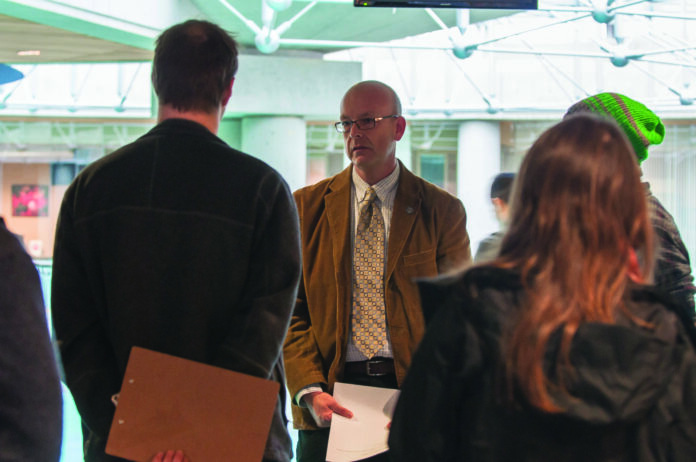
Lorne Davies, SFU’s first athletic director and inaugural football coach, passed away last night in St. Paul’s hospital from illness related to his heart and kidneys.
“Lorne meant everything to SFU athletics — it was his life’s work,” said Milton Richards, SFU’s senior director of athletics and recreation in a statement by SFU Athletics. “We will forever carry his spirit in our hearts every time our student athletes put on the Clan uniform to enter competition.
Davies was picked to head SFU’s athletics program during the school’s inaugural year by chancellor Gordon Shrum, a position he held for 30 years until 1995. Davies was instrumental in making SFU the first Canadian university in the NAIA, which allowed Canadian athletes to stay in Canada but compete against American competition. It also enabled the school to hire full-time coaches and offer athletics scholarships at a time when Canadian universities did not typically allow it.
Davies also chose the original Clan colours — blue, red, and white — and said they represented loyalty, courage, and honesty, respectfully. “Our crest will always be a tribute to Lorne, his values, and his vision,” commented Richards.
As head football coach, Davies led the SFU football team for its first eight years and achieved a 34–21–1 record and .616 winning percentage.
He also spent six years as a special assistant coach to the BC Lions.
Davies was to be recognized in April with the SFU Distinguished Community Leadership Award, which recognizes individuals for distinguished community service and impact on the community.
Davies is survived by his wife of over 60 years, June, and his two sons, Lorne Jr. and Glyn.
To raise awareness of First Nations culture and history, “Validating 500 Years of First Nation History” came to the Talking Stick Festival held at SFU’s Goldcorp Center for the Arts on February 22. The unique, experimental-learning theatre piece was created by Métis artist Suzanne Keeptwo. This unconventional production required each audience member, or “participant,” to bring a blanket to the show in order to take part in the story.
Surrey
Designed to give SFU pharmacist-hopefuls more information about how they can build their career in Canada, the BC Pharmacy Association and Skills Connect for Immigrants Program held an info night at SFU’s Surrey Campus on February 24. In addition to presentations from distinguished speakers in the pharmacy industry, the event provided SFU students with an opportunity to network with representatives from local pharmacies and hospitals.
Harbour Centre
What is the true nature of the United Nation’s Security Council? Paul Heinbecker, former Canadian Ambassador and Permanent Representative to the United Nations, shed light on the inner workings of Canada’s role in the Security Council in a lecture, entitled “Canada and the Security Council: Good Times and Bad.” SFU’s School for International Studies and the Canadian International Council presented the public lecture on February 19 at Harbour Centre.
The Shadow has been a hotspot for SFU students and alumni for the past 31 years. - Brandon Hillier
The Shadow has been a hotspot for SFU students and alumni for the past 31 years. – Brandon Hillier
On March 28, SFU students’ local haunt, the Mountain Shadow Pub, will close its heavy wooden double doors for the last time.
A frequent favourite of SFU students and the North Burnaby community since its establishment on June 23, 1984, the pub — fondly referred to as “the Shadow” — no longer fits into its neighbourhood.
Just a block away from the Hastings at Duthie bus stop, the Shadow was intended to be a part of the commercial corridor that would connect Hastings Street to SFU’s flagship campus.
According to the Shadow’s current owner, Michael Anastasi, the fact that the pub’s location ended up being a highly residential area was “the demise of the Mountain Shadow.”
Anastasi, who has owned the Shadow for over 10 years, said that this ‘demise’ has been a slow process. “The area grew residentially and the pub grew as well, but when the pub grew it caused many complaints by neighbours,” he explained.
Anastasi went on to say that the City of Burnaby, local police, and even SFU Security were involved in incidents of complaints on many occasions.
“If we would have a band [. . . or] a DJ, even though we bolted all the windows shut and pretty much made it soundproof, the neighbours would still call the police,” said Anastasi.
These complaints often resulted in the pub being fined, which lead Anastasi to conclude that the pub was no longer viable in its current location.
“We met with the City of Burnaby, all the councillors and the mayor, and tried to work out a deal,” said Anastasi. “Their only solution was moving the pub to a commercial location, meaning Hastings. Meaning somewhere else.”
Upon its closure, the pub will be demolished and the lot used to build condos. However, Anastasi will continue to hold the pub license, and predicted that the Shadow may be reincarnated at a different location in Burnaby in the next couple of years.
When asked if he would like the new pub to maintain a connection with SFU, Anastasi responded, “Of course that would be ideal. I think pretty much everywhere in North Burnaby is accessible to SFU, so that’s the priority, for sure.”
Colin Sharp, an SFU alumnus and former Residence Orientation Leader (ROL), recalls that the Shadow was an integral part of an annual residence tradition.
“As an [ROL], you are required to stay sober during the multiple days of training and multiple days of actual orientation,” recounted Sharp. “You were considered an ROL until Sunday at 5:00 p.m. Every year, by about 5:20 p.m., the Mountain Shadow was full of us.”
The closure of the pub doesn’t only mark the end of an era for SFU students, but for the wider community as well. In the ’80s, the Shadow was a favourite haunt of Canucks players. Anastasi explained, “This is where they would come every Saturday or a couple times a week to hang out after games.”
He continued, “They didn’t go downtown. They came to the Mountain Shadow.”
Anastasi said that the number of patrons and former patrons of the pub who have reached out since hearing of its imminent closure has been overwhelming.
Those patrons are also eager to get their hands on a physical piece of the pub’s history, coveting everything from the iconic stained glass windows, to the original wooden furniture, to the signed, game-worn Canucks jerseys that line the walls. The Shadow will be holding an auction from April 1–4 to allow people to bid for their favourite pieces.
“There are millions of alumni from SFU who are really sad, and they’re coming on a weekly, daily basis right now to say farewell,” said Anastasi.
Would you donate your organs? Should you be able to choose where they go after you die? These tough questions and others were discussed at a talk given earlier this month by BC Transplant at SFU, coordinated by the SFU Health Ethics Club.
Held in Blusson Hall on Burnaby campus, the event featured speakers that brought up the benefits and also the issues and concerns around organ transplantation.
One of the biggest logistical issues facing organ transplantation is the limited supply of donor organs. Longer life spans and lower accidental death rates mean that, as the population ages, the need for organs may far outstrip supply in the coming years.
In its most recent general report, the Canadian Organ Replacement Register states that there were just over 3,400 patients on the kidney transplant waiting list in 2012.
BC residents can register on the BC transplant website to opt to donate their organs when they die. The organ donor registration form includes options to allow only certain organs to be used, as well as an option to opt out of donation altogether. Currently, the most commonly transplanted organ is the kidney, and it is consequently the organ in highest demand.t
Along with the process of organ donation, BC transplant coordinators explained the complications that surround transplantation. The buying and selling of organs on the black market creates an environment where those of lower income may put themselves into dangerous situations in order to make money.
Perhaps an issue closer to home is the decision on how to rank potential organ recipients on the waiting list. In recent news, a 45-year-old mother of two and patient at Vancouver General Hospital, Alice Zhang, was removed from the kidney transplant waitlist after having reportedly exhibited signs of mental illness. Zhang contended that she was removed because of complaints she made regarding her treament in the hemodialysis unit. As of time of press, Zhang is set to appeal the psychiatrist’s decision at a review board.
Speakers also discussed the controversy durrounding the process of organ donation. In England as recently as the mid-1800s, it was regarded as blasphemous to mutilate a dead body.
However, advancements in modern medicine have shown that for those with end-stage organ failure, organ transplant is often the best option.
Responding to the concern that BC transplant staff would deny patients life-saving care in order to use their organs, Jennifer Payandeh, vice-president of the Health Ethics Club explained that, “The staff from BC transplant are not even involved until two doctors have declared that a patient has succumbed to brain death.” The separation of the health care staff and transplant staff protects the interests of the potential donor.
Payandeh ended the discussion by mentioning that the subject of health ethics is far reaching, and will likely affect everyone at some point in their life: “Being informed will help you make better decisions about your own health care.”
The event featured a screening of the satirical film, Dear White People. - Washington Post
The event featured a screening of the satirical film, Dear White People. – Washington Post
Have you ever experienced discrimination because of your race or ethnicity? If so, you are not alone, as was made clear at an event on campus this week called “Pardon Me For Being ________.”
On Tuesday, Feb. 24, the Black Awareness Student Initiative Network (BASIN) provided a screening of the satirical film Dear White People at Halpern Centre. The film draws on the experiences of African-American college students in the United States.
At the conclusion of the screening, participants contributed to a dialogue regarding the issues addressed in the film and their own personal experiences regarding racism and discrimination.
BASIN is an SFU student-led organization that works to provide a support network for people of African and Caribbean descent. It also provides education and awareness regarding the diversity of black experiences.
According to the event description, “Pardon Me For Being ________.” was put together as an initiative to “unite Black, Biracial, Coloured Caribbean and African diaspora students and our allies within the SFU community,” in order to bring to light to the experiences of those community members.
“The event was made to offer the SFU community a platform to discuss issues of race and discrimination with others as a means to share ideas and concerns we have as well as to share solutions,” said Robyn Bloomfield, president of BASIN. “Our hope is to provide our community with a physical oneness and presence on campus, offering support to whomever is in need.
Bloomfield emphasized that issues concerning race and discrimination need to be discussed rather than internalized. She explained, “Many of our experiences are silenced rather than voiced. This event provides us with the opportunity to think critically about our experiences and how these issues still exist.”
While the month of February is officially recognized as being Black History Month, the identity and character associated with these experiences are not confined to a month alone. “While Black History Month is a great way to learn from the experiences of my ancestors, people need to realize that being black is a constant, everyday experience,” explained Miriam Sise, an at-large member of BASIN’s executive team.
She continued, “It is hard to be in a classroom or walk through the halls and see nobody who looks like you.”
Bloomfield and Sise also pointed out that the often one-dimensional portrayal and tokenization of black people’s experiences in the media does not fully encompassing the full range of experiences; while many people share a skin colour, this does not necessarily mean that they come from the same place and cultural background.
“Our project is not about merely being ‘black,’” said Sise. “We are acknowledging that racism is an inherent part of modern society. Being aware of [the multitude of] experiences allow people from many different countries to feel included in our initiatives.”
Students presented SFU's associate vice-president, student services, Tim Rahilly, with their petition in the halls of MBC. - Leah Bjornson
Students presented SFU’s associate vice-president, student services, Tim Rahilly, with their petition in the halls of MBC. – Leah Bjornson
Concerned members of the SFU Teaching Support Staff Union (TSSU) presented their petition against the international student health and dental plan, Guard.me, to the SFU administration on the morning of Feb. 25.
After collecting approximately 600 signatures from international students and community members, the group marched through campus to rally support before delivering their petition to SFU’s associate VP student services, Tim Rahilly.
“We’re just going to reiterate our demands, which we’ve been telling him for quite some time, and really just hope that they finally say yes,” explained Orion Kidder, TSSU organizer. “The ultimate goal is essentially to give students back the choice of whether or not they want that two months of health insurance when they first arrive in the country.”
The Guard.me plan has come under considerable scrutiny over the past few years. All new international students are automatically enrolled in Guard.me, which offers health and dental care to international students, as they aren’t eligible for a Canadian health care plan for the first two months that they are in the country.
The TSSU is particularly concerned that Guard.me automatically re-enrols students in the plan, which costs over twice the amount of the previous insurance plan. The group is also upset with the fact that SFU receives a five per cent return out of every fee collected.
“This is clearly an unreasonable plan,” said Kidder. “It’s more expensive than it needs to be, it doesn’t actually solve the problem it set out to, so [I ask students to] help us.”
The TSSU did just that when they toured campus on Wednesday morning, knocking on doors to ask students to join them in presenting the petition to Rahilly.
Reagan Belan, the TSSU chief steward, spoke with The Peak as the group walked around campus. “[This is] an issue that’s close to our heart,” she said. “Even though we are a workers’ union, we are also students.”
Upon entering the Maggie Benston Centre (MBC), the students encountered Rahilly, who happened to be in the building at the same time. Kidder seized the opportunity to present their petition to him in a public space.
“The very simple nature of it is, we think our members deserve a choice,” Kidder told Rahilly. “If it’s that important to get them medical coverage, there are better ways to do it.”
Rahilly replied that he has been following the matter closely and is familiar with the concerns of students. “I would like to find a way that, with the GSS and the SFSS and other stakeholders, that we can make sure we’re taking care of our students. That’s our main concern.”
Rahilly went on to say that the university has not yet renewed its contract with Guard.me, but that they cannot remove or switch providers immediately due to logistical issues.
Kidder said after the meeting that he was mainly pleased with how the conversation went. “We feel like we made an impact,” he stated. “We’ve really made it clear to the university, and Tim Rahilly in particular, that [the situation] can’t stand the way it is.”
However, he felt that there were still many steps to be taken towards a solution: “In the future, we really need to have full, meaningful consultation.”
Two University of Toronto students initiated a snowball fight event to help lighten the spirits of their fellow students during midterm season.
The event was primarily promoted on Facebook and brought a crowd of approximately 400 students to U of T’s Front Campus.
Jonathan Cassin, a student who participated in the snowball fight, commented: “Everything was fun, but the spontaneity of it is what really made it special. It brought all kinds of students together, from arts [and] science to engineers.”
With files from The Varsity
Carleton students profit from “Roll Up the Rim” losses
Student-owned Rooster’s Coffeehouse at Carleton University is offering 20 per cent off any size coffee, tea, or hot chocolate to anyone who brings in the “please play again” tab from their Tim Hortons’ cup.
Carleton University Students’ Association president Folarin Odunayo said, “We’re hoping this can build up the attendance at Rooster’s [and] get people more excited about their coffeehouse. We want students to come to our business.”
So far, students have responded positively. A second year “Tim Hortons regular” commented, “It’s like a consolation prize. I mean, I’m worried Rooster’s won’t have enough coffee to keep up with the demand.”
With files from The Charlatan
UBC students petition for referendum on divesting in Israeli companies
UBC’s branch of Solidarity for Palestinian Human Rights (SPHR) is petitioning for a referendum on the Alma Mater Society’s (AMS) divestment and boycott of companies that support Israel’s occupation of Palestine.
In order for the proposed referendum to be part of the upcoming AMS elections, “the petition needs to reach 1,000 signatures from students who are currently enrolled at UBC.”
Policies in line with the global BDS (boycott, divestment, sanctions) movement have been passed in the student societies of various North American universities, including York, Ryerson, and branches of the University of California.
It is April 3, 1968. Inside a homely hotel room in Memphis, Tennessee, renowned civil rights activist Martin Luther King Jr. paces about anxiously as he struggles to write his next speech. He orders room service in order to escape his writers’ block, and a maid named Camae delivers the order up to his room. He attempts to flirt with her at first, but once he learns the true purpose of her visit, his life changes forever.
The Mountaintop is an engaging fictional imagining of Martin Luther King Jr.’s last night on Earth. Brimming with humour, wit, reverence, and heart, this play has a little bit of everything, while being comprised of only two characters and a single setting — that Memphis hotel room.
Photo courtesy of David Cooper.
Dion Johnstone brought the late Martin Luther King Jr. to life on stage, not glorifying him as a civil rights leader but portraying him as a regular man with a passion for his work. King was portrayed as a loving father, but a worn-down man, one who persevered through abuse and hate as he continued marching for his cause of equality. King also had his own insecurities and fears, and Johnstone added complex dimensions to a man that has been put on a pedestal in history.
Crystal Balint shone as the sassy hotel maid Camae, who puts King in check. Flirty yet full of wisdom and wit, her character is instantly likeable, and her chemistry with Johnstone fuels the plot nicely. One of the highlights of the show was when she imitated Preacher King himself, putting on his jacket and shoes as she gave a passionate sermon about how America should, in her terms, “fuck the white man!” Even though she is a fictional character, Camae was never performed as anything other than being an authentic confidante to King.
The play was a rare gem in its incorporation of humour into its tribute to the late civil rights leader. The snappy dialogue between Johnstone and Balint certainly elicited more than a few laughs from the audience. Yet it tugged at the heartstrings too, as the value of King’s work is shown to be ever more important through the depiction of his suffering.
An hour and a half flew by in an emotional tour de force, channeling flirtation, anger, and sorrow between the two characters, and at the play’s stunning conclusion few eyes were dry. I would even go so far as to say that it was one of the best plays I have ever seen.
It added a striking depth to King’s words as he said: “Like anybody, I would like to live — a long life; longevity has its place. But I’m not concerned about that now. I just want to do God’s will. And He’s allowed me to go up to the mountain. And I’ve looked over. And I’ve seen the Promised Land.”
The Mountaintop is presented by Arts Club Theatre Company February 12 to March 14 at the Granville Island Stage. For more information, visit artsclub.com.
In celebration of Chinese New Year, FlyOver Canada is presenting Flight of the Dragon, a flight simulation ride that takes participants soaring over China in addition to the regular program of flying over Canada.
The 4D ride simulates the flight experience by having viewers strapped into a seat with legs dangling below and rows of seats that move back and forth as the images fly by on the giant 19-metre spherical screen. For the first half of the show, a mischievous dragon leads viewers on a flight above the Great Wall, rice paddies, and spectacular cities and vistas of China. The show provides a stunning bird’s eye view of Shanghai, the Himalayas, and the majestic Great Wall.
Photo courtesy of FlyOver Canada.
After a brief pause, the ride continues and viewers travel from the Newfoundland to British Columbia in the FlyOver Canada segment. The sensory experience was complete, as we felt the wind in our hair and a fine spray of mist on our faces while flying over Niagara Falls. We also smelled the farm-fresh scent of the prairies as we flew alongside a pack of horses.
While the experience was exhilarating and the vistas were striking, I felt that the twenty-minute run time was not enough. What we did see was stunningly beautiful, but I think we should have seen more of these countries to make the experience feel worthwhile.
Flight of the Dragon is presented by FlyOver Canada from January 15 – March 5. For more information, visit flyovercanada.com.
George Balanchine is known as one of the most influential ballet choreographers of the 20th century, and his contemporary works range from experimental to exquisitely romantic. As one of the leading presenters of Balanchine’s work, Miami City Ballet was invited by Ballet BC to present three of his works from different periods of his career.
Ballo della Regina started off the program with a classical ballet set to Verdi’s vibrant Don Carlos score. Full of energy, the young dancers of Miami City Ballet filled the stage with Balanchine’s buoyant choreography. Made up of a few elaborate variations that involve a few pas de deux and plenty of stage time for the corps, this work is lively and fast-paced. Although the company should be commended for their execution of this work, there were some technical aspects, specifically with the corps, that I found distracting.
Photo courtesy of Daniel Azoulay.
Symphony in Three Movements, one of Balanchine’s contemporary works using experimental choreography and right angles is set to the more discordant score of Stravinsky. The plain black and white leotards make a bold statement for the corps, and the soloists stood out in pastel colours. The simplicity of the costumes was mirrored in the stripped-down movements that show Balanchine’s ability to play with lines, angles, and the ballet form.
This piece was very impressive, but I was also distracted by a couple of moments where an arm was not in line with the others, or the technique could have been more polished in the corps.
The final work, Serenade, was a breathtakingly romantic ballet of emotional intensity set to Tchaikovsky’s Serenade for Strings in C. It is easy to see why Balanchine refers to this work as his “favourite child.” As the dancers glide around the stage in baby blue long tutus, the heartwrenching score renders their movements all the more striking. The work begins with the corps holding up one hand and gazing into the distance, and ends with an even more melancholy promenade as two of the male dancers hold their partner straight up and walk slowly through the two lines of the corps.
Miami City Ballet showed the range and brilliance of Balanchine’s choreography, and despite a few technical flaws, it was an impressive evening of dance.
Balanchine was presented by Miami City Ballet February 19 – 21. For more information, visit miamicityballet.org.