Home Blog Page 1007

Say “cheese” and embrace your femininity

0
Credit: Christopher Paquette (Flickr)

Orange is the New Black actress Laverne Cox has recently been under both praise and scrutiny from the media and feminist communities due to her recent nude photo shoot for Allure magazine.

Though many women undergo public scrutiny for similar photo shoots, hers is targeted largely due to the fact that she is a transgender woman in the public sphere. Members of the public hold different stances on the matter — some supportive or indifferent, others judgmental and discriminatory.

Nude photo shoots are a widely disputed topic in general. Some believe that women are pressured into these types of shoots in order to conform to misogynistic views of what a ‘beautiful’ or ‘magazine-worthy’ woman should look like. In doing so, they believe women conform to patriarchal norms in which they must be feminine and slender in order to appear beautiful across the glossy spreads.

But in approaching it this way, we negate the woman’s power within the situation. Instead of a viewing the woman pictured as a conscious actor making her own decisions, she is negated to a player within a game she has no control over. She is delegated a role in which society controls her every action based upon its sexist system.

While this may in part be true, it doesn’t explain the whole situation, and takes the woman — her choices and beliefs — out of the conversation completely.

In baring their bodies, women reclaim them — a display of radical self-love.

On the other hand, many women, such as Laverne Cox, believe that by modelling in these types of shoots, they are reclaiming their femininity within their own terms. Rather than being told how to dress and perform their own gender, they take the lead and behave how they chose. In baring their bodies, they reclaim them — an act of empowerment, and a display of radical self-love.

Laverne Cox illustrates that she is confident in the body she has and the gender she is, and she doesn’t feel that she needs to be ashamed of what makes her who she is, no matter what society tells her. In making this choice, she and other women take back their own power within public spaces.

When critiqued about her stereotypically feminine looks during an interview with renowned feminist activist bell hooks [sic], Cox defended how she chooses to perform her gender. “This is where I feel empowered [. . .] and comfortable. I think it’s important to note that not all trans women are embracing this [referring to blonde wigs and high heels], but this trans woman does. And this trans woman feels empowered by this.”

When did the conversation change to what makes a society, rather than an individual, feel comfortable and empowered? While a conversation regarding society’s influence on gender is valuable to have, it isn’t the only narrative we should pay attention to.

At the end of the day, celebrities and trans women are still people like you or me. They are individuals who have the power to choose how they portray themselves, whether that be on an average day, or within the pages of a fashion magazine.

Woohoo, Boohoo

0

edit-20049-1430759368-4

Woohoo: Mothers

Ahh, mothers. They can drive us crazy sometimes. However, when push comes to shove, your mom is always in your corner. While she may not understand the things you do or the music you listen to, she’ll always be the first to lend a hand in your success.

Your mom is the one who always gets you up in the morning after your alarm has failed (yet again). She’s the one who packs your lunches even after you tell her to stop. And who else is going to remind you about the chores you definitely didn’t forget to do?

So raise a glass to the woman in your life who will brag endlessly about your exploits, big or small, who will continue to show embarrassing pictures of you to friends and family, and who will never stop loving you even if you don’t call her as much as you should.

Boohoo: Mother’s Day

It’s Mother’s Day, and I know for a fact that you forgot about it! Blame the Moon and the Easter Bunny all you want for the sporadic date changes, but you knew it was fast approaching. Good luck sifting through what’s left of the Mother’s Day cards at the supermarket; you and I both know the good ones are long gone.

Pick one that is sentimental; a joke card is not going to cut it this year. And don’t you dare make her a spaghetti necklace because you spent the last of your paycheck on an overpriced exclusive drink cup at the Avengers: Age of Ultron premiere. This woman raised you — buy her a day at the spa or at least a bottle of wine so she can forget about how bad you’ve screwed this up.

Fun fact for you: Mother’s day was originally called Mothering Sunday. You’re about to find out why.

A whole new world

1
Enoch Weng enjoys a beautiful sunny day on Burnaby Campus. - Phoebe Lim
Enoch Weng enjoys a beautiful sunny day on Burnaby Campus. – Phoebe Lim

Newly elected President of the Simon Fraser Student Society (SFSS) Enoch Weng stepped into The Peak’s offices to talk about his impending term, a cheerful yellow balloon trailing behind him.

Weng spoke about some of his hopes and plans for the year to come, including increasing transparency and opening lines of communication between the society and its members. His people-focused approach to student politics, eagerness to take in feedback, and fondness for the magic of Disney bodes well for the new SFSS board of directors.

What do you think the best part about being president will be?

Oh wow, trickiest question! The best part of being the president [will be] having my own office! *laughs* [Actually,] the biggest part of being the president is the responsibilities associated with it, things like represent[ing the students], [and being] the spokesperson of the SFSS.

I want to be that guy who does his job, can be seen in his office, but at the same time can be [a] visible person who you can interact with. I guess what most excites me is [. . .] I’m just honored by the students [and] their choice to elect me to really represent them.    

As the only Presidential candidate without a slate, how do you feel your individual candidacy affected your campaign?

There were times where being the only independent candidate you [didn’t] have that sense of connectedness to a team. I didn’t run [on a slate even though] I really do believe in the idea of a slate; the problem is that often times there are members who don’t have the same ideals but are there by association, or were just placed there. I didn’t feel comfortable being on a team where I wasn’t able to have worked with [the members] before to have a good understanding of how they work.

What do you see as the biggest challenge you will face?

I have a quote for that! “Sometimes the right path is not the easiest one,” [said] Grandmother Willow [in] Pocahontas. What I mean by that [is] when you’re in the role where you have to represent all of your constituency groups, in this case the entire [student] membership, you’re bound to face big decisions, differing points of views and creative tension with different groups.

I think the biggest thing I [realized] is you can’t please everybody, and that’s something that kept me up at night because I want to make sure everyone is happy. I want to make sure it’s ohana, [where] everybody gets a voice.

How do you plan on managing and ensuring cooperation among board members?

When you’re working in a team that was elected democratically, people are going to have different ideologies and different feelings.

It’s about recognizing that we’re all from different walks of life and skill sets. It’s about how we celebrate and recognize that each person is different, and at the same time standing strong as a board together. I’m really excited to be working with this board, because even though everyone [has] different thoughts [and] points of view, I feel that we can really work well together.

At the end of the day we’[ll] still [be] able to just hit the pub, have a beer, watch some Disney movies, and we’ll get along fine. 

In your platform you indicated communications regarding Build SFU is one of your priorities. How do you plan to improve outreach and engage students in the conversation?

Right now, a fact of the matter is there’s a lot of information out there, but how are you able to tell what’s true and what’s not? Where are the sources coming from and what are the major points of contention? There was a survey that was sent out recently, so we’ll be following up on that, just to kinda see, what’s the general flow of the students.

It’s about listening to people’s opinions, but also responding. “Sometimes the quietest voice has the most reason,” and there are a lot of students that are very quiet. That doesn’t mean that they’re not involved. We’re looking towards how we [can] engage with them, but also how we can let them voice their opinions.

You also indicated a desire to change the structure of the board. What steps do you plan to take to implement such structural transitions?

A lot of the [SFSS’s] policies and governance in general is quite outdated. It was written at a time where SFU and the student society was much [smaller] and very politically active, so the structure was set for that time period.

When I mentioned governance reform, it’s things like our committee structure, our executive roles, and our FARM reps. How do we [ensure] role clarity? And also, how can we really look into steps and say if there are really any bases that are not covered? [We should look] at the organization as a whole and [identify] the inefficiencies. Where are the redundancies, the overlaps and how [can we] really work together?

What are your plans for after you complete your undergraduate degree?

Honestly, I don’t know. I don’t have an end goal. I mean, it would be nice if I did something with music, maybe even pursue business, and for me it’s how do I pursue all these different aspects of my life?

As long as I’ll be around people, I’m happy. My years at SFU have been so amazing. My direction in life [will be] where God takes me, as long as I’ll be surrounded by people, and to be able to learn, but also to be able to give back — that’s my happy place.

Which Disney song do you hope will be the anthem of your presidency?

My heart is so torn — its like trying to decide which child to pass on your legacy. I think I’m going to go with “I’ll Make a Man Out of You” from Mulan! Close contenders [are] “You’ll be in my Heart” from Tarzan and “Your Heart Will Lead You Home” from The Tigger Movie.

Can you sing it for me now?

“Be a man / We must be swift as a coursing river / Be a man / With all the force of a great typhoon!”

Vancouver Beauty

0

Online Vancouver beauty
Image by Justine Crawford || Concept by Jacey Gibb


Facebook wants to rob us of our democratic news

0
Photo Credit: Phoebe Lim

Realizing how dependent the masses have become on Facebook for daily news updates, the social media giant now aims to partner with news companies to host news material.

Personally, I can’t help but be highly skeptical of big corporations coming together for sensitive causes like informing the masses. Call me a conspiracy theorist, but something about Facebook proactively consolidating and controlling what news counts as worthy of our attention seems a tad Nineteen Eighty-Four.

With the uprise in independent media outlets, major news publications have been under increasing public scrutiny. It’s no secret that on numerous occasions, narratives pushed through large media outlets tend to be biased. Now that Facebook plans to forcibly upload pieces of these same news articles onto our news feeds, they stand to sway public opinion to a large extent — yet another attempt the network has made to control our entire media experience.

Today, social media offer consumers the ability to create and share content that is important to them. This has fostered a more democratic media environment, one with values that major publications do not oftentimes reflect. Facebook could therefore abandon a fundamental source of attraction users had to it in the first place.

My issue with the proposed partnerships is the fact that as a profitable corporation, Facebook will more than likely be influenced by corporate interest in posting news, leading to dollar-driven stories permeating user feeds. Historically, commercialized information has frequently been exposed as misleading — a potential risk in trusting a company as large as Facebook to curate news-worthy material.

Facebook inherently says that their algorithms trump the work done by users.

Secondly, Facebook implies that they know exactly what interests users, using that information to ‘suggest’ posts on our news feeds. In my experience, many of those suggestions prove bothersome and fail to actually appeal to my interests. With the news partnerships, the site would now have the power to ‘suggest’ what is news-worthy and what isn’t. Judging from the track record Facebook has in taking my interests into consideration, I’m not too excited to see what news they think is important to me.

The network also seems to be working on the assumption that users visit the site for news because they trust the site itself. What the company fails to realize is that the site is trusted because its content is largely user-curated or created. Facebook inherently suggests that their algorithms and codes trump the work done by users to create an experience. This falsity defies the whole concept of media that is social.

You could argue that one could simply turn to other sources and ignore Facebook news. However, by virtue of Facebook’s other services that command so much attention, users will inevitably find news stories while scrolling through their feeds, making the issue unavoidable even for people who have other news source options.

Undoubtedly, the social network has discovered what may be a lucrative business opportunity by capturing even more marketing dollars through millions of clicks. In hosting an array of other publications, Facebook stands to become an even larger media monster than it currently is. But in terms of news content, I feel as though the website should aim to maintain its position as simply a news platform rather than an actual news reporter.

Predicting the Champions and Europa League semi-finals

0
Credit: Glenn Harper (Flickr)

As we near the end of both of Europe’s continental soccer competitions, the Champions League and the Europa League, soccer fans have been blessed with four fantastic semi-finals. Here are my thoughts and predictions on each.

Champions League

Bayern Munich vs. Barcelona

Perhaps the most exciting matchup out of the four, this one sees two extremely strong teams with a flair for attacking go at it over two legs. Barcelona have been in absolutely terrific form, their last defeat coming against Malaga on February 21.

Bayern have been their dominant selves in Germany and in Europe, overcoming a 3–1 loss against Porto by winning 6–1 at home and have recently secured their third straight Bundesliga title with four games to go. This means that they will be able to rest key players leading up to the game, unlike Barcelona, who hold a precarious five point lead in La Liga.

Despite this, it would be hard to bet against Barcelona, who may currently have the world’s best three attackers: Messi, Suarez, and Neymar.

Predicted winner: Barcelona

Juventus vs. Real Madrid

Another great matchup that sees the defending champions, Real Madrid taking on the very strong Juventus side that has dominated domestically the last four seasons. Juventus have a 14 point lead in Serie A, are on pace to win their fourth straight title, and are in the Coppa Italia final.

Real Madrid are in their fifth straight semi-final and are looking to become the first team, since the tournament was formatted to its current setup in 1992, to defend the title. Similar to Bayern Munich, Juventus have the luxury to rest key players in their upcoming league matches, but that likely won’t matter against a very strong Madrid side.

It will be a very tight series, and closer than most people seem to think, but I believe Real Madrid will squeak through.

Predicted winner: Real Madrid


Europa League

Fiorentina vs. Sevilla

Fiorentina sit fifth in Serie A, and it looks like the only way that they will be able to secure a champions league spot next season will be to win the Europa league. Sevilla are the defending champions, and are currently fifth in La Liga, two points back of a Champions League spot.

Domestically, Fiorentina’s form is troubling, but in Europe they’ve been impressive, especially against Dynamo Kyiv. However, Sevilla are the defending champs, so I have to give the advantage to them, although I believe it will be a tightly contested two legs.

Predicted winner: Sevilla

Dnipro vs. Napoli

Napoli are near the top of Serie A, being two points back of third-placed Roma for the last Champions League spot. In Dnipro, they face a team that sits second in the Ukrainian Premier League, six points behind Dynamo Kyiv, who Fiorentina beat in the quarter finals.

Napoli are the clear favourites here, with star striker Gonzalo Higuain and manager Rafael Benitez. ‘Rafa’ has had success in cup tournaments before, winning the Champions League with Liverpool in 2005 and the Europa League with Chelsea in 2013 as the intern manager.

Predicted winner: Napoli

Student entrepreneurs “hack” their way to sustainability

0
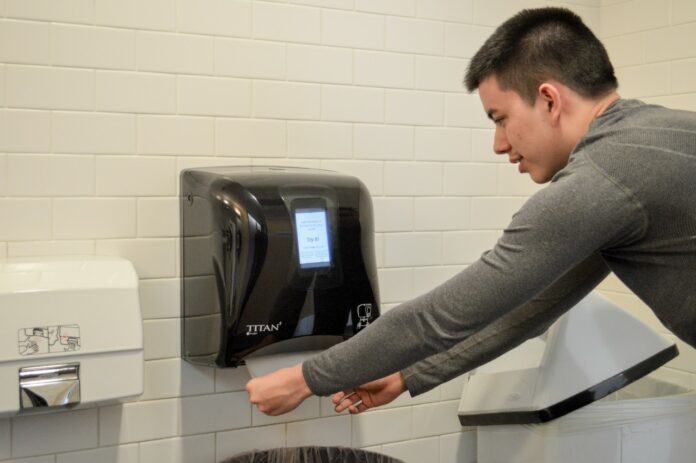
The screen on the front of the dispenser communicates the volume and cost of usage. - SFU News

An interdisciplinary team of SFU students has won the Sustainability Trophy in nwHacks, an engineering competition or “hackathon,” for their sustainable paper towel dispenser they have dubbed “PullMeNot.”

The invention dispenses paper towels while displaying the impact of consumption to the user and collecting data to help businesses and organizations make more sustainable choices.

Siv Padhy, a fourth year communications student, said that the dispenser “does two things. On the front end, it shows [the] immediate impact of waste in using paper to the user. On the back end, it tracks data on usage for businesses and organizations to use for their own needs.”

The dispenser tells the user via a screen how many paper towels they have used in real time, the monetary cost to the organization, as well as the total carbon dioxide emissions that would be released if everyone used the same amount.

It uses Wi-Fi modules to communicate this information to a server. Padhy explained the strength of this feature in comparison to the water bottle filling stations which, in part, inspired their idea: “The problem with those is that they are not networked, meaning [that] they don’t send data anywhere.”

Hacks is the largest hackathon in Western Canada. This year the theme was “sustainability” and there were judges from Google, Facebook, and Apple. The hackathon occurred over three days, non-stop with little time for sleep. Padhy remarked, “It’s kind of like finals but even harder.”

Padhy said that the team, which included arts, computing science, and business students, used their diverse backgrounds to their advantage.

“We said ‘let’s build something cool, but let’s have some impact tied to it,’” Padhy continued, “Something that quite clearly, even if you weren’t an engineer, you could see some value in it. So that’s what kind of set us apart.”

The PullMeNot team plans to further develop their project “horizontally” and “vertically.” Essentially, they want to improve the design of their dispenser to make it better suited to a customer’s needs. They also want to expand into other products.

Richard Arthurs, a first year mechatronic systems engineering student, explained, “One of the important takeaways is that this doesn’t stop at paper towel. It’s just kind of the beginning. We have to make sure our modules — the stuff that deals with the Wi-Fi — can connect to any sort of sensor for something we want to measure. [. . .] If we have a modular system, half the work is already done when we want to monitor something else.”

On the business end, they are currently in talks to pilot the project at SFU’s Surrey campus. Arthurs explained that they are looking into optimizing the dispenser for manufacturability, power use, and ease of installation. Team member Steven Huang is developing a web-based dashboard which will illustrate data to the customer by using graphs and tables.

Padhy commented, “It’s one thing to be able to track anything and everything but if it’s not useful it’s just noise. From a social point of view, we want to make sure we’re equipping people with the type of info they need to reduce consumption both on a consumer scale and a larger scale.”

He continued, “On the front end — consumption — we can immediately show people their impact on a larger scale beyond just their action. The analogy I like to use is: if 7 billion people threw one penny into a pot, that’s a lot money.”

The problem is, as Padhy laid out, “No one sees the penny or the pot.”

This week in comics

0


The Adventures of Agoraphobia Man: World Defender (Jacey Gibb)
web comics

Seagull Square (Jill Mandrake)
Seagull square
Peers (Leslie Lu)
CMYK-Peers
Pun 2 3 (Sarah Walker)
Screen Shot 2015-05-08 at 3.52.48 PM

Evolution can be a pain in the back

0
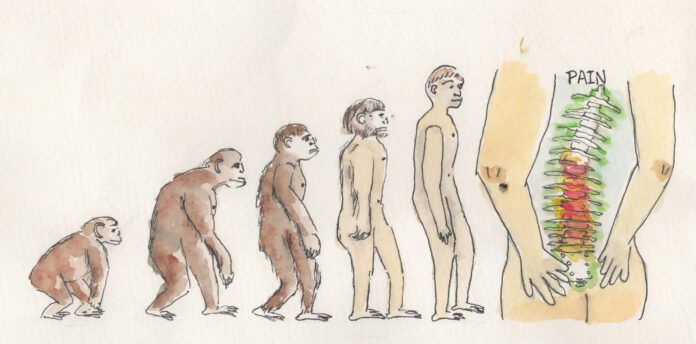
Evolving into walking on two legs could be a cause of back aches. - Momo Lin
Evolving into walking on two legs could be a cause of back aches. – Momo Lin

Recent research from SFU archaeologists suggests that back pain is linked to walking upright on two legs.

The findings show that some people with vertebrae more similar in shape to the ancestral chimp are less adapted to bipedalism, and more likely to experience back pain.

SFU archaeology’s Kimberly Plomp and Mark Collard co-authored a paper titled, “The ancestral shape hypothesis: An evolutionary explanation for the occurrence of intervertebral disc herniation in humans,” along with colleagues Una Strand Viðarsdóttir, Darlene Weston, and Keith Dobney. It notes that humans are more susceptible to back pain than non-human primates due to their two-legged way of walking.

Plomp captured the vertebrae shape of 71 humans, 36 chimpanzees, and 15 orangutans. She found that human vertebrae with a pathological lesion called the Schmorl’s node are closer in shape to chimpanzee vertebrae than human vertebrae without the lesion.

“What I was capturing was the shape of the vertebral bodies and the pedicles,” Plomp noted. “One of their biomechanical functions is to withstand compression. [With] bipedal locomotion we put a lot of pressure on our spines, especially if we lift something heavy,” she said.

Walking on two legs “increases the compression happening on our vertebra, and these particular shapes that we’ve identified as being closer to chimpanzees may not be the right shape to properly withstand the amount of stress placed on a spine due to bipedalism,” she explained.

Chimpanzees are the closest out of the apes to human beings, sharing about 98 per cent of our DNA. Humans share a common ancestor with chimpanzees, from which they are believed to have split from eight to nine million years ago.

“Every modern human is fully evolved. We think that this shape represents an ancestral shape,” she said. “Since we both seem to share this shape — humans who have this condition and chimpanzees — we hypothesize that this shape is probably from that shared common ancestor. [. . .] They were likely quadrupedal.”

The paper conclusively links the shape of human vertebrae with that of chimpanzees, but Plomp mentioned that they are considering other possibilities.

“The vertebral shapes associated with Schmorl’s nodes may be a consequence of intervertebral disc herniation [a tearing and consequent bulging along the spine] rather than its cause,” the paper stated. “However, we do not consider intervertebral disc herniation causing changes in vertebral shape to be a good explanation for our results.”

Plomp noted that the research is still in its early stages, but that there may be clinical benefits.

She hopes for the development of “methods [that] might be able to be used in clinical research to identify people — especially high risk individuals like athletes — [who] might be more prone to back problems.”

TSSU takes first strike action

0

SFU’s Teaching Support Staff Union (TSSU) commenced job action after serving a 72-hour strike notice to university administration on April 16.

The TSSU is made up of over 1,500 members and represents teaching assistants, tutor markers, sessionals, and the English Language and Culture/Interpretation and Translation Program (ELC/ITP) instructors. The union has been bargaining for over a year now, since its collective agreement with the university expired on April 30, 2014.

TSSU members voted in March with 92 per cent in favour of strike action. The strike mandate allows the union to initiate job action and put pressure on SFU without withdrawing all services.

ELC/ITP instructors are now implementing an overtime ban that will continue indefinitely. The TSSU has communicated the intention to perform further job action as necessary.

As per a request by SFU, an Essential Services Order was put into place on April 21 in order to obligate all SFU staff to maintain operation of the powerhouse and animal care facilities during job action.

The university has confirmed three additional days of bargaining over May 13–15. TSSU chief steward Reagan Belan shared her hopes for these negotiations, stating that the union has been “very vocal about wanting more dates.

“What would be great is if we had meaningful exchanges and actual questions or criticisms about our proposals,” she said.

SFU administration responded in an online update with their own wishes for the upcoming bargaining talks: “We hope those meetings will be productive in advancing proposals and moving toward a mutually agreed Collective Agreement that supports a strong student-[focused] and sustainable learning and research environment across all SFU campuses.”

Belan commented that there has been little direct response from the university regarding their particular requests. “We haven’t really heard any sort of criticism or complaints when we ask for questions or problems that could result from the implementation of that language,” she said.

“Then we can start to amend our proposals to take into account those types of operational realities.”

Some of the TSSU members’ key issues that Belan emphasized were seniority for long-time staff who currently have to reapply each semester, benefits for ELC/ITP members equal to other staff, as well as an improved hiring system.

The university has recognized some of the union’s concerns in their published statements and have expressed the intention of “setting the record straight” in regards to employee benefits, timely remuneration, and safety training for staff.

Administration also added, “We would strongly prefer to avoid any disruption to our students’ academic pursuits or our broader SFU community.”

In a press release, TSSU spokesperson George Temple noted that, “Over the last decade we’ve seen class sizes and workloads increase while funding hasn’t kept pace.

“As SFU approaches its 50th anniversary, our members demand that Senior Administration recommit itself to SFU’s stated mission: to provide quality education and research.”