Home Blog Page 1004

University Briefs

0
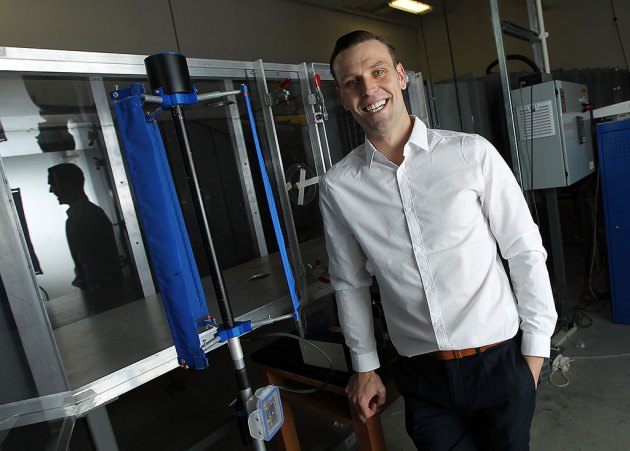
Photo courtesy of The Windsor Star

UBC student writes 52,438 word dissertation without punctuation

A PhD candidate at the University of British Columbia wrote a 52,438 word dissertation, titled “Indigenous Architecture through Indigenous Knowledge”, without any punctuation.

       About the unusual nature of his writing, Patrick Stewart, an architect from the Nisga’a First Nation, said he “wanted to make a point” about the “the blind acceptance of English language conventions in academia.” This deconstructionist approach to the English language led to certain professors finding his work unconvincing.

     At the defence of his thesis, Stewart answered questions for more than two hours, which ultimately resulted in his work being approved.

With files from National Post

University of Windsor student wins $25,000 for project

Kyle Bassett, a PhD student in engineering at the University of Windsor, won a $25,000 prize last week at the Ontario Centres of Excellence annual Discovery Conference in Toronto. Basset’s innovation won him the David McFadden Energy Entrepreneur Challenge.

      His idea for a five-volt portable turbine to provide energy for remote communities won the competition against nine other finalists from Ontario.

   The development of Bassett’s turbines is at an advanced stage and he has already launched his own company, RMRD Technologies, to produce them for commercial usage.

With files from Windsor Star

Satellite Signals

0
Image credit: Eleanor Qu

Woodward’s

The Goldcorp Centre for the Arts hosted the “Instruments Beyond Borders Benefit Gala” on Wednesday, May 13. Hosted by actor Dan Payne and Global TV’s Lynn Colliar, the concert raised money for the Recycled Orchestra of Cateura, Paraguay and the St. James Music Academy of Vancouver’s Downtown Eastside, which provides free afterschool music lessons for children.

Surrey

On Tuesday, May 12, students at the Surrey Campus enjoyed coffee, ice cream, and conversation for a good cause. For the cost of a toonie, students were invited to the Campus Bursary Coffee Hour, held in the Faculty of Education main office in SFU Surrey. The proceeds of the event went towards the Surrey Campus Bursary Fund, which helps students in financial need fund their university education.

Harbour Centre

SFU’s Institute for the Humanities presented the book launch of Nothing to Lose but Our Fear: Resistance in Dangerous Times on Tuesday, May 12. The book includes conversations with international scholars and activists, and discusses “how can we think critically and act productively in a world awash in fear.” The event also included a panel discussion with the author Fiona Jeffries, Kwantlen criminology faculty member Michael Ma, and Davina Bhandar, adjunct professor at SFU and Kwantlen.

The Sensationalists is an immersive dance experience

0
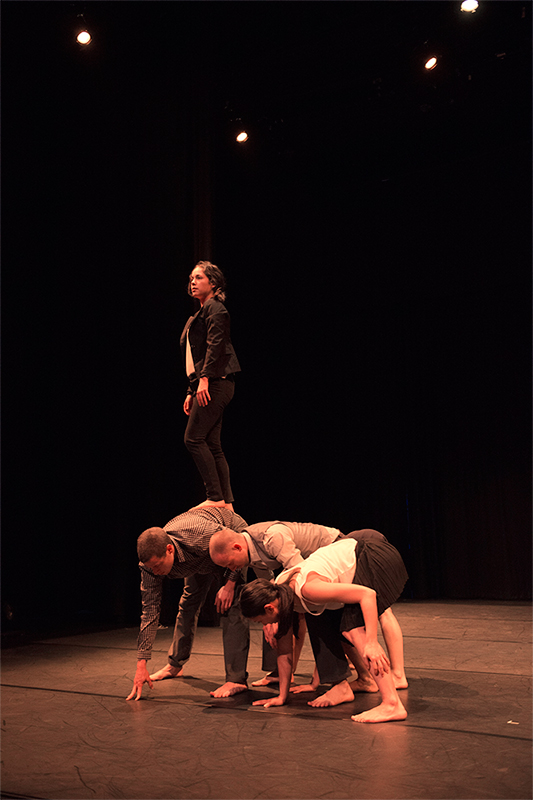
Photo courtesy of David Cooper.

Up close and personal on the Cultch stage, the 605 Collective danced around, in between, over, and under us as we were immersed in their performance.

This experimental work had the dancers wearing headphones while singing or speaking to us about various topics, such as the Milky Way galaxy. It was very interesting to see how audience members reacted to the dancers as they repeated a sequence of movements and we slowly began to mimic them. Throughout the entire show, there seemed to be a collective consciousness at work.

If you weren’t interested in standing on the Cultch stage for most of the performance, there were cheaper balcony seats available where you could comfortably watch the action unfold below. While I had been apprehensive about joining the group on the stage, I was glad that I wasn’t stuck in the balcony where I wouldn’t have been able to experience the full effect of this work.

As the dancers moved through us, hands gently touched backs to signal their presence and they gradually came together, moving as a unit and subtly carving out an open space in the centre of the stage. They took turns placing their headphones on an audience member who would timidly copy them by singing what they heard.

After we all felt a bit more comfortable on stage, the group began walking over each other, holding audience members’ hands for support. Their choreography was impressive as they climbed over each other making their way to the back wall where they pressed one dancer straight up and brought a group of us to hold up our hands as she gently laid down on top of the crowd. Another beautiful moment was when she stood on the shoulders of two others and they moved her legs, as if she was walking on air.

After what felt like a very short time, we were guided to stand along the back wall behind the dancers who gradually led us to our seats, where a pair of headphones were waiting for us. Now it was the six dancers’ turn to use the entire space of the stage, performing their sweeping, athletic choreography. A microphone at the front of the stage broadcasted into our headphones as the dancers took turns telling us secrets about each other and talking about sensory experiences.   

This collaboration between the 605 Collective and Theatre Replacement is an innovative project exploring the senses and the boundary between audience member and performer. That relationship was blurred many times throughout the performance, and it was thrilling to be a part of their creation.

The Sensationalists will be presented by the 605 Collective and Theatre Replacement May 12 to 16 at the Cultch. For more information, visit thecultch.com.

In the Heights is a soulful musical

0
Photo courtesy of David Cooper.

Nina Rosario (Kate Blackburn) returns to “el barrio” of Washington Heights after her first year at Stanford University, and her family and neighbours greet her with open arms. The only problem is that she has dropped out after losing her scholarship and doesn’t know how to let everyone know.

Full of catchy rap songs, sharp dancing, and plenty of Latino flavour, this Tony Award-winning musical will capture your heart with its soulful story.

Corner store owner Usnavi (Luc Roderique) introduces us to the neighbourhood with the opening musical number, and all the characters soon dance in the streets, setting the upbeat tone of this Dominican-American neighbourhood. Roderique captured the audience’s attention right away with his skilful rapping, and the whole cast came together with precise, well-defined movements.

Usnavi — whose name comes from his parents seeing “US Navy” on the side of a ship when they immigrated to America — wants to return to the Dominican Republic to visit his homeland, but he is struggling financially. Meanwhile, his precocious cousin encourages him to speak to Vanessa (Elena Juatco) who works at the nearby hair salon instead of just giving her free coffee.

The other salon workers provided some laughs as they gossiped about the neighbourhood, and Abuela Claudia (Sharon Crandall) provided the paciencia y fé (patience and faith) that everyone could use a little more of. Crandall’s portrayal of the lovable neighbourhood grandma was nuanced and genuine as she treated everyone as part of her family.

The main love interest in the show is between Nina and Benny (Chris Sams). They were childhood friends, and when Nina returns, they quickly become much more than that. Nina’s father (Francisco Trujillo) isn’t pleased because, although Benny works for his taxi company, he isn’t Latino. Her father decides to sell his business in order to pay for her to return to Stanford, leaving Benny unemployed, which causes strife among them all. The chemistry between Nina and Benny was very natural, and they both impressed with their strong vocal performances.

Struggling to figure out where she belongs, Nina’s character is relatable and sympathetic in an authentic way. This show was brimming with Latino humour, eye-catching dance moves, and characters that I wanted to get to know better.

In the Heights is presented by Arts Club Theatre Company April 30 to June 7 at the Stanley Industrial Alliance Stage. For more information, visit artsclub.com.

The Peak is hiring a Digital Strategist!

0

We are looking for a new Digital Strategist (or Web Producer) to join our team and help maximize our online presence. If the job description below is of interest to you or someone you know, send a resume and cover letter to [email protected]

Purpose: The Digital Strategist’s purpose is to oversee and improve The Peak’s online presence and engagement through its website and the use of social media.

Duties: 

  • Devising and implementing strategies to drive and hold online traffic to The Peak’s website and social media profiles, with an emphasis on improving: size of audience, reach, engagement (community and campaign metrics)
  • Tracking and reporting web analytics of The Peak’s website and social media profiles
  • Monitoring, listening, and responding to users who reach out to The Peak through the website and social media channels
  • Communicating with the collective and editors to set and achieve online presence goals
  • Developing and managing digital marketing campaigns and projects
  • Utilizing a range of digital strategy techniques (Ex: SEO, content strategizing, Lean Canvas facilitation)
  • Managing redesigns of The Peak website, with aim of constantly improving user experience
  • Overseeing design of social media profiles
  • Planning and overseeing the budget of all digital marketing (ex: promoting Facebook posts, Google adwords)

Qualifications:

  • Must have knowledge of online marketing strategies, softwares, and platforms
  • Ability to work independently while maintaining open communication with the team as a whole

Other notes:

  • This is a staff position and will be hired when the position is to be vacant
  • Pay is an hourly wage of $14.50, tracked by the individual and submitted to the Business Manager for payment every two weeks
  • Hours are flexible and will change from week to week, with an average of 8-12 hours per week

NOTE: not meeting the stipend requirements may result in dismissal or pay reduction.

For more information, email [email protected] or [email protected], or drop by our offices in the Maggie Benston Centre (MBC 2900)

Ballet BC presents two works inspired by The Rite of Spring

0
Photo courtesy of Chris Randle.

Nijinsky’s The Rite of Spring is an iconic modern work of art that has been adapted by ballet companies all over the world since its premiere in 1913. Set to Igor Stravinsky’s famously dissonant score, it was a revolutionary work that caused audience riots and still sparks heated discussions.

Ballet BC’s new work, Rite, takes its inspiration from Nijinsky, but aside from a few audience members who left before it was over, the piece received a much warmer reception. I can understand why a few people had to excuse themselves from the theatre during the performance — Emily Molnar’s choreography was set to an original score by Jeremy Schmidt of the rock band Black Mountain, and it was a cacophony of high pitched, piercing, industrial sounds that were, frankly, not easy on the ears.

The eyes, however, were treated to a beautiful, minimalist set by Bocci creative director Omer Arbel that featured a low hill in one back corner, a large branch in the other, and each of the front corners sloping down in front of the stage. The completely white stage was a stark contrast to the black costumes of the dancers and added to the post-modern feel of the work.

The black costumes, harsh soundscape, and ominous whispers at the start and finish of this work created a dark, almost nihilistic tone that seemed to oppose the original intent of Nijinsky’s work. I had to keep reminding myself that this was not a new interpretation of the work, but simply inspired by it. Other than some similarities in choreographic form and the creation of a busy, chaotic stage, I found it hard to draw a connection between this and the original Rite.

The program describes the work as taking place after the original ends, “where the body, mind and spirit transition.” While I found it hard to reconcile that with what I was watching, I enjoyed the original movement vocabulary, which did pay tribute to the inimitable Nijinsky.

The second half of the program was another work inspired by The Rite of Spring, Consagración, which was set to Stravinsky’s original score. Gustavo Ramirez Sansano’s choreography also paid tribute to Nijinsky, but used that spirit to interpret the transformation and exhilaration of puberty, as described in the program notes.

With large upside-down pyramids of black fabric strips creating unique lighting effects, the dancers began this piece in white tunics and moved in synch with sharp, optimistic energy. They gradually removed the tunics to end the piece in underwear, and two of the male dancers performed an emotionally charged pas de deux which left the house rapt.

For more information, visit balletbc.com.

Keeping up with the Clan

0
Image credit: GNAC Sports

The spring semester may have ended, but there was no such break in the world of SFU sports. Here are the highlights from between exams and the first day of classes:

Men’s basketball names new head coach

SFU Athletics announced on April 15 that Clan alumnus Virgil Hill will be the men’s basketball team’s seventh head coach.

Hill, who played forward for the Clan from the 1989–90 to 1992–93 seasons — nicknamed “Air Virgil” in a 1989 issue of The Peak — and graduated with a Bachelor of Science in kinesiology, replaces former head coach James Blake who resigned after going 38–90 over five seasons.

Hill is the first SFU alumnus to take the job in 20 years, since former Toronto Raptors head coach and current Portland Trail Blazers assistant coach Jay Triano coached the team from 1989 to 1995. It was under Triano that Hill started his coaching career as an assistant coach, a position he held for six years.

The Sarnia, ON native was previously the head coach of Laurentian University, a Canadian Interuniversity Sport (CIS) school, from 2000 to 2007, and most recently served as the head coach at Collingwood School, a private high school where he taught math as well as strength and conditioning.

“What I want to bring to the team is a sense of togetherness and community. When I [played] there, that was the overarching message from the coaches [that] we were part of a bigger family,” he told The Peak. “The first part of that is having an eye on local recruiting.

“When you have kids from the area — or close to the area — that gets people supporting you, because people want to support the local kids.”

Hill indicated that he will not bring back the full throttle offence that Blake had adopted for the team last season. The style gave the Clan an exciting game, with the team leading the NCAA Division II in scoring offence with 104.2 points per game and a record of never shooting below 75 points (the previous season’s lowest scoring game resulted in only 49 points for the Clan). But it only resulted in three more Great Northwest Athletic Conference (GNAC) wins than the season before, and a 6–12 record in the conference.

“I’m just not sure that was the right way to go,” Hill said. “That type of offence just puts too much pressure on your offence because you’re forced to score a lot of points, and it’s tough to score 100 points a game. So I think that playing a little bit slower, a little bit more deliberate [. . .] makes more sense.”

Football coaching staff set

SFU Athletics announced the hiring of Jaime Hill on April 10 as the new defensive coordinator of the Clan.

Hill previously spent two seasons as the defensive coordinator at Portland State University, an NCAA Division I team. He was also the defensive coordinator at Brigham Young University (2006–2010), another Division I team, Humboldt State University (2002–2003), and the University of Chicago.

He also coached alongside current Clan offensive coordinator Joe Paopao in a stint with the XFL’s San Francisco Demons, and as a co-defensive coordinator with the Ottawa Renegades in the CFL, where Paopao was head coach.

Hill is replacing Abe Elimimian, who was brought on by former Clan head coach Jacques Chapdelaine as defensive coordinator, but left after a year for a job with the University of Hawaii.

“Jaime [Hill] understands how to create defensive schemes that enable players to excel and succeed,” head coach Kelly Bates told SFU Athletics. “His knowledge and experience is going to be extremely beneficial for us.”

SFU Athletics also announced the hirings of Tom Kudaba and Dennis Kelly as defensive line coach and associate offensive coordinator, respectively. Kudaba and Kelly are both Clan alumni and were long time high school football coaches.

From the 2014 coaching staff, Travis Hayes, defensive backs coach and equipment manager; Bryan Wyllie, linebackers coach and recruiting co-coordinator; Michael Lionello, director of football operations and recruiting co-coordinator,; and Jon Klyne, receivers coach, will all be returning.

Keenan North, a senior defensive lineman for the 2014 season, was also named a graduate assistant.

Lemar Durant: movin’ on up

After going undrafted in the 2015 NFL Draft, former Clan wide receiver Lemar Durant accepted an invitation to the New York Giants mini camp on May 8 and 9, where he competed to make an impression on the team, and vied for a spot at the main camp.

“Getting drafted would have been nice, but I didn’t think about it too much,” Durant told Monarch of the Clan. “The main goal is to make an active roster spot and invite to the main camp. I’m really just going there to have some fun and not put too much pressure on myself.”

Durant led the 2014 Clan in receiving yards with 685 yards in eight games played.

While he tries to find a job in the NFL, Durant is also a hot name in the CFL — he was ranked eighth in the CFL Scouting Bureau’s final prospect ranking released on April 24. The 2015 CFL Draft will be held on Tuesday, May 12.

Softball improves upon 2014 season

Despite a promising start to last season, with the SFU softball team winning four of its first six games, it missed the GNAC playoffs for the second year in a row. The team ended the season with four straight losses and only one win in the last 13 games. Three out of those four losses to cap the season were shutouts.

However, the team did improve from their 2014 campaign in which they had only four wins in the entire season, achieving a 17–29 overall record.

“Looking back, we made significant strides over last year but still have a ways to go to return to the standard our program has been known for,” head coach Mike Renney told SFU Athletics.

The team particularly struggled against their GNAC rivals, only posting five wins in the conference.

One bright spot for the Clan was their 2–1 series victory over the UBC Thunderbirds. SFU notched the season series after 9–2 rout of the Thunderbirds in the Clan’s last home game on April 19. The Clan lost the first game of the series 9–4, but won the second game 6–3.

In the previous season, SFU lost its only game to UBC 4–0, while in 2013, SFU lost the season series 2–1.

Three seniors — shortstop Danielle Raison, pitcher Kelsie Hawkins, and catcher Kaitlyn Cameron — played their last game for the Clan this season. Junior Rachel Proctor held the team’s best batting average at .354, while freshman Taylor Lundrigan led the team in hits and runs with 48 and 28, respectively. Proctor was named to the GNAC all-conference first team, while Raison and Hawkins made the second team, and Lundrigan was an honourable mention.

Men’s golf headed to national championship amidst first conference title win

The SFU men’s golf team have made the cut for the NCAA Division II National Championship for the second year year in a row — their second-ever appearance. The Clan tied for third at the NCAA Division II West/South Central Regional at Hiddenbrooke Golf Club in Vallejo, CA, held from May 4 to 6 with the top five teams earning a spot at the national championship.

Coming into the tournament, the team was ranked ninth in NCAA Division II competition. The Clan played their best golf on the first day, shooting a combined 296, good enough for second place — only six strokes behind the lead. On days two and three, SFU shot 309 and 303, respectively. Sophomore Alan Tolusso missed the second game due to illness, and although only four of the five golfer’s scores count towards the final score, having one golfer missing meant that the team had to use everyone’s scores — not just the four best.

“It is not unusual to shoot a higher team score after a decent opening round,” head coach John Buchanan told SFU Athletics after the second round. “With Alan [Tolusso] out, I think having to play with just four counters [. . .] spooked them. It is like having no safety net to cover you if you shoot a bad round, and you start thinking about it.”

Freshman Chris Crisologo led the Clan with a +4 performance, and ended the tournament tied in sixth place individually.

Leading into regionals, SFU also won the GNAC Championship — their first-ever NCAA conference title — held in Coeur d’Alene, ID on April 20 and 21. SFU broke the tournament records for lowest score and widest margin of victory — shooting a total of 837 (-15) over three rounds and beat second place by 37 strokes. The Clan were also the only team to shoot under par.

The Clan also had the top four golfers of the tournament: Brett Thompson (205 strokes, -8), Crisologo (206, -7), John Mlikotic (212, -1), and Kevin Vigna (214, +1). Thompson and Crisologo soundly beat the previous record for the lowest score at the tournament — 212 strokes — which Mlikotic tied.

The Clan will travel to Conover, NC to compete in the NCAA Division II National Championship from Monday, May 18 to Friday, May 22.

With files from SFU Athletics and Monarch of the Clan

SFU makes switch to Compass Card

0
SFU students will be tapping in and out on transit starting this summer. - Phoebe Lim

“The Compass Card is your new way of travel,” Colleen Brennan, TransLink’s VP of Communications, told The Peak. This June, all SFU students will replace their monthly paper U-Passes with Compass Cards, before the general public has adopted the system.

Brennan explained the reasoning behind a gradual rollout: “It’s a very complicated undertaking to roll out a program like [this] under a very complex system like ours.” Taking into account already existing models from across North America, TransLink has decided that it is best to introduce transit users to the Compass Card in a “staged manner.”

Here are a few key pieces of information SFU students need to know about the transition:

1) Starting May 19, all U-Pass kiosks located on any of the three campuses will stop dispensing paper passes and instead dispense compass cards. The kiosks will be in place until September, after the incoming class has a chance to receive their card.

2) On June 1, the launch goes live and Compass Cards can be used to tap-in and tap-out.

3) All Compass Cards distributed through the U-Pass kiosks have waived the $6 deposit required for purchasing the card. However, after September, students will have to go to fare dealers such as Safeway and London Drugs where they will have to pay a deposit.

4) While students no longer need to visit the kiosk monthly, they must log on to the U-Pass TransLink portal to load a monthly U-Pass on to their card.

5) The process of applying for a U-Pass exemption will be the same as before. However, those applying for an exemption due to receiving a U-Pass from another institution no longer need to provide a copy of their U-Pass. They must instead provide SFU with their card’s serial number.

***

The environmental impact of the transition could be significant, explained Danielle Finney, TransLink’s Senior Communications Advisor for the Compass Project. Said Finney, “That would be 130,000 paper passes that are no longer being shipped by truck to the 10 campuses every month. So it’s not only about a reduction in paper and wood products, but also in greenhouse gas emissions.”

Brennan added that, as opposed to users flashing their passes, the Compass Card’s ability to track card usage could lead to improved transit service. She explained, “One of the beauties of this card and one of the reasons why transit organizations moved to this system is that it does allow us to plan better.

“So, when we are planning our routes [and] planning our system out, we are able to see what the travel patterns are for people. It allows us to optimize our service with respect to that.”

Rella Ng, SFU’s Associate Registrar for Information, Records and Registration Services, noted that, “Right now with flash pass, there is no data on what routes students (or anyone) is taking. Data is the tool to help us with functionality.”

Brennan spoke to the choice of rolling out the Compass Card to students before other groups, noting that students form a quarter of TransLink’s entire customer base. “Students are a really important customer group for us,” said Brennan. “They tend to be more heavy users of transit, they’re more likely to adopt early when it comes to new technology, and they are also are quite happy to give [us] feedback.”

Finney concluded, “We’ve worked really closely with all of the schools to make sure that students get the information they need to make this as seamless as possible.”

Avengers: The Age of Ultron is an entertaining blockbuster

0
Photo courtesy of Rolling Stone.

Too often, you will hear the term ‘popcorn movie’ thrown around in a negative context. Sometimes you will hear ‘blockbuster’ uttered as if it’s poison, as if the mere idea of a big budget movie with lots of explosions is harmful to the masses when they could be watching some independent film about people with severe emotional problems instead.

Well, the truth is, blockbuster movies can be a lot of fun — and that’s what Avengers: Age of Ultron is. There’s a good chance you could forget what happened in the movie the day after you watch it, but you will be entertained by this fun ride for the over two hour runtime.

The film jumps right into the action with the Avengers fighting some HYDRA base located in Sokovia — the obligatory fake Eastern European nation. Things are going pretty well for the Avengers — nameless henchmen just don’t stand a chance — until two new superpowered bad guys show up: Quicksilver (Aaron Taylor-Johnson) and Scarlet Witch (Elizabeth Olsen).

Quicksilver can run really fast, but it’s Scarlet Witch who is more of an inconvenience as she has telekinesis and hypnosis abilities, and the power to cause people to hallucinate their worst fears. (Did I mention they both have hilarious Eastern European accents that slip in and out throughout the movie and sound like Bela Lugosi’s Dracula voice?)

Naturally, the Avengers get their prize — Loki’s scepter from the first Avengers — but not before Tony Stark (Robert Downey Jr.) is blasted with seeing his fear of not doing enough to save the world, and sets out to build a robot, Ultron, to protect it. Unfortunately, Ultron (James Spader) turns out evil and that’s the plot, more or less.

To be fair, while I called this a ‘popcorn movie,’ Avengers: Age of Ultron has remarkably good characters and the relationships between them are certainly more interesting than in the average blockbuster. A good portion of that is probably due to director Joss Whedon (for those of you who aren’t already huge fans) cutting his teeth making TV shows with a foundation of strong characterization, and, of course, witty dialogue.

That wit is certainly in effect here. It does feel a bit more restrained in this than the first Avengers, though I think this works in the film’s favour. The wit certainly hasn’t disappeared, but it isn’t overdone this time around either.

The characterization work because of the actors. There are no weak performances in the film (even Olsen’s and Taylor-Johnson’s laughable accents didn’t really hinder their performances). Mark Ruffalo was probably the best of the bunch, with James Spader’s performance as Ultron as another highlight.

If there was one overt problem, it’s that the ‘wow’ factor from the first Avengers is gone — it’s no longer surprising to see all of these characters at once. But I guess that’s what happens when there’s a new comic book movie coming out every couple of months.

Overall, it’s not the best Marvel film, but it’s an entertaining movie, and that’s all that really matters.

SFU film students present short at DOXA

0
Photo courtesy of Jessica Johnson and Ryan Ermacora.

Many SFU students are strong, caring people who support each other’s success, so I wasn’t surprised to find plenty of folk from the School for Contemporary Arts on hand to celebrate the screening of Jessica Johnson and Ryan Ermacora’s documentary short E&N at the DOXA Film Festival.

E&N is a slow, haunting rumination on the invisible history beneath the E&N rail line that runs along southeastern Vancouver Island.

Not many people know of “the great land grab” of the 1870s, where this railway comes from, when the British Columbia and federal governments granted a railway belt of two million acres of land to the E&N Railway Company in exchange for the construction and operation of the rail line. About one third of that land belonged to the Hul’qumi’num. Much of the power of Johnson and Ermacora’s film comes from their experiments in rhythmic sound, the rain, the rail and the ferry, which, as Johnson said, “connect landscape without context and images that don’t necessarily connect visually. We wanted to put people in the moment.” The duo decided to submit to DOXA after Ermacora, who volunteers with the Cinemathéque, received a suggestion from an industry friend that they should show their films to the public.

E&N opened for DOXA’s premiere of Canadian filmmaker Cliff Caines’ first feature, A Rock and a Hard Place. Like Johnson and Ermacora, Caines displays a deep fascination with rhythm and sound. An eerie industrial-organic soundscape runs through his voyage 7,000 feet down into the Goldcorp mine at Red Lake Ontario, one of the richest gold mines in the world. Almost imperceptibly, it forces an intuition of the vast pressure sitting upon the rock at such depth, and the fragility of the people there.

In long takes of the machinery and people working in the mine, Caines traces the path of gold, from the rock pulled out of the wall to the production of gold brick, and exposes the audience to an otherworldly experience that few people get to see. Off-camera, miners and townspeople relate stories of disasters, deaths, strikes, the people and town, and uncertainties about their future. Caines, speaking of what it was like to film in the mine, said, “They cracked jokes with me about man being the softest thing down there.”

Both E&N and A Rock and a Hard Place use slow, observing shots of repetitive movement, and of stillness, to open up thoughtful, meditative relationships with their subjects. Their imagery breathes. Simple and soothing, and at times tinged with the cold unease that is a part of Canada’s hard country, both films are refreshingly different from the conventional documentary narrative built around dramatic conflict. 

Each film has its own distinct tone and subject matter, but when placed side by side, a dialogue over the aesthetic qualities of sound and imagery in film emerged between the two. I think these new, experimental Canadian filmmakers are on to something, and I look forward to seeing more of their work — Johnson and Ermacora’s especially. Not only because they represent SFU, but because the world they present is so fascinating.