Home Blog Page 992

The Young Romantics are well represented in SFU’s art collection

0

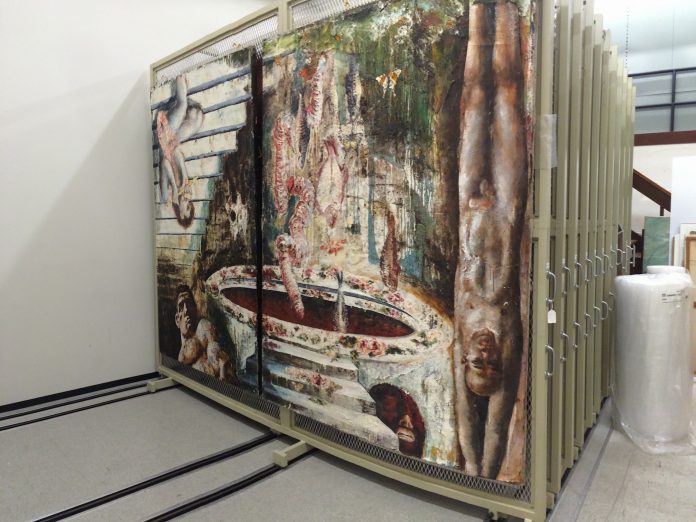
On a massive canvas, tar, enamel, varathane, oil, and corduroy create images of bodies which frame a circular opening. Adorned with flowers, the opening looks like a ceremonial basin with ribbed bodies of fish descending into the opening, along with fleshy intestinal viscera that hang like sausages over a stove pot.

Attila Richard Lukacs’ painting, Trial & Error, also includes a young, nude male sitting upside-down on an inverted staircase. He holds a flute and is draped by an intestinal feather boa while another male body, also upside-down, is elongated on the opposite side of the surface.

The painting sits within the SFU Art Collection vault. It is dated 1986, which means it was completed within the year following the Young Romantics exhibition at the Vancouver Art Gallery. This landmark exhibition of Vancouver painting was curated by Scott Watson and included Lukacs, along with Graham Gillmore, Angela Grossman, Vicky Marshall, Philippe Raphanel, Charles Rea, Derek Root, and Mina Totino.

Almost all of the artists represented in Young Romantics were recent graduates of Emily Carr College of Art & Design between 1979–85, and had already participated multiple shows together in the years leading up to large exhibition at the VAG.

In much the same way as the term ‘Vancouver School’ collects artists such as Jeff Wall, Ian Wallace, Ken Lum, Vikky Alexander, and Rodney Graham as photoconceptualists, the designation of ‘Young Romantics’ functions to group these eight artists within a particular style of painting.

While the former term has come to be thought of as representative of a regional aesthetic (aided in part by the term’s site-specific and pedagogic associations), the latter’s influence is less obvious to the non-Vancouverite. As outlined by Scott Watson “Toronto’s new painters are concerned with subject-matter and construct a didactic stance[. . .]. Vancouver’s young painters practise a métier and are concerned with the manipulation of their materials to an extent that sets them apart.”

This concern with materials is evident in Trial & Error, as well as in other works by these artists included in the SFU Art Collection. One work by Angela Grossman, titled The Wedding, is a large, multi-panel painting executed on old theatre flats using enamel, oil, and tar. These materials create an uneven surface upon which anthropomorphic forms haunt the intransigent lines of architectural decay. In Sound and Vision, Charles Rea represents the interior of the Pantheon in Rome by painting oil onto a surface of books.

With the exception of a few paintings scattered around the SFU Burnaby campus by Graham Gillmore, Vicky Alexander, and Derek Root, the majority of the works by these artists reside within the collection’s vault. While there are some massive works that would be difficult to install based purely on scale — such as Grossman’s The Wedding which, when assembled, measures approximately two by three metres — even the works on paper could be logistically difficult to display on the walls of SFU, since they need to be framed.

Scott Watson wrote that “today’s painters[. . .]react to the slick, polished look of the world of manufactured images they live in.” Thirty years on from when this was written, Watson’s words still ring true.

Comic Connoisseur: Birthright re-energizes cliché-ridden fantasy genre

0

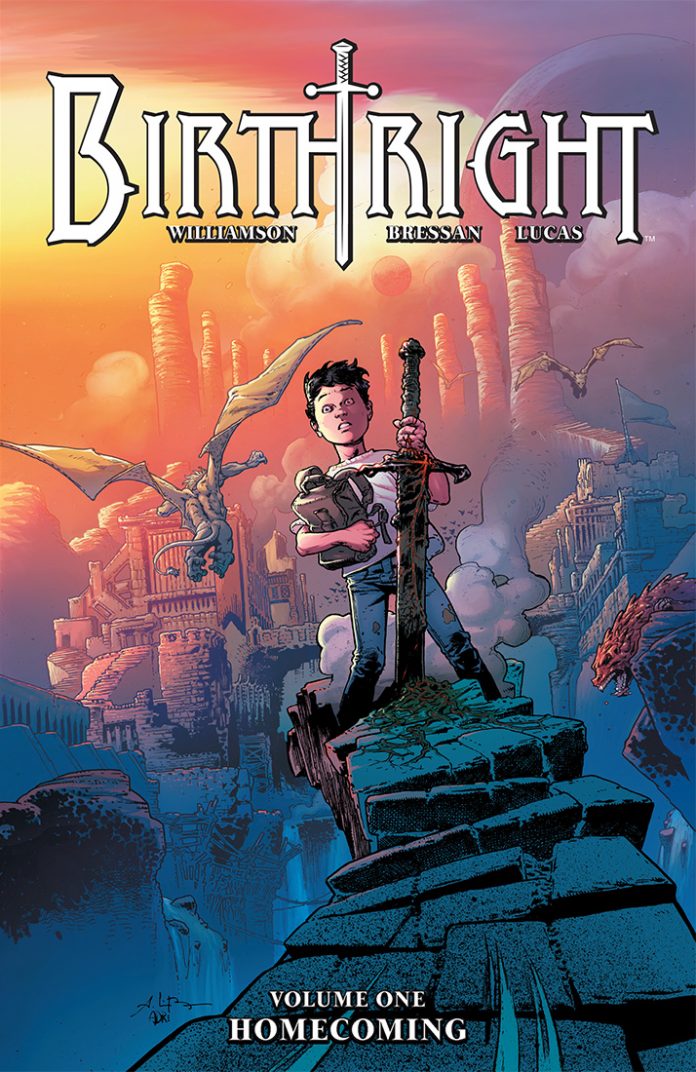
At first glance, Birthright seems like a hodgepodge of ideas audiences have seen a hundred times over. It has the usual smattering of concepts readers have come to expect from the fantasy genre.

The story is as follows: a young boy named Mikey Rhodes is misplaced from his family and is thrust into an unimaginable new world filled with danger and intrigue. He is tasked with overthrowing an evil despot of insurmountable power.

His supporting cast is a vibrant mix of mythical creatures, ranging from a pack of gibbons to a ferocious warrior ogre. The main character’s chief love interest is a strong female character who chastises him frequently. And, last but not least, there is a prophecy to which the main character is connected, one he is tasked with completing.

On the surface, the story seems impeccably paint-by-numbers. Birthright, though, has more to it than you would expect.

While readers are given intermittent bits and pieces of Mikey’s wild adventures, they are never the true focus of Birthright. The real focal point of the story is Mikey’s family and how they have dealt with his disappearance.

Williamson and Bressan bring to life a heartbreaking look at how a child’s disappearance can shatter a once well-knit family. Brought to us from the perspective of Mikey’s older brother, we feel the anguish of losing a sibling. We see a marriage dissolve under the accusation that his father murdered his young brother. In only a few pages, readers can feel the heavy burden of the characters and emphasize immediately.

However, everything changes for the shattered Rhodes family when they are brought together by the FBI. At long last Mikey Rhodes has returned, but he is not the same little boy they remember. Only a year has passed, but Mikey is now a full grown man and a fearsomely strong warrior. While his return is a means for celebration for the Rhodes family, the real reason behind Mikey’s homecoming is far more foreboding.   

Joshua Williamson produces a story accessible for an audience young and old that expertly juggles pulse-pounding action with strong character development. He weaves the dual storylines of a young and old Mickey Rhodes seamlessly; readers will never prefer one story over the other. Each tale brings its own amount of intrigue to other evoking wonder about what the character has gone through and what his deceptive agenda holds.

Andrei Bressan brings both worlds of the story to life in stunning fashion. Every page is diabetic, shock-inducing eye candy. Bressan’s action sequences and emotionally charged panels leave readers turning the pages to see what beautiful image he will bring to life next.

Birthright is a welcome breath of fresh air for readers, an overdue and welcome change from recent fantasy stories that gives hope for the future of the genre. It is a fantastic reminder you should not judge a book by its cover — a sentiment we all tend to forget from time to time.

Laugh Track: Ryan Mutama

0
Illustration by Saida Saetgareeva

Ryan Mutama is a stand-up comic living in Vancouver who uses comedy as a way to explore more serious, social issues. The Peak caught up with Mutama to discuss race humour, how living in Vancouver has affected his comedy, and what the next step is.

[Interview has been edited and condensed for print]

So, where are you from?

I was born in Manchester, England and we moved to Vancouver when I was two. Then we moved to the States for five years, and finally we moved back to BC. I’ve lived in Vancouver for 16 years now.

What are your views on Vancouver?

I guess I don’t have the most positive opinion of Vancouver, but I am grateful for having grown up here. I wouldn’t be the same person I am without having lived in this town. The perspectives that make me a comedian were made in Vancouver. If I grew up in Chicago, I would have questioned things less. The biggest theme in my stand-up comedy is race relations. I have such an opinion on it because I grew up in a place where I always had to be an observer. If you’re the only black kid in an elementary school, you think, “Where are the people who look like me on TV?” I got to think a lot about race and culture and differences between people. Being unique forces you to analyze things.

How would you describe your comedy to someone who hasn’t seen it?

Random observations about race relations, seen through the lens of pop culture or politics. Most of the time, I’m analyzing race relations, but I’m analyzing them in a certain way. I have this joke about Morgan Freeman and why he’s always helping out white people in every movie. I like pointing out things that people may not have noticed. I like to throw people a snippet of a bigger issue in hopes that they think about that bigger issue or will walk away being slightly enlightened about race.

Regarding comedic IQ, do you think people can learn to be funny?

Yes, people can learn to be funny. I get annoyed when people underestimate comedy. People have this impression that comedy is for stupid people doing stupid things and anybody can do it, but it isn’t. It is such an art. The smarter you are, the better you are; the more observant you are, the better you’re going to be at it. When I write a joke, I ask myself, “Why do I find this funny and why will the audience find it funny?” Asking yourself those questions strengthens your comedic IQ.

People have said that your type of comedy is reinforcing black stereotypes. What is your response?

When you do race humour, there is always a question of, “Am I being responsible with my humour? Is what I’m doing reinforcing stereotypes?”

In order to do race humour effectively, a lot of people will interpret what you are doing as being irresponsible and reinforcing stereotypes. With Dave Chappelle, a lot of his sketches were about race and racial stereotypes.

There will be two types of people receiving his material: stupid people who say, “Yeah, that is what white people do” and there are smart people who look at that same material and say, “Oh, he is making fun of what people think white people do or he’s making fun of what people think black people do.” Two sides of the same coin: reinforcing stereotypes or lampooning what people think stereotypes are.

People have a comedic IQ and it’s something that can be gained. You can then learn to see past the surface and whether what a comedian says has real depth or if it’s just shallow.

Where do you see yourself seven years from now?

The next step for me is entering the arena of television and broadcasting. I want to know how to make a television program. I want to know how to direct, produce, and write efficiently. Also, I want to work on myself and my personality. I want to make sure that I am confident enough, experienced enough, and funny enough to be on camera.

If you were to sum up comedy in one sentence, what would it be?

“Necessary for the sanity of humanity.” Comedy is such a beautiful thing because it is curing. If you’re having a crappy day and something funny happens or someone tells a joke or makes you laugh, it’s a great release.

Everybody should have a sense of humour; everybody should laugh. You gotta keep sane, and I feel like humour is the best way for someone to keep mentally healthy.

For more on Ryan Mutama, you can go to his website, Black Geek Media, or you can check out his YouTube channel, also Black Geek Media.

The week in comics

0

8-10 SERVINGS
8-10 servings (by Jacey Gibb)

Seagull Square #5
Seagull Square (by Jill Mandrake)

Agoraphobia Man copy
The Adventures of Agoraphobia Man: World Defender (by Jacey Gibb)


Screen Shot 2015-06-05 at 6.51.01 PM
Peers (by Leslie Lu)

SFU’s bullies to begin accepting Bitcoins

0
Photo by Phoebe Lim

With the SFU’s bookstores now accepting Bitcoins in exchange for textbooks and other callously over-priced course materials, several campus bullies who regularly beat students up for their lunch money are reporting that they will also be accepting Bitcoins effective immediately.

“We were skeptical when Bitcoins first came onto the scene,” said Travis “Knuckles” Barkley, a second-year Communications student and self-proclaimed wedgie king, “but over the years we’ve watched Bitcoins develop into something we’d be foolish not to embrace.

“I saw the slogan ‘new money for a new world’ on one of the new automated vending machines in the bookstore. It’s a saying I like to think we embrace as the social regulators of SFU.”

With Bitcoin vending machines unveiled at each of SFU’s three campuses late last month, it’s never been easier for students to acquire or transfer Bitcoins — a move that could also bring change to the bullying landscape at SFU and beyond.

“It’s really the natural progression for bullies to take,” Sarah Lebowski, a financial planner for Vancity credit union told The Peak. “The target demographics for most bullies are nerds and dorks, two groups who are among the most enthusiastic about a digital currency becoming more popular. If bullies want to take full advantage of this trend before it takes off, now’s the time to be tripping people they think might be smarter than them and tormenting them in ways that’s both scarring and financially beneficial.”

First made available in 2009, Bitcoins are a form of digital currency that allows for immediate transactions between individuals without the involvement of a third-party. Other benefits to Bitcoins also include lower fees than most banking institutions and a greater transparency to users through an online database that includes information on all Bitcoins.

But some critics are saying it’s too early to tell which way Bitcoins are heading, and that the safest thing for bullies to do is keep shaking down dweebs for cold-hard cash instead of Bitcoin redeemable codes.

“People love jumping on bandwagons they think are great but know very little about,” says Steve McBride, one of the few bullies at SFU who only accepts physical money or cigarettes as payment, “that’s all Bitcoins are. Some millennial jerkoffs trying to convince you Bitcoins are worth something while they take your real money.

“If any nitwit tries to give me Bitcoins instead of his actual money, I’m just going to beat them up even more!”

When asked to comment if he or his similar-minded cronies were worried about the long-term sustainability of Bitcoins, Barkley said that it wasn’t a concern and that The Peak should really stop hitting itself.

Twelve other types of currency the SFU bookstore should start accepting

0
AVMs have been placed in bookstores on SFU’s Burnaby, Vancouver, and Surrey campuses. - Phoebe Lim

With our university’s bookstores now accepting Bitcoins, it seems SFU is on track to a future less dependent on traditional institutions like regular money. While itís at it, here are 12 other types of currency we would like to see SFU accept in the future.

1. Magic beans (just no family cows)

2. Galleons (should goblin workers be next?)

3. Galactic credit standard (Jedi mind trick)

4. Gil (is this real life, or Final Fantasy?)

5. Rupees (better get smashing pots)

6. Schrute bucks (#Dwightatorship)

7. Pogs (remember those?!)

8. Canadian Tire money (finally useful)

9. Pennies (they’re making a comeback)

10. Monopoly money (duh)

11. Beanie Babies (until we flood the market again)

12. I.O.U.s (you know we’re good for it)

Why Saudi Arabia is the right choice to head UN Human Rights Council

2
Photo courtesy of Wikipedia

Last month Saudi Arabia announced their bid to behead head the United Nations Human Rights Council, following the end of its current leader Germany’s term. Though some choose to label the move as outrageous due to the alleged “non-humanist conduct” practiced by the nation, there are always two sides to the stoning rock.

The council’s head regularly rotates through continents, the next being Asia. Saudi Arabia’s rivals for the running include Bangladesh, China, the United Arab Emirates, India, Indonesia, Japan, Kazakhstan, the Maldives, Pakistan, South Korea, Qatar, and Vietnam. (Unfortunately, fan-favourite North Korea was too busy maintaining their totally existent submarine missiles to participate.)

Though some may be skeptical of Saudi Arabia’s running, going so far as to describe it as “the final nail in the coffin for the credibility” of the HRC, I think this is a step in the right direction for the infamously complacent UN. For these naysayers, I have one piece of critical advice: don’t be so closed-minded.

Media outlets have pointed out the “irony” of Saudi Arabia announcing their bid just a few days after releasing job postings for eight new executioners. Though the media social justice warriors are quick to criticize, they really aren’t taking the time to understand the macro benefits of this announcement. Each executioner is a Saudi citizen who, as is permissible under the nation’s law, most likely has between one and four wives. By supplying an income to those wives’ husbands, it’s plausible that some of the money earned from the jobs will go towards supporting them. Are you against supporting Saudi women?

Saudi Arabia is simply more advanced than their fellow UN members at understanding the benefits of gender roles. Since women cannot handle the money, they don’t have to worry about their emotions and period blood getting in the way of managing expenditures. That’s how the fiscal safety-net of patriarchy works. It’s basic economics.

Looking back to my 10-year-old prime, I lament not fulfilling the universal female ambition of becoming a child-bride, instead having to settle for receiving an education, now stuck unmarried with my withering 21-year-old body. Thankfully, many Arab nations, including Saudi Arabia, actually understand women’s need to be looked after. The country has seen past the delusional wish-wash of democracy, instead giving power to a far more concise and straightforward method of governing: hereditary autocracy.

By avoiding citizen input in their legislation, Saudi Arabia has much less trivial bureaucratic trumpery to go through when implementing the nation’s law. While many h8ers call such traditions outdated and immoral, they fail to see the innate equality that is systemic within it. Saudi culture punishes women, children, sodomists, hedonists, sorcerers, and guys-that-just-look-at-you-funny alike. It does not discriminate against who it discriminates against. The UN’s mantra literally revolves around equality, therefore it is only fitting that the most equal nation lead the organization responsible for ensuring equality.

So for the appraisal of who should head the HMC, I’m putting my support behind Saudi Arabia. Their logical judgement and refutation of Western morals renders them clearly superior for making decisions on how to uphold worldwide justice. Personally, I’m thankful that Germany’s finally getting the boot — because, y’know, Nazis.

SFU mourns VP finance and administration

0
Pat Hibbitts, convocating in June, 2009. - SFU President's Office

SFU’s VP finance and administration, Pat Hibbitts, passed away suddenly last Tuesday after serving as a senior executive member for over a decade.

Hibbitts began her academic career in Ontario, earning her BA at the University of Toronto and her MBA from York University. In 2009, she received her EdD from SFU’s faculty of education.

She was joined in her SFU convocation by her daughter Kelly — graduating with a BA in history — who played a key role in her doctoral thesis. Hibbitts’ thesis documented her personal experience with the K–12 system as a mother who saw labels and disability assigned to her children as their family moved between a number of mine sites across Canada.

President Andrew Petter’s statement on her passing highlighted that Hibbitts also “wrote extensively on the power of narrative and the human experience in the education system and was active in issues of Aboriginal and health policy.”

She also served as an Affiliated Scholar in the Centre for Studies in Educational Leadership and Policy. In Spring 2010, Hibbitts was the visiting scholar for the University of Bath’s International Centre for Higher Education Management.

Before arriving at SFU, Hibbitts was VP business and finance at the University of Northern British Columbia and director of finance and administration of Sir Wilfred Grenfell College at Memorial University.

On behalf of SFU, Petter conveyed, “Our thoughts are with Pat’s family and friends at this difficult time.”

SFU recognizes Komagata Maru incident

0
Photo courtesy of SFU University Communications

Students, political leaders, and community members congregated at SFU’s Vancouver campus on May 23 to honour the 101st anniversary of the arrival of the Komagata Maru.

A memorial of the Komagata Maru incident was erected in 2012. It remains in Coal Harbour to the honour immigrants who were turned away from starting a new life in Canada.

That same day in 1914, the overcrowded ship from Hong Kong carrying 376 passengers was denied docking at a Vancouver port. Of the 376 Sikh, Muslim, and Hindu passengers on the vessel, only 20 were allowed to remain in Canada due to the Continuous Passage regulation, which had been enacted in 1908.

The regulation came at a time when the Canadian government was discouraging the immigration of people of Asian descent, and disallowed the immigration of people not travelling directly from the country of their birth.

The Komagata Maru was led out of the harbour by the Canadian military on July 23, 1914, and the crew was forced to sail back to Budge Budge, India. However, upon arrival in Budge Budge, nineteen passengers were shot and multiple others imprisoned.

SFU has been commemorating the Komagata Maru since 2010. Brian Owen,  Associate University Librarian at the SFU Library, spoke to the The Peak about the university’s participation.

“The SFU Library undertook a very large digitization project commencing in 2010 to collect, digitize, and provide a wide array of historical content and resources on the Komagata Maru.

“We worked with a wide range of community participants from the South Asian community, including interviews with community pioneers and others familiar with the event,” explained Owen.

The SFU Library, along with Citizen and Immigration Canada, launched an educational website about the Komagata Maru in 2010.

The website shares historical documentation about the event and the passengers on board the ship. Recently, 50 new photos and a lost diary of J Edward Bird, a lawyer for the Komagata Maru passengers, were posted to the site.

Owen shared, “The intention of the site is to provide a comprehensive and balanced resource for anyone wanting to find out more about the Komagata Maru and the issues associated with it.”

The library will continue to update the site with new additions from specific populations involved in the event, and has educational resources for children from kindergarten to grade 12.

“The latest additions include several diaries from the local South Asian community. There are also lesson plans that were developed for use by K–12 teachers,” Owen continued. “All of the content is open to the general public; in the last 12 months the site had almost 29,000 visitors from 117 different countries.”

Owen further stated objectives of the Komagata Maru memorial and website are to expose the significance of the event in Canadian history, to capture the struggles of Indo-Canadian community, and to support the spread of knowledge through the public education system and the community at large.

Think before you borrow

0
Photo courtesy of GotCredit (Flickr)

A report from the Fraser Institute states that Canadians are carrying a large amount of debt, and that this may not be that bad. Philip Cross, a former chief economic analyst at Statistics Canada, states that our debt is generally being used as an investment for financing an education, obtaining a mortgage, or starting a business.

He believes that taking out loans for such ventures will pay off, and that our debt is under control — especially given that Canadians are “locking into low rates,” thus decreasing the risks of their overall debt.

I agree with Mr. Cross that loans taken out for education, a mortgage, or starting a business can be beneficial, but it really depends on whether your education, mortgage, or business will become a true asset — generating income — or remain a liability.

To take out loans in order to learn a trade or an applied science is generally going to guarantee financial independence. However, it’s financially risky to take out tens of thousands of dollars to pursue whatever other academic studies that might not guarantee you a job.

If you happen to major in one of these fields, it may leave you unemployed or working three low-paid part-time jobs just to live. Meanwhile, compounding interest begins to accumulate on those loans. A Bachelor’s degree can be an asset, but majoring in a field that is low in demand and taking out massive loans to pay for it can also be a liability.

To take out tens of thousands of dollars to pursue certain academic studies that don’t guarantee you a job is financially risky.

Even if you manage to put your college or university education to good use, another form of debt awaits: your mortgage. The Canadian Real Estate Association states that Canadians have taken on nearly $8.3 trillion in mortgage debt. And while the average individual income according to Workopolis is $49,000, the average cost of a house is roughly $450,000.

Even if one has a spouse to help pay for the mortgage, it could take more than a decade to pay off. And this excludes a lot of other sizeable expenses such as utilities, educational loans, vehicles, children, and unexpected events such as unemployment, spousal separation, or career change. While some people believe that their house is an asset, it is actually a liability, unless you’re renting it out.

If you’re interested in starting a business, I think this is a fantastic idea. But know it is associated with a lot of risks.It usually takes at least a few thousand dollars, yet, according to statistics published by the Small Business Administration, roughly half of all business establishments endure for only five years, and only a third make it past 10.

So, if a business is part of your plan, it might be a better idea to save enough money to start your own, being that it only takes a few thousand, than to take out loans. This way you won’t be indebted to the bank if your business isn’t successful.

Philips Cross seems a bit optimistic about our supposedly overblown debt crisis. So I’ll be the voice of reason: using loans for the aforementioned reasons can definitely be beneficial, but doing so  really requires knowledge, reason, and foresight.