Home Blog Page 990

SFU Ombudsperson celebrates 50th anniversary

0
Jay Solman has served as SFU’s Ombudsperon since 2009. - Photo courtesy of Kamil Bialous

As old as the university itself, the SFU Office of the Ombudsperson is significant in that it was the first of its kind found at an academic institution in North America.

The office is an independent resource for the university community that aids in conflict resolution when it comes to issues of academic integrity, academic difficulties, or misunderstandings related to language skills or different culture.

The word Ombudsperson may throw some people off, as it has its roots in a 300-year-old Swedish term, ‘ombudsman’, meaning “person who has an ear to the people.” ‘Ombudsperson’ means an advocate for fairness and equity, rather than for individual’s specific complaints.

As the university opened in 1965, the students at the time felt that the Ombudsperson was something that would benefit the university. “At that point, there were no other ombudspersons in any other universities,” explained Jay Solman, SFU Ombudsperson.

For the 50th anniversary, a joint conference was held in May “where ombudspersons from all over North America and Europe came. It was hosted at the Harbour Centre downtown, and SFU did contribute to the conference as a sponsor,” said Solman.

The office has evolved over the years in response to turnover in students, faculty members, and student societies. In 2007, students had approached the university because they felt that the office was needed to fall in line with where other offices had gone.

Solman explained, “Over time, things start to get more professional, they grow. [. . .] So [SFU] felt that having a jointly funded office [by SFU, the Graduate Student Society, and the Simon Fraser Student Society] — that was fulfilling national standards.”

“[The university] should be transparent, we should be clear with our policies.”

Jay Solman,

SFU Ombudsperson

The office is independent, as it is not affiliated with any other parts of the university. According to Solman, “The independence is about the respect that the office is given, and the understanding that there is a reason for independence within the university.”

The primary role of the Ombudsperson at SFU is in conflict resolution between the university and students. When students feel like they have been treated unfairly by the university, the Ombudsperson is one of the resources that they can seek.

“This office helps the students exercise their rights, in some way, and also helps the students to understand how to resolve a problem within the university,” expresses Solman.

The Office of Ombudsperson works in two ways: holding the university accountable to a standard of treatment of its students and helping the students directly.

“[The university] should be transparent, we should be clear with our policies, we should be timely in the decisions we [make], and a student should have a real understanding of what happens if they are accused of something,” emphasized Solman.

About 400 students a year come see the Ombudsperson through referrals. There are variety of issues that the Ombudsperson deals with, such as students in Residence and Housing, students with extenuating circumstances, grade appeals, graduate students who have issues with their supervisors, issues around fees and transfer credits, students with issues about certain policies in the university and academic integrity.

Said Solman, “Every day is different. There are always unique problems.

“University is complicated, and then when you get different answers, that can be hard to figure that out,” he added.

“I am a resource. I am really here to help students resolve issues. [They do] not need to be huge issues.”

Reconciliation begins with respect

0
Photo Credit: Adam Madojemu

The damage that was inflicted on First Nations children within residential schools is a painful part of Canadian history. Children were forced to assimilate into Western culture, having their language and customs beaten out of them. Even when they had forgotten their native tongue and their home, they were always seen as outcasts, as peoples who never truly belonged in Canadian society.

On June 2, the Truth and Reconciliation Commission (TRC) released a final report which included 94 recommendations on how Canadians can begin to move forward in repairing the “cultural genocide” committed by residential school staff, as well as their relationships with First Nations peoples. These recommendations included the creation of a National Centre and Council for Truth and Reconciliation, and policy objectives regarding Aboriginal health, education, justice, and commemoration, among others.

While Stephen Harper publicly apologized to former residential school students in 2008, the pain and sorrow inflicted by these institutions is not something that a simple apology can fix. The atrocities committed at residential schools were actually far worse than the few details that Canadian public social studies and history classes imply.

In 1965, Russell Moses wrote a letter to the Indian Affairs branch of the federal government detailing his experiences in a residential school, after they had asked for a candid account of his schooling.

Education and legislature is important for raising awareness about what First Nations peoples have been through.

Moses spoke of scarcely having enough to eat, while some children resorted to stealing food scraps meant for the pigs to feed their  own empty bellies. The children had no toothbrushes, no underwear, and were beaten if they were caught speaking their native tongue. Religion was forced upon them, but it lacked any sentiment of Christian love and care.

Even back in the ‘60s, Moses emphasized the importance of the preservation of Aboriginal culture and, most of all, that people received a proper education. The TRC echoes this by combatting stigma and judgment against First Nations peoples, through putting an emphasis on educating the public about residential school history.

Education and legislation are important first steps towards raising awareness about what First Nations peoples have been through, but we can’t truly erase the hurt of the past. While the recommendations of the Commission are certainly admirable, they can only be put into action through collaboration with First Nations peoples on how to best implement these principles. Their input needs to be valued in order to ensure that their people and their culture are fully respected.

True reconciliation will only come with forgiveness, and the focus that the government and the general public place on making sure that history doesn’t repeat itself. We all have a part to play in remembering this dark part of Canada’s history, and moving forward to a future filled with hope and understanding.

Grad Corner

0

gss_logo_color-300Strategic Plan Consultation

The Council moved to hire an external consulting company to help the GSS develop and implement its Strategic Plan.

Greg Christie, Director of Finance prefaced the motion by saying, “We’re at a very interesting [point of time] in the society where we’ve been giving serious consideration to [. . .] how we want to run the GSS over the next few years.”

Scott Blythe from AdvanceU1st Consultants gave a brief summary of his firm’s proposal to assist the society to specify its goals, and to define and carry out actions to help achieve those goals. He identified a few points of improvement, including a lack of planned action to carry out goals and ways to measure their success, as well as there being no structured points of communication with university governing bodies like Senate or the Board of Governors.

Concerns from Council representatives included hiring externally instead of providing opportunities to grad students, and there were some questions regarding the ambiguity of the language in the proposal.

Interim Executive Director Mike Soron pointed out the advantages of having someone external who is not bogged down by regular society business to work on long-term planning.

The motion ultimately passed by simple majority.

Executive Director Hiring

While Mike Soron is currently filling in as Interim Executive Director of the GSS, come September, the staff position will once again be vacant.

Council voted to begin the hiring process of a new Executive Director and appointed a hiring panel. The society will advertise the position over weeks to come, and will be accepting applicants until the end of July. The selected candidate will be ratified at the August Council meeting and will be trained to take over in September.

The position will pay a yearly stipend of approximately $70,000 — a figure which was concerningly high to some representatives of the Council. It was pointed out that this was the national average for a director of a non-profit organization with one to two years of experience.

Some discussion revolved around the possibility of the position being held by a student, as the GSS has articulated a desire to create opportunities for graduate students. Soron replied, “We would be putting the society at risk, quite honestly, by not having somebody with the institutional memory lasting over a year, a full-time dedication to the society separate from any academic commitments [. . .] I do think that’s quite important.”

The hiring panel will add a testing component to the process to ensure candidates meet the desired level of skill for the position.

Satellite Signals

0

WEB-woodwardWoodwards

The Goldcorp Centre for the Arts will host a discussion on Tuesday, June 16 on the future of Canada, and the “dark history we may be unknowingly repeating” — referring to the removal of social security services in accordance to economic austerity policies.

The talk, led by Harry Leslie Smith, a 92-year old social activist and WWII veteran, and The Tyee, will present Smith’s personal anti-austerity beliefs, his experiences of the Great Depression, and his emigration to Canada.

surreySurrey

SFU is a co-sponsor of an art exhibition titled “From Punjab, with Love,” which is on display at the Surrey Art Gallery until August 2, 2015.

The exhibit features a 2.4 metre by 9.1 metre mural by Orijit Sen, based on his famous original housed at the Virasat-e-Khalsa Museum in Anandpur Sahib, India. The mural portrays “the daily life, history, myths, and festivities of the Punjab region through the centuries.”

vancouver

Harbour Centre

The Department of Gender, Sexuality, and Women’s Studies is hosting a “Herstory Cafe,” titled “Canadian Political Cartoonists View the Struggle for Women’s Rights.”

On Thursday June 18 from 7:00 to 8:30 p.m., political cartoonists Chris and Cynthia Hou will be discussing how Canadian cartoonists have portrayed issues regarding women and women’s rights over the past 150 years. 

Woohoo, Boohoo

0
Photo courtesy of NBC

Woohoo: Hannibal

That’s right: the best show on TV that you’re still not watching is back. Get ready for another season of mouthwatering dishes made of human organs, overly stylized homoerotic tension, and Gillian Anderson being flawless.

This season, our favourite Dante-quoting, classical-music loving cannibal has settled down in Florence, where no one seems to notice he’s a wanted criminal even though it’s 2015 and the Internet has presumably posted pictures of his dreamy cheekbones on every Facebook wall and Twitter feed.

But who cares? Hannibal has never really been about believable plots — it’s about watching a suave serial killer gradually find his way into our hearts while his victims gradually find their way into his stomach. Don’t be surprised if the show’s third season ends up being its most visually striking and exciting yet, without having to resort to tired, misogynistic plot twists. Eat your heart out, Game of Thrones.


Boohoo: Hannibal

Okay, I admit it: Hannibal was pretty badass. Consistently ranked among the most talented military strategists in history — secondly only to Alexander the flipping Great — Hannibal’s exploits in the Second Punic Wars against the Roman Empire earned him his legendary status, most notably due to his march towards Rome in which he took 100,000 troops and 40 war elephants through the French Alps and almost took the capital. So you’re probably asking: how could this guy possibly count as a boohoo?

Well, if you were a Roman, you better believe Hannibal was a boohoo. Seriously: this guy posed a real threat to the most powerful empire in the world at the time, nearly capturing the city of Rome with little help from his native Carthage. When he was eventually exiled, he poisoned himself so as not to fall into enemy hands. And even after his death, Roman parents would use the story of his conquests to scare their children into behaving.

So yeah, don’t fuck with Hannibal.

Senate Report

0
Photo courtesy of SFU

CELLTR Update

During the question period, Senator Jon Driver responded to a request for an update on the new Centre for English Language Teaching, Learning, and Research (CELLTR) initiative.

Driver spoke to the multilingual nature of the Lower Mainland and added that SFU’s campus community reflects that diversity.

“As a university, we ought to be very proud that we graduate large numbers of students who are competent in more than one language,” said Driver.

“Nevertheless, the English language abilities of some of our students can make it more difficult for them to progress through their programs.”

Driver explained that due to concerns around that difficulty, a committee was formed and taking into considerations their report as well as some parallel examples from other institutions. He came to the conclusion that “the right approach to supporting students for whom English is not their first language is to integrate those supports across the university rather than segregating those supports into a particular functional unit.”

Out of this came the idea for CELLTR, a small unit that would organize and expand efforts to understand the university experience of students for whom English is not their first language.

Senator David Paterson expanded, “What’s new about CELLTR is the integration of research and service delivery.” He also added that the research component would allow the centre to constantly assess the impact of their services and then improve them.

SFU President Andrew Petter added, “It has the potential to create cross-cultural communication that will not only assist with linguistic competence, but also provide educational, cultural, irreversible development that can go way beyond that.”

Board Gags

0
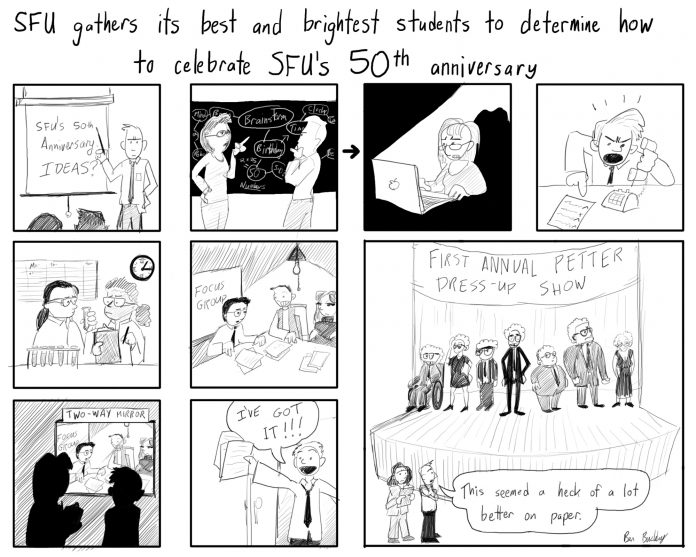
By Benjamin Buckley

The GM food debate is more complicated than just GM food

0
Photo courtesy of Lindsay Eyink (Wikimedia Commons)

First of all, and perhaps most importantly, I want to congratulate the author of The Peak’s article “Why Can’t We Eat Like Europeans?,” published June 1, with her weight loss and newfound awareness of her diet and lifestyle.

But I feel like GM foods are being unfairly blamed.

The problem is that health issues are so incredibly nuanced and complex that it’s really difficult to tease out what’s really going on.

So what I’m hoping to persuade you is that in a similar way, the GM food debate isn’t as simple as whether GM foods are safe.

Firstly, food is different in North America for a lot of reasons. One of which is the corporate environment that we do our business in. Monsanto, a frighteningly affluent organization, has employed some shady business practices to become a major stakeholder in the American corn and soy market.

The company sues farms that have fields that are accidentally cross pollinated by their GM crops because of the patents that they have on the artificially added genes. Even if their GM crops were perfectly safe to eat, their business practices would still be shady.

So companies using patent law to run competitors out of business is definitely a mark against GM crops. But even if that didn’t happen, agricultural practice isn’t great as is. In order to increase efficiency, huge farms will cultivate the same crop in bulk. This makes economic sense, but it also makes the crop incredibly vulnerable to pests and disease because usually the whole field is genetically the same, GM or not.

Food is different in North America for a lot of reasons. One of which is the corporate environment that we do our business in.

As a result, farms rely on pesticides and other chemicals to a huge degree. In recent years, North America has seen a huge drop in bee populations which have been linked to overuse of these pesticides; we’ve been shooting ourselves in the foot because without bees, we can’t pollinate our crops that we’ve been spraying with pesticides.

Another factor that complicates the GM food debate is that even if a certain food is safe, too much of it still might be incredibly bad for you if you eat too much of it. North American food is much sweeter than its European counterparts, usually due to added sugar. Regardless of whether it comes from a GM crop or not, that added sugar can still lead to increased risk for diabetes, kidney failure, heart disease, and stroke.

So after all of this, it might not even matter whether GM foods are safe because of the myriad of things that surround them. But I did some research anyway.

I’ll confess that I was looking forward to finding something definitive that concluded that GM foods were perfectly safe. But when I read a scientific article that said so, I saw that some of the scientists worked for Monsanto. So I looked again and found another, but the results were inconclusive. Then I kept looking.

What I found in the end was a huge body of work showing that people are actually pretty confused about whether GM foods are safe or not. There seem to be just as many studies that say they’re dangerous as that say they’re safe, and a lot of scientists are saying that more work needs to be done.

So what I think it boils down to is this: if you’re a politician, pass laws that prevent agricultural companies from screwing farmers over, if you’re a farmer, try to use as few pesticides a possible, and if you’re a person who cares about their health, eat a healthy diet. But at the end of the day, blaming health problems on GM foods, or calling them universally good or bad, is oversimplifying something very complicated.

Bard on the Beach brings Shakespeare to life

0

One of the goals of festivals such as Bard on the Beach is the promotion of the works of William Shakespeare. This is promotion not from obscurity, but from the negative association so many link with his name — so often related to the difficulty or perceived inaccessibility of his texts.

One can only applaud such goals. Shakespeare, perhaps more than any other literary figure in history, has too often suffered the groans of kids in school who see him only as a laborious chore, the barrier to a good mark or an easy semester. Most are introduced to him at an early age, and the only remnant they retain of a Shakespearean education is the difficulty of his text. Many adults will surely have similar memories and complaints.

The reason why this happens varies, though much of the reaction can be linked to how Shakespeare is taught in school. This is where festivals like Bard on the Beach are meant to help. Show Shakespeare in a setting other than a classroom, and his greatness can be more easily pinpointed, free from the pressures of getting a good grade.

This year’s Bard on the Beach certainly has the plays to achieve this goal. King Lear, ranked among Shakespeare’s best, touches on emotions that stick long after its end — which is a reason so many struggle to read it or act it. Every generation has found something different in it, something else to remember from it, from the difficulties of aging to the pangs of unreturned love or the forgotten cruelty a child can levy on their parent.

Love’s Labour’s Lost, a much lighter and more comical play, is a personal favourite. Its central theme is whether the pursuit of study can be seen as so noble that its students are willing to forgo youthful love for it. 

Another comedy to be performed at this year’s festival is The Comedy of Errors. If the title seems familiar it is because the phrase itself, like so many of Shakespeare’s lines, has entered our general lexicon permanently. The play is one of Shakespeare’s earliest, but the language and humour is so inviting that, like King Lear and Love’s Labour’s Lost, it counteracts the image of a boring and unexciting Shakespeare.

Moving away from plays written by Shakespeare, and in a list of delights one can expect from Bard on the Beach, is Shakespeare’s Rebel. This stage adaptation of C.C. Humphrey’s successful novel follows the life of John Lawley, a man stuck in the centre of the politically revolutionary fervour of Elizabethan England. Among Lawley’s many goals, he wants to continue his job as a fight choreographer for the plays of Shakespeare.

The larger context of the play also helps to shed light on another aspect of Shakespeare: as universal as his plays and characters are, they also had something to say about the age he lived in, a fact this play highlights in between inspired duel scenes and exciting glimpses of a past era.

Shakespeare’s greatness lies in his ability to articulate your own thoughts and feelings better than you could. Whatever joys or woes colour your life, there is a brilliant passage from Shakespeare related to it. To read his works is to find a collection of characters, to borrow a line from his friend and contemporary Ben Jonson, “rammed with life.” If Bard on the Beach can do something to display this, then they will have achieved their goal.

Puppy Therapy at SFU Woodwards!

0

SFU hosted another puppy therapy event, this time at Woodwards! Learn a little bit about the dogs personalities and what it is like to train and foster this pups!

Created by Paige Smith and Abigail Markowitz

Special thanks to SFU Health & Counselling