Home Blog Page 923

Woohoo, Boohoo

0

Woohoo: Hotmail

I’m a classics kind of gal. I adore all things old. Shakespeare takes over my bookshelf, Elvis takes over my iTunes library, and Degrassi takes over my DVD collection. All things old are gold.

And this is how I feel about my archaic Hotmail account — every early 1990s child’s dream. Fancy emails accounts like [email protected] and [email protected] made us very excited to lurk inside our inboxes full of atrocities.

Anything and everything from “If you don’t send this to seven people within the next five minutes, your dad will die tomorrow,” and “These naked Asian women are ready for you” ads seem to have found your email address, whether or not you actually signed up for them.

The phishing scams that Hotmail has to offer are plentiful, but quite frankly, we’re old enough now to know better than to believe the Nigerian Prince who’s willing to give us $6 million USD if only we help him get into the country for two grand.

Boohoo: Out-dated, hot males

Hot males have a way of capturing our attention, old or not. From George Clooney to Zac Efron, there’s always a choice for someone. Hot males exist in our SFU halls: from Julian Somers in Health Sciences, to Robert Prey from the Communication faculty, each department has got something sexy to offer.

Hot males make me happy. I’m thankful to stand close to them, to talk to them, to creep down the hall after them, to watch from the windows of their homes as they cook dinner. . . hypothetically, I mean.

But all of this changes as soon as I see a hot male using Hotmail. Like, come on, dude. It’s the 21st century. Get with the program. And by program, I mean Gmail, duh. Unless, of course, you’re Clooney, in which case you may use Hotmail.

However, I draw the line at Internet Explorer. Just, no.

Textbooks are okay, PDFs are not

0
Image by Olivia Tsai

Since the beginning of my university career, the most exciting part of a new semester has been buying new books at the bookstore. I know that this isn’t the most affordable or efficient way to get my course material, but I do enjoy new books; the ability to crack the spine and inhale that new book scent. I’m even okay with having to purchase custom-bound course packs. And while I may sound as if I’m advertising for the SFU Bookstore, I actually defend all print books for class in general.

Sadly, the PDF has become the bane of my university experience; I haven’t had a class in recent memory that hasn’t included multiple PDF readings, if not entirely comprising the course reading list. While this may seem like an excellent idea to save money, for me it simply isn’t worth it. One reason being that I don’t appreciate having to fight with Canvas to download my readings. While it’s nice to have access to an online learning hub, Canvas doesn’t constitute the most user-friendly experience, and depending on how well my professor understands the system, I may spend an excess 30 minutes trying to find one reading.

Also, what platform should I read it on? My highly distracting electronic device that’s one quick swipe away from a black hole of procrastination? Do I buy a printer, ink, paper, and an industrial stapler to print my own copy? Or do I waste time buying a printing card and having to return to library to keep printing unbound pages? None of these options seem like a great idea, yet this is the predicament I face. We have to be prepared to waste our valuable time and money to print off reams of paper that we will probably never give a second glance to, and that we can’t even sell to the next wave of students taking that particular class.

Professors often justify this PDF conundrum as being more cost-effective for students, or because they don’t like the way that that the supplementary readings are printed by document services. My time is money and I would rather have a neatly organized, pre-printed and bound set of readings than have to print, organize, and try to not lose what is sometimes 40-plus loose-leaf pages of readings per week.

Finally, PDFs allow professors to sneak extra readings into the course curriculum. When registering for class, I always look at the course outline so I can prepare myself for what I will have to read, and so I can roughly estimate how much time the class will take.

The books listed seem manageable for my selected course load; inevitably, though, when the syllabus arrives, there are three to five supplementary PDF-based readings every week to accompany the books that are also assigned. While it is my own fault for forgetting that there are always PDF-based readings, I naively hope that what the outline lists as assigned books are truly the only readings for the class.

I know that the PDF isn’t going anywhere because of the importance placed on technology in academia, but I really do miss the printed book, the fact that it is nicely bound, and unplugged. And when all else fails, it decorates your shelf to make you look more educated than you feel. 

Political selfies relay excitement, not self-indulgence

1
Illustration by Momo Lin

As I type this, Internet-Zach finds himself swimming in two types of digital expression: political spiels spurred by the critical October 19 election, and the omnipresent stream of selfies. As different as they appear on the surface, they have much in common.

Social media makes self-expression simple;  we can make ourselves an open book to the rest of the world. Inevitably, our aims in placing ourselves on display in such a way are called into question.

People commonly accuse avid Instagrammers of using selfies to brag; to show off themselves and their lives like trophies, putting the rest of us to shame. As being politically-minded and civically-engaged grows steadily trendier, many who showcase their political views through social media are painted with a similar brush.

Jen Gerson, the writer who first made this point, summarize her argument best in The National Post on October 13 by saying, “It’s not even about being part of a political party as much as it is about demonstrating that you’re part of a political party. The sort of person who belongs to such things.” That is, people post photos taken with ‘X’ political leader not out of real concern for politics, but to ensure others know how fashionably educated they are.

While there are undeniably such people out there, portraying everyone pushing the #StopHarper hashtag as cut from the same cloth seems rash. That the point is made through a comparison to the selfie is an awfully condescending double-whammy. There really shouldn’t be anything wrong with sharing aspects of your life on a platform that’s specifically designed for doing so, nor should it result in being labelled a ‘fake.’

Gerson describes the selfie as a symbol of how self-obsessed we’ve become in the modern age, but it’s more than a vain indulgence; it’s a mark of healthy confidence and self-love. Why should we make fun of it any more than we do other forms of photography? If we ourselves, humans, full of emotion and intrigue, don’t qualify as art, then what can?

She proceeds to link selfies and politics, and bases her doubts of people’s passion towards the political issues on the kind of posts people make. As an example, she notes that selfies taken with Justin Trudeau “rarely, if ever” include actual discussion of his platform in the caption.

But really, this is a little petty. It very much comes off like asking someone: “You like this band? Prove it. Name five of their songs.”

Gerson is a prime example of a significant subset of people — those who eschew forms of social media and look down on those who embrace it. ‘Of course selfie-sinners couldn’t actually have intelligent thoughts,’ is what it amounts to, and this is both close-minded and elitist.

I do apologize for the fact that, in the event that I meet the leader of my preferred party and take a photo with them, it will probably not be accompanied by an APA-style essay even after it hits the Internet. I’d like to think I’m allowed to support a party without being obligated to speak on their behalf at every opportunity.

Perhaps I was more concerned with being in the moment and sharing my excitement than going into details. Perhaps I figured that anybody who cares either already knows about my party’s platform, or has the ability to check for themselves within seconds. Perhaps I’m respecting that not everyone appreciates being flooded with political info on their news feeds.

And maybe, just maybe, I’m secure enough in my political beliefs that I don’t feel like I have something to prove.

This week in comics

0

AgoraphobiaThe Adventures of Agoraphobia Man: World Defender (Jacey Gibb)

BW- Jeremys ExcusesJeremy’s Excuses (Reuben Newton)

BW-CrapsideThe Crapside (Ryan Stella & Darien Lechner)

Screen Shot 2015-10-30 at 9.53.19 PM Creator’s Pet (Destiny Hsu)

Screen Shot 2015-10-30 at 9.53.30 PMPeers (Leslie Lu)

Satellite Signals

0

WEB-woodwardWoodward’s

The Djavad Mowafaghian World Art Centre will play host to a panel discussion titled, “Social Inequality in the City” on Monday, Nov. 2.

Starting at 7 p.m., the event will explore the growing inequality gap between the wealthy and the poor and how it relates to “decreasing health outcomes, poorer education levels, higher rates of mental illness, higher levels of incarceration and less social mobility.”


segal_building-01Segal Building

What is the ecological role of forest fires in BC and how do they affect human health issues? Experts will address these questions in the free lecture, “BC’s Balancing Act: Forest Fires, Ecology, Smoke and Health.”

The talk will be held at 7 p.m. on Nov. 5 in the Segal Building downtown.


Surreysurrey
As a part of SFU’s 2015 Community Summit, SFU Surrey presents “Leading and Learning,” an evening of conversation around using innovation to improve sustainability in cities like Surrey. The event will feature presentations from community leaders on Nov. 5 from 7 to 8:30 p.m.

Midterms

0

It’s that time again, midterm season. Few can name a time more depressing.

Created by Paige Smith & Eric Smith
Special thanks to Jacey Gibb & Joel Lionborn

TSSU ceases job action

0

SFU’s Teaching Support Staff Union (TSSU) will be ceasing job action and allowing its members to release grades effective immediately after voting to enter into binding arbitration with SFU administration.

The union voted by majority on Oct. 28 and with the recommendation of the TSSU Contract Committee to accept Final Offer Selection through binding arbitration.

As a result of this vote, job action ceases immediately and the two parties will return to the bargaining table over a period of 21 days.

If, after the bargaining period, there are outstanding items, arbitrator Vince Ready will have the final say on matters and his decisions will be binding.

One TSSU concern that was ironed out in a Memorandum of Agreement, pertained to the arbitrator’s authority to make a binding decision. “Initially, what we had received from SFU’s administration was something that did allow the employer to undo the binding arbitration,” said TSSU Chief Steward Reagan Belan.

That option has since been removed from the Final Offer Selection process. Belan explained that this removal was key to allowing the Contract Committee to feel comfortable recommending that members vote to accept the proposal.

“In an ideal situation, we won’t have anything to refer to Final Offer Selection — we’ll just deal with it all in bargaining and the arbitrator will not enter into it,” expressed Belan. She added that she is “optimistic” that will be the case.

SFU stated in an online labour update that it is “strongly committed to this process and anticipates a respectful and productive conclusion to bargaining.”

In the meantime, TAs and sessional instructors are allowed to release their students’ grades as soon as possible.

SFU warned students that this process might take a while: “The University is prioritizing the return of grades to students as soon as possible, but this may take a few weeks.”

All withheld grades are currently locked in archives and members will need to physically go and retrieve them. Belan concluded, “We would just ask those students to be patient, because it will take a little bit of time.”

Volleyball team drops fourth straight game

0
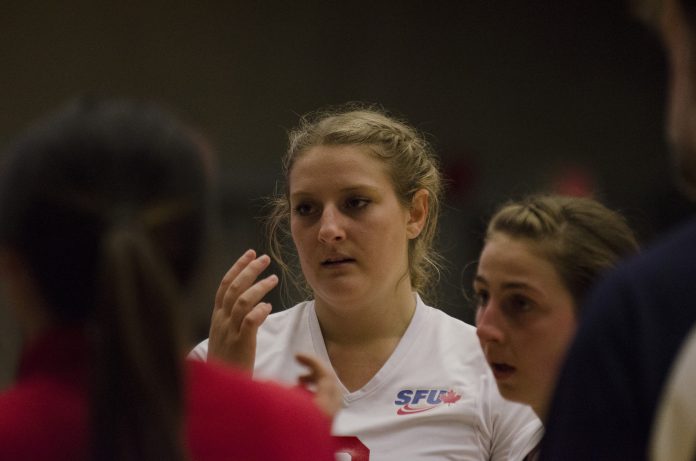
SFU hopes to end their four game skid against MSU-Billings tonight at 7 pm.

The SFU women’s volleyball team were handed their fourth straight loss with a four set defeat to the top Great Northwest Athletic Conference (GNAC) squad, the Western Washington University Vikings on Tuesday at home. Though the Clan fought well in the first set and came on top 31–29, the Vikings showed why they’re the top team in the Pacific Northwest. They stormed back to win the next three sets 25–20, 25–11, and 25–21.

The last time that these two teams played, SFU played an excellent first set before losing 1–3 as well. The same was to follow this time, too. Cheeky dinks from Madison Power, powerful spikes from Tessa and Devon May, and lightning quick digs from libero Alison McKay frustrated the favoured Vikings throughout the set. It was tit-for-tat right on until the end, when the Vikings gained three points in a row to get a 24–22 lead and two match points. However, SFU defended well and tied it back at 24 all.

During a timeout called by WWU after SFU tied it up 24–24, the SFU jazz band played an excellent rendition of Kenny Loggins’ classic “Danger Zone,” a song perfectly matching the action. Both teams rode into the danger zone and traded set points, but it was the Clan who was able to keep their cool and came out on top 31–29.

The second set also started out very even, with both teams trading points evenly. However, tied at 7–7, Western Washington was able to go on a run where they got nine out of the next 10 points, establishing a 16–8 lead. Though SFU was able to tighten the ship after that, the damage had already been done and Western Washington took the second set 25–20, tying the match at one set apiece.

After the intermission, the third set began, and it was the visitors who looked far livelier of the two teams. They stormed out of the gate to a 12–3 lead, and never looked back. It became clear why WWU is ranked as high as they are, as it seemed like every SFU spike was either blocked at the net or went straight to a Viking player. The effort for the Clan was clearly there, but throwing everything and the kitchen sink was not enough to faze Western Washington as they went on to take the third set 25–11.

SFU Head Coach Gina Schmidt gave some needed words of wisdom during the break, and SFU came out swinging in the fourth. Madison Power and Devon May began spiking like they did in the first set, and blocking by Tessa May stonewalled the WWU front court. All this, combined with more spectacular digs from Alison McKay, gave SFU a commanding 15–8 lead.

However, it was not to be, as the Vikings clawed back to tie it up at 18 all. A series of long rallies ensued, and it was Western Washington who came out on top in those, building a 24–19 lead. SFU was able to save two match points, but the third time was the charm as WWU took the fourth 25–21 and won the match.

After the match, Schmidt said, “I thought we fought hard, you saw a lot of good long rallies. We did a lot of good things, but they just did a few more good things.”

SFU hopes to end their four game skid against MSU-Billings tonight at 7 p.m.

SFU student aids in Bolivian economic development

0
Photo courtesy of SFU News

Gretchen Hernandez, a recent SFU graduate with a PhD in geography, has been passionately involved in a Community Economic Development (CED) program for Bolivia’s Indigenous peoples since 2007.

The training program, which was initiated by Hernandez, has helped 4,000 Bolivians, including indigenous leaders, municipal officials, and organisations map out their own paths of development.

Funded by the Canadian International Development Agency, the program aims to help communities as well as leaders work together to build on their available resources and improve their environmental and socio-economic conditions.

Hernandez, whose research focuses on the way the indigenous people of Bolivia are creating collective economic pursuits, is excited and inspired to continue her work as a social entrepreneur.

The Peak: How did you get involved with this project?

Gretchen Hernandez: I was a volunteer in 2003, and I saw a need for this kind of training in economic development. I made a link to SFU from someone I know and then I wrote a funding proposal and created this program.


P: Can you explain a bit about the training program?

GH: We established an innovative training program in Bolivia with Bolivian development professionals that brought together into one classroom all kinds of people, such as leaders from organizations, professionals, [and] people who work in the government. [. . .] The classroom creates a kind of a neutral space away from politics, so that people can get together and discuss what they can do to better the community.


P: What do you hope it will achieve?

GH: My real goal [is] to create economic justice and share knowledge. I was interested in redistribution so that people who are marginalized or on the outside and don’t benefit as much from economic assistance can take control of their lives and reap more benefits from sustainable development.


P: What is the most significant or memorable thing about taking part in this initiative for you?

GH: The big milestone was when the government there changed, and the Indigenous people had to be more powered; the indigenous leader just walked into our office and said, “this is the training that people might need.” From there, our program took off into this whole different area of working with Indigenous people in rural areas.

One of the most memorable things said to me by those people: ‘’We came into this program thinking that we are poor and we came out knowing we are rich, rich in land, in culture, in our social relationships, in our knowledge. And now we know that and we don’t have to wait for someone else to come and make things better for us’’.   


P: What’s next for you?

GH: I’m working with communities in one region to develop business plans for small agricultural ventures for Indigenous people, so that they can reach markets with their agricultural products. I have also started working on internship programs. We are going to send Canadian interns to work over there and I have also been hired as a faculty member at SFU in the Faculty of Environment. My job is to identify new research, training and international development opportunities in Latin America for SFU students and faculty.


P: Any particular message you would like to share with the readers?

GH: I just want to tell them that I think international cooperation is really the way that we can make a difference in the world. We can get to know each other and inspire each other to make the world a better place.

Queen of the Clan: A conversation with Theresa Hanson

0
Theresa Hanson comes to SFU after ten years at UBC.

After the resignation of Dr. Milton Richards in June, the SFU athletics department had a huge hole to fill. They needed someone who could lead this program into the future, and deal with the issues at hand. They seem to have found the ideal replacement, as it was announced Monday that Theresa Hanson was named senior director of athletics and recreation at SFU.

She becomes the first female athletic director in the school’s history, as well as the sixth overall. Her career has taken her to where it all started, as Hanson started as an assistant coach under the legendary Allison McNeil in 1988. The Peak sat down with the new leader of the Clan to talk about her new position at the school.

The Peak: What attracted you to the job here at SFU?

Theresa Hanson: It was a great opportunity first and foremost, and a career move for me. I’ve been the associate athletics director at UBC for 10 years, and this opportunity came up and I thought it would be a great fit for me. I’ve got ties to Simon Fraser that go back years, long before you were born. And then I also thought that in my career, it was the right time and the right place for a career move for me. I was very humbled and thrilled to actually get the job.

P: How does it feel to be back here, running it all, after starting your career here as an assistant coach on the women’s basketball team?

Hanson: It feels great. It’s a little bit surreal right now because I don’t start until December 14. But I am generally excited about it because I think that SFU has a lot of potential. It think that it’s a bit of a sleeping giant, and I think I have a lot to offer. I really hope I can make a difference.

P: What are some of the first things you will start implementing when you start the job?

Hanson: Well, the first thing is that I need to meet the people. I need to listen and I need to learn, and I need to evaluate everything. I look at the facilities and I look at the structure of the department and I look and the budget, and the funding and everything, and get all that information first before determining and evaluate what comes next.

Obviously the goal is to improve on things, the goal is always to provide those excellent opportunities for student athletes, and for the student body as a whole through the campus recreation program. So I need to listen and learn to start with before I can determine a plan going forward.

“I think that SFU has a lot of potential. It think that it’s a bit of a sleeping giant”

P: You said that one of your goals is to start engaging with the alumni more. How will you go about doing that?

Hanson:  You know, I really think one of the best measures of success for an athletics program is engaging the alumni. Again, that’s about meeting the people. Meet them, [and] listen to them. There’s such a great tradition at Simon Fraser, and the alumni are the biggest part of that, and they’re very invested in the program. So you want to listen to those people, you want to nurture relationships, because when you have you’re alumni on board, anything’s possible.

P: Will you be continuing the policy that Dr. Richards put in, which was free admission to students for home games?

Hanson: I don’t even think I can answer that question right now. Again, it’s one of those things that I need to really dive into the athletic program and see how programs have been running, and what’s worked, what hasn’t worked, what we can do better. So I think that it’s too early to answer that question, but certainly we want to engage the students to come to the games.

P: What do you think is your biggest challenge heading into this position?

Hanson: Good question. [. . .] The department both athletics and recreation, need some stability and leadership. Maybe one of the biggest challenges is really to get everyone on [the same] side, get everyone on board, and figure out a way to work together that we’re all getting the same goals. Trying to be excellent in everything they do.

P: How do you go about engaging the student body here to attend games, and to have them be a part of the athletics experience?

Hanson: That is the ultimate question on every university campus. Simon Fraser is a big university — 35,000 students over three campuses — and it’s a high academic university. Students are here first and foremost for their academics. And it’s a commuter campus, so not all the students are staying up here. So how do you get them to stay and how do you to support and have that school spirit for the SFU teams? That’s the biggest question, and it’s faced everywhere.

I think working really close with campus recreation, [because] we’re part of the same department, [is key]. So, how can we work that athletes support the recreation programs, and recreation helps get students to come and support the men’s and women’s clan teams.

P: With your connections inside UBC athletics, does this mean we can look forward to the Shrum Bowl sometime in the future?

Hanson: I certainly hope so. I was talking earlier today about the Shrum Bowl, and to coaches. It’s a game [where the] win-loss is a big part of it, and the bragging rights is a big part of it. But I think in the bigger picture, it’s really about engaging the greater community with university sport. We’ve got Simon Fraser and UBC, two of the province’s’ largest universities in the same community. So what a great opportunity for community engagement with the Shrum Bowl.