Home Blog Page 922

SFU marches to victory over Marauders

0
SFU were able to avenge their 1–0 defeat from earlier this year.

Though the night might have been cold, the SFU Clan men’s soccer squad continued their hot form with a 3–0 win over a defensive minded University of Mary Marauders side on October 24. This successful result gives SFU their third win in a row (all shutouts), their longest winning streak of the season.

The match was excellently officiated by FIFA and Women’s World Cup referee Michelle Pye, who said that the game “ebbed and flowed. It started off with everyone being a bit cautious, and as the score line changes emotion gets into it [. . .] it’s a game of emotion and in this match we saw it, it went up and down.” Her statements were a very accurate description of the 90 minute battle.

The last time these two teams tangoed, it ended with the Marauders winning 1–0, though it was SFU who held the majority of the shots. In the first half, it appeared that this match would follow the same script. The Clan held the lion’s share of possession, with U of M sitting back and comfortably absorbing the pressure. SFU piled on the shots but was rarely able to hit the target, while the Marauders were content to try and attack the Clan solely from counters and set pieces. It had all the makings of a classic smash and grab for the American side.

However, in the 51st minute, the Clan were finally able to break through. Adam Jones headed down a cross towards Brendan Shaw, who comfortably slotted away his first of the season. After 141 minutes of keeping the Clan off the scoresheet this season, the Marauders finally succumbed to overwhelming pressure from the Clan.

Instead of stepping back to defend their lead, SFU went for the jugular. Centre midfielders Mamadi Camara and Kyle Jones took control of the middle of the park, and their distribution kept the University of Mary back line constantly on the back foot.

This constant barrage led to the floodgates opening late in the game. In the 80th minute, SFU left midfielder Calvin Opperman expertly deked out a U of M defender and crossed in the ball for Anthony Van De Vendel to volley into the net. The trouncing was complete eight minutes later, when Calvin Opperman received a throw in, calmly turned and blasted a beautiful strike into the top right corner.

When asked what the SFU Clan did differently this time around against University of Mary, Head Coach Clint Schneider said, “We finished our chances [. . .] We’ve been creating chances all year round and it’s nice to score a couple. Three different players scored today, which is good.”

Commenting on their successful run of late, coach Schneider said, “It’s a collective effort. Every player understands what’s at stake, the fact that we need to win our games here on out [. . .] Collectively the guys have come together.”

The next home game for the Clan is this Saturday against Western Washington. Kickoff is at 7:30 p.m.

SFU chancellor awarded for lifetime achievement

0
Anne Giardini has served as chancellor of SFU since being appointed in 2014. - Photo courtesy of University Communications

Anne Giardini, SFU’s chancellor, will be recognized with a lifetime achievement award at the Western Canada General Counsel Awards next month.

Giardini received her undergraduate degree from SFU in 1980. Having pursued a major in economics and a minor in political science, she went on to study law. Giardini says that there was an underlying theme in her academic studies.

“I was interested in power, how it got exercised, and who had control. Having learned about economic power at Simon Fraser, legal power was another kind of power I wanted to learn about.”

Giardini continued, “It’s not that I was power hungry, I simply wanted to understand power from different areas.”

After receiving a degree in law, the now-chancellor began working at one of the world’s leading forest products companies, Weyerhaeuser Company Limited. Giardini has received awards for her legal and corporate work as a part of Weyerhaeuser’s legal counsel and then as president of the company. She has also been a strong proponent of encouraging greater female engagement in non-traditional sectors and roles.

Since 2010, Giardini has been appointed to the commonwealth group of senior lawyers, the Queen’s Counsel, has received the Robert V.A. Jones Award for her contributions to corporate law, and has been noted as one of Canada’s Top 100 Most Powerful Women by the Women’s Executive Network.

Aside from her career at Weyerhaeuser, Giardini has also published two novels, The Sad Truth about Happiness, and Advice for Italian Boys. Currently, she is working on a third novel.

“My latest novel that I am working [on] is about death. There is still some work to be done on it, but it will eventually be released.”

Giardini’s mother, Carol Shields, was a novelist. Giardini is currently editing a collection of her mother’s writing advice which will be published in the Spring of 2016.

In addition to her legal work and writing, Giardini volunteers her time for and serves on the boards of several Vancouver organizations.

Giardini commented on how her time at SFU shaped who she is today: “My time at SFU made me curious. The professors and the students I met were all different and had different interests. And mostly, they were all passionate about what they were doing.

She continued, “I think my time at SFU gave me a lifelong curiosity about what people do, what drives them, and what moves them.”

The chancellor noted that she believes curiosity to be vital to an undergraduate education.

“Curiosity is a very important aspect of what you get out of an undergraduate degree. An undergraduate degree opens your mind to some of the possibilities out there.

“I really hope that students are not closed minded about their undergraduate degree. It really should open up possibilities.”

Women’s basketball shoots for a surprise finish

0
Erin Chambers averaged 23.5 points per game, and started every game for SFU last season.

Last Season: 4th

GNAC Coach’s Poll: 5th

Last year was a successful one for coach Bruce Langford’s team. With the team finishing in fourth place and advancing to the semifinals of the GNAC tournament, the year was full of highlights for the Clan. However, this season might be a bit more challenging. With only nine players on the roster at the moment, and Erin Chambers turning professional, it will be interesting to see where the team finishes by the end of the season.

“I think that we’re going to surprise people,” said Head Coach Langford. “A lot of people think that we lost a fair bit of offensive talent. We’ve got an opportunity for some kids to step up, and we’re going to see them do that.”

Much like the men’s basketball team, the women are also losing their star player. This past summer, Erin Chambers turned professional, and is now playing in Portugal. “We recognize what she brought to the team, and we recognize that we have to change our style a little bit because of that,” explained Langford.

“We have an opportunity for some other players to one: step into her job, and two: to take on a slightly different shape. I think we’ll be a better rebounding team, and I think we’ll be more of a team-oriented team. Last year, people could just let Erin do some things, that she then did a very good job of. This year that won’t happen for us.”

As of writing, the Clan only has nine players on their team, a considerably small size for a basketball team. And it was almost eight. “This year we are only nine, but nine isn’t a crisis stage. It looked like it was [going to be] eight two weeks ago, because it looked like Meg Wilson might not play this year. And if that were true, that would be a huge impact to us.

“The doctors are saying that maybe she can play this year, and if she does, nine is a way easier place to be than eight was.”

Langford said that Wilson’s medical issues involve her leg. Two different doctors have given two different diagnoses, one with compartment syndrome and one with popliteal entrapment. The first will allow her to continue to play through some pain, while the other will require surgery that would put her out of action for a year.

Despite the stress over current team size, coach Langford is excited by the upcoming class of recruits that have committed to the program. “We’re very excited by them. They’ve got great athleticism, very good skill, shoot the ball really well. They have huge upside potential, all five of them. They’ll be the best recruiting class I’ve ever had.”

The women’s basketball team’s season starts with some preseason games, the next one being Saturday against Lewis & Clark College. The home opener will be Thursday, December 3, when the Clan take on perennial powerhouse Alaska Anchorage.

Men’s basketball fall to UBC in Buchanan Cup

0
Despite a competitive first half, UBC dominated the second to win 101–71.

The SFU men’s basketball team lost the first Buchanan Cup held in five years by a score of 101–71 last Tuesday in front of 823 fans in UBC’s War Memorial Gym.

The Buchanan Cup was once an annual game between the SFU and UBC men’s basketball teams; prior to SFU joining the NCAA, it was only missed several times during a period between 1972 and 1978, and twice between 1998 and 2000. UBC leads the series with 18 wins to SFU’s 15, while the two teams split the 1981 edition as it was played as a two-game affair. UBC won the last two games, held in the 2008–09 and 2009–10 seasons.

SFU jumped out with an early lead as second year guard JJ Pankratz put the first three points of the game on the scoreboard. This, however, would end up SFU’s only lead in the game, as UBC quickly responded with a three-pointer of their own.

“We need to work on playing at tempo; we don’t play at pace yet. UBC plays at a pace that we can’t emulate in practice, so playing a game is feedback for us to go, ‘Now we know we need to play at a faster pace,’ because we’re going to see opponents like that, if not better — that’s the takeaway,” said first year Head Coach Virgil Hill, whose first game was a 74–56 exhibition loss to Thompson Rivers University on October 24.

Despite this, SFU played a competitive first quarter. The game was played under CIS, rather than NCAA rules, therefore split into 10 minute quarters instead of 20 minute halves. SFU trailed by only five points at the end of the quarter, with a score of 29–24.

The second quarter initially appeared to be more of the same, with SFU nearly tying the Thunderbirds. However, in the last five minutes, UBC took over the game going on an 18–1 run, giving them a dominant 54–35 lead.

“UBC’s a good team. We played with them for about 15 minutes, and then that last five minutes of the first half, they ended the half on an 18–1 run and we just couldn’t respond,” said Hill. “We’re in there, kind of like a fighter, back and forth, back and forth, and then at that point the knockout punch happened.”

From then on, UBC proved too much for the young Clan team. A Jordan put on a show for the Thunderbirds — guard Jordan Jensen-Whyte led scoring for both teams with 22 points. In the end, UBC won the third quarter 28–16.

SFU won the fourth quarter by score of 20–19, but the one-point victory was clearly not enough to overcome a 30 point deficit. Pankratz led SFU in scoring with 21 points. Max Barkeley, a junior guard transfer from Victor Valley College playing his first season for the Clan, put up an impressive showing with 14 points and an in-your-face attitude across the court. However, he was also called for five personal fouls which led to his ejection from the game.

Patrick Simon, who played last year for the Clan but transferred to UBC in the offseason, managed 10 points for the Thunderbirds.

SFU plays next Saturday, November 14 against Central Washington University at home in the West Gym at 1 p.m.

Renowned activist examines impacts of settler-colonialism

0
Roxanne Dunbar-Ortiz (R) explained the connection between settler-colonialism in America and Canada. - Photo courtesy of Roxanne Dunbar-Ortiz

The Institute for the Humanities at SFU hosted one of the most highly anticipated lectures of their fall series on the topic of “Settler-Colonialism and Genocide Policies in North America.”

The Facebook event for the lecture, which took place on Tuesday October 27, had 1,737 positive RSVPs, however the ICBC Concourse at SFU’s Morris J. Wosk Centre for Dialogue was only able to accommodate around 200 people.

“This has got to set something of a record for us,” commented Samir Gandesha, Director of the Institute for the Humanities.

The lecture was delivered by Roxanne Dunbar-Ortiz, retired professor and author from Oklahoma, who spoke to examples of American policies and rhetoric, as the US is her area of expertise. However, she acknowledged that many of her points are transferable to the Canadian context as both countries share similarities in their colonial pasts. 

The title of the lecture series, “State of Emergency,” was drawn from a TED-x talk given by one of their speakers from earlier in the semester, Pam Palmater. Gandesha explained, in light of the release of the Truth and Reconciliation Commission report, “Professor Palmater drew attention to the fact that, particularly from an Indigenous perspective, Canada was and is in the midst of a ‘State of Emergency.’”

“The most obvious example of this was the previous government’s stubborn refusal to mount an inquiry into Canada’s national disgrace: the hundreds of missing and murdered indigenous women over the past several decades,” said Gandesha.

Dunbar-Ortiz’s lecture addressed the way settler-colonial policies have and can be portrayed.  “United States government policies and actions related to indigenous peoples, though often termed racist or discriminatory, are rarely depicted as what they are: classic, classic, cases of imperialism and a particular form of colonialism — settler-colonialism.”

She strongly believes the term “genocide” should be used in describing the atrocities inflicted upon North America’s indigenous peoples, discussing the origin, history, and application of the word.

Dunbar-Ortiz explained that all five acts of genocide, as identified in Article II of the United Nations’ Genocide Convention, were committed against the indigenous people.

The acts include “killing members of the group; causing serious bodily or mental harm to members of the group; deliberately inflicting on the group conditions of life calculated to bring about its physical destruction in whole or in part; imposing measures intended to prevent births within the group; forcibly transferring children of the group to another group.”

Explaining the perspective of Australian anthropologist Patrick Wolfe, Dunbar-Ortiz remarked, “The question of genocide is never far from discussions of settler-colonialism. Land is life, or at least land is necessary for life.”

She argued that the expansionist goals of the settler-colonial forces required violence and the threat of violence to achieve their goal of exterminating the indigenous populations as a people, not just as individuals.

She rebutted a popular argument against the use of the term genocide: “Genocide certainly doesn’t have to be complete to be considered genocide. That’s ridiculous; saying there were ‘too many Indians left,’ 10 per cent of the original population, is ludacris.”

Gandesha explained that “People are [. . .] often confused at why an Institute for the Humanities organizes the kinds of critical events, such as the one this evening, insofar as an Institute that is geared to a Western tradition seems to be deeply complicit in [. . .] the very history of Settler-Colonialism.”

He explained that the Institute aligns itself with a “counter-tradition” within the Western tradition, “that has elaborated a powerful critique of colonization, domination, and exploitation.”

Indigenous peoples photo exhibit comes to SFU

0
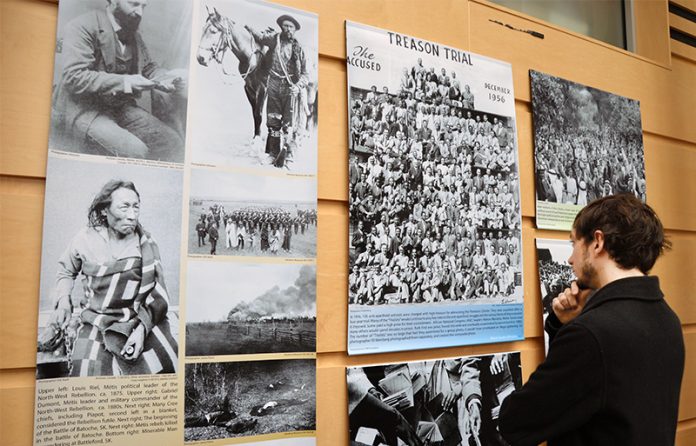
The exhibit will be housed in the Saywell Atrium until November 6. - Photo by Lisa Dimyadi

Dispossessed but Defiant, a travelling photographic exhibition arrived at SFU last week.

Created by the Canadians for Justice and Peace in the Middle East Foundation (CJPME), the exhibit showcases historical and contemporary photography of indigenous experiences of dispossession from South Africa, Palestine, and Canada.

Located in the Saywell Atrium, the display was brought to SFU through a collaboration of the world literature program, the Office for Aboriginal Peoples, and SFU’s Institute for the Humanities. The photographs will be on display until November 6.

Dispossessed but Defiant presents over 80 photos drawn from various archives, libraries, and individual collections, by both amateur and professional photographers.

The exhibit was curated and contextualized by CJPME through consultation with an expert in each of the areas of interest. It deals with the restriction of free movement and peaceful protest, as well as forms of dispossession like land loss and cultural pressures, amongst many others.

This exhibit hits close to home as SFU itself is situated on unceded Coast Salish territory.

Melek Ortabasi, the director of the SFU’s world literature program, frames the exhibit as part of the university’s mission — to create opportunities for dialogue around social issues. “SFU, to its credit and peril, has thrown itself behind the motto of ‘The Engaged University,’” she said, adding that it falls within this mandate to examine difficult questions.

The exhibit aims to personify the experiences and stories of the dispossession of indigenous peoples through the use of photography, drawing from multiple traditions from the invention of photography to the present day.

It counts on institutional records, anthropological photographs, studio portraits, and press and activist photography to illustrate a narrative of indigenous “‘migration,’ ‘exile’ ‘homeland,’ and ‘dispossession,’ as some of most viscerally wrenching human concepts,” expressed Ortabasi. 

Through projects such as this, the world literature program aims to unpack the concept of travel, movement, and tradition — by tackling “these difficult questions, and how they are mediated from one culture to another,” explained Ortabasi.

In three photographic case studies located in different places, the exhibit attempts to provide an opportunity to examine the Canadian indigenous experience in relation to that of other countries, through the organization of five clusters of photographs that suggest a thematic arrangement.

The photographs chronicle well-known historical moments like residential schools in Canada and Nelson Mandela’s election under universal suffrage in South Africa. However, the exhibit also presents some less familiar pieces of history. 

The exhibit provides a broader view of traditional lands, ways of life, dispossession and resistance in its various forms by showcasing photographs of agriculture in pre-partition Palestine and referencing the failed creation of Bantu homelands under apartheid.

Through the combination of text and compelling documentary photography, Dispossessed but Defiant aims to cast a wide lens on the experience of indigenous dispossession and to encourage productive discussion of surrounding issues.

University Briefs

0
UVic plans to make upgrades to technology for the astronomy program. - Photo courtesy of The Martlet.

UViC students offer new perspective on astronomy

[VICTORIA] — University of Victoria (UVic) students are looking to reinvent stargazing and upgrade the astronomy department at their university. The Committee for Upgrading the Learning Telescopes is a small and relatively new group at UViC. They currently lack the funds they need to fully realize their goal — to enhance the public experience of watching constellations on their open stargazing nights.

The committee has made adjustments to the 20 inch telescope model on campus and they also plan to work on the 32 inch model, Canada’s largest on-campus telescope.

With flies from The Martlet

New chancellor appointed at University of Western Ontario

[LONDON] — The University of Western Ontario appointed alumni Jack Cowin, founder of Competitive Foods Australia Ltd., as it’s 22nd chancellor.

He graduated from Western in 1964 with a degree in Psychology and was involved in the university’s wrestling and football teams.

Cowin told The Gazette, “I’ve got some views on education, what’s required and where Western should be going in the future. I’m glad to play that role.”

With files from The Gazette

Internships scarce for international med students

[HALIFAX] — About 60 per cent of international students applying for internships in medicine at Dalhousie University are being denied. 293 out of 486 applicants were rejected last year because the dates and departments they chose were already full.

Not only does this cost them the $500 Association of Faculties of Medicine of Canada fee, but also the non refundable $775 Dalhousie application fee. Canadian and local students receive preference over the international students.

With files from The Dalhousie Gazette

SFU consults community on 2016–2017 budget

1
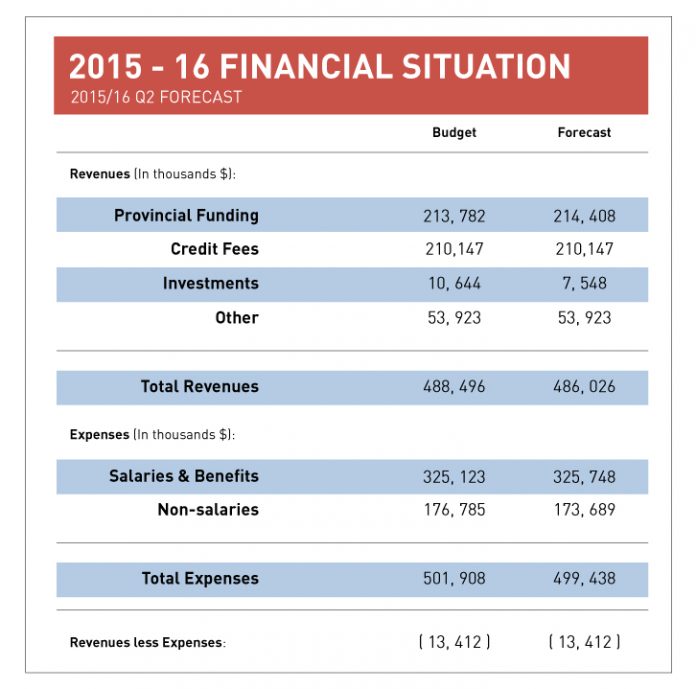
The financial outlook for 2015–2016 shows a revised investment projection with marginal changes elsewhere. - Graphic by Gabriel Yeung

SFU recently held a community consultation on the university’s 2016–2017 budget on October 29.

The session outlined SFU’s financial outlook and made budget recommendations for 16–17 with the help of Associate VP Finance Alison Blair.

This community consultation was the last of four events, after which the university will continue to put the budget together until it is ready to be confirmed in its final form by the Board of Governors on March 24, 2016.

Blair noted that “market uncertainty” in 2015 and 2016 “has caused us to revise some investment income projections.” Income from investments was revised down to $7.5 million from the initial projection of $10 million in 2015–2016.

Last year’s tuition fee increase of 2 per cent for all students led to a $4 million increase in revenue and the additional 8 per cent increase for international undergraduates only led to a $6.5 million increase in tuition revenue for 2015–2016. 

Among the recommendations for the next fiscal year’s budget made were an “across the board tuition fee increase of 2 per cent,” and a 25 per cent higher fee for international fees for the Masters of Business Administration (MBA) program, MSc in Finance, and the Management of Technology MBA, over the domestic fees.

While the audience in the Diamond Family Auditorium was sparse, those in attendance raised questions about various aspects of the budget recommendations, especially the raise in international student fees for the MBA program.

Said one student in a question to the presenters, “If this is a consultation, which I’m not sure if anything we say here today will change anything, I would like to speak against [differential fees].” She continued, “It is an exploitation to charge one group [more] for the same product depending on where they’re from.”

VP Academic and Provost Jon Driver characterized the rationale for differential fees as “pretty straightforward arithmetic.” He explained that the university currently dilutes the grant it receives from the provincial government by taking in more students than the province pays for.

He noted that the university considers the cost of accommodating more graduate students as “the price of being involved in research.”

Said Driver, “In the case of the MBA program, I think we would see this as a less research intensive program. It’s basically a program that confers a very significant financial advantage on the people who go through the program.”

One question from the audience brought up the issue of divestment from fossil fuels and whether or not the issue was on the table for next year. Blair responded, “No, not at this time.” She did, however, mention that the board recently created a Responsible Investment Committee and is “looking into” investing more into sustainable industries.

The Ubyssey reported on Oct. 26 that UBC is currently lobbying the provincial government for removal of the cap for domestic tuition fee increases of 2 per cent.

Driver explained SFU’s position on the cap, referring to a document produced by the Research Universities Council of BC (of which UBC and SFU are both members), which states the group “[does] not want to appear either in favour of taking the cap off or in favour of the cap being universally applied because [members] do have certain programs where there is a genuine need to increase tuition.”

The Simon Fraser Student Society (SFSS) was also on hand to detail the society’s role in the university’s finances. VP External Relations Kathleen Yang spoke to recent lobbying by the SFSS:

“We asked for four key things,” she explained: funding for open textbooks, increase to capital funding, and the ability to self-finance capital projects were among the concerns the SFSS brought to the provincial government.

“Those are our key asks,” said Yang, “Whether or not they take those key asks is another story.”

Sitting down has never been so friendly

0
The bench is meant to serve as a safe space for people to talk about mental health issues. - Photo by Lisa Dimyadi

Have a seat and make a friend! SFU’s Hi-F.I.V.E. Movement for Mental Health has unveiled a new Friendship Bench on Burnaby Campus.

Operating with the support of SFU Health and Counselling and the Simon Fraser Student Society, Hi-F.I.V.E. is a student-led group that started at SFU to advocate for mental health awareness.

The group hopes that the gift of the bench will become a symbol of the importance of mental health for all visitors to campus and will encourage people to feel comfortable to talk openly about mental health issues.

“Resources do exist and help is nearby if you need it,” said Hi-F.I.V.E. coordinator Tanya Miller, emphasizing that no one should have to “suffer in silence.”

Located in a courtyard on the south side of the AQ, across from the SFU Gallery, the bright yellow bench invites passersby to sit a spell, connect with others, and foster a safe space for individuals that are in distress.

The bench is the only installment in Western Canada and just one of five that the project has begun to roll-out. Hi-F.I.V.E. hopes to have the courtyard renamed to reflect the significance of the space. 

Photo by Talha Qadir

The Friendship Bench initiative was founded by a group of three men who have all grappled with or experienced a loved one deal with mental health issues and suicide. Suicide survivor and co-founder Sam Fiorella got involved with the project after his son, who was a student at Carleton University, took his own life in 2014.

“The bench itself was chosen to represent the coming together of students and students helping each other out, talking to each other,” explained Fiorella. “We wanted something that was more than a one-day campaign, that was a permanent thing.”

The project raises funds to install benches on secondary and post-secondary campuses across the country, as well as donate $1000 to a local campus group to provide mental health awareness education, marketing assistance, and financial support to services for those in crisis.

Each bench is accompanied by a plaque and a URL leading people to all the mental health resources that their school makes available to students. People are encouraged to use the hashtag #yellowisforhello as a public forum for open and honest communication about mental health.

The Friendship Bench’s partnership with Hi-F.I.V.E. will extend outside of SFU. “If campuses don’t already have a mental health initiative, they’ll suggest Hi-F.I.V.E.

It is applicable to anywhere, really,” said Miller, adding that the University of Tokyo, among others, is currently in the process of adopting a Hi-F.I.V.E. group of its own.

The initiative’s webpage encourages people to connect with others: “Getting the help you need or making the difference in the life of someone struggling starts with a simple ‘hello.’”

Laugh Track: Paul Anthony

0
Illustration by Gabriel Yeung

If variety is indeed the spice of life, then Paul Anthony’s Talent Time is a bowl of Carolina Reaper peppers soaking in Tabasco sauce. A live variety/comedy show currently in its eighth season, Talent Time combines musical acts, live comedy, and unique/bizarre performances into one of Vancouver’s most deliriously enjoyable monthly events. (Each installment also gets filmed, edited down, and later aired as a half-hour cable access show.) At the centre of it all is Paul Anthony, creator, talent booker, host, and titular glue that keeps everything together.

Read on to learn more about how Talent Time has changed since its debut eight years ago, what an act needs to make it a good fit for the show, and how committed Anthony is to keeping Talent Time going.

Where did the idea for Talent Time come from?

There are so many different answers to that, one being that I’ve done a variety show my whole life. When I was a kid, we would put on little shows at Thanksgiving for our family, and I used my cousins and aunts and uncles. So I’ve always been interested in variety performers and I always get really bored with any scene. A lot of comedian friends will just do comedy shows and hang out with other comedians, and a lot of musician friends just go see their friends’ bands play, and that’s about it. But I’d be going on the SkyTrain out to a mall in Surrey to see a talent show, and I’d watch two hours of garbage and then you’d see something that’s so fantastic and magical and I’d want the whole world to see it. And I could never get friends to make that journey, so I thought I’d bring the acts into the city and put on a variety show.

How has the show changed over its eight seasons?

It’s grown at such an interesting, organic rate, which means really slowly in this case. I was trying to figure out what the show was this whole time. I wanted the format to be somewhat of a variety too. I was using different co-hosts all of the time, I was really playing with what you could get away with, what the audience was drawn to. The first couple of years, it was more punk-rock and raw, with some positive moments and then a lot of really dark shit, and as it kept going it slowly became about championing the human spirit. I didn’t mean to do that on purpose; it’s just what the audience responded to the most, and what I liked more. Over the years it’s become a real community show. I’ve stayed in contact with a lot of people who’ve been on the show, some have become friends.

Historically, are there any types of acts that have been fan favourites for the audience?

If it has all of the elements, of being something that people don’t generally see or haven’t even thought of it existing, and then you add genuine talent with a really interesting personality, then that’s a homerun. But that’s hard to find. We have lots kids and seniors on the show, people who aren’t hyper-conscious of being cool or what they look like. They’re just going from the heart.

What are some of the challenges that come with being the host to such a range of eclectic acts?

It’s challenging to stay present the entire time, when I’m producing the show. I can’t help but think about, “Okay are they setting the next thing up? Has that sound effect been loaded yet?” If you’re not present as a host, it’s kind of painful to watch, and I’ve done that way too many times. One thing that takes the pressure off is having my co-host Ryan Biel, which is one of the reasons why I brought him on. He’s just so funny and likable and present, that if I’m off in my head for a moment doing something, the show doesn’t fall apart.

What were you drawn to first: comedy or acting?

I always liked the sound of humour. I would go to bed curled up to my ghettoblaster speaker and listen to old comedy shows, whatever was on the radio. Even as a kid I remember not really getting it; I just loved the idea of laughter. I remember watching my dad make his friends and family laugh and it just seemed so magical. I started acting as a sort-of skipping school strategy. I wanted to stay home from school, but I had just seen Ferris Bueller’s Day Off and I thought that if I walked out into the world like me, the principal would find me. So I’d put on my dad’s clothes and started walking differently and putting on accents, so then I could go out and rent a movie and get a personal pan pizza from Pizzahut, come home and enjoy the day.

Then I started just doing all sorts of experiments, like dressing up like a homeless kid when I was 11 and just riding the bus and going through garbage cans and seeing how people reacted. The psychology of it all was what interested me, just figuring out why people do certain things. Even now I still find it fascinating.

What can people look forward to at the upcoming Games Night edition of Talent Time?

You’re going to see the great acts that you’ve come to expect from the show, including a 12-year-old pop singer who wrote and recorded her own pop song; we have the Runaway Four, who do videogame medleys, so they’ll be playing to actual gameplay from retro video games; comedian Sophie Buddle; a couple of surprises. And then the second half will be the Family Feud part. We’ve actually built a set for it. It’s going to be very analogue and hand-made, but made by really talented people; a lot of them professionals in movie and theatre, so it’s got a cool mixture. The games are real questions too. I did research to find surveys of 100 people, so I wasn’t just making it up.

What do the next eight years hold for Talent Time?

There’s something really hilarious to me about doing this show my whole life. I think I’m in it for the long-haul, because it seems really funny to be 80-years-old and still hosting this show. Like, a cable-access variety show that you’ve hosted for your whole life? That’s just funny to me. And that just shows the stupid lengths I’ll go to for something that makes me laugh, because I’m willing to just mess with the trajectory of my whole life so that when I’m on my death bed, to just be chuckling to myself that I did a cable-access show for zero money my whole life. I have a daughter who’ll be two in December and she was first on the show in her ultrasound video, so maybe one day I can pass the family business off.

Experience the magic of Paul Anthony’s Talent Time for yourself: the Games Night edition is on November 5, with a new Talent Time happening on the first Thursday of every month at the Rio Theatre.