Home Blog Page 799

World News Beat

0

RGENTINA – Women marching against violence

Tens of thousands of women held a demonstration on October 19, marching in the streets of Buenos Aires to protest violence against women. The event was organized under the #NiUnaMenos movement (“Not one less,” meaning no more women lost to domestic violence), after the rape and death 16-year-old Lucía Pérez. The country passed a law specifically punishing “femicides” and other crimes targeting women four years ago. However, according to a national government organization that supports survivors of violence against women, every 30 hours a woman is killed in these crimes in Argentina.

With files from The Guardian

FRANCE – French government starting to demolish the migrant camp in Calais

The French government has started to dismantle the “jungle” of Calais, in northern France, where a reported 6,400 migrants currently live. The authorities were given one week to send migrants to centres all over the country by bus, where they might claim asylum. Many national government organizations oppose the operation, arguing that the authorities will not be able to ensure migrants’ security and that children could be harmed by police’s tear gas. Moreover, they contend that demolishing the “jungle” will not prevent migrants who want to reach the UK from getting there, or building other camps.

With files from Le Monde & The Guardian

VENEZUELA – Pope Francis calls for a dialogue between the president and the opposition

The Venezuelan National Assembly seemed to be heading towards a recall referendum on President Maduro, successor of the late Hugo Chavez. However, this effort was stopped by the National Electoral Council. Henrique Capriles, leader of the opposition, immediately called this move “a coup d’état.” Maduro met with Pope Francis, who called for a dialogue with the opposition to improve the well-being of the population. Venezuela has faced a dramatic economic collapse due to the sharp fall in oil prices and residents have suffered food and medicine shortages. The International Monetary Fund has projected an inflation rate of 1,660 percent in Venezuela in 2017.

With files from CNN

Promises and performance: How the Trudeau government stacks up

1

[dropcap]I[/dropcap]t has been a full year since seven million Canadians, charged to action by bright-eyed optimism, voted for real change, social progress, and a really great haircut. On October 19, 2015, the Liberal Party of Canada was elected to not only lead the country, but to do so with a landslide majority government.

For almost a decade, Canada has struggled with a prime minister and cabinet whose attitude towards transparency and the media bordered on contempt. After years of being unable to hold the government fully accountable for things like unbridled spending and a callous attitude toward equal rights lobbyists, Canadians fought back and demanded “Real Change.”  

In the interest of full disclosure, I must mention that I am a member of the Liberal Party of Canada. But like many other Canadians, I am deeply concerned with what my government is doing and not doing for me in Ottawa, all partisan objectives aside. Trudeau gained unprecedented support promising social progress, defence of civil rights, a strong middle class, and a Canadian government that would be transparent and accountable to the public. A year later, we know the prime minister’s luscious locks and popularity are still going strong — but how are his promises holding up?

Canadians need know what promises our government is keeping, and which ones they’re sweeping under the rug.

We will have to wait another three years to pass a final verdict on the Trudeau government. After the first year in power, though, what progress has our government made toward the platform we elected it on? After all, a total of 219 campaign promises does not leave much room for a slow start.

Don’t worry, it’s not as tall of an order as it once was: the government has already achieved 34 and broken another 26 of them. Do you know which category the changes you voted for have fallen into?

The following is a sample of some of the key issues that arose over the course of the 2015 election, and the actions that have been taken to follow through on these promises. If they should convince you of one thing, it is not the vices or virtues of the Trudeau government, but the importance of keeping our government accountable.

Canadians have been offered a luxury that we aren’t especially used to: government transparency. More than ever before, Canadians not only have access to the information necessary to monitor our government’s activities, but have endless mediums available to speak out and keep them accountable to our needs and their promises. With these changes comes a new responsibility for Canadians to stay informed and voice their concerns.  

To stay informed on developments with the specific policies I have mentioned — as well as the other promises the Trudeau government made upon taking power — you can visit the Trudeau Metre website: a citizen-run accountability campaign which allows voters to analyze and report on the government’s progress toward its election promises.  

The Promise: “We will repeal the problematic elements of Bill C-51, and introduce new legislation that better balances our collective security with our rights and freedoms.” – Liberal Party of Canada

Real Change: None.

In October 2014, Canada fell victim to a terrorist attack which ended in a dramatic shoot-out on Parliament Hill and left Nathan Cirillo, a Canadian serviceman, and the attacker himself dead. Canadians were shaken to the core and the Conservative government (in power at the time under the leadership of Stephen Harper) answered with Bill C-51, which promised to empower the Canadian Security Intelligence Service by allowing them greater access to citizens’ personal information and permitting them to detain any citizen for up to seven days on suspicion of terrorism.

This became a strong point of contention in last year’s election, as the Conservative government touted the importance of national security and the NDP took up the fight for civil liberties. Meanwhile, Trudeau’s Liberal Party believed that Canadians could defend their cake and eat it too.  

The Trudeau government promised that, while it would not fully repeal the Anti-Terrorism Act, it would make significant amendments to ensure that the civil liberties of Canadian citizens would be protected. Now, a year later, with no amendments proposed, one has to wonder if this was a case of Trudeau’s campaign writing cheques his government can’t cash.

Promise: “[Our government] will ensure that government science is fully available to the public, that scientists are able to speak freely about their work, and that scientific analyses are considered when the government makes decisions.” – Liberal Party of Canada

Real Change: Alain Vézina, regional director of science at the Bedford Institute of Oceanography, confirmed in an email to the CBC on November 6, 2015 that scientists’ exchanges with media were no longer restricted.

At the best of times, the relationship between the Harper government and the Canadian media was cold; at worst, it drew unfavourable comparisons to George Orwell’s 1984. Under the Harper regime government, scientists were permitted to speak to media only if it was approved by federal communications officers who would field interview requests to approve questions, answers, and which scientists would be spoken to — a system which was cumbersome and impractical, if not outright oppressive.

In one instance, the CBC reported 110 pages of email correspondence with 16 different government communications officers for a single interview with a single scientist. This not only created an iron curtain between the Canadian public and our scientific community, but it created a reluctance among the global scientific community to work with Canadian scientists for fear of being tied down by government regulations.  

Within a week of taking power, the Liberal government lifted this communication ban, allowing Canadian scientists to speak openly about their work at home and abroad.liberalballon

Furthermore, on February 29, the Royal Society of Canada confirmed the Liberal government’s appointment of a chief science officer of Canada. The officer’s primary mandate is to maintain scientists’ freedom of speech, facilitate government scientific activities, and advise the prime minister and his cabinet on policy decisions.  

Promise: “Public policies affect women and men in different ways. We will take these differences into account when making decisions in Cabinet.” – Liberal Party of Canada

Real Change: Canada’s first gender-balanced cabinet . . . because it was 2015.

To many, Trudeau’s appointment of Canada’s first cabinet with equal numbers of men and women seemed more like a social statement than an imperative government policy — and a lot of Canadians felt that was reason enough to appoint them. However, this decision was significant to more than just gender equality, as it addressed the issue of demographic representation.

Canada’s population has long been divided, very equally, between men and women. In fact, as of the 2016 Canadian census, the balance of men and women in the population differs by less than one percent. With this in mind, the former government’s cabinet (which was never a 50/50 split) not only displayed inequality in the opportunities it offered to women, but also devalued the voices of over 15 million Canadians. A gender-balanced cabinet is necessary not only to Canada’s social conscience but in order for us to be a true and effective democracy.  

Promise: “We will bring an end to the discriminatory ban that prevents men who have had sex with men [MSM] from donating blood.” – Liberal Party of Canada

Real Change: Hardly. On August 15, Health Canada implemented a policy which would allow gay and bisexual men to donate blood — provided they have abstained from sex for at least one year.

This seems like a hollow victory to begin with. Consider as well that the existing policy was not a complete ban on blood from MSM donors, but a requirement for five years of abstinence. The question on the minds of many members of the LGBTQIA+ community is, in today’s society, why is high-risk sexual behaviour still regarded as a gay problem?  

“Sadly, it was gay men who first suffered the initial epidemic of HIV through risky sexual behaviour and it is this stigma, that all gay men touch HIV in some way shape or form, that terrifies the general population about the use of our blood products,” said Kristopher Wondga, a nursing student and self-identified gay man. “I see first-hand just how important blood products are to those who use them, and I wish that I could help. Have I had sex in the past year? Yes, I have. Have [I] conducted my sexual behaviour in a way that lower[s] my risk of HIV infection? Yes, I have. Have I been tested for HIV at least once in the last six months? Yes, I have.”

To change the terminology of this policy which is — as the Liberal Party has previously described — discriminatory, without changing the policy itself, is simply putting a new label on an old problem.

Promise: “We are committed to ensuring that 2015 will be the last federal election conducted under the first-past-the-post voting system.” – Liberal Party of Canada

Real Change: Not only has no change taken place, but the government’s motivation to follow through with this promise has weakened — and it’s our fault.

At least, that was the explanation recently given by Prime Minister Trudeau. In an interview with Le Devoir, Trudeau said “Under Stephen Harper, there were so many people unhappy with the government and their approach that people were saying, ‘It will take electoral reform to no longer have a government we don’t like,’” and that “under the current system, they now have a government they’re more satisfied with and the motivation to change the electoral system is less compelling.”

The first-past-the-post system elects a government by allowing citizens to vote for members of parliament (MPs) who will represent their riding. Each MP is a member of a political party, which has elected its own leader prior to the election. Once Canadians have elected their MP, the party that won the most ridings will take power and their leader will be sworn in as prime minister.

This is a perfectly effective approach to a bipartisan election but the rise of the NDP, Green Party, and Bloc Québécois has created a glitch in the system. With votes in each riding split between candidates, a party not only does not need support from the majority of the country to win the election — it doesn’t even need it to win a majority government!  

Last fall, the Liberal Party won by a small margin in so many ridings that, after earning 39.5 percent of votes, it now occupies 54 percent of the seats in the House of Commons (184). On the other end of the spectrum, the Green party gained 3.5 percent of the vote and won one seat, while the Bloc Québécois earned 4.7 percent and won 10.

A broken clock is still right twice a day, and it seems misleading for Prime Minister Trudeau to equate a popular government with an effective electoral process. While the overall result of last year’s election may have been what the majority of voters wanted, there is still a distinct contrast between who Canadians voted for and who is governing them.

Since his interview with Le Devoir, there has been mass outcry, and Prime Minister Trudeau has back-pedalled a little to say that the Liberal Party will look into alternatives. The fact remains though, that we might not get to see any “Real Change” in the next election.

Big things expected from women’s basketball

1
Elisa Homer is expected to be a key contributor for the team this season.

The 2015–16 season did not start in the most idyllic way for the Clan. One of SFU’s forwards, Meg Wilson, was forced to take a medical redshirt after only two games. The team also went through an injury crisis, ending up with only six healthy players.

However, the team defied all expectations and changed the narrative in its favour. The Clan ended up with a 13–7 conference record and even made it to the Great Northwest Athletic Conference (GNAC) semifinals. Simon Fraser took fourth place in the GNAC.

“I think we had success, but we would like to have more success,” said head coach Bruce Langford. “Last year was a little bit of a slippage in terms of where we really would like to get to.”

Not only did SFU women’s basketball find its way to the semifinals five years after switching to the National Collegiate Athletic Association (NCAA) Division II, it has arguably been one of the most prosperous teams at SFU. “We were supposed to be a two-year transition from the CIS [Canadian Interuniversity Sport],” observed Langford. “We ended up losing six kids, but we recovered from that nicely. We had a really nice run where we made the nationals the first year we were eligible and made the nationals a couple years in a row.”

The team will now be able to rely on a good calibre of players, as coach Langford explained. “We recruited five high school kids and we have one transfer. I would say that our youth is the best we’ve had in the last 10 years. The kids are multi-skilled in different ways. Two of them are better defenders, which should help us defensively.”

The Clan has set the bar high once again. Coach Langford is “not only looking for the winning record,” but has also established an intense non-conference schedule and made it challenging to physically and mentally brace the girls for NCAA rhythm. The first part of the preseason will consist of three games in three days. The girls will be facing California Baptist University, Augustana University, and Colorado School of Mines in the Disney Tip-off Classic on  November 4–6.

Coach Langford will be able to rely on more than his main three-pointers this season. SFU welcomed talented recruits and added to its frontcourt transfer Tayla Jackson, who played all 31 games last season for NCAA Division I UC Irvine. Jackson will be joined on the court by 2014–15 All-GNAC Honourable Mention Meg Wilson — who “has been such a good example of leadership in games as she has come off from injury” — as well as the team’s leading scorer Elisa Homer, and Ellen Kett who was top five in the NCAA in assists.

While the Clan seemed to be fairly dominant offensively on the court throughout last season, coach Langford reflected on the changes that need to be made for the upcoming season.

“We have been young every year since we have been in the NCAA. I don’t think we are consistent enough. I don’t think we rebuilt well enough. Those are two areas we really need to improve on.

“Last year we weren’t deep in certain positions. Some players were careful on the court about getting fouls and not being too physical. We have addressed those issues with our new recruits.”

The quest for the GNAC Championships starts on December 1 against Alaska Anchorage on the road.

Jaya Rampuri set for a bright future

0
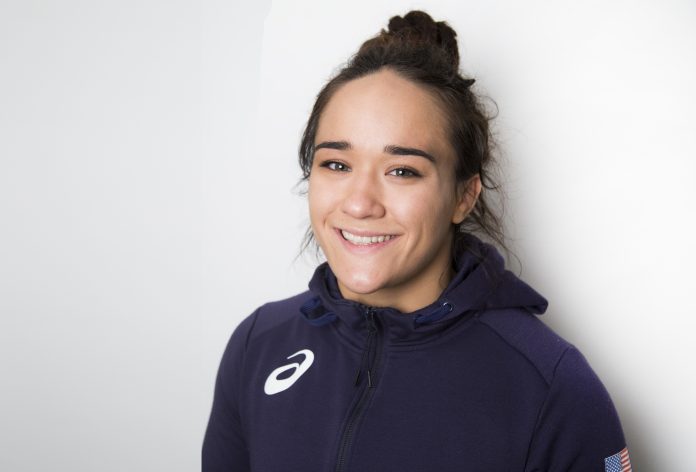
Rampuri finished 11th in both the Western Washington and the Concordia invitationals.

For most students, your first semester at university is a time of adjustment. Almost everything is different from high school, from the size of the classes to the expectations of schoolwork; it’s a serious step up.

Now add the commitment of a demanding practice schedule, and you get a sense of what Jaya Rampuri, a first-year communication major on the women’s golf team, has had to adapt to since the start of the semester.

“I went from being a very unorganized person to a super organized person,” said Rampuri on how she has had to adapt to university. “I’ve got a planner that literally tells me when I’m doing things at what time, and how much time I have. Especially with readings, I won’t go to sleep until that reading is done, because I know it needs to be done, otherwise I’ll fall behind.

“In that sense, I’m trying to make sure I’m staying on top of my schoolwork, but I also want to make sure I designate a certain amount of time to practice.”

The practice schedule is demanding. Rampuri practices “six times a week” for multiple hours at a time.

“We practice down at the range all together once a week for two hours. But we’re expected, and we do, play five days besides that one day a week.

“We buddy up [as well], we just go and chip around or we’ll hit the range or we’ll go on the course. It’s just honestly what you feel you need to work on. Right now we’re focusing a lot on the short game, because that’s something we’ve all been struggling with. We lose a lot of strokes there.”

With her skill level, you would think Rampuri would have been playing golf as long as she could remember. But Rampuri started relatively late, as she didn’t start playing golf until the age of 13. She started at the insistence of her mother, who asked her to try it out.

“To experience a team win is so much more than an individual win from my perspective.”

“I wanted to start competing in tournaments when I saw the LPGA [Ladies Professional Golf Association] come to Vancouver Golf Club, which is my home club,” Rampuri explained. “When I saw them come, I watched the girls and I was pretty inspired. So I asked my mom to put me in more tournaments.

“[From there] I went into some junior events and I started playing, and then once I kept playing I just wanted to get better and better at it. So I started working harder, started playing more days. I went from playing once a week to almost seven days a week.”

Despite some offers from various schools, including UBC where her sister played, she decided to come to SFU to test herself against the best.

“SFU just made [the most] sense,” she explained. “I like that they’re NCAA [National Collegiate Athletic Association], I like that I can compete in the United States, and travel a little bit and play against really good competition. Plus the education is very good.”

She’s been adjusting well on the course as well. Rampuri finished 11th at both the Western Washington Invitational and the Concordia Invitational. The team finished first in their first two tournaments too.

“It was a pretty big high,” she said on the early success the team has found so far this year. “To experience a team win is so much more than an individual win from my perspective. It put us on a high and it showed us how good we are and how much potential we have. So I’m looking forward to the rest of the season and to continue to win tournaments.”

Despite being way in the future, Rampuri already has a clear vision of what she wants to accomplish once her time is up at SFU.

“As of right now, I would love to be a coach for golf. I have a long way to go for that. I’m coaching here and there, helping out with the Vancouver Golf Club or with the LAB team I go out to see. [. . .] I’m helping out in that sense getting some experience. But I guess the ultimate goal is to go professional. If that ever comes my way I would definitely like to take that opportunity.”

With a fantastic start to her collegiate career so far, don’t be surprised to hear Jaya Rampuri’s name frequently in the future.

Public health students share their work at Practicum Poster Day

0

On October 20, SFU’s master of public health (MPH) students gathered to share their experiences from summer practicum placements around the world.

The master of public health program is in the faculty of health sciences at SFU. After two semesters in the classroom, MPH students spend 11 weeks working for an organization in the healthcare field. Kate Carty, coordinator of the public health program in the faculty of health sciences, said this experience is important for “bridging the academic world and seeing how it works in the real world.”

Carty plays an active role in the practicum program, and tries to find a good fit between students’ interests and organizations’ needs. This year’s practicum students worked across Canada and the world, including placements in Ottawa, South Africa, Vietnam, and the Dominican Republic. MPH students were involved in everything from literature reviews, compiling data, and evaluating programs to hands-on implementation.

Tatiana Popovitskaia worked with the BC Centre for Excellence in HIV/AIDS to research the effects of policing practices on sex workers in Metro Vancouver. She said her experience, which included analyzing research and conducting interviews with sex workers in Downtown Vancouver, helped her apply what she had learned in the classroom in a meaningful way.

“This is not only research for research,” Popovitskaia said. “It’s research for advocacy.”

She added that the work she and her colleagues do in their practicums may be used as evidence for future policy decisions and, as she said, “That’s pretty cool.”

Hadia Samim completed her practicum with the United Nations High Commission for Refugees in Kuala Lumpur, Malaysia. “I always wanted to work with vulnerable populations,” said Samim, who researched refugees’ access to health services. Samim assisted with the planning, coordination, and evaluation of health services for the over 92,000 refugees in Malaysia. “It’s emotionally draining,” she admitted of her work, but said it was highly rewarding to see tangible interventions and resettlement taking place.

Richard Han worked with the First Nations Health Authority evaluating student engagement in First Nations youth. Han was inspired to work with First Nations youth after volunteering on a reserve in Bella Bella. Data is lacking on reserves across BC, Han said. He plans to study the relationship between culture and student engagement for his capstone project.

The event allowed returning MPH students to share their experiences and offer advice to first-year students in the program who will be applying for their own practicums soon. Second-year MPH students will go on to complete their capstone project, in which they must apply a theoretical lens to a topic they are interested in, often something the students learned while on their practicums.

Do you have what it takes to be Keeping up with the Joneses?

0
The Gaffneys (Galifianakis and Fisher, centre) put their boring lives aside to keep up with the Joneses (Hamm left, Gadot right).

Keeping Up with the Joneses stars Zach Galifianakis and Isla Fisher as the most stereotypical, boring married couple on the planet (the Gaffneys), and Jon Hamm and Gal Gadot as the Joneses. The Joneses are gorgeous, sophisticated, multi-talented, awe-inspiring people — and they’re spies.

I fully admit that I wasn’t expecting much as I hunkered down in my seat, but bless this movie for being the highlight of my week. Given the premise, I was afraid it would consist of too much second-hand embarrassment and dumb one-liners from the Gaffneys as they try to navigate high-stakes espionage. I’m so happy I was wrong. You will be too, if you choose to go see it — which I recommend, if you want to spend almost two hours laughing.

Fisher plays one of those nosey suburban moms who’s naturally suspicious of people who don’t look at a house before they buy it, and who are too perfect for their little neighbourhood. It’s only because of her character, Karen, that the Gaffneys catch on to the fact that their new neighbours are spies.

Karen also supplies a lot of the physical comedy, moving around ridiculously trying to hide from the Joneses’ windows. But part of what makes this movie a winner in my book is that it doesn’t rely on just one kind of comedy. In addition to the physical, there are some pretty great one-liners that have enough wit to make the entire audience cackle.

There are also comedic moments surrounding sexual confusion, with each of the Gaffneys seeming to contemplate, however unlikely, how life on the other side of the Kinsey scale would be. Like I said, the Joneses are classically exquisite specimens.

And there is also my favourite kind of humour: the kind that surrounds flipping chauvinists on their asses with what a woman can and cannot do. Mrs. Jones with darts is a must-see.

Of course, this wouldn’t be an action comedy without the firepower. There are explosions, car chases, and plenty of bullets flying in the latter half of the film. Despite the seriousness of the situation, the Joneses and, in turn, the Gaffneys still manage to make light and get the audience to laugh.

There’s an actual spy plot, combined with henchmen and ransoms, betrayal and corporate theft — but when the bad guy is Patton Oswalt it’s hard to take him seriously at all.

Go with friends, take your date, or go by yourself. See if you can keep up with the Joneses.

NEW MUSIC FRIDAY

0

By: Tegan Gallilee-Lang, Courtney Miller, and Jessica Whitesel

Follow The Peak on Spotify to stay up to date on New Music Friday.

“Fake Love” – Drake

Jessica Whitesel: The beat is 🔥 but Drake is lukewarm. While he has found something that works for him, 30 should be an opportunity to try something new and call it a midlife crisis if it doesn’t work. Instead he released something that sounds like it was cut from Views. ¯\_(ツ)_/¯

Courtney Miller: I really can’t deal with these vocals (if I can even call them that) this early in the morning. I don’t want to take your place, Drake, I just don’t want to listen to you anymore. The track minus the vocals isn’t bad — it’s actually pretty chill and mellow — but these vocals are just such crap. I can’t.

Tegan Gallilee-Lang: You know you’ve made it when you start writing songs about the hardships of fame. Listen, I’m not really a fan of Drake’s new Sims-background-music-esque direction in sound, but I’m glad that Canadian kid is living his dream.

“After the Afterparty” – Charli XCX feat. Lil Yachty  

JW: Oh man, these lyrics hit close to home. So 10/10 for relatability, but the beat is old AF. It sounds so familiar, also Lil Yachty’s auto-tune feels out of place. But I’m not going to lie, I’d still probably listen to it for the mems.

CM: This is a perfectly fine track and I could see it being a good alarm song because it starts chill and then gets raucous. It’s pretty generic though in that I’d be hard-pressed to tell this song specifically apart from the hundreds of others that sound like. But it’s a good listen.

TGL: Ugh, the thought of even attending an afterparty is daunting enough, what kind of lunatic parties after the afterparty?? Go to bed, you weirdo. This is an average tune. Could see it getting airtime but it’s nothing really special.

“Holy War” – Alicia Keys

JW: I loved that the buildup actually went somewhere! Overall this is a pretty solid track. It highlights the strength of Keys’ voice in the pared down parts, and in the part where the percussion comes back her ability to have raw emotion while maintaining musicality. 👌

CM: Aw yeah, I’m liking this guitar and soft bass drum thing going on. Keys’ vocals glide over the music, tying it all together. I’m calling it now: playlist fave. “Maybe we should love somebody instead of polishing the bombs of holy war” is a pretty impactful lyric, and the song is full of them.

TGL: As soon as the bass drum kicked in I was like YUP. I’M ALL IN. I am ready to be slayed by you, Alicia Keys. But as soon as she started singing the lacklustre lyrics and forced social justice message, it detached me from the song completely and I was left disappointed at this total waste of potential.

“Längesen” – Petter feat. Eva Dahlgren

JW: Holy juxtaposition. The backing track is a beautiful mix of strings and piano, then comes in this Swedish rap that sounds super serious and emotional done in a deeper male voice (Petter), and then this female voice (Dahlgren) sings. And holy crap I want to learn Swedish just so I know it’s as emotional as it sounds and not — as cynical as this is going to sound — about fucking bitches and getting money.

CM: It’s a mournful tune with breaks of hopeful piano. Petter and Dahlgren both match the music in different contrasting ways. Petter has his rap vocal style which really works, especially with the conviction you can hear in his voice, and Dahlgren has the smooth and melodic vocal style. Kinda sad, but worth listening to (and learning Swedish!).

TGL: This song was a lot of me waiting for the dude to finish rapping so I could hear the lullaby-like chorus. I appreciated the strings, but I wouldn’t listen to this song again. I just can’t get anything out of the spoken-word stuff if I don’t know what is being said, ya know?

“You Remain” – Kungs feat. RITUAL

JW: I don’t know how to feel about this song. It feels new, but it also feels like it’s been done multiple times before. It’s like a mashup of Calvin Harris’ beats, Drake’s lyrics, and the vocal stylings of James Bay.

CM: The horns and percussion in this really carry the vocal-less parts of the song, and the vocals work really well with the picked guitar notes. It starts off really slow and ballad-like, and then it gets a little dance-y as you progress through the song. I listened to this a few times, so I think I liked it.

TGL: I really like the intimacy in the vocals of this song. It feels like he’s singing it to you right in front of you. Also, big shout-out to the trumpet bit which totally makes the song.

“Time After Time”  – Iron and Wine

JW: It’s the season of “Time After Time” covers — this is about the third or fourth I’ve heard — but it’s the best one. This song was made for Iron and Wine, and even though I usually like originals better, this version beats out Lauper’s for me hands down.

CM: Is covering Cyndi Lauper a 2016 thing now? First Anna Kendrick and J.T., now Iron & Wine. It wasn’t bad, but I feel like it was unnecessary. It was also really easy to ignore because I hit play and then tuned back in for like the last 15 seconds and had to replay it. They did it well, it just didn’t have to be done at all.

TGL: OK, so this is an acceptable cover for, like, an impromptu radio performance maybe, but I feel like if you’re gonna actually sell it you have to do a little more with it or change it up a little so that I’m not left sitting here just missing Cyndi Lauper.

“Let Me Explain” – Bryson Tiller

JW: Pleading and acting like an ass isn’t a good look on anyone, and wrapping it up in an R&B track doesn’t help. He’s not even directing this song at me and I want to yell, “Explain what?” But the beat is OK, not that that makes up for him singing, “Don’t be afraid to break up with me,” followed shortly after with, “Then I grab your waist and act like nothing’s changed.” Not cool. 🙅

CM: This sounds like a thousand other songs and at least 20 others we’ve seen doing these playlists. I can’t find anything redeeming enough in here to make me ever want to listen to it or one of its clones ever again. He sounds like an ass in this, lyric-wise, and I’m unimpressed.

TGL: Oh hey there, slow jam, you tool of seduction. All I can really picture while this song is playing is a robe-wearing Bryson Tiller hip-rolling towards me with low eyebrows and a creepy smile.

“Swim Against the Tide” – The Japanese House

JW: I like this. I wish there was a little less fuzz and distortion in the backing track, but it still works. It reminds me a bit of Bon Iver, but less Bon Iver-y. Like a Bon Iver for the people. It’s def going on one of my driving/studying playlists.

CM: The intro was long and the track sounds like older, more laid-back and lazy Owl City. But it also sounds like a boring video game. I’d pass just because of how easy it is to ignore this song. It’s bland.

TGL: This song was mellow and pleasant during my SkyTrain ride, but I definitely won’t remember it beyond this sentence.

“Before” – Empire of the Sun

JW: I get why people should like this. It’s a nice laid-back indie track, with some pop notes thrown in. But it reminds me a little too much of the music scene in the earlier parts of the 2010s for me to fully get behind it — especially the fade out.

CM: I like how optimistic this is right off the bat, musically. Then the vocals come in and I feel like this would be a good one for all the people who like their notes high. The singing is pretty trancey and incidental.

TGL: I feel like over a couple of listens I could really like this song. I mean on my first listen I was already head-bobbing along, so we’re off to a good start, I suppose.

“How Far I’ll Go” – Alessia Cara

JW: I’m happy that Spotify told us this was from Moana, not because it’s a bad song — it’s pretty great for modern Disney — but because it seems like a lyrical departure for Cara. Which makes sense since Lin-Manuel Miranda penned it, as opposed to Cara who writes most of her own music. If the rest of the Moana soundtrack follows in the vein of this song it’s going to be one of the best Disney soundtracks.

CM: I take it back — this is my fave off this playlist. The music grows with the vocal melody and it all compliments each other really well. There’s the millennial “whoa-oh-oh” happening and everything. Miranda’s penmanship and Cara’s voice are an A+ combo.

TGL: I will inevitably like this song, by virtue of the fact that it will be in a Disney movie. I appreciate the Hawaiian feel and positive message. Très excited for this movie.

“home” – gnash feat. Johnny Yukon

JW: This is a super touching song about family, which is refreshing. It’s a mix of rapping and vocals but neither is particularly strong or stands out. It’s the lyrics themselves that make this song as strong as it is. So come for a song and stick around for the storytelling.

CM: I appreciate the fact that I can understand what he’s saying. The vocal effects do not improve the song at all. It was very decent in that I wouldn’t mind if someone else put it on, but there is certainly no need to listen to this again. I do agree with Jessica, though, the lyrics are the best part.

TGL: Cut the cheese, please. Though the sentiment is sweet and the melody hopeful, we don’t really need to be told that “home is where you are” another time.

“Playground” – Møme

JW: I’ve listened to a lot of EDM and this one has some of the best musical presence. It’s not a rollercoaster of bass drops and overdone plinking sounds, but it does capture the feeling of being on a playground, including leaving the playground when you’re sad that you’re leaving the playground.

CM: The absence of vocals is oddly relaxing after this playlist. This was a good one to end on because it chills you out. It’s actually pretty fun and I could see it being a good dancing song at a club. I mean, I don’t go to clubs, but if club music was more like this, maybe I would. OK, that’s a lie. Still like this though.

TGL: I might use this song when I’m studying! It has no vocals, so my brain won’t be confused by the words on my page and the words in the song. Also it’s focused and energizing.

COLUMN | LIST BITCH: Six ways to not be an asshole this Halloween

0

This goes out to those of you who wish to avoid being a fucking dick this Halloween. We are swiftly approaching the time of year when suddenly, the poor, disillusioned public seems to think it’s OK to perpetuate racist, sexist, discriminatory, or otherwise boring ideas. Read on to avoid joining the rest of the predictable assholes.

  1. For the love of God, please do not dress up as Pocahontas if you are not actually of aboriginal descent.

Yes, I understand you love Disney. Yes, I understand Pocahontas was your favourite princess movie when you were a kid. No, I don’t understand why you think appropriating a rich and important culture in such a trivial way is OK. “Sexy” Pocahontas is an entirely other issue on its own — aboriginal women have been oversexualized throughout history, and are three times more likely to be victims of spousal assault. Simultaneously sexualizing a race and appropriating their culture is basically as disrespectful as you can get.

  1. Don’t be that too-cool-for-school human who shows up to a party “ironically” dressed as themselves.

This is neither funny nor cool. At best, it’s a thinly veiled cop-out. At worst, you seem like a pretentious douche who thinks they’re above Halloween or dressing up. You know you want to.

  1. That girl who is rocking a sexy costume is none of your business. Don’t waste your time slut-shaming just because you’re insecure.

It’s a real shame that Halloween is the only time of the year when women feel comfortable enough to dress in outlandish garb without being shamed. Don’t open your mouth about some girl’s costume being “whorish” or any other lame adjective you want to project onto us. Whether someone is dressed in a full-on Big Bird costume, or a slinky maid’s uniform — let us girls have our fun, and take your bitterness elsewhere.

  1. Do not dress up as a killer clown.

This is just mean. I am scared shitless just considering seeing something like this on Halloween.

  1. Don’t dress up as a nun or priest, or as a sexy nun or priest.

That is just icky. The number of Facebook posts I see on Halloween along the lines of “I usually call him Father but tonight I call him Daddy” makes we want to hurl everywhere. Catholicism is a religion a lot of people hold really close to their hearts. Whatever way you spin it, these costumes are just weird.

  1. Don’t be that person who criticizes every girl or guy who shows up in a last-minute or half-assed costume (e.g. army person, cat).

Look, dude, I came here straight from an eight-hour shift. You are lucky I took the time to draw on some whiskers and get some ears. Please let me revel in my mediocre holiday spirit in peace.

Men’s basketball is “laying groundwork” for the future

0
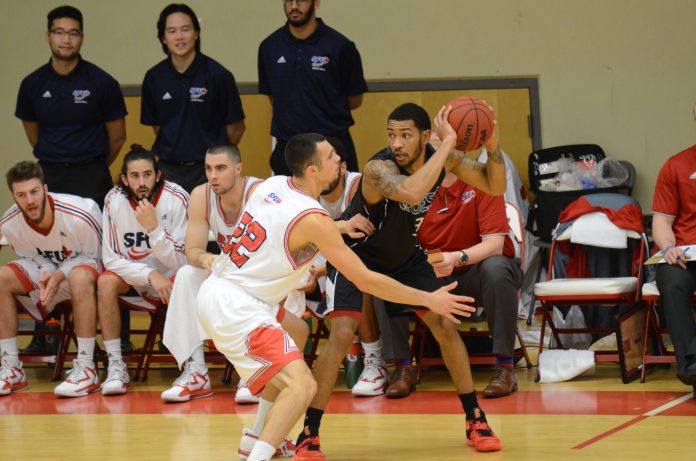
Gibran Sewani (#21) is one of two returning senior on the team.

“I want this program to be a program that makes the playoffs every year,” head coach Steve Hanson said. “Until we’re a top six team, I won’t stop.”

It’s a great vision from the first-year bench boss.

In six years playing in the National Collegiate Athletic Association (NCAA) — four of them eligible for a postseason berth — the team hasn’t made it once. The closest was in then-head coach James Blake’s last season in 2014–15, when they took a 6–12 conference record to seventh place, short of the standings by one place.

That’s the big picture plan, though. They won’t be making the playoffs this year, and Hanson’s not trying to deceive anyone; he’s fully aware of the challenges ahead.

“The goal is to win every game, so you ask me what the expectation is, we want to go undefeated,” he said. “But that’s not reality.”

This is the third season with a different head coach, with Blake’s successor, Virgil Hill, having left after only one season.

It was a tough season. From November to February, the team embarked on an 18-game losing streak, and finished 2–24 overall. Just one win came from a conference opponent, the other coming against Douglas College, which SFU usually handily beats.

To add insult to injury, there was a high amount of roster turnover — despite having only one senior — during and after the season, which saw the team lose some of its best players. Star freshman Oshea Gairey, who with 13.3 points per game looked to be the future of the men’s basketball team, left the program after the season. Junior transfer Max Barkeley, who was probably the most exciting to watch, parted ways with four games left in the season.

Hill resigned in April, leaving the team a shortened recruiting season.

Hanson, who was the lead assistant coach on the team last year, is likely in for another tough year. Last season was supposed to be a rebuilding year of sorts, and with the turnover of coaches and players, it could be seen as a lost year.

This team probably won’t put up too many wins, but that’s not the main focus this season.

“Right now, it’s just laying the groundwork, and it’s something we have to continually talk about — is creating a culture. I mean, regardless of what happens in the games, it’s how we play,” said Hanson. “We’re still in the building phase of trying to create a culture in which if anyone walks into practice, we want to be the hardest working team in the league. [. . .] I want the fans to appreciate how hard we play.”

With only two seniors and four juniors listed on the team, it’s going to be a young team.

“I think the young guys bring a ton of energy and excitement, but they’re green, so when they start playing some 24-year-old men who have been in his league for three or four years, it’s tough,” Hanson explained. “We only have two seniors. [. . .] They’ve been through three coaches now, they’ve been through some really tough times, and I think that will really help the team a lot.”

In addition to the youth factor, it’s going to be a lot of new faces. The team brought in a recruiting class of five, four of whom are transfers from other collegiate institutions: junior Kedar Wright from UBC (CIS), redshirt freshman Vinnie Safin from Chico State (NCAA Div II), junior Iziah Sherman-Newsome from Laramie County Community College (junior college), and redshirt freshman Michael Provenzano from Lake Superior State (NCAA Div II). Out of this class, the only pure freshman is guard Othniel Spence.

Wright, who was initially supposed to play with the team last year but sat out, is expected to be an “impact player.” In his final season with UBC, Wright put up 11.8 points per game and in seven of the eight final games, he played over 30 minutes. The Ubyssey wrote that he “was often delegated the task of guarding opposing teams’ most dangerous offensive ball handler,” and that he “gets in the face of his defensive assignments and plays with a little bit of an attitude.”

The team also added two walk-ons. The 6’1” guard Bongani Moyo was already a student at SFU, and had actually tried out the year before. Hanson is still deciding where he fits with the team in his freshman season, but Moyo is “probably not in the rotation right now.” The other walk-on, Devin Cvinatovich, a 6’7” forward who played at Kwantlen before their athletic program folded, will be the program’s lone redshirt.

Right now, it’s just laying the groundwork, and it’s something we have to continually talk about — is creating a culture

Rounding out the new faces are two players not new to the team, but who will be playing their first year of college basketball. The 6’7” forwards Aleks Vranjes and Graham Miller will jump in the rotation after redshirting last year.

Previously announced recruit Chase Hobenshield will not be joining the team, instead taking his services to Vancouver Island University. Hobenshield was expected to redshirt. As well, a Serbian recruit fell through because he did not meet SFU’s English proficiency standards.

“We’re a little bit different than the other schools,” said Hanson of the difficulties recruiting for SFU. “A lot of the junior college academic expectations are not high enough for SFU, so a lot of talent, so a lot of talented junior college players will go to some of our rival schools that just don’t have the same academic standards, so I’d say we miss out on 70, 80 percent of the talent that’s out there because they can’t get into SFU. That’s what we’re up against.”

Only six players who played minutes for SFU last season return this year. Of the pack, JJ Pankratz and Gibran Sewani will probably lead the team offensively. Andrew Williamson and Bowen Bakken proved themselves last year in their freshman season as guys capable of playing big minutes and adding to the secondary scoring. Hidde Vos, one of two seniors, and Tyrell Lewin, the tallest player on the team at 6’8’, round out the core.

As per NCAA rules, the team could only begin full practices October 15. For that, SFU began their season practicing in Whistler.

Conference play doesn’t begin until December. However, before that, the team embarks on a series of exhibition games and non-conference games, which were chosen by Hanson.

“A lot of teams have more T-shirt scrimmages early,” explained Hanson. “I just want to play the best competition all the time, because that’s who we’re playing in league. So we’re playing a couple of teams that we should have some confidence with early — that’s not a bad thing, we didn’t have too many wins last year — so I think it’s good to get some positive things going, but we’re playing some really tough teams all year long.”

This non-conference scheduling is something the first-year head coach is learning on the job.

“I think every year you get a little wiser,” he said. “I think there’s even some things now that I look at the schedule that I might change for next year as far as when we start playing. We’re playing pretty early this year, but we’ll see how it works out.”

This year, the goal will be putting the pieces in place for the team of the future. Like the football team right now, which suffered a similar coaching carousel, a great deal of this season will be in how this team reacts to adversity — because there will be losses.

The men’s basketball team begins play with exhibition games against Douglas College and Columbia Bible College this Saturday and Tuesday respectively.

Mental illness is hard to see and even harder to talk about

0

It’s Wednesday evening. I’m sitting in bed and have just made myself a chocolate chip brownie mug cake because it was a rough day and I need comfort food. The warm cup rests on my lap, right in front of the bright screen of my laptop, which I blankly stare into.

About a week ago, I signed up to write another article for this beautiful publication and out of all the topics I could have picked, I chose to write about mental health. It would be easy, I thought. Dealing with depression and anxiety has been on my mind for the best part of the last months, so it would be no problem to write about some of those thoughts, right?

Not quite.

October 10 was World Mental Health Day and Twitter was buzzing with people sharing their struggles, expressing comfort and support, and giving out virtual hugs. It really reminded me of how even though our experiences may feel isolating, there is always someone who is going through similar struggles, who can relate. Simply talking about mental health is so important to raise awareness, decrease the stigma surrounding it, and show the many facets and aspects and angles of it. Speaking up creates community and a mutual exchange of comfort of support.

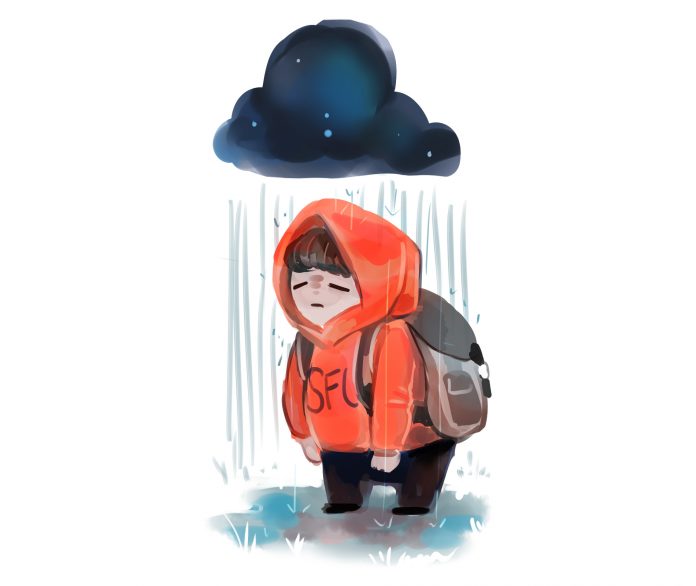
And yet, talking about mental health can be incredibly difficult. For me, one big obstacle is internalized stigma. My own mind messes with me constantly, it tells me that what I’m experiencing is not that bad, that I should just get over it, that I don’t have my shit together and am just a disorganized person with no discipline to pull myself together.

It tells me that I don’t fit the stereotype of the “typical depressed person”, who is unable to get out of bed in the morning, becomes completely isolated from the outside world and has suicidal thoughts. But I can get out of bed in the morning, I can clean myself up, make breakfast, go to classes, meet my friends afterwards, get my assignments done on time and still love life too much to think about suicide. I function, therefore I couldn’t possibly be depressed. Or so my depressed brain tells me.

Because my depression is not visible, it becomes difficult to talk about it. I feel like people might think I just want attention, that I’m making this up to be interesting, that I’m making too much of a deal out of it, because after all it’s not that bad and other people have it worse, right? The simple solution to it all is to look on the bright side and count your blessings and just be happy.

My own mind messes with me constantly, it tells me that what I’m experiencing is not that bad.

I have a roof over my head and food whenever I want it, warm clothes for the winter, a super supportive family, and amazing friends. I’m on exchange at a great university in one of the most beautiful cities of the world and I can financially afford this experience. I couldn’t possibly be one of the luckiest people on the planet and still be depressed — or at least that’s the story my depression tells.

So ungrateful and selfish! The depression in my mind continues.

Another reason talking about mental health is often difficult for me is that I’m a very rational person — but I can’t rationally explain my depression. As I described before, I have no rational reason to be depressed, there was no traumatic experience to trigger my depression. Because I rely on rationality so much, I can become super confused by what my mind is telling me.

I know that depression cannot simply be cured by being happy, I know that I’m not making this up, I know that I’m usually a very organized and disciplined person — and yet my mind sometimes tells me the opposite. It’s hard for me to understand if depression is really a part of me or actually separate from me.

Recently, I ended my long-distance relationship because I felt like it was sucking energy from me that I desperately needed elsewhere without providing any happiness in return. Only now, I’m not sure if it wasn’t actually depression that was consuming all my energy, not the relationship.

Was I depressed because of this relationship, or was I unhappy with the relationship because of depression? I have a lot of question to answer, and destigmatizing mental health topics has to be the first step.

So yes, talking about mental health can be extremely difficult — and yet, I highly encourage you to do it anyway. For me, speaking out has had a hugely positive effect on how I view and deal with my depression.

I first opened up about it in a post on my personal blog last month, and immediately messages from friends and acquaintances came pouring in, saying that they knew exactly what I meant, that they had or still were experiencing very similar things. They encouraged me to get professional help and reassured me that reaching out for help is not a sign of weakness, but of strength. I’d like to encourage you to do the same thing.

Talk about mental health, whether you speak to a close friend or loved one or a counsellor or your dog about it, whether you write about it in your diary or publish a post on your blog or on social media — just talk about it. Because you’re not alone and you don’t have to fight this battle alone, there is help, there is community, and we truly are all in this together.