Home Blog Page 793

Student attendance extremely low at open sessions for sexual violence policy

1
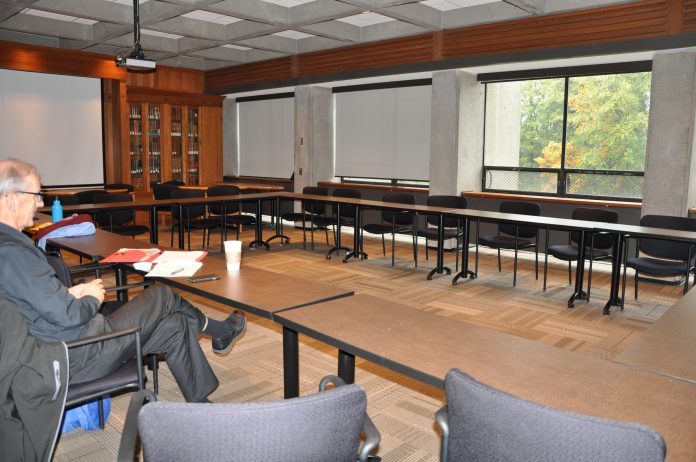
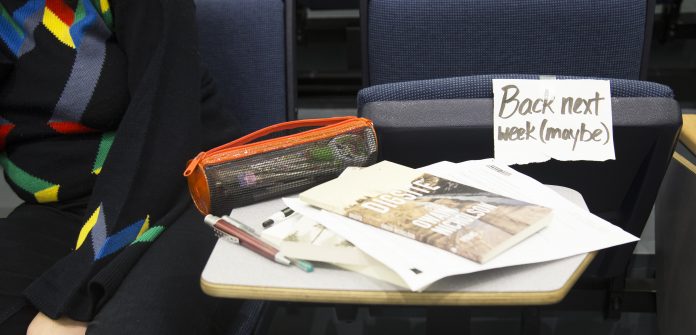
Pictured: Jon Driver hosting an open session to nobody. Not pictured: The snacks offered, sitting alone and untouched behind him.

When SFU held a town hall to discuss what the sexual violence and misconduct policy should look like, it was packed full of students and staff would were very vocal about what they want to see from the policy.

About halfway through the open sessions for consultation on the policy across the Burnaby and Surrey campuses, almost no one has attended to ask questions or start a dialogue with those tasked about sexual violence at SFU and what can be done.

“I don’t think we were expecting to get hundreds of people, but we were expecting perhaps to get a couple dozen students,” said Dr. Jon Driver, former VP Academic for SFU and part of policy development group. “I’ve been to at least four or five of these personally, and no students have shown up.

“It has been disappointing,” he added.

The point of the open sessions has been to connect with as many students as possible who have thoughts or concerns regardless the policy and want to influence it while it is being shaped. Over 50 students have given their feedback online, including responses that have come during the times when the open sessions have been available.

“I think initially it was because we hadn’t advertised it very well,” he said. “[But now], we’re not sure why students aren’t taking the opportunity. Obviously it’s midterm time, people are very busy, people are bombarded with information. This may just be something that’s not on the top of people’s priority lists.”

According to Driver, the Simon Fraser Student Society (SFSS) has done a wonderful job in helping to promote the sessions once the advisory group realized the lack of advertising. Still, after seeing what can be accomplished in-person after targeted meetings with groups, the potential benefits of the open sessions are just not being taken advantage of.

“We typically start rather slowly, but then it moves into some question and answer, and often moves into a dialogue. We’ve had a number of very good discussions with people that have really almost turned into a seminar,” said Driver. “I think the big opportunity for students if they come to the open sessions is to have that dialogue.”

He went on to say that while it is beneficial for students who are looking to have their concerns addressed and provide input, it is also very valuable to the policy makers.  

The open sessions also come with one more bonus that you cannot get online.

“We were told pretty early on that we have to have food, so we have been providing cookies and chips and so on,” said Driver.

For more information and to find out when you can drop by an open session, visit their website here.

SFU blows third-period lead to Selkirk College in home opener

0
SFU is now 2-1 on the year.

It was a game that SFU hockey probably should have won.

After SFU scored to make it 2–0, it looked like the team was on pace for a solid win in the home opener. However, five straight goals from Selkirk, with their first two on the power play, meant the Saints took the two points and ended SFU’s perfect start to the season.

“We had a 2–0 lead, and we gave it away,” said head coach Mark Coletta after the game. “Penalties cost us, and I think the emotion level wasn’t where it needed to be.”

Early in the game, SFU was dominating, and was unfortunate not to be more than 1–0 up after a quick goal early in the first. Selkirk looked slow in the first and second periods; a product of playing the night before, and the team’s 0–2 start to the year. And when Graham Smerek scored early in the third to make it a two goal, it looked like the game was over and done with.

However, Selkirk is the four-time defending British Columbia Intercollegiate Hockey League (BCIHL) champion for a reason. They won’t go down without a fight.

Just a few minutes later, SFU got into penalty trouble. Selkirk got a five on three, scored, then scored on the resulting five on four to tie it up. They added two more before getting an empty net goal to make it 5–2.

“You can’t give up penalties and expect to win in this league,” said Coletta on the third-period breakdown. “They got four power play goals, and it is what it is [. . .] We just didn’t find a way to put them away.”

Now it’s about refocusing. The season is still young: SFU still has 21 games to play before the regular season wraps up on March 4. However, this loss is a bit concerning considering past events with this team. In the final game of last regular season, SFU gave up a two-goal lead against the University of Victoria in the third, losing the game in overtime. The next week, they ended up losing in the first round of the playoffs to Trinity Western in two straight games, as BCIHL playoff series are best of three. Putting this loss behind them is key to getting results going forward.

“I think it’s the leadership,” said Coletta on what needs to improve. “The older guys in the room have to make sure they’re better, and that they’re better with the younger kids and making sure they’re holding their own. So it’s one of those things where the group within has to find a way to make themselves better, and then we have to be on top of them.”

Take your participation marks and stuff them

1

I hate participation marks.

There, I said it. I hate them, and they don’t just waste my time; they waste everyone else’s, too. They’re quite possibly the most pointless marks you can get in a class. Yet as I’ve progressed through university, they’ve just become a bigger portion of your overall mark.

I’ve never felt that instructors should mark participation, because participation should be a natural part of an overall engaging course.

What is an engaging course, you ask? For me, it’s a course where the professor clearly enjoys the material that they are teaching, and lectures in a way that passes on some of that passion to their students. It’s course material that makes you think and synthesize what you’ve learned. It involves discussions that happen organically if these preceding conditions are met.

I’ve never liked being forced to go to class, even in high school — where I probably skipped more days than I attended. I tended to avoid classes where the material or teacher wasn’t engaging, or if they covered things that I could more efficiently teach myself. There were only two classes that I went to regularly: art and history.

In both of these instances, the content was interesting and the teachers were amazing. Thank you, Mr. Lindell and Mrs. Johnson, for keeping me interested enough to keep coming to your classes.

Then I hit first year of university, where there was really no way to keep track of attendance or participation in lecture halls of 300-plus students, so I finally felt free to learn the way I so desperately wanted to. And I did.

My first year was filled with days where I just read the textbook and attended a minimal number of lectures. I successfully taught myself first-year chemistry and geography among other things. But then I advanced beyond first-year courses and transferred schools.

Reaching SFU was a shock to my system. Even larger lectures forced me to participate — thanks to the godforsaken iClicker — and there seemed to be some sort of hand-holding mentality that permeated through all aspects of learning.

While I see the allure of professors who care about you and how you’re doing in class, I find the forced participation and the attached marks smothering. It feels less like I’m actively learning, and more like I’m having to check certain boxes to reach a desired outcome, which strikes me more as passive learning.

As my mom put it, “It’s like group work in elementary school. There is always the one smart kid who ends up carrying the group and then everyone else benefits. But still, there is really only one person actually learning.”

I also don’t get people who try to counter my hatred of participation marks with, “But you paid for the class. Shouldn’t you go to get your money’s worth?”

No. I’m paying for the credits whether or not I attend, and the professor gets paid whether or not I’m there. If they want me to attend their class, they should focus on being a better lecturer or teacher, instead of just forcing people to come by having a significant amount of marks tied up in their presence.

Next time you hear me complaining about participation marks, it’s not just that I have to go to class whether I want to or not. It’s that, if professors actually cared about making a lasting impression on students, they’d do it through placing importance on actual learning, instead of on being able to sit in a room for four hours talking about nothing.

SFU Clan should pick a new name

1

As one of Canada’s most prominent universities, you might expect that Simon Fraser University would strive towards a standard of diversity and acceptance that matches the reputation it puts forward in every sphere of student life. Saying that, it is time for our school to look into picking a new name for its sports teams.

It’s not Washington’s football team, but the Clan, the moniker for the 17 varsity teams at SFU, is named after the ancestors of Simon Fraser, the explorer of Scottish descent who is the namesake of our university. It makes sense at first glance, seeing as we base a lot of school symbolism — like our crest, our motto, and our tartan — on the Frasers of Lovat, Simon Fraser’s Clan.

We even got special permission to use the name from the Lord Lovat from 1965, who attended the school’s opening and gave his blessing for SFU to adopt the imagery of Frasers of Lovat into our school’s spirit.  

While the Clan comes from Scottish tradition, so do some of the more infamous actions of the Ku Klux Klan (KKK). For example, cross-burning and the racist associations of lighting crosses on the yards of African American people’s houses in the USA actually began as an old Scottish act used for a declaration of war. It was used in the War of 1812, to call members of Scottish clans to defend their territory.

While this act is primarily associated with the KKK, it is worth noting that the roots of the notorious hate group are Scottish. The details of this are explored in depth in the novel The Clansman. In fact, the group was once known as the Kuklux Clan, combining the Greek kyklos (meaning circle) with a clan.

On top of its dubious historical connections, we should recognize the effect that even the word “clan” can have on our southern neighbours. With SFU primarily playing in the USA as the sole Canadian team in the National Collegiate Athletic Association, changing the name to something with less questionable connotations would also be a sign of respect to those whose lives and heritage have been dramatically affected by the Klan.

The team wasn’t always named the Clan. They were originally named the Clansmen, but that name was changed long before any of the current students at SFU first got here. There isn’t a lot of information online, which leads me to speculate that it might be because of the implications of the word Clansmen, or the fact that women’s varsity teams deserved more respect.

With all due respect to “tradition” and “history,” this wouldn’t be the first school I’ve attended which has changed its team name; I know firsthand that it can be done. The teams from my high school, Western Canada High School in Calgary, were called the Redmen when I was a student there, and had been since the 1940s.

In 2014, the team changed its name to the Redhawks, with then-principal Kim Hackman saying that the name was changed to be more inclusive.

While universities and high schools don’t have the same culture surrounding them and they don’t exist on exactly the same plane, I feel as though this sets an example of how to acknowledge a name that is past its prime.

Members of the name-changing committee said they acknowledged the name wasn’t always seen as controversial. Then-student Mihnea Nitu told the Calgary Herald that, “It kind of became derogatory over time, which is why I’m OK with why we had to change the name and the reasons that we did.”

That’s the point we’re at with the Clan. It wasn’t always the wrong name, but it’s time that SFU moved on from a word that now carries such negative, emotional weight.

For what it’s worth, I’d suggest the Highlanders.  

Don’t feed the killer clowns with your attention

0

There’s no shortage of historical examples of people behaving irrationally and cruelly — shall we say, monstrously — when they feel that behaviour will get them attention. In fact, monsters are precisely what are spawning at playgrounds across the world in the form of killer clowns.

No, it isn’t just Halloween arriving early. Reports of “killer clown” sightings have become frequent across North America and Europe, involving people dressed up as terrifying clowns loitering in quiet neighbourhoods to scare innocent community members. Citizens and police alike have judged these clowns as a threat which communities must respond to urgently and vigorously. Law enforcement has gone so far as shutting down schools and arresting threatening clowns in otherwise peaceful neighbourhoods.

But there’s no need to worry ourselves so much: these killer clowns, existing solely for the purpose of scaring children, aren’t some psychopathic form of necromancy. They’re just an ordinary problem created by ordinary people — people, perhaps, who lack fulfilment in their lives and seek entertainment by inciting terror.

To determine what these people hope to accomplish by dressing up as killer clowns, we need look no further than the digital society we spend far too many of our waking hours on. The Internet is where the killer clown was born.

In 2013, a young filmmaker dressed up as a killer clown as a social experiment and posted pictures of his guise on Facebook, perhaps in bad taste. From this first instance, photos of killer clowns spread to the corners of the Internet, where there’s no shortage of irrational, cruel monsters ready to take advantage of the new idea.

These sorts of people are best-described as trolls. They make comments that can defile even the most innocent and beautiful things on the ‘net, and get away with saying insulting and rude things with no consequence. What trolls have in common with their monstrous cousins, killer clowns, is anonymity.

No one can see the true identity of an Internet troll, just as no one can see the face of the person behind the clown mask. Perhaps it’s this very anonymity that some people find so terrifying about clowns, just as they fear the dark and the unknown.

The increasing frequency of killer clown sightings suggests that the behaviour of these clowns is largely determined, and even unintentionally encouraged, by media. People who have researched this phenomenon have determined that sightings of these clowns come in waves: society experiences a flurry of killer clowns every few years.

This suggests that newly spawned clowns are just copying the offensive behaviour that they’ve heard about in the news or on social media. When clown sightings increase in frequency, they receive more coverage, which lets them reach a wider audience, including potential troublemakers.

This results in a positive feedback loop that causes the phenomenon to spread around the world. One community even saw killer clowns used as an advertising ploy — evidence of the clowns’ success at generating attention.


By fearing the clown, we’re only feeding the troll. We would do better to ignore this over-publicized phenomenon, stop giving it the front page, and leave no incentive for the attention-seeking killer clowns to hide behind their masks while feeding on the fear of children.

Don’t shame artists for the liberties they take

1

In case you missed it, Demi Lovato recently made tabloid headlines for her comments regarding a piece of fan art by self-taught Romanian artist Vladimir Serbanescu. The drawing in question depicts Lovato in a pose similar to the one she sports on her “Body Say” cover art, only this time reimagined as a mermaid.

Serbanescu took some liberties in the proportions of Lovato’s body — most notably, making the bosom larger.

After seeing the picture as it spread through social media, Lovato commented: “Is that how my boobs should look? It’s gorgeous, but that’s not my body.”

Lovato fans immediately started calling Serbanescu and his fans (who jumped to the artist’s defence after Lovato’s comments) out for body-shaming Lovato, who has had previous issues with eating disorders. The artist defended his portrayal by saying to Seventeen magazine, “I enlarged her breast just because I wanted her to lay on it and the posture of the body wasn’t allowing it, therefore the only solution was making them bigger.”

Now, I don’t really care about either Serbanescu or Lovato, at least not any more than I do about any other human who I’ve never known personally. (This level of care basically amounts to “Please have a good life and don’t fuck up anyone else’s in the process.”) But this is a conversation of art, creative licence, celebrity status, and what should and should not be allowed.

Both Serbanescu and Lovato make valid points. Serbanescu’s is that he created a piece of art in order to fit his artistic conception — which as an artist is fair, and even expected of him. Lovato meanwhile points out that it is her body, and the perceived slight of Serbanescu’s breast enlargement certainly doesn’t help the public’s perception of the female anatomy.

I get her point. But Serbanescu recreates celebrities as mythological creatures and spirits. It seems naïve to expect that, in this realm of mythology, the creatures would adhere to human ratios and standards — they aren’t human.

I’m not saying that this artist is Picasso, but in general, we hail Picasso for reimagining the distribution of bodily elements. I doubt the famed painter actually thought that our noses should be on our foreheads or that our eyes could just go wherever.

As a public figure, the unfortunate reality is that Lovato’s image is not her own. She cannot cultivate which artworks of her get shared with the world. Celebrities become part of the public realm in that sense, regardless of whether or not that should be the case.

Serbanescu tried to show his appreciation of Lovato by blending her image with that of a mermaid, another image which he enjoys. I don’t think he should be penalized or ostracized because of his creative choices. I think he did the best he could under the circumstances.

He saw that although she said the drawing was “gorgeous,” she was less than thrilled with how she was portrayed. He responded by saying that he never meant for his art to be taken as some kind of guide for what he thinks female bodies should look like.

Our Western culture’s perception of the female body and our idolization of a certain body type are deeply problematic, and they can lead to eating disorders, poisonous body image, and extreme social pressure to conform. That’s not in contestation, and I don’t wish any of that on someone. But it seems to me that Lovato may have taken this fan art misstep a bit too far.

Cozy feelings filled the Fox when Andy Shauf took the stage

0
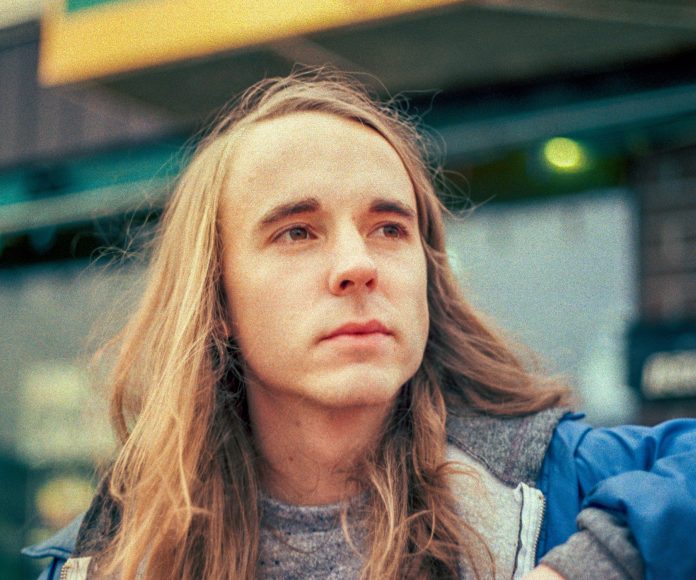
Andy Shauf returns to Canada amidst a full year of touring.

There’s something to be said about small, cozy concerts in a crowded venue; where the easy-going tone of the coming show is set by the star casually walking in and out of the venue. With a fear of an oncoming typhoon hovering in the air, a long line-up of people outside of the Fox Cabaret wait to be let in. They’re all bundled up in rain jackets, boots, sweaters, and scarves, braving the looming storm for the solace of Canadian artist Andy Shauf’s sold-out show.

The atmosphere (quite literally) changes the moment you enter the warmth of the Fox Cabaret, checking your numerous fall-ready layers at coat check, and settling down, drink in hand, waiting for the show to begin. There are just about enough people there to fill the floor when the opener, Scattered Clouds, fills the room with dark, heavy bass, slick synths, and plenty of reverb. The band reflects the overhanging storm, hypnotizing the audience with ominous rhythms and recitative lyrics.

After a strong set by the trio, the crowd is handed over to the main act of the evening. Shauf takes the stage with an almost meek demeanour, immediately launching into a laid-back rendition of “Alexander All Alone” with his four-piece band, and the noise of the crowd is reduced to a background clamour. There is a palpable connection between Shauf and his band. Shauf and his drummer don’t go a full song without maintaining concentrated eye contact with each other, keeping a steady beat throughout.

The intimacy of the venue is matched by the band, from the very beginning of the set to the end — “The Magician,” followed by an encore performance of “Wendell Walker.” Shauf’s unique and pleasantly soft voice, the pianist’s strong harmonies, easy-rolling basslines, and an ever-steady beat from the drummer melded into what was a lovely show.

Shauf and his band made it easy for the audience to forget that the city outside wasn’t actually a warm and hazy Friday evening.

Bringing New West history back from the dead — literally

0
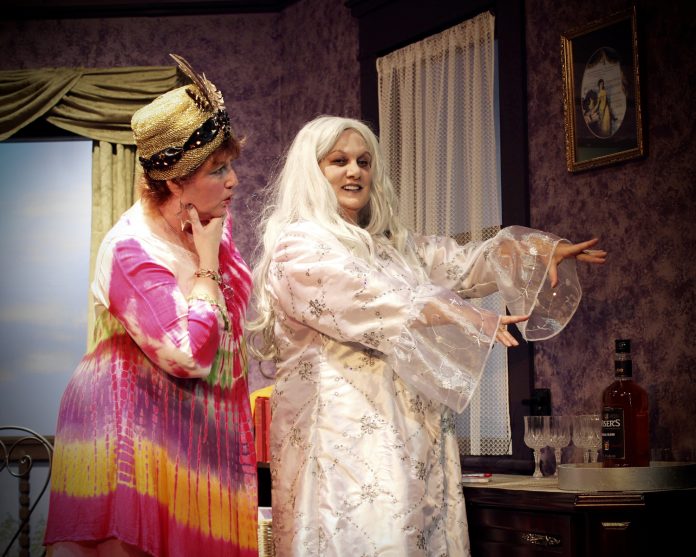
Alison Main Tourneur and Jacqollyne Keath share the stage in Body and Soul, running from now until October 29.

What happens when a person travels forward through time only to meet their own ghost? Playwright Elizabeth Elwood explores this possibility in her current production, Body and Soul.

Elwood spoke to The Peak a few days into the show’s run, and she said everything has been going well, aside from having to replace a couple of cast members. “Three and a half weeks ago our stage manager broke his arm, and his cameo role had to be replaced,” said Elwood. He is still managing the show, but wasn’t able to perform.

Only one week before the show, another cast member with a major part fell ill and had to be replaced. “It’s been a real challenge,” she said, “but they got it together for opening and it all went smoothly.” You might start thinking the show is haunted, but it’s not that kind of show — it’s actually a comedy.

The story follows Timothy Grey who leaves his job to write about the history of New Westminster. His friend decides it might be a good idea to bring back a resident ghost in order to ask the ghost about historic details for the book. When the ghost’s previous self ends up travelling through time and they come face to face with each other, things get complicated. “They end up bringing back the real person too, and it gets chaotic; they rewrite history,” said Elwood.

Set in a heritage home in the Queen’s Park neighbourhood of New Westminster, and shown in the Bernie Legge Theatre right in Queen’s Park, the show couldn’t be more local. Elwood explained that she wanted to include as many local references to New Westminster history as she could, and she also based her set design on Irving House to add historical accuracy.

Elwood’s idea of a ghost and the person that ghost used to be travelling through time first appeared in a marionette show she did called The Christmas Spirit. In that show there was a haunted, old fashioned manor house, and the ghost and its time-travelling double seemed to be a hit with audiences. This time, there are actors instead of marionettes, and the only thing that remains is that one plot device. Body and Soul was written over two summers in Pender Harbour, where Elwood does most of her writing.

“People always get a chuckle out of ghost stories,” said Elwood, and she thinks audiences will enjoy the element of romance and humour in this show. “It’s an upbeat, happy show. Not a slapstick farce, but more of a smile and a chuckle; it’s a witty and whimsical story.”


Body and Soul will be presented by the Vagabond Players at the Bernie Legge Theatre from October 6 to 29. http://www.vagabondplayers.ca/body-and-soul  

Acting out gaps in Cantonese culture

0
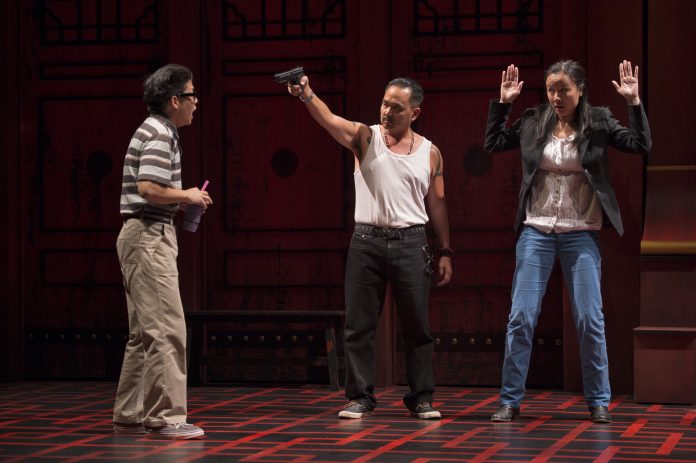
SFU alumnus Milton Lim (left) shares the stage with Raugi Yu (centre) and Andrea Yu (right) in Gateway Theatre's production of King of the Yees.

SFU theatre alumnus Milton Lim has been busy over the past few years with his company Hong Kong Exile, creating and directing interdisciplinary works. He doesn’t often find himself acting in another company’s work, and he is very excited to be playing Danny Ma in King of the Yees at Gateway Theatre. He is also enjoying this role because he shares a cultural background with his character, which doesn’t often happen. “It’s satisfying to have that specificity.”

Playwright Lauren Yee based King of the Yees on her relationship with her own father, and the story follows Lauren as she embarks on a journey after the disappearance of her father in San Francisco’s Chinatown. Because the characters are based on real people, Lim said he did a considerable amount of research in order to properly represent his character. “But I didn’t have to dig deep about living as a young Chinese man; that research has been done,” he laughed. He did however have to learn a bit of Cantonese for his role.

Lim described the play as a very accurate representation of the gaps and deficiencies in knowledge that can occur between family members in Cantonese culture, allowing for a greater appreciation of the complexities of the culture. “For people of our generation, it’s parallel to Lauren Yee’s experience,” he said. He thinks all audience members, regardless of their cultural background, will relate to the father-daughter relationship, concerns about personal cultural history, and intergenerational gaps in knowledge. “I personally look forward to my parents and brother coming to see the show. I think it will be affectual; it will start a conversation.”

With fantastical elements and a lion dance, the play sounds like an entertaining ride with a strong, unpredictable plot. In a behind-the-scenes video produced by the Goodman Theatre in San Francisco, Lauren Yee described it as starting from a very realistic place and then exploding into a joyride.

There are other SFU folks involved with the show, including sound designer Stefan Smulovitz who is a music instructor in the School for the Contemporary Arts, and director Sherry Yoon who is an alumna.


King of the Yees will be presented at Gateway Theatre from October 13 to 22. https://www.gatewaytheatre.com/yees

Exploring the idiosyncrasies of elections with Fight Night

0
Fight Night takes the concept of how voters can be influenced to the stage.

With the US presidential election looming, politics and democracy are on many people’s minds. Fight Night explores the way democracy works and how easy it can be to be influenced by a candidate.

On the phone from Belgium, Angelo Tijssens — the writer and cast member who plays the “ringmaster” role in the show — explained that making a show where the audience could vote was an idea that their artistic director, Alexander Devriendt, had on his bucket list for a while. “It was something he thought he’d like to do one day.”

After Belgium went through a period of having no government, they began talking more about the idea of creating the show. “We had no government for 540 days. No party could form a majority, so we started talking about doing the show.”

The audience is given a device to vote electronically for their choice of the five actors after each segment of the show — similar to a televised debate — and actors are eliminated along the way.

The actors are not representing themselves as politicians, but they use the same strategies to gain audience support such as portraying themselves as the underdog or appealing to emotions. Tijssens said, “We wanted to make a show about what happens when you get to the voting booth; how easy is it to be influenced?”

The actors may be on stage for one segment or for the entire show, and often compete with each other to see who will last the longest. “Some actors are in the dressing room for 75 percent of the show,” explained Tijssens. But they’ve learned how use audience appeal to their advantage. As Tijssens said, “There are subtle little ways to bend the rules we’ve made for ourselves.” They never know how the show will end and have to prepare for any eventuality. For example, one segment is set up as a talk show where they discuss what has happened so far, and this scene has 128 different versions.

“It’s a battle, of course,” said Tijssens about elections. From the way debates are set up as win or lose affairs, to the many war and sports analogies used to describe them, they are seen as a fight among the candidates. “Before we had democracy we had to fight to decide who would rule,” explained Tijssens. “It’s still a battle, but now it’s semantic warfare.”

Another concept they wanted to explore through this show is the tyranny of the majority: the idea that a majority of 50+ percent can have all of the power, and the rest of the public has no say. “History has shown us that there is no better system than democracy,” said Tijssens. He believes there are simple changes we could make to improve it, though, such as reducing the amount of money involved in an election. “Money buys you votes, votes get you power, and power gets you money,” said Tijssens. It’s a vicious cycle.

Tijssens has never been to Canada (“the better half of the continent,” as he described it), and he is looking forward to spending a couple of weeks in Vancouver, with plenty of time to sightsee during the day before taking the stage at night.


Fight Night will be presented at the Cultch from October 18 to 29. http://thecultch.com/events/fight-night-2/