Home Blog Page 792

SFU volleyball gets revenge on Seattle Pacific

0
SFU remains third in the GNAC conference with the win.

Saturday night, SFU volleyball played host to the Seattle Pacific Falcons. A game late in the season between the third- and eighth-ranked teams in the conference in most instances does not matter a whole lot. However, the Clan needs to win every game to increase the chances of being selected to postseason play. They did their part, beating Seattle Pacific 3–1.

“I thought aside from the little stretch in the second where we played a fairly focused game and did a good job of executing what we wanted to do offensively and defensively,” said head coach Gina Schmidt afterwards. “I was pleased with that. We did have a little bit of a let-down in the second set, but came back well for sets three and four.”

The stretch that she referred to was when Seattle came back from a 20–12 deficit to eventually win the set 25–23. From there however, the Clan turned it around, winning the next two sets in convincing fashion.

“I just pointed out that we had 13 hitting errors in the second set, and probably in the second half of that second set,” Schmidt said, on what she told the team after the second set. “You can’t win games when you score half the points for the other team. I just told them if we can eliminate those [mistakes], then we’re in good shape.”

The game marked a sort of revenge game for SFU, as they were swept by the Falcons in the game in Seattle back on October 13.

“When we were in Seattle [. . .] we gave up a lot of points on our side. Our offence did not execute on their side. That’s what we [talked] about, we wanted to make sure we were taking care of our side tonight and that will help take care of the result. It was much better execution start to finish than compared to our game down there.”

If this was a big game for SFU, then the next match is massive. They’ll travel to Western Washington to play the Vikings; in the match here in the West Gym on September 14, they beat them in a five-set thriller. A win will move them within one game of them, but also assure them of third place in the conference.

“They’re a good team, and when we were here, it went five. I expect another hard-fought game down there on their court,” said Schmidt on what to expect. “They don’t make a lot of mistakes, so essentially it will be making sure that we make them earn their points and take care of the ball on our side. Again, [we have to] execute our game plan.”

$5 a Day Challenge: Meal planning to avoid death

0

This is the second in a week-long web series that documents Kevin Rey’s experiences living off of $5 worth of food a day. Check back daily for another post.

I’ll bet all of you who read my previous article are wondering something.

Why didn’t I just buy like 48 packets of ramen, and maybe an orange to fight off scurvy? I mean, other than you can’t really buy locally sourced instant noodles.

It’s certainly cheaper to eat like that. Mac and cheese and canned soup cost less than a dollar per meal, but all of that variety of food has a serious flaw: it’s the food equivalent of packing peanuts. Years ago, I made myself incredibly sick by relying on instant meals and pizza pops for my nourishment. It’s no surprise, considering that a lot of processed food is incredibly high in salt, trans fats, and sugar.

Actually, the amount of sugar in our diet got a lot of attention earlier this year when it emerged that the sugar industry had been influencing research on the link between sugar in disease.

I know, I know. It sounds like one of those awful conspiracy theories that accuses the illuminati of causing brain cancer via Justin Trudeau selfies. But as cartoonishly evil as it sounds, it really happened. In 1957, a scientist published a paper in The Lancet scientific journal, pointing at sugar as a cause of heart disease. Several years later, the sugar lobby paid Harvard researchers to publish a paper that disagreed, placing the blame on fat rather than sugar.

But I digress.

For this challenge, I didn’t want to revert to my ramen-fuelled state. I wanted to do a little better. So today, I took my time making food that I really enjoy.

I soaked beans overnight, then rinsed and cooked them thoroughly. I added them to a pot where I had cooked some onions, garlic, and tomato paste into this sort of caramelized “flavour base.” After some simmering and seasoning, I had that with a side of rice.

When I was growing up, my dad would joke with my sister and I, asking if we wanted any of the beans he had simmering on the stove. At the time, the thought was completely revolting. But now, it’s honestly one of my favourite meals.

I’ve had this many times before, but this was the first time I had made it using dried beans rather than canned. It tasted a little different, but what was the most surprising to me is how much cheaper it is to buy the beans dried. Sure, I had to think one day ahead and soak them overnight, but by my math I saved around 40 percent of what I would normally pay.

Breakfast was pretty good too: bread from a local bakery with margarine and jam.

As day two draws to a close, I’m feeling pretty good about this whole venture.

But maybe I’ll start fattening up my cat. Just in case.

screen-shot-2016-11-11-at-4-54-04-pm

Amy Schumer, “Formation” isn’t for you

0

I remember the night Beyoncé decided to bless us with “Formation.” I was on exchange in England, chatting with a friend on Skype, when I had to stop what I was doing and take it all in. The song was fire, but this was Beyoncé; I expected nothing less.

What I found really powerful were the visuals that accompanied the song, proudly putting our history on display. Black women were showcasing their natural hair. New Orleans-based southern black culture was being celebrated. A young black boy in a ‘hood was dancing in front of cops in full riot gear.

Combining the above with lyrics focusing on celebrating Beyoncé’s southern roots, I understood that “Formation” was meant to speak to black people, and specifically, black women — reminding us that we slay. That’s why seeing such a call of solidarity be distorted and mocked for somebody else’s agenda is so irritating.

Recently, Amy Schumer released a mimicry of Beyoncé’s video, titled “Get in Formation.” Schumer lip-syncs along to the song, featuring cameos from actors like Goldie Hawn, Joan Cusack, and Wanda Sykes. The closest we get to acknowledging the original visuals’ significance is Sykes’ cornrows — but this is the equivalent of “But I have a black friend . . .” and I’m not here for it.

Schumer is a white woman. “Formation” isn’t meant for her, nor is it meant to be used by her. By completely changing the imagery and focusing almost solely on her own experiences, she misses the fact that this song speaks of blackness and black femininity in a way that she, as a white woman, cannot understand.

Think of it this way: Queen Bey throws an incredible party for black women to celebrate us. I and all my black girlfriends show up with our ‘fros, twists, and braids on point. Our makeup is on fleek, and we are feelin’ good! Suddenly, Schumer bursts in, tries to draw all the attention to herself, and gets mad when we explain, “You can come hang out with us, but don’t make it about you.”

Regardless, this could’ve been easily resolved if Schumer heard the criticism and apologized. However, she responded by saying, “I had Beyoncé and Jay Z’s approval. They released it on Tidal exclusively for the first 24 hours.”

Um, nope. That’s not how this works. We haven’t seen an official endorsement from the Knowles-Carter family, probably because Beyoncé is busy dominating the world, so that’s not a valid defence.

Meanwhile, a tribute may be well-intentioned, but it doesn’t change the fact that Schumer‘s trying to turn a piece that’s so blatantly for black women into a tribute to all women. She could’ve used a song that’s not so directly connected to black culture.

She talked about empowering all women, failing to acknowledge that black women experience life differently than white women. It’s white feminism at its peak, and I’m not here for it.

This doesn’t mean that non-black people can’t listen to “Formation.” Shoot, I play it as loud as I can for my friends, reminding them that their best revenge is their paper. What it does mean is that this song is a celebratory space meant for me, a black woman, and it needs to be treated as such.

Black women face prejudice on a regular basis. My sisters are murdered and their names aren’t even spoken. When a powerful figure within popular culture — who is also a black woman — creates a piece of art specifically for me and my girls, that is sacred and special.

Until she gets that, Ms. Schumer will not be going to Red Lobster.

SFU men’s soccer ready to make long playoff run

1
SFU will be playing its first playoffs game on the road at Interbay Stadium in Seattle.

Neither the weather on Burnaby Mountain nor the finest defensive lines in the Great Northwest Athletic Conference (GNAC) were able to stop SFU men’s soccer on the road to success. The Clan easily found its way to the playoffs after a regular season full of potential and world-class goals. Simon Fraser was crowned last week as GNAC champions after 15 unbeaten matches, losing only one game 1–0 to the Western Washington Vikings. SFU is currently ranked first in the 2016 National Collegiate Athletic Association (NCAA) West regional tournament, and third nationally.

It is no doubt that head coach Clint Schneider is well-equipped for the NCAA tournament. Coach Schneider will be able to rely on junior midfielder Adam Jones, who recently earned the award for GNAC Player of the Year. Jones led the Clan with 10 goals and nine assists, including a hat-trick. The forward line grew stronger with the addition of forward Riley Pang, who took the award for Freshman of the Year and tallied four goals for his first season. Sophomore Mamadi Camara came second in the ranking behind Jones with nine goals and six assists registered. Captain Ryan Dhillon was also decisive with a total of four goals and seven assists.

The Clan’s defence is as promising and productive as the offence. Junior Magnus Kristensen, who played every minute of the regular season, had a very bright season and was named GNAC Defensive Player of the Year. Senior goalkeeper Brandon Watson registered a record 30th career shutout and became GNAC’s all-time shutouts leader.

Nine of the Clan’s players were represented in the all-conference team. “To me, I think every one of our players deserves to be mentioned. I feel that good about our group and I told that to the guys. We’ve had a hell of a year so far. It’s a team effort,” said Schneider. Schneider, who led the Clan at the top of the table after finishing second during the 2015 season, earned the award for GNAC Co-Coach of the Year.

The Clan will face fifth ranked Cal Poly Pomona for its first NCAA playoff game at Interbay Stadium in Seattle. SFU’s men’s soccer has faced Cal Poly Pomona once early in the regular season, taking over the Broncos with a score of 2–0.

“We don’t play thinking there’s no room for mistake. You just play your game. The biggest with our guys is being confident; it’s the belief that they can be successful. If a mistake happens, then how do you respond? Well, you respond in a positive way. That’s been preached from start to finish. For the most part, we did a good job. We’re consistent about how we respond; we talk about selflessness a lot. We don’t think that we’re playing anybody better than us, right or wrong. If we play well, we should get the results.”

Simon Fraser will not be hosting any game at Terry Fox Field. As the only Canadian school in the NCAA, Simon Fraser must play all NCAA games in the United States. The Clan will be playing at Interbay Stadium in Seattle, home of the Seattle Pacific Falcons. Coach Schneider commented on this decision.

“First, I’m very grateful that SFU’s athletic administration supported us [hosting playoffs at home]. Every one of us want to be in Canada. You can’t approach the game thinking it’s unfair. With that being said, I would be lying to say that I’m frustrated. This is the second time it happens, and it won’t be the last time. There will be other sports in our athletics department [that] will go through the same thing. To me, it is an absolute disgrace that the NCAA continues to treat our Canadian students that way. I feel empowered on behalf of our student athletes, because they deserve better. Again, we’re very fortunate that we’re able to host in Seattle. We’re very fortunate that this Friday is off from school and so our guys are not missing class. Even if we’re in Seattle, we would leave Thursday and miss class on Friday. None of the team[s] has that problem except for us. We’re fully aware of that as a coaching staff.”

Going in against the 2015 national runner-up — Cal Poly Pomona lost the NCAA title in a 4–0 contest against Pfeiffer University — coach Schneider can trust his highly skilled team to hopefully add another win against the Broncos and make a deep run.

$5 a day challenge: A real food fight

1

This is the first in a week-long web series that documents Kevin Rey’s experiences living off of $5 worth of food a day. Check back daily for another post.

Things are way too expensive in Vancouver.

By now, I think we’ve all had that moment where we’ve seen yet another bombed-out crack house with no windows and at least three ghosts selling for a cool $1.5 million on the real estate market. We just don’t react anymore, because it’s so common to see.

Early this semester, I wrote an article about just how absurd it is to rent as a student in Vancouver — but in all honesty, the financial gouging doesn’t stop there. The same premium prices apply to many other facets of life, like gas and food. Expatistan, a website that aggregates prices for all kinds of products, ranks Vancouver as the third most expensive city in Canada, and 27th in North America out of 67.

Starting in 2012, an organization called Raise the Rates has shown just how disconnected wages are with the cost of living in Vancouver. Each year, they issue a challenge, asking participants to only spend the same amount on food that someone could if they were on welfare. Since rates have been frozen while rent and other costs have steadily increased, in 2016 that amount was $18.

Only $18 for an entire week’s worth of food.

I’m not going to pretend that students at SFU are under the same kind of pressure as people supported by welfare (although there were SFU students who literally couldn’t afford a place to live, so they camped out on campus), but we do have to pinch pennies lest our student debt become sentient and try to conquer the world.

We’re also bombarded by a never-ending torrent of information that is asking us to consider society, our health, and the environment with every transaction we make. Eat less meat, buy local and organic, no dairy, no gluten, no cannibalizing other students. You know, the usual.

Taking all that into consideration, The Peak and I hatched a plan. We thought it would be interesting to see what kind of life is possible when we really hunker down on our food spending. So, for the next week, I am going to only spend $5 a day on food.

Some thrifty (read: graduate) students among you have probably already figured out that something like this should be easy for me if I roam campus for scraps and free food from departmental events. But for almost all of us, that’s not really possible.

I’m going to behave like a reasonable student with limited free time.

Here are the rules of my $35 Week Challenge:

1 – I can only spend up to $35 for the week on food and drink.

2 – I can only accept free food if other students could reasonably do the same.

3 – I am going to buy local as much as I can, since I’m constantly being told to do so.

By the end of the challenge, we’ll see if I’ve managed to survive mostly intact, or if I’ve started to do an impression of Matt Damon at the end of The Martian.

Today was my first day on the challenge, and I can already tell this is going to be really difficult. There’s something about seeing a bounty of untouchable food at home that seems to make me even hungrier than I would normally be. At the same time, I can’t help but be a little disappointed in myself: I haven’t even gone 24 hours and my stomach is ready to leap out in search of a better host.

New Westminster has a great farmer’s market that brings in produce from Chilliwack and Surrey, as well as other homemade cheeses, wines, and such. So, I went in search of my supplies for the week. The vendors were all very friendly, and I had a good time doing my best impression of an environmentally conscious retiree.

But the thing is, $35 really doesn’t go that far. I had an existential crisis when a vendor told me that the butternut squash I had brought him would be $5 on its own. I immediately thought of one day in the week where all I would eat is that squash, and I think my stomach started to pre-emptively digest itself.

Full disclosure: I normally shop at that farmer’s market and will probably continue to do so after this challenge ends. There are lots of good tangible reasons to buy local produce like freshness, reduced environmental footprint, and supporting farmers who treat their animals well. The big problem is that their stuff is several times more expensive than the food imported from China that ends up in the chain grocery stores. For better or worse, my local pride got the best of me and I ended up buying mostly local.

After some deliberation and fretting, I decided to pick up these supplies for the week:

  • 12 eggs
  • Two cans of tomato paste
  • 900g red kidney beans
  • 800g long grain rice
  • 800g all purpose flour
  • 800g semolina flour
  • Four onions
  • One head of garlic
  • One loaf of bread
  • One jar of strawberry jam
  • One litre of one percent milk
  • $2.50 for things like spices, salt, and butter, that are really hard to buy for only one week.

We’ll see how this week goes.

screen-shot-2016-11-11-at-4-55-01-pm

Clan volleyball earns second straight sweep

0
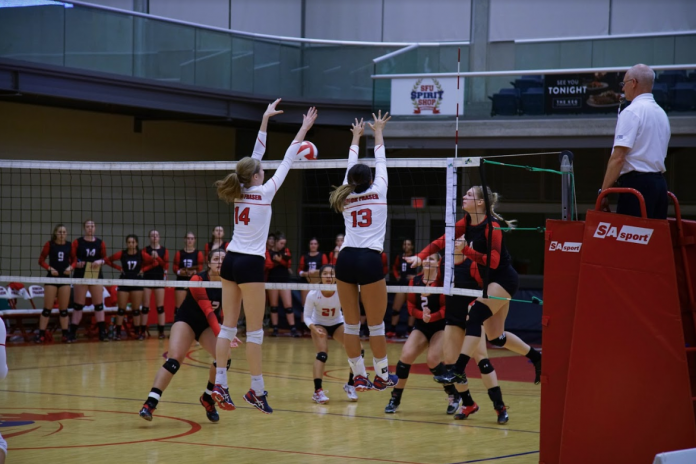
Nicole Chevrier (#14) had four kills on ten attempts, while Tamara Nipp (#13) had 43 assists.

The SFU volleyball team earned its second straight sweep on November 10, taking down Saint Martin’s University in three consecutive sets. The Clan was impressive throughout, leading for most of the game and never relinquishing control. The team won each of its sets 25–21, 25–13, and 25–19, respectively.

A late push at the end of the third set that tied the game was not enough to give Saint Martin’s the edge it needed. A veteran-laden Clan team managed to clamp down on defence while maintaining its strong offensive play.

“I think we put them in trouble with some serving, which is one way to get them out of their offence,” said head coach Gina Schmidt when asked about how they were able to stay focused down the stretch. “I think our hitters did a good job of mixing it up and finding ways to score.”

With only three games left in the season after Thursday’s, the matchup with Saint Martin’s was an important stepping stone leading up to the playoffs. Currently ranked third in the Great Northwest Athletic Conference (GNAC), the Clan is poised to maintain this level of play and get into the playoffs.

“[Playoffs are] not something we’re thinking about. We’re just focusing on getting the W. Our focus is on how we execute. If we execute, then those things will take care of themselves. It’s really about playing our style of volleyball and playing up to our potential,” coach Schmidt said on whether or not they are looking forward to the playoffs yet.

Two-time GNAC Defensive Player of the Year, Alison McKay, echoed this statement: “Playoffs are in sight but we’re still taking it game by game [. . .] We’re not looking too far ahead, we’re just trying to stay realistic.”

McKay, who had 17 digs in the contest, is just one of the seniors in the Clan starting line-up. With a veteran core, many members of the team are relied upon to keep the team focused during moments like the late run by Saint Martin’s.

“We executed things on our side. We took care of the ball and got it done,” McKay said when asked how they closed out the game.

“We do have several seniors on the floor and that certainly helps. They’ve been through a lot in their time here and we rely on them to have that poise in all situations,” coach Schmidt said about the seniors on her starting line-up.

The Clan improved to 19–6 overall and 12–5 within the conference after the win against Saint Martin’s. The team is currently ranked third in GNAC as well as in the whole Western region. It is important to note that the team is behind Western Washington University (WWU) in GNAC rankings because of WWU’s better conference record, but is higher in the Western region because of the Clan’s better overall record.

Clan volleyball plays at home again on November 12 in West Gym before heading on the road against Western Washington University on November 15.

Remembering Canadian soldiers from abroad

0

“To the valour of their countrymen in the great war and in memory of their sixty thousand dead this monument is raised by the people of Canada.”

That is what I read while standing on the plain green fields of Vimy Ridge in the north of France, knees shaking from the 2C weather, and teary-eyed from one of the most moving memorials I have ever seen.

When you think of spending a semester abroad, you typically think of drinking and partying — and while there was some of that, there were also some moments that moved me in ways I hadn’t anticipated.

When I got off the train in the small town of Lens, I honestly didn’t expect much. Small-town France has a reputation of being a little rough around the edges. I spent the night in an apartment, and in the morning, I pinned a poppy to my chest and started my trek towards the Vimy Ridge Memorial.

Getting out of the car, I was greeted by two very tall limestone pylons. I was quiet — everyone in my group was. The memorial was breathtaking. We walked up to it, slowly, taking it in from every angle. There were 20 or so statues, all expressing something so different and powerful, you couldn’t help but cry, smile, and pray as you walked around the monument.

Sacrifice, mourning, innocence, strength, courage, loss. The statues told it all.

When it came time for the ceremony, my friends and I gathered in a crowd of maybe 100 on the fields below the memorial. Looking up, we heard “Scotland the Brave” begin, and saw some of the bagpipers follow. Immediately, tears rolled down my cheeks. I looked around, and thought to myself about how many people died where I was standing so that I could have the life I do now.

The ceremony continued, the colours were marched in, speeches were given, and anthems were sung. All the while, I was fighting not to collapse right then and there.

Once the ceremony had ended, we walked up the side of the ridge to the museum and trenches. We stood in front of fields still warped from the war. Grazing on the fields at the museum were sheep, which I found a little strange. I asked why they had sheep out there, and apparently, in most parts of northern France, the fields still have active shells hidden under a layer of grass, so sending lawn mowers isn’t an option. The rolly hills plagued with bumps and humps were shocking, and the perfect reminder of what man can do to nature when we fight one another.

I walked through the restored and preserved trenches in complete silence. There was a cemetery on the other side of the memorial and we walked over to find a sea of white crosses. Again, all in silence.

Spending Remembrance Day at Vimy Ridge is an experience I will not soon forget. To stand on the fields where so many lost their lives is so different from standing in your school gym or having a moment of silence while at work. I had no idea how powerful Remembrance Day could be until seeing firsthand a community that was freed by Canadians. If you ever get the opportunity to visit a Canadian war memorial abroad, take it.

What does Remembrance Day mean to millennials?

1

Ninety-eight years ago, the “war to end all wars” came to an end. In this global conflict, Canada mobilized 620,000 soldiers. Of these soldiers, 20,000 were under the age of 18 when they volunteered. So many of these brave souls didn’t come home. Roughly one third of the mobilized soldiers did not come home.

This is often considered the “lost generation,” as even those who returned home were affected for the rest of their lives. Just over two decades after the end of WW1, the world was once again at war. This conflict would go on to claim 60 million lives from around the world, including another 40,000 Canadian soldiers.

Beyond these conflicts, Canadian soldiers have gone wherever they are needed. This includes deployments during the Korean War, the Vietnam War, the Yugoslav wars, the Gulf War, the Iraq War, the War in Afghanistan, and the current fight against the Islamic State of Iraq and the Levant, as well as many others. Sacrificing their lives to protect people at home — protecting people like you and I.

The Peak wanted to find out how the student body felt about Remembrance Day, so we asked some SFU students, “What does Remembrance Day mean to you?”

What makes this sacrifice so stunning, is the fact that it is done for us, by people we don’t even know, and people we would most likely never meet.

As Jamie Shorter, fifth-year criminology student, suggested, “Remembrance Day is a day of reflection and of gratitude for those who have made the ultimate sacrifice to protect our freedom. My relatives were members of the British Army. November 11 is a day to honour their service and sacrifice.”

This was a common sentiment among the millennials I asked. As Peter Han, third-year psychology student, put it, “Obviously, there’s this generation that sacrificed their youth or basically their lives during their youth for the liberation of our country and to fight for our own good and I feel like it’s just an important time to give thanks to those people that let us live the quality of life that we have today.”

Echoing these two opinions, Patrick Sawers, fourth-year business student, said “Remembrance Day is about recognizing how everything we take for granted is the product of some truly unbelievable sacrifices by others. I think it’s important that everyone takes some time out of their day to appreciate those that gave their lives for us.”

The common thread that links each of these statements together is a notion of sacrifice. Not only that, but that it was a sacrifice made so we can live in the country we live in today. I had an opportunity that I am truly appreciative of, to ask this same question to a pair of veterans, who know better than anyone what sacrifice is.

As Sargent McTavish, of the Royal Westminster Regiment Airborne Infantry put it, “Remembrance Day causes me to take time to stop and think about the sacrifices others have made. We as a country, the things that we sometimes get angry about, if we stop and think about it [. . .] those weren’t just given to us, they had to be fought for.” Sargent McTavish elaborated on the First World War, saying “there’s not a city in Canada that wasn’t affected by that war [. . .] Back then you took a train across the country for days, then get on a ship for days. We are so lucky.”

Similarly, Corporal Reimer suggested that “Remembrance Day [is] also a sad day as I think about my friends that did not come home from tours of duty when I did. When I think about Remembrance Day, I think of honouring their sacrifice and paying respect by attending my local cenotaph. Veterans should be honoured because they put their lives on the line so we can all live in peace. It’s an important day for me to spend time with fellow veterans and remember those who have paid the ultimate sacrifice.”

The statements of Sargent McTavish and Corporal Reimer highlight the sheer extent of sacrifices of soldiers and their families. There are the sacrifices of those who went to war and came back deeply affected, both physically and emotionally, by their experiences; there is the sacrifice of the loved ones of soldiers who are sent to conflict zones, not knowing day by day if they will return home; and of course, there’s those who make the ultimate sacrifice with their lives.

What makes this sacrifice so stunning, is the fact that it is done for us, by people we don’t even know, and people we would most likely never meet.

Just the fact that 100 years ago, there was some 18-year-old boy, like thousands around him, who volunteered to spend weeks travelling across the country and the ocean, to go to a country he has never been to, just to risk his life so I can live in the free country I live in today. These men and women are willing to sacrifice everything for you. This Remembrance Day, please ensure you respect and honour that sacrifice.  

Special thank you to Sargent McTavish and Corporal Reimer for their service and the interviews.

Women’s cross country off to nationals

0
Rebecca Bassett, Miryam Bassett, Julia Howley, and Addy Townsend all finished in the top 30 of the individual rankings.

After a year’s absence, SFU’s women’s cross country team is back at the national championship. After a year where the team was “a little complacent” according to head coach Brit Townsend, they finished second at the West Regionals this time around — good enough to qualify for the event on November 19 in St. Leo, Florida.

“Regionals were awesome, the girls really came through,” said Townsend. “They’ve had a set goal since August at our training camp that they wanted to make nationals. Last year they just missed, and I think part of it was [. . .] maybe they were a bit overconfident, but they just didn’t have that focus that was needed. But that focus was definitely there this year, and it’s shown in every single race that they’ve run so far leading up to the regionals.

“They were ready. They were ready going in, they knew what they wanted to achieve, and they went out and did it.”

However, it was a disappointing day for the men’s side. They finished ninth, which unfortunately was not good enough to qualify for nationals this year. In the year previous, they qualified and finished 12th at the national championships.

“I think they showed up at the regionals, it was at altitude, they had to run 10k, and they were so excited and determined they went out really hard. Faster than they should have, especially two or three of our runners.”

The Clan was led by Rebecca Bassett, who finished eighth in the individual rankings. Miryam Bassett and Julia Howley finished 11th and 12th respectively, while Addy Townsend finished 26th. These four runners will be expected to lead the way once again for SFU at the national championship, but coach Townsend also needs other runners to exceed expectations if the Clan is going to get a result.

“I need those four to do what they always do,” she explained. “What I need is my fifth, sixth, and seventh to do something beyond what they’ve done before. Pick off some people, get some numbers, especially our fifth spot, because that’s our last scoring spot. But sixth and seventh can still pass and make a big difference, because they can displace a fifth place runner on another team. So every part of it is really important.

“If we can close that gap from one to five, and make that really small, then we’re going to perform a lot better.”

That fifth runner is expected to be Reta Dobie, who has been “consistently in that spot all year.”

Now the focus turns to preparing for the event. The key for the women will be to refocus after putting all of their effort into qualifying for the national championship.

“The trick now is to refocus and set some new goals from the national championships. What can we achieve as a team? It’s not enough to just go there, we want to achieve something special.

“My goal and the goal we’ll discuss as a whole team is finishing in the top 10. If we can do that, then we’ve achieved something very special.”

Footloose from Main to Granville

0

Site-specific dance: it’s dance outside the studio, outside the theatre, outside of the controlled environments where you would expect to see it. Site-based dance brings dancing bodies out to engage with the world in all of its complexities.

Look around.

Where are you right now? What architecture do you see around you? What are the people around you doing? What did this site look like 10 years ago, or 100 years ago?

These are some of the questions dance artists consider when creating site-specific dance, one method of contemporary dance.

“Moving dance offstage is exciting because it allows it to cross paths with people who might not be interested in dance otherwise,” said Alana Gerecke, PhD.

As an SFU alumna, Gerecke has concentrated on site-specific dance through practice and research for over a decade. After graduating from the SFU dance program in 2004, Gerecke co-founded Behind Open Doors, an interdisciplinary dance group that makes site-based work in Vancouver. Since then, she and four other SFU alumni have explored and performed all over the city.

“The False Creek area and Olympic Village is one area we spent a lot of time in,” Gerecke told The Peak. “[In and around the Vancouver 2010 Olympics], we were trying to find ways to explore what the new social mixing was looking like and also engage all the dynamic features of the new architecture down around the waterfront.”

She and the dancers immersed themselves artistically in the area, experimenting with trying to fit their bodies along the urban architecture and dancing on a makeshift stage by the water.

Gerecke explained that site-based dance is unique because it “makes practitioners think long and hard about the places they’re using and inhabiting.” Before choreographing their routine, the artists will spend extensive time researching and observing the area and how local people already use it. Rather than just parachuting into a space and imposing dance movement onto it, the method allows the performance to be a response to the site itself.

Other artists in Vancouver have used site-specific dance to engage social and political issues, making performances in conflicted areas like Vancouver’s Downtown Eastside (DTES). In 2008, Vancouver artist Althea Thauberger’s project Carrall Street was inspired by film crews. Thauberger used film lights to illuminate an area of Cambie Street between Hastings and Cordova one evening, setting the stage for a number of different commissioned performance pieces that addressed pertinent social issues.

Artist Karen Jamieson has also made community-based dance projects in the DTES for decades. Her noteworthy 1998 work The River happened along the historic Brewery Creek, one of the major waterways in Vancouver’s development. Over four nights, hundreds of people came to see the show and trace the path of the waterway. The piece raised questions about the relationship of urban development to the natural landscape and the life that it supports.

“Any time work is sited outside, especially in areas that have really rich or complicated histories, whether the work intends to or not it’s engaging with those histories,” Gerecke adds. As well as dancing herself, Gerecke has done postgraduate studies in site-specific performance through SFU’s English department. Right now she’s working on a postdoctorate that looks at more colloquial contexts, like flash mobs.

_dsc0015

In the drizzly October weather, a group of third-year SFU dance students experimented with site-specific dance creation around Downtown Vancouver. The group danced beside the Georgia Viaduct, in a bubblegum pink painted alley off Seymour Street, at Blood Alley in Gastown, and even inside the Woodward’s complex. Much time was spent thinking about the histories of the locations and social issues there, but also trying to highlight the depth, length, and scope of urban architecture compared to human bodies.

As you can imagine, the dancing caught the attention of passers-by. By changing the “movement vocabulary” of the area, site-dance can trigger the people who see it to think differently about how we all move through everyday spaces. According to Gerecke, this can expose the “classed” and “gendered” habits of city dwellers, and bring to light the unofficial codes of the use of space.

Compared to sculpture, dance in public spaces is fleeting and can seem to disappear quickly. But to those who experience site-based dance, the site could be forever changed in their memory, leaving the “ghost” of the performance behind.

Site-based dance is exciting because even if for a brief moment, it bridges the gap between performing artists and public through the shared use of public space. It also uniquely roots us as artists to make work that is local and speaks to issues that are here and now.

_dsc0125