Home Blog Page 640

Year in Review

0


From reconciliation, to addressing sexual misconduct, to the political associations of our team name, 2017 was the year SFU opened up dialogue about issues that resonated in our community. We present a rundown of our top news stories of the year.

SFU cancels Aboriginal Transition Program . . . and then revives it

The abrupt cancellation of the Aboriginal University Transition Program in April due to declining enrolment prompted a petition by faculty to bring the program back for the coming academic school year. The petition gathered 885 signatures, and in August SFU revived the program when it announced an interim Aboriginal University Preparation Program piloted by the faculty of arts and social sciences, to be launched in the spring 2018 semester.

Historic report and ceremony mark the beginning of reconciliation

2017 marked the start of SFU’s journey towards reconciliation. To assist the university’s allocation of $9 million in reconciliation funds, the SFU Aboriginal Reconciliation Council submitted Walk This Path With Us, a report consisting of 33 calls to action, including the creation of more dedicated cultural spaces and removing offensive colonial artwork on campus. The consultation process was initiated in fall 2016, and the report was submitted to the Office of the President on June 15. On October 16, a traditional Kwis Ns7eyx̱, or witnessing ceremony, was led in Convocation Mall by members of the Coast Salish First Nations to mark the historic moment.

Kinder Morgan tank farm starts construction amid growing local protests

Controversy surrounding the Kinder Morgan pipeline expansion project continued from 2016 through this year. Most notably, the four-day Walk for the Salish Sea march to protest the project began in Victoria and concluded at the base of Burnaby Mountain. In November, SFU President Andrew Petter called the tank farm project an “unacceptable” safety risk to students and the university as it posed “significant and deeply concerning” risks. The Trans Mountain project was approved by the federal National Energy Board in August, but the decision is now being challenged in the Federal Court of Appeal by First Nations, activists, and municipal governments. Work to accommodate the pipeline expansion project at a nearby marine terminal has begun, and boring for the project is scheduled to start in February 2018.

SFU responds to 2016 sexual violence incidents with new policy draft and Sexual Violence Support and Prevention Office

SFU kicked off 2017 by releasing a draft of its Sexual Violence and Misconduct Prevention, Education, and Support Policy for feedback to address the sexual violence incidents on campus that came to light in 2016. A crucial period of editing followed the release of the draft, where members of the SFU community raised concerns and questions regarding the policy. Two of the most scrutinized issues remain: the design and staffing of the Sexual Violence Support and Prevention Office and the procedure for the reporting and investigating of a sexual violence report. Dr. C.J. Rowe was named the inaugural director of the office which was slated to open in fall 2017, but was delayed.  

The stadium is back

After cancelling the Build SFU stadium in August 2016, the Simon Fraser Student Society (SFSS) proposed a new version of the project in March, which was approved. After being approved by SFU, the plans for the new stadium were unveiled later in the year at an open house. The stadium will be adjacent to the Lorne Davies Complex and will be paid for through $10 million in undergraduate levies paid to the university between 2019 and 2030.

SFSS transfers food and beverage services

Highland Pub and the Ladle were shut down along with all other SFSS food and beverage operations after years of significant deficits. The SFSS then considered leasing the pub and coffee shop space to another food and beverage operator, meeting resistance and concern from many students, including a new student club titled Save the Highland. The operations were ultimately taken over by the university. While the food court remained open, Higher Grounds Coffee Shop was slated to open in fall 2017 (but didn’t), and the Highland Pub is expected to open in early 2018.

Controversy over SFU team name

Philosophy professor Holly Andersen petitioned to assert that SFU should change the name of its sports team from the SFU Clan due to associations of the name with the Ku Klux Klan. The name originates from the Scottish roots of the namesake of our university, Simon Fraser.

Food supplier changes and cafeteria strike

As their contract with SFU’s food supplier at the time (Chartwells) came to an end, SFU food service workers held protests and rallies for continuing job security under the new contractor. Tensions rose when a misleading email titled “URGENT: 160 SFU cafeteria workers received termination notices” was sent out by graduate student Monica Petek to a portion of SFU students. Online and hard copy petitions by cafeteria workers garnered over 1,500 signatures by the SFU community.

New Music Friday

(Linda Shu / The Peak)

“Mi Gente” – J Balvin, Willy William, Beyoncé

Edna Batengas: I wouldn’t care if the Beatles and Michael Jackson were on this track. I found this song incredibly annoying. The beat will be forever stuck in my head.

Leila Bonner: All in all, it’s great for dancing to and that’s it . . . maybe that’s all it needs to be.

Louise Ho: Like most pop songs it has a catchy beat. As Edna said above, it’ll get stuck in your head, but I wish that there was more variety to the song. It does get tiring. It is cool though that songs in different languages are getting more focus.

Remy Brayshaw: A song that features Beyoncé and has a fun, catchy beat . . . doesn’t get much better than that.

Grace Rose: I don’t really understand why people are so shook that Bey is singing in Spanish. She literally put out an entire album in Spanish for the Spanish language market. Yes it’s repetitive, but it’s a bop.

“Passionfruit” – Drake

EB: To be honest, this isn’t one of my favourite Drake songs, but I’m still cool with it.

LB: As someone open about their lack of interest in Drake’s music, the mellow beats and vibes that this track gives off are too good. Surprisingly good.

LH: I don’t really listen to Drake, but I knew that this song was incredibly popular. I don’t think that I’d listen to this song really, but I think when it’s just the music playing without vocals this is something that you could listen to in the background with its smoothness.

RB: As longtime fan of Drake, I appreciate this song simply because it shows a less commonly seen side of him and his music. With the smooth mix of sounds from different genres, he is able to combine both the sweet and sad sides of a heartbreak. This song is much more than just another Drake song.

GR: It has a super strong groove which is great, but if I’m honest, I really like this song because it allowed for the Paramore cover of the song which I think I prefer. It’s not the strongest song from More Life but it’s definitely a standout.

“HUMBLE.” – Kendrick Lamar

EB: YES. This song is everything, no further comments from me.

LB: A straightforward jam that goes for it with no tricks. Not my taste, but a solid song.

LH: To be honest, the first time I heard a sample of this was from Us the Duo’s 2017 hits YouTube video. In all honesty, it’s a head bopper. It makes me want to rap!!

RB: In a song that lasts barely three minutes, Kendrick is able to touch on a range of different topics, making this a song that truly deserves the attention it has received.

GR: While this song goes hard, I can’t help but feel some type of way about how he talks about women in this song. It’s 2017 AND Kendrick is capable of rising above that tried and true trope of misogyny in hip hop.

“Bodak Yellow” – Cardi B

EB: Cardi B speaks to me on a whole other level. I love everything about this song.

LB: Not going to lie — Cardi B’s not for me. Gotta respect her confidence and self-assertion, though.

LH: I’ve never heard this before and I don’t think I like it very much, unfortunately. It’s mainly the beat that I’m not that fond of.

RB: I’ll admit that it took me a while to get into Cardi and this song, but eventually it happened. Honestly it’s now one of the most played songs in my music library.

GR: “You know what. You can’t mess with me even if you wanted to. These expensive. These is red bottoms these is bloody shoes.” – A Mood from Queen Belcalis Almanzar.

“Shape of You” – Ed Sheeran

EB: I used to love this song until it became overplayed. Now it’s meh.

LB: One of the most popular songs this year, despite people being divided on Sheeran’s album. Get it? Divided? I’ll, uh, show myself out. In all seriousness, though some of the album’s hits were better, I think, the quirky beat of this one is memorable.

LH: Fun, catchy, dancy. I really enjoyed this song a lot and it seems that Ed Sheeran never fails to make a hit that people love. I remember this being a five-second ad before a YouTube video played, and it aggravated me because I didn’t know what the beat was, but it sure was catchy. Then it was released and it was great!

RB: I’ve always been a fan of Ed Sheeran and his work, but this song never became much more than a song on the radio for me. There’s no denying it’s a fun and upbeat song, it just has never stood out to me.

GR: Look Ed. We get it. You know how to write great pop songs. But issa no from me.

“The Weekend” – SZA

EB: I was never really on the SZA wave but it’s an alright song.

LB: The synth and harmonizing from this gives it some serious chill ‘80s-reminiscent soul. Not something to listen to all the time, but dang, if it isn’t a smooth song. Well, until the last 30 seconds.

LH: It’s smooth but probably not something that I would listen to. The ending was surprising though!

RB: After listening to the entire album I can say this song is not my favourite, but still good nonetheless. The intricate backdrop and the emotion in her voice pairs very well with the lyrics of the song, making it an overall great composition.

GR: I used to think this song was a great bop to celebrate the weekend until I realized it’s really a song about a woman who’s sleeping with another woman’s man. I am single and cannot relate but the production is really good.

“1-800-273-8255” – Logic, Alessia Cara, Khalid

EB: This song is more important for anyone who has had suicidal thoughts or know someone who has been having suicidal thoughts. It was sweet reminder that we all matter and that we are all loved.

LB: A really beautiful song with some hard-hitting lyrics that take on a serious subject you wouldn’t expect to touch on so openly in popular music. Vulnerable and thought-provoking.

LH: Heard this song on an award show. Combines catchy lyrics with beats that allow us to keep the message strong in our heads.

RB: From the moment I first heard this song on the day of its release I knew it was gonna be something special. In a time where many mainstream hip hop songs are embedded with negative undertones, Logic is able to counterbalance all the others with a beautiful and captivating song that has likely touched more lives than we will ever know by reminding us we’re never alone.

GR: I heard this song for the first time while watching the MTV VMA’s which involved a performance featuring people who had survived attempts to take their own life. It really drove the message home and made a powerful statement. I appreciate it a lot.

“Feel It Still” – Portugal. The Man

EB: Nah, please keep your hands to yourself. This song is sooo annoying.

LB: This is the song that you know you’ve heard somewhere. You know you have and it sounds so familiar, but you have no clue when you did or what it’s called. Its beat sounds like something you should walk to on your way to take on the world.

LH: AH love this song, it’s good. Very catchy.

RB: This is another one of those songs that I always find myself dancing too, most of the time without even realizing I was until it’s over.

GR: This song makes me think of this. Not sure why but I’m just gonna go with it.

“Mask Off” – Future

EB: Anyone that knows me knows that I’m a sucker for anything with Future!

LB: The song didn’t blow my mind, though the flute-like background part was certainly a unique choice. Meh.

LH: You know, I didn’t know who this song was by because I heard it first from a parodied version. It’s certainly catchy.

RB: This is a song that I’ve never gone out of my way to listen too, but I also wouldn’t skip it or turn it off if it did come on. Decent song, but nothing special in my opinion.

GR: I really like the sample which is super catchy, but the hook is literally drugs. Issa another no from me.

“Despacito (Remix)” – Luis Fonsi, Daddy Yankee, Justin Bieber

EB: Even though this song was overplayed I’ll always get up and sing and dance to this song.

LB: Another major hit and a pretty enjoyable song overall! It’s hard to hear it and not want to dance.

LH: I must admit, this song was catchy. I remember this being the song that Justin created problematic rhymes for because he didn’t know the Spanish? And he kept saying Doritos, taquitos, burritos.

RB: In the beginning this song was super catchy, fun and uplifting . . . it became one of those songs that could turn my mood around as soon as it came on. That being said, with time I’ve found myself growing tired of it. This song was a great summer anthem, but won’t be anything more than for me.

GR: Honestly I know I praised Bey earlier for making a Spanish language song/album but Bieber’s response to not knowing the words to this song was problematic, which coloured how I see this song. It’s catchy but I can pass.

“Look What You Made Do” – Taylor Swift

EB: Ugh Taylor, Taylor. Nuff said.

LB: This song sounds like a rehashing of tacky rap music that is clearly meant to sound intimidating but falls oh, so far short. Honestly, it’s not unenjoyable and it could be better — it could! But that chorus…..

LH: As a huge fan of Taylor I was SO excited for this track to be released. My first reaction was that I loved the pre-chorus, but the chorus was really eh. The lyrics were so bang on with pointing out certain things, too! She will always come back from the dead.

RB: The first time I heard this song my friends and I couldn’t get through it without having to turn it off following the first chorus, but somehow it has started to grow on me. Again this is another song I don’t go out of my way to listen to, but I also don’t find myself in a rush to turn it off anymore.

GR: We didn’t MAKE you do anything. You’re grown. You chose. Cut it out.

“Man’s Not Hot” – Big Shaq

EB: How can you not LOVE this song?!

LB: The vibe of the track is pretty good, but the song doesn’t stand out aside from that. I’ve heard this kind of track before and I don’t need to hear it again.

LH: Not my cup of tea, unfortunately.

RB: To be completely honest this is the first time I have heard this song, and I don’t see myself listening to it very much in the future. Not something that fits in with my personal taste in music.

GR: This song taught me quick maffs, reminded me that my dad is 44 (which he isn’t but gonna work with it), and that my girl knows that he got the sauce. No ketchup. Just sauce, raw sauce. It’s also a brilliant parody of UK grime which makes me love it even more.


SFU women’s basketball ends 2017 with a bang

0
True freshman Kendal Sands continues to impress as a SFU athlete. (Photo courtesy of SFU Athletics)

On Sunday afternoon, the SFU women’s basketball team hosted Alaska University in a New Year’s Eve matchup. The Clan ended 2017 the right way, taking a commanding 73–49 victory behind a double-double from Sophie Swant and productive nights from freshmen Jessica Jones and Kendal Sands.

SFU started the game off hot, with a 9–0 run in the first quarter. The teams went neck to neck for the rest of the quarter, with the Clan holding a 22–13 lead at the end of the frame. Swant was dominant, scoring 12 of her 21 points in the first quarter on 4–6 shooting with a pair of free throws and two threes. At this point, it looked like it would smooth sailing for SFU.

The Clan hit some rough waters in the second quarter, however, only scoring seven points in the frame shooting a dreadful 2–18 from the field. Luckily, the Nanooks also struggled with scoring in the quarter, only trimming their deficit to six by halftime: 29–23.

In the third quarter, a layup from Alaska’s Josie Sewell tied the game for the first time since it was 0–0 at 31–31. This appeared to fuel the Clan, as they went on a 22–6 run to end for the rest of the frame. Jones put up double-digit points in the quarter with two threes. After a tie game earlier in the quarter, SFU were up 53–37 heading into the fourth.

The Clan allowed no room for a comeback in the fourth, never letting the Nanooks within 14 points for the rest of the game. Strong play to end the game gave the Clan a blowout victory in a game that could’ve gone either way in the second half. The 73–49 victory gives SFU their first Great Northwest Athletic Conference (GNAC) win of the season.

Swant finished the game with a 21-point, 10-rebound double-double, also contributing on the defensive end with two steals and two blocks. Jones contributed with 17 points, six rebounds, and three assists, as well as adding in three steals. Both players had strong games from behind the arc as well, with three and four threes, respectively. Sands had one of her stronger games in a Simon Fraser uniform, putting up 11 points on a efficient 5–8 shooting from the field off of the bench.

The Clan is now 1–3 in the GNAC and 6–6 overall. They will begin 2018 on the road, as they travel to Monmouth to take on Western Oregon University on Thursday, January 4. Tipoff is at 7 p.m.

Guillermo del Toro discusses creative process, casting, and cinematography behind The Shape of Water

0
(Photo courtesy of Gage Skidmore)

The Peak was recently invited to listen in on a press conference call with Guillermo del Toro, where he discussed his recently released film The Shape of Water. This film is a labour of love and del Toro has been developing it almost his whole life.

        He started by explained the origins of the concept: “Well, I actually was thinking about it since I was six years old . . . Then in 2011 I was having breakfast with Daniel Kraus, a guy I co-authored Trollhunters with, and I said to him, ‘What are you working on?’  He said, ‘Well, I have an idea. It’s not quite written at all but it’s the idea of a janitor that works in a super-secret government facility and befriends an amphibian man and takes him home.’ I knew at that moment that politically, thematically everything would fit because I was not entering through the front door but through the service door into the story. I bought the idea from him and started working on the screenplay in 2012.”

When asked about working with cinematographer Dan Laustsen, who del Toro has worked with on past films, he elaborated on what makes them such a good pair, “Dan and I share a love for what we call ‘single source lighting,’ meaning most of the light is coming from, let’s say, a window, a skylight, a lamp, and then the rest is you try to model in a very aesthetic but very naturalistic way with bounces, soft lights, rim lights; that type of thing gives a movie style but it doesn’t look artificial.” As del Toro mentioned, this is a lighting style that was heavily employed in The Shape of Water, giving it its unique visual flair.

The film, like some of del Toro’s previous works, is set during a particularly dark time in human history. He explained the choice to set The Shape of Water during the Cold War: “I think that movies that happen anywhere matter nowhere, and movies that happen anytime matter at no time. You need to as a storyteller choose the place they take place in and the time they take place very, very, very carefully and very specifically.  And ‘62 for me is of course the Cold War, the space race of course, but it’s the last fairytale time in America, a time in which America kind of dreams itself into what we conceive as the modern America.”

        Del Toro’s films often strive to combine the mundane and the mythical, and do so in a way that is deeply human and relatable. “I thought that . . . the Cold War [was the] perfect setting to bring a creature from the ancient past and a love story in a time of difficult communication. Also the movie is a movie about our problems today and about demonizing the other and about fearing or hating the other, and how that is a much more destructive position than learning to love and understand.”

Communication is a major theme in the film, the protagonist Elisa (Sally Hawkins) cannot speak, and neither can the amphibian man that so fascinates her. On having two characters that cannot communicate with each other using conventional methods, del Toro said, “The first thing is that I think that words can lie but looks cannot. I wanted to have characters that were able to communicate to the audience their emotions and their love through looks, touch, and body language and essence, because it’s impossible to talk about love. You can sing about love but you cannot talk.”

        Del Toro also touched on working with Doug Jones, an actor that he has worked with on a multitude of occasions, starting in 1997. Jones also played an aquatic humanoid in the Hellboy films. Del Toro, however, is aware of the potential for comparison. In a separate interview, Jones assured audiences that the amphibian man that he plays in The Shape of Water is a very different character from Abe Sapien. For del Toro, casting Jones in this film was an easy decision. “…Doug is a really terrific actor. If I didn’t think that I wouldn’t have given him Shape of Water in which he needs to hold his own with an actor like Sally Hawkins, or an actor like Michael Shannon, or Michael Stuhlbarg. He is fantastic . . .” Jones began his career as a trained mime, but according to del Toro, matured into a strong actor.

        Both Elisa and the amphibian man are looked upon as the other, and are dehumanized for their inability to speak. This is something that separates them from many people, but it is also something that brings them together.

        Every part in the film was cast with great care, and the part of Elisa was no exception. del Toro said this about his decision to cast Sally Hawkins as the protagonist: “The misconception we have a lot is that a great actor is an actor that delivers great lines. But in reality, a great actor is an actor that listens to the other actors and is present and looks at the other actors and makes them come to be, and Sally has that magic.”

        If the themes of communication, the Cold War, love, the supernatural, and what it means to be human interest you, than be sure you don’t miss this film.

        The Shape of Water was released in Canada on December 8, and is currently showing in some theatres.

Justice League is an entertaining but controversial superhero story

0
(Image courtesy of Warner Bros.)

Depending on your perspective, director Zack Snyder’s Justice League provokes mixed feelings or total resentment as a sequel to his other movie, Batman v Superman: Dawn of Justice. Justice League has a talented cast and gives the DC film universe momentum that it lacked before, but it is layered with flaws and controversy.

     Colossal battles pitting main antagonist Steppenwolf against the Justice League and Themyscira’s Amazons provide the film with stylized, intense action. Snyder gives equal opportunities for showmanship to all six heroes of the Justice League. One did not overshadow another in their individual moments, especially during the film’s action sequences.

      Henry Cavill’s performance as the resurrected Superman is impressive. Jason Momoa’s portrayal of Aquaman as a heavy-drinking tough-guy loner is passable enough to entertain. Ben Affleck continues portraying Batman as subdued, gruff and brooding. Among the gifted actors portraying the movie’s superheroes, Ezra Miller as Flash really stands out as the story’s central source of comic relief. Miller’s performance brilliantly evokes Flash’s fascination and excitement in working alongside Batman and the rest of the League. He portrays Flash as a naive goofball, whose child-like mentality and hyperactive quips provide a good dose of humour. His comical interactions with the film’s superheroes develops into a natural synergy with the more dramatic encounters between other League members.

     Snyder explores each hero’s personal suffering through their hardships and failings in a way that deeply humanizes these characters. One instance of this is an interaction between Cyborg (Ray Fisher) and Wonder Woman (Gal Gadot). The two heroes form an understanding during their time on screen together that genuinely conveys their emotional strife in coping with loss, and in tolerating a world that they feel isolated from. These encounters make the film’s superheroes relatable and grounded individuals, struggling with real-life problems.

     Gadot as Wonder Woman gives a performance that is powerful in every sense of the word. However, the movie has provoked backlash on social media due to significant changes made to the Amazons’ costumes in the film. These costumes deviate from the previously fully armoured uniforms for a more skimpy look. Unlike Lindy Hemming’s meticulous costume design in Patty Jenkins’ Wonder Woman movie, the Amazons’ costumes in Justice League are more revealing, including impractically bare midriffs. Although the film’s Amazon warriors maintain their fierce resolve and courage as a people, the film has drawn criticism for sexualizing these characters.

The Amazons’ costume controversy will linger long after the film’s box office run ends, so we can only hope that future DC superhero films will portray their female characters more realistically. Overall, Justice League is an entertaining story of superheroes.

SFU undergraduate mental health visits increased tenfold, reports insurer

1

The student health plan administrator has reported that the number of insurance claims for mental health visits has increased tenfold over the last five years. Studentcare stated that the claims made by undergraduate students for counselling services has increased from just over 80 recorded in 2012 to a total of 800 last year.

“It is two things: there is more of a willingness to talk about it. There is a destigmatization, more students are willing to access that care, but it is also that [mental health] care is more necessary now than it has been before,” Studentcare representative Kristin Foster told the Simon Fraser Student Society (SFSS) Board of Directors at a meeting on December 1.

The amount undergraduate students spend on counselling has tripled over the last five years, rising from $30,000 in 2012 to more than $100,000 this past year.

The information was provided as part of a presentation on the claims from 2016–17 by the administrator of the society’s health and dental plan. Foster added that the amount students pay out of their own pockets has not increased because the plan now covers more of the counselling services.

The claims made for counselling included visits to psychologists, social workers, and registered clinical counsellors that were eligible for coverage under the insurance plans provided through the student society. The plan now offers opportunities for students to access mental health professionals using online services offering access to psychologists.

In a referendum in spring 2017, the society passed a bid to raise the health and dental plan fees up to five per cent per year for the next three years in order to maintain the level of coverage. At the start of the summer semester, a five per cent increase was implemented.  

Foster said that the decision to raise the fees by five per cent was based on initial projections, but the actual numbers brought about a reduced premium for the current year — leaving an additional $24 per student enrolled in the plan available for the student society’s reserve fund.

The reserve fund could be used to subsidize the student fees so that the costs of the plan remain steady in the coming years, according to Foster.

The total health claims from 2016–17 reached $1,176,574 with 38 percent of the claims going towards prescription drugs, 33 percent for vision care, 22 percent for paramedical costs which include physiotherapy and chiropractor visits, and seven percent for medical services and equipment.

The dental claims for the year amounted to $2,629,325 with almost 60 percent going towards preventative services and the remaining amount spent on other dental procedures such as fillings and surgery.

The health claims per student enrolled in the plan have increased substantially since a referendum in 2014 allowed the SFSS to introduce the option with enhanced coverage. In 2012, health claims were $33.18 per capita which has nearly doubled to $60.33 in the most recent 2016–17 year.

Board Shorts

0
Irene Lo / The Peak

SFSS finalizes date for elections next semester

The Simon Fraser Student Society (SFSS) Board of Directors decided on the dates for the election of board members next semester at a meeting on December 1. The approved notice of elections set the voting period for March 20, 21, and 22, 2018.

This will be the first election to take place since the board overhauled its elections policies following the vote last year. The requirement that the board set voting dates is part of the new policies that are intended to increase candidate and voter turnout as well as resolve difficulties in the delivery of elections.

Now that the dates for the voting period have been set by the board, the timeline for the rest of the election period will be established by the Independent Electoral Commission.

Society to develop sexual misconduct policy

The board approved a bid to develop a sexual misconduct policy for SFSS staff members as the society intends to adopt the university policy for incidents that involve students in the spaces it administers.

Education representative Jamie Zhu explained that the society will be supporting the university policy in its spaces, but that the society will need to develop its own policy for its particular circumstances, which encompasses its staff.

In June, the university had approached the student society to urge them to consider developing their own policy because the SFU policy would not have jurisdiction in spaces held by the society, such as the society-owned Student Union Building.

Board considers making funding available to external groups

The board approved a recommendation to expand its granting program so that it can accommodate applications coming from independent groups on campus.

The proposal came from the accessibility committee after the society had received a request to provide accessibility funding to an unaffiliated group, explained Jimmy Dhesa, vice-president student services.

“The accessibility fund is set up to be distributed to students and student groups who are making requests that are going to improve their experience on campus,” added chief executive officer Martin Wyant.

The SFSS already has a granting process for students as well as clubs and student unions which fall under the umbrella of the society. The next steps will be to put together a plan for expanding the granting program that will have to come back to the board for approval.

Pub night comes in under budget

The sold-out pub night hosted by the SFSS just before Halloween came in well below the expected budget, according to the event report received at the board meeting. The budget for the event was originally over $5,000, but the actual costs were just over $3,200 before the revenue from ticket sales.

The cost of the pub night incurred by the student society came in at $475.

Men’s basketball struggle in second half and lose 96–71 to Western Oregon in conference opener

0
Dustin Triano (son of SFU alumni Jay Triano) played 16 minutes against the Clan. Austin Cozicar / The Peak

It started out the way the way SFU wanted — they were playing the kind of basketball they needed to play.

Kedar Salam had scored the first five points of the game — a jumper and a three — and SFU held that lead for much of the first 11 minutes.

But with about eight minutes left in the first, Western Oregon put up nine straight points, showing how they won six straight non-conference games and why they’re ranked 13th nationally.

While SFU did manage to take back the lead 45–43 with 1:45 left in the first half, they ended it down 50–45. The second half wasn’t any better.

The Wolves’ aggressive style was tough for the Clan to match.

“We got a little bit tired. They’re a little bit deeper than us and we needed to come out in the second half and get some stops,” said head coach Steve Hanson. “And we didn’t.”

It didn’t help that, in the second half, Western Oregon seemed to sink nearly every three-point shot, connecting on 10 of 15 attempts (66.7%) in the frame.

In the end, the Wolves built a 25-point lead and ended the game 96–71.

It was, perhaps, not an unexpected result facing one of the conference’s toughest teams, but considering the competitiveness and the skill SFU showed in the first quarter of game action, it was all the more disappointing.

SFU shot quite well in the first half, going 18-for-31 (58.1%) from the field and five-for-seven (71.4%) from the three-point line, but struggled to find that success in the second.

“We just couldn’t put two good halves together, and [the Wolves are] a powerful team, they shoot the ball very well, and they made us pay,” said Hanson. “I was a little disappointed we didn’t hold them to a little closer, but [. . .] as much as we’re disappointed in the result tonight, we’ve just got to forget it and get ready for Concordia [on Saturday].”

SFU were also outrebounded 40–30.

“We’re struggling a little bit rebounding now, and it’s a little bit frustrating, but we’ve just got to keep working on it every day, and rebound by committee and get rebounds from different guys,” explained Hanson. “That’s just discipline in practice.”

Salam led the team on the scoresheet, putting up 20 points. He was one of three players to put up double digit points, along with JJ Pankratz (14) and Michael Provenzano (10).

Pankratz, Hanson explained, has been limited by an ankle injury that was suffered on the California road trip at the beginning of the season. “So he’s playing on one leg; we’ve got to get him healthy. When he’s healthy, he’s a big difference maker for us.”

Salam appeared to have injured himself just over five minutes into the second frame, after losing his footing while running back to his own zone. After subbing out, he only played one more shift after that, lasting 2:43. He played the entire first half.

Pure freshman Matthew O’Brien looked good in limited action, putting up five points in 12 minutes of court time.


Updated: Independent student groups denied space in Student Union Building

9
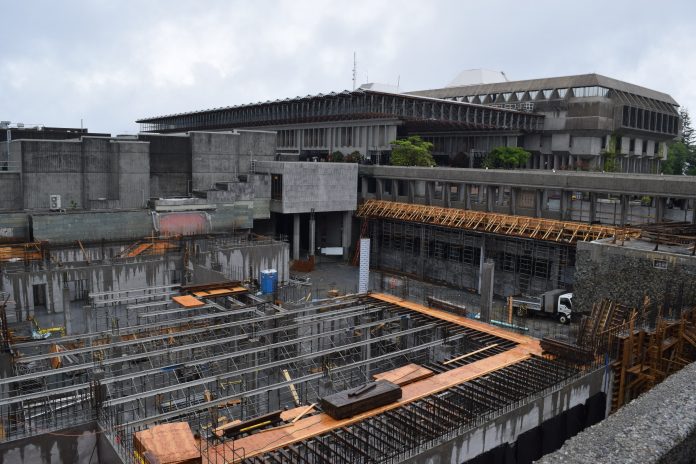
The Student Union Building is currently under construction and is scheduled to be completed in fall 2018.

Editor’s Note: As an independent student society, The Peak Publications Society participated in the process initiated by the Simon Fraser Student Society to express interest in organizational space in the Student Union Building. The Peak Publications Society is no longer pursuing office space in the Student Union Building and does not have an interest in the process. The coverage in this article undertaken by a member of our editorial team is not influenced or informed by the non-editorial activities of The Peak Publications Society.

On-campus student societies including campus radio station CJSF, the Simon Fraser Public Interest Research Group (SFPIRG), and Embark are speaking out after being allegedly denied space in the up-and-coming Student Union Building.

The trio of independent student societies says that they were recently informed by the Simon Fraser Student Society (SFSS) that their bids for organizational space in the Student Union Building were unsuccessful. The decision has raised concern that some of the societies will have to move off campus next summer.

“This denial has caught us by surprise, and we are very confused, bewildered, and disappointed by this decision,” said Craig Pavelich, the communications director for SFPIRG, in a statement. “We don’t know what to do, so we will be exploring our options.”

The SFSS put out a call earlier this semester for student organizations to state their interest in office space in the new Student Union Building. At the time, SFPIRG and CJSF told The Peak their organizations could be left homeless when their leases run out and they must vacate their offices in the Rotunda in June 2018.

READ: Student groups struggle to find space on campus

In response to the concerns, the SFSS informed The Peak on the afternoon of December 1 that the choice not to provide offices in the Student Union Building to the societies was due to extensive interest from clubs and student unions and limited openings in the new building. The SFSS has instead offered to lease SFPIRG and CJSF space in Forum Chambers and The Undergrounds in Maggie Benston Centre, according to SFSS President Hangue Kim.

“Embark is currently housed in the West Mall Complex and could request that the university continue to lease space to them as they are not at the same risk of losing their spaces as the other external groups,” he added.

The Peak did not receive comment from SFPIRG and CJSF regarding the alternative office spaces by the time of publication.

Embark seeks answers at board meeting

The issue was brought up by Embark during a presentation about their organization at the SFSS Board of Directors meeting on the morning of December 1.  

“I think the purpose of our meeting today is to have a dialogue with the SFSS board about the recent decision to not invite the other student societies [into] the Student Union Building,” said Dima Lavrentyev, the chair of the board of directors for Embark.

“We are not here to ask you to change your decision, we are here to gain a better understanding from the board members about how this decision was made and why. It is important for us because we want to gain more clarity, something that we haven’t been able to get in the past.”

Lavrentyev added that Embark was involved with sustainability consultations for the Student Union Building and asked the board what criteria they used to determine who was eligible for space.

Kim replied that the board was not able to answer the questions during the presentation.

“I’m going to just stop it there,” Kim said, adding that the board was under the impression that Embark would just be presenting about their organization. “Until we have a discussion as a board, we can’t answer really any of those questions.”

In the meeting, vice-president university relations Erwin Kwok noted that the decision was pending board discussion and was not yet final.

Societies involved in project from beginning

The three student societies emphasised that they were involved in the process of consultation around the Student Union Building in its early stages and many were shocked to find out that they would not be allocated a suite in the new building.  

“The SFSS and BuildSFU have striven to include us in the SUB project, from before the BuildSFU levy was even passed by referendum, and throughout the consultation and development process,” stated Pavelich. “The SFSS and SFU led us to believe that there would be space for student organizations in the SUB.”

The student levies for the $55 million project were approved in a referendum in the spring of 2012 though construction only started in 2016.

“This [decision] surprised and disappointed us as we have participated in various consultation processes for the project since [the] very beginning,” said Magnus Thyvold, CJSF station manager, in a statement. “We are still trying to determine what to do next and what [our] options are.”

The other organizations housed in the Rotunda, including the Women’s Centre and Out on Campus, are under the umbrella of SFSS services and will be guaranteed space in the Student Union Building.

SFPIRG and CJSF lease their current office spaces through the SFSS, but their leases are scheduled to run out next summer and the suites will be returned to the university when the Student Union Building opens sometime in fall 2018.

SFSS prioritizes student clubs, unions

The SFSS determined after receiving a large number of submissions that four out of the five available suites in the new building would be for undergraduate clubs and student unions to use, but the allocation of the last suite is still being finalized, according to Kim.

“During the design phase of the SUB, the SFSS suggested that existing campus groups would have a strong case to be made to continue leasing space from the SFSS. Space was never promised to these groups and no agreements were signed to provide space in the SUB,” he said.

“We also recognize that clubs and student unions do not have the financial capacity to lease space elsewhere, whereas external groups collect student fees which could be allocated to leasing space elsewhere,” continued Kim.

The SFSS reported that some of the factors considered when choosing how to assign the office spaces in the Student Union Building was the impact on undergraduate students and the student experience. The fact that the other student societies are not part of the SFSS was a factor in the decisions, according to Kim.

In the board meeting, the SFSS indicated that it had asked the independent societies to keep their discussions confidential until use for all the spaces was determined, something that Lavrentyev said was not communicated to Embark.

Erin Daly, the executive director at Embark, told the board that they were also under the impression that the decision about who received space in the Student Union Building was finalized.

However, Kim, who requested that the conversation be continued privately, insisted that no final decision had been made.

In the afternoon on December 1, Kim told The Peak that the SFSS has informed clubs and student unions that they will be prioritized for office space and are waiting on some responses from the independent student societies before assigning the spaces offered in Maggie Benston Centre.

“We recognize the ongoing need for more space on campus and are doing all we can to use our SUB office space as effectively as possible,” said Kim.

SFPIRG and CJSF stated that they will be continuing their discussions with the SFSS and the university next semester.

Update on December 11, 2017: In a response to The Peak, CJSF station manager Magnus Thyvold confirmed that the radio station was informed that there may be space available in Maggie Benston Centre.

“However, we were also told the SFSS is waiting to hear from SFU about whether those spaces could be suitably renovated with respect to accessibility and the floor space required to do what we do,” Thyvold said in a statement.

“As student-funded, student groups on campus, we were invited to participate in the development and design process for the building from the beginning, and have been under the impression that spaces in the new SUB were being developed with our groups in mind,” Thyvold added.

“Our members are SFU students and therefore it makes sense for us to remain on campus because it’s where we can best serve them. The University has told us they see providing space to student groups as the responsibility of the SFSS and so we find ourselves in this pickle without practical alternatives.”

Dear DC Comics: the Amazons are warriors, not sex icons

2


One sticky-hot summer day, my best friend and I walked out of the movie theatre and sat in her car finishing our candy and gushing about how we
finally had a superhero movie with a female superhero.  

Ah, Wonder Woman. Women played an instrumental role in your creation and casting. You were interesting, with a punchy script, an awesome soundtrack, and killer action scenes. Better yet, Batman wasn’t there for once. Though they doubted you, Wonder Woman, you are officially the highest-grossing superhero origin movie of all time, you and your $821.74 million box office sales.

I can’t believe DC ruined such a good thing.

Now part of the DC cinematic universe, Wonder Woman appears in Justice League (released November 17). Though Gal Gadot reprises the role, the Amazons themselves have changed. More precisely their costumes, which now leave the Amazons’ stomachs, shoulders, and legs barer, as well as draw more attention to their breasts.

It’s an uncomfortable throwback to Princess Leia’s slave bikini, which Carrie Fisher hated. And it hasn’t escaped anybody that the transition coincides with new male directors and costume designers . . . Though the actresses portraying the Amazons have spoken out against the backlash, saying that they were not made to feel more sexualized or in any way uncomfortable onset, I’m still displeased.

Here’s your classical canon. In her book The Amazons: Lives and Legends of Warrior Women across the Ancient World, historian Adrienne Mayor follows the trail of warrior burials and pottery shards that led the Ancient Greeks to imagine an entire nation of women warriors.

The DC canon is that the Amazons of Themyscira are an immortal, ethnically diverse race of warrior women, blessed by Olympian goddesses and birthed from the souls of women who unjustly died at the hands of men. Wonder Woman first appeared in 1941, at a time when women were taking their place in voting booths, factories, the war effort, and society as a whole.

Her creator, Dr. William Moulton Martson, was a noted feminist in a polyamorous relationship with two women, and a psychologist deeply concerned with how Americans viewed violence and women.  He noted that “the only hope for civilization is the greater freedom, development, and equality of women in all fields of human activity.”

Changes in Wonder Woman’s costumes over the decades reflect superheroes’ ability to mutate and reflect social change, including a shrinking hemline in the ‘60s and ‘70s as first-wave feminism took off. A historiography of Wonder Woman reads as a parallel to the history of feminism, which is why this armour change is so upsetting.

Sure, Spider-Man’s suit changes from movie to movie, but that’s by a hair, not in design, intention, or colour scheme. The new Amazonian armour seems especially foolish when costume designers have already noted that the boob-cup encrusted breastplate design would counterproductively direct the pressure on your chest so that in the event of a hit or a fall, your sternum would shatter.  

Physics aside, this armour is sexist. Yes, a woman has the right to wear and present her body however she wants. But we’re in a world where women are overly sexualized and denied agency and control of their own bodies, as the survivors of sexual violence and harassment who are stepping into the public light show. Besides, the Amazons are, shockingly, not real. The image onscreen is not their own; it is a male creator’s projection.  

What I appreciated about the original armour design was that it prioritized the Amazons’ warrior aspect. Everything from the material used to the shape of the armour referenced Roman armour, and its design allowed for and enhanced their fighting style. This new armour showcases the powerful and athletic builds of the Amazons, but would leave them extremely vulnerable in battle. Their greaves have shortened, their arms are bare, and nothing protects their groins.

This change is not practical, and it shifts the focus to the Amazons’ femininity. Though this femininity is an extremely important part of their characterization, journey, and history, it should not come at the cost of their warrior nature.

After this, I don’t want to hear any more complaining from superhero movie fans when characters are recast with new races or sexualities — à la Sam Wilson as a black Falcon. Don’t throw consistency in the face of progressive productions that reflect contemporary realities, when two movies can’t maintain the same costume design for the same group of women for a year.