Home Blog Page 640

New student-eating bird discovered at SFU

0
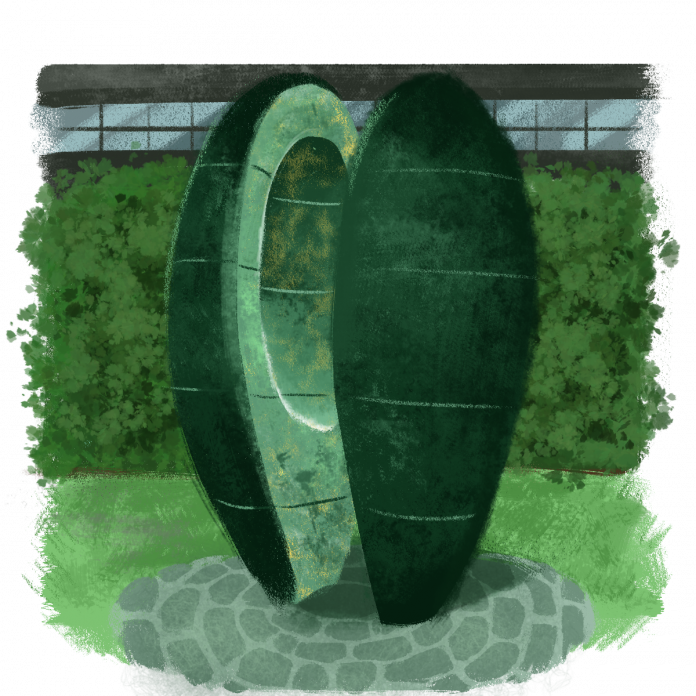
ILLUSTRATION: Tiffany Chan

By: Jennifer Low, Avian Correspondent

Ever wonder why SFU’s architecture is filled with dark tunnels and hallways? Or what the heck the avocado/egg in the AQ really is? Well, world-renowned researcher and scientist, the one and only Joe King, reveals that his team’s shocking discovery of a new addition to SFU’s fauna may be the answer.

Dr. Joe King and his team have found evidence of a new species of bird that has apparently inhabited Burnaby Mountain and SFU’s campus since the first few weeks of the school’s construction. Based on substantial DNA tests, it is revealed to have hatched from what SFU students have always assumed was merely an egg-shaped statue.

According to King, the newly identified animal is found only on Burnaby Mountain due to the ideal elevation level. The organism has left scientists puzzled for years, owing to its elusive behaviour and flight patterns. Not one to fork over hard-earned cash for outrageously priced food, the animal subsists off the koi fish found in the AQ’s reflection pond and first-years who do not know the hallways well enough to remain indoors to get to class.

The animal’s dietary habits have landed the new species with the name: studiosum comedenti or “student eater.” According to University of Lou Decruss geneticist Bill Lowney, who has been studying birds of prey for over a decade, the creature is a member of the vulture family. “The students are basically dead inside, so that makes this thing a vulture, doesn’t it?” he states.

When asked if SFU will still remain open in light of this discovery, the team and government officials assure the public that the creature, though dangerous, will not impact the operation of the university.

“SFU was built to be a mountain fortress,” says Howard I. Noh, an SFU representative.  “There’s no use hiding that fact any more . . . the architects  were warned that there could be something . . . something lurking on the mountain and thus the building came to be what it is. It was always assumed [that] there was something on the mountain, but with no hard evidence, there was no reason to why a school shouldn’t be up there. Even now that they have identified the studiosum comedenti, the school will remain open . . . so what if a first-year gets carried off every now and again? We get hundreds of applications daily!”

Despite asserting that professors are doing all they can to keep students safe by giving them essays, assignments, exams, and long lectures to keep them indoors as long as possible, Noh recommends that students refrain from wearing brightly coloured clothing and opt for the more generic dark grey hoodies that can be purchased from the SFU Bookstore to stay safe.

Dr. Candice B. Fureal, an educator at SFU, recalls giving a three-hour lecture and requiring her students to attend tutorials and complete online assignments just to ensure their safety. “I do what I can!” she states in an emotional interview. “I would give them more work if I could!  

Fureal is not the only one looking out for students’ well-being; professor Mark Hardy spends extra time to make sure his tests are as difficult as possible to ensure his students spend more time safely in the library than in the dangerous outdoors.

“I have this theory,” says Hardy, “that the Bird is more likely go after students with higher GPAs because if you’re going to eat a student, why wouldn’t you go after the best and brightest? I know that theory hasn’t been tested yet, but I like to lower my students’ GPAs just because I care!”

The animal is described as being one of the largest flying birds in existence. It is an effective hunter with a sharp, pointed beak and talons, and the ability to camouflage itself amongst its surroundings in order to sneak up on prey. The studiosum comedenti possesses a well-developed sense of smell that enables them to seek out fresh blood. They are capable of very fast flight for several hours at a time and seldom hang out on the ground. The bird is an expert mimic and is discovered to be particularly good at mimicking the sound of the university’s fire alarm, much to the annoyance of students living in residence. Busting yet another mystery of SFU’s Burnaby campus, the vibrations given off from the bird’s flapping wings is credited with disrupting cell and Wi-Fi service in all areas of the campus.

“The wings move tremendously fast,” King explains, “Faster than even that of a hummingbird . . . and with its immense size, the vibrations can cause some serious disruption to digital signals.”

After years of research and blind hope, King is happy to finally have undeniable proof of the creature’s existence.

“I was really struggling,” King confesses. “For years people said I was crazy, but I knew there had to be a reason for the lack of fish in the koi pond, the strange, unknown piece of public art, and why the university looks like a government facility! I just knew it!”

Studies of the bird’s genetic makeup suggests that the studiosum comedenti egg may have been laid several hundred years ago. Due to the cement-like fossilization of the egg, scientists have concluded that the creature may have taken years to hatch, which may be why its detection has taken so long. Despite the fact that these groundbreaking discoveries have offered some answers, what we know about the studiosum comedenti is still limited. King and his team are excited to take on the challenge.

SFU students help draft Canadian youth policy

0
(Chris Ho / The Peak)

By: Nathaniel Tok, Peak Associate


Earlier this year, SFU students Pallvi Sehijpaul and Leejoo Hwang participated in The Canada We Want Conference series in Ontario to help the federal government develop Canada’s first youth policy.

     The brainchild of Prime Minister Justin Trudeau, who is also Canada’s Minister of Youth, the youth policy is intended to give youth a voice which can help guide government policy and create meaningful change for youth in Canada. Under the policy, youth are defined as those 15 to 24 years old.

     According to Trudeau, “This initiative is about making sure young Canadians from all walks of life, across the country, can have their say on what the Government’s priorities should be for youth. The youth policy for Canada — built for youth and by youth — will make sure that their important perspectives guide our way forward.”

     The policy will examine issues faced by Canadian youth and look for ways to resolve those issues to support youth. According to Hwang, the policy aims to “give youth a voice, give them a sense of responsibility, [. . .] just to get youth involved.”

     The Canada We Want Conference was the largest youth consultation process in Canada and had participants examine a wide range of topics from mental health to truth and reconciliation to how food is marketed to youth.

     “We came together across Canada,” Sehijpaul said. “There was enough representation from everywhere. There was a lot of voice from the Indigenous population, and that was meaningful because often we don’t hear their voices. We all contributed our ideas and thoughts around each topic and how they are reflected in our communities.”

      According to Sehijpaul, each group would “filter the major themes of the problem and [come] up with solutions with ways to fix those problems on the national and local level. We came up with 10 recommendations.” The conference allowed participants to talk through their ideas about the various topics to governmental and business representatives. At the end of the conference, members presented the issues faced by youth and their possible solutions to decision makers from the government and the business sector.

     Students unable to attend the conference are encouraged to give feedback on the policy online at youthaction.ca; the website also lists various events around the country that are being held to allow youth to enter into dialogue with the federal government. Moving forward, Hwang and Sehijpaul are aiming to have local consultation meetings on SFU campus to encourage other SFU students to participate in the process.

     Sehijpaul believes the youth policy will benefit youth and it will “create a foundation for youth to thrive.” She encouraged others to get involved, saying “your voices matters and is taken into account.”

Clan go 1–3 in crucial four-game series against Northwest Nazarene University

0
With a win and a loss, Jessica Tate is now 4–3 on the season. (Photo courtesy of SFU Athletics)

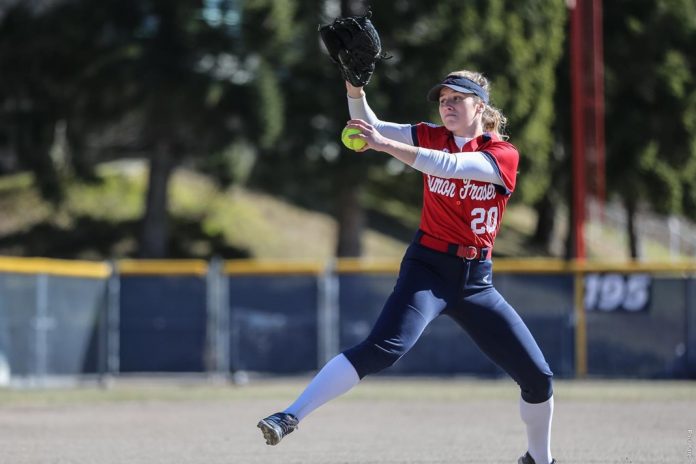
After struggling on a road trip in California from March 23–25, SFU’s softball team’s road woes continued as they travelled to Northwest Nazarene University (NNU) this past weekend. The Clan, who came into the weekend as second in the conference with a dominant 8–4 conference record, have now fallen to 9–7, placing them behind Northwest Nazarene for fourth place in the Great Northwest Athletic Conference (GNAC) by winning percentage. A win in the first game of the series indicated that SFU was back to its winning ways, but the team went on to get swept in the next three games.

Game 1: 2–0 for SFU

Obviously the highlight of the weekend for the Clan, game one was won by fantastic pitching for SFU. The effort was done by Jessica Tate and Alia Stachoski, who pitched four and three innings each, respectively, combining to only give up four runs in the shutout. For Northwest Nazarene, however, freshman pitcher Jordan Adams managed to lower her GNAC-leading earned-run-average to 1.99, as both runs for the Clan were unearned. SFU managed only three hits in the complete-game effort, but made them count. Victoria Saunders got the hit of the game, hitting a double to lead off the fourth inning before scoring on an error. In the sixth inning, SFU added on another one, as Hailey Gearey hit a single, moved to second on a sacrifice groundout, moved to third on a sacrifice bunt, and scored on a throwing error. For a game in which the Clan struggled with offence, great pitching and a couple errors from their opponent would make the difference.

Game 2: 7–8 for NNU

Game two was the exact opposite, as both teams did a great job of hitting, with Northwest Nazarene narrowly beating out SFU. After shutting out their opponents in game one, the Clan gave up five runs to the Nighthawks in the first inning, and were playing catch up from then on out. After being down 8–1 heading into the sixth inning, however, SFU managed to make a game of it. In the sixth inning, the team scored six runs on six hits, with doubles from Gearey, Hannah Boulanger, and Taylor Lundrigan being the big hits. Despite this, NNU starter Rae Young came back to pitch the seventh and final inning and managed to shut out the Clan.

Game 3: 0–3 for NNU

After giving up zero earned runs in game one of the series, Adams came back for the Nighthawks to pitch a complete game gem in game three. She gave up only three hits in the contest, while striking out eight. This marks her eighth consecutive start giving up one earned run or less, as she continues to dominate the National Collegiate Athletic Association II. For SFU, Tate also pitched a fantastic game, giving up only five hits. Her one mistake came in the fourth inning when she gave up a two-run homerun to Shelbie Martinez. She is now 4–3 on the season.

Game 4: 2–8 for NNU

The finishing touch on a disappointing weekend, hardly anything went the Clan’s way in game four. The only bright spot was the fourth inning, where SFU scored two runs; one off a double by Amanda James, and one off of a Kate Fergusson single. For NNU, they scored three runs in the third, two in the fourth, and put the game out of reach with a three-run homerun in the fifth. Stachoski started, giving up five runs in 4.1 innings of work. She is now 8–8 on the season.


After nine straight games on the road, the Clan will happily return to Terry Fox Field next weekend. They will play a double-header against Saint Martin’s University on Saturday, April 7, before playing a double-header against Central Washington the next day. Saint Martin’s sits right behind the Clan with a 6–6 conference record, while Central Washington is first in the GNAC with a 9–3 record.   

SFU track and field impress at two events in California

0
Ally Ginther ran her first 5,000 metre race for the Clan after transferring from Washington State. (Photo courtesy of SFU Athletics)

This past weekend, the SFU track and field team travelled down to sunny California to compete in the San Francisco Distance Carnival and the Stanford Invitational. The trip would prove to be very successful for a handful of the SFU distance runners, as Aaron Ahl, Reta Dobie, Ally Ginther, Oliver Jorgensen, and Addy Townsend all recorded top times.

The feel-good story of the weekend was certainly that of Jorgensen’s. He has battled leg injuries for the past two years and was awarded the Rick Jones Award for Courage at the SFU Athletics Awards Show earlier this week. Saturday, then, was his first 3,000 metre steeplechase race since injuring his ankle last summer. As if that wasn’t enough, he blew everybody away by running seven seconds better than his previous personal best time with a time of 8:58.72.

In what was a tight race for first spot in the heat, Jorgensen finished third, just one second behind heat winner Ricardo Estremera from Puerto Rico. He finished fifth out of the 82 total competitors in the event. Perhaps most importantly, however, Jorgensen placed himself in the National Collegiate Athletic Association (NCAA) II top ten, as his time was the sixth best time ran in the nation this season.

In the same event, Ahl finished with a time of 9:15.28. This time now has him ranked 14th nationally, although he finished 20th in the event. This is due to the event being an “invitational,” meaning that runners from both Division I and outside the NCAA were also competing.

On the women’s side, Dobie also ran a personal best in the event. She won her heat comfortably, leading the pack of runners for the final three laps of the race. With a time of 10:40.12, she is now ranked seventh in the NCAA II for the 3,000 metre steeplechase.

Ginther, a redshirt senior who transferred from Washington State, ran in her first 5,000 metre race for SFU this weekend. She finished 14th in the event with a time of 17:10.90, which gets her barely inside the top 10 in the nation at tenth.

As can be expected, Townsend continued to impress in a SFU uniform as she competed in the 1,500 metre. Her time of 4:26.94 placed her fourth in the heat, but more importantly, sixth in the event nationally. Her best event is still the 800 metre, in which she is ranked fifth nationally.

SFU’s next event will be next weekend, as they host the Emilie Mondor Invitational. Catch all the action on Terry Fox Field on Saturday, April 7.

A student’s experience at the Kin Games 2018

0
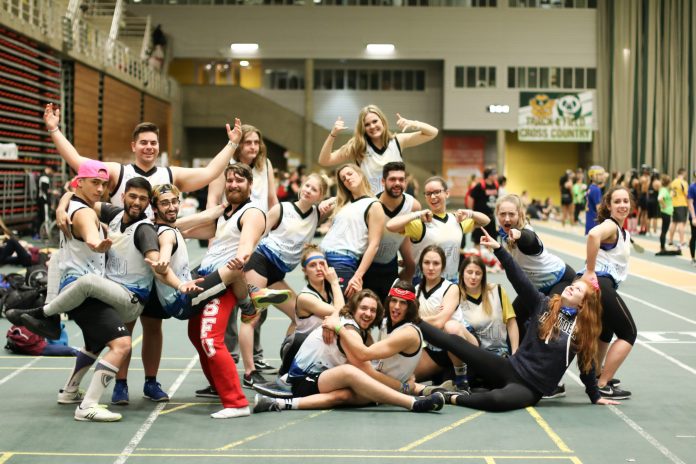
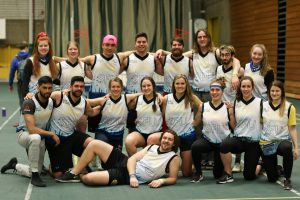
“Kin games is love and friendship. It is one weekend where you make 600 new best friends; this is exactly what the world needs now.” – Malcolm MacRitchie (Kin Games rookie–top row, fifth from left). Hannah Davis / The Peak

By: Hannah Davis

The Kinesiology Games (Kin Games) is an annual kinesiology conference which brings university students together for three days to meet new friends, network, learn, compete, and promote their respective schools’ kinesiology programs. Universities from across Canada send teams composed of students to participate in the games and proudly represent their schools. This year, the University of Alberta was the Kin Games’ gracious host, meaning us West Coast kids got to experience Edmonton’s prairie cold. There were 32 teams from universities across the country who entered the games, and Simon Fraser University was one of them.

I can proudly say that SFU REPRESENTED at Kin Games. The team brought home first in the dance category, second in the spirit category, and third place overall, meaning our university was elite amongst 31 competing schools. The trophies and past jerseys are displayed in the kinesiology wing, by the Kinesiology General Office, so anyone can go and have a look at them. While it is incredibly significant that the team could proudly take home three wins, it becomes even more significant when considering this team’s origins. The team has progressed immensely since its humble beginning five years ago. While talking to Erin Williams, one of the captains of this year’s team, she said that it was initially challenging to build a substantial team each year that could consistently attend the event, and now look at us! We have become a true contender at the Kin Games.

“Kin Games is a fantastic opportunity to meet friends on campus and across Canada. I’m lucky I got to be a part of a team like this, especially at a school like SFU where it can be hard to make friends.” – Lucas Zayonc (Kin Games veteran). Hannah Davis / The Peak

This was my first year participating in the Kin Games, and people were right when they told me that the experience would surpass any expectations I had. Upon arriving in Edmonton, I immediately felt welcome and included at the event. The team of dedicated volunteers and staff who ushered me in on the first day were friendly and inviting, and acted as an indication of what the rest of the conference would be like. There was something really amazing and almost indescribable about the way in which the event seems to foster an intense sense of community, or more accurately, KINmmunity. To exemplify this, some taglines of the weekend were: “you’re a beauty,” “you’re all tens,” and my favourite, “we are all best friends.” Sometimes entire groups of people would break out chanting the latter, which felt entirely reminiscent of summer camp, but better and with less mosquitos. Team members also traded gear; hoodies, T-shirts, rubber wristbands, hats, and any other variation of their school’s swag, a practice which further emphasizes the conference’s ever-present promotion of community.

“[Kin Games was the] best weekend of my university career. [I’m] so lucky to have been apart of such a positive and hilarious group of beauties.” – Alison Bogar (Kin Games rookie, third from left). Hannah Davis / The Peak
At the conference, there were four categories in which teams could be awarded points: sports, dance, academics, and spirit. The points scored in each each category ultimately determined the final rankings of the competition. This year’s sports were unfamiliar to most participants: sepak takraw (armless volleyball), Aussie rules football (fancy Australian rugby), hurling (Irish lacrosse) and Quidditch (Harry Potter sport), which ensured that each competitor would be on a relatively even playing field upon entering the competition.

Each school also prepared a dance to perform, and were scored based on a number of components including creativity, technique/execution, difficulty, and presentation quality. SFU’s awesome choreographer, Katriana Wong, included waaking and krump into the team’s choreography. To get an understanding of what this means, check out the dance video here.

The spirit category included a wide range of challenges, from donating to a charity (SFU’s Kin Games team donated clothing and other items to the Developmental Disabilities Association), to making up chants, to taking photos with bears at the University of Alberta campus, to overall being a positive and encouraging group of people while participating in all conference events. Academics consisted of each team attending a variety of lectures, then having the team collectively tested on their knowledge at checkpoints during a 2.5 km run/race. Never have I felt so much pressure to pay attention during lecture.

The SFU team held weekly practices to rehearse and learn the dance, as well as go over sports rules and discuss spirit challenges. While the primary function of these weekly meetings was evidently to prepare for Kin Games, they also acted as an outlet and distraction from the inherent stresses of being a university student. Erin Williams, one of the captains and veterans of this year’s team, exemplified this idea in sharing that “it’s really easy to get consumed in school stress, especially in upper-division courses, and Kin Games has always been a way for me to get away from that once a week. It’s shown me how important it is to find balance, and also introduced me to some great people to look up to along the way.”

Certainly a great experience for the SFU Kin team! Hannah Davis / The Peak

Overall, the support each person had for each other, for their team, and for teams from other universities was staggering. As one who may not always step out of her shell upon meeting new groups of people, I felt included and encouraged at all times. I feel so happy and lucky to have had the opportunity to participate in the event, and to have been able to get to know such an incredible group of people. Kin Games veteran Konrad Maludzinski said, “Kin Games has made my university experience more fun and meaningful than I could ever imagine,” which emphasizes the profound effect the conference has on individuals. While both rookies and vets of the team have their own particular experiences of the Kin Games, the heart of what each person communicates seems to remain similar: the love, support, and feeling of community is real at Kin Games.

World News Beat

0

By: Nathaniel Tok, Peak Associate


Last male northern white rhino dies

Sudan, the last male of his subspecies, has died at age 45 in Kenya. He was euthanized due to age-related diseases which affected his muscular-skeletal system and his skin. Scientists have stored his genetic material and are hoping that in vitro fertilization can keep his subspecies alive. His death leaves only two female northern white rhinos in the world. Previous attempts to get Sudan to produce offspring had failed, so Sudan was placed on Tinder where researchers hoped to raise funds for fertility treatment. The northern white rhino subspecies in Africa was decimated by hunters in the 1970s and 1980s.

With files from Reuters.


Fatality causes Uber to suspend self-driving car tests

Uber has stopped self-driving car tests in North America after a woman was hit by a self-driving car and killed in Tempe, Arizona. This is not the first self-driving car accident, but it is the first fatal one. Self-driving cars are believed to be able to help prevent road accidents and to be the future of driving. Many US states and automobile firms are investing heavily in the hopes of using the technology. Uber first started trials of the self-driving cars in Pittsburgh in 2016 and was also conducting trials in San Francisco and Toronto.

With files from BBC News.


Canada unveils new gun control bills

Canada’s federal Liberal government is introducing new gun control laws which could include increased background checks and screening. Another proposal would require gun vendors to keep records of gun inventory and sales. This legislation follows from a campaign promise to make guns harder to acquire. Crime in Canada is trending downward, but gun-related crimes are rising. Though gun-related crime rates are still lower in Canada compared to the US, they are higher than Europe and Australia. There were 2,465 crimes committed in Canada involving guns in 2016, a 30% increase from three years prior. Gun control is a controversial issue in Canada with a large rural population favouring the use of guns and gun control advocates arguing for tougher laws.

With files from BBC News and CBC News.


Chinese capital issues third smog warning

Beijing issued its third major smog warning this year as the central part of the Beijing-Tianjin-Hebei region is scheduled to endure medium to heavy air pollution. The Beijing environmental protection bureau issued an orange alert, the second-highest level in a four-level system, which requires factories and heavy industry to reduce production by 30% to 50%. This restriction will affect over 700 firms in the capital. The highest warning level in the system has not been used this year. Beijing was recently recognized as the biggest reducer in average pollution from October to February among 28 northern Chinese cities.

With files from Channel NewsAsia.

Pacific Rim Uprising is an action-packed sequel that fires on all cylinders

0
(Image courtesy of Universal Pictures)

By: Jonathan Pabico

If you have to watch one action film before summer break begins, I highly recommend Steven S. DeKnight’s Pacific Rim Uprising. DeKnight ups the ante as director, surpassing the previous film, Pacific Rim, which was directed by Guillermo del Toro. This sequel is a breath of fresh air with its vibrant visuals, fast-paced perils, and thrilling spectacles. With cooler giant robots (Jaegers) and more deadly alien monsters (Kaiju), the film is a fitting new instalment to an enthralling franchise.

     The film’s stylized action scenes are relentless and pure fun from beginning to end. Backed by breathtaking visuals and elevated by a powerful soundtrack, these action scenes redefine colossal — especially during the film’s final fight. The movie’s fierce and frenetic bouts get better, and there is never a dull moment. Every Jaeger’s use of their unique weapons and sophisticated designs adds to the inventive quality of the movie’s action. With ruined cityscapes as an intense battleground, the film offers satisfying, but brutal grudge matches between the film’s Jaegers and Kaiju.

     However, DeKnight crafts this film as more than just destructive fights between giant robots and alien beasts. Behind the action extravaganzas are the underlying themes of corporate interests, militarism, the consequences of war, and the long-term impacts of loss, that drive the narrative. DeKnight also shapes Pacific Rim Uprising as a coming-of-age story by focusing on growth as the movie’s central theme. He offers an Ender’s Game appeal through the film’s teenage characters that strive to become the world’s future saviours.

     The movie’s only flaw is the absence of Charlie Hunnam, which creates a void in this sequel. However, John Boyega (best known for Star Wars: The Last Jedi) is superb as the film’s newest lead. Portraying Jake Pentecost — son of Stacker Pentecost from the first movie — Boyega’s performance is more than enough to compensate for Hunnam’s absence. He embodies DeKnight’s theme of growth by portraying his character as a rugged youngster, alienated from his family, but eventually becomes an aspiring Jaeger pilot in a war-torn world.

     Boyega also has great repartee with the film’s cast. He and Scott Eastwood have a comical, but mild rivalry as the film’s main Jaeger pilots. However, Boyega’s sibling-like relationship with newcomer Cailee Spaeny is more amusing and provides the story with energetic heart. If that’s not enough, Rinko Kikuchi is back as Mako. While Kikuchi’s role is minimal in this movie, she portrays a matured Mako, and her brief scenes with Boyega evoke a relatable family dynamic that humanizes them as more than just characters raised in a world of iconic robots and monsters. With believable characters and a commanding cast, Pacific Rim Uprising is a bold, entertaining sequel.

Best hikes in Vancouver

0
Rumour has it Garibaldi Lake is actually just Cool Blue Gatorade. Kelsey Nikl / The Peak

By: Andrew Ringer and Eva Zhu


Andrew’s hikes:

Garibaldi Lake

Difficulty: Intermediate

Time: Five hours

Camping: Yeee

Driving time from SFU Burnaby: 1.5 hours

No matter how blue you understand water to be, you will still be surprised when you see Garibaldi Lake. IT IS BLUE . . . or turquoise, depending on how good your colour game is. To reach this holy water basin, however, you are going to have to hike. This isn’t your average stroll to your spin class, but it isn’t as hard as walking up the Saywell Hall staircase either. Walk around the lake and take in the mountains, flowers, water, and Instagram picture opportunities. Definitely doable in a day, but I would recommend spending the night so that you can hike Black Tusk the next day.

Nothing but true meaning for as far as the eye can see. Kelsey Nikl / The Peak

Black Tusk

Difficulty: Peak difficulty

Time: 11 hours (from the parking lot)

Camping: Yeee

Driving time from SFU Burnaby: 1.5 hours

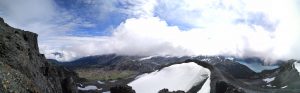
This hike is also in Garibaldi Park, and is the most exciting one the park has to offer, although it is also the most difficult. My girlfriend bought me hiking boots for this one, because I wanted to do it in New Balance sneakers and the idea embarrassed her. She was probably right, as per usual. However, this highlights the importance of holding out, because my hiking boots are sweeeet. The hike is not very difficult if you stop where the signs tell you to, but if you’re going to hike to the bottom of a volcano, you might as well hike to the top. Watch out for falling rocks, blistering winds, lava, and yuppies, but enjoy the beautiful views and actually accomplishing something for once.

Rest in pieces, pita bread. Kelsey Nikl / The Peak ​

Lindeman Lake

Difficulty: Intermediate

Time: Two hours

Camping: No

Driving time from SFU Burnaby: Two hours

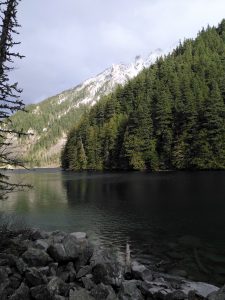
In order to truly feel out in the wild, this hike may be for you, as it is relatively quiet compared to many in the Vancouver area. At around the one kilometre mark, you will see a rockslide from many years ago that buried the original blueprints for the SFU Burnaby campus, leading to a quick redraft and the school we have today. As you get to the lake, you will notice many more boulders that are perfect to sit on. DO NOT drop food, however, as you may find yourself trying to fish out pita bread from between the rocks as I did. The expiry date on the package isn’t until 2019, so go exploring and get a free snack.

2000 metres up never looked so good. Kelsey Nikl / The Peak

Quarry Rock

Difficulty: Weenie

Time: 1.5 hours

Camping: No

Driving time from SFU Burnaby: Half an hour

If you want a hike that you can carry your dog on, this is it. But also, if you want a hike that you carry your dog on, get a new dog. The hike is easy, it’s green, and it’s an Instagram machine. Once you reach the top, you have a clear view of Burnaby Mountain and the grey cathedral that rests upon it. Bring a pair of binoculars, and you may be able see a Guadalupe burrito being eaten by an SFU student across the water. Bring a Mason jar, and you may be able to fit in with the local town folk. The one issue for the hike is parking, but true adventurers will walk or bike.


Eva’s hikes:

Gear Jammer, Mel’s Trail, Trans Canada Trail, and Cardiac Trail

Difficulty: BPK 110  

Time: One hour

Camping: SFU residence townhouses

This hike is not for those looking for an easy walk between classes. On this hike, you’ll need to be in fairly good shape if you want to be able to descend the Gear Jammer — a jagged and rocky path that is not for the faint of heart — and still have enough in you to climb the rest of the hike. Mel’s trail is where you’ll start feeling the burn, but don’t give up, because the views on the Trans Canada Trail that leads back to SFU are breathtaking! Look down and you’ll see acres of trees, green as they can be. Look up and marvel at the beautiful blue sky. Look ahead and you’ll be greeted with a breathtaking view of Burrard Inlet.

Gear Jammer, Function Junction, Powerline Trail, Trans Canada Trail, and Port Moody

Difficulty: MATH 100

Time: Two hours

Camping: Shell House

Strap on your hiking boots and bring a water bottle for this scenic route, because it’s a wild ride from start to finish. Instead of turning up onto Mel’s Trail after descending the easier half of Gear Jammer, keep going and take up the challenge of the steeper half. Do remember to take it slow so an ambulance won’t be in your itinerary. Your hard work will pay off as soon as you set foot onto Function Junction, because it’s all smooth sailing from there. As you keep descending down the Trans Canada Trail, look around you at all the other people who have decided to make this popular trail part of their day. Don’t forget to take a look at the magnificent cityline while walking the trail!

Poplar Trail and Nicole’s Trail

Difficulty: Grad school

Time estimate: 1.5 hours

Camping: Hamilton Hall

Only those who are extremely fit and skilled at maneuvering their way across a path made of nothing more than some rocks will be able to take on this hike. If you can barely walk in a straight line without falling down, this hike definitely isn’t for you. This hike is neither an easy route or a scenic route, but once you make it to the bottom of Nicole’s Trail, you’ll feel like a million bucks. When descending this hike, remember to take it slow, because accidentally putting your foot in a puddle of water might ruin this amazing experience for you. Take extra care when walking (or crawling, if you have the aforementioned balance problem) on top of the log, because falling would not be in your best interests.

Cardiac Hill, Trans Canada Trail, and Hastings Street

Difficulty: PHYS 190 (astronomy)

Time estimate: Three hours

Camping: N35 night bus

If you have the better part of a day off, why not grab a few friends, a picnic basket, and a portable speaker and conquer this physically non-demanding, but long, hike! You’ll get off to a steep and grueling start on Cardiac Hill, working your heart to its max as you make your way to the Trans Canada Trail. Fear not, though, because the hard part is over. Now, take a deep breath of the fresh mountain air, and continue your way on the rest of the hike. When you get to Hastings Street, congratulations, you’ve made it! We suggest stuffing your face with some pasta with your friends before heading back up, and unless you’re really up for the challenge of hiking back, consider taking the bus back home.

SFU students take the Zero Waste Challenge

1
Image courtesy of The Peak

By: Jessie Harper and Kimberly Huynh

Jessie’s story

My journey with zero waste living began while I was living in downtown Vancouver in a 180-square-foot apartment. I had a bar fridge, a tiny piece of countertop, and a sink. I did all my cooking on a hot plat

e or in a toaster oven. I was also a full-time student working 30 hours a week to support myself and living mainly off of debt, as many of us do. I had to be creative with my grocery shopping because if I bought too much, I wouldn’t be able to eat it all before it went off, or worse, it wouldn’t even fit in my fridge. Buying less packaged food helped save valuable fridge space. Another main reason I started to reduce my garbage was because my place was just so small and stuffy. I would take the trash out three times a week so it wouldn’t smell, and each time I was amazed at the amount of trash one person accumulated. One day, I saw an ad on Facebook for Nada, a zero waste grocery pop-up shop. It was only a short walk from my work, so I went after a shift. Transitioning to a reduced-waste lifestyle didn’t happen overnight, but I haven’t looked back.


Kimberly’s story

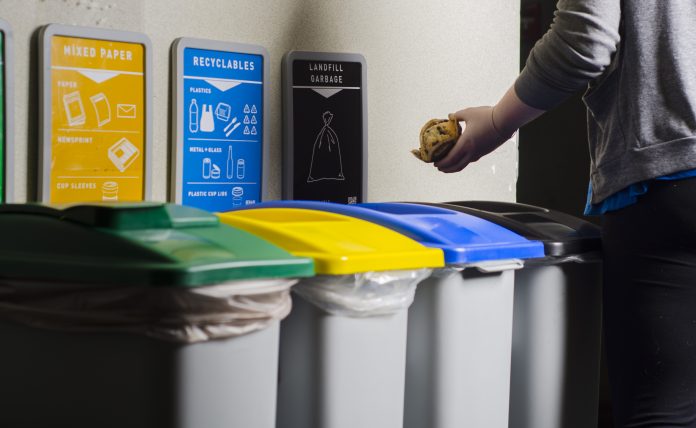
Trying to generate zero waste as an SFU student is rather difficult and within 24 hours; I failed. But honestly, I kind of expected this.

I’m generally the type of person to think twice before trashing something. I’ll always ask myself if there’s a way that I can cut down on waste, or if I can recycle or compost what I do need to get rid of. That said, I’m that person who gives people the look whenever recyclable or compostable objects are thrown straight into the trash. I just never understood why people carelessly threw things into the garbage when they didn’t have to.

When I started the Zero Waste Challenge, I thought that I would generally have an easy time. I thought that I would at the very least last a whole 24 hours without generating waste, but boy, was I wrong.


Jessie’s story: Starting the challenge

This weekend was the first time I’ve pushed myself to try and generate no waste at all. The main challenging thing about zero waste is that it takes a lot of forethought, something I generally lack. Being prepared is the number one way you can avoid generating garbage, because most waste is created for our convenience. Take away coffee cups, plastic cutlery, plastic bags, you name it. What it really comes down to is saying ‘no’ to a lot of things, and substituting the essential things with sustainable, reusable options. I discovered the impact of carrying a water bottle, having a set of cutlery in your purse or car, saying ‘no thanks’ to a straw in your drink, and choosing to refill a container instead of buying prepackaged food . . .


Kimberly’s story: Off to a rough start

I think it’s worth pointing out that a rule that I had set for myself was that both trash and recyclable objects were considered waste, but compost wasn’t. This definitely made the challenge a lot harder than I had originally anticipated.

Within the first few hours of my day, I had used paper. And thus, failed the zero-waste challenge essentially as soon as it had begun.  

Paper is probably something that we overlook in our daily lives as students.

I’m sure that there are many students like me who prefer to work with paper rather than the computer. I enjoy taking notes by hand on looseleaf or writing on lecture slides that I print out before class. Also, when taking notes on readings and what-not, I prefer taking notes on paper or writing my notes out on the computer and then printing them out later. I do this because I feel that I work best with paper; I retain much more information when I’m writing things out rather than when I’m typing them out. For students with a paper preference, a zero waste lifestyle seems impossible. As a side note, another issue with taking notes by hand is that I go through tons of pens and highlighters!

Additionally, many SFU classes require students to use paper; for example many professors ask that students hand in a hard copy of their assignments. If you think about it, that’s a lot of paper. I’ve had a handful of courses which require papers that are up to 20 pages. Think about it: 20 pages x 150 students in the class = 3,000 pages. SO. MUCH. PAPER. I personally have a stack of all hard-copy papers that I’ve had to hand in throughout the years just sitting in my closet gathering dust. Sigh.


Jessie’s story: Friday

I work full-time at an office and take classes online. I usually bring oatmeal to work every morning for breakfast. My office has cutlery, dishes, and mugs so I don’t need to worry about bringing them from home. For lunch, I brought a meal in a Tupperware container, but forgot about scaps . . . My office doesn’t have a compost. So I put the scraps back in my Tupperware and took them home to compost.

Another thing I’d forgot to prepare for was coffee. Yes, my office has mugs, but they only supply individual creamers and sugar packets, and despite having spoons, most people use disposable coffee sticks. I sacrificed my morning coffee.

After work, my husband and I went grocery shopping. This was probably the biggest challenge of the weekend because I usually always make compromises for perishable food. It’s essentially impossible to buy some things like cheese, yogurt, and frozen fruits without plastic in a regular grocery store. We purchased a lot of vegetables using cotton produce bags instead of the store-supplied plastic ones. I just wash these with our laundry and reuse. We purchased milk in a glass bottle, ginger beer in glass bottles, steaks from the butcher section in compostable butcher paper, and some Diet Coke in recyclable cans. Even so, this shop did accumulate a bit of garbage. There was a tag on the asparagus, the sticker holding the steak papers together, and the twist ties on the bunches of herbs. While the rules of this challenge were to see how long I could go without generating waste, I wanted to keep going and see how the rest of the weekend went.

In terms of cooking at home, this weekend we only used food that would create no garbage. We do our best to purchase everything possible from stores that allow refills or bring your own container, such as Bulk Barn and The Soap Dispensary.

Because this challenge was so short-lived, I didn’t have to face long-term items creating waste. Items like makeup, clothing, and shower products, that are all made of or wrapped in plastic, are the most challenging to sacrifice and change for me. People who can go a month without throwing one thing away are in a whole different ball park and I admire them from afar, for now.


Kimberly’s story: Pesky paper

It’s safe to say that I’ve come to the conclusion that a zero waste lifestyle is not plausible for students because of our dependence on paper. So, how can we minimize the use of paper? I’ve done the following things:

  1. I print my notes double-sided when I can and make sure that two to four pages are printed per sheet. As a bonus, I don’t know if it’s just how my brain works, but I feel that I retain a lot more information when I have two pages of notes per sheet printed because I don’t have to flip around pages as much. Printing like this also saves money since the library charges $0.11/page, which adds up! I could have saved so many trees (and my own money) if assignments didn’t require being printed a certain way. Unfortunately, most of my classes require APA citation, which doesn’t allow for two-sided printing.
  2. I usually use recycled pieces of paper when I study, like the blank side of used paper. You could also do this with flashcards, or make your flashcards out of scrap paper.
  3. I love using a whiteboard to study because I’m not throwing away paper. I just have to erase and then write whatever! There is, of course, the waste that the dry-erase pens create when they run out of ink, though.
  4. I use a piece of paper until I no longer can! I have a bunch of paper by my printer that has only one side used, so I’ll save it so that I can print (eventually) on the other side.

Above all, I think the most important thing that students can do to minimize the amount of paper they use is to think before they print. Do you really need to print something out? I know that I admitted to being one of those students that likes to work with paper, but the least I can do is make the conscious effort to minimize my waste as much as possible.

I’m interested to see if SFU students 50 years from now could avoid the paper waste as profs finish the move towards digitalization.


Jessie’s story: Saturday

On Saturday afternoon we were invited to our friend’s birthday party in a nearby park, and my husband suggested we ride our bikes and pick up a Slurpee on the way there. The bike riding sounded very in line with my challenge, but the Slurpee? This time I thought ahead and brought a reusable tumbler with a straw and got my Slurpee in that. The guy at the counter couldn’t have cared less, and charged me for the smallest size despite my letting him know how large my cup was. I will admit, it was nice to tease my husband that I got more than he did, for less price and less waste.

Sometimes I’m scared to ask people to accommodate me, but generally when you tell them why, they are really understanding. For example, checking out at the grocery store, the cashier automatically started to put our steaks in a separate plastic bag. When I stopped her she seemed offended, but when I explained my challenge, she was very understanding. Later that night I went out for a drink with some friends for St. Patrick’s Day. I will admit, I stopped for McDonald’s on my way home, but my burger was wrapped in paper and came in a paper bag that I brought home to compost, so no garbage! It can be done.


Jessie’s story: Sunday

My challenge came to a screaming halt on Sunday afternoon at none other than Ikea. If someone (your mom) offers to drive you somewhere and buy you food, the answer, as a broke student, is generally yes. We had lunch in their cafeteria which didn’t come in the way of my challenge since they have dishes, cutlery, glasses, the works. If we put Ikea on a spectrum with other mega companies in terms of sustainability, Ikea is doing pretty dang well. They pack their furniture into flat boxes not just so it fits into your car better, but so they can ship more product in smaller spaces. Why pay to transport air? They are also converting over to all LED in their light fixtures which, compared to incandescent bulbs, use 85% less energy, designing functional home waste sorting systems, and always looking to use more sustainable packaging and materials for their products (like mushroom styrofoam). I purchased a few things for the house, as one does at Ikea, and though there was no devilish styrofoam, there was plastic wrap and that’s a wrap on my zero waste weekend.

I lasted 64 hours without generating waste (minus a few produce stickers). While this is an awesome personal accomplishment, it has only empowered me to go further and implement more. If anything, don’t feel overwhelmed by the want to make a change for the better. The more we do, the less goes in the landfill.

Peak Speak: What Grinds Your Gears?

0
On this week’s episode of Peak Speak, we ask students what grinds their gears. Filmed by Calvin Truong and Gigi Seifelnasr