Home Blog Page 559

SFU softball win first game of GNAC season, but continue struggles over weekend

0
The Clan are now 1–11 in the GNAC so far this season. (Photo courtesy of SFU softball)

While the SFU softball team was able to get their first win of the season, their struggles continued overall when they hosted Northwest Nazarene for a four-game series over two days. Going 1–3 in the series, the Clan now drop to 1–11 in the GNAC so far this season.

Game 1:

Game one was tight, but SFU faced a great pitcher in Jordan Adams from NNU. She pitched all seven innings, giving up only two earned runs and striking out five. Right fielder Kate Fergusson hit an inside-the-park homerun to lead-off the Clan in the first inning, and catcher Amanda Janes drove in another run for SFU late, but the team eventually lost 3–2 as they were unable to score a run in the bottom of the seventh.

Game 2:

The most exciting game for the Clan so far this season, the team finally got its first GNAC win behind a huge performance from Janes. After falling behind by three runs in the second inning, SFU came back with five runs of their own. After heading into the seventh and final inning tied 5–5, Janes stepped up to the plate. She delivered with a walk-off home run, which may mark a turning point in the GNAC season for the Clan. The team won 7–5, with pitcher Anissa Zacharczuk picking up the win.

Game 3:

After a great win to end Friday’s set of games, SFU could not get anything going against NNU in the first game on Saturday. The Clan went down 7–0 by the fourth inning, and while they were able to pick it up a bit, the deficit proved to be too much for the home team. Janes homered again, hitting a two-run home run in the fourth inning, giving her six dingers on the season. Fergusson drove in the third and final run for SFU with a single in the fifth inning. Eventually, SFU lost 7–3.

Game 4:

The final game of the series was closer, but the Clan were unable to keep up with the Nighthawks offense once again. A five-run sixth inning for NNU was the difference in the game, started by a two-run home run by Nighthawks first baseman Kylie Orr. While the Clan came up with four runs in the sixth and seventh innings combined, they eventually lost 7–5.

With the series loss, the Clan are now 1–11 in the GNAC so far this season. This record is not quite representative of the team’s season, however, as they have gone 5–1 in games outside of their conference.

What’s next:

The team will host Western Washington University for two games on Monday before travelling to California to compete in the Tournament of Champions next weekend. Monday’s first game begins at 2 p.m. at Beedie Field in Burnaby.


SFSS welcomes its new executive director, Sylvia Ceacero

0

On March 11, 2019, the Simon Fraser Student Society (SFSS) board of directors announced that Sylvia Ceacero would be the student society’s next executive director, following Martin Wyant’s exit in fall 2018.

Wyant announced in November 2018 that he would be stepping down from his role as CEO of the SFSS in pursuit of a different employment opportunity in Thunder Bay, Ontario. As a result of this, in December, the student society started a three-month hiring process to find a different candidate to fill Wyant’s role.

According to Samer Rihani, acting president of the SFSS, the student society hired an external headhunting company, Leaders International, to recruit top-tier candidates for executive-level positions.

The screening process was a tedious one as we had quite a large pool of candidates to choose from. The applicants ranged from individuals across Canada with various years of expertise and knowledge, and [Leaders International] screened through each applicant to make sure they found the top level candidates [ . . . ] At the end, they came back with the top seven which were then screened to the final three,” explained Rihani in an email interview with The Peak.

Rihani further explained that the three finalists were chosen by Leaders International based on the criteria the student society had given them.

“We looked at traits from our past CEO that we appreciated and found useful, but also what new traits we hope to find such as open-mindedness and transparency.”

When asked what criteria the SFSS used to hire the new executive director, Rihani responded: “We looked for traits that we felt our student body was constantly yearning for. In this sense, we looked for transparency, willingness to work with all student groups on campus, and great oversight of staff.”

The three finalists were then invited to a community consultation between the SFSS board of directors, representatives from Out on Campus (OOC), the Women’s Centre, First Nations Student Association (FNSA), and the general SFU membership. This which place on February 8, 2019, at the SFSS Undergrounds. At this public consultation, each finalist was given 30 minutes to present and attendees had the opportunity to provide the candidates with feedback.

Rihani mentioned that because the three finalists were working for a different employer at the time of the hiring process, their names couldn’t be disclosed due to privacy agreements.

Furthermore, the consultation couldn’t be live streamed, photographed, or broadcasted on social media.

The SFSS board members who were responsible for leading the internal executive search committee were Russell Dunsford, Jackson Freedman, Amrita Mohar, and Jasdeep Gill. After the public consultation, Dunsford, Freedman, Mohar, and Gill made a recommendation to the other SFSS board of directors where they then unanimously agreed to hire Ceacero as the next CEO of the SFSS for the next five years.

“Along with the input from OOC, Women’s Center, and FNSA, we took all input to heart [including the general membership] and made sure that our final choice was one that matched the closest with what all of our students and groups were asking for,” said Rihani. “Our new Executive Director fit many of these traits and allowed us to feel confident in an Executive Director who exemplified exactly what our students constantly told us they wanted.”

Prior to commencing her role at the SFSS, Ceacero has worked on multiple non-profit and for-profit initiatives at the provincial and national level with more than 20 years of experience. She was the CEO at the BC Seniors Living Association, SHARE Family and Community Services, as well as the National Association of Federal Retirees.

The Peak had the opportunity to sit down with Ceacero and asked her why she was interested in becoming the student society’s CEO, to which she replied: “I see a great deal of opportunity for growing the society and working with [a] young group of individuals who are very keen to make things happen for the [undergraduate student society]. That was the part of the appeal [and] the opportunity to do things together.”

“I’m very excited to be here. I look forward to many years of service [ . . . ] and deliver the vision on the 26,000 undergraduate students at SFU,” said Ceacero.

The SFSS copy centre is permanently closed

0

On March 18, 2019, the Simon Fraser Student Society (SFSS) copy centre officially closed its doors after operating in the Maggie Benston Centre for more than three decades. Student unions and student clubs will have to find an alternative service to print their banners and flyers for recruitment and fundraising purposes.

The motion to suspend the SFSS copy centre was passed at an executive meeting amongst the SFSS board of directors in late January 2019. Samer Rihani, acting president of the SFSS, explained in an email interview with The Peak that the board members wanted to pass the motion as soon as possible to begin planning for the service termination and to give students and staff ample notice to prepare. Therefore, they held this internal meeting where they unanimously agreed to terminate the print service.

“The reason for holding this internal meeting was because the board of directors did not want to wait until the next board meeting where the motion would not be able to officially pass until then [ . . . ] We wanted to pass it as soon as possible so that we could begin discussion with the union and get staff notified right away,” said Rihani.

He also explained that the SFSS staff as well as the copy centre coordinator, Nancy Mah, were well informed of the process as soon as the decision was made.

According to a statement provided by the student society, the copy centre is not as heavily used by its membership anymore, with an average of 11.4 customers accessing its service in fall 2018 — and in some cases, some of these clients were not even affiliated with the SFSS. The Peak was unable to confirm how big these print orders were on average.

The statement further adds that from 2009–18, the SFSS has subsidized approximately $466,771 towards the operational costs of the copy centre, which equates to an average of $46,677 in subsidies per year. For the 2018–19 fiscal year alone, the student society budgeted $29,446 for the copy centre, according to the statement provided.

In addition, the student society had to subsidize approximately $12.50 for every print order that was made at the copy centre, regardless of whether the print request was large or small, i.e printing a banner for $600 versus printing documents for $5. The subsidies were used to cover any financial losses incurred by the copy centre in case its revenues were not enough to sustain its operation, according to Rihani.

The continual loss of the copy center each year has had numerous board[s] discussing the status of the copy center for years,” said Rihani. “What we realized was that it was a continual loss where most of the usage was not coming from undergraduate students.

“About half came from grad students and SFU administration which showed us that with the continual loss, as well as the $12.50 subsidy for EACH [sic] order, we knew there were better services available to consider in place of the copy center.”

The SFSS document also noted that there are multiple other printing services at the three SFU campuses, such as Cornerstone Printing (Burnaby), SFU Document Solutions (Burnaby and Surrey campus locations), Staples Copy & Print, as well as Vistaprint and Linxprint.

Rihani noted that as long as student groups and student unions keep their original receipt, they can be reimbursed by the student society for their print orders.

When asked if the student society had consulted with student groups and student unions prior to approving this motion, Rihani replied: “The news came out to student groups in a shorter period of time due to the fact that the continual loss was becoming an issue for us. We did not want to leave this to be a problem for the next board.”

The student society also included in their statement that the copy centre was developed at a time when “e-books did not exist,” the internet and social media were less popular, “home-based printing options were very limited,” and cell phones were not as advanced as they are today.

Rihani concluded the interview by stating that the SFSS board of directors currently have no plans for the space of the now-retired copy center, which is located in MBC 2260, for other initiatives as the new Student Union Building is nearing completion. In addition, Rihani stated that Mah will continue to work for the SFSS in a new capacity as a member services coordinator.   

SFU W.A.C Bennett library will have a new Media and Maker Commons space

0

The SFU W.A.C Bennett library at the Burnaby campus will be getting a new Media and Maker Commons space which is slated to open in fall 2019.

The new space, set to be located in the southwest corner of the library’s main floor, will have 3D-printers, a laser cutter, a sewing machine, a working antique letterpress, open benches for project work, small electronics, and other features, according to Gwen Bird, university librarian and dean of libraries in an email interview with The Peak.

“The goal is to create a student-focused space that will support students’ creative curricular and co-curricular work,” said Bird. “It’s meant to be a place for students to meet and work together on creative projects.”

Some of the projects that students will be able to work on in the space include course assignments, such as: “when students are given the opportunity to build a prototype for an entrepreneurial idea, or to produce a short video instead of writing a paper to demonstrate their learning in a course,” said Bird.

The Media and Maker Commons will also house a podcasting studio, a “one-button” AV studio, and a small editing suite. In addition, workshops and training will be provided for some of the equipment.

Construction for the new space began in fall 2018. Once complete, it will be open to SFU students, faculty, and staff. The development is funded by SFU’s Capital Planning Steering Committee, SFU Innovates, along with some money from the Bennett library’s endowments, according to Bird.

Bird explained that a lot of the aforementioned equipment is currently available at certain SFU faculties, departments, and labs throughout the three SFU campuses. However, in those cases, only students who are taking a specific course or are enrolled in a specific program have access to the equipment.

“By basing this facility in the W.A.C Bennett Library, it will be open to all students, and open [for] longer hours,” said Bird.

When asked if a similar space will be developed at the SFU Surrey and Vancouver libraries, Bird mentioned that there is interest in similar spaces, especially at the Surrey campus, but she doesn’t know if there are any plans to install this kind of facility at the satellite campuses.

When asked if the services will be provided for free and if students have to book the equipment ahead of time, Bird responded: ‘We are still working out the exact service model. Some equipment will likely need to be booked, while others will have open availability. Some materials will be provided, but there may be cost-recovery associated with some of the consumable materials provided.”

“We are excited to launch this new space for all SFU students,” Bird concluded. “You’ll soon start to see some of our promotional materials around campus asking the question, ‘What will you make?’”

Adidas provides equal pay for FIFA women’s soccer team

0
It was about time. (Photo courtesy of Flipboard.com)

By: Youeal Abera

On Friday, March 8 (International Women’s Day 2019), sportswear company Adidas announced that they will be paying equal bonuses between the winning players of the men and women’s FIFA World Cup teams.  

The announcement by Adidas came with an electrifying response, one that reflects a very old debate between those who believe women athletes deserve equal pay, and those who don’t.

Twitter user @Jonesy23 responded to the Adidas announcement by tweeting, “Classic ‘not sexist’ quote but until women can perform at the same level as men they should not be paid the same.” Further down the timeline, Twitter user @icklebeckster tweeted, “Even if I agreed (which I don’t) why does that mean that Adidas shouldn’t reward them in the same way as male athletes, for doing the same job and having success in their own field? Which is ultimately what this is all about…?”

This debate doesn’t just stem from Twitter. This is a conversation that has been around for decades, and people still find themselves entrenched in its never ending search for a solution. The idea that men get paid more than women because their leagues get more attention is a recurring argument. But is popularity really such a significant factor if women put in just the same amount of work and even end up outperforming men in the same sport? Moreover, what always stumps me is a question that I personally have never found an answer to: what do men lose if the women athletes in their sport receive equal pay?

I’ve searched for an answer to this question by listening to what some of the most prolific athletes have had to say regarding the wage gap in sports. In a 2016 interview, Hope Solo articulated what the US Women’s Soccer team was fighting for when it came to the wage gap in soccer, “In this day and age, it’s about equality, it’s about equal rights, it’s about equal pay – and we’re pushing for that.”

I remember reading quotes from Serena Williams talking about the wage gap in sports, and listening to what her most sincere thoughts were, “These sports have a lot of work to do. And I really hope that I can be helpful in that journey because I do believe that women deserve the same pay. We work just as hard as men do. I’ve been working, playing tennis, since I was three years old. And to be paid less just because of my sex — it doesn’t seem fair.”

I also remember reading an essay titled This is Personal by Steph Curry, and seeing what he had to say about the wage gap,  “Every day that’s when we need to be working to close the pay gap in this country. Because every day is when the pay gap is affecting women. And every day is when the pay gap is sending the wrong message to women about who they are, and how they’re valued, and what they can or cannot become.”

Funnily enough, all three of these star athletes never said that men in sports need to be “taken down” so that women can be uplifted. Plainly, each individual stated that because women put in the same amount of work as men in the world of sports, both should be paid the same amount of money.

It’s fairly evident that if Adidas provides the  FIFA Women’s soccer team with the same bonus compensation as the men’s team, the men won’t lose anything. If the women were to receive this equal pay, men wouldn’t receive less money, inhabit smaller houses, or even lose endorsement deals. Men would still have access to all of these great resources.  Rather, equal pay would just help women in sports gain equal opportunities.

If equal pay between men and women in sports wouldn’t place men at any disadvantage, it’s clear that some men are so vehemently opposed to such advancement for women because they don’t want to relinquish their male privilege. As a result of this fear, these men would rather maintain these unfair economic and social differences than welcome a world where men and women are compensated equally for putting in the same amount of athletic work.

Consider the tea spilled on mental health in SFU’s Tea Time with Anxiety

0
This student written and directed play was hosted by Xongos Arts Club— Image courtesy of Hugo Li

By: Kim Regala, Peak Associate


As a fellow SFU student, I have definitely had my fair share of anxiety and my moments of panic. And while mine are sometimes only limited to feelings of pressure from deadlines and exams, these experiences are especially frequent and unavoidable for those who suffer from clinical anxiety or depression. Mental illness is not a topic that is often brought up, but in Tea Time with Anxiety, director and lead actress MaFer Douglas aims to shine a light on how it influences our personal relationships and everyday lives.

Tea Time follows the story of Serena, an aspiring visual artist and tea enthusiast, who is soon to be married to her fiancée Lucas, a casual knitter with a taste for cereal. Right away, Douglas establishes their defining traits and the dynamic of their relationship. Serena spends the majority of her time working on her paintings for an upcoming exhibition. At the same time, she remains anxious throughout the entirety of the play, using tea as a way to avoid confronting her worries on her art show and upcoming marriage.

Lucas, on the other hand, is the complete opposite. He has a bubbly and cheerful outlook on life, frequently offering positive reminders and maintaining the role of a supportive partner.

From the start, it is made clear that Serena suffers from an anxiety disorder, and Douglas gives a stunning performance that allows us to understand this perspective. Her portrayal of a struggling artist suffering from mental illness felt life-like, garnering empathy from her audience as it felt straight from the heart. The use of sound and lighting further captured Serena’s conflicted thoughts and heightened the extremities of her illness. Flickering lights alongside muffled voices cued instances in which Serena feels trapped in her inner voices, and the audience themselves are able to capture this emotional state too.

While Douglas’s performance felt raw and personal, she reveals that it was Lucas’s character that struck a chord with her most. I spoke with Douglas, and she notes: “[Tea Time] is a story told from Serena’s point of view, but actually, I think my favourite character was Lucas because he actually stays there for all of it. And you know, not a lot of people actually do that.”

Douglas then recalled a conversation with Lucas’ actor, Aman Mann, and asked him what he would have done had he been in that situation, and he said that he would have found it difficult to stay. And surprisingly? Douglas agreed.

“That’s what we do,” she said,  “There’s not a lot of people who stay . . . they normally walk away.”

Tea Time is a thought-provoking depiction of mental illness, and how it affects individuals and their loved ones. It urges its audience to reflect on their own actions towards people they know who suffer from similar afflictions. The play embraces the powerful message of hope and love, because while it is far easier to walk away, maybe most of us will choose to stay.

Although director Douglas and producer Xongos Arts Club haven’t announced any future performances, Douglas hopes to perform Tea Time with Anxiety in the near future again to shine a light on mental health awareness.

There’s no place online where offensive words and imagery should be acceptable

0
Photo by Elena Hsu/The Peak

Written by: Gene Cole, Opinions Editor

One of the incredible things about the growth of the Internet is how much it’s become part of the real world. People everywhere are on it, looking at the same spaces through the same apps and talking about the same topics. It’s like a shared room for learning and entertainment, like a giant on-demand library and playground that we can all rely on.

So if you walked into a place like that in real life, would you spraypaint something pointlessly hostile or cruel towards someone on a wall? Probably not, but people seem to be doing the equivalent online and thinking it’s okay because it’s just the internet. But the Internet is as real as the ground we walk on, and offensive material has no right to exist on either space.

Nearly everyone has seen offensive posts online. Racist and sexist comments, disrespect towards victims of serious tragedies, offensive symbols, and unpleasant images are everywhere. Some can certainly be more immediately concerning than others — an innocent person receiving harassment and threats is probably more pressing than a disrespectful meme comparing local protests to Nazis — but they all have a shared effect of making people feel uncomfortable or unsafe. I can’t imagine anyone wanting to feel that when they casually open up Facebook or Twitter in the morning.

And yet many of these posts still exist, justifying their pointless actions by saying what’s on the internet matters less, when that’s becoming less and less the case as it grows in popularity and public understanding.

After all, we all use the Internet enough lately that your online usernames might as well be on your driver’s license. Employers are constantly growing more likely to look through your presence on social media to find out more about you, meaning everything you do is likely going to be looked into at some point. Making fully private posts and accounts is getting harder as everything is becoming tied to your singular Google or Apple accounts. Nobody is truly a ghost on the internet anymore, and no matter how secretive you’re being, there’s probably a way someone can trace everything you do.

Even putting the selfish reasons not to post these things aside, not wanting to be unfair to others should be enough reason to avoid putting offensive content into a public space.

It generally isn’t hard to tell if something could be interpreted as bigoted, and if you are uncertain you can always ask someone who might know better — maybe a parent or a friend, even the moderator of the page or website you want to post on. Being nice costs you nothing besides some of your time and consideration. In doing that, you make a space that welcomes as many people as possible, and lets our social media spaces be a reliably welcoming environment to you and everyone else.

If you post things like this, please put one more degree of thought into how much it really benefits the world to use a certain image or word. If you manage an online space, I urge you to hold your users accountable and kick them out when they don’t, because your space is more than a bunch of data online. It’s where people live, interact, and want to be at peace, and there’s no excuse for making that space unpleasant.

Captain Toad takes charge in Treasure Tracker his own complex and charming puzzler

0
Image courtesy of Polygon

By: Ben McGuinness, SFU Student


Captain Toad: Treasure Tracker is bright, charming, and beautiful. Much like Super Mario 3D Land, it features small, self-contained levels of floating blocks coated in meadows, beaches and palaces  — and baddies, of course! While the building block aesthetic is sometimes worn thin in the Marioverse, the style fully compliments this gameplay, and each level is brimming with detail. Each one acts as a puzzle cube, which you rotate, poke, and prod to find stars, diamonds, and other hidden secrets.

Toad starts his quest collecting Power Stars to rescue Toadette from a nasty bird named Wingo. They reunite to hunt down the foul fowl, and don’t mind grabbing plenty of loot on the way. Also similar to 3D Land, the gameplay is very modular. Finding each level’s star usually takes about a minute, but you might revisit them many times to finish the other goals. This makes it a perfect casual game that you can pick up anytime and play in short sessions. Yet some of its goals can be tricky, making 100% completion a more satisfying long-term challenge.

Even though Treasure Tracker is an action-puzzler originally released for Wii U in 2014, as with many gems for the neglected console, Nintendo gave it a second chance last year for the Switch and 3DS. While it didn’t make a splash initially in the gamer world, we should definitely take notice this time around.

There isn’t much reason to re-buy the game if you own the Wii U edition, and in terms of graphics, it will render best on the Switch. But Treasure Tracker fits naturally with the 3DS’ controls, and the depth added by the 3D feature helps to analyze the dizzying layers of each puzzle.

For what feels like a cute game, it can get frustrating at times. Toad clocks out at two enemy hits, which seems unnecessary. Falling over and a time penalty might have been more appropriate. And if you’ve ever found Toad’s voice irksome, his chirps and squeaks may grate your nerves at times. The hint for finding “hidden Toad” in each level is a shrill squawk that gets louder the closer you get — yikes! Toad’s charm successfully stands on its own, along with Toadette’s, but here he remains as a slightly annoying, one-dimensional cartoon just yet.

Treasure Tracker is full of colourful detail and tons of goals, easy to pick up and play but with plenty of challenges across dozens of levels. Though it’s a total detour in the Mario universe, it’s one worth taking.

Captain Toad: Treasure Tracker is available to play on the following platforms: Wii U, Nintendo Switch, and Nintendo 3DS. All versions retail at $49.99

Captain Marvel shines with original storytelling, despite its offbeat direction

0
Image curtesy of The Verge

Written by: Jonathan Pabico, Peak Associate

Filmmaker duo Anna Boden and Ryan Fleck’s long-awaited Captain Marvel finally hits theatres. The film excels featuring diverse characters and an unconventional style with offbeat tones.

Brie Larson brings a strong and empowering performance as Captain Marvel. Larson perfectly portrays the first female Marvel superhero on the big screen. With an edgy demeanour and an unbreakable resolve, Larson is compelling as the fearless protagonist. Furthermore, Larson uses Marvel’s alienated experiences with the film’s 1990s culture to evoke her character’s uncertainties with her past. Backed by close-ups and vivid natural lighting from the story’s settings, Larson’s portrayal humanizes Captain Marvel as she rediscovers her personal identity.

Unlike most superhero movies, the story is surprisingly more comedic than an action-oriented extravaganza. Larson’s wickedly hilarious scenes with Samuel L. Jackson as a younger Nick Fury provide a grounded social dynamic that supplies most of the film’s humour. With a sharp script, their witty dialogue makes the movie the most light-hearted superhero tale since Thor: Ragnarok.

In addition to Larson and Jackson’s scenes, the story is incredibly offbeat as it undercuts the superhero narrative formula. While the movie has energetic action sequences, the narrative relies more on outlandish antics and anticlimactic moments to deliver an entertaining story. This approach benefits the film’s originality, but it is excessive in some scenes that become more awkward than genuinely unorthodox. The plot’s zany direction will satisfy some viewers, but may catch any moviegoer off-guard who would expect more action spectacles. On a more sentimental note, the film even included a touching tribute that honours the late Stan Lee.

Despite everything, the film still suffers from a few things, namely, weak chemistry between Larson and Jude Law. Larson and Law’s scenes together are bland due to a weak relationship between their characters. As a result of this shortcoming, they are not as vibrant as Larson’s more fun dynamic with Jackson.  In addition to Larson and Law’s incompatibility, the story has unrealistic secondary characters through their shallow reactions to the film’s events. Consequently, the narrative is disjointed and sometimes loses its believability.

Aside from Larson’s portrayal, the film’s most exciting feature is the first live action debut of the shapeshifting alien species the Skrulls. The movie uses the Skrulls as fascinating metaphors for duplicity and deception that not only foreshadow the story’s future dangers, but also foreground the plot’s spy world atmosphere. These characters, however, could have been further developed for deeper philosophical questions about the ambiguities behind identity.

Overall, Captain Marvel subverts expectations to deliver a story different from its predecessors. With new and familiar characters, the narrative offers an offbeat tone that boldly takes its lead hero’s story to new directions. While its unconventional style is hit-or-miss for some moviegoers, the film excels with highly original storytelling and Brie Larson’s captivating performance as Marvel’s first leading super-heroine.


Compagnie Marie Chouinard captivates Vancouver Playhouse with Hieronymus Bosch: The Garden of Earthly Delights

0
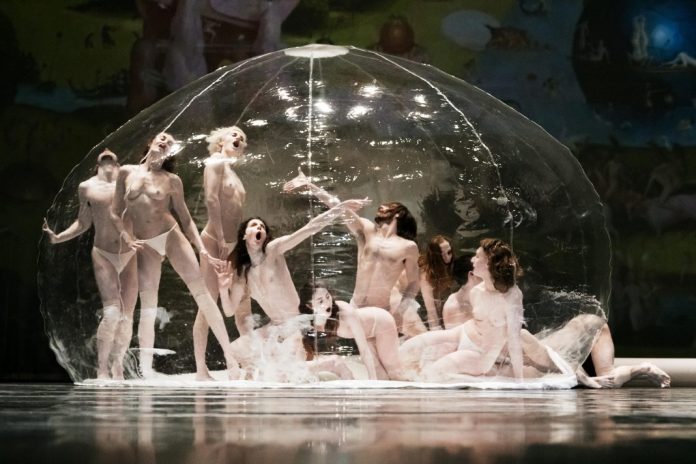
Image courtesy of Murray Paterson Marketing Group

By: Yelin Gemma Lee, Peak Associate


Hieronymus Bosch’s surrealist triptych The Garden of Earthly Delights has been marvelled at for its imaginative details. With Compagnie Marie Chouinard’s choreography, it lets the public experience the spirit of the painting through a unique dance performance full of raw humanity and emotion.

In the pre-show talk, Annie Gagnon, the rehearsal director of CMC, encouraged us to “feel” what is happening on the stage instead of trying to understand it or analyze it. Going into the show with this in mind, I found my senses absolutely mesmerized and exhausted by the intense performance on stage.

The show began with a stage-wide projection of Bosch’s triptych. They began with the panels folded, then opening and zooming into the centre panel, The Garden of Delights. However, this wasn’t the most interactive part of the visual component; there were two circular projections on the left and right edges of the stage, zoomed in even further to a specific detail in the painting being shown on stage then.

These visual components shifted along with the dancers’ movements and also connected the performance to the painting every step of the way, but proved to be distracting. The dancers were mainly nude and painted in white head to toe, leaving traces of their body paint on the floor of the stage. Although there was music and sound to accompany the choreography, it was clear that the painting was the main muse and focus.  

The choreography was split into three acts in accordance to the original three panels of the triptych; The Garden of Delights (central panel), Hell (right panel), and Paradise (left panel) in that respective order.

The first act was whimsical and comical. It depicted scenes of pleasure, overabundance, and careless delight, but was far from calming. The dance depicted the chaos and devilry of the centre panel through obsessive, repetitive, and odd body movements and facial expressions.

The second panel, Hell, was unsettling, agonizing, and increasingly chaotic. It was unassuming at first, the set being made up of household items, but with the dancers screaming and snarling to the creepy sound effects that went along with their contortionistic choreography, the whole scene was enough to just about stop your heart.

The third act, Paradise, was serene, ethereal and beautiful, which was an eerie contrast to the previous act. The image shown on the panel was of Adam, Eve, and Jesus, repeated and stretched out — ever present in the choreography of the last act.

‘Paradise’ ended with the dancers moving as a group to slowly exit the stage, but not before dancing in the directly in front of the projection — where their bodies were camouflaged into the green image of the grass in the painting, their arms reaching towards where the image of Adam, Eve, and Jesus was projected.

Each dancer expressed individuality in their facial expression and body movements but often came together as a group. They all demonstrated an unparalleled synchronicity and rhythm: even when they were dancing separately, you could see that they were communicating with their bodies to gracefully share the stage. They moved in response to one another, and often mirrored each other.

I felt that the theme of the performance was the complex condition of humanity, and in the bizarreness of it all, an intimate narrative of the painting’s spirit. It didn’t feel like the main point of the choreography was to imitate the painting, but rather to process it, which in itself is its own masterful work of art. The audience was given an opportunity to watch the dancers process this painting piece by piece and communicated it to us through their bodies.

Through raw vulnerability and sensual stimulation, Compagnie Marie Chouinard presented an inimitable experience completely deserving of its roaring standing ovations.