Home Blog Page 502

We need to stop e-cigarette use before it ruins a generation like tobacco did

0
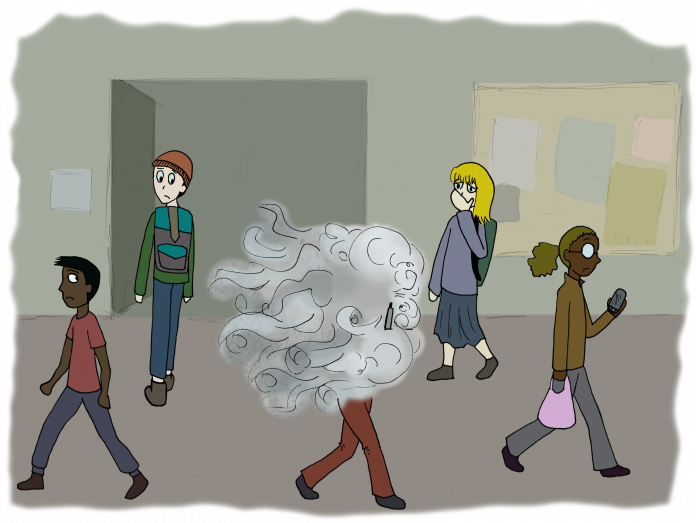
E-cigarette ads targeting youth are shockingly familiar and need to stop. Illustration: Alice Zhang/The Peak

Editor’s note: This piece has been updated to reflect the fact that Juul does not advertise to youth or intend its product for youth consumption.

By: Lubaba Mahmud, Staff Writer

We have to stop being so naive about e-cigarettes. At present, the same mistakes of the previous generations are being repeated that allow young people — high school students and university students alike — to become addicted to a more technologically advanced poison than cigarettes. The more we study e-cigarettes, the more we learn that they are anything but safe.

To start, e-cigarette use leads to nicotine addiction. E-cigarettes aren’t just flavouring and swirling puffs of vapour; 99% of them do in fact contain nicotine. For this reason, doctors recommend that teens and individuals who aren’t already addicted should not use e-cigarettes in order to avoid dependency. Studies have shown that early use of nicotine makes it harder to quit, and easier to become hooked on other addictive substances.

The reason for anxiety around nicotine addiction in youth is due to the very serious consequences for brain and nerve functions. 

While it is true that e-cigarettes are a healthier alternative to tobacco products because users aren’t inhaling a multitude of toxic chemicals, this reported safety is marginal at best, and even then only for those already addicted to nicotine. While it shouldn’t need to be said, inhaling any sort of artificial chemical is going to cause lung disease. The links between e-cigarettes and fatal disease are already becoming apparent. 

What’s even more troubling is the ease with which e-cigarettes have filled the iconic hole left by tobacco companies in youth culture. Juul, one of the most popular e-cigarette brands, is used in memes and cartoon imagery by social media influencers. While Juul itself isn’t responsible for these digital images, they are eerily similar to the old advertisements produced by tobacco companies. Young people should know better than to be taken in by these harmful images. 

Images featuring young and playful models in colourful scenes across social media are meant to attract our attention. The product itself is meant to keep people addicted, to keep them buying. Unfortunately, it also may be slowly killing many of them. 

As SFU students, we need our focus for long hours of study. We can’t afford to have that interrupted by the effects of nicotine consumption. But neither can we afford to lose the futures we’re working so hard towards right now. Remember the lessons of the past. E-cigarettes are no more safe than tobacco is — in fact, they’re more similar than you might realize. 


In an act of futility, The Peak turns to the SLC to learn about time management

0
The Peak vs. Father Time

By: Paige Riding, News Writer

Have you ever walked into a classroom with a coffee in hand, only to realize that everyone else has an exam in front of them that you completely forgot about? Or have you planned to start a paper for weeks, only to realize those “I’ll do it tomorrows” ran out? Perhaps a workshop on time management might help you figure out the hustle of being a student, working, and actually (maybe) having a social life.

The Student Learning Commons (SLC) in the SFU Library holds a series of workshops every semester about various aspects of being a good student. “Desperate times call for desperate measures,” declared The Peak, and thus set out to attend a workshop entitled ‘Time Management for Busy Students,’ to help get the current issue out the damn door. 

On September 6, in the W.A.C. Bennett Library, criminology PhD. candidate and Graduate Facilitator Suzanna M. led said workshop on time management. It focused on taking responsibility for one’s own time, and utilizing SFU’s resources to succeed as a student. 

One of the first exercises in the time management workshop is to fill out a sheet called “Where Does Your Time Go?,” documenting one’s typical weekly schedule. Though SFU’s Library page recommends that one spends two to three hours per credit per week on studying, this is easier said than done. After filling out the handout, not a single participant in the workshop had this many hours left over in the week.

“[Being a full-time student] is more than a full-time job with how much work we put in,” Suzanna said. She suggests something called the “Four Quadrant” system, in which one splits one’s tasks into one of four categories (see photo) that involves organizing daily tasks based on both urgency and importance. While finishing quadrant one, ‘important and urgent,’ is the most critical, (for example proofreading a research paper due in the morning), Suzanna advises students to plan their time so that they are putting most of their time into the second quadrant, ‘important but not urgent.’ This would allow students to stay on top of the often overwhelming amount of work involved with post-secondary education. By working on larger tasks in small chunks well before they’re due, one avoids having those tasks fall into the ‘important and urgent’ quadrant, where much academic stress arises. This method of incremental work allows students to avoid self-inflicted semesterly burn-out.

“We are full-time students, but that doesn’t mean that it’s all we do full-time. We have other things going on in our lives, so that’s what time management is: making sure we have enough time for school, but also having enough time to keep the other things in our lives going,” Suzanna says. With other commitments cutting into potential study time, the balancing act gets harder and more stressful.

The workshop also encouraged the attendees to take a more detailed look at how they spend each day specifically. Each participant at the meeting admitted that leisure time consumes a large chunk of their days, perhaps more than they would like to admit. The workshop emphasized that taking responsibility for how one individually spends their time is critical, whether that is staying up late watching YouTube conspiracy videos, reddit shit-posting, going out with friends too often, or other poisons of choice. Suzanna notes that many students struggle in saying no to their friends or employers; ‘Fear of Missing Out’ is a genuine concern for many students. On top of potentially paying for school with a job (or two), students may be able to avoid unnecessary stress by allowing themselves to learn ways to make their lives easier. To this end, the SLC’s many workshops endeavour to give students these tools.

Despite the workshop, this article was still submitted late. The Peak still gives the workshop an A+. We’re sorry Suzanna, it’s not you, it’s us.

The Student Learning Commons holds a number of workshops every semester related to academic success. Despite The Peak’s failure in this regard, you may yet have hope. The list of workshops is available at https://www.lib.sfu.ca/about/branches-depts/slc


Contracts, time, and money: the largest issues that educators face in the world of labour

0
Educators want fairness in the workplace

By: Jess Dela Cruz, News Writer

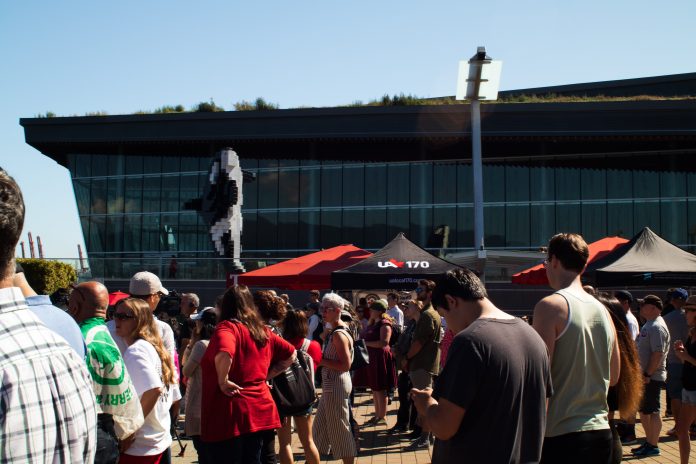
Amongst the tourists, families, cyclists, couples, and curious wanderers, a Labour Day event hosted by the Vancouver District and Labour Council took place at the Jack Poole Plaza on September 2. Booths of various labour organizations were present, celebrating educators, union workers, hospital employees, labourers, and working people in a “free, family-friendly event filled with union booths, entertainers, and family activities” — as stated in the event poster. 

And though SFU’s own Faculty Association or Teaching Support Staff Union (TSSU) were not present at this event, their message of fair labour practice for educators was still heard from the Federation of Post-Secondary Educators of BC (FPSE) and the BC Teacher’s Federation (BCTF)

FPSE had a booth set up where secretary treasurer Sean Parkinson sat down with The Peak for an interview. He explained that the FSPE is “an umbrella that represents 19 post-secondary universities and colleges here in BC,” among them Capilano University, Douglas College, and Emily Carr University of Art & Design. SFU’s faculty association is represented by another provincial organization, CUFA BC (the Confederation of University Faculty Associations of British Columbia).    

When asked about what fair labour means to Parkinson, he discussed the inequalities sessional professors face when compared to permanent faculty members. He says, “We have a growing number of precarious academic faculty. Often called ‘sessionals’[ . . . ] who do, by and large, the same work as other academics but they get paid much less and they don’t have job security.”

Parkinson adds that students are impacted by not having a professor who is around full-time. He says, “Many students want to talk to their [professors]. When they encounter a sessional [ . . . ] that person may not be there to help with a letter for graduate school . . . When students make these connections they want the informal teaching as well: the mentorship [and] talking about the profession.” 

Students also frequently have a teaching assistant (TAs), who help the students understand what was discussed in lecture by leading discussion in smaller groups. They also provide guidance in student’s writing through feedback, student hours, and emails. 

 Jorji Temple is a TA for the SFU English Department and is a member of the TSSU where they serve on the contract committee, which helps negotiate the collective agreement for TAs.  The TSSU represents TAs collectively, which includes bargaining on behalf of them during contract negotiations and representing them in work-related problems. It is currently bargaining with SFU, and Temple is “part of a team of elected members who are negotiating a new collective agreement, or contract, that sets the conditions of our work.” 

They elaborate by stating, “it covers everything from pay and benefits, to how to get a job, to protections against discrimination and harassment.” 

When further asked on their position, Temple believes “a crucial part of this job is letting the SFU community know what’s happening in negotiations with SFU administration, and talking to TSSU members about what they want to change about their work.” 

However, Temple believes that “there are a few problems with the current way TA work is organized at SFU. One of them is overwork.” They further compare how TA’s in different departments are paid differing amounts. Moreso, they discuss how tutor/markers (TAs for online classes) are “generally paid less, with more responsibilities — and often little training in how to do that job well.” 

For Temple, one of the main issues is job security, which entails temporary contracts, few benefits, few or no sick days, and no pension at all. They say, “In negotiations, we’re trying to end the cycle of temporary employment that keeps people working these contracts end to end, and instead shift them into regular jobs that give them some stability.” 

As a TA in the Department of Political Science, Violeta Maria Dima expresses great passion for teaching and the connections she makes with her students. Despite the challenges of being a TA, she finds great reward when her students succeed.

Dima expands on the role of what a TA does when not in class. “To effectively manage such [ . . . ] complex demands, TA work also entails regular training, meetings, and adaptation in accordance to classroom needs . . . I not only encourage an environment of engagement within my tutorials, but I also focus on getting to know my students before I sit down and formulate lesson plans.” 

Her relationship with the TSSU is heavily focused on the Union’s Legal/Advocacy Branch in which she is a member of the Anti-Harassment Committee. In an email to The Peak, she explained how her role there is to present “key mechanisms of defence for the rights, protections, and hard-won benefits of the teaching support staff here at SFU.”

Similar to Parkinson and Temple’s responses, Dima further elaborates on the contract inequalities between full-time professors and sessional instructors. She says, “Given the degree of both uncertainty and stress that is compounded by the relatively short windows of notice given to teaching support staff, I believe that teaching contracts should be restructured so to extend for at minimum two terms.” Dima also vouches for less shared desk and office space and the creation of “an amended pay structure that better accounts for variances in course demands.” 

Not only are the problems of contracts, time, and money evident in post-secondary institutions, but within public high schools as well. BCTF also had a booth at the Labour Day event where June James, a staff member from the BCTF, agreed to have an interview with The Peak. The BCTF “is a federation and union that supports public school teachers and students in the province of British Columbia,” James says. 

She tells us, “One of the most positive changes that have been done in the last few years is our Supreme Court win [in November 2016] to the right to bargain class size and composition language in our collective agreement.” To James, this win was significant because “it meant that there was service for students with special needs, and that class sizes could not go over a certain number of students.” 

The BCTF is currently in the midst of bargaining with the NDP, though on recess as requested by the meditator. 

When asked what fair labour meant to her, James says, “Oh my! That’s a really loaded question  [ . . . ] fair means having all schools get what they need.” She recalls her experience working in an inner city high school in Surrey. The school had high levels of poverty and many students from refugee families — James’ concern was that these students should be able to have the same kinds of advantages “that the kids in West Vancouver get.” 

It is important to recognize the ongoing struggle for labourers as they face hindrances in their careers. While in the past issues of child labour, lack of overtime pay, and little to no time off were most prevelant, labourers still deal with and fight against inequalities. Better contracts, more time, and more money are the main factors that educators are fighting for in order to receive equality and fairness within the learning institutions they work within. Some of the main factors educators are still fighting for in order to receive equality and fairness include: better contracts, more time, and more money. Though many people are aware that Labour Day is a statutory holiday (and that SFU students get to stay home), what often goes unsaid is the reason why the day exists. 

The Labour Day event at Jack Poole Plaza was meant to celebrate the historical and current struggles of workers, labourers, and their families continuing to strive for equality and fair labour practices within their workplaces — not just another day off. 

 

Weird Al Yankovic captivates fans new and old with unique Strings Attached Tour

0
The Strings Attached tour included a live symphony orchestra to accompany Weird Al Yankovic. Image courtesy of Weird Al Yankovic.

By: Kelly Chia, Staff Writer

In one word, Weird Al Yankovic’s Strings Attached concert was bonkers. Prior to going to this concert, I knew about Weird Al, but I didn’t know him very well — my only real exposure to him being my friends belting out his pop parodies in our teenage years. So when I walked into the ornate Queen Elizabeth Theatre on August 19, I was . . . confused. I knew Weird Al’s Strings Attached tour featured a live symphony orchestra, but what did that mean for a musician that I had primarily associated with cartoon music videos and polka? 

Well, for starters, as my friend and I gazed upon the crowd, we caught sight of a lot of young families seated around us. Some were dressed semi-formally for the theatre, but others were dressed in colourful three-piece suits with top hats — they looked like Dr. Seuss characters! As we took our seats and joined them, the show began. We all sat and cheered as a 42-piece orchestra started the evening with live medleys of Star Wars music, each set gearing us up for the man we were all there to see. Finally, Weird Al took the stage to a roaring crowd.

I’m not sure what I really expected, but his vocals surprised me. His voice rang like a bell, clear and crisp, even through the difficult and high notes. Seemingly with ease, Weird Al traveled through genres, belting out the notes — these were the moments in which I truly appreciated his vocals rather than his lyrics. I didn’t know all of the songs, but I was entranced nonetheless by Weird Al’s powerful stage presence. Coupled with orchestral swells and lots of brassy notes, the music enveloped me in the warmest hug. I was reminded of why I loved being in places like these — anyone at the concert could pick up on the audience’s love for the performer. Their joy was contagious; I whooped and sang along with the crowd wherever I could.

That was another thing that I appreciated — Weird Al had an awesome setlist. His songs ranged from throwbacks like “The Biggest Ball of Twine in Minnesota,” which was released in 1989, to more modern, iconic tracks like “White and Nerdy.” Weird Al performed the latter number on a segway without a stutter. 

Weird Al would joke with the audience between numbers, running up and down flights of stairs in the theatre and interacting with us. He was clearly an experienced performer and loved the stage, which is always fantastic to see.

During the frequent costume changes between songs, clips of Weird Al’s numerous collaborations and cameos played on stage. He’s appeared on various cartoon shows, from The Simpsons to the more recent Teen Titans Go. If I didn’t know before, it was crystal clear how much of a cultural impact Weird Al’s music has had in North America. A song was doubly famous if Weird Al parodied it; for example, after Weird Al covered Nirvana’s song “Smells Like Teen Spirit” (titled “Smells Like Nirvana”), a million more units of the band’s second record Nevermind were apparently sold.

Weird Al came to deliver to fans that were there for his obscure tracks and the ones that were there for his pop parodies. Even if his music still felt comparatively new to me, it didn’t diminish my enjoyment of the show. Weird Al is an enthusiastic and talented performer with unparalleled stage presence, and it’s no wonder that he’s been in the game for so long.

Your weekly SFU horoscopes: September 16 – 22

0
An illustration of a girl with long flowing hair. Astrological signs and stars shine around her.
ILLUSTRATION: Marissa Ouyang / The Peak

Written by Zach Siddiqui, Humour Editor

Aries — March 21–April 19

Your reputation of blood, guts, and rage follows you everywhere. What you need this week is a publicity stunt to change your image. Head off to the fire pits in Convocation Mall, marshmallow skewer in hand, for some wholesome campfire-side roasting. No one needs to know that the pillowy, weirdly shaped white things you’re toasting are your cheating partner’s fascinating family jewels.

Taurus — April 20–May 20

Four years ago, your TA promised they would leave comments on your final paper after sending you the mark. This could be the week to finally go to their office hours and talk to them. Or you could just keep waiting. (Need encouragement? There’s an 8% chance your TA is also a Taurus. This would then mean a 97% chance that they are still at SFU, as opposed to the 93% that all the other students have.)

Gemini — May 21–June 20

Your future is full of possibilities — too many for me to decipher. You need a more versatile divining tool. Tarot isn’t enough. So go to the gaming shop, build a deck of Yu-Gi-Oh! cards focused on the “Gemini” subtype of monsters, and get dueling. This will narrow down your future-sight by destroying most of your possible futures. Not only will most employers judge you for playing a children’s card game, but Gemini cards suck ass. 

Cancer — June 21–July 22

Don’t go to any parties this week. No, I don’t care if there will be Miss Vickie’s Salt and Vinegar Chips. You can only say the phrase “this has been the most revolting night of my entire existence” about so many nights before everyone stops believing you. And if 2019 was any indication? You really need to save up your credit for next summer’s spread of disappointing soirees. 

Leo — July 23–August 22

For years, all of the other astrology signs have been dissociating. But this week is your time to trailblaze and re-sociate. Feel everything. Experience reality. Go to Fall Kickoff. Attach your consciousness to yourself and your surroundings like Lena Dunham trying to cling to relevance — except better, because you don’t deserve to be compared to Lena Dunham.  

Virgo — August 23–September 22

Your professor might confront you this week about why you aren’t doing the readings he so lovingly wrote and charged $100 a copy for. Tell him that he and his class are exactly the disease your mother had in mind 17+ years ago when she Googled “how to do vaginal seeding for my infant.”

Libra — September 23–October 22

Pay attention to your pH balance this week. Feeling too acidic or alkali? Dilute yourself by staying hydrated. The healthiest fluid for you would be the rivers of gutter-adjacent water that will flow in front of SFU Goldcorp when it inevitably downpours. It will enrich your spirit.

Scorpio — October 23–November 21

This week’s despair will come from the knowledge that you have to wait for #LIBRASZN to pass before we get to #SCORPSZN. But cheer up. Does #LIBRASZN really have to happen if all the Libras mysteriously drop dead ahead of time from water contamination?

Sagittarius — November 22–December 21

This week you might learn that an old flame has just flown out to Toronto to start grad school. Who cares? They’ll die first when Parliament Hill finally bursts under the weight of Canadian politics’ many, many elephants in the room, scattering burning oily shrapnel all across Ontario.

Capricorn — December 22–January 19

Your group-mates for The Group Project want to wait until four weeks before your presentation week to start working on it. Don’t let weakness win. Finish the entire assignment by yourself this week. Afterwards, you could confront the TA about your problems. Or you could keep it simple and do what you always do: cry impotently to your friends about this while they’re in the middle of crying impotently to you about something way less important.

Aquarius — January 20–February 18

Lucky you: you expended all your emotions for the month last week! So you don’t have any vulnerabilities to exploit. At least, not ones you’ll notice before October.

Pisces — February 19–March 20

A choice lies before you this week. Once and for all, what kind of Friday night wine aficionado will you be? The kind who projects your voice, or the kind who projects your psychological complexes?

Vancouver’s QS World University Ranking isn’t all that it seems

0
Vancouver has a suspiciously high ranking considering its affordability issues. Illustration: Anthony Liao/The Peak

By: Nicole Magas, Opinions Editor

Vancouver’s grades are in and it has been given a mark of 71.6% as a student city by the QS World University Ranking system, which is an annual publication of global university rankings. That’s a solid B- by the standard of most SFU departments. It’s not bad, but it’s not great either. Which is why it’s so mind-boggling that Vancouver managed to place 16th out of 120 other international cities by QS.

It’s not that I don’t believe Vancouver has merit. It’s absolutely a beautiful, vibrant, and dynamic city to be in — especially if you have the money to enjoy it. But that’s just the point: since the coming of the 2010 Olympic Games, Vancouver seems to have been on a mission to aggressively price out lower-income individuals in an attempt to claw its way to international metropolitan status. As of this year, Vancouver is the second most unaffordable city in the world behind Hong Kong. This statistic leaves room for students to wonder how this situation doesn’t drag Vancouver’s QS ranking to the bottom of the sea.

To be fair, the QS ranking does take affordability into account. Vancouver received a 50/100 for this metric, and the only thing shocking about that number is that it’s not lower. What is perhaps more surprising is that Vancouver’s “university ranking” score — the average of the scores of the individual universities within Vancouver — of 46/100 is what dragged its overall score down the most (shout out to SFU for that contribution). 

The problem is that QS weighs each of the categories it uses to rank cities equally, even if the indicators within categories are not. So affordability (within which tuition costs are given the highest weight, above even the cost of living) is weighted the same as student mix, which measures the relative diversity of the student population. 

Arguably, the weights between categories are set equally because the importance of each category (students’ opinions, university rankings, student diversity, desirability, employment prospects, and affordability) is subjective. However, it becomes apparent how Vancouver’s ranking could be skewed when a 92 for diversity is given equal consideration as a 50 for affordability. 

And it’s in subjectivities that the QS ranking system loses its relative usefulness to students, schools, cities, and anyone else with a stake in identifying where is best to study. While subjectivity is smoothed out in the equal weighting between categories, it plays a significant role in the weighting of indicators within categories. Someone had to subjectively decide that the Economist Livability Index would be weighted higher than both the safety and pollution scores combined to determine overall desirability

What would paint a better picture of student city rankings at an individual level would be to allow users to create their own weights — possibly by including a sliding scale of importance for each category and the indicators within categories. At best, the current QS rankings score is only an evaluation of what the survey takers themselves view to be the top cities in the world to study in, not necessarily how students themselves perceive these cities. 

Students using this ranking system as a basis for decision making should take Vancouver’s 16th place ranking with a grain of salt. There’s a lot of good things going on in this city, but they may not be the sort of qualities that are most important to you. 


Devil attends his first ever history seminar, tearfully thanks students who advocated for him

1

Written by Zach Siddiqui, Humour Editor

Decades of SFU student activism have finally paid off, it seems. Last Monday, a HIST 466 seminar welcomed a very special new student: the Devil himself.

Ever since Lucifer’s original fall from Heaven, the lack of colleges in Hell has left Satan with no opportunity to pursue higher education. But modern transit infrastructure has changed everything, especially in Metro Vancouver. As the school closest to Hell, SFU has a long history of students from all disciplines advocating for the Devil and his cause. 

Their efforts finally bore fruit last Monday. Students walked into their room in the AQ to find the Devil seated happily at the front of the classroom, ready for that day’s seminar discussion on whether or not Emperor Caligula was a good husband. 

“I just can’t believe I’m finally here,” the Devil sobbed during a statement to The Peak. “I’m so excited to finally speak for myself on the pros of tyrannical dictators throughout global history, instead of relying on tall, pale, sickly-looking boys in trench coats and oversized glasses to do it for me.”

According to the Devil, though the school had been “hesitant” to accept him as a full-time undergrad, he was being permitted to audit the course and see how he “fit in” with the rest of the students.

“I’m not worried, though,” he confided. “Those tall, pale, sickly boys? They’re so nice to me! They know I’m really shy these days, so they always speak up on my behalf. And they’re good at it. Whenever they advocate for my point of view to the class, they always get all the little nuances of my opinions, without me having to explain first.

“It’s almost as if they actually just believe the same things as me.”

Many other students were proud of the Devil and excited to see what he would contribute.

“I mean, yeah, he’s going to be more insufferable and evil than everyone who advocated for him put together,” noted Carla Laurent, a third year history student. “But he seems really eager to learn, so at least he’ll come to class having done the readings.” 

At the end of the seminar, the Devil, with tears of lava trickling from his beautiful eyes, stood before the class and bowed to them in gratitude. 

“It meant a lot,” said Dr. Jenny Blizzard, the professor teaching the HIST 466 seminar, “considering, you know, why he ended up in Hell in the first place.

“But it does worry me . . . I don’t want him stoking these kids’ egos. I don’t think I can deal with any more of my students developing God complexes.”

None of the Devil’s advocates in the class seemed prepared to comment. Though The Peak approached multiple advocates, each one deflected interview requests with demands that the reporters drop everything and debate them — on what topic, exactly, was unclear.

SFSS’s Annual General Meeting recurs on September 25

0
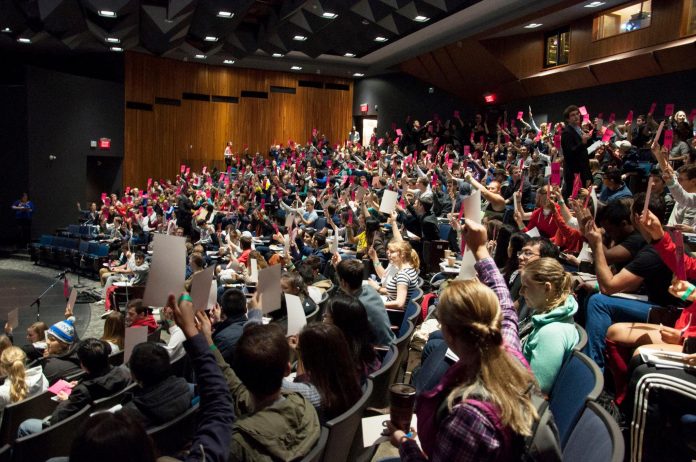
An SFSS AGM from 2014

By: Paige Riding, News Writer

There’s a lot of acronyms plastered across campus this Fall. Ones that say things like “SFSS,” (Simon Fraser Student Society) and “AGM” (Annual General Meeting). As a new (or possibly returning) student, you may wonder what all these acronyms even mean as well as whether or not they pertain at all to you. 

“Our meetings are your meetings,” states the SFSS website in bold, colourful text. Beyond a catchphrase, the AGM is the “highest level of decision-making authority within the Simon Fraser Student Society,” according to the SFSS AGM webpage. The AGM is the society’s way for members to communicate with one another, which may include addressing: major events, the society’s future plans, and getting input from those in attendance. The AGM is a place for students to stand toe-to-toe with the Board of Directors on a relatively level playing field and have their input on the society’s yearly endeavours. 

The meeting takes place each year around the months of September and October. 2019’s AGM is just around the corner, being held on Wednesday, September 25.

One important reason for students to pay close attention to the SFSS is that it is funded through fees levied on all undergraduate students. These fees include a substantial $107.99 for full-time and $54.01 for part-time students (this is not including fees levied from other student groups, such as The Peak and CJSF). Even if students feel disconnected from the student society, they are helping to pay for its events, operations, and the pay of both its staff and elected representatives. 

During the meeting, several important reports will be given to the membership, including the Society’s Annual Report, the President’s Letter to Membership, the Financial Report, and the report from the SFSS’s auditor on the financial state of the organization. 

Giovanni HoSang, SFSS president, notes that “near the end [of the AGM], we will give the opportunity to students to raise questions, concerns, [and] suggestions for the Society… This is a venue to have your voices heard as students.” 

This is the time in which “students ask any questions and raise concerns about various issues of importance. . . [this is] the biggest way to have [students] voices heard on record, for the rest of the membership to note and organize accordingly. Every student is on a level playing field and gets to participate in the business of the society where each student gets one vote,” HoSang says. 

One vote may not seem that impactful, but multiply that by over 16,000 enrolled undergraduate students that could get involved and that is when waves are created. An example of this, notably in the Fall of 2018, occured when students voted to impeach the President of the SFSS, in a demonstration of large-scale direct democracy.

The meeting will be held at the Leslie Gordon Diamond Family Auditorium on Wednesday September 25. Registration time for the AGM is 12:30 p.m., with the event kicking off at 1:00 p.m.. Students are required to show their SFU student IDs to enter.

Want to learn more? The AGM’s Facebook event page provides updates on the event. HoSang invites students to contact either himself ([email protected]) or [email protected] for information on the AGM. Look forward to an email providing a copy of the AGM package in your SFU inbox shortly.

Election rundown: Scheer’s unclear stance on same-sex marriage and abortion leaves voters confused

0
Voters don’t yet know where Scheer stands on important issues. Photo: Adrian Wyld/The Canadian Press

By: Kelly Grounds, Peak Associate

The October 21 federal election is fast approaching and the party campaigns are heating up. The Liberals have taken aim at the Conservatives by pulling up old videos of party leader Andrew Scheer. These videos of Scheer include homophobic comments about same-sex marriage in 2005, and a conversation that he had with anti-abortion activists in 2017. Scheer responded by saying that if elected, his party would not reopen the issues for debate and accused the Liberals of “dredging up divisive issues.” 

While it is possible for people to change their political views, it is not actually clear that Scheer has genuinely adopted a more progressive view of these two fundamental and controversial rights for Canadians. With abortion rights being pulled back from our neighbours to the south, it is even more important to know exactly where all of our potential leaders stand on this issue — lest we lose the ground we’ve gained as well. 

The problem arises when Scheer is asked about his stance: he either avoids the question or further confuses the public. Though he has said that he will protect the rights of all Canadians, he has also stated that his MPs would be able to table bills according to their beliefs. This raises the question of whether or not one of these bills could, in theory, be focused on restructing or revoking the rights of Canadians to marry whom they choose or obtain an abortion. 

Overall, it appears that Scheer is not actively trying to challenge the laws on abortion and same-sex marrigae laws. Instead, he appears to be focused on ensuring that all of his MPs have the opportunity to freely voice their opinions and put forward bills based on their values. The issue here is that should an MP put forward a law to reverse or curtail these rights, we do not know how Scheer would react. Would he choose to protect the established laws for LGBTQ2+ and women’s rights, or would he allow his MPs to play partisan politics to undermine them? 

The Liberals and Conservatives entered September nearly tied in the polls. With voter opinion this close, it could be anyone’s election. Scheer clearly stating his views on abortion and same-sex marriage could give his party the boost it needs to pull ahead; until he does, however, he will be leaving many Canadians wondering in October if their rights would be secure with him in charge.


Most popular couple in grade 12 shockingly breaks up on third week of university

0

Written by Gabrielle McLaren, Editor-in-Chief

BURNABY, BC — To the absolute shock of their community, Crystal Lemay and Hunter O’Brian, the hottest couple in the 2019 graduating class from Coquitlam’s John Green Secondary School, broke up against all odds three weeks into their SFU careers. 

“I couldn’t believe it,” said Gabby Hart, first year communication major and former head of John Green Secondary’s grad committee. “They have been together since, like, tenth grade. Hunter’s grad proposal was the most romantic thing that’s ever happened in any of the Tri-Cities. Her wedding Pinboard was the cutest. 

“When I heard, I had to tell everyone, just to make them as sad as me.” 

According to sources close to Lemay and O’Brian, the couple’s relationship became rocky after Welcome Week ended, when the adrenaline rush of free pancakes and fresh highlighters wore off and the sound of drills meeting concrete brought the couple back to their new brutalist reality. 

“We all thought they were going to last forever,” Hart said. “They were the only couple not to have a pregnancy scare, like, at all.”  

To complicate things further, O’Brian found himself spending the majority of his time on the Burnaby campus, while Lemay’s classes were mostly at Harbour Centre. In an exclusive interview with The Peak, O’Brian elaborated on how university life tore the couple apart. 

“At first, we thought we’d be able to make long distance work,” O’Brian said. “We told ourselves that we would still be connected by the 95 B-Line and our dreams. When I didn’t get into the one and only PSYC 101 tutorial she and our 12 closest friends had in RCB [Robert C. Brown Hall], it all started going downhill.” 

At the time of press, it was unclear who had broken up with who. O’Brian danced around the subject before calling the break-up a mutual choice made by the former king and queen. When The Peak sat down with Lemay at the Cornerstone Starbucks, she frowned over her latte.

“He said that?” Lemay said. “Whatever . . . it’s fine. University is an opportunity for a fresh start. As you can see, I got a helix piercing against my mom’s will and dyed my hair.”

“It’s not like we were going to get married,” O’Brian told The Peak.

“He said that, too?” Lemay asked, shifting uncomfortably. “That’s not what he said at Holiday Inn when . . . It’s whatever; I’m on Tinder now.”