Home Blog Page 497

Closure cravings: My life of starting and ending romances just for the post-relationship coffee dates

0

Written by Zoe Vedova, Peak Associate

My heartbeat was frenetic that morning. It shook the blood in my veins as I gripped my phone. I’d contracted a heinous bout of emotional stability. Now, the hunger for relationship turmoil screamed through my every waking moment. But please don’t worry — I’m a highly evolved creature, adapted to the inhospitable edge of valid coping mechanisms. 

Adrenaline was high and blood sugar levels were low, and that could only be rectified by one event: a high fructose, hazelnut caramel syrup-saturated coffee date with my recent ex-boyfriend.

My phone jumped with his incoming text.


I really think it would be easier if we could talk about what happened in person yk? 

What about coffee tomorrew? 

*tomorrow lol


I grinned manically. 

It was Closure Time. 

There’s great artistry in the emotional gratification of painstakingly chronicling every mundane misdemeanor my ex and I made against each other throughout our torrid, Tinder-based, three-week-long relationship. A coffee shop is the ideal destination: it’s private enough that you can each lie about deleting the other’s nudes out loud, but it’s also public enough that the caffeine catalyst will escalate petty insults about each other’s music tastes into a fight that ends with you stealing their headphones when they depart. Oh, that rush . . . Norepinephrine . . .

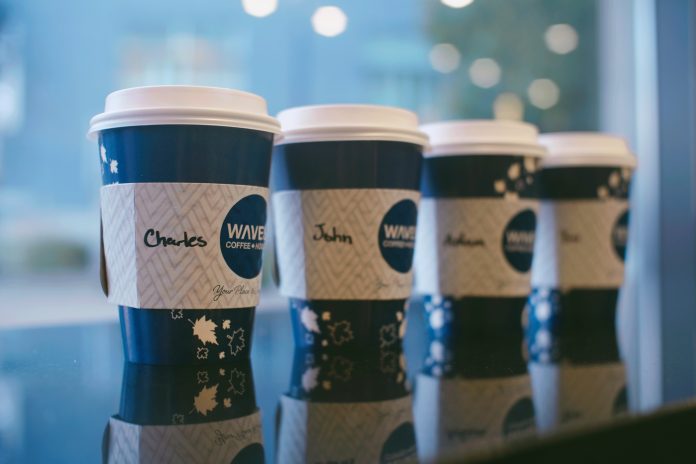
Closure of this calibre cannot be desperately gleaned somewhere as simple as the Cornerstone Starbucks. After all, my accusation that you didn’t like the name of my cat (Dromedary) could be interrupted by a crim student accidentally lusting over a serial killer out loud. 

No, what I need is the burning filament of an incandescent lightbulb to highlight my glistening eyes, along with a plethora of succulents lined up on an unsanded pinewood shelf to witness our fractured hearts. 

I wasn’t the amateur closure-coffee dater I was when I first began orchestrating my breakups to ascertain chaos and caffeine. I let my break-ups ferment now, age like wine. Nothing is worse than a purely amicable send-off from which neither partner can indulge in the added weight to their emotional baggage. 

Only once, shamefully, was I outmaneuvered. The boy escaped to a soul-searching backpacking trip of trendy hostels in Japan before I could schedule anything. In my defence, he was a Cancer. 

I could already taste the fair trade matcha latte, dripping down the back of a throat tightening with emotion. And if this date tomorrow was bland, well — I glanced down at my phone, relishing in the fresh Tinder notifications — there would be a new break-up just around the corner.

SFU Hockey riots after pile of dead rats in Residences is prioritized for NCAA accreditation

0

Written by Dylan Webb, Sports Editor

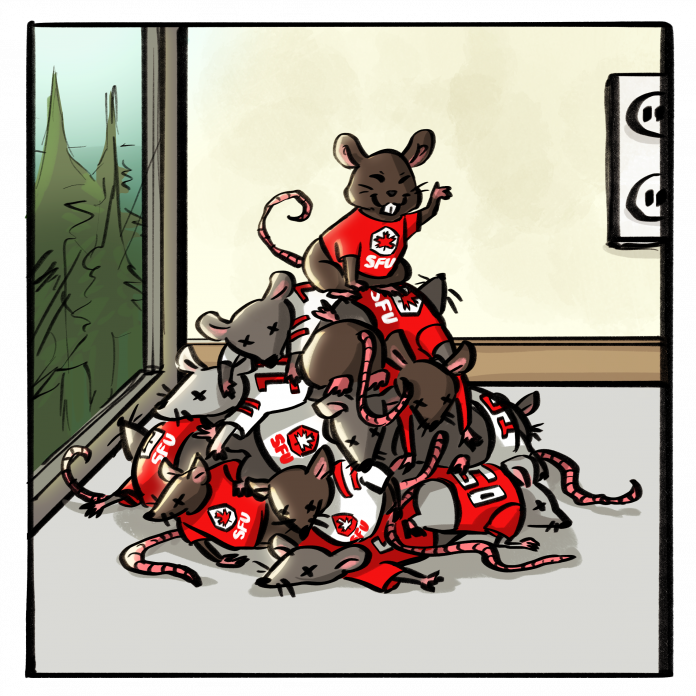
The NCAA National Committee has released their list of sports programs that will receive NCAA accreditation for the 2019–20 athletics season. Among the notable additions to SFU’s already strong slate of NCAA-competing programs are the school’s Quidditch team, its board games club, and — to the surprise of some in the athletics community — a pile of dead rats that was found in the Burnaby campus student residences.

While SFU now boasts an even broader range of NCAA-accredited athletics programs, the Men’s Ice Hockey team was omitted for the eighteenth year in a row. It’s unclear what the hockey team might do to secure the institutional backing required to make the jump to the NCAA, other than switch sports altogether or become a heap of deceased rodents.

Following the accreditation announcement, reports surfaced on social media of a rowdy group of incensed athletes loudly occupying Convocation Mall. While the cause of the riot was initially unclear, a handful of students, barricading themselves in the W.A.C. Bennett Library, shared live tweets of the proceedings. The posts referred to puck-shaped holes in the Maggie Benston Centre windows and anti-SFU chants echoing off the concrete walls. 

Shortly after the National Committee’s accreditation announcement, a press release from the pile of dead rats indicated that, though the team of rodents possesses multi-sport athletic abilities, they will compete in the Division 2 GNAC rat basketball conference. 

“While the NCAA did give us the option of fielding soccer, basketball, and ice hockey teams, we’ve settled on the Division 2 GNAC rat basketball conference. We’ve chosen not to ice a rodent hockey team due to embarrassment for, and fear of backlash from, the SFU hockey community,“ a spokesperson for the pile of dead rats said in a follow-up interview with The Peak.

On the heels of the NCAA’s accreditation announcement, the SFU Board of Governors released its newest budget update. The document indicates that while the board’s annual transfer to the SFU Hockey club will hold steady at 12 secondhand bath towels and one three-day-old fruit platter per annum, it has indeed allocated funds in its yearly budget for a new rat basketball arena. Their new arena, like most other buildings on campus, has an expected completion date of January 2038.

Maggie Rogers dazzles at the Orpheum Theatre

0
Maggie Rogers blends folk and dance music to create a sound that’s all her own. Image courtesy of Joseph Okpako / WireImage.

By: Remy Brayshaw, SFU Student

There are countless different ways to spend a Friday night in Vancouver, and choosing to spend it dancing the night away with Maggie Rogers was without a doubt the best decision any of us could have made on September 13. From the moment Rogers took the stage, she illuminated the grand and historic Orpheum Theatre as if she had performed in that venue dozens of times before.

Having grown up in Maryland, it only made sense that Rogers would adopt a sound that was primarily inspired by the folk music genre. After studying at the Clive Davis Institute of Recorded Music and spending time abroad in Europe, Rogers also became influenced by a new genre of electronic dance music. She merged this discovery with her folk sound to create a style of pop music that is very unique to her. It’s quite easy for an artist to construe such grand intentions of creating something new and exclusive to them, but it’s rare that they can bring those visions to life. Rogers has done just that with her music, seemingly effortlessly. 

As the house lights dimmed and the stage lights lit up the theatre, a very obvious shift in energy took place as Rogers and her band took the stage. She began the show with “Fallingwater,” and from the first beat of the song until the end of the show, Rogers filled the stage with a sense of passion and spirit that many artists couldn’t. It was as if the show was her own personal dance party, and she only stopped for a quick breath in between one song and the next.

The energy that Rogers gave off as she flawlessly performed made it impossible for anybody in the crowd to stand still, forcing each and every one of us to let loose and enjoy the music in a way many attendees likely never had before.  One of the less obvious yet most impressive aspects of Rogers’ performance was the way in which she coordinated the lighting of her show to correspond with the emotions and feelings behind each of her songs, demonstrating her own creativity and personality that shines through in her music.

Although the majority of the night was spent dancing to Rogers’ funky beats, bright lights, and impressive vocals, she ended the show with a beautiful and largely unexpected encore. After a few technical difficulties involving the sound system, Rogers took the audience back to her roots and performed the song that catapulted her to fame. This performance of “Alaska,” done in the way she originally wrote it in her bedroom many years ago with nothing but her guitar and raw vocals, ended the night with a newfound connection between Rogers and her audience. In addition, this performance allowed her to showcase her incredible talent for songwriting one last time before her dazzling performance came to an end. 

If anyone had entered the theatre that night unsure of who Maggie Rogers was, there is no possible way they left without also admiring her talent and feeling a new sense of optimism for the future of pop music. If this is only the beginning for Maggie Rogers, we should all be very excited to see what she brings the next time she leaves her mark on Vancouver.

Month of Welcome is about more than just free stuff

0
SFU offers new students lots of untapped resources. Photo: Zeh Daruwalla/The Peak

By: Mishaa Khan, Peak Associate

Month of Welcome is an exciting time for students. With an abundance of resources, freebies, and activities being thrown their way, it’s one of the only times students can freely enjoy university without drowning in assignments, exams, and other commitments. In organizing the Resource Fair, BBQ, and fun activities, SFU excels at providing students the support they need to begin university. However, the onus lies on students to take advantage of this time to be well prepared when school starts.  

Two of the most common complaints I have heard from SFU students is that SFU is an anti-social, commuter campus, and that SFU does not care about its students enough to provide them with adequate resources. The extended Month of Welcome challenges those criticisms, providing students an opportunity to build social connections, and giving students a chance to talk to campus partners about available student supports. If, after all this, students still feel that they haven’t been given a proper orientation into the university, it’s because they haven’t fully taken advantage of the Month of Welcome.

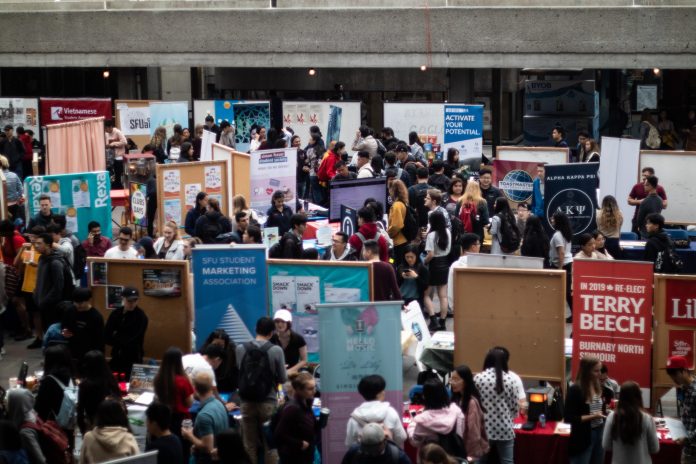
SFU holds a Resource Fair during Month of Welcome on all three campuses: Burnaby, Surrey, and Harbour Centre. Despite this, many students are still clueless about the services SFU offers and subsequently complain. However, students are partially to blame for this lack of knowledge. Instead of complaining, students should understand what resources SFU has to offer by talking to the representatives present at each SFU student service tables.

Unfortunately, one of the problems during the Resource Fairs is that there ends up being longer lines for the free items and shorter lines where there are none. As someone who helped out during the Month of Welcome, I saw most SFU services offering freebies to attract attention, but individuals would come, grab the freebie, and leave without trying to understand the value of the resource. To get the most out of this orientation time, students need to focus on more than just swag, and actually engage with the valuable information offered at each table. 

Just as with the rest of one’s time at university, no one is going to chase new students around and tell them what to do and when to do it. Nobody will hold their hands and force them to make friends, build connections, and form the support networks they will need. The most SFU can do is put the tools in front of new students; they must be responsible for their own well-being. Students are paying for these resources, so why not take full advantage of them? 


Election Rundown: Trudeau’s talk of opioid crisis solutions is a vote grabbing technique

0
British Columbians want real solutions to the opioid crisis. Photo: /The Star

By: Connor Stephenson, SFU Student

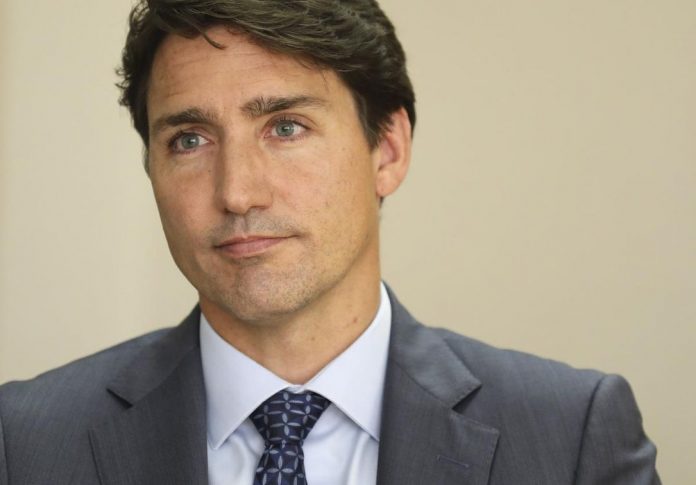
On Friday August 30, Prime Minister Justin Trudeau met with Vancouver mayor and former New Democratic Party MP for Burnaby South, Kennedy Stewart. The two met on the front steps of Vancouver City Hall and proceeded to speak about what they have planned for the future of Vancouverites and Canadians more generally. Their main talking points included battling the opioid crisis, new housing developments, and extending the Millennium Line division of the SkyTrain down Broadway Street.

However, one thing to keep in mind is that all this hyped-up rhetoric is a by-product of election season, a political strategy to secure votes. Voters should remember not to be swayed by the staging of high-emotion issues when weighing the candidate they believe best represents their interests. 

Aside from Trudeau’s photo-op with Mayor Stewart, in which he made brief statements about where the money will be invested, his re-election platform more generally gives no explicit indication as to where the money is intended to be allocated. Given that this is such a pressing matter, would it not be important to clearly lay out to voters what the federal government has planned moving forward? 

Considering the significance of the effects of the opioid crisis across Canada, and particularly in British Columbia, Trudeau’s focus on this issue makes him appealing to some voters. Trudeau says his government plans to continue to work toward a solution to the epidemic through legislative change and further investing in border security, safe injection sites, and resources for first responders. Part of this plan includes working with international partners.

The federal government says that they are exhausting all options when it comes to finding a solution to the crisis, and part of that involves a  $100 million investment, nation-wide, to fund the battle against the opioid epidemic. This is a significant amount of money, and it could potentially provoke a favourable change. 

In British Columbia alone, opioid related deaths rose from 1,007 in 2016 to 1,546 in 2018. Both local and federal governments acknowledge that this is a public health crisis. However, previously implemented solutions appear to not have been very effective, given that opioid related deaths in Canada increased by over a thousand in two years. 

Admittedly, it would be expecting too much to anticipate a positive change in such a short time period, however, the opioid problem is getting worse. Trudeau’s promise of continued investments now, when he had years to address this beforehand, can be interpreted as political rhetoric exclusively designed to attract votes. If Trudeau is genuine about resolving this issue he should be more inclined to employ bold strategies. Decriminalization of illicit drugs has been proposed, but Trudeau and his party are not in favour of this. It might be wise to reconsider if they plan on capturing British Columbian votes come October.    


The US’ response to the Saudi oil strikes makes little political sense

0
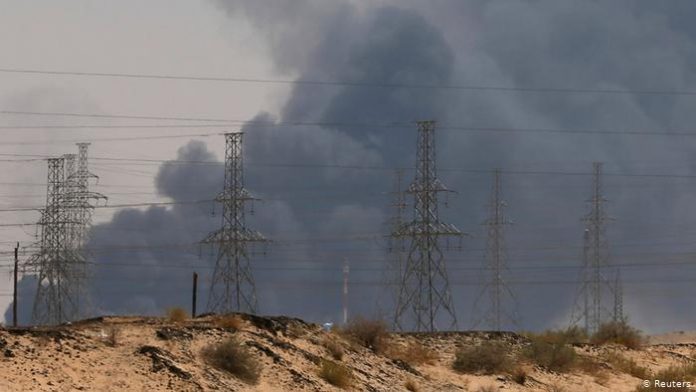
The damage to the refineries was relatively minor. Photo: /Reuters

By: Kelly Grounds, Peak Associate

On September 14, a drone strike critically damaged two of Saudi Arabia’s oil manufacturing infrastructure. The attack was allegedly carried out by Houthi rebels, a group that appeared after the Arab Spring and are fighting for freedom in Yemen. They are currently engaged in a proxy war against the Saudi-led coalition in Yemen.

This attack halted production of 5% of the global oil exports. While there were no casualties reported — and it is expected that the kingdom of Saudi Arabia will have both refineries back online by the end of September — a global market panic has set in.

However, despite the dip in oil production resulting from these strikes, the panic is not related to oil prices, which are expected to calm down. The panic is instead related to the potential of a new war between the United States and Iran. 

Iran was drawn into this issue after Saudi officials claimed that the drones used in the attack were launched from Iran, north of the kingdom. Officials further claimed that the weapons were the type used by the Iranian government. After hearing these accusations, the United States came to the defence of their ally, suggesting that the attack was the Saudi’s “9/11.”

The United States is obviously not located in the Arab Peninsula. Moreover, the attack was not as bad as it was initially thought to be. So why is the White House comparing it to “9/11,” an attack that killed approximately 2,753 people? There are implications within that statement, the biggest being a precedence for military action in the region which could potentially make the humanitarian catastrophe in Yemen worse. 

If this were to happen to a close US ally like Canada, the President’s reaction would make a bit more sense. However, Saudi Arabia is not a close ally in the traditional sense, so the hyperbolic jump to Saudi Arabia’s defense is puzzling — especially as it only draws the US into further conflict in the Middle East.


By stripping the patriarchy, Hustlers highlights badass female friendships

0
Hustlers features an all-star cast, including Lili Reinhart, Jennifer Lopez, Keke Palmer, and Constance Wu. Image courtesy of STX Films / Variety.

By: Kitty Cheung, Peak Associate

Sexy. Provocative. Criminal. These are just a few words one might use to describe this powerful, female-driven movie. Inspired by a true story, Hustlers recounts the story of a group of former strippers who leave dancing to build an empire out of luring white-collar men into clubs and hotel rooms, drugging them, and stealing from their bank accounts. 

Having grown up fucked over by American capitalist society, these women decide to take matters into their own hands by targeting Wall Street assholes and their credit cards. They’re glamorous, independent, and business-savvy — well aware of their charm and allure, they’re also dangerous.

The screenplay, written by director Lorene Scafaria, was inspired by an article from The Cut written by Jessica Pressler, titled “The Hustlers at Scores.” The article tells the real-life story of Roselyn “Rosie” Keo and Samantha Barbash (fictionalized in the film as the characters Dorothy/Destiny and Ramona, respectively) and the other women they recruited into their money making scheme. The film’s script borrows many notable lines from the article, notably “Just a sprinkle” and “What a boob!”.

The film’s editing fluctuates between present-day and flashback as Destiny (played by Constance Wu) recounts her side of the story. The present-day portions of the film centre around Destiny’s experience during an interview with journalist Elizabeth (Julia Stiles) from inside Destiny’s flawless suburban home. 

Hustlers begins with Destiny struggling to make ends meet as she supports her aging grandmother. Defeated and dejected by the difficult nature of her strip club work, she looks to senior dancer Ramona (played by Jennifer Lopez) for guidance. Eventually, the two lose touch, only to reunite after the 2008 economic crash when Destiny joins Ramona in her grand “marketing” scheme.  

The theme of female friendship runs strongly throughout the film. Women supporting women is especially apparent in the first scenes inside the strip club’s dressing room. There’s lively energy and excitement in the fun teasing between the women, whether they’re talking about their work or their dildos. The diversity of the cast, featuring women of different body types and colours such as Keke Palmer, Lili Reinhart, Cardi B, Lizzo, and Trace Lysette, is especially apparent in these dressing room scenes.

While the relationships between the characters were portrayed convincingly by the cast, the more technical aspects of the film also had a hand in establishing its theme. For example, the colouring of the strip club scenes was visually striking and evocative: lush with pink and indigo hues, it’s pretty, feminine, and strong.

The soundtrack of the film offers major throwbacks to Top 40 hits from the 2000s. From Britney Spears’ “Gimme More” to Usher’s “Love in this Club” to Lorde’s “Royals,” it was interesting to see how music was used to denote different time periods within the storyline.

As a critique of patriarchal capitalism, this is a story about boss ass bitches taking charge of their careers and their livelihoods. While conflicts definitely do arise between Ramona and Destiny, the story of these (literal) partners in crime demonstrates the strength and intricacy of female friendships. 

Hustlers is currently showing in movie theatres across Canada.

What Grinds Our Gears: Stop making us pay for access codes and broken web content

0
There’s no reason for digital information to cost as much as a textbook. Illustration: Alice Zhang/The Peak

By: Ahmed Ali, SFU Student

As students, we already have a lot of expenses at SFU. Between just tuition and textbooks, we’re dropping over $2,000 per semester at least — more for international students. But another expense that you don’t expect until it smacks you in the wallet are access codes for certain courses. 

Particularly people in the sciences, students will be familiar with a course requiring you to use your instructor’s code and an access code from the bookstore to sign in to an online site for assignments and practice. 

The problem with this is that even if you have the material from a previous course like biochemistry (MBB) or bought the books secondhand, you still have to buy the codes again — in some cases costing $80 or more. And even if you already had access to a site from a previous course, the website may say that it’s expired, requiring more chats with customer support. 

I’ve personally had several different providers of access codes (Wiley, Cengage, Pearson Masterings, Webassign). With them comes no shortage of issues: connecting, downed servers, browser support and cache problems, weird marking systems and, recently, an overcharge of $481.36 for a $125 code and textbook package . . . 

It’s a pain to constantly deal with all of these different sites, pay extra fees, and fiddle with tech issues — all for information I may already have! At the very least, enrolling into a course should grant you automatic access to all the necessary online materials, without the need for extra hoops to jump through.

Inside the Human Traffic Jam

0

Peak Sports Mailbag: Week 5

0
Side profile of a mailbox with a basketball in the middle with flames surrounding it.
What is up with all these letters? Photo: Amazon Marketplace

By: Brandon Braich, Peak Associate

Hey Peak sports readers,

My name is Brandon Braich, and I’m this week’s host for the NBA basketball themed Peak Sports Mailbag. Thanks so much to all of our readers for submitting their basketball-related questions, and my apologies if your question didn’t make it into this week’s edition. Usually, the Mailbag host will only answer three or four questions. Don’t worry though, as all questions submitted count for an entry into the raffle draw whether or not they are addressed in the Mailbag. Now, onto the questions!

Question 1: “Why don’t any NBA players shoot free throws using an underhanded toss? Wilt Chamberlain toyed with this for a month during his career and it’s been shown to be a shooting approach that has fewer variables. Is it just that players don’t want to look silly in front of their peers or is there something more to it? – Gurpreet. 

Answer: Rick Barry is perhaps the most successful example of a player using the underhanded free throw technique. Barry was a 89% career free throw shooter, and promoted the style to his peers, who for the most part, rejected the advice. At the end of the day, the strategy does not make sense for most of the NBA. Guards should be able to make free throws at a very high percentage and it is only logical to continue to use the form they use for all their shots. Strong free throw shooters regularly shoot around 90%, the elite mark Barry achieved. 

The question that arises is whether players such as Chamberlain, who famously struggled with free throws, should adjust how they shoot. Big men have physical disadvantages when it comes to free throws due to their height, strength, and large hands. Hulking centers are not able to get as much arc on their shot and have less touch and control.

Despite the seemingly small size of a hoop, it actually can fit two basketballs at once, so the higher the angle the ball is coming in, the larger the target is. The big benefit to underhand shooting is the ability to get more arc for taller players that struggle with this. Given the data and science that support this, it appears the biggest obstacle to more players adapting this strategy is the simple problem you have mentioned; the optics of doing a “granny shot” would be embarrassing for most players!

Question 2: “When do you see Vancouver getting an NBA team again, if ever? In your opinion, what are the main reasons Vancouver couldn’t support an NBA team? Do you think it would be different now?” – Darren. 

Answer: When the NBA comes to town in a few weeks for another pre-season game, Vancouver will once again get a taste of NBA action after losing the Grizzlies nearly two decades ago. The Grizzlies were an example of managerial failure, as one cannot say the city did not support them. Considering the team never won more than 23 games in a season, the fact that attendance began to fall in their last couple years cannot be blamed on the fanbase. 

The NBA, despite continuing to grow and generate profit, may not exactly be looking to expand. While the league as a whole pulls in massive revenue, on an individual level many teams actually lose money before revenue sharing. As a result, adding more franchises may dilute the profit of the other teams.

The other obstacle facing expansion to Vancouver lies just south of the city. Seattle seems to be next in line for a franchise since the city has an NBA quality stadium as well as a large, built-in fan base from their Supersonic days. Regardless, the fact that the only northwest NBA team is in Portland is a travesty for all the NBA fans living in this region, and even expansion into Seattle will allow the game to grow here in Vancouver. 

Question 3: Do you expect any more large transactions before the season begins?” – Nigel.

Answer: Chris Paul seems to be the obvious target to move. OKC is heading towards a rebuild and should be looking to deal Paul and his large contract, while CP3, despite his age, can still be a difference maker on a contender. A potential deal however will not be straight forward, as you would expect the Thunder will want to receive assets in return, which may be difficult due to Paul’s contract. Paul is due to be paid a whopping 38 million this coming season. 

A rumoured possible destination are the Miami Heat, who are looking for another star player to pair with the recently signed Jimmy Butler. The Heat are a compatible partner as they are one of the few teams that can match salary with contracts that are expendable, most notably, Goran Dragic, Dion Waiters, and Kelly Olynyk. The question will be if the Heat will be willing to send a 1st round pick in return, or possibly their best young asset, Justise Winslow. 

I would expect the Thunder will not be any rush to make a deal, so this may stretch into the season, but it is unlikely that Chris Paul will finish the year in Oklahoma City. 

If you would like to participate in future editions of the Peak Sports Mailbag and be entered in a raffle for an end-of-semester prize, here’s what you can send to [email protected]

  • Sports-related questions that our weekly host will answer
  • Weekly theme ideas to guide our questions

Or: sign up to host the Mailbag (and get paid)!

Thanks to all of you SFU sports fans for blowing up my inbox!

Next week’s theme is: Rugby

Next week’s host is: Chris Turenne 

Send in your questions to [email protected]