Home Blog Page 495

To make the most out of university, students should take morning classes

0
ILLUSTRATION: Cora Fu / The Peak

By: Muhammad Saad Iftikhar, SFU Student

Finding the motivation to get up and go to class can be hard, especially if you happen to have lecture scheduled at an inconvenient time. Is it better to get up early and get school over with, saving the rest of your day for more pleasant activities, or is having time to carefully work through your daily routines before class the optimal route? Here are my thoughts on the best and worst times to have class.

8:30 a.m.: Going to class at 8:30 a.m. can mean waking up at least two hours before the class. Living away from university in Metro Vancouver takes between minutes and hours on public transport during normal rush hours. This means rushing to make breakfast and get ready before the bus leaves. One bonus that comes with this time is waking up with the sun in preparation for a future of co-op studies, or a professional career.

10:30: Classes held slightly later in the day give students some room to stay up later at night — for partying or studying purposes, whatever. It also allows students enough time to complete morning rituals like showering, getting ready, carefully choosing a weather-layered outfit, and preparing notes for class. As a bonus, there’s still enough time after class for social activities.  

12:30 p.m.: Most of my peers prefer to go to class at this time because it allows for a comfortable amount of time to do exercises in the morning. Students are thus able to go to class with a fresh mind. One possible downside is having to postpone lunch, especially if the professor doesn’t allow eating in class. 

2:30: It’s the middle of the day for most students, which means students having to manage schedules for various activities before and after the class. This kind of break up makes it hard to motivate oneself in the morning while waiting for class to start, and even harder in the evening, after class ends. The result is that not a lot actually gets done aside from going to class.

5:30: Evening and night classes are obviously beneficial for night owls and those with part-time jobs. These classes give students a lot of room to do all the things they need to during the day — whether that be test preparation or hangover recovery. For some students, this time slot can be annoying as they look forward to night as the time they get to relax. 

Overall, the best times to take classes are in the mornings. It’s best to get classes over with early to have time to do other things in the afternoon, such as volunteering and socializing. This helps to break up the monotony of school and also establishes consistent routines throughout the week and into the future. Later morning classes have the added benefit of allowing time at the gym, which boosts metabolism and helps the body and the mind to get through the day with full energy. Afternoon or evening classes leave students with the temptation to spend most of the day sleeping, which disturbs daily rhythms.  

Mitch Ledyard talks hockey, school, and chocolate with The Peak

1
Ledyard on the ice at the Bill Copeland Sports Centre. - Photo credit / SFU Hockey

By: Rija Butt, SFU student

Second year student Mitch Ledyard has a dangerous obsession with chocolate, but that won’t stop him from being the best version of the hockey player his dad and uncle have taught him to be. 

Having grown up in Port Coquitlam, BC, Ledyard came to Simon Fraser University knowing he could balance academics and hockey. Ledyard is aiming to major in communications and minor in business, with aspirations to go into marketing in the near future. His love for hockey began because of his father and uncle, who got the chance to play in the National Hockey League (NHL), which was a major source of inspiration. Later on, Ledyard adopted his uncle’s number 12 to serve as a constant reminder of the hockey-related lessons his father and uncle passed on to him. 

The Peak had the opportunity to talk to Ledyard about hockey, school, and everything in between. 

The Peak: I love that there’s a personal touch to your passion for hockey. Can you tell me a bit about being mentored by your dad and uncle while you were getting into the game? 

Mitch Ledyard: I had the privilege of being coached by my dad until I was about 13, so it was always nice talking to him a little extra on the side for pointers and ways to get better.

P: You also mentioned that both your father and uncle played in the NHL. Do you see yourself playing in the NHL one day, or do you have different dreams? 

ML: You never really know. The NHL is the greatest league in the world, so that may be a bit of a stretch. But I can definitely see myself playing professionally after I am done collegiately. Europe would probably be the best experience overall, as far as playing and travel goes, so anywhere out there would be ideal.

P: Being a second year student at SFU and playing a high level of hockey must get tricky sometimes. How do you manage the balance between work and play?

ML: The balance of hockey and school can be difficult at times with the course load. But coming to the rink every day and being around your teammates/brothers and playing the game we all love is very refreshing; it really takes your mind off of the stress.

P: Who would you say is the biggest supporter that helps keep you at your best, inside and outside of the team?

ML: Inside the team, I would have to say everybody. Every person in our locker room, from top to bottom, wants to win and in order for us to do that, everybody has to be accountable for themselves and each other. Pushing your teammates to strive for success is the biggest motivator in my eyes. Outside of the team has to be family. My parents come to every single game, always ask me how practice went and how my teammates are. They are very supportive of my decisions and are always there for me.

P: Going forward into a career with your sights set on marketing, what do your future plans for hockey look like?

ML: Well, after university, I want to try and play professionally if something is available for me. If that doesn’t work out, then staying involved in the game is for sure something I am looking to do. Working for the Canucks would be pretty cool. Growing up watching them play, going to games, and then working for them would be surreal.

P: You have been a very promising player on the ice. What has been one of your favorite moments with the team so far?

ML: Last year, we went to Alaska to play a few NCAA teams. That was a really unique experience for me. To see their facilities and a different part of the world was pretty special.

P: Adding on to the earlier question, how do you and your teammates get through the bad days?

ML: We all get caught up in school and we dread it every day when, really, there aren’t any really bad days. We all get to see each other every day, have some laughs at the rink, and we go to a pretty prestigious school, so that’s a benefit as well. But coming to the rink every day and doing our thing on the ice helps the most, in my opinion, and other guys will probably say the same.

P: Have you ever thought about what life would be like if it wasn’t for hockey and all the people that you’ve met during this journey?

ML: I honestly haven’t really thought about that. My life has revolved around hockey my whole life, and everything I do, I try to base it around that. I have met so many amazing people on my journey so far. I’ve had some really great coaches and personnel who have taught me a lot and challenged me. I’ve met most of my best friends through hockey, so I can’t ask for too much more.


SFU Hockey adds three students to team staff

0
McKeowen Watts, SFU Hockey's new statistics and video coach - Photo credit / McKeowen Watts

By: Michael Lenko, Peak Associate

The SFU Hockey team has continued its summer of revamping the organization with the announcement of the hiring of three SFU students. Jordan Allen, McKeowen Watts, and Lauren Fuerderer have all joined the Clan for the 2019–20 BCIHL season. Allen will be filling the role of equipment manager, a position that was left vacant last season. Fuerderer has been hired as the team’s marketing coordinator and Watts will be the first video and analytics coach in Clan history. The Peak sat down with all three of the new hires to find out a little more about their background, role with the program, and expectations for these positions. 

Jordan Allen is a fourth year, majoring in criminology. In his role as equipment manager for the team, he will be relied upon for a wide variety of duties including: managing a thorough inventory of all team equipment, the organization and upkeep of team facilities like dressing and storage rooms, and procuring or providing general maintenance to equipment, tools, apparel, and accessories. 

With Allen carrying out these important off-ice duties this season, players will be more free to focus on their on-ice performance. The Peak sat down with Allen to discuss his new position.

The Peak: Why did you decide to get involved with SFU Hockey?

Jordan: I’ve always been interested in hockey and I’ve played it my entire life at a fairly high level. I played rep hockey all the way through minor hockey. I thought, why not start a career in it if I like it so much? And getting involved with the school [team] is a good way to do it.

P: You were involved with the 2019 World Junior Championship here in Vancouver last year. How do you think that experience will help you as equipment manager?

J: : It gave me good experience of working with guys around the age [18–20]; knowing how everything works and being that old myself is helpful. It was a lot of good experience with professionals, who are already in the industry. They gave me a lot of great tips and just general learning that made it a great experience.

McKeowen Watts is a third year student at SFU. He is aiming for a major in statistics and a minor in business administration. As the statistics and video coach, Watts will be providing the coaching staff and players with clips of important video and statistical analysis of games. This will help the Clan better prepare for opponents and allow the players and coaching staff to see where they need improvement. The Peak was able to discuss the details of Watts’ new position.

The Peak: What made you decide to get involved with SFU Hockey?

McKeowen: I wanted to be able to be involved with a hockey team in a coaching/statistics role.  Having it be with the team of the school I attend makes it even better!

P: How do you think your role with the team will impact players performance and the roster decisions the coaches make?

M: I think that I will be able to provide a different perspective for the coaching staff. I plan on providing scouting for the team to give them the upper-hand on our opponents. I also plan on collecting and tracking team data — giving both micro and macro analysis to the players and coaches to improve on ice performance.          

Lauren Fuerderer is a fourth year SFU student, majoring in Marketing and Human Resources. She will be the team’s marketing coordinator for the upcoming season. This role is dedicated to improving student engagement and community involvement to increase attendance at games. She will help run promotional events and fundraisers, while finding other ways to build awareness of the team. The Peak spoke with Fuerderer about her involvement with the team and the promotions she has in mind for this season.

The Peak: What made you decide to get involved with SFU Hockey?

L: I decided to get involved with SFU Hockey because, not only does this role allows me to gain experience in my field, but I can also combine it with my passion for sports. Being a former SFU student-athlete, I am quite familiar with the athletics programs and I was looking to get involved in ways that can both benefit me, career-wise, as well as give back to the SFU athletic community.

P:  In an earlier interview with Director of Education and Player Experience, Ryan Sandrin said he wanted to create a more collegiate like atmosphere for the team. What are some of the ideas that you have for doing this during this season?

L: My main focus for this season is to increase student awareness about the team to hopefully encourage their attendance at our games. I feel, in the past, the hockey team has been under-recognized around campus and that, with increased exposure, the team can become a more integral part of the school community. I plan to coordinate several fundraisers as well as events at our home games and create brand partnerships to get a buzz going around the team. I am excited for this upcoming season and can’t wait to play a role in the growth of student engagement with the team.        

Allen, Fuerderer, and Watts will not have to wait long to help the Clan on a game day as the team will kick off their regular season schedule on October 11 at the Bill Copeland Sports Centre. The home opener is the first opportunity for the revamped roster and staff to come together for a meaningful game that will go toward building a competitive team.

New photo exhibition at Club Ilia strikes at the heart of the SFU community

0
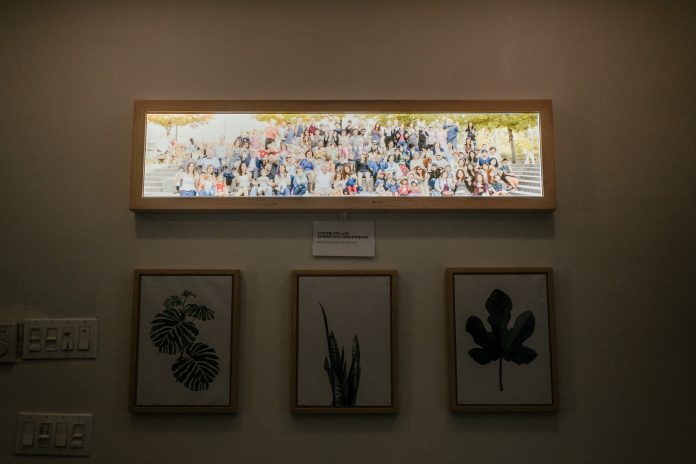
Photos from SFU’s history are displayed throughout the restaurant. Image courtesy of Chris Ho / The Peak.

By: Kelly Chia, Staff Writer

In an effort to help foster a strong sense of community on Burnaby Mountain, SFU alumna Jennyfer Chamberland, who works with Club Ilia, has created an ongoing art exhibition in the restaurant, curated from the SFU archives. Chamberland and Tina Blakeman, general manager of Club Ilia, spoke to The Peak about their motivations behind the selected pieces.

I met Chamberland and Blakeman at Club Ilia to view the photo exhibition and discuss its origins. Chamberland was deeply motivated to curate pieces that spoke to the SFU community because of her connection to it. 

Chamberland has multiple connections to the mountain: she was a student at SFU, staff member at SFU, lives at UniverCity, and has a daughter at the school. With this, she claims to have a big heart for the school and restaurant. “I was happy to reach [out] to my contacts and knowledge of this community to make the display,” Chamberland said, gesturing to the newly framed photographs all over the restaurant.

Club Ilia has been open at SFU for over 10 years, and it’s located right between the campus and UniverCity, the residential and commercial community developed adjacent to the school. Its history and location make it the perfect intersection where the campus community meets the larger Burnaby Mountain community. This was the starting point for Chamberland’s work.

Chamberland reached out to SFU Archives and Records Management first, then explored alternate sources to curate this collection. 

“We reached out to The Peak, but we also reached out to other groups like the Terry Fox Foundation, [the] First Nation studies [department], various sports teams, and other community groups like the SFU Community Trust.”

At the time of The Peak’s meeting with Chamberland and Blakeman, there were 12 displays in the restaurant, all revealing different parts of the SFU community. One frame showed athlete and SFU alumnus Terry Fox, and another showed activist and Nobel Peace Prize recipient Desmond Tutu receiving an honourary degree. The black and white tint cast over all of the photos made them look timeless. 

Image courtesy of Chris Ho / The Peak.

“I wanted to capture photos of key figures,” Chamberland said, looking at the photos. 

She and I conversed briefly about the significance of these people and their relationships to SFU. Pointing to the frame of Desmond Tutu, she said, “A lot of people don’t know that he was here to give a degree speech! A new student coming in might find that really neat.

Image courtesy of Chris Ho / The Peak.

In the main room of the restaurant, more photos are framed above the seats. The two pictures that drew my attention depicted students protesting tuition hikes in the 1980s, photographs which remain relevant for students today. 

Image courtesy of Chris Ho / The Peak.

“SFU has a history of protest,” Chamberland nodded, looking at the photographs. “We tried to capture some student protests [ . . . ] it’s always been a struggle. So when you look at these pictures, and you see that continuity [from then and now], it’s a conversation starter.” 

Engaging with the SFU community is ultimately Chamberland’s goal with the exhibit. 

“A lot of students are coming here from far away, and they’ve left their homes. You know, it’s scary enough being a full time student in a far away place. [But] where do you go to make connections?” Indeed, Chamberland’s sentiments highlighted SFU’s reputation as a commuter campus. 

Chamberland said that Club Ilia has, by virtue of its location, a role in creating this special space for the community. 

“Sometimes the campus hasn’t provided a lot of options for that. But we [Club Ilia] feel like we have that intimate space, that home-cooked kind of feeling [ . . . ] where people can come and connect.”

For future plans with the exhibit, Chamberland is looking to the SFU Community Trust. 

“They have a lot of pictures that reflect the SFU community up here,” explained Chamberland. 

“They’re literally building a community up here,” she continued, referring to UniverCity. 

Moreover, Chamberland is also looking to engage with student groups to capture some of their activities, such as showcasing the art of SFU students. Chamberland indicated that there are many directions the exhibit can go, as it is the restaurant’s first launch into a creative partnership with the community.

“This was our first selection, and what we plan to do is continue to get submissions from various groups and actually change them up on a regular basis,” Chamberland explained, noting that she’d like the pieces to help people learn more about their campus and their community. 

Jennyfer Chamberland’s curated exhibition of archival photos is currently on display at Club Ilia.

SFU needs to find better ways to update students on construction changes

0
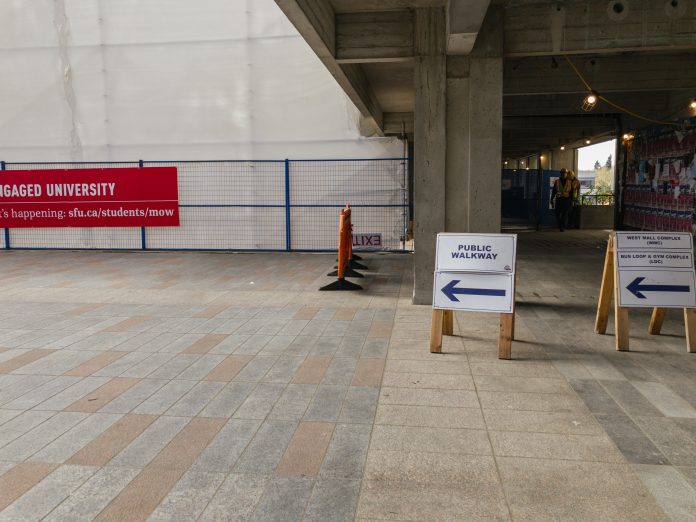
SFU is a place of learning first and construction needs to work around us. Photo: Andres Chavarriaga / The Peak

By: Jennifer Low, Peak Associate

Campus-wide construction has made SFU a maze of public walkway signs and blue fences. In addition, the beginning of the fall semester also brings about a whole new set of challenges with increases in student foot traffic and poor weather making navigating around construction sites even more difficult and frustrating. Poor first years scuttle across campus with maps that don’t indicate blocked areas. Returning students realize that their usual short cuts and routes are inaccessible or ruined by the sounds of jackhammers. And all the students trying to get to the upper bus loop are forced to take the same depressing muddy path through that creepy blue pyramid. 

Honestly, I didn’t expect to still be getting lost in my fourth year at SFU . . . OK, maybe I thought I’d lose my way in some God forsaken tunnel in Robert C. Brown Hall, but never in the wide-open spaces of the Convocation Mall or Academic Quadrangle courtyard! 

Recently, while walking from West Mall to the library, I hit a never before seen dead end next to the Rotunda. I, along with many other students, were rerouted around to the other side instead. But with only one way to get through to the other side of campus, the walkway beside the Maggie Benston Centre was packed with soggy students standing shoulder to shoulder and holding umbrellas still dripping from the rain. 

“At least this beats having to take the upper walkway,” I thought, remembering last semester and the unnecessary number of stairs and uncovered areas students had to traverse.  

SFU needs to step up and be more considerate of students’ needs, especially when it comes to student foot traffic in slippery, wet conditions. With no immediate solutions to construction rerouting in the near future, SFU can start by updating their paper maps and the SFU Snap app to comprehensively detail where students can walk to mitigate these problems. This may also include providing alternative routes in case of poor weather conditions.

I know that SFU looks like a medieval dungeon, and that we need the construction to improve and maintain our school’s infrastructure, but that doesn’t mean that students should be sacrificing their time and education to accommodate construction. 


SFU opens conference play with second loss at home this season

0
The Clan offense in motion - Photo credit / SFU Athletics

By: Brandon Braich, Peak Associate

In their first GNAC game of the year, SFU fell to Azusa Pacific 38–12 in front of a crowd of 656 at Swangard Stadium. Despite the lopsided final score, the Clan were within striking distance for most of the game, but allowed the Cougars to pull away in the second half. 

In the first quarter, Dante Davis put the visitors up 7–0 with a short one yard plunge. Davis finished with 79 yards on 16 carries with three rushing touchdowns. The Clan struggled to move the ball early, with Brandon Niksich being unable to connect on several throws down the field.

Fortunes changed for SFU a few minutes into the second, when Niksich hit Solomon Hines out of the backfield for a 75-yard touchdown pass. After getting behind the defense, Niksich feathered in the pass perfectly, allowing Hines to romp into the endzone untouched. However, on the ensuing extra point attempt, a bad snap led to a failed conversion which kept the game at 7–6.

After forcing a stop, the Clan got the ball at their own 43-yard line looking to strike again. But after failing to convert on third down, coach Thomas Ford decided to roll the dice by keeping his offense out on a fourth down and four at midfield. Niksich dropped back and was able to escape the pocket when the Cougars brought pressure, but was intercepted by Micah Roth, giving Azusa Pacific the ball back with excellent field position. 

The Cougars quickly capitalized after a long run by Zikel Reddick set up another touchdown run for Davis. The Cougars had success running the ball throughout the night, finishing with 314 yards. The ground attack was led by quarterback Anthony Catalano, who made a surprise start for Azusa Pacific. While Catalano struggled through the air, he finished with 128 yards rushing on only six carries. 

Niksich was able to shake off the early mistake, though, striking down the field again by hitting Rysen John for a 50-yard touchdown. John lead all pass catchers with 122 yards receiving. The missed extra point proved costly however, as the Clan were unable to complete the two point conversion, leaving the deficit at 14–12 heading into the half.

Azusa Pacific answered quickly to start the second half, with Catalano leading an 88-yard drive down the field that ended with a 12-yard completion to tight end Shane Hursh to make the game 21–12. 

Later in the fourth quarter, the Cougars looked to extend their lead with a short field goal. The Clan were able to block the ensuing attempt to keep the game within reach. Unfortunately, on the very next play, Niksich was intercepted again, this time by Ben Sukut, who returned the interception 29 yards for a touchdown. 

The game was finally put out of reach when Davis rushed for his final touchdown with five minutes left in the fourth, pushing the lead to 35–12.

Despite the loss, there were obvious positives for the SFU squad, including the best game of Niksich’s young career. The freshman quarterback finished with a career high 312 yards passing and two touchdowns. The game also saw the return of Mason Glover from injury, who rushed for 45 yards on 12 carries. 

Isaac Evans lead the way defensively, finishing with nine tackles, including four tackles for a loss, and two sacks. 

SFU will now hit the road for a visit to Western Oregon University for their second conference game of the year. The Wolves are 2–0 in conference play. 

SFU Sports: The week ahead

0
Photo credit / SFU athletics

By: Dylan Webb, sports editor

SFU sports fans can cheer on their hockey, volleyball, and men’s soccer team’s at home this week. Here’s a brief breakdown of some of the SFU sports action lined up for the week of October 6–13.

Volleyball:

Returning home from a long road trip spanning almost half of the continental US, the SFU Volleyball team hosts two conference opponents this week at the West Gym. On Thursday October 10, Seattle Pacific University will visit Burnaby Mountain. Two days later, on October 12, Saint Martin’s University will visit for the first time this season. Both games will tip off at 7 p.m. and Clan themed socks will be given away to fans at each game.

Men’s Soccer: 

The SFU Men’s Soccer team will host Concordia University on October 10 at Terry Fox Field for their third conference game of the season. The team will aim to continue its strong start to the 2019 season by knocking off their Oregon-based rivals. Kickoff is scheduled for 7 p.m. 

Women’s Soccer:

Continuing a string of four consecutive road games, the women’s soccer team visits Interbay Stadium in Seattle, WA to take on Seattle Pacific University. Kickoff is 4:30 p.m. on October 12.

Hockey:

After a cross-continent road trip to Worcester, Massachusetts to take on NCAA Division 1 opponents Holy Cross University and Sacred Heart University, the SFU Hockey team will open their 2019–20 British Columbia Intercollegiate Hockey League season this week. The Clan kicks off their quest for a championship with their home opener on October 11 at 7 p.m. at the Bill Copeland Sports Centre. 

Football:

The Clan will travel to St. George, Utah to take on the Dixie State University Rams in their sixth game of the season. The team is still in search of their first win of the season. This out-of-conference contest takes place on October 12 at 6 p.m. at Trailblazer Stadium.

SFSS scores with Fall Kickoff 2019

0
Fall Kickoff 2019 was a big hit with students

By: Jess Dela Cruz, News Writer

Rumour has it that SFU is boring. Period. 

Vice President of student life, Jessica Nguyen, wanted to challenge the negative stereotypes that have been brought upon SFU. Nguyen hoped to achieve this by bringing back Fall Kickoff and expressed, “we wanted to show that SFU can have fun.” 

Fall Kickoff was last held in 2017. But this year, SFSS events committee chair Monish Farswani said, “Fall Kickoff 2017 had many incidents that reflected badly on the SFSS and SFU.” 

But this year, Farswani and the events committee “wanted to create [a] sense of engagement for first year students and allow them to experience the fun activities the SFSS has throughout the year right within their first month of school.”

This year’s lineup was Snakehips, MadeinTYO, Outr3ach, Manila Grey, Illyminiachi, Eric Reprid, and Fuji Kyle. In collaboration with Timbre Concerts and CRESCENDO1, an events and entertainment company, SFSS “wanted a Rap/EDM vibe that would get students out and bring a festival type atmosphere,” said Andrew Araneta, who was also on the events committee prior to graduation. In previous years, the concert took place in Convocation Mall. However, due to construction, it took place in Strand Hall lot. 

Student safety was SFSS’ priority this year. There was heavy security, first aid, and an ambulance on standby. Farswani said, “we wanted to make sure that everyone inside the venue could enjoy their experience and feel like they were in a safe space.” 

The rappers and DJ’s had a hard time getting the crowd energetic in the first few hours. This was evident as the lot was fairly empty in the beginning hours and attendees had their own little groups spread out all over — talking to each other whilst the performances were going on. At one point, Illyminichi asked the crowd to come closer to the stage and said, “I need more energy!” The vibe was low and the transitions from performer to the next were long. 

When asked about what they were thinking of Fall Kickoff so far, student Amin Sharifi said, “lame, lame, and lame.” Ahmed, another attendee who preferred not to give his last name, commented, “I’m ready to bust out all the moves. . . [but] people are not dancing as much as I expected.” Things quickly turned around, however,  as more students came and the sun started to set. 

As Manila Grey, Outr3ach, MadeinTYO, and Snakehips performed, the crowd became larger and larger; there were always groups of people trying to snake their way through the front. At this point, it was so crowded that the only move that one’s own body could physically do was just stand and pump their fists in the air.  

“The best part was when everyone was singing loud, dancing, and just getting lost in the music,” said Medy Sin. 

Multiple mosh pits happened throughout the night consisting of a lot of pushing, falling down, and getting up to do it all over again. The crowd made an effort to sing, dance, and record this moment with their friends and lovers. The timing of the lighting, which was flashing in tune with the music, and the loud bass that one could feel in ones chest, gave the latter part of the evening a feeling of intensity.  

Ending right at nine o’clock with Snakehips’ All My Friends (ft. Tinashe and Chance the Rapper),  those with after party tickets headed to The Study for drinks and more dancing to a DJ hired by the SFSS. 

Following the event’s conclusion, students had many opinions. One student, Pooria Arab, expressed her gratitude for the event in “providing [her] mind, [her] body, and [her] hips with a break.” Arab stated, however, that “if [Kickoff] had started later, like around six and ended at midnight, then it would have been a whole other experience.”  

Some students like Bradeon Van Gorkom, however, decided not to attend Fall Kickoff. His decision was because of the ticket price. He said, “I didn’t want to spend money on an event that I would stay up all night for and possibly get sick. . . Fall Kickoff seemed fun and I would have gone for a little while if it was free.” 

Another student, Shana Edalat suggested to include more food trucks, designated areas to sit, and the performers’ merchandise to purchase for next Kickoff.  However, she was overall satisfied with the event. 

“I expected it to be a concert or rave-like event and was not disappointed.”


SFU can support trans* rights by not conflating free speech and hate speech

0
Transphobic feminist Meghan Murphy is set to speak at the November 2 event. Photo: /The Georgia Straight

By: Gabrielle McLaren, Editor-in-Chief

I’m so sorry to all my trans*, genderqueer, nonbinary, and queer peers. You shouldn’t have to deal with noted transphobes speaking on your campus. 

Meanwhile, SFU is claiming neutrality vis-à-vis the “How media bias shapes the gender debate” event. Hosted by an SFU professor at the downtown campus, the lecture features a line-up of speakers known within the LGBTQ2+ community for transphobic discourses and ideals — including Meghan Murphy. She previously booked a room at the Vancouver Public Library, after which VPL was barred from walking in the Pride Parade. Why? Because performative allyship means nothing if you are, in concrete ways, giving hatred a platform.  

Following public outcry and concerns, SFU issued a statement that can only be described by my grandpa’s favourite ice cream flavour: vanilla. SFU claims that it “support[s] the right [ . . . ] to engage in free speech within the limits of the law” and respects the event because “freedom of expression is a core component of intellectual enquiry and central to the pursuit of knowledge.” Yet one paragraph later, SFU insists that it “support[s] the right of trans community members to define their own gender identity and to be respected . . .” You know that saying “you can’t have your cake and eat it too”? Well, you can’t stomp on queer rights and love us too. 

Here’s the thing: hate speech is never free. If you have the privilege to think so, it’s quite simply because you aren’t bearing its brunt. The existence and legitimacy of trans* folks is not up for “intellectual enquiry,” discussion, or debate — our school should know better. By tolerating an event where trans* rights and existences are up for debate, SFU is implying that there are multiple answers to the question “are trans* lives valid and valuable?” 

The only answer to that question is yes. We don’t need to host events to figure this out. We don’t need to cough up tangible resources — such as space on campus and audiovisual equipment — to mull this over. Our university shouldn’t entertain the notion that there’s room for debate where human rights are concerned.

As a foil to this and an example of institutional responsibility and authenticity, the Department of Gender, Sexuality, and Women’s Studies put out a statement expressing their disappointment, reaffirming their values, and announcing that they will support an event countering this one. Finally, they refer students to organizations working with and for trans* communities. This is how you make sure that your institution is not perpetuating violence. SFU should follow this example. 

I would encourage you to use your own right to free speech at the protest organized by SFU students against this event on November 2 instead.   

Out of this world: CJSF’s Fundrive returns for 2019

0
CJSF’s Fundrive runs October 4–11 this year. Image courtesy of Zeh Daruwalla / The Peak.

By: Andrea Renney, Arts Editor

Tucked away in the Rotunda, where the sound of local music can be heard faintly over speakers installed outside its doors, CJSF Radio (90.1 FM) has been serving SFU in various formats since 1974. The station offers a diverse list of programs, hosted by your fellow SFU students and other members of our community. CJSF aims to “provide points of view that are rarely expressed in mainstream media,” and they endeavor to be a platform for music that is underrepresented on commercial radio stations.

For the second year in a row, the station is running its Fundrive on-air during October 4–11. What’s a Fundrive, you may ask? “[A] fundrive is an on-air fundraising campaign that is fashioned like a telethon, but for radio — so it’s a radiothon,” explains CJSF Programming Coordinator Robin Erikkson via email to The Peak. This year’s fundraising goal is $12,000.

During the Fundrive, CJSF DJs create special themed programming for their regular shows. 

“Programmers make appeals to our listeners for financial support, and our listeners call in to make a pledge or donate online,” Erikkson explains. 

She says a lot of their programmers will produce a “best of the best” type show for the Fundrive, while others will create something “a little more novel for the occasion.” This year’s Fundrive theme is space, so we can likely expect some diverse interpretations of what that means to each DJ.

CJSF’s budget comes primarily from a portion of the activity fee that all SFU students pay along with their tuition each semester. However, Erikkson explains that the rising costs of doing business mean this amount doesn’t stretch quite far enough to cover the station’s daily operational expenses. This is where the Fundrive comes in. 

“Last year’s Fundrive increased our budget by 4%, and this year our goal [of $12,000] will increase our budget by 5%,” says Erikkson. In addition to helping offset operational costs, Erikkson says a portion of the Fundrive funds will also be set aside for the station’s pending relocation on campus due to space issues.

Last year’s Fundrive also allowed CJSF to embark on a unique new project: their Studio 6 live sessions, which are live musical performances recorded at the station’s satellite studio in the 312 Main shared co-working space. Some of the 2018 Fundrive funds were used to outfit the space, and Erikkson says that a portion of the 2019 funds will be used to maintain the project. 

So what’s the best way for SFU students to support CJSF? Get involved with the station! 

“CJSF depends on member participation and people power,” says Erikkson. There are many ways students can volunteer with CJSF: hosting a radio show is the obvious choice, but the station also has opportunities in its music reviewing, public relations, writing, and production departments.

Another simple way to spread the word about the station involves carsharing services such as car2go, Evo, and Modo. After rocking out to their favorite CJSF show, students can leave the car tuned to 90.1 FM for the next driver to enjoy. 

Keep your dial tuned to 90.1 FM October 4–11 for special Fundrive programming. You can help CJSF reach their $12,000 goal by calling in to the station at (778) 782-CJSF each day during the Fundrive, or by donating online at cjsf.ca/donate.