Home Blog Page 464

Hot, budget-friendly tips for fighting the flu

1
Illustration: Danielle Ragas / The Peak


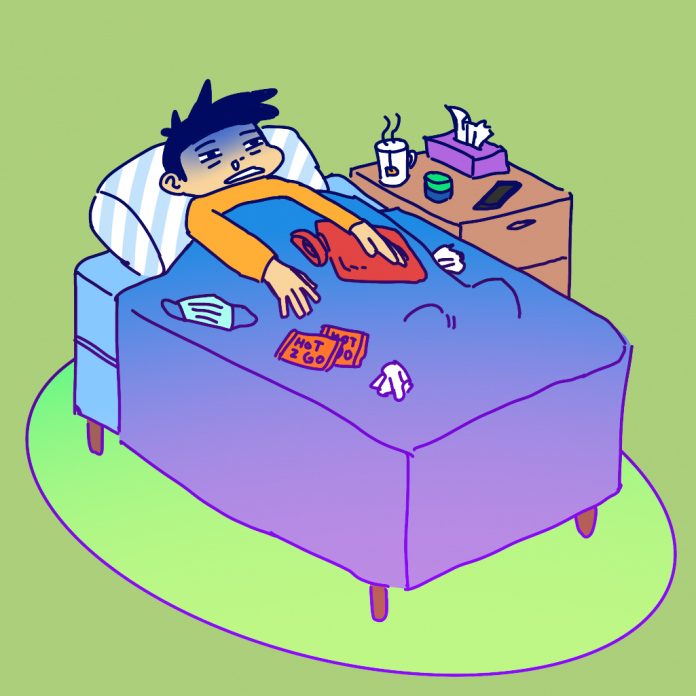
The reign of flu season has begun. Your favourite symptoms — fever, stuffy nose, sore throat, cough, and body aches — are back and ready to attack. Since my friends and I have been taken hostage by some particularly nasty flus before, I’ve learned how to tackle them over the years with tried-and-true techniques. If you’re unfortunate enough to get reacquainted with the autumn sickness, you may be looking for a cure. Taking medicine (hoard night-time flu tablets, cough drops, and nasal sticks) and having plenty of rest and fluids are most important. To add to these, here are a bunch of grandma-approved home remedies that you can try to help quicken the recovery process:


  • Unleash the magic of vapor rub
    Vapor rub is the mentholated potion that fights hard against flu monsters. Massage the ointment a couple of times a day on your chest, neck, and back for soothing relief. However, if you have any conditions that affect your breathing or airways such as asthma, medical advice should be obtained before using vapor rubs. Common brands include Vicks VapoRub and Tiger Balm.
     
  • Steam yo’ face 

Steam inhalation is a common way of clearing nasal passages. The moisture from steam helps to thin the mucus so that you can temporarily get rid of that annoying stuffy nose. To undertake steam therapy, pour boiling water into a bowl, and drape a towel over the back of your head. Inhale the steam from about 8–12 inches away from the bowl, keeping your eyes closed. Inhale it for 5–10 minutes, and repeat it for a couple times throughout the day. Since I’m a true fan of vapor rub, I add it to the water when it’s still hot but not boiling anymore.


My mom swears by this honey lemon ginger tea, so it’s been a go-to in our house for years. The ingredients, which have anti-inflammatory and antioxidant properties, make it a great homemade remedy. For an extra punch, try adding turmeric to the tea.


  • Gargle like you’re a gargling goblin, girl
    To alleviate a sore throat, add half a teaspoon of salt to warm water and gargle the water at the back of your throat for a few minutes. Do this frequently to flush out bacteria and reduce chances of oral infection.


  • Who needs a bae when you have a hot bag
    For some comforting warmth, I put a hot bag/pack on my chest. It reduces shivering and helps with body aches. If you’re not getting enough bed rest, these help especially for strained muscles. Secure that bag and place it on yourself for 15–20 minutes.  
  • Eat super soup-er foods
    Soups are the ultimate food for when you’re sick (check out The Peak’s article for some student-friendly soup recipes). Since I always suffer from a lack of appetite when going through the flu, I’ve found that fruits, such as oranges, act as a good snack and help me to regain appetite. Also, spicy foods can help to clear sinuses and be another appetite booster.


If your flu symptoms don’t improve within two weeks, it’s a good idea to go to the doctor as soon as possible. You can make an appointment with SFU Health and Counselling by contacting them at the phone numbers listed below. The SFU Burnaby and Vancouver clinics are open from 9:00 a.m. to 4:30 p.m., Monday to Friday, whereas the SFU Surrey clinics are appointment-dependent. Otherwise, students can use Medimap, which shows users nearby available walk-in health clinics and their wait times.


Burnaby clinic: 778.782.4615

Surrey and Vancouver clinics: 778.782.5200

 

Everything you need to know about SFU’s sexual assault resources

0
Photo: Chris Ho / The Peak

CW: Mentions of sexual assault 


It’s been roughly two months since two SFU students were assaulted on Burnaby campus. With this in mind, care and sensitivity is still needed to address sexual assault in university campuses. For students looking for the necessary support, places like the Sexual Violence Support and Prevention Office (SVSPO) are integral. Although the SVSPO has been open for roughly a year, this small office located at the Diamond Hall Alumni Centre is hidden away from most of SFU Burnaby. This week, The Peak interviewed one of the SVSPO to one of the office’s Case Managers, Julie Glazier, via email asking her a few questions about what help the SVSPO can provide to university students, how their process works, and more. 

The Peak: If I want/need to talk someone at the Sexual Violence Support and Prevention Office,  where do I start? 

Julie Glazier: If you are looking to speak to someone in the Sexual Violence Support & Prevention Office (SVSPO), we have a variety of options available for connecting with us.    Contact information for all staff can be found on our webpage, with options to connect by phone, text, email, during drop-in hours or by appointment and of course SFU community members are welcome to come to our office and visit anytime. 

P: Am I allowed to go to the SVSPO if I’m a guy/Indigenous/unsure what happened/just want to talk to someone once, etc.?

JG: Absolutely anyone who is a member of the SFU university community can come to the SVSPO for supports and services. We are happy to meet you at a time and location of your choice, and want to make our services as accessible to the entire university community as we possibly can. The SVSPO is here for you regardless of who you are, or how you’ve been impacted and when the incident/s [sic] occurred. Even if you are unsure how to describe your experience, meeting with a Case Manager is a good way to begin that discussion.

P: How much personal information do I need to disclose?

JG: Anyone seeking assistance from this office will only need to disclose the amount of information they are comfortable sharing. Some Clients wish to disclose their entire experience, while others prefer to provide general information needed for us to provide them with relevant support. Regardless of what you wish to share, we can find options to assist you.

P: Would I need to give my SFU/FIC ID? 

While we do need to identify Clients when providing some streamlined services between departments on campus or external agencies, there is no need to identify yourself to seek general information, options, and supports. If identifying yourself is a barrier to you receiving service, please let us know, and we will respect that decision.

P: What if I want to only talk to someone on the phone?

JG: Connecting by phone is a great option!  You can call our Case Managers at our office line at (778)-782-7233, or you can connect directly with one of our Case Managers on their cell phones (published on our website on the Contact Us page). If you prefer to text, Case Managers are happy to do that as well.

P: What if I wanna see someone in person?

JG: If you wish to see a Case Manager in person, you can make an appointment directly with the Case Managers by emailing, calling or texting them. Otherwise you can stop by during drop-in hours, if you would prefer not to make an appointment directly.

P: How do I get to the office? And why is it so in the middle of nowhere? 

JG: The office is located in the lower level of the Diamond Hall Alumni Centre, room 014.  Our main entrance is within the lower level of the building, and we have a more discreet side entrance accessed by stairs outside of the building. We have provided a wayfinding video on how to access the office, on our webpage. The location of the office was determined not only by [the] available space on campus, but also with the thought that the location offered privacy to those attending the space regardless of their role [within] the university, student, faculty or staff. 

If the location of the office is a barrier for anyone, please know that we also meet clients at the Surrey and Vancouver campuses. We are also willing to meet at an alternate location of your choice, either on or off campus. Just let us know how we can best connect with you!

P: How long would I need to wait for an in-person meeting?

JG: We do our best to see all students immediately. If that is not possible, expect to be seen [sic] same day or next day.

P: I got an appointment! What should I expect to happen?

JG: If you have made an appointment with a Case Manager, you should expect to be treated with care and respect. Our Case Managers will provide you with information and resources specific to your situation, so that you can make informed choices on the best options for yourself. Case Managers will then assist you to help streamline access to those resources and options. 

Depending on your situation, you may wish to receive information and/or assistance with medical care, reporting options, counselling services, or a variety of other matters. The appointment is very much tailored to your specific needs. We follow your pace, and you are in control of the process. We are here to support you. 

P: Would I need to pay for any of these services provided?

JG: All services at the SVSPO are free of charge and confidential.

P: What kind of help could I get?

JG: A wide variety of assistance is available, including support, information and advice. We provide personalized safety planning, referrals to other on or off campus supports and resources, transportation options for medical or other emergency service visits, information packages for yourself or a friend, academic and workplace accommodations, and much more. Whether you have been directly impacted by sexual violence, or are supporting someone who has been, we are here to help.

P: Is there anything else I should know about the SVSPO?

JG: The SVSPO’s supports and services are available to you regardless of when or where the incident/s took place. We know how difficult it can be to reach out, and we acknowledge and honour the strength it takes to come forward and make an initial connection.  

Political Corner: The withdrawal of US troops from Syria aids only ISIS

0
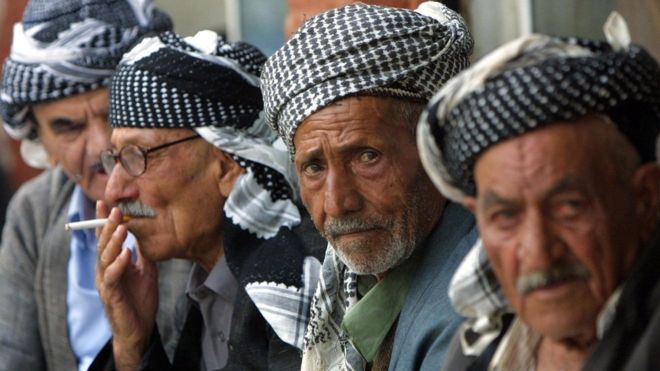
The Kurds are caught between a rock and a hard place after US withdrawal. Photo: /AFP

Since the beginning of October, US troops have been pulled from the northeast area of Syria. They were in the area providing support to the Syrian Kurds who have been fighting as part of the Global Coalition to Defeat ISIS. Aside from helping push back the terrorist organization and defeating ISIS’s caliphate, the Kurds have also been guarding approximately 11,000 captured ISIS fighters and their families. This was critical in order to ensure that these fighters not regroup and reform ISIS.

Having the US as allies allowed the Kurds to be successful. The sudden withdrawal has left a gap in support that had been critical for the Kurds while they were acting in part for US interests in the region. The US has tried to close this gap in negotiations with Turkey in October. It was President Trump’s hope that Turkey would take over in the region.

The problem with this decision is that since 1984, the Turks have been fighting against a Kurdish autonomous state within their borders proposed by the Kurdistan Workers’ Party (PKK). Turkey, the European Union, and the United Nations have designated the PKK as a terrorist organization. The Turks believe that the People’s Protection Unit (YPG) — which was the group allied with the US against ISIS fighters in Syria — is an extension of the PKK. Because of this, since entering the region following the withdrawal of the US, the Turks have begun a bombing campaign targeting the northeastern area of Syria where the Kurds are located.

In anticipation of the arrival of the Turks, thousands of Syrian Kurds have fled towards Iraq. The main fear propelling this mass migration is the risk of an ethnic cleansing against the Kurds. 

In the wake of their exit, there is also a new fear: ISIS fighters escaping from the abandoned prisons. Approximately 1,000 reported ISIS-related prisoners have escaped since the US began their withdrawal.

Aside from the fact that this troop withdrawal could lead to a resurgence of ISIS, it is fundamentally unfair to the US’s Kurdish allies. The Kurds have supported the US militarily countless times from WWII to the Gulf war. Syria is no different. Kurdish support meant that the US could keep its troops away from the fighting while the Kurds were in the line of fire. 

In the end, while the Kurds lost their support, the rest of the world was placed in a more dangerous place. Without the US presence in the region, ISIS may feel emboldened and attempt to restart their caliphate. There is also a greater fear that the frequency of terror attacks across the region and in Europe may increase as well. All in all, it appears that the US has left all of their allies in a more precarious position than they were in at the beginning of October.

Asking students to pay to volunteer is fundamentally unfair

0
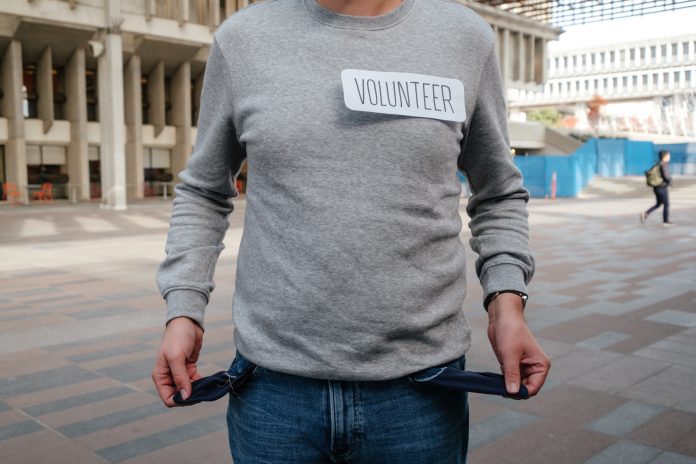
No good deed goes unpunished. Photo: Chris Ho/The Peak

One of the benefits of being a university student is building relationships within the institution — especially for students with academic aspirations. However, as neoliberal austerity claws further into all facets of our lives, everyday living expenses, the rising costs of tuition, and the subsequent necessity to engage in the precarious labour necessary to even remain in university — much less attend its events and opportunities — are making it increasingly difficult for students to balance the books.

Which is why I was so dismayed by an email calling for student volunteers for the annual Canadian Anthropology Society (CASCA) conferences. The event, held in Vancouver this year jointly with the American Anthropological Association, is quite a big deal within the discipline, and purportedly a good opportunity for students. 

However, a detail in the call for volunteers struck me. Students wanting to volunteer were first asked to become CASCA members for the student rate of $25. They would then have to pay the student rate to attend the conference, an additional $80. For those keeping track: in order to volunteer for this conference, students had to pay $105 up front. Students who agreed to work two four-hour shifts (eight hours) would have the $80 conference fee reimbursed. This, however, effectively makes the position less of a volunteer gig, and more of a paid freelance opportunity — one that is notably paying less than the legal minimum wage, at $10 per hour.

When asked by The Peak why students were required to pay in order to volunteer at the event, one of the conference co-chairs, Dr. Pamela Downe, explained that CASCA “is a non-profit organization” that “invest[s] monies generated by [conferences] directly into . . . organizational activities that are overseen by a series of academic networks as well as an Executive Committee, all of which are run by volunteers who tend to hold university faculty or postdoctoral appointments.” Downe went on to say that CASCA also provides “generous provision of travel bursaries and . . . work[s] to facilitate ride- and accommodation-shares” to students who want an opportunity to attend.

While I understand the financial difficulties of running large-scale events as a non-profit organization, there are a few things that I would like to point out from a student’s perspective. 

First of all, being an unpaid volunteer as a university faculty member is arguably less of a financial burden than as a student. After all, faculty members integrated in the workforce already invest a great deal of time in paid employment, making it easier to donate time. However, students, particularly full-time students, devote much less of our time to paid employment. Instead, the bulk of our time is invested in activities that already require us to pay large sums of money. Students are arguably in greater need of being paid for the work that we do.

Secondly, if budgets do not allow an organization to pay students for their time, they should at least not ask students to pay to volunteer — especially not $105. Even if a significant amount of that money will be reimbursed based on  hours worked, many students do not have $105 of disposable income available at any given time. Even as a full-time student with a decent paying job, surprise expenses of even $100 can be the deciding factor in how many meals I can eat in a week.

Finally, anyone with any sort of economic ties to the art world is familiar with the phrase “I can’t eat exposure, Brenda.” This is a critique of labour being requested for the love of it. However, if one’s labour is valuable enough to request it, then it’s valuable enough to pay for. In the current economic system we live in, doing something “for experience” is beginning to take on the same connotations. 

Free labour is a particularly difficult situation for students, but it’s not unique to us. While I have suggested that it is easier for working adults to shoulder the costs of unpaid volunteer labour, the overall experience of selling one’s labour in the capitalist system doesn’t change just because one exists in a slightly higher income bracket. We are all being squeezed by the disparity between stagnant wages and the rising cost of living. This unfortunate reality means that fewer people are able to afford to give their time to unpaid labour — we can’t eat our exposure, and neither can we pay our rent in experience. Capitalism has essentially made volunteering untenable for many people.

The irony in all of this is that an education within the department of sociology and anthropology gives students the tools with which to critique these practices. Students shouldn’t be asked to pay to volunteer at conferences, especially those that may provide valuable experiences for later employment opportunities. But more broadly, as a society we must all be more willing to challenge the economic system that demands people work for less, pay more, and donate their time in unpaid labour to have a slightly better opportunity to claw ahead of our peers.

What Grinds Our Gears: Students who don’t understand the etiquette of a shared laundry room

0
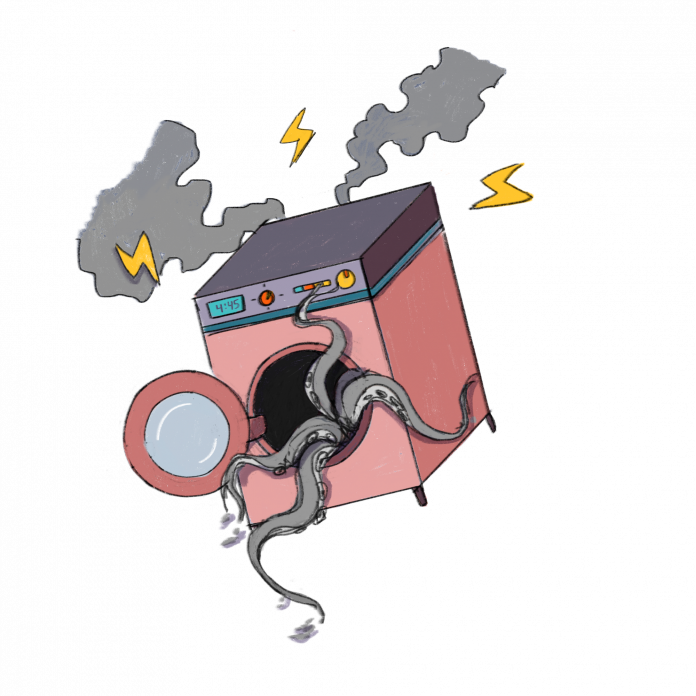
The real horror story is in the residence laundry rooms. Illustration: Sabrina Kedzior/The Peak

The shared laundry rooms in the Towers are graveyards for long-lost left socks and the hometown of bacteria colonies. The white-washed walls below fluorescent hospital ward lighting are unavoidable for those practicing basic hygiene — so a solid half of the residents.

With about six washing machines to accommodate an entire building, all those nasty clothing articles thrown in the wash have a tendency to leave a stench. What makes the creeping odour of mildew from these machines so additionally delightful is how easily it could be avoided. If users honoured the “LEAVE DOOR OPEN AFTER USE” sign displayed over each and every machine and on every wall, life doing laundry would be dandy.

Instead, the laundry room is the hotspot for apathetic students. Let’s talk about the ones who ignore built-up lint. This lint is more easily jettisoned than a student during the break of a four-hour lecture. “But Paige, is leaving lint in there really so detrimental to the performance of the dry cycle that costs $1.70?” Yes. It is a fire hazard that places the entire building at risk. But will that stop Brad from grabbing his four Hollister shirts and two pairs of straight jeans without batting an eye at the pound of lint left in the machine? No.

Half of these kids are so used to their moms cleaning their clothes for them that even the concept of buying laundry soap is utterly foriegn. Perhaps basic life skills like following directions and knowing how to keep themselves clean is too much to ask of the students at Canada’s engaged university.


Accessibility, environmentalism, and safety are missing from SFU’s transit strike response

0

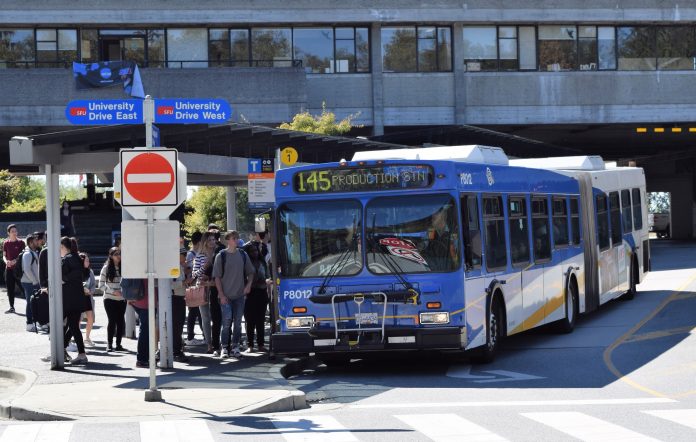
For a school that embraces its multi-campus nature and celebrates environmentalism, SFU’s reaction to the transit strike is remarkably hands-off. No matter how the strike proceeds, it’s important to remember that our university’s first stance was that, “operations at SFU will continue as usual with regards to normal hours of work and class schedules.” 

Online, SFU recommends that anybody not already driving “consider alternative transportation in advance,” as if that wasn’t the first thing on everybody’s mind. The anxious energy around campus only increased as we waited to see what the strike’s first phase would look like. 

SFU has also offered to accommodate extra drivers’ parking and drop-off needs, but this really only helps those with licenses, cars, and the money to run them or use carshare services. In the SFU Carpooling Facebook group, folks seem generous about either loading up or helping each other pay for gas — which is great. But SFU could also pitch in by waiving parking fees for carpoolers or reaching out to ride-hailing and taxi companies to offer discounted rides to the mountain.  

The real kicker is SFU’s proposed alternative transportation page. Here, options are: carpooling, car sharing, ride hailing, cycling, and (my personal favourite) walking — which all come with built-in assumptions about physical or financial ability. It’s also a little ironic, given SFU’s environmentally conscious initiatives, that they support the striking bus operators so little. Where are the press releases acknowledging the importance of transit workers? 

Walking and cycling aren’t great transportation alternatives either, given the mountain’s safety record for cyclists and women. The “walking” subheader informs students that there are “no sidewalks leading to SFU” and that “trails are not on SFU property and we recommend you use caution. These trains [sic] are not lit and we do not recommend using them at night.” This obviously does not help students commuting during one of the darkest times of the year. I’m astounded by the hypocrisy of recommending a mode of transportation and simultaneously providing a disclaimer for it — presumably so my family can’t sue if I get abducted or mauled by a bear on my way up to a test I can’t miss. 

Because, after all, SFU also isn’t giving professors and TAs the obligation or resources to be accommodating to students. They recommend that “If you have concerns about your ability to get to campus in the event of strike activity please discuss options with your professor/instructor or supervisor.” This assumes that professors will, out of the goodness of their hearts, make accommodations for students — without SFU providing the obligation, incentive or even the support to facilitate this. How powerful does SFU think students are? We aren’t the ones who can support professors looking to live-stream or record their lectures, invigilate exams in more accessible locations, or incentivize professors to replace in-class exams and participation with digital options.

Striking is all about honouring workers’ rights in the face of institutional failure. Just as the Coast Mountain Bus Company failed its workers and their needs, SFU is poised to fail its students. Expecting financially insecure, differently abled, and/or non-driving students and staff to function normally when crucial infrastructure is yanked out from under our feet with little to no support is unreasonable, and maybe a little callous. Even striking union members were concerned about inconveniencing or incapacitating students and low-wage workers. 

Why can’t our university be more hands-on in providing us the infrastructural support we need and acknowledging just how important transit workers are to this institution?  While I understand that it was never SFU’s job to get me to school, I did not sign up to go here, pay my tuition, and build my schedule with the expectation to walk to class.


Man pauses to breathe, gives audience fleeting false hope that he’s done talking

0

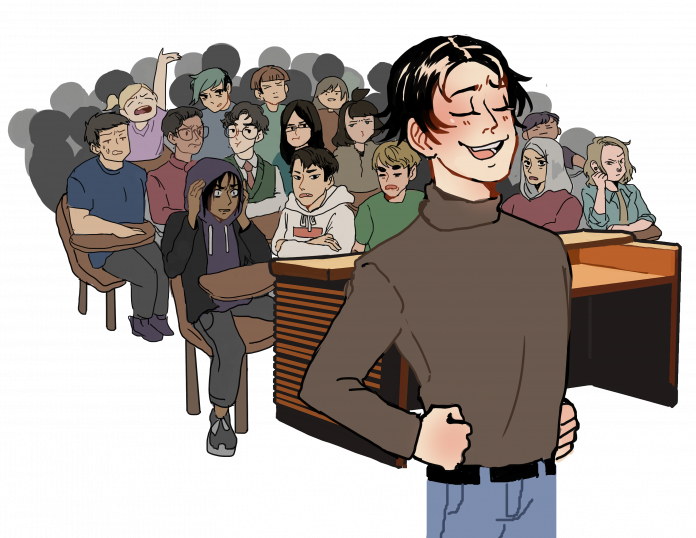
It’s Thursday afternoon, and we have a breaking headline coming in from the conference room in the West Mall Centre. The speaker, a young man, pauses to take a single breath . . . and despite the momentary hope his action telegraphs, he does not stop speaking. 

We go to Janet, a student in the conference room who contacted The Peak with a time-sensitive tip.

“Yes, hi!” Janet meets our eyes before getting shunned by a collective stare from the rest of the listeners. She continues in a hushed tone:

“He just started standing at the podium and speaking . . . we’re not sure who he is, but it felt rude not to listen.” 

Janet suspects that the man is a 20-year-old political science student who has gone off the rails between his midterms and defending his political beliefs. No further information on the man’s background is available at this time, as social mores have held us hostage too tightly for us to interrupt him with questions about his identity. The aforementioned defense of his political beliefs is not actually lucid enough for us to be certain that that is, in fact, what it is. 

The student continues his infernal rant about how his relatives are swayed by Facebook posts. Just when it seemed like the student had all but exhausted the topic, he cruelly continued. 

“Communism works in theory, but. . .”  The man pauses, air passing through his lips and expanding his lungs. He takes a swig of water. He gives the audience a long, meaningful stare. The tension in the room is evident as the listeners lean forward, waiting for him to speak up — or not. 

It’s madness, momentarily. And then he exhales again, speaking up on what he alleges his professor from two semesters ago told him about the flaws in practical communism.

We probe another audience member whose eyes are beginning to droop: “How long has this been going on?”

“For 20 minutes,” they respond tiredly — so tiredly. 

Inevitably, the student has started talking about Freud to sustain his theories on the political state. While his speech has the cadence of academic expertise, the actual content was not worth penning. He seemingly finishes, and a student lets loose a single clap. The student sublimates into the air under the heat of a judgemental hush from the rest of the audience, who by now are invested in suffering the ordeal as a unit. 

At this time, the student still has not stopped. No indications have been given of when the impromptu speech might end, and the situation has gone from mildly inconvenient to truly obnoxious.

Trapped on campus: Your guide to surviving Halloween night at SFU

0

It’s Thursday evening — October 31. While all your friends are smearing on eyeshadow from garish palettes they’ve saved since middle school and ripping open miniature Kit Kats with their teeth as they pre-game on straight vodka, you’re shuffling alone through the AQ after your 9:20 p.m. lecture. Fog has already suffocated the mountain when you receive a TransLink update: severe weather will prevent busses from driving up Burnaby Mountain. 

You have become trapped on campus on Halloween because TransLink has inconveniently left you for dead. It is now up to you to celebrate and survive the night by yourself. But where do you head first? 


PART I: Trick or Treat-ment 

If you wish to engage in North America’s only acceptable form of communism, trick-or-treating, try the psychology department. There are usually a few psych majors holed up at night psycho-analyzing each other as a form of flirting. All it takes is a knock on their department door to find out whether they have any candy left after being stingy at Clubs Day. 

But be warned: the Canadian Code of Ethics for Psychologists has no power after dark. If you get lured into a quick test, you could be battling more emotional demons than you anticipated. But you will get $2. 


PART II: Communications labyrinth 

Do you wish you could manufacture the nail-biting paranoia of a haunted corn maze in the comfort of indoors? Since you’re already stuck on campus, your next step should be to check out the bottom floor of the communications department. After twisting and turning under low cement ceilings, you’re sure to feel that you’re being chased down by a killer, eerily beckoning you to your death with the promise of an easily accessible advising appointment. 


PART III: Evil Minimart 

Closing out the festivities, your night slinking around SFU will inevitably lead you to face the ghost children of the AQ and the vicious ghouls in West Mall. But you’re not going to be able to fight the spectres crying out haunted curses or the wraiths shrieking about destroying civilization if you’re only armed with a dried-out highlighter. Evil Minimart, operating as the Maggie Benston portal to Hell, has your back. 

In the depths of the convenience shop, find potions (expired Gatorade), weapons (mechanical pencils that double as switchblades), and ornate, demonic scrolls filled with supernatural-slaying incantations (all the Latin phrases pulled from the Criminal Justice Code). It might be a shock when it turns out the creepy ghost children were just a few lost first years, and the ghouls were business students at a networking seminar. That, honestly, is even worse.


FIN: The Final Girl ™

It’s Friday morning — November 1. 

Bleary-eyed, you collapse ragged and traumatized onto the deceptively, torturously hard bench across from Images Theatre. You’ve beaten the business students and escaped the first years. You are the Final Girl. And, oh god . . . good luck on that 8:30 a.m. midterm of yours. 

Deadweight

0

“OK, I guess we may as well start,” I say to a roomful of students. “So! I’m gonna talk about the different aspects of—”

The door bursts open.

A decaying corpse stumbles in, Starbucks drink in hand. Raw meat and instant noodles — the scent spreads to every corner of the room. The corpse groans incoherently as it makes its way up to me.

“Oh! Cool! Dave, you made it.”

From my seat, the prof raises his hand. I nod for him to go ahead.

“I thought you had the flu, David?” he asks, tentatively. “You already feeling, er, better?”

Dave groans and looks over at me.

“I must have read that email wrong,” I quickly cover. “It must have not been that serious. Anyways, now that we’re both here—” 

Dave’s arm falls off its socket. The Starbucks cup explodes on the desk in front of us. Scarlet and gooey, something is spreading across the laminate, enveloping my laptop.

I jerk the laptop away and start wiping the desk with my sleeve.

“Do you need any napkins?” asks the prof, getting up to help.

“No, no, it’s all good,” I say. “I got it on sale, anyway.”

“If you’re sure . . .” says the prof. “David, why don’t you start us off while he’s dealing with that, then?”

Head bobbing slowly and silently, Dave looks at his arm on the floor.

“His mom gave him that arm,” I chime in, pushing the goo in the garbage. 

“Ah—!” The prof seems somewhat abashed. “David, do you need a second?”

Dave looks at me, groans, and shakes his head. He begins groping his pockets with his remaining arm, looking for something. His hand dives inside his ribcage and pulls out a crumpled piece of paper. Gingerly, he places it in front of him on the gooey desk and starts to unfold. There’s only one word on the page.

Dave gurgles and spits something out. Clearing his throat, he shouts—

“—Braaaains!”

. . .

Hand trembling, he folds the paper back up and puts it back in his ribcage.

“I think the PowerPoint is really going to make sense of what Dave here is getting at,” I tell the class, putting the laptop back on the desk before turning back to my partner. “Right! Did you bring the HDMI cable?”

Dave looks back at me, pupils slowly swelling.

“No, yeah, that’s fine. I can just—we’ll just wing it. It’s good,” I stammer, closing the laptop. “The first aspect that we’re going to talk about has to do with, um—”

Dave’s left leg crumples, and crumbles, under him. Losing his balance, Dave bashes his head on the desk as he falls He’s lying in a pool of flesh crème brûlée.

“You know, Dave? Why don’t you just take a seat?” I urge. “I can take it from here.”

He nibbles on my leg under the desk.

“No, really, it’s fine,” I say. A shiver runs up my calf, through my thigh. “That flu looks serious, man. Just . . . take a seat.”

Dave’s hand shoots up in the air. He grabs the desk for support and sits himself on a chair.

“Before you get started, I just want to remind you,” the prof calls across the lecture hall, “I’m grading you as a group.”

“Ah—” I punch the desk. Little specks of red dotting the top . . .  “Son—! of a! Braaaains!”

Your weekly SFU horoscopes: October 29–November 4

0
An illustration of a girl with long flowing hair. Astrological signs and stars shine around her.
ILLUSTRATION: Marissa Ouyang / The Peak

Aries — March 21–April 19

Your stars spell terrible destinies for you this week. And you’re just going to have to put up with that. You think you have an unfair relationship with astronomy? Talk to Remus Lupin and get back to us.

Taurus — April 20–May 20

Not sure what to hand out to trick-or-treaters this year? You can’t go amiss with Post-It notes covered in quotable excerpts from the scholarly works of Friedrich Hayek. After all, the ideal free market is the world’s biggest trick of all.

Gemini — May 21–June 20

Expecting to be haunted this week? Draw a salt circle around your overpriced residence. Then, burn one of your SFU sweaters from first year, the ones you thought would help you move on from your high school traumas and integrate into the nonexistent mountain community. 

Cancer — June 21–July 22

Suitors are disappointing you left and right this week. Just start dating your favourite mason jar. It will faithfully hold onto your possessions, and it’s far too transparent to get away with lying to you. 

Leo — July 23–August 22

Worrying about what to wear for your Halloween parties? You shouldn’t be. Because you don’t wear costumes — you are a costume. The filth-mongers you go to school with should feel so blessed to be able to vainly try and dress themselves in imitation of your luminous image.

Virgo — August 23–September 22

As fall kicks into full swing, enjoy yourself by playing around in piles of gathered autumn leaves. Careful, though — you just might scatter the very pile of scrap leaves that the Canadian government is using to hide the under-construction pipeline from judgmental eyes.

Libra — September 23–October 22

No need to feel bad about never inviting your partner to the Avocado. Take this week as your chance to instead invite them to the cushy inside of a gigantic pumpkin. The person you love and trust above all can jack your lantern any day. 

Scorpio — October 23–November 21

Find some time this week to loiter on the 2000-level of Maggie Benston Centre and stare into the gigantic spiralling hole. They say that staring into the depths of Pandemonium for long enough will let you carve out a reservation there for your essence, for when the end times manifest.

Sagittarius — November 22–December 21

Your friends might ask for some last-minute advice on masks for their costumes. And you’re absolutely the most qualified to give it. Every human interaction you’ve ever had has arguably just boiled down to you and a series of social masks.

Capricorn — December 22–January 19

You’re tired. So, so tired. But you can push through this week without ending up as an illegally plastinated corpse in a friend’s attic — I believe in you. 

Aquarius — January 20–February 18

You’re increasingly suspicious that you, yourself, might be a vampire. You love the taste of your nemeses’ blood, and you are always a little more cold, pale, and depressingly attired than what would befit the weather. But worry not. No vampire could ever intrude on other people’s homes, plans, relationships, and lives with the practiced ease that you do.

Pisces — February 19–March 20

You want the odiferous truth? Fine. Stop wasting time with your horoscope and start researching for your next round of essays while you have the chance, you belugas.