Home Blog Page 462

The Sterling Prize in Support of Controversy looking for nominations

0
Photo Courtesy of SFU

Written by: Paige Riding, News Writer

The Sterling Prize in Support of Controversy is looking for nominations until February 15, 2020. This prize may be awarded to any individual in any academic field whose potentially controversial work positively affects Simon Fraser University or academia while meeting certain ethical criteria.

According to SFU’s website, “the Nora and Ted Sterling Prize in Support of Controversy was established at Simon Fraser University in 1993 to honour and encourage work that provokes and/or contributes to the understanding of controversy.”

Associate Director of Communications and Marketing Rosetta Cannata explained in an email to The Peak how a nominee is chosen for the award.

“To win, the work must be more than simply controversial. It should present new ways of looking at the world, be daring and creative, decidedly unconventional and distinctly untraditional. In short, the Sterling Prize celebrates work that challenges complacency,” Cannata wrote.

Past winners included Layla Cameron for her research and activism against fat discrimination in 2018, Cherry Smiley in 2014 for her feminist work to abolish prostitution and her anti-violence work against Indigenous women and girls, and Rick Routledge and Alexandra Morton for their work documenting threats to British Columbia’s wild salmon from coastal fish farms back in 2012.

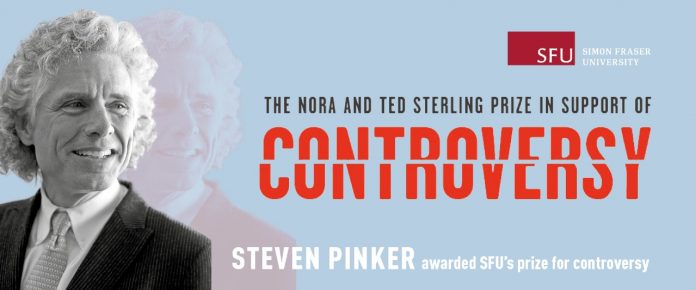
The most recent winner of the award, Steven Pinker, is an experimental psychology professor and author. He received the award in 2019 for his book Enlightenment Now: The Case for Reason, Science, Humanism, and Progress

During his lecture following the presentation of the award, Pinker argued not only that “some of us are more controversial than others” but also that “controversy can be exaggerated because academia is becoming more politically polarized [ . . . ] and that empirical hypotheses are easily confused with moral convictions.”

The namesakes of the award, Ted and Nora Sterling, impacted others through their own pioneering acts. Nora helped to establish community-based mental health programs in the United States. She then moved to Vancouver and helped pioneer the first folk-art store as well as New-Small & Sterling Glass Studio in Granville Island.

Ted fled from Austria in 1940 to the United States with his family. After enlisting in World War II, Sterling turned to focus on his education. After receiving his doctorate, Ted then established SFU’s computing science department, serving as its chair. He understood the controversy associated with potentially compromising one’s privacy through computing technology and warned those around him. 

If you know someone who likes stirring the pot of academia or society in the best way, nominate them before February 15. More information on the prize and how to nominate someone can be found on the Sterling Prize website


SFSS adopts new reproductive rights policy, causes SFU Lifeline to no longer be recognized as a club

0
Photo courtesy of Peak Archives

Written by: Michelle Gomez, Assistant News Writer

As of December 2019, the Simon Fraser Student Society (SFSS) has decided to adopt a reproductive rights policy. This policy has caused SFU Lifeline to no longer be recognized as an SFSS club. 

Amongst other conditions, the policy states that the SFSS opposes any activities “that interfere, intimidate or attempt to intimidate students from making informed decisions about sexual and reproductive health and reproductive rights.” 

It also opposes distributing material that are “intended to shock, disturb, or harass students into adopting a particular belief with respect to sexual and reproductive health and reproductive rights (including abortion).” 

The policy further states that the SFSS will not recognize any group that does not adhere to these principles. 

Sylvia Ceacero, Executive Director of the SFSS said in an email to The Peak that the “SFSS’ adoption of this policy confirms our stance on women’s reproductive rights.” 

SFU Lifeline’s club mandate, states that the club “advocates for pre-born children, whose human rights are violated by abortion [ . . . ] [they] are dedicated to raising awareness about this issue, and providing women with the support and resources they need to make a life-affirming choice that respects both mother and child.” 

Health Sciences Representative Osob Mohamed explained in an interview with The Peak that not recognizing a group as an SFSS club entails not providing resources to the club, including funding and room booking privileges. She noted that despite this, “they are free to organize on campus as any other external group does.” 

According to Mohamed, SFSS Board members had been in discussion about the matter since 2015. She explained that during the last board term, the SFSS Council put forward a request that the Board formally look into the issue. She also noted that students also contacted the SFSS about this.

An online petition created by SFU students in 2019 states that “We the students are outraged that SFU allows such discriminatory political views to be spread on campus.” At the time of writing this article, it has generated 234 signatures. 

SFU Lifeline vice-president Lily Moric (with assistance from president Lois Umali), wrote in an email interview with The Peak that “our freedom of thought, belief, opinion and expression are being violated by the SFSS when they refuse to support any student club that does not agree with their pro-choice view.” 

She explained that without room booking privileges and hallway permits, the club would have to pay around $10,000 per year to continue operating as they are now. 

“It is [the SFSS’s] job to represent the student body as a whole, and this necessarily entails endorsing clubs with opposing views.” 

Moric added that Lifeline will be challenging the policy. So far, they have created a petition that has generated 520 signatures at the time of writing. 

Mohamed noted that “[SFU Lifeline’s] freedom to express themselves I don’t think is being infringed upon in this case, it’s more so a matter of the resources that we won’t provide.” 

“Of course people do have pro-life stances and they are free to express that. The issue that we had with Lifeline was a lot of distribution of materials particularly that were quite damaging to some of our students’ mental well-being.” 

Coming Up at SFU: February 10–14

0

Written by: Lubaba Mahmud, Staff Writer

Reading in the Arts and Social Sciences

The Student Learning Commons is hosting a 50-minute workshop on reading strategies for students in the Faculty of Arts and Social Sciences (FASS). It will introduce four reading strategies for writing essays, research papers, critical analyses, and the like. 

The workshop is free for all students, and requires registration — participants can register through the event’s page. It will take place in the W.A.C. Bennett Library, Room 3008 on Tuesday, February 11, from 12:30 p.m. to 1:20 p.m. 

Climate Emergency: The Citizen’s Guide to Climate Success

In this talk, Mark Jaccard, author of prize-winning book The Citizen’s Guide to Climate Success

will discuss how people can overcome climate myths, as well as climate-friendly actions they can take. He will also explain the effectiveness of such personal consumption decisions in relation to the process of electing climate-conscious politicians. Another speaker, Matt Horne, Climate Policy Manager for the City of Vancouver, will share policies that Vancouver is implementing to mitigate climate change.

The event is free and reservation is not required, but organizers recommend arriving early as they anticipate a full-house. It will take place at the Vancouver campus, Room 1900, on Tuesday, February 11 at 7 p.m.

Valentine’s Day But Not Really

The Global Student Centre is hosting a two-day drop-in style event where participants can hand-paint and decorate messages of love and gratitude. Snacks such as cookies, berries, and chocolate will also be provided.

The event is free and registration is required, with attendees able to register on the event’s page. It will take place in the Global Student Centre (AQ 2013) from Thursday, 13 February 3:00 p.m. to Friday 14 February, 2:00 p.m.

Speed Friending with Out On Campus

This event provides an opportunity to make new friends on campus. There will be several five-minute rounds where participants can converse . In these rounds they can write the names of people they would want to stay in touch with on their ‘speed-friending card.’ A post-event email indicating matches will be sent out to students.

The event is free and requires registration, which includes providing social media information. It will take place in MBC 2294, on Friday, February 14, from 1:30 p.m. to 3:30 p.m.

Board of Governors and Senate Elections

SFU’s Board of Governors and Senate are holding their annual election from February 1113. There are sixteen elected student positions on the Senate, with one student from each faculty, and at least three positions each for undergraduate and graduate students. There are 25 candidates for the student Senate positions.

There are two elected student positions on the Board of Governors, one for an undergraduate representative and one for a graduate representative. The undergraduate position is contested by four students, and the graduate position is contested by two students. 

Students will receive instructions in their SFU email on how to vote in the election.

Grad Student Society AGM

SFU’s Graduate Student Society is holding its 2020 Annual General Meeting (AGM) on February 11 from 5 p.m. to 6 p.m. in MBC 2290. Dinner will be served from 4:30 p.m. to 5:00 p.m. and a social will be held at Club Ilia after the event. The meeting is open to all members of the society in good standing (currently enrolled graduate students at SFU). The AGM is the most important annual event for the society, and an opportunity for members to hold their elected representatives accountable.


Valentines to give your favourite plagiarizers

0
Siloam Yeung

Written by Gabrielle McLaren, Editor-in-Chief

Siloam Yeung

“Are you on exchange from Tennessee? Because you’re definitely not getting a 10/10 from me”

Siloam Yeung

“On a scale from 1 to 10, you’re the 1 I need to teach about citations”

Siloam Yeung

“Nothing could be sweeter than getting you expelled, Valentine”

Siloam Yeung

“Cupid called. He saw you copy-pasting.”

Siloam Yeung

“Roses are red,

Violets are blue, 

You didn’t change the font colour, 

How fucking dumb are you?”

Your weekly SFU horoscopes: February 10–16

0
An illustration of a girl with long flowing hair. Astrological signs and stars shine around her.
ILLUSTRATION: Marissa Ouyang / The Peak

Written by Zach Siddiqui, Humour Editor

Aries — March 21–April 19

This week, tell your suitor that it’s French kisses or nothing — and you really do mean French kisses. If your date’s lips can’t whisper Jean de la Fontaine’s “Le corbeau et le renard” to you from memory, start to finish, then there’s just no future there.

Taurus — April 20–May 20

You can’t go wrong with a nice romantic seafood dinner this week. The tanked lobster at Superstore scuttling away from the cashier’s tongs loves you almost as much as you love him . . . or so agriculture has raised you to blindly believe. 

Gemini — May 21–June 20

You will spend this Valentine’s Day extremely unsatisfied. It’s hard when no one understands you like you do. As Sartre said, hell is other people — your best bet is to spend the night cuddling a big fluffy strain of coronavirus. 

Cancer — June 21–July 22

The one you love will get you very hot this week. And you’ll love it. Thank God you’re pining after someone who’s not afraid to rack up a heating bill on that thermostat in this death weather.

Leo — July 23–August 22

Beauty is your sword and shield this week. When a classmate raises their hand to steal your participation marks, cut them down with an alluring look and cut in with the exact correct answer to whatever question your instructor asked — or a super BS answer that will make people take pity on you and lull them into a false sense of security, your call. 

Virgo — August 23–September 22

You do many different kindnesses for your partners, but this week, you should consider letting them reciprocate. If anyone deserves to be sweetly serenaded in the middle of the night with “Turn Down for What,” it’s you and your martyrdom.

Libra — September 23–October 22

You and those close to you need to find a place to confess this week, where you can confess to the sinful nights you’ve all shared. Getting together via group chat to scour the embarrassing Instagram of that old classmate you all hate is just not something you do out of wedlock. 

Scorpio — October 23–November 21

You’re gonna rock someone’s whole world this week. They will never be the same when they find out you can pour classic and maple pecan syrup into coffee. 

Sagittarius — November 22–December 21

There’s no week like this week for you to do with yourself that thing you like with your persecution complex. 

Capricorn — December 22–January 19

Romance is exhausting. Spend this week in bed whenever you can manage it. Let your freshly laundered bedding and Godiva chocolates protect your virtue, constitute your vice, and imitate your valium.  

Aquarius — January 20–February 18

Punish yourself this week with whips. Cool Whip, Miracle Whip, Cheese Whip, and whatever other gross commercial brands you’ve been buying and then promptly shoving to the back of your family’s fridge to rot. Disgusting. 

Pisces — February 19–March 20

You are a pure innocent daffodil and you shouldn’t be reading The Peak. ~x~Drink water and transfer to Pigfarts~x~

QUIZ: What form of birth control are you?

0
Reproductive Health Supplies Coalition via Unsplash

Written by Zoe Vedova, Peak Associate

From gutting public school sex education classes to threatening to decrease access to abortions, our sexual health is constantly being policed by the government. Let’s turn the lens back on the institution that’s put us in this position. Answer these bureaucratically afflicted questions to figure out to which federally controlled genetic roadblock you are intrinsically connected.

    1. Which do you consider the greatest political mistake?
      A) The assassination of Archduke Franz Ferdinand
      B) British Columbia’s confusingly worded 2018 electoral referendum ballot
      C) Napoleon Bonaparte’s decision to invade Russia during the winter of 1812
      D) Julius Caesar trusting way too many friends 
    2. How do you choose who to vote for?
      A) Whichever party gives me the most free swag on campus
      B) I do meticulous research, watch the debates, introspectively evaluate my beliefs, and then panic and vote for the party I’ve always voted for 
      C) I accidentally voted for the Libertarians because I thought that was the Latin spelling of Liberals
      D) Communist
    3. Which one of these men has been a Canadian prime minister?
      A) William Michael Brown
      B) Gregory Pincus
      C) Brian Mulroney
      D) None of the above
    4. Should the legal age to vote be lowered?
      A) Absolutely! The more people accessing the freedom of democracy, the better
      B) Absolutely not! The fate of a country’s political future is way too big a responsibility
      C) If a younger person wants a vote, they can just use my ballot — I almost never remember to go
      D) I don’t care. It’s not like our choices are that great anyway
    5. Will you commit high treason?
      A) Listen, I may have assisted an enemy state, but I was having so much fun at their house party
      B) Yeah, I’ve been planning on it for months, and now that Harry and Meghan are moving here, it’s never been easier
      C) Bro, smoking weed is legal now
      D) I could commit high treason . . . as a treat
    6. How did you find out about the 2019 Canadian federal election results?
      A) John Oliver didn’t do a segment on it, so I didn’t know it was happening
      B) The CBC
      C) I got drunk for the sole purpose of NOT finding out who won that night
      D) I literally haven’t processed the 2016 American election yet; you can’t expect me to keep track of Canada too
    7. Scariest political figure in Canada?
      A) Still Stephen Harper . . . always Stephen Harper
      B) Andrew Scheer
      C) Every individual with political alignments based on unexamined biases and dogmas
      D) The ghost of William Lyon Mackenzie King that haunts me all afternoon
    8. When will the government collapse?
      A) With my help, any day now
      B) I won’t let it collapse until we get our first elected female prime minister
      C) It’s going to naturally happen no matter what we do. I’m content to wait it out 
      D) The SFSS hasn’t collapsed yet?


If you got mostly As – Condom 

You’re unabashedly confident enough to be yourself at all times. You’ll talk to anyone, go anywhere, and are always down to make a quick joke to break tension. Unfortunately, your authentic self is so well socialized that you’ve gotten comfortable only ever putting in 80% effort into all activities. That missing 20% can have some seriously intense consequences if left unaccounted.

If you got mostly Bs – The Pill

While your ideal world would be filled with bullet journals, meal plans, and five-year goals, you’re distinctly aware that having every day mapped out is incredibly unsustainable. You know what you believe, even if you’re not entirely certain what the long-term ramifications of these beliefs will be. Thankfully, you’ve managed to strike a balance with the chaos of life, and for the time being, you’re committed to it. 

If you got mostly Cs – The Pull-Out Method

This should be a real wake-up call for you. 

You need to take some responsibility over your existence before your negligence starts a new one.  

If you got mostly Ds – Abstinence

You’re not just abstinent from sex — you’re abstinent from everything. There’s no freer spirit than the one who truly doesn’t give a fuck, staying out of everyone’s sordid business. The entire world might be ripping itself apart, but as long as no one drags you into their drama, you’re content not dragging anyone into yours. Well, besides the fact that you do have the ghost of Canada’s tenth prime minister to deal with. Ironic that the guy who talked to ghosts has become one.

Our list of some of the best sex scenes in film

0
Photo via IMDb
Photo via IMDb

by Madeleine Chan, Meera Eragoda, Zoe Vedova

I know we have all seen it: a sex scene on television that is just too choreographed and perfect. It could be the teenagers whose first time is absolutely flawless, or the exact same hetero white couple that we see in nearly every single romcom, or that television sex shot with only the male gaze in mind. Whatever it may be, sex in film can be very poor. 

So with that in mind, our collective has curated a list of films that seem to be doing it right. They’re bringing attention to the fact that sex can be more than just that one white man with a six pack humping. 


Booksmart 

by Madeleine Chan, Staff Writer

Photo via IMDb
Photo via IMDb

Directed by Olivia Wilde, this overall incredible film about youth, the future, and expectations also contains a realistic sex scene. 

Enamoured by each other at a year-end party, high school seniors Amy and Hope capture the nervousness of first times and the realities of sex, like the awkwardness of getting the other person’s clothes off. Their actions are also very mutual and consensual, with Hope even asking if Amy wants to continue when she says she’s a bit dizzy.

In addition, even though the two are underage, the scene feels more exploratory and loving than predatory. Despite the two literally engaging in sexual relations, they are never actually sexualized or in the male gaze because most of the shots only focus on their faces. 

This scene breaks the facetious façade around sex and depicts an honest look at sexual intimacy, while also representing non-heterosexual love.


L Word: Generation Q 

by Meera Eragoda, Staff Writer

Courtesy of SHOWTIME

L Word: Generation Q is queering the lines of sex, and doing it well. One of my favourite sex scenes in this show was in the opening. It starts with one of the characters, Dani, going down on her partner, Sophie, first thing in the morning. The scene makes it clear that the show is not going to shy away from explicit sex scenes, similar to Game of Thrones. Except that here it’s consensual, queer as hell, and doesn’t feel gratuitous. 

They also make a point of showing Sophie’s boobs in all their glory, brown tits and all. I love that her boobs actually have jiggle power and that they aren’t just the tiny ones we’ve seen a thousand times before. Moreover, I also love that two queer women of colour are being featured. The scene ends with us finding out Sophie is on her period and doesn’t hide the period blood on Dani’s finger. Which, yaassss, please! Let’s fucking normalize periods and period sex! 


Rocketman 

by Zoe Vedova, Peak Associate

Photo via IMDb
Photo via IMDb

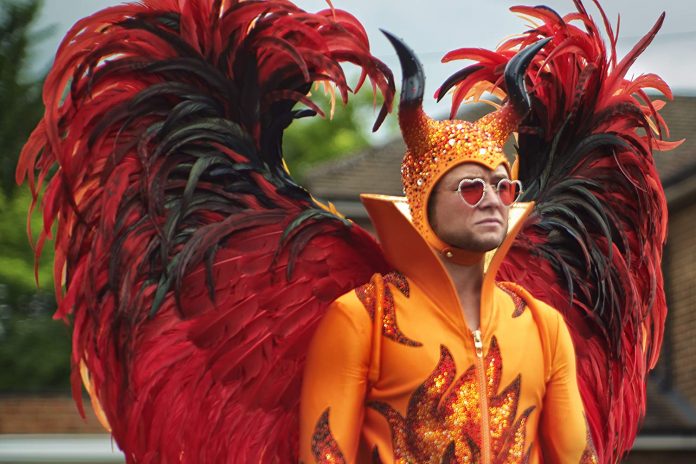
Rocketman, the 2019 biopic on Elton John, explored the artist’s tumultuous rise to fame through a surrealist, musical narrative. Though the film exposed the gritty, destructive path of addiction hidden behind stardom glamour, as well as the psychological trials of childhood, one area it didn’t press a darkened filter over was the sex scene between Elton John and John Reid. 

The scene is presented as a raucous burst of light in which every grin, touch, and item of clothing flung aside is propelled by mutual excitement. Accompanied by close up shots of grimaces, tears, and shaking, the film positions their sexuality as intimately intertwined with pain, stirring up audience fears of dire consequences later on. 

Rocketman, normalizes queer sensuality on screen, hinting at a cinimatic future in which the term ‘gay sex scene’ will be rendered blissfully irrelevant. 

Peak Speaks Podcast – Random Questions with Talha

0

Listen here: https://pod.link/1464226637

The next step in women’s sexual freedom is access to free contraceptives

1
The most effective forms of birth control end up costing women much more than men. Illustration: Anthony Liao/The Peak

By: Meera Eragoda, Staff Writer

As someone who has had the experience of having my birth control switched up about seven times due to side effects, I’m well aware of the cost of prescription birth control. Each switch has increased the cost until it went from $20 to $80 per month. There is an egregious gender bias apparent in many aspects of consumerism, and sex is no exception. In order to enjoy safer sex, women and those with uteruses are unfairly tasked with the cost and responsibility of obtaining contraceptives, as well as having to deal with their side effects — from spotting to mood swings to depression. Men, comparatively, face none of these barriers. If women are going to be saddled with so much of the social burden of sex and family planning, then at the very least they need access to free birth control.

Currently, if women and people with uteruses want to use the most effective methods to prevent a pregnancy, then they require costly prescriptions that their male counterparts don’t. Take intrauterine devices (IUDs) for example. According to the Candian Paediatric Society, IUDs “are the most effective forms of birth control available and doctors should recommend them to adolescent girls before any other method.” They are, however, also the most expensive, with a cost of up to $380. While oral contraceptives on average are attainable at a lower cost up front, they are also subject to greater human administration error. If doctors are advocating for IUDs over oral contraceptives, these options need to be made financially feasible.

With the system we have now, the burden is on women to navigate the medical system, and in many cases, to shoulder the cost of contraceptives. Young women especially have to either come up with the money themselves, or rely on their parents’ health plans — something that requires giving up their privacy. Obtaining contraceptives tailored for men, on the other hand, is as easy as a trip to the grocery store for a pack of condoms. 

The likelihood of a male oral contraceptive coming our way anytime soon is incredibly low. Previous attempts to introduce the “male pill” have been unsuccessful due to concerns surrounding side effects such as acne and severe depression. Men just aren’t motivated to risk these side effects, especially since they’re not at risk of becoming pregnant themselves. Besides, they have access to condoms, which are already cheaply available, if not downright free. 

However, condoms have a higher risk than other contraceptives of not working, and don’t protect from external pressures to not use one. Women who aren’t able to afford more effective forms of contraceptives may then be forced to rely on condoms and their partners’ willingness to use them, increasing their risk of an unplanned pregnancy.  

During the time my doctor was experimenting with different oral contraceptives for me, I was privileged enough to have full-time employment and took advantage of extended health benefits. While I no longer have full-time employment, I still have the SFSS Health and Dental Plan which offers coverage for up to 80% for oral contraceptives. However, most youth, low-income, and marginalized people with a uterus do not have these options. 

In order to combat this, AccessBC, a grassroots campaign started by young activists based mainly in Victoria, is advocating for free contraceptives for everyone with uteruses. Their campaign seeks to decrease the number of unplanned pregnancies (experienced by 61% of Canadian women) by making prescription contraceptives free for all women and people with uteruses. The group notes that this will significantly decrease the number of annual unplanned pregnancies, and the associated financial burden this places on women. 

We currently occupy a privileged position of being able to attend post-secondary education (although it might not feel that way because of all the debt). Studies have shown that for women and people with uteruses, access to contraceptives hugely increases the ability to attend and remain in a post-secondary institution. If financial barriers to contraceptives are unfairly gendered, then isn’t the simple solution to remove them? As university students, shouldn’t we be trying to uplift everyone to our level, not letting sexist policies derail access to higher education, among other things? It’s time we all join AccessBC in their fight. Write to your MLAs today — free contraceptives should have been a thing yesterday!

Rules? What rules? How Roger Nielson forced the NHL to evolve its regulations

0
Roger Nielson also popularized the waving of the white towel at hockey games. — Photo: Bardown

By: Connor Stephenson, SFU Student

In the NHL, the only rule is . . . there are no rules. Well, not exactly, but occasionally in the rulebooks of professional sports, there are loopholes that allow coaches and players to deploy some oddly entertaining tactics. Some coaches and players that are more creatively inclined even rely on these loophole-exploiting strategies to consistently give their teams a competitive advantage. 

The most famous of these is former Vancouver Canucks coach Roger Nielson, who conceptualized  brilliantly strategic plays explicitly based on his knowledge of the rules and their blindspots and inadequacies. 

Nielson had an impressive tenure as a head coach in the NHL with a career that spanned from the late 1970s to the early 2000s — not to mention a creative mind. Most famously, during a shootout or penalty shot, Nielson would swap his goalie out for a forward or defender. As the opposing player was preparing to skate down the ice to take their penalty shot, Nielson’s player would charge at the puck carrier and knock the puck away before the opponent could get even remotely close enough to the net for a scoring chance. Further to this, Nielson would direct his goalie to leave his stick and other easily removable equipment in front of the net before leaving the ice. This served as another, technically legal, protective layer should the skater be unable to stop the advancing player. These tactics undoubtedly provoked confusion and indignation in his opponents, but they were not explicitly forbidden.

These were certainly not the only tricks Nielson had up his sleeve. He also exploited the rule that a team is not permitted to have less than three skaters on the ice. Knowing this, Nielson, in the hopes of running down the clock in the final minute or two, would deliberately order an additional one of his players onto the ice for an intentional too-many-men infraction. Since a team couldn’t have any less than three players on the ice, Nielson knew that he could perpetually dump an extra player on the ice without being further penalized. The theory behind this tactic was that having numerous plays stopped would prevent the other team from being able to set up in the offensive zone to score. And of course, Nielson’s team wasn’t at a progressive disadvantage, because the most they could be down was two players. All of this, if it went as Nielson had drawn it up, would culminate in a win.

Subsequent to Nielsen’s creative coaching endeavours, the league was forced to reconcile the inherent flaws in some of its rules. In response to Nielsen’s tactics, rule 24.2 was added to explicitly state that a team is only permitted to use a goalkeeper in the net for penalty shots and shootouts. In addition, there was a rule change pertaining to intentional too-many-men infractions, dubbed the Deliberate Illegal Substitution rule, which dictates that, if a player takes a deliberate too-many-men penalty, the opposing team will be awarded a penalty shot (rule 74.4).

The rules and parameters of the NHL are constantly evolving as the game does, and they surely would have changed even if coach Nielson wasn’t there to cleverly work around them. Despite this, I think all hockey fans owe Roger Nielson a standing ovation for strategizing in a fashion that provoked hilarity, entertainment, and regulatory improvement.