Home Blog Page 435

We shouldn’t wait until an emergency to spare a thought for our marginalized communities

0
Emergency COVID-19 shelters prove vulnerability is a matter of government choice, not lack of resources. Photo courtesy of the City of Edmonton

By: Madeleine Chan, Staff Writer

When I heard about the new COVID-19 support for Indigenous communities from the BC government I was, frankly, shocked. Legitimate help for Indigenous people during a pandemic was the last thing I expected, considering the colonial history of catastrophic neglect. Of course increased actions around healthcare, transportation, and accomodation are great, but it begs the question: why hadn’t they been taken already? 

Indigenous communities had been struggling under the inequities of colonial rule centuries before the arrival of coronavirus. For example, many of them are vulnerable to food insecurity, and some don’t even have clean drinking water. Meanwhile, groups like the Wet’suwet’en nation are still being invaded by the state with the continued construction of multiple unsanctioned pipelines — at the same time that the government is supposedly recognizing their legal land rights.

Why does there have to be a full-blown global emergency for the government to support marginalized people? The government has the means to carry out this assistance, as is made apparent by their other recent charitable act of giving smartphones to the homeless. While giving people the ability to connect to services, resources, friends, family, and more through these phones is definitely positive, this action feels very much like an afterthought rather than a priority.

In a similar vein, under the Emergency Program Act, and with the help of nonprofits and local municipalities, Vancouver has recently provided hotel rooms and community centre spaces for all of the people who were living in Oppenheimer Park. According to a report by CBC, this was done to “reduce the chance of an outbreak of coronavirus among [Vancouver’s] most vulnerable people.” Knowing that if they don’t “clean up” homeless camps the virus will spread even more throughout the province shouldn’t be the only reason that they want to help. 

It seems like the government is acting on aid because they know that the potential continued spread of COVID-19 through these communities is harmful both physically and economically. But they knew that these communities were vulnerable long before COVID-19, so it seems quite hypocritical for them to only take action now. The very fact that they already called these people are the most vulnerable just highlights how much they think that it’s only an emergency when it’s an emergency for the government — that is to say that an increased total COVID-related death count might be perceived as a crisis of response to the voting population. For the people in need, every day is a crisis.

Instead of mitigating marginalized suffering after the fact, how about total prevention? The government should prioritize things like affordable and accessible housing, food security, and clean water access before the next global disaster. Working on recognizing Indigenous rights to their own land as well as their political autonomy instead of holding them at the mercy of a neglectful federal government would also give them the means to provide their own emergency preparedness structures tailored for the needs of their communities. 

Having strong, pre-existing systems in place to support marginalized people would make it so the government wouldn’t have to come swooping in like superficial superheroes to seem like saviours at the eleventh hour. It would mean that these communities would not have to struggle to simply stay alive as a baseline.

There needs to be support for marginalized communities at all times, not just when it’s expedient for the government. Remind yourself that it is the government’s past and present actions that have caused these inequities, but also that they have always had the power to fix it. Action taken early means that there is less reaction to the problems that could and should have already been solved.


The Midnight Gospel visually and intellectually tests the bounds of reality

0
Courtesy of Netflix.

By: Manisha Sharma, SFU Student

The Midnight Gospel is the brainchild of actor and comedian, Duncan Trussell, and creator of Adventure Time, Pendleton Ward. Found on Netflix, The Midnight Gospel was created as a visual alternative to Trussell’s podcast, Duncan Trussell Family Hour. Both the podcast and show offer an insightful examination of topics such as existentialism, spiritualism, and death, with some of the show’s episodes containing excerpts from Trussell’s podcast.

However, the show offers what the podcast cannot in the way of graphics that are weird, wacky, colourful, and a visual paradise to anyone who admires art. The protagonist in the show is a pink, no-nosed, googly-eyed boy named Clancy, who wears a wizard hat over his shaggy hair. Clancy, voiced by Trussell, travels to different universes through a multiverse machine and interviews different beings for his “spacecast” (the space equivalent of a podcast). In one episode, he is seen interviewing a six-legged, dog-looking hippo creature with reindeer horns while he himself is morphed into a bird-headed being with snakes for legs. 

Clancy delves into discussions with multiple characters throughout the series, each offering individualistic views on the topics presented. One of whom, Clancy’s mother, offers a calm, accepting view on death in contrast to the usual fearful take on that subject. Clancy’s voice is strangely soothing and gives his character a certain humility. Despite the topics discussed in each episode being heavy, Clancy delivers it all with light-hearted humour.

The Midnight Gospel is visually trippy, but a compelling delight. Courtesy of Netflix.

It’s no surprise that Trussell’s own life is incorporated into that of Clancy’s, given that The Midnight Gospel is based on Duncan Trussell’s Family Hour, integrates excerpts from interviews done on the podcast, and has Trussell himself voicing the protagonist. This is made clear in the last episode of The Midnight Gospel where Clancy and Trussell’s worlds clash. The episode incorporates an excerpt from an interview with Trussell’s late mother. Throughout the show, Clancy is referred to as Duncan but always reiterates that his name is Clancy. However, in this particular episode, when his mother calls him Duncan, Clancy doesn’t stop her. It seems as if Clancy is an alternate version of Trussell but in an alternate universe. 

I will admit that it can sometimes be hard to focus on what Clancy is discussing with the almost overwhelmingly stimulating visuals and graphics of the show. Each episode has so much going on that it may be hard to take in all at once. In one scene, Clancy and the president of the world he has travelled to are discussing drugs and meditation, while simultaneously fighting off zombies. This is definitely a show that you will want to watch again to learn a little more and see a little more than you did the first time.

The whole show is cleverly beautiful in its construction. If you’re looking for a show that is mind-bending and has an incredibly equivocal take on life, yet is therapeutic, then I recommend this show. Although, I would recommend this show to anyone. It will make you feel like you have been on a soul-searching journey and have come out of it a completely new version of yourself. The Midnight Gospel is available to watch on Netflix and is a show that will leave a lasting impression on you just like it did on me.

Equitable consideration of learning styles is needed for remote-learning success

0
ILLUSTRATION: Kitty Cheung / The Peak

By: Devana Petrovic, Staff Writer

There are many barriers that students may face with remote learning, including accessibility and access to technology. However, it is important to address how another semester of online instruction will also put students with different learning styles at a disadvantage if they remain unsupported. While some students might find this situation advantageous, others may find remote learning poses some significant conflicts with their preferred learning style. These conflicts, if overlooked, may create learning difficulties for students who would otherwise be able to adapt their learning preferences in a classroom environment.

There are a few learning styles in particular that may suffer from the mass migration to online learning. These include interpersonal (social) learners, kinesthetic (physical) learners, and linguistic (verbal) learners. For example, students who learn best when collaborating with others may feel a decrease in attention and motivation when forced to work entirely alone or through video chat formats.The lack of tutorial discussions, study groups, or a professor’s in-person office hours may also negatively affect an interpersonal learner’s performance over time. 

On the other hand, the nature of online learning is likely to advantage solitary or intrapersonal learners, who prefer self-study and are individually motivated outside of large groups. As a linguistic learner who learns primarily through speech, the shift to online learning has been difficult for me as well. I need to be able to hear my professor in lecture in order to fully comprehend the material, and Canvas discussion boards just don’t cut it. 

In an in-person environment, professors can more easily adjust for these small quirks in learning style through variety in tasks and assignments. However remote learning drastically reduces the number of resources faculty have at their disposal to make sure all students have a fair chance at proving their competence. The question then becomes: are professors prepared to take on the extra work of making sure all of their students are getting the full benefit out of their new, remote classes? 

Although accommodating all learning styles in an online format is unrealistic, there are still some ways in which professors can be mindful of students who may be disadvantaged. Class livestreams can allow professors to check in with students on the pace and efficacy of their lectures. Increased utilization of multimedia can also be very beneficial to students of various learning styles. Luckily for us, SFU students have access to a host of resources through our libraries.

It is, however, essential that student voices are included. This can be achieved by providing students with regular opportunities to give feedback, and then actively applying suggestions wherever necessary. Flexibility is going to be key to making sure no student is forced to accept substandard outcomes when they might otherwise have done better.

It is important that SFU continues to prioritize quality of education and their students’ ability to get the most out of their time in university, no matter the circumstances. Without considering the various learning styles that may be limited in the online format, the university is not doing its due diligence to provide their students with equal opportunities for success. 


Brighten up your day with Mala the Brand’s eco-friendly candles

1
Melody Lim holding a Mala the Brand candle. Photo courtesy of Mala the Brand.

By: Sara Wong, Peak Associate

For local artists and artisans, business took a drastic and unexpected turn when COVID-19 hit. In the midst of a pandemic, it’s hard to find many optimistic stories, yet that’s exactly what I discovered in SFU alumna, Melody Lim, and her candle company Mala the Brand

What sets Mala the Brand apart from other handmade-candle brands in Vancouver is Lim’s focus on sustainability. All the materials she uses, for both the candles and the packaging, are eco-friendly. Lim sources out recyclable materials that, in turn, are reusable. In fact, you can return an empty Mala the Brand candle jar for $1 off your next purchase. Additionally, thanks to partnerships with social enterprises Tree Era and Plant the Peace, every Mala the Brand candle purchased leads to a tree being planted. In the seven months that Mala the Brand has been operating, over 2,210 trees have been planted.

I asked Lim how her time at SFU played into the development of Mala the Brand. Her email response was glowing, “SFU has helped shape me into the person I am today, through the experiences, knowledge, and community that I was privileged to be able to come across.” 

Lim goes on to describe the skills she developed along the way, which she deems invaluable. “How [I] communicate, network, and critically apply knowledge to my tasks at hand [can be seen] in the way I conceptualised and secured partnerships with my brand,” she told me. 

However, it was SFU’s co-op program that had a direct impact in her decision to launch Mala the Brand. “My first internship [was] where I discovered and fell in love with the concept of digital marketing. Being a start-up, it’s there that I was able to learn all the ins and outs of a business as I wore many hats (PR, email and social marketing, product launch campaigns, etc.) while in that position,” she shared. 

As a recent SFU graduate from the department of communication, Lim participated in this year’s Coast Capital Savings Venture Prize, SFU’s premier competition for entrepreneurs. Due to COVID-19, the competition was done remotely. Mala the Brand emerged victorious, receiving the top prize in the venture category — a grand total of $35,000. 

During a time where most small businesses are facing serious financial hardship, I was curious as to whether or not COVID-19 still presented obstacles for Lim after winning the Venture Prize. “My business has not too drastically been affected by COVID-19, other than shipping services having major processing delays, which results in certain products and launches to be pushed back a few extra weeks, as well as seeing severe delays in packages being received by customers,” Lim revealed. 

Lim employs no staff, handling every side of the business herself. From producing the candles in small batches to processing each order to managing social media pages, Mala the Brand truly is a one-woman show. 

COVID-19 has put a hold on a lot of plans for the future. Yet, at the same time, it’s given people (though admittedly those with relative financial security) a lot of freedom to explore the lengths of their creativity. Is now the right time to start a new project? Here’s what Lim had to say when I asked her what advice she had for young, aspiring entrepreneurs at this time, “I would say take advantage of the internet! Everything you would ever want to know is probably online, and most resources nowadays are free.” 

In conclusion, “With picking new things up or starting something fresh, there will never really be a perfect time [. . .] you kind of just have to start!”

What Mala the Brand’s steady customer base shows is that consumers value and support local artisans. That needs to continue happening in order for small businesses to survive. So the next time you’re ready to treat yourself to some extravagant candles, and help plant a tree, check out malathebrand.com.

The National Women’s History Museum provides a futuristic way to view the past

0
Colourized photo of Annie Easley, NASA mathematician (1955). Image courtesy of National Women’s History Museum.

By: Madeleine Chan, Staff Writer

I’ll admit it. I’m not really a museum fanatic. Sure, I’ve been to plenty of them and enjoyed basking in the aura of dusty relics, but I’ve never been totally excited to go to one. However, the National Women’s History Museum did manage to pique my interest.

Exclusively online, this unique museum documents American women’s history through a “growing state-of-the-art online presence.” The website features exhibits, oral histories, educational materials, resources, and virtual programming, among other information. There’s even a section where you can submit the history of a woman in your life to honour their legacy.

Many of the exhibits were very refreshing to go through because they showed many facets of the past that aren’t typically covered in our standard education. One of my favourite exhibits that exemplified this was called Fun in the Sun, and documented girls’ summer camps through photos. Seeing girls diving off of piers, doing archery, going for hikes, and simply having carefree fun as early as 1920 was very heartening to witness. When I think of women’s history, I typically think of the suffragettes and the numerous waves of feminism, so it was nice to see that the past wasn’t all about patriarchal suffering.

However, learning about the lesser-known heroes of the civil rights movement was also enjoyable as it highlighted just how expansive women’s rights movements were back then. My favourite part of the museum was seeing how, in exhibits like The Women of NASA, leaders of movements were portrayed through colourized pictures. It was particularly striking to see historical figures of colour depicted in colourized photos as the old photographs I often see of them are in black and white. The life that the various shades bring to their history was something I found to be very refreshing.

The digital format of this museum lent itself well to a more flexible and creative presentation of information. Most of the exhibits were laid out like your typical museum with boxes of text to accompany each piece, but in numerous galleries there were also 360 degree photos that you could move around as if you were standing there taking the picture. The Harriet Tubman exhibit was particularly interesting because there were Google Maps street views of the exact sites of her struggles. The locationless museum is also very beneficial for people like me who wouldn’t necessarily spend the time or the money to physically go to a museum, but still wanted to take in its contents.

Despite this, I did find myself missing the vibes I would get from physically being in a museum. After scrolling through many of the exhibits, I almost felt like I was back in a 100-level class, hurriedly trying to catch up on Powerpoint slides before an exam. This feeling grew stronger when I saw that some of the exhibits were just straight up Prezi presentations. Of course, the online setting cannot truly replicate the feelings of a physical museum, but nevertheless I still found it to be a great attempt.

Overall, I commend the effort that went into designing this interactive and accessible gallery that gave me a taste of what life was like for women in the past. If you’re looking for a slice of historical life from the comfort of your own home, this is a solid way to delve into that world. You can find the museum at womenshistory.org.

Stardew Valley offers calming and accessible sim-gaming for isolation

0
Courtesy of ConcernedApe.

By: Molly Lorette, Peak Associate

With tensions and stress running high in the midst of the current worldwide pandemic, many gamers have turned to low-stress gaming as a method of escapism. Given that Nintendo’s newest addition to the Animal Crossing series, New Horizons, had already been widely anticipated and coincided with the social distancing restrictions, the Crossing-mania skyrocketed. However, if you’re like me and don’t own a Switch, you may feel a little left out of the gaming community’s newest hot ticket. Additionally, with multiple business closures and cutbacks on hours, many students may find themselves out of work. This means spending a ton of money on a console or a digital version of the game is not possible. 

However, if the colourful and lighthearted nature of a pastoral life simulator is still appealing, I would like to point you in the direction of indie game, Stardew Valley. This game is readily available on multiple different platforms including PC, Mac, PlayStation, Xbox, iOS, Android, Luix, and Switch, making it much more accessible than New Horizons. Not willing to drop a lot of money? You’re in luck! Generally, the retail price ranges from $10 to $20 CAD depending on the console you choose to use. 

Both New Horizons and Stardew Valley share multiple similarities. In both games, your character joins a small and close-knit rural community, where you harvest fish, crops, and fossils for the sake of improving your quality of life, as well as the town itself. Both games contain an engaging cast of villagers to befriend or loathe silently (though the characters don’t tend to react when you hit them with various tools like they would in New Horizons. Shame). However, while Stardew Valley does offer the ability to invite friends onto your farm, it seems to mostly be single-player oriented.

Courtesy of ConcernedApe

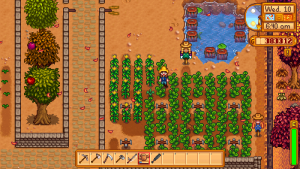
In Stardew Valley, the player has inherited acreage from their late grandfather. They escape the crippling burden of their desk job in order to explore a relationship with both nature and their new small community, which is being threatened by the evil mega corporation, Joja. The game is rather open in its possibilities, and doesn’t require you to follow specific tasks. However, one of the main quests available to you is the restoration of a decrepit community centre by collecting and harvesting various items which you can find throughout the playable world. An aspect that I appreciate about the community centre is that the game forces you to take your time, as you generally have to play through a full in-game year to acquire a vast majority of the required items. As a matter of fact, I only just finished my bundles recently for the first time, which took me around 53 real-time hours. 

While competitive and fast-paced games are fun, I’ve always had a soft spot for sandbox style games such as The Sims, Minecraft, Harvest Moon, and Animal Crossing where I am allowed to roam and interact with the game as I please. Seeing as the premise of Stardew Valley is the escape from 9–5 corporate jobs, the slower pace of the game seems to mirror something similar to the sentiment of avoiding the rush of modernity.  As mundane as it seems, the routine of caring for your farm animals, crops, and greeting your fellow villagers is remarkably calming.

Courtesy of ConcernedApe

In contrast to Animal Crossing’s seemingly endless villagers, my favourite aspect of Stardew Valley is the smaller set of citizens available to socialize with, befriend, gift items to, and even marry in certain cases. The characters all have unique backstories and distinct personalities which can be explored, and even deal with more mature, realistic issues. This includes depression, alcoholism, PTSD, aging, and homelessness depending on which characters are befriended. Seeing these beloved characters struggle with these issues truly fleshed out the playable world around me, and drew me further into the story. 

Recently, every time I find myself anxious I tend to turn to my PC for comfort and boot up Stardew Valley. It has served as a happy place for me over the past few weeks, and permits me to slow down and take a breather while I explore the countryside around me. If you ever similarly wish to escape, relive the nostalgia of 8-bit, or just give sandbox gaming a try, I would highly recommend trying Stardew Valley!

If one day I just buy a farm and run away from all my responsibilities, you’ll know what happened to me, and you’ll know what game to blame.

Peak Speaks Podcast – Headline Roulette

0

Listen here: https://pod.link/1464226637

Everyone should participate in the COVID-19 survey to ensure the best pandemic response

0
The BCCDC survey is short and most of its questions are voluntary. Image courtesy of BCCDC

By: Nicole Magas, Opinions Editor

Look, no one is more surprised than every math teacher who mercy-passed me through high school that I not only excelled in my department-mandated stats classes, but I actually enjoyed them, too. And one thing I learned from these surprising gems in my post-secondary career is the value of broadly-gathered survey and census data. Right now, as governments play a delicate balancing game of how much reopening is too much/too little, survey data is absolutely invaluable. This is why it is imperative that as many people as possible take the BC Centre for Disease Control COVID-19 Survey.

The survey is open to any British Columbian over the age of 18, and asks a number of questions that are meant to better understand how COVID-19 has affected people in this province. The questions range from asking about the economic impact of the virus, to how it has changed behaviors, to simple knowledge questions about the spread of the virus. Almost all of the questions are voluntary, so there is absolutely no reason not to take the 10–15 minutes to complete it.

So why is this survey so important right now? It’s not just a government wellness check to see how its citizens are coping with the stress of the pandemic — although that is certainly a part of it. The data collected from this survey will help policy makers and health officials determine how badly quarantine measures have actually affected people’s health and financial circumstances. It will show which regions are doing better than others. It will guide decisions on how much of the economy needs to be reopened, or which areas (such as elective healthcare) need more resources for remote services if restrictions are impossible to remove at this time.

Our post-pandemic future could also be mapped out by the data collected in this survey. For example, will economic stimulus be more needed than trauma support and mental health services? Will hospitals or doctor’s offices need to prepare for a rush of postponed appointments, and could these locations be other potential hotspots for future waves of the virus? By analysing how people are feeling and where they may be struggling today we can better prepare for what the fallout of all this may be tomorrow.

And the survey will guide messaging decisions for our ongoing pandemic response. It’s perhaps no surprise that lockdown measures — although proven effective — have not been universally well-loved. This could be due to incorrect perceptions of the danger of the virus among certain populations. If public health officials can pinpoint whether this is due to economic fears outweighing fear of illness, lack of knowledge about the virus, or a feeling that the danger isn’t close enough to an individual to be of concern, then public messaging can be altered that incorporates these perceptions into the broader context of the pandemic. With better messaging, perhaps public health compliance will increase, and with it the overall health and safety of the public as a whole.

But these benefits are only obtainable if health and public policy officials have as clear a picture as possible of the circumstances of British Columbians. Incomplete data causes all sorts of problems for researchers and policy makers looking to find or understand social trends. Lack of data hinders our ability to address problems as they are occurring and improve the lives of people who may be needlessly and invisibly suffering. While at this time it is unfeasible on a number of fronts to poll every eligible person in BC about their COVID-19 experiences, more data will be more helpful than less.

The BCCDC survey expires on May 31, 2020. If you have not done so already, I urge you to take it if you can. Share it with friends and family and explain its importance. There may be aspects of our pandemic response and its consequences that we’re not yet aware of, but that can save us a lot of grief down the road. But only if we have enough data to assess our situation now.


Faster and cheaper COVID-19 testing kits are being developed by SFU researchers

0
Photo courtesy of SFU News

Written by: Nathaniel Tok, Peak Associate

SFU Post-Doctoral Fellow Lena Dolgosheina and Professor Peter Unrau of molecular biology and biochemistry are using their previously developed imaging technology called Mango to help produce cheaper and faster COVID-19 testing kits.

In an email interview with The Peak, Dr. Unrau discussed the research further. 

The project is funded by the Canadian Institute of Health Research (CIHR), which is offering rapid funding to Canadian researchers whose work helps to address COVID-19. According to the CIHR, 227 eligible applications have been submitted and 99 grants have been provided at the time of writing. Dr. Unrau said that the process of writing the grant application and receiving the funding took two weeks. 

 The Mango imaging technology is able to detect COVID-19 RNA within living cells, explained Dr. Unrau. Saliva samples will be used for the COVID-19 testing kits, collected through the swab method. 

Most current tests are “multi temperature” tests, which require expensive equipment. According to Dr. Unrau, the Mango test will be cheaper and easier to conduct because it is performed at a fixed temperature. 

It will also be significantly faster than other testing methods. Dr. Unrau noted that currently, test samples are transported to centralized test centres where the results are processed — this ultimately is a longer process due to both transportation and testing. Dr. Unrau is hoping that the Mango test kits will be able to collect the sample and perform the test in an hour, all done onsite at a hospital. 

Additionally, Dr. Unrau explained that the Mango system also makes important contributions to disease research, as it can detect when RNA processes “go wrong or break,” as is the case with cancer. He noted that this Mango makes this detection easier, “and thus should simplify the study of human disease.” 

Dr. Unrau noted that the test kits are not commercially available yet, as they are still undergoing reliability testing.

BC’s COVID-19 health policies are being informed by SFU professor’s research

1
Image courtesy of SFU Department of Mathematics

Written by: Harvin Bhathal, Peak Associate

SFU mathematics professor and infectious disease modeller Dr. Caroline Colijn is using mathematical modelling to project trends in the COVID-19 pandemic. Her research has allowed provincial health officers to better determine the next steps during the pandemic with regard to its COVID-19 health policies.

Dr. Colijn was also selected by the Chief Science Advisor of Canada to sit on a multidisciplinary science expert panel to advise on COVID-19-related scientific developments. Additionally, Colijn has a track record in public health modelling as she was appointed as a Canada 150 Research Chair in Mathematics for Infection Evolution and Public Health in 2017.

Mathematical modelling is the best tool we have to explore possible impacts of our choices and also the uncertainty due to key unknowns,” Colijn said in an interview with The Peak

Dr. Colijn explained to The Peak that the factors considered in calculations for mathematically modelling the outbreak of COVID-19 include: “Reported case counts, estimates of time between symptom onset and reporting, the time frame when distancing measures ramped up, and the numbers of tests that were done.” 

With this information, Colijn and her team “use a model to estimate the strength of distancing, and compare it to the estimated critical threshold.”

On May 6, 2020, the BC Provincial Government eased the COVID-19 restrictions that have been in place since March due to the global pandemic, allowing for gatherings of up to six people.

Dr. Colijn was supportive of this measure, saying: “There is room for some cautious relaxing of distancing measures. This should be done in combination with strengthened testing and contact tracing and with a close eye on COVID-19 cases, because it’s easy to go too far.”

Furthermore, Dr. Colijn stated, “We have estimated that distancing has been effective in BC and that community transmission is now relatively low; this will continue if contacts are kept below the critical threshold.”

According to the BC Centre for Disease Control, 78,665 COVID-19 tests have been conducted in BC as of May 4, 2020. In an article for The Province, Colijn spoke in favour of random testing, noting that BC “could accomplish random testing with about the same number of tests it is doing now.”

Dr. Colijn’s MAGPIE (Mathematics, Genomics, and Prediction in Infection and Evolution) research group has also been modelling the COVID-19 global pandemic, transmission rates, and the effect of physical distancing on the outbreak trajectory.

According to Dr. Colijn, “If too much contact resumes, cases will rise, potentially quickly. This could undo the benefits we have achieved.”

Dr. Colijn and her team have also been granted funding from Genome BC to further examine the effectiveness of current measures and when restrictions should be relaxed.