Home Blog Page 423

Senate Report: June 8, 2020

1
(Photo from Peak archives)

Written by: Paige Riding, News Writer

Petter elaborates on his anti-racism statement and SFU’s equity initiatives 

During Monday’s Senate meeting, SFU President and Senate Chair Andrew Petter discussed the University’s resources and support to those “working to break down barriers to inclusion through the equity, diversity, and inclusion.”

Petter noted that the University is currently considering further steps that can be taken to combat racism and discrimination, as well as additional support that they can offer to vulnerable students.

“Across the university, we’ve heard an outpouring of opposition, revulsion to racially motivated violence and discrimination, support for black students, faculty, and staff, as well as for members of other marginalized groups and other forms of discrimination.”

“I think there is a genuine and deep commitment to doing so, difficult though it may be and inadequate though our may be from time to time.”

COVID-19 virtual town hall in the works

Petter announced that another virtual COVID-19 town hall is in the works, this time providing information to faculty and staff via a streamed presentation.

“Of course, virtual town halls aren’t the same as in-person ones, but hopefully, this will add to our efforts to provide good information and answer questions as they arise,” Petter said.

Petter provides update on SFU’s COVID-19 research efforts

Petter discussed SFU presenting at the Virtual GovTech Summit to governmental organizations like the Canadian Border Services Agency, Stats Canada, and Employment and Social Development Canada last month. 

Director of SFU’s Big Data Initiative Dr. Fred Popowich presented on how governments can use data responsibly and ethically to solve COVID-19 challenges,” Petter said.

He also noted that 50 SFU researchers were awarded over 11 million dollars from the National Science Engineering Research Council of Canada as “part of the Discovery Grants Individual Program.”

Senate discusses the search for the new VP Academic and the conflicts surrounding the search

Senator Daniel Laitsch raised concerns regarding the search for the new VP Academic. In particular, Laitsch noted the Board’s decision to bypass the typical public presentation of a short-list of candidate(s), despite a public presentation being “historically what was done.” Instead, the board went through the selection process and chose a single candidate for the position. That individual will either be approved or denied for the position at a later time.

The preamble provided by Senator Laitsch says: “the public presentation is a key part of building trust between the academic community and the university administration. I am disheartened to know that even this basic opportunity for engagement and collegial self-governance has now been taken away.”

“Ultimately, we have no public accountability. I realize that times are ‘different,’ but we do have the technological ability to provide the SFU community with a public presentation and consultation process.”

According to Senator Joy Johnson, the board went through “unconscious bias training” and then held interviews with candidates.

“As per best practice but, in particular in relation to concerns about equity, diversity, and inclusion, the interviews were based on the competencies and the role profile that was developed,” Johnson continued. Overall, Johnson estimates that about 30 hours went into this decision process.

Petter noted that the wording of the policy writes that these proceedings “may” need to be conducted, but it is the “committee’s jurisdiction” to determine whether or not public presentation of candidates is required.

In an attempt to compromise, Laitsch and Senator Colin Percival suggested having the chosen candidate present to a closed session of the Senate.

“At least in that case, you have a confidential introduction to the VPA in a private manner,” Laitsch suggested.

While Petter acknowledged these concerns, no compromises were established during the meeting.
Council Corner: June 9, 2020

0
Chris Ho/The Peak

Written by: Michelle Gomez, News Editor

Discussion with SFU senior leaders about student services in COVID-19

The GSS meeting began with a presentation followed by discussion with Rummana Khan Hemani (SFU’s Vice-Provost and Associate Vice-President, Students & International) and Erin Biddlecombe (Senior Director, Office of Vice-Provost Students & International). 

Hemani began by noting that aside from Residence and Housing services and the health centre, all other student services are virtual at the moment. A challenge that their office is currently facing is “how to effectively maintain relationships and interactions with students in this remote way.”

Hemani explained that a group is being formed between Ancillary Services, Student Services, the faculties, Graduate and Postdoctoral Studies, and the Library to discuss which services should be provided online and which should be in person in the Fall. 

Biology Councillor Allison Dennert noted that many graduate students will be financially impacted in the long term due to having to cancel field research or lab experiments, thus delaying their thesis and forcing them to extend their degree. 

Dennert added that “a lot of students are feeling that the decision to charge students late fees right now has been not necessarily in good faith and not in keeping with [ . . . ] the appreciation toward grad students that I think the university wants to convey.” 

Hemani responded that a lot of discussion took place regarding how to handle tuition in the summer term. “To some degree we’re fairly relaxed on the tuition payment policy at SFU compared to other institutions,” she stated. 

Hemani responded that late fees are not a significant source of income for SFU, but rather “a mechanism through which we encourage students to pay on time.” She explained that SFU relies on cash flow, and thus, it would not be possible for the institution to function if all Summer fees are outstanding until the end of August. 

GSS Calls Upon SFU to honour Its agreement with Research Assistants at TSSU

The GSS passed a motion that calls upon SFU to honour its Memorandum of Agreement (MOA) to recognize Research Assistants (RAs) as employees of the university.

As reported previously by The Peak, the joint statement issued by SFU and the Teaching Support Staff Union (TSSU) in November 2019 “stated that SFU would voluntarily recognize TSSU as the official union for all RAs.” 

As laid out in the MOA, collective bargaining was to begin in May 2020, however, this process has not yet begun. 

The motion passed states that the GSS will call upon SFU to honour the MOA, including promptly bargaining for a collective agreement for RAs. 

Director of External Relations Matt McDonald read out part of a recent email received from SFU’s VP Academic and Provost pro tem Jonathan Driver about the issue.

“The initiative has been very complex and while we have had a delay in the dates with TSSU for a number of reasons [ . . . ] we want to reassure you that we are putting every effort into continuing with this critical work of making research personnel employees of the university.” 

Solidarity with Black Lives Matter 

A motion mandating the GSS to stand in solidarity with BLM was carried. The motion includes condemning systemic racism, empowering the GSS Executives to support the education efforts of Black organizers, empowering the Executive Committee to publish a statement of solidarity, and encouraging the GSS membership to educate themselves and speak up against racism. 

Director of Academic Relations Rahil Adeli said that: “Black people continue to face discrimination, murder, and brutality at the hands of police [ . . . ] It is our duty as a society to take action, raise awareness, and create change.” 

Geography Councillor Claire Shapton said, “I’m really glad that we’re writing a statement of solidarity [ . . . ] it’s important to be in solidarity and part of being in solidarity is [ . . . ] criticizing our own systems.” 

The motion was carried unanimously. 

Dora Kamau is creating empowerment-focused spaces for women to heal

0
Kamau uses Instagram to lead empowering meditations for women. Courtesy of Bliss Your Heart

By: Michelle Young, Staff Writer

Dora Kamau is a Vancouver-based meditation teacher and mindfulness artist who hosts meditation classes and conversations for women to emotionally heal from stress, trauma, and self-doubt. Previously the founder of Bliss Your Heart, “an online and in-person platform [ . . . ] with the intention to foster meaningful and intentional connections [and] community in Vancouver,” Kamau focuses her work on self-care and self-discovery for all women, seeking to “empower women through clarity, connection, and conversation.” 

Though Kamau is no longer active under the Bliss Your Heart alias, she continues her work via Instagram, hosting and co-hosting a variety of wellness events, workshops, and conversations. Most recently, she held the Instagram live, “you can’t police my joy,” a conversation and meditation for “all black beautiful bodies.”

Kamau has a library of guided meditations where she focuses on healing. These three to ten-minute audio clips feature her soothing voice and affirming words. Paired with peaceful music, these meditations invite listeners to be present and aware of themselves via their breath and bodies. While these guides are similar to many meditations — pushing those who are participating to unclench their jaws and relax their shoulders — Kamau takes them a step further. From my experience, typical meditations are filled with calming flowery words and images. Kamau’s, however, contain powerful words that are woven together to sound nearly poetic. She touches on topics like unapologetically setting boundaries and being compassionate towards oneself. Though these pieces are calming, they are nonetheless powerful. 

Kamau has studied Psychiatric Nursing, holds a Bachelor of Arts in Psychology, and is “interested in human nature and how we interact with ourselves and our environment.” She told Douglas College in an interview that her work stems from personal experiences: riddled with trauma and in search of healing, Kamau wanted to “create a space for other women like [her], to gather and hold space for one another, where [they] could silence shame by having powerful conversations about self-love, self-care and mental health.” 

Motivated by the normalization of burnout culture and encouraged by her ability to inspire young Black women, Kamau’s work pushes for change — change within ourselves, to take care of ourselves, recognize our needs, and to love ourselves. She also pushes for greater societal change as she continues to facilitate conversations and create spaces that advocate for compassion, women’s rights, and Black empowerment. 

You can find recordings of her past events and search for upcoming events on Kamau’s Instagram.

Takao Tanabe workshop provides new abstract styles for artists to apply in their work

1
Takao Tanabe’s Forest 5 illustrates the sumi-e technique used in his art. Courtesy of Mira Godard Gallery.

By: Michelle Young, Staff Writer

The Vancouver Art Gallery’s Christina Jones hosted a one-hour Zoom workshop on Takao Tanabe’s work, inspiration, and styles as part of their Art at Home Live workshops. Tanabe is a Canadian painter who studied internationally and is renowned for his landscape pieces. 

I entered the session ready with the paper and coloured pencils it required, but found that the workshop did not provide a step-by-step guide to drawing. Rather, it discussed how artists can take inspiration from certain styles and apply them to their work. The session focused on how to portray “hard-edge” landscapes . 

The workshop began by asking attendees where they feel at ease in nature, with replies in the chat box citing landscapes like oceans and forests. Attendees were presented with Tanabe’s different styles — some pieces more abstract than others. The workshop focused on his rigid and geometric pieces (such as pieces like Gate and Window), and viewers were shown how to use masking tape to emulate Tanabe’s angular style by breaking up landscapes into smaller, simplified shapes. Tanabe’s softer works were also introduced, such as his piece, Dark Hills. The hosts explained how Tanabe aimed to learn a variety of techniques, like typography and sumi-e — the monochromatic Japanese style of ink painting used to create Dark Hills which emphasizes the “quality of the line.”

Throughout the workshop, attendees were asked to describe Tanabe’s work with words and participate in a few speed-sketches to identify the focal points of this work. One of the focal points identified was the harsh emphasis on the horizon line in his landscape pieces that contrast against his softer depiction of other elements in nature. These exercises helped create a concrete association with Tanabe’s abstract style and the conceptual ideas of the workshop, especially as attendees were asked to apply the suggested techniques in their own time. 

While the lack of technical guidance may have been a disappointment to some, I appreciated how viewers were given the opportunity to take the concepts they resonated with and apply them however they pleased in their work. The workshop succeeded in presenting conceptual ideas memorably, and in demonstrating valuable techniques for artists to make their own. 

When asked by the host for advice to give to aspiring artists, Tanabe said they simply need to have “the drive.”

The Vancouver Art Gallery is hosting a variety of at-home lectures and workshops, which can be found on their events page. Past events have been recorded and can be enjoyed on their YouTube channel, including this workshop. Per COVID-19 guidelines, the Vancouver Art Gallery is open to the public as of June 16, with special hours for frontline workers.

Luminous Territories glows with beautiful and insightful Indigenous storytelling

0
SFU alum Jade Baxter’s short film Beyond Hope explores small town life through simple visuals. Courtesy of Jade Baxter and Mackenzie Reid Rostad.

By: Madeleine Chan, Staff Writer

I didn’t know so much could be said in such little time, but Luminous Territories tells it all. Presented by The Cinematheque in partnership with the Contemporary Art Gallery, Luminous Territories is a collection of four short films curated by Emily Dundas Oke and Maria-Margaretta that were screened online from June 5 to 7. The collection aimed to explore the “intersections between land and memory” by contemplating “how the sovereignty of storytelling arises in our day-to-day life through embodied articulations, dance, and or DIY culture.”

The first film Tsanizid (2019) was performed and directed by Beric Manywounds, a “Two Spirit writer, filmmaker, and intermedia performance artist from the Tsuut’ina Nation of Treaty 7.” A movement piece that ran for only six minutes, it depicted, as described at the end of the film, a “Two Spirit transformation ceremony.” The visuals were stunning, with a soft glowing moon centered against the darkness of the night sky and Manywounds lit in hues of purple, blue, and pink. It was almost hypnotic because of the delayed effect used to make it seem like there were multiple echoes of Manywounds. Even though no words were said, I could still understand the deep inner exploration that the movements seemed to convey.

Birds in the Earth (2018), created by Finnish photographic and video artist Marja Helander ran for only 11 minutes but felt eternal in its message. The film featured two ballerinas synchronously dancing against various vast landscapes and buildings to soothing yet disconcerting melodies. My favourite part of the piece was when the pair stopped dancing and covered the words “State-owned” on a direction sign so that it only read “land.” It was hauntingly beautiful, with a tinge of a hopeful sadness. 

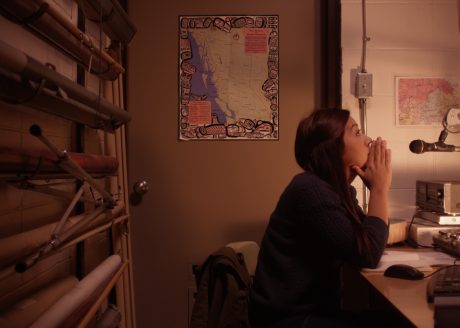
SFU alumni Jade Baxter from the Nlaka’pamux Nation directed the next film Beyond Hope (2016), which also clocked in at 11 minutes. This one explored life in the small town of Lytton, which is located about an hour’s drive north of Hope in the interior of BC. It was told through the lens of Minnie, a young radio host, as she “listens and broadcasts the tale of The Boy and Owl into her community.” I adored the cinematography in this film as it had really innovative framing, simple visuals, and told a whole story even without much of a plot. I particularly liked the framing in one shot where it felt like the viewer was in the backseat of Minnie’s truck, staring out the window at the passing hills, as if we were along for the ride. 

The last film D.I.Y (2019) was written and directed by Taran Kootenhayoo, a “Denesułįné and Stoney Nakoda multi-disciplinary storyteller from Treaty 6 territory, Alberta” who currently lives in Vancouver. Based on a real experience, the film told the story of a young skateboarder and his spontaneous yet meaningful conversation with an older man at a skatepark. In the panel that was available to view after the four films, Kootenhayoo explained that it was about the exploration of being on a territory that is not your own and finding a piece of it there. In this case, it was in a stranger. In five short minutes, it was still able to remind me of similar unexpected but significant encounters with strangers, and almost make me miss the potential for those to happen.

In addition, the ensuing panel allowed the directors and curators to talk more about how their work connects (or doesn’t) to the land they are on and their struggles with land in relation to identity, culture, and current controversies, giving even more depth to their stories.

Luminous Territories brought four short films together to create a screening that feels like a whole saga of captivating storytelling in itself. Check out The Cinematheque for future screenings that I am sure will be as beautiful and rich as this one proved to be.

DOXA’s There’s No Place Like This Place, Anyplace provides a poignant look at gentrification anywhere

0
The film revolves around the teardown of historic landmark, Honest Ed's. Photo courtesy of Steven Andrachuk / blogTO

By: Meera Eragoda, Arts & Culture Editor

As COVID-19 inequities have shown, gentrification has long been a hot topic in Vancouver and many other cities across Canada. It’s a word packed with a lot of meaning. Without oversimplifying it too much, I like thinking of it as a developer’s rebranding of a neighbourhood in order to make it more attractive to wealthier people in order to increase developer profits. Gentrification is something that is going to affect us all (if it hasn’t already) as we try and build our careers in an increasingly unaffordable city.

Experiencing gentrification firsthand, Lulu Wei, a Toronto-based filmmaker and cinematographer, filmed There’s No Place Like This Place, Anyplace to document her own and others’ experience in the Bloor/Bathurst neighbourhood of Toronto. While this film focuses on Toronto, the patterns of gentrification are applicable everywhere. The film was produced by Ali Weinstein, music composed by Laura Barrett, and editing done by Sarah Bachinski and Perry Walker. Currently, the documentary is playing virtually at Vancouver’s documentary festival, DOXA, and is coming off a win of the Rogers Audience Award at Toronto’s Hot Docs Canadian International Documentary Festival.

The film follows Vancouver developer, Westbank (known for such egregious eyesores as the Vancouver Torqued Chandelier), as it takes over the property that used to house the landmark, Honest Ed’s, for 75 years. The founder of Honest Ed’s, Ed Mirvish, also owned several buildings in the surrounding area which he rented out to artists and small, independent businesses, making the area very vibrant. 

I was talking to a friend from Toronto about this film and they expressed how heartbroken they were when Honest Ed’s was torn down. This is a feeling that is echoed throughout the film. Honest Ed’s was a discount store that had historic value in the community for the low prices it offered, which made it affordable for many new immigrants to get their start in the city.

Ed Mirvish’s son, David Mirvish, comments on the legacy of Honest Ed’s saying, “New people coming to this country went there for their first clothes, their first frying pan, their first winter coat, and their first shoes, and their first everything. So my father was a port of entry for many, many families.”

The film doesn’t make any value judgments about David Mirvish, though he sold the property after Ed Mirvish and his wife passed away — which I think slightly overlooks one of the contributing factors of gentrification as he could have done many other things with it. 

Despite this, There’s No Place Like This Place, Anyplace explores other important topics. This includes dissecting what Westbank’s definition of affordable is when they talk about making a certain number of units available at an “affordable” rate.

As Dr. Deborah Cowen from the University of Toronto explains in the film, “Another problem is affordability is being defined in relation to average market rents, not in relation to people’s incomes [ . . . ] Affordability, you’d think, would be ‘can someone afford it?’ not ‘is it cheaper than the average rent?’”

Because Westbank taking over meant an increase in rent, both residents and business owners who relied on actually affordable rent in order to survive had to move elsewhere. In addition, the very few “affordable” units came at no cost to Westbank as the City of Toronto ended up subsidizing them.

One of the businesses that faced displacement was a Black-owned bookstore and gathering space, A Different Booklist (now The People’s Residence). Itah Sadu, the owner, comments on how Black voices are often overlooked in conversations of development, even when their communities have deep roots in a neighbourhood, and how they have to demand that their voices be heard. 

“When people of African descent came to Toronto, Bathurst Street was their meeting place [ . . . ] Were we in that narrative? Or did we have to get ourselves in there? Oftentimes there’s a prescription already in place for us to respond to. We’re not just responding to gentrification. What we want to do is to stay on Bathurst Street.”

Throughout the film, Westbank is shown as attempting to have community engagement in order to build something that retains the character of the neighborhood, without actually spending any of their money. However, the emptiness of this rhetoric is shown by the final result and their refusal to acknowledge the detrimental impact they have on independent businesses, as well as residents who rely on affordable rents along subway stations.

This film by Wei is such an important one and I highly encourage anyone wanting to learn more about gentrification, the insidiousness of Vancouver developers (or developers in general), or the history of Toronto to watch.

There’s No Place Like This Place, Anyplace is available at DOXA’s virtual festival until June 26 with the student admission price of $6.99.

SFU holds virtual convocation ceremony for Spring 2020 graduates

0
Courtesy of Simon Fraser University

Written by: Paige Riding, News Writer

On the evening of Thursday June 11, SFU hosted a half-hour virtual convocation ceremony to celebrate over 4,500 SFU graduates. 

This event was supplemented by specific faculty celebrations on SFU’s website. These celebrations included brief messages from the Dean of each faculty and separate undergraduate and graduate videos highlighting each graduate.

Director of Ceremonies and Events Gloria Chu spoke with The Peak over email about convocation.

“A lot of work from many teams across the university came together to reimagine a virtual convocation that would be meaningful, celebratory, and grad focused. In a very short time, we consulted widely, with grads, faculties, and departments at SFU; and we researched and consulted with our many external contacts as well,” Chu wrote. 

The main convocation began after a montage of SFU’s scientific advances, research efforts, engagement with Indigenous peoples, some SFU pipe band tunes, and student speakers encouraging the use of the hashtag #MySFUGrad2020 on social media.

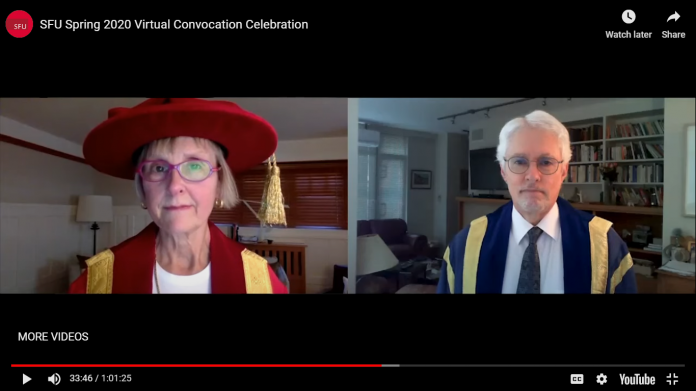
Chancellor Anne Giardini and President Andrew Petter presented an opening speech, followed by a traditional welcome from Elder Margaret George, a member of the Indigenous Student Centre’s Elders Program. Elder Margaret provided a brief prayer and thanked the families of graduates for attending and celebrating with the Spring graduates.

Minister of Advanced Education, Skills & Training Hon. Melanie Mark also provided encouraging words, followed by further remarks from the Chancellor and President Petter acknowledging the atypical situation for 2020 graduates. 

Eight honorary degree recipients were acknowledged for their “scholarly, scientific, or artistic achievement, or in recognition of their exceptional contribution to the public good.” This is the highest honour provided from SFU. The recipients provided brief addresses to the graduates, congratulating them and wishing them luck in the future.

“You’re graduating in 2020, a year that will go down, hopefully, in the history books as the year of the great realization. COVID-19 has woken us up to the power of our welfare states and social services. Services that have been underfinanced and undervalued [ . . . ] All of this means that we must change the way we produce, the way we design, the way we consume, the way we build communities and safety nets, and especially the way we bring new voices to the table to discuss all this,” said Dr. Mariana Mazzucato, one of the eight recipients.

After the honorary degree recipients, student speakers from the class of Spring 2020 gave short speeches.

The event ended with the official graduation announcement and congratulations from the Chancellor and President. Within two minutes, thousands of students were mass convocated. Graduating student’s names and degrees are listed under each of the faculty celebrations websites.

Chu spoke on the efforts of those working in unusual circumstances to make this celebration happen.

“All who have been working on these virtual convocation celebrations have taken these new challenges with a complete ‘we are here to do whatever it takes’ attitude. Because they all understand that these are challenging times for all and especially the Class of 2020,” Chu said.

“We are so very proud of your accomplishments! And, we recognize that the virtual convocation was not what you were expecting after all your hard work. But, we hope that you know how much we appreciate all of you. We are looking forward to celebrating with you at an in-person convocation soon when it is safe.”

There is no good reason not to change the name of our sports teams

0
Is McFogg even a real Scottish terrier? Image courtesy of @SFU Twitter account

By: Nicole Magas, Opinions Editor

The recent Black Lives Matter protests around the world have turned a new page in the chapter of global anti-racist conversations. Locally, SFU’s athletics teams’ name has once again been the subject of critical scrutiny. Admittedly, playing under a name like “The Clan” isn’t great optics for a supposedly liberal university like SFU. It’s incredibly insensitive to the teams and players we compete against who associate such a name with the KKK — particularly those players in the US. Frankly, the name is cringy under the best of circumstances, and for too long awkward gestures to our supposed Scottish heritage have been used as an explanation for why the name hasn’t yet changed in our 55-year history.

Honestly, at this point in time, history is not enough to justify keeping a name that not only causes offense, but endangers our players as well. Those who cry the loudest against the removal of racist colonial icons or names appeal to history as a basis for resisting progressive change. Yet some histories — especially white colonial history — shouldn’t be put on a pedestal. Aside from the fact that using history as a justification to continue celebrating people and events that oppress others is a pretty shitty thing to do, the history that these appeals are based on is often romanticized at best or flat out incorrect at worst. In the case of SFU’s Scottish history, it’s a little bit of both.

Like our campus’s legendary prison architecture or the opening of the SUB, SFU’s Scottish “heritage” is more fabrication than fact. As SFU history alumni Georgia Twiss articulates, SFU’s connection to Scottish history was from its inception more about piggy-backing on the clout of established Scottish nobility than anything else. In Twiss’s words, “Simon Fraser symbolized a prestigious sense of historical continuity and heritage that was lacking in the locally-branded ‘Instant University’.” And while you may be thinking, “Of course, we’re named after one of the first European explorers in Western Canada,” you should know that’s not even the Simon Fraser she’s talking about.

SFU gets its name, its crest, its motto, and the name of its athletics teams from the much more contemporary “Simon Fraser, 15th Lord Lovat, Chief of Clan Fraser of Lovat” in a bid to adopt a sense of precedence it didn’t, at the time, possess. This is akin to sitting next to the cool kids day after day, until everyone else just assumes you’re cool too. There is nothing in the “manufactured history” of our Canadian university that is so inherently Scottish that it must remain beholden to names that are detrimental to our students and our relationships with other institutions. 

Our university was founded in the heart of the Civil Rights movement. It should have been apparent to anyone not dedicated to crafting prestige out of a faux connection with Scottish nobility that a team name like “The Clan” — or the Clansmen as it was originally called — was a bit problematic. But regardless of whatever cultural or ideological blinders the university’s founders had at the time, the fact remains that this name has been allowed to continue for 55 years. And while objection has naturally been raised in that time, the university has yet to meaningfully address what it calls a “difficult issue.”

Over the last half century our school has built a diverse community of students and faculty, with a rich, expanding tradition of campus activism. We long ago lost the need to associate ourselves with the upper echelons of an antiquated, foriegn class system — if we ever truly had such a need. Surely there’s some other name we could pull from our annals to rebrand our sports teams that’s better than “The Clan.”

After all, what’s in a name? A football team by any other name would still lose just as many games.


Abolition, not reform, is the answer to the problem of police brutality

1
It’s time to defund and dismantle our policing system. Illustration: Reslus/The Peak

By: Meera Eragoda, Arts & Culture Editor

The recent prominence gained by the push to “abolish/defund the police” has mainstream politicians like Trudeau scrambling to turn these movements into a conversation about police reform. Not only does the focus on reform miss the mark of what the protesters are calling for, it is also ineffectual in preventing police brutality. Police abolition sounds extreme, but nothing less will work to fix a broken policing system.

So what’s the difference between police reform and abolition?

Police reform is based on the idea that the police play a fundamentally beneficial role in society, in spite of the few “bad apples” that give them a bad name. The argument is that with proper training and more technology like body cameras, the police will be held more accountable and will, hypothetically, be less violent. 

As the implementation of body cameras in the US has shown, however, such measures don’t stop police brutality. As many Black people have pointed out, we shouldn’t need to see Black bodies being murdered to believe that police brutality is real and that the police are dangerous.

Police reform attempts to paper over this reality with more training and more resources. In doing so, however, it serves only to direct more funds towards a fundamentally violent institution designed to criminalize already marginalized people. 

Police abolition, on the other hand, seeks to weaken and ultimately eliminate the police altogether. Abolitionists recognize that police forces were created in order to protect the wealth and private property of a small percentage of white men. Black abolitionists in particular recognize that this definition of private property included their ancestors, and that early police forces were actually slave patrols.

This history is present in Canada as well. The RCMP was created in order to dispossess Indigenous people of their land and resources so that it could be commodified by the few. The RCMP was instrumental for displacing Indigenous communities and taking Indigenous children away from their homes and placed into residential schools. They also enforced the internment of Japanese Canadians during WWII and continue to criminalize poor and racialized folk.

Abolition means reckoning with this history of racism and dispossession by funnelling funds away from the police and towards other community initiatives such as mental health, education, and housing in order to make the police largely redundant.

Sandy Hudson — who has been instrumental in bringing the defund the police movement to the mainstream press in Canada — gives an example specific to Toronto how responded to fare evasion by adding more police officers at subway stations. She explains that if the City of Toronto redirected the funds they used for adding these extra officers into making transit free for all, this would eliminate the need to criminalize fare evasion in the first place. Given that the people evading fares are those who can’t afford them, policing fares equates to criminalizing poverty. Making transit free would make things more equitable and give everybody the opportunity of access.

This perspective can be applied to housing, mental health initiatives, education, and so much more. This is what Minneapolis just elected to do and in the Yukon, they’re experimenting with having unarmed community safety officers respond to calls instead of the police. Defunding the police and increasing funding for community care will help keep everyone safer and contribute to a more equitable world. 

In our city where the police budget is approximately $314 million — an increase of 140% from 2001 — but where homelessness has been rising year after year, we need to ask ourselves what we want to prioritize. Do we want these funds going toward making sure everyone in our city has proper housing, enough to eat, mental health resources, education, and more? Or do we want to continue to fund the policing people for trying to survive in a system built to oppress them?

There is a template letter to Vancouver City Council that will help add your voice to those calling to defund the VPD which can be found here. I urge you to fill it out and send it.


Closet Cases: Stories on when we came to terms with our queer identity

0
Illustration: Maple Sukontasukkul / The Peak

By: Kitty Cheung, Molly Lorette, Victor Yin

One of my favourite toys during early childhood was the household mop. My family kept the mop and bucket outside on the balcony of our Strathcona apartment. I would flip this mop upside-down and she would transform into my gorgeous dance partner. Together, we would twirl around on the balcony, executing dramatic dips as I ran my fingers through her “hair.” Even though my mom scolded me for touching the mop’s grimy strands, I remember our performances as marvellously free and fun. 

Reflecting on these kinds of memories now, it seems so clear that I am queer. As I entered adolescence and began to learn about sex and sexuality more in-depth, I would have identified as questioning. It wasn’t until after I graduated from high school that I became certain that I am pansexual: I feel like I could fall in love with anyone, regardless of their gender identity. 

I had always thought that once I knew I was queer, everyone would somehow find out. But that never happened. I felt comfortable keeping this truth to myself for the first few months, mulling it over until I was sure I had achieved full comfort and self-acceptance. I didn’t feel the need to tell anyone right away, but even if I did, I wasn’t sure how to bring up these topics. It didn’t feel right to just update my Facebook status to “I’m pan now uwu” and call it a day. Only intimate conversations (and I guess a Peak article) would do. 


As I made friends in university and grew a trusting support system, it became easier to come out during one-on-one conversations. I realized that when you come out, you come out multiple times, to each new person you choose to share this part of your identity with. 

I come out to my mom once every few months. I started with giving subtle hints such as “What if I want a wife instead of a husband?” Each time, I’m met with resistance and denial. The love is there, but I know we’ve got a long way to go if I’m to live life on my own terms.

These conversations with my mom are difficult, but they make me feel especially grateful for my close friends and chosen family. With this community, I love that we can have conversations where we both lament and celebrate our intersectional identities. 

– KC


Interestingly, I never had many moments of being unsure of my sexuality once I actually realized that I might not be 100% straight. The first time I had the inkling of attraction to someone of the same gender, I can recall going home and immediately consulting the internet before saying to myself, “Oh. That explains a lot.”

While I’m certain that I had several crushes on girls before I came out, in my mind’s eye I just really wanted to be their friend. While the complete and utter lack of self awareness was a large contributing factor, my well acquainted friend, “internalized homophobia,” played a large part in shielding my brain from my true feelings. Time and time again, I used to look at girls and think about how beautiful they were, and what it might be like to kiss them before reminding myself, “No. That’s gay. You aren’t gay. You like boys.” Now, I realize that most, if not all, the large playground crushes I had in my early days was compulsory heterosexuality.

Even after I realized that I was queer, I still dealt with internalized homophobia time and time again. Each time I allowed myself to get close to someone, I always found that a whisper from the darkest caverns of my consciousness would halt me, telling me that what I was doing was wrong. While I never found it hard to accept my sexuality, it was hard exploring my identity with others. Admittedly, while accepting attraction is easy, true exploration is something that I still struggle with even after being out for seven years. 

That being said, allowing myself to silence my internalized homophobia has been an amazing tool to be able to understand my true self. Silencing that voice has allowed me to become an unapologetically affectionate person. It has allowed me to understand that I am more than deserving of love from others. It has also permitted me to explore relationship structures that exist outside of the monogamous structures that have been laid out for me. While I never expected it as someone with intimacy issues, I have recently come to realize that my heart is capable of more love than I was fully aware of. 

In several ways, the journey to fully identifying as someone who is both queer and a part of a loving and healthy polyamourous relationship was both easy and difficult. Labeling myself has never been hard, but internalized voices shedding doubt upon my identity has proved difficult. The constant struggle, however, reminds me that my queer journey is never over, and permits me to express myself in new and exciting ways each day so that I might silence that pesky voice for good. 

– ML


I hit send and the bright screen stared right back. My heart was racing. I had just come out to my best friend over Line, because I couldn’t keep it a secret any longer. It was a late night under-the-covers type of conversation, the time when everyone is tired and inhibitions are down, so I had decided it was a safe time. Getting to that point was not easy. Coming to terms with your identity is not easy when you are an angsty teenager with crippling self-esteem issues living with conservative Asian parents who absolutely want nothing to do with those homosexuals

So I didn’t want to be gay. Just like how I didn’t want to be Chinese, because everything was just harder when you lived in a Eurocentric society. I was so anxious and scared as I waited for my friend to reply — she was half-Asian so I knew she would empathize with my fears. Looking back now, I don’t remember her exact words, but I know she was supportive and she told me how she was bisexual herself. I was so relieved. 

And so, began my very slow journey out of the closet. I came out again and again. When I said the words out loud to myself in the bathroom mirror. When I changed my Facebook status to “interested in men,” even though it was hidden on my profile. When I came out to my brother. When I tried coming out to my parents and it ended super poorly. When I saw Love, Simon in the theatre with my friends. When I went to my first Pride (last year!). It took me a long time and a lot of unlearning and relearning to put the pieces together and become comfortable with who I am, in every dimension, but I am so glad I did. Closets are safe, but being out is worth it. This is who I am, and I wouldn’t change a single thing.

– VY