Home Blog Page 411

Communication graduate left searching for the “s” she swears was at the end of her major’s name

0
Photo: Victoria Loveland / Pixabay

By: Alex Masse, SFU Student

This year hasn’t been great for anyone. Students have online schooling to dread, and graduates are braving the “new normal” in search of work. Most of them, however, have one particular advantage: they actually know what their major is called.

Sure, graduates of 2020 probably didn’t imagine they’d receive their degree in remotely-delivered celebration boxes, but they knew what was on the paper inside. They knew what would go on their resumes, their LinkedIn profiles, their Facebook accounts. 

This was not the case for Marsha Harold, graduate of the department of Communication, who recently sat down with The Peak for an interview to discuss her experiences. 

“I’m a comms grad,” she told me during her utterly confusing introduction. “But technically, I’m a comm grad, aren’t I?” 

And technically, she would be. The School of Communication has always been communication — singular. So why is it that so many SFU students, some even majoring in communication, call it communications? 

“It’s ironic,” Harold said, laughing in a way that made me worry for her mental wellbeing. “The major is all about, well, communicating. We look at, like, mediums, and how mediums help you clearly get ideas across. But this isn’t a clear idea. This is a messy idea. The only way it’d be funnier is if this were, like, linguistics.” 

Harold brought out her degree and, sure enough, it read that she had graduated as a communication major. 

“At first I thought it was because I transferred here from Kwantlen,” she continued. “Over there, it’s called communications. Weird, huh?” 

Before I could agree, she continued.

“To make matters stranger, Kwantlen’s abbreviation for Communications courses was COMM. So I took COMM 1100 and such. Sidenote, why do they use four digits over there for their courses? Is it to compensate?” 

I shrugged. Probably to compensate, yes. 

“Anyways,” Harold went on, “you know what’s downright bizarre? The course abbreviation for SFU’s communication classes, and that’s communication — singular — is CMNS.” Again, she shoved her degree forward. “C-M-N-S. Ssss. Where’s the “s” here, though? Why is there an “s” in the abbreviation, when there’s none in Communication?” 

I didn’t have time to get any theories in. She was on a roll, spit flying with all these “s” sounds.

“I think it’s a coverup,” Harold said in a hushed tone. “Some kind of scheme. While all my peers were doing joint majors and co-ops, y’know, securing their careers or whatever, I was figuring out why this had happened.” 

We asked if she had any ideas or leads. 

“I bet it’s an algorithm thing,” she told us, her eyes alight. “People only want communication or communications-with-an-S degrees. Not all of us will make it. Someone is trying to keep us unemployed.”

I reminded her about her comment that her communication peers were getting joint majors and doing co-ops successfully. This only made her angry. 

“What about those of us who just wanna coast by on a nice degree and watch TV for homework?” she demanded. “What, do you want me to be an IAT kid, too? You want me to learn programming? Or take the English joint major and write even more essays? That would only get in the way of me working on this.” 

Harold continued insisting that solving this mystery was what she was meant to do. Truthfully, it is puzzling that the course abbreviation is CMNS when the major is communication, but I doubt it’s because of a massive conspiracy. SFU is just like that.

Student has life-altering epiphany in the complete silence of a Zoom breakout group

0
Photo: Nikita Kachanovsky / Unsplash

By: Zedd Strangelove, SFU Student

Quarantine was in full swing, and due to my own poor choices, my classes were, too. The beginning of online lectures were rough enough with my HBO subscription providing me a 34-minute attention span. Three hour online lectures were the perfect time to binge-watch my remaining brain cells away. About halfway through an episode, I flip the window on my laptop back to the Zoom meeting. To my unpleasant surprise, there lay the face of my scowling professor staring at me. I then notice I’m the only person left in the main meeting. Uh oh . . . 

“Where have you been? I’ve been trying to get you to go into your breakout room for the past few minutes?” muttered my clearly thrilled professor.

“Oh? Sorry about that. I think I was having some connection issues.” I knew that wasn’t true, and so did my prof, but neither of us had the energy to pursue the topic. She sighed and told me to join the group, and so I did. But I did not realize what was to come. 

I joined the breakout group as I would any other Zoom call: video turned off, voice muted. The screen loads and I see the other three group members. My classmates appear to stare at me, though I know their eyes only linger on their screens in search for something to pass the time — as long as it’s anything but speaking aloud about the discussion question. 

I watch one of them order a bulk pack of Fruit of the Loom underwear on Amazon through the reflection in their glasses. Another is browsing the Tinder meat market, swiping right at an unholy pace. They’re shopping in bulk. The last one seems very rather disappointed by the rest of us, but still isn’t saying anything at all.

I stare into the four soul-sucking windows on my screen in deep introspection. Usually I’m not one for dwelling on such deep thoughts at 11:30 a.m. on a Tuesday, but the alternative was talking about Jane Austen, so the choice was rather obvious. 

I honed in on each of my classmates, each as an ingredient in the overall sandwich that is quarantined online classes. The whole image was unappetizing overall, like an egg salad sandwich stuffed with sardines left on the floor in the middle of the AQ for a few days. Stepped on by Air Force 1s, briefly examined by a Beedie student doing a cost-benefit analysis to determine whether or not they should eat it, and then left rejected on the floor, the four of us sat in silence for what seemed like hours. The only sounds that broke the quiet were our melancholic mutters of agreement to the one student who insisted on typing out a mini thesis to the discussion question in the chat box.

Together we created a monstrosity of a sandwich that should not have existed in the first place. And indeed, it did not truly exist. It was a metaphorical sandwich of the mind, the only physical trace being the toxicity lingering on my breath. 

There I was, more self-aware than ever. 

I checked the time. Only five minutes had passed. As I blinked my eyes, my classmates dissolved and my professor was on my screen again. This time the scowl had deepened.

“So are you going to join the breakout room or not?”

I didn’t respond, and just slowly hovered the mouse over the disconnect button. I cherished the feeling that came with my sweet release from the class. I don’t think I’ll learn much this semester, but what I’ve already learned is just how dangerous day drinking can be.

What Grinds Our Gears: SFU’s bookstore should be helping me find books

0

by Sara Wong, Peak Associate

Having the correct copy of a required course reading is extremely important. That’s why I primarily rely on the SFU Bookstore when purchasing my course materials. However, for the second semester in a row, the bookstore has elected to operate solely online, using VitalSource to assist students in tracking down ebooks that fulfill their course needs. This service is useless to me because a majority of the books I need are not available in a digital format. It’s also pointless because my professors tend to want students to have physical copies of the assigned books for engagement during synchronous sessions.

My professors have noticed the bookstore’s lack of course material too. “I am writing to ask you to consider ordering this textbook from Amazon,” one of them addresses my class in an email. I’d rather not line the pockets of a man whose net worth is larger than the endowments given to Harvard, Yale, and the University of Texas combined — but desperate times call for desperate measures. 

At the SFU Library, you can now pick up holds or request digital scans of book chapters. I don’t see why the bookstore can’t resume in-person pickups as well, with obvious safety measures in place. The library doesn’t have as large a variety of materials as the bookstore, so those of us who need physical copies of texts are forced to spend more time and money elsewhere. Given the world we live in at the moment — full of financial insecurity and limited business operations — the SFU Bookstore should be doing more to ensure that SFU students are well-equipped for their forthcoming studies. 

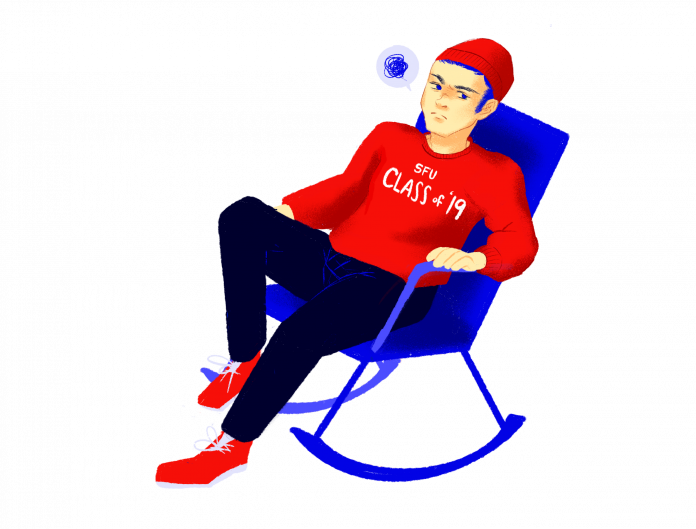
The recollections of an SFU Boomer

0
Illustration: Tiffany Chan / The Peak

By: Carter Hemion, Peak Associate

Here’s the skinny of it: incoming students for the online Fall 2020 semester are getting off too easy. They get to wake up at 8:29 a.m. for their 8:30 a.m. lectures, go to class without pants, and munch on a family-sized bag of Doritos without the ensuing glares from their professor. Quite frankly, it’s not fair and it really ticks me off. They haven’t had to work for their SFU experience the same way us veterans had to!

When I started at SFU, I had to trek 10 minutes from my dorm to my morning lecture, relearn the dense campus labyrinth along the way, and dodge small talk with my kooky neighbour who’s always fishing for compliments! And all this for what? Just to sit in the most uncomfortable chairs while the drilling sounds of my professor and those outside just drone on?

These newbies will never know the struggle of pushing against a traffic jam of kiddies more obsessed with their Snapchats than the safety of others just trying to get to class. What’s worse is when you’re late leaving because your last professor in WMC wouldn’t stop talking about their breakfast burritos. We couldn’t just click a little “Leave Meeting” button and see them on the flip side. No, we had to sit through the entire lecture and we couldn’t just turn off a camera and audio when we had to go to the bathroom. I bet these whiny, Canvas-only, video-chatting teens were too lazy to even learn cursive.

Don’t even get me started on living on a mountain. These little squirts are missing out living in their cute little climate controlled rooms in their cute little stable WiFi houses! I once ran into a coyote outside Technology and Science Complex 2 when I was walking to the store at night, and the little devil just started trotting my way. I was just trying to go to Nesters for my organic, non-GMO, gluten-free, diet white grape juice. 

We, the real students, got stuck on campus in the snow and ice when buses couldn’t make it all the way up. I felt about ready to become Jack Torrance from The Shining, stuck in my dorm with a 10-page paper trapped on a snowy mountain with no escape in sight. That’s the real SFU experience. And all the first-years these days are too busy being wet rags and sitting on their phones instead of getting out and smelling the fresh mountain air!These wussies are just starting degrees, not having to work for it at all. No student athlete cults, no construction waking them up, no searching for the AQ 4th floor classrooms, no real hard work. We really paved the way just to watch them through a grainy Zoom call as they sit in bed with their computer notes and home brewed coffee. Stop dipping in my Kool-Aid and do something productive for once!

U-Pass reinstated for fall 2020 semester

0
PHOTO: Gudrun Wai-Gunnarsson / The Peak

Written by: Karissa Ketter, News Writer

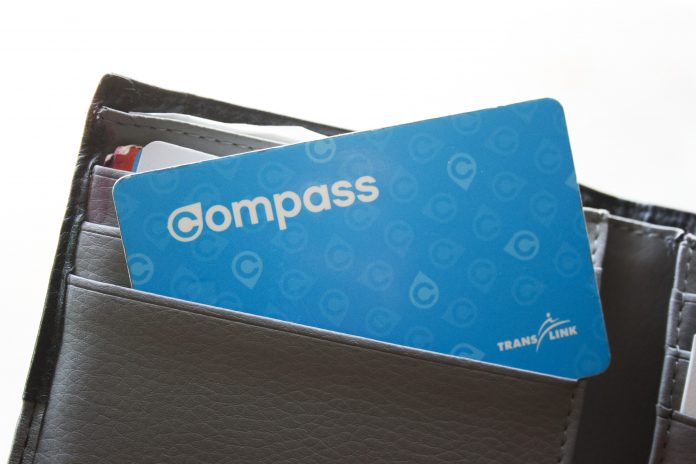
The Simon Fraser Student Society (SFSS) voted to reinstate the U-Pass for the Fall 2020 semester. The U-Pass BC program was suspended over the summer due to COVID-19, but according to the SFSS website, they “worked with TransLink, and other post-secondary institutions and student associations in Metro Vancouver” to reinstate the program as of September 1. 

The U-Pass program affords students a compass card to ride the bus, SkyTrain, and SeaBus for a cost of a $170 student fee payable to their university every semester. It also includes a discount for the West Coast Express. This rate of $42.50 a month for discounted transit saves students from “paying anywhere from $98–$117/month,” according to Samad Raza, the VP External Relations at the SFSS, in an email statement to The Peak

Raza said that “through a survey, [the SFSS realized that the] majority of students are in favour of U-Pass” because they “depend on [it] for necessary travels to jobs, grocery stores and other personal trips.” 

Some students are exempt from the student fee for reasons such as residing outside of Metro Vancouver or if they are enrolled in less than three units. Otherwise, all students are required to pay the student fee. While the SFSS isn’t involved in the exemption requirements, Raza stated that they “are looking into more ways to help [the] students who are under financial burden.” In an email statement to The Peak, Jillian Drews, a representative for TransLink, stated that “TransLink administers the program but does not set eligibility criteria” and suggested that students with questions or concerns be directed to “their school or student association.”

A petition by an SFU student calls for an exemption from the student fee during COVID-19 and currently has over 300 signatures. Some students are against the mandatory student fee as classes have been moved to remote learning, but others maintain that the U-Pass program is only available because of the number of students paying for it. 

For full eligibility and exemption rules, information can be found on the SFU website.

Wildfire extinguished on Burnaby Mountain

0
PHOTO: Jonathan Wong

Written by: Michelle Young, News Editor

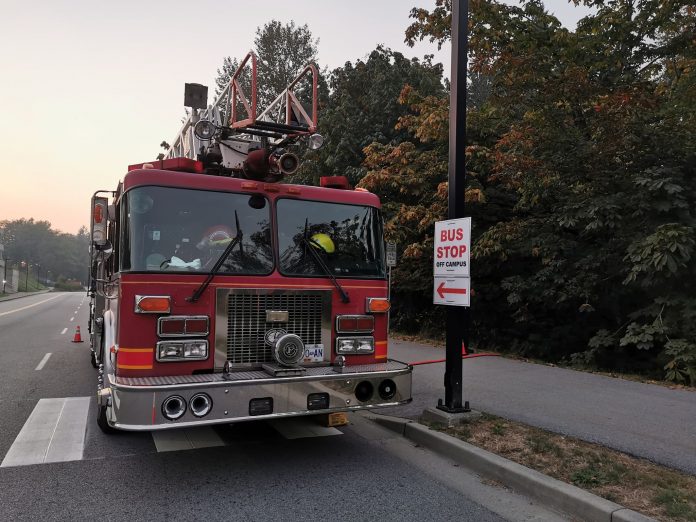
On Friday, September 11 a fire burned on the northern side of Burnaby Mountain. The Burnaby Fire Department was called at 12:20 p.m. for a fire that was “500 to 600 feet across,” according to assistant fire chief Dave Younger on Burnaby Now. The fire was located around “the site of the old Shell gas station, north of University Drive.” 

Around 5 p.m., Burnaby Fire stated on Twitter, that the “fire [was] extinguished quickly by a strong initial response and highly coordinated field operations.” 

Younger said that a helicopter with a fire crew was called in from Chilliwack to aid with the wildfire. It took the crew nearly an hour to locate the source, and they believe it “started below a tree fort.” The cause is currently unknown. 

The Peak spoke with assistant fire chief Stew Colbourne, who stated that the fire was “difficult to get to” due to the location of the fire, which was down a cliff. Crew came in “from the bottom [of the mountain] looking up and from the top looking down” to find the source. Colbourne added that setting up hoselines in a remote area was also difficult. 

Fire crews were on Burnaby Mountain “shortly after noon [ . . . ] til darkness on [September 11] and then they went back [on] the second day to check that everything was out.”

Chief Safety Officer Mark LaLonde said in an email statement to The Peak that Campus Public Safety “took direction from [the Burnaby Fire Department]” and that “at no time was there a threat to the SFU community.” 

In regards to fire safety, Colbourne said “to always be safe when you’re out in the outside environments in the trails and the bushes because it’s the end of the summer and we haven’t had significant rain for sometime and any sort of ignition sources [ . . . ] could cause forest fires or fires in the bushes.”

This is a developing story that will be updated for more information as frequently as possible. If you, or someone you know, knows more information regarding this story, we’d like to hear from you. You may remain anonymous. Please reach out to [email protected] with any further information you are comfortable sharing.

SFU to introduce its own virtual private network

0
PHOTO: Erick Cerritos / Unsplash

Written by: Mahdi Dialden, News Writer

SFU has prepared a new Virtual Private Network (VPN) service ready to launch in September. This will allow students to connect directly to SFU servers and enables them to send and receive data that they could only access by being at SFU.

The VPN is being introduced because of the shift to remote learning. Chief Information Officer Mark Roman explained in an interview with The Peak, “Some of the things folks wanted to do with our existing services, they couldn’t do.” For instance, “if [students] have a laptop that requires updates, [they] would’ve had to be on campus,” Roman said. SFU is preparing an announcement for students, which will have a thorough explanation of how to use it. 

The university is preparing for a remote fall semester, which may mean a busy time for support staff. In preparation for this rise in traffic, there will be “more staff at the service desk, and longer hours at the service desk as well,” Roman explained. 

IT services will also be adding multi-factor authentication (MFA) to the VPN. Roman explained that MFA is an added precaution during login, which is seen all over the web. It will require your user ID and password and something additional, which you would likely get from a device — such as a phone through a text. In the situation where a “password is phished or compromised, it would prevent a [hacker] to use [your] system.

“Our strategy at SFU for IT is what we call ‘the one IS vision,’ where all of our systems should work together in a seamless fashion, and all the people that support those systems should work together in a seamless fashion,” Roman said. 

The introduction of VPN is a first in a series of new advancements that the IT department at SFU is unveiling for the future. “One of the big things that [we’re] introducing [is] Microsoft teams. [It] will provide us with the capability to improve collaboration,” Roman added. This will allow them to use OneDrive which will give the ability to “concurrently update and work on documents together as groups.”

Roman also said that they are planning to “introduce a research administration system for the whole university that will reduce the administrative burden for researchers at the university [and] improve workflows and help improve the overall efficiency of how we administer research at the university.”

Roman concluded, “IT has been absolutely central to keeping everything going [ . . . ] There’s over 400 IT people at this university who have been working really hard day and night to keep all these services going. A big thanks to everybody in it, who’s kept the university running.”

Dialogue, not debate, is needed for democracy

0
PHOTO: Christina / Unsplash

by Madeleine Chan, Opinions Editor

I really couldn’t pinpoint when social media became such a tiring vortex of people just screaming their opinions, hoping that others will scream back. This kind of chaos is also so prevalent in the realm of politics, with heated, daily attacks now being common from politicians on all sides. Not to mention how seemingly structured formal debates that occur around election seasons only result in insult and injury. We can’t continue to express our opinions in this cyclical black hole of unproductiveness. Introducing dialogue, the idea of productive conversation, is necessary to ensure the survival of healthy democratic practice.

Having a conversation focused on dialogue means that you are openly listening and exploring, with the goal of learning and understanding other perspectives and experiences. With debates, the end goal is to “win,” to get some sort of prize, recognition, or just the satisfaction that you bested the other person. If a goal in a conversation is only to be the best, then what is the point of having the conversation? Dialogue not only provides space for open discussion, meaning that no one is on a particular “side,” but it also allows for error and for someone to not be faulted if they get something wrong or stumble. It also doesn’t see any opinion as “wrong” or of a lesser quality, just because it is different from the prevailing thought.

Debates do have the ability to provide structure and clarity to a conversation, however they can also be restricting in their format. Dialogue allows for a flexibility and openness that can’t be explored in a structured back-and-forth debate. This has the potential to create deeper understanding and empathy between conversants. 

The idea of dialogue isn’t a new phenomenon, either. I won’t lecture on the importance of the public sphere, I’ll save that for communication professors. Though, the idea of a place where people are dedicated to taking time to converse with the intent to foster change dates back to — in the eurocentric world — the 18th century. A more recent example of this is SFU’s Morris J. Wosk Centre for Dialogue, which has been engaging with the idea since 2000. Now, this concept just needs to be more broadly engaged with by the general public.

In action, greater consideration of dialogue over debate would look like engaging with empathy and understanding. Imagine elections where candidates aim to understand each other’s points of view rather than diminishing them, and a social media sphere filled with substantive comments that add to continuing conversations about important social issues. Simply, a democratic ideal where all voices are heard and considered equally. This absolutely does not mean that prejudiced beliefs like white supremacy should now be considered. But, in general, that conversation should be held where people can understand instead of hastily shutting down any opinion that they don’t also hold.

Implementing greater practice of dialogue won’t magically solve our problems, but it puts us on the path to a better understanding of them, our own opinions, and how to deal with them. Next time you have a burning thought, consider speaking, not shouting. Who knows, maybe someone will even speak with instead of at you. 

Watch the-peak.ca for a recurring, web-exclusive Opinions in Dialogue segment where SFU students engage in casual dialogue about various topics concerning SFU and the world. 

Millionaire returns from isolated Caribbean retreat, complains about forced isolation in the real world

0

By: Serena Bains, Staff Writer

I just returned from a peaceful silent retreat from an island in the Caribbean, the name of which is not important for true soul-searchers like me. To my dismay, I returned to a dastardly state of affairs where self-isolation is the norm. 

I thought initially that physical distancing referred to my children or taxes. You can imagine my disappointment when I discovered it entailed quite the opposite. 

I am now confined to my luxury villa in Vancouver for two weeks where my neighbours are but a few measly acres away. It is cruel, really, how I have to suffer alone in quarantine. I can’t even make use of my $50,000 parking spot in Yaletown.

To make this quarantine worse, my tenants are refusing to pay rent and I apparently no longer have the right to evict them. This is what happens when a special snowflake, big government, communist authoritarian like Justin Trudeau has power. You cannot even kick people out on the street anymore! These people just sit at home and get addicted to government handouts. Pathetic.

It is not just because I, as a white man, can not empathize with any individual who has experienced hardships. It is because I can not empathize with anyone at all.  

Thankfully, this glorious free market awarded hard workers like myself $500 per tenant because I work for my money as a landlord. People do not understand how tough it is managing property that I do not know the address of.

People may not see it now, but this pandemic is an opportunity for people to really make something of themselves. Take a coding bootcamp, read a self-help book, manifest your destiny by taking what is rightfully yours and definitely did not belong to anyone before you. There are so many ample opportunities for everyone.

I have done this work, I cashed out my trust fund. Do I get any recognition? Of course not. I did the hard work of being my father’s son and some people just do not have the capacity to accomplish that.

It is shocking that I am being treated with such disrespect. What crime did I commit? The crime of inheriting an amount of wealth that could never be spent during my lifetime? Sue me! (But as a fair warning, my lawyers could eat your lawyer for breakfast, buddy.)

In all honesty, I regret ever stepping out of my private jet, into my Tesla, and re-entering such an authoritarian regime.

A Zoom love story: How I fell in love within the confines of a 4x5cm box

0
Photo by Chris Montgomery / Unsplash

By Molly Lorette, Peak Associate

Oh how the utter bliss from classes seems to have faded since the transition online!

No, I’m not talking about the increased difficulty in communication, nor am I talking about the increased workloads and expectations piled on by my professors in the wake of a global pandemic. I’m not even talking about the constant devitalizing anxiety plaguing me day after day that this may be our new reality for the indefinite future.

I’m just left yearning for the joy brought on by finding love at first sight within Saywell’s walls. 

No longer do I feel the thrill of meeting eyes with the hottest member of my class, hopelessly pining after the mysterious, unattainable scholar despite not knowing the first thing about them. Why do I even bother looking good for class anymore? My love life is as hopeless as the prospect of having an eventful 2020. 

Or so I thought. Then, it happened. On the first day of my class, I locked eyes with them

I could hardly believe my luck! How was it possible for someone to be that perfect? I urgently click off of gallery mode and fill my screen with their face carved by the Zoom gods. I have no hope focusing on my prof’s words at a time like this.

And I just know they feel the same way.

I can feel our heartbeats synchronize as our eyes meet pixel by pixel. I can feel it through each breath they take, through each nod of acknowledgment to the lecture material neither of us care about, each adjustment to their AirPods. I watch obsessively each time they turn a page, each time their adorable nose scrunches up at a tricky topic. I drink it all up like a nitro cold brew before an 8:30 lecture. 

I sigh wistfully each time we end a lecture, longing to see my Zoom muse once more.

I pine endlessly for them. I get ready each morning for them. Each smile and each bat of the eyelash I dedicate solely to them. 

Today, however, I search for their beautiful face in gallery mode and come up empty

I wail! I cry! How ever will I find true love now?

Oh.I turn on my webcam, and there I am in all my glory. I admire my jawline, each perfected curl, and I smile. My true love.