Home Blog Page 40

2025 SFSS vice-president candidate details concerns around name misspelling

0
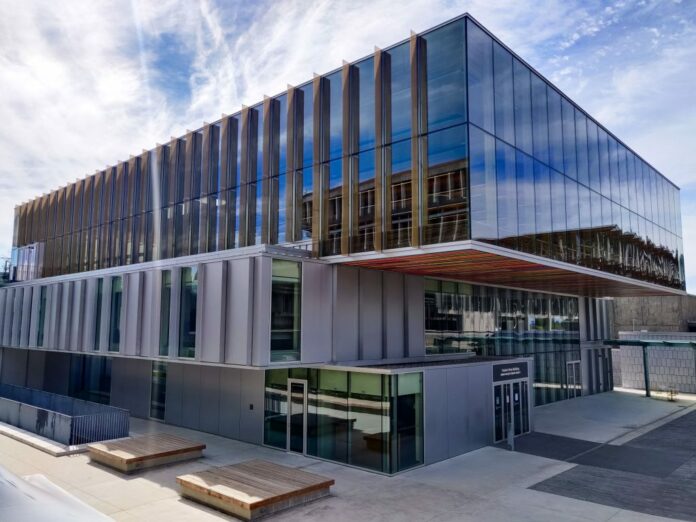
This is a photo of the SFSS building on a bright, sunny day, where the glass of the building reflects the blue sky and clouds.
PHOTO: Kriti Monga / The Peak

By: Lucaiah Smith-Miodownik, News Writer

Vaibhav Babbar, who also goes by Vee, spoke with The Peak after his lingering concerns about the election were brought to the paper’s attention by an anonymous source. 

Babbar, who served as one of the associate vice-presidents of events and student affairs during the 2024/25 term, ran in this year’s election cycle but was not elected by a margin of 88 votes. He said issues around his platform commenced before the election took place. At the candidate debate, his nickname was incorrectly spelled “Veer.” At this point in the election, the mistake “was fine because I reached out to [the SFSS] and they apologized,” he said. “But then they did the same thing again in the polling ballot itself. It was supposed to be ‘Vaibhav,’ and they did ‘Viabhav,’” with the “I” and “A” switched.

“I sent them an email regarding this, and the email was ignored, and after the election, I raised concerns about this, and they just apologized,” Babbar said. “But obviously, you need to fix that right away while the election is going on, not after elections.” He also noted some of his friends did not recognize his name on the ballot. When he explained his friends’ confusion to the SFSS, they said Babbar’s friends should have recognized him as there was only one candidate beginning with a V. 

“It didn’t feel like an acknowledgement of their mistake. It just felt like they’re trying to defend their position,” he said.

“It’s a big election, it’s a major university election in BC and it’s the whole student society — not a club, not a union — the whole student society.” — Vaibhav (Vee) Babbar, 2025/26 candidate

Babbar also raised concerns about the voting system used for the election, a topic The Peak reported on earlier this year. While individuals were able to cast more than one vote by switching browsers or using incognito mode, The Peak previously reported that “the election system has safeguards in place to ensure that each student gets only one counted vote,” according to the SFSS and the Independent Electoral Commission.

When Babbar asked for proof that illegitimate votes had been removed, the SFSS told him they could not release the raw, unfiltered polling data.

The Peak reached out to the Independent Electoral Commission for additional comment, but did not hear back by the publication deadline. SFSS also informed The Peak that they were unable to comment at the time of the article.

At the time this piece was published, the SFSS has no plans to run a re-election.

Easy udon for when the executive isn’t functioning

0
ILLUSTRATION: A warm bowl of Udon noodles, with cut tofu slices and vegetables (carrots, green onion) near the bowl
ILLUSTRATION: Cassandra Nguyen / The Peak

By: Noah Jozic, SFU Student

A dear friend shared this recipe with me, knowing I was struggling to cook regularly because of mental health challenges. This super easy udon is her go-to when she is low on energy. I could see it was effective right away — when she first made it for me, she had been eating udon all week! Now, whenever I’m brought down by executive dysfunction, depression, or other barriers that keep me from getting in the kitchen, I keep her recipe to heart as a reliable, convenient, and healthy meal option.

A few features make this udon stand out as a low-barrier meal:

  1. Easy prep, on impulse

This udon can be prepared at a moment’s notice, using long-lasting ingredients. The easiest version, featured below, uses tofu and frozen veggies. It’s a great option if you worry that your produce will only go rotten after a bad week, or if you prefer a consistent meal plan. If you need novelty to feel good about eating, you can always vary each batch with fresh and preserved ingredients: sesame seeds, wakame seaweed, bonito flakes, mushrooms, green onions, leafy greens would all work with this recipe. Greens could be the usual spinach or kale, but my friend has even used nettles foraged from Burnaby Lake!

Many of these ingredients require no chopping, and most only need to be heated through before serving.

  1. The right soup base

A delicious store-bought soup base makes the difference between this recipe and other quick soups I’ve tried. My friend introduced me to Kikkoman’s Hon Tsuyu soup base, available at T&T, which has a lovely smoky flavour straight out of the bottle. If you can’t find that soup base, feel free to swap it over to either miso paste or a vegan alternative. Do keep in mind that Hon Tsuyu and miso may contain fish.

  1. Single-servings, and the right pot

Personally, I prefer a single-serving option because it makes the meal fresh every time. A surprising game-changer for me was buying a small saucepan to make this recipe. Before, the thought of using and washing a big pot was daunting enough to keep me from cooking. My gadget of choice is a Zwilling one-litre pot from HomeSense. It has a nice, heavy base, and the brand is a personal favourite, so I’m always happy to bring it out. However, as I say this, feel free to choose any cookware that will feel good to you!

RECIPE

4 tablespoons Hon Tsuyu soup base (or an alternative, like miso)
500 ml water
1 packet udon noodles
Tofu, to taste
Frozen vegetables, to taste (eg. cauliflower, broccoli, carrot blend)

1. Add the soup base and water to a small pot. Bring to a boil.
2. Add noodles to the pot.
3. Slice or cube tofu. Next, stir the soup gently to untangle the noodles, then add tofu and vegetables.
4. Simmer for around five minutes until all ingredients are hot. Make sure the noodles have cooked for at least as long as the package indicates.
5. Enjoy!

Personal reflections on the launch of Elegy for Opportunity

0
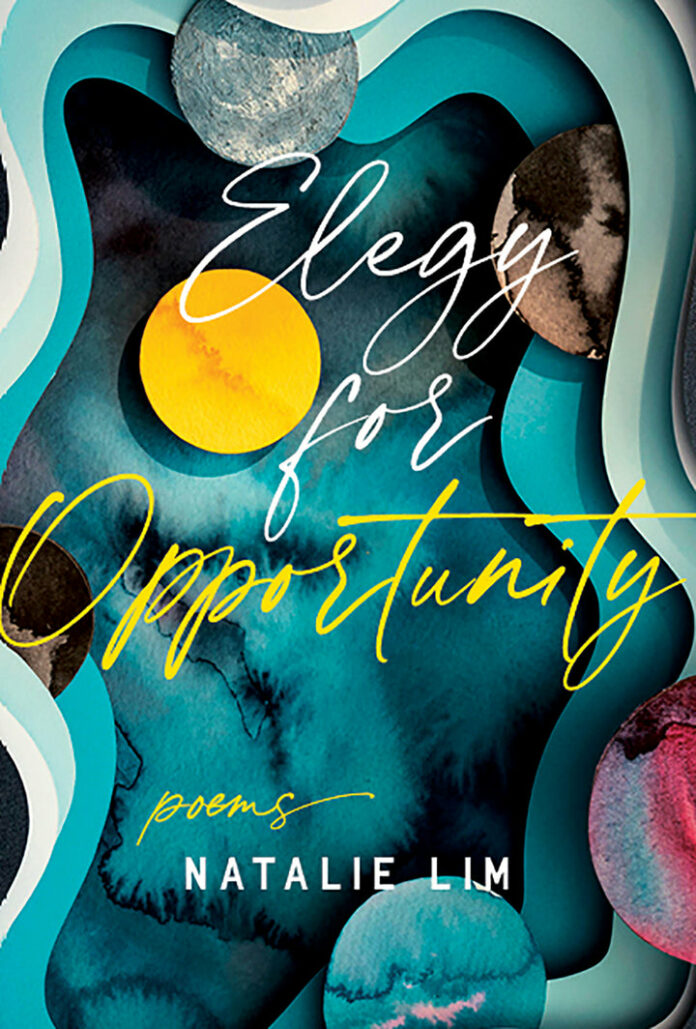
This is a cover of Natalie Lim’s book, Elegy for Opportunity
PHOTO: Courtesy of Buckrider Books and Wolsak & Wynn

By: Alex Traynor, SFU Student

On May 10, I ventured down to SFU Harbour Center in Vancouver for the first time to attend the official book launch for Elegy for Opportunity, written by the award-winning poet and SFU English alum Natalie Lim. I knew I couldn’t miss the event as soon as I read the question Lim explores in her work: “How do we go on living and loving in a time of overlapping crises?” As someone grappling with the philosophical dread of how I can continue functioning as if nothing is wrong in the world, I hoped Lim’s poetry would provide some insight and validation. I wasn’t disappointed.

Upon arrival, I quickly realized that this event was more than a celebration of Lim’s debut book. It was a testament to her profound impact on a vibrant and connected community. The room was packed, the energy warm and uplifting. Friends, family, colleagues, fellow writers, and academics filled every seat, eager to celebrate the esteemed poet and her work. The event opened with Mallory Tater, a four-time author and lecturer at UBC’s School of Creative Writing, who described Lim’s poetry as an expression of community kindness. This simple description resonated with me, and became evident as I read her works. Despite feeling a distinct lack of community during my time at SFU, this event gave me a glimpse of what a supportive creative circle looks like. I’ve generally felt helpless in finding any semblance of community since becoming an adult, watching neoliberalism invade social reactions — encouraging individualism, isolation, and meritocracy. In a political and economic climate where it’s everyone for themselves, building strong communities is a direct act of resistance to the systems that benefit off of us feeling detached. 

Stephen Collis, the chair of SFU’s English department, took the stage next. He recounted reading Lim’s first ever published poem arrhythmia, a piece that explores her identity as a Chinese Canadian, and how it impressed him so much that he encouraged its publication. She would go on to win the CBC Poetry Prize for the piece in 2018. Following Collis, Isabella Wang, author of Pebble Swing, read a poem dedicated to Lim, referencing a line from arrhythmia to connect their shared experiences. The tribute was emotional, making it clear that the afternoon was as much about celebrating Lim’s work as it was about honouring her connection to those around her. Lim’s long-time friend and Vancouver-based poet Tina Do also shared a piece written for her that left Lim in tears. By then, I’d already decided to buy a copy of Elegy for Opportunity. I had promised myself to engage with more art this year, and the authenticity and vulnerability of Lim’s prose felt like the kind of art I needed to support. 

Elegy for Opportunity intertwines love poems with tributes for the deceased NASA space rover Opportunity. After being overtaken by a sandstorm on Mars in 2018, the robot’s 15 year service to human scientific research came to an end. Lim was struck by the collective mourning for this machine that had been programmed for the very purpose of permanent exile — this paradox spoke to her about humanity’s capacity for love and grief. Initially titled Everyone I Love is Now, Lim’s love poems in the collection explore love in its multifaceted nature, including familial love, companionate love, love for environment, and even love for non-living objects, like that we reserve for machines. During the discussion and Q&A facilitated by Mallory Taylor, Lim spoke about the duality of love and grief, describing how grief can deepen our understanding of love, especially in those moments when love seems most fragile. Before reading the first poem in her book Love Poems Don’t Win Contests, she shared how self-doubt almost kept her from publishing work that felt too vulnerable. But in the end, Lim chose to lean into that discomfort, allowing her rawest, most honest reflections to emerge. 

For Lim, Elegy for Opportunity is a book for this particular moment in time, a time marked by fear, loss, and uncertainty — all the while eliciting endless moments of connection and tenderness. Created during the start of COVID-19, Lim grappled with how joy and connection can blossom in times of lockdown, and how young people increasingly fear the future due to climate crises, active genocides, and threat of facism. Despite such bleakness, the resilience of the human spirit is undeniable, and I love how this book illustrates the tumultuous burden and joy of the human experience in this age. 

I feel honoured to have been in that room and to have experienced those couple hours. The event reminded me that paying attention to space and time by allowing yourself to be fully present in the moment comes with the most rewarding results.

SFU student versus campus construction: Installment 2

0
ILLUSTRATIONS: Small illustrations of traffic cones (two variations) and construction workers to place around the borders of the photos.
ILLUSTRATION: Noah Jozic / The Peak
Small illustrations of caution tape and construction ladders to place around the borders of the photos.
PHOTO: Mason Mattu / The Peak
Small illustrations of caution tape and construction ladders to place around the borders of the photos.
PHOTO: Mason Mattu / The Peak

Political Cartoon: Carney gives into Trump

0
politcal cartoon
CARTOON: Cliff Ebora / The Peak

By: Cliff Ebora / The Peak

#NotClueless: I, like, totally attended the Met Gala

0
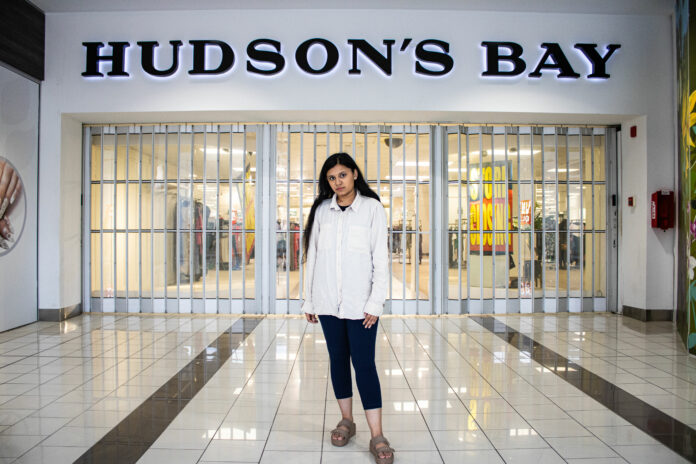
A confident girl standing in front of a closed Hudson’s Bay location. She’s wearing oversized clothing and birkenstocks.
PHOTO: Prerita Garg / The Peak

By: Zainab Salam, Influencer of Influencers

Today, I have to start with a confession; I was totally buggin’. Because, like, can you even imagine being personally invited to the Met Gala? Well, I could. Not to brag, but your girl over here scored a highly exclusive, VIPPP platinum ticket to the Met Gala last week. Let me tell you all about it. #LongCaptionIncominggggggg

It all began when I received a super exclusive DM from a brand that I’ve been dying to work with. And no, I’m not telling anyone the name ‘cause Y’ALL BASIC. They wanted me to attend the Met Gala as their brand ambassador. I mean, hello? As if I would ever pass up the opportunity to be photographed in my totally vintage (second-hand) dress while casually standing next to Anna Wintour. What’s next? Be on the cover of Vogue? #TotallyGoingToWriteThisInMyManifestationDiary #It’sTotallyGonnaHappen #YourGirlyIsAModel 

The theme this year? Liquidation. So avant-garde, right? I was obsessed. I thought, what better than to represent the BC every day girly, than wearing Aritiza? TNA is everything the Met Gala stands for: class, style, and a dash of mall-culture nostalgia. 

Anyway, I show up, and right away I’m thinking, wow, they really went all out with the aesthetic. Polished floors stretched endlessly, like some kind of chic runway. Mannequins are half-dressed in couture that stands dramatically under harsh fluorescent spotlights, which I assumed was a bold commentary on the fickleness of fashion. Yeah, people, my English courses came in a clutch! 

There was even an escalator that wasn’t moving — clearly a metaphor for the struggle of ascending the fashion world. I was, like, totally, living for the immersive experience. I sauntered through the exhibits, which included racks of designer labels, heavily discounted by the way. I assumed it was part of the evening’s theme: liquidation. How revolutionary! 

I mean, the whole thing was so authentic. Bargain bins? Stunning. Bold “Everything Must Go!” banners? Genius. And the fashion? Unbelievable. People were walking out with the oversized shopping bags, really committing to the whole liquidation theme. I was like, this is why the Met Gala is ICONIC! 

I wandered around, spotting other celebrities, SOOO many fashion seniors were there. I was like, OMG, is that a retired supermodel or the dead grandma from Up

Of course, I did what any iconic Met Gala guest would do — I started networking. It’s the fashion business after all. You’re a nobody if you don’t know somebody! I leaned over to this one lady in an oversized fur coat (a bold choice for liquidation chic, might I add), and I was like, “So, who are you wearing?” She gave me this weird look and whispered, “Clearance rack, aisle three.” The dedication to the theme was inspiring. Another guest was clutching a garment so fiercely. The haute couture world is vicious! 

The event staff was nowhere to be seen. So discreet. So minimalist. They got their NDAs on lock down. 

You guys don’t understand, the vibes were gorgeous. They made me feel like a true icon that evening. Like, Bella Hadid? Who dat?? 

And, to all of my #haters who were mean in the comments. Tryna hate on me, saying, “You’ll never be famous enough to be invited to anything!” Ya’ll can suck it! I said I will be famous. And here I am, F.A.M.O.U.S.. 

TTYL, catch ya’ll on my next adventure. I just know it’s going to be buzzworthy. #Influencer #BCRepresentation #FeelsLikeADream #WAP

Updated 2 hours later: 

To everyone saying I didn’t go to the Met Gala, and that it was actually a Hudson’s Bay, y’all are haters! I don’t pay attention to haters. #Unbothered #IAmAnIcon #VeryDemure #KylieJennerMakeupTrendTagForLikes #PleaseViral #F4F #NigerianPrinceNeeded

And to all of my fans, love you guys. Don’t forget to smile.

From the campus to the big screen: SFU student film goes global

0
a raven
IMAGE: Courtesy of Kitty Cheung, Patricia Sugiarta, Brent Waldbillig, and Rania Abdulaziz

By: Ashima Shukla, Staff Writer

What started as a class project has since turned into a creative awakening for Kitty Cheung, SFU alum and former Peak staff. Bringing together poetry, live action, and illustration, the short film Ad Hominem 2 is a bold act of creative resistance on many levels. Using SFU lecturer Chantal Gibson’s poem Add Hominem, this film perfectly encapsulates the quiet discomfort of complicity. 

Starring Claret Egwim-Nwagbara, the film spans across multiple SFU campuses, with scenic shots punctuated by hand-drawn illustrations — a metaphoric graffiti defacing colonial symbols — to the rhythm of Gibson’s words. These animations, painstakingly drawn frame by frame, intervene and disrupt our colonial history without erasing it. Instead, they guide the eye to interrogate the symbols we take for granted at SFU and across Metro Vancouver. As Cheung told The Peak, the animations and typography were inspired by historical colonial illustrations, co-opted to visualize not just rage but also the scribbled and wild form of the poem itself. 

As a viewer, the film’s cohesiveness is a testament to the deeply collaborative process of its making. As Cheung explained, each of her teammates brought unique strengths to this project. While Rania Abdulaziz was in charge of the illustrations, Brent Waldbillig focused on sound design and Patricia Sugiarta and Cheung herself worked on editing. “All four of us have filmed shots that ended up in the final film,” Cheung said. From creating the storyboard and compiling shotlists, to incorporating feedback from their classmates, the film is a product of true teamwork. 

Originally created as a coursework for IAT 344 (Moving Images), the film’s visual inventiveness caught the eye of curators and judges across the globe. It has been accepted into several film international festivals, including ZEBRA Poetry Film Festival in Germany, Drumshanbo Written Word Poetry Film Competition in Ireland, Living With Buildings – VI in the UK, Midwest Video Poetry Fest in the USA, alongside a screening at the Vancouver Public Library Poetry Month Video Poems

Cheung realised that the making of this film has allowed her to resist the “voice of capitalist society” that says “you need a proper, stable job.” 

Cheung credited the “the incredibly helpful” guidance of mentors in achieving this outreach and recognition. Dr. Kate Hennessy, the instructor of IAT 344, offered encouragement and practical insight into creating festival submission packages. Also of importance to the work was Vancouver’s 2022–24 Poet Laureate Fiona Tinwei Lam, who helped the team navigate the process of adapting a poem into cinema over multiple drafts. In this, Chantal Gibson herself was consulted early on, “to make sure our interpretations were faithful to what she was intending.” As Cheung said, “We were being careful and respectful around this conversation on colonialism, regarding my position as a filmmaker living and studying on unceded lands, and attending this university named after a colonizer.” 

Upon receiving the first acceptance from Ireland, Cheung recalled, “I opened my email and just jumped out of my chair.” Aspiring to be an artist since she was a child, Cheung realized the making of this film has allowed her to resist “this voice of capitalist society” that says “you need a proper, stable job.” Cheung confessed that discovering such worldwide awareness was “encouraging,” and motivated her to continue creating. 

“To know that my existence [and] my ability to live in Metro Vancouver — while I am incredibly grateful to live here — is made possible through colonization and genocide and horrible violence is heavy,” Cheung reflected. However, to her, this is part of a “continual conversation to keep having.” Currently working on a new poetry collection inspired by Vancouver’s Chinatown and her own experience growing up among the East Asian diaspora, Cheung continues to interrogate identity, loss, belonging, and memory in her creative work. But like many emerging artists, she also finds herself negotiating the tension between passion and pressure — “the reality is, I do need a job.” However, Cheung is hopeful of finding a balance between life and work that also enables her to continue creating. 

To other creatives who are also driven to make something, Cheung quoted Doechii’s post-Grammys instagram live, “Just try things.” She explained, “I found it really encouraging because it is so simple.” To every artist out there striving for change, she wanted to pass on a message: “Put your work out there because you never know what might happen. You might win a Grammy, you might get accepted into international film festivals! Who knows? Just try it. Allow yourself the time and space and resources to pursue your dreams.”

Friends of Simon: building community through education

0
ILLUSTRATION: A classroom filled with students grouped around a tutor
ILLUSTRATION: Cassandra Nguyen / The Peak

By: Phone Min Thant, Arts & Culture Editor

The author of this article is a Friends of Simon tutor. Following The Peak’s conflict of interest policy, the piece’s payment has been reduced. 

“It’s the best job I’ve ever done,” Teagan Leong began as she described her experiences as a tutor for Friends of Simon. If you are affiliated with the SFU faculty of education, that name might ring a bell.

Friends of Simon — or FOS, as it’s more commonly called — is an award-winning tutoring project endorsed by the SFU faculty of education, bridging the gap between SFU students and the K-12 education scene in the Lower Mainland. I spoke to Leong and a few fellow tutors, asking them to share their personal stories of their times at FOS. I also got to speak with Amrit Cojocaru, the program coordinator, to learn more about the history of FOS, its functions, and its significance in the wider SFU and education communities.

Cojocaru described FOS as a tutoring and employment project, fully funded by donors such as United Way BC, with some support from SFU. “As an employment project, we hire undergraduate students at SFU and employ and train them to become tutors to work with newcomer refugee students in a K-12 setting.” FOS began as a pilot tutoring project 19 years ago, envisioned by Paul Shaker, a former dean of the faculty of education. Cojocaru said that since then, FOS has employed around 950 tutors from SFU and worked with over 5,700 students from schools in the Lower Mainland. As she described the program’s history, Cojocaru highlighted the importance of the program’s coordinators, including Angela Flumerfelt and Kanwal Neel, who have been supervising its operations since a few years after inception. 

“The work of Friends of Simon is when the tutor meets the student, and all of our administrative work goes towards that priority,” Cojocaru said. She noted how, when working with students and families who are still learning English, it’s important to “think about intention and impact.” When asked to describe her experiences as a coordinator, Cojocaru said, “It’s soul food for me.” 

Friends of Simon is an award-winning tutoring project endorsed by the SFU faculty of education, bridging the gap between SFU students and the K-12 education scene in the Lower Mainland. 

The tutors themselves were more than enthusiastic to share their stories. Leong described a typical tutoring session after school: a question of the day, homework and worksheet time, and literacy activities, which are designed to improve the student’s literacy skills while keeping them engaged. Leong, who joined the program to gain hands-on experience in education, added, “I met a lot of new people through this program with similar interests of my own, careerwise.” Having started only last September, she said, “I was really nervous but ultimately all the tutors are all really helpful and are willing to give you tips,” referring especially to the guidance provided by lead tutors, an essential part of everyday life at FOS. “Just being able to make a difference in the lives of young kids is really important to me, and FOS definitely makes that possible.” When asked to reflect on her experiences in one word, Leong chose: rewarding. 

Mattea Cifrek and Christopher Sit, two lead tutors who have been at FOS for over a year each, added their experiences to the mix. Sit described FOS as “a no-barriers program, so everything is free for the students who join, we don’t reject students, we don’t turn down anyone.” Sit described FOS as slightly different from a common tutoring program. “Whenever we mention what a tutor is, people have an idea that it’s a very one-on-one sit-down with them.” Sit added, “I think we are that but also a lot more than that. The idea is to provide tutoring but also a place to be.” Cifrek described it as providing “a safe space” for newcomer students after school. Cifrek mentioned that when working with other tutors, despite their differences, they share the same goal of “creating a positive and welcoming environment.” Lead tutors play a crucial role in coordinating daily plans for FOS’ sessions. As both Sit and Cirfek explained, lead tutors set semesterly schedules, assign tasks, consult with teams, write reports, and organize roundtable talks to gather feedback on issues like classroom management. Chris also said his experiences were “rewarding,” while Mattea similarly opted for “fulfilling.”

A key in FOS’ significance to SFU and the local education scene is its ability to build a community. While the program achieves this aim on a daily basis, the annual field trips to SFU really showcase the spirit of the community. I talked to Sunnie Kim, Elise Chan, and Dominion Sam, co-organizers of this year’s trip, to briefly comment on the significance of these events. “We want students to see themselves in university, or post-secondary institutions in the future because many of them are newcomers.” Chan added that exposing students to seeing their tutors in their own element on campus is a big reason why these field trips happen. Sam also said these field trips “are a way to celebrate the last two semesters of tutoring” and “just enjoy being with each other.”

Kim spoke to the impact of last year’s field trip: “having 16 schools altogether with all these students from different places, it just felt like it was just coming together and celebrating that we are a big community.” From a collaboration with the SFU women’s soccer team to the pizza lunch, the trip was full of meaningful moments. Kim had one particular memory, “When I saw my high school site, I could tell they were wearing their best outfits, they were talking about university and going to SFU — it was a lot of inspiring moments.” Chan agreed with Kim, saying that both tutors and students had a lot of fun. “I was a newcomer four years ago, I came here when I was in grade 11. I actually wish I could [have been] at FOS and got to experience the field trip.” 

With such testimonies, it was no wonder then that when asked to choose one word to describe FOS, Cojocaru went for “community” — several other members holding similar views. The good news is that this community of tutors and educators is always hiring, so give @sfu_fos a follow on Instagram and stay tuned for more hiring drives.

Police presence outside Downtown Eastside harm reduction sites sparks concerns

0
sourced photo from org that sent press release
PHOTO: Courtesy of P.O.W.E.R.

By: Zainab Salam, Staff Writer and Hannah Fraser, News Editor

Healthcare workers and patrons in Vancouver’s Downtown Eastside (DTES) are voicing concerns that the Vancouver Police Department (VPD) is “deterring access to harm reduction sites.” Harm reduction is an “evidence-based approach to care” that minimizes harms by “preventing infections, illness, and injury related to drug use and sexual practices.” 

According to a press release from the organization Police Oversight With Evidence and Research (POWER), police presence has significantly increased near harm reduction sites. POWER defines itself as a “community-led response to unaccountable institutions.” 

VPD officers have been observed “parking and lingering directly outside safe consumption and healthcare sites,” allegedly violating a long-standing informal agreement between the VPD and Insite, Vancouver’s supervised injection site. POWER also claimed there is an agreement to “not enforce drug possession laws directly outside of Insite’s premises.” This contradicts VPD spokesperson Sergeant Steve Addison’s recent claim to The Tyee that there is no policy — informal or formal — “about officers parking out front of harm reduction sites.” 

Caitlin Shane, a legal advocate with the DTES human rights organization Pivot Legal Society, has been seeking clarity about this issue for years. In 2022, she directly contacted the VPD and was informed that the informal policy discouraging officers from blocking access existed, but it was not going to be formalized unless a complaint was filed. 

The VPD said they are currently focusing on public safety in the DTES through increased police visibility and enforcement with their Task Force Barrage. However, healthcare providers and patrons worry that this presence could discourage individuals from accessing critical health services. 

“This is a situation that we’ve been hearing about for years in terms of police loitering outside of sites, but definitely in the last couple of months, we’ve received an influx in reports from patrons and service providers.” — Caitlin Shane, legal advocate, Pivot Legal Society

Shane said that when police presence deters individuals from accessing harm reduction sites, they are “more likely to be using drugs alone or in back alleys, or without sterile injection equipment.” She added, “When people don’t have access to these sites, they’re less able to engage in risk mitigation strategies, like using an overdose prevention site or getting sterile equipment, or having someone witness them in the event of an overdose.

“We can’t take risks like this. We need to ensure that people are getting the services that they need,” she said. “The reason why we need formalized policies is precisely so that we don’t end up in a situation like this.”

Pivot Legal Society works closely with marginalized communities to ensure their legal rights are protected. The Supreme Court of Canada has provided a legal right for individuals possessing drugs to access harm reduction sites without facing prosecution under criminal drug laws. “This is a situation that we’ve been hearing about for years in terms of police loitering outside of sites,” said Shane. “But definitely in the last couple of months, we’ve received an influx in reports from patrons and service providers. 

A study by the British Columbia Centre for Disease Control published in 2019 estimated that harm reduction interventions, including supervised consumption sites, averted about 3,030 overdose deaths in the province between April 2016 and December 2017. The program also estimated that “82% of all death events were prevented with the Take Home Naloxone program, witnessed consumption sites, and opioid agonist treatment from January 2019 to October 2024.” These sites also serve as accessible entry points to broader healthcare services, including “testing for sexually transmitted and blood-borne infections, mental health care, and social services and supports.”

“It’s very confusing. We’re getting mixed messages from the VPD, and it’s our belief that this is probably the most dangerous time historically to be sending mixed messages to people about what to expect when accessing a harm reduction site,” Shane expressed. A 2024 study published by BMC Medicine stated that overdoses are “the leading cause of death in BC for people aged 10–59.” CBC reported that there were “more than 2,500 deaths in 2023” related to this.

The Peak did not receive a response from the VPD by the publication deadline.

Parents 4 Palestine rally for the Nakba to be taught in schools

0
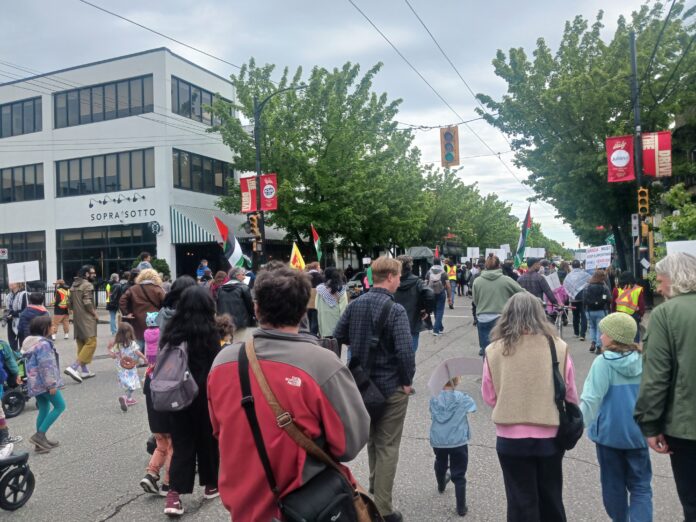
This is a photo of a group of people — including adults, children and youth — marching down a street with Palestinian flags.
PHOTO: Corbett Gildersleve / The Peak

By: Corbett Gildersleve, News Writer

On May 10, youth, teachers, and parents from Parents 4 Palestine Vancouver rallied at Grandview Park about the need to include Palestinian history in the BC curriculum. Around 75–100 people gathered with Palestinian flags, signs, and banners, listening to opening speeches by organizers and a young Palestinian girl who also led people in practice chants. The group also marched down Commercial Drive to Queen Victoria Annex Elementary. 

The Nakba — meaning “catastrophe” — refers to the history of “mass displacement and dispossession” of “more than half of the Palestinian population” from their homes and land as of the 1948 Arab-Israeli war. 77 years later, the United Nations Relief and Works Agency for Palestine Refugees (UNRWA) estimates that more than five million Palestinian refugees exist across the Middle East, reflecting the “ongoing injustice suffered by the Palestinians.” In December 1948, the UN General Assembly passed a resolution calling for the refugees to return to their homes and receive compensation and property restitution. However, Palestinians have been continually denied these things to the present day

“We need to understand the truththe truth about our history and especially as it connects today to understand what’s going on in the Middle East.” — Nicole Spencer, organizer, Parents 4 Palestine

The Peak attended the rally and interviewed Nicole Spencer, a Parents 4 Palestine Vancouver organizer and member of Independent Jewish Voices, to learn more about the group’s demands. Spencer stated that since last year, Parents 4 Palestine Vancouver has advocated for this history to be taught. Their petition, through Action Network, specifically calls on the BC Ministry of Education and Child Care to include the Nakba in social studies classes in public school curricula. The petition notes that “students are asking critical questions — but classrooms lack the historical context needed to answer,” and teachers lack the tools to do so. Spencer added, “We need to understand the truththe truth about our history and especially as it connects todayto understand what’s going on in the Middle East.” 

The ministry told The Peak that between April and June 2024, they “held several engagement meetings with community groups and education partners.” After receiving feedback, such as to include the creation of Israel and Palestinian genocide in schools, the ministry stated they “will expand the grade 10 social studies curriculum in the 2025–26 school year,” focusing more “on discriminatory policies and injustices to racialized and marginalized groups in BC and around the world.” They also stated that teachers “have the professional autonomy to teach topics that fit within the curriculum.”

When asked if there’s a risk to the Nakba not being taught, Spencer said, “Absolutely, of misinformation, that people don’t know the reality of what’s happening, and that’s dangerous because we see the danger and the violence that’s happening right now.” Spencer highlighted that she didn’t learn about residential schools when she was younger, but is grateful that her children learn about it now. With the petition asking for an elementary and secondary school curriculum change, Spencer spoke about age-appropriate ways to learn about Palestine’s history and the impacts of the Nakba. One example they gave was Homeland: My Father Dreams of Palestine, written by Hannah Moushabeck and illustrated by Reem Madooh. This illustrated autobiographical book, meant for ages 4–8, tells of a father recalling his memories of the old city of Jerusalem to his three daughters. It is a place “they cannot visit,” but “will always return” to through his memory. 

“It’s important for me to know what happened to my people, because I want to feel proud, and I want everyone in school to know what Palestine is.” — Palestinian child at the rally

When asked about people being concerned that the Nakba is too heavy for young kids, Spencer said, “We have to recognize how skilled educators are at knowing how to teach these things in a way that’s safe for everyone.” For instance, with regards to residential schools, teachers can use resources provided by the First Nations Education Steering Committee for grades 5, 10, 11, and 12 to teach their students.

The march from Grandview Park was energetic, with regular chants led by Palestinian youth. These chants ranged from “BC government hear our call, teach the Nakba to us all!” and “Teach, teach Palestine!” to “We don’t want no two-state, take us back to ‘48!” Their chants also included “One, two, three, four, genocide is not a war!” along with calls for a free Palestine. The march was escorted by Vancouver police, who blocked off traffic at intersections. When the marchers arrived at the elementary school, tents were set up for kid activities, including buttonmaking, face painting, and snacks. 

Additional speakers read youth-written poems, shared their experiences as teachers, Jews, and Palestinians. A Palestinian child shared, “It’s important for the world to know about Palestine because it happened to my family. It’s important for me to know what happened to my people because I want to feel proud, and I want everyone in school to know what Palestine is. Then they will help, they will speak up, and one day Palestine will be free, if we teach one kid at a time about Palestine.”