Home Blog Page 389

Samhain: the roots of Halloween and how to celebrate it in 2020

0
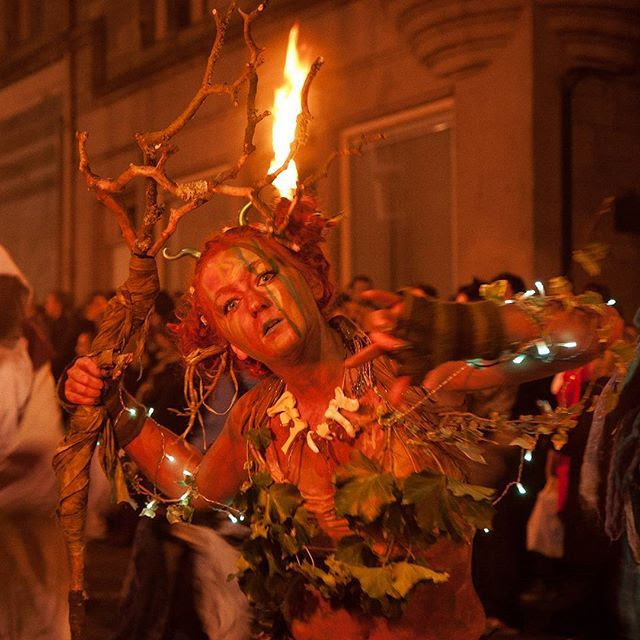
Photo courtesy of Beltane Fire Society.

By Kimia Mansouri, Contributor

In honour of the spooky season and all the little rituals we are used to during Halloween, I thought it would be well-deserved to look at the roots of this holiday. Since we all are social distancing and keeping it safe this year, you can celebrate Samhain (/ˈsaʊ.wɛn/) without jeopardizing anyone’s health. 

A Brief History of Samhain

What some people might not know is that Halloween could have Celtic Pagan origins — an idea that is often challenged. Due to the term “Celtic” forcibly positioning all the regions that belonged to the “Celts” under this name, we cannot assume the cultures within this limiting word share their significance. 

While Irish medieval literature and the Welsh medieval tales might have similar festivals, they are actually quite different from one another. It is important to note that most of the archaeological or historical evidence that we have available are either written by Christians or Romans, and are either often biased against Pagans — or they’ve been passed on in oral tales, which was common in the past. 

Halloween (Hallow Even), and All Saints’ Day are, in simple words, the Christianized version of Samhain, but not necessarily derived from it. 

Based on Tochmarc Emire (The Wooing of Emer), a 10th-century Irish mythology tale, Samhain is the first of the four “quarter days” in the Irish medieval calendar and the ancient Celtic calendar, which essentially marks the beginning of the year. In this ancient calendar, the year is divided into two; the light half when they celebrated fertility and embraced warmth, and the dark half when they prepared for the winter and the cold months ahead by gathering crops, making Beltaine and Samhain the most important feast days of the four. 

Today, the four quarter days include Samhain on October 31/November 1, Imbolc on February 1, Beltaine on May 1, and Lughnasadh on August 1. 

Additionally, the ancient Celtic calendar is also a highly debatable topic, as one of the oldest pieces of evidence being held in a museum, the Coligny Calendar, demonstrates summer as the beginning of the year, and even that is not conclusive. 

“[S]leepless from Samain, when the summer goes to its rest, until Imbolc when the ewes are milked at spring’s beginning; from Imbolc to Beltine at the summer’s beginning and from Beltine to Brón Trogain, earth’s sorrowing autumn” (Homer and the European Epic, 2011, p. 70).

So far, there is nothing deadly or scary about this occasion, so the question is: why and how is it relevant to jack-o’-lanterns? 

Like with many old manuscripts, there was a misunderstanding with the definition of Samhain. Some would say it simply means “summer’s end”, but some claimed that it’s referring to the name of a Celtic god called Balsab, meaning “Lord of the Dead”; but the latter claim lacks proper support. 

Another question that pique’s everyone’s interest: did they sacrifice humans? While Romans such as Julius Caesar believed they did, some others are opposed — and again, we are left with no reliable clue to answer this question.

The Rituals

Regardless of all the uncertainty about Samhain, we can be confident to declare it a three-day harvest festival that involved feasting, drinking, and bonfires. Furthermore, the “Celts” believed that during this time, the veil between this and the spirit world was at its thinnest and basically, something like Pixar’s Coco would occur where the ghosts and fairies (called “sidh”) would come to visit. 

When the sky is dark and spirits are roaming the earth, the logical solution would be lighting some bonfires to keep the dark at bay, and dressing up in costumes to either hide from or scare the spirits away. In actuality, we know so little of what precisely happened in Samhain, and whether it was all devoted to the dead. 

The assumption that Samhain was the festival of the dead belonged to James Frazer in his book, Golden Bough. Frazer explains how dead people revisit their old homes, but that could have been easily misunderstood with All Souls’ Day, which is a Christain time of praying on behalf of the dead who are in purgatory, a place between heaven and earth. Nonetheless, Kevin Danaher, in his book, The Year In Ireland, claims that portions of their crops used to be left on the ground for the spirits. 

Ritual bonfires are assumed to be one of the highlights of this event. The symbol is quite similar to that of Chaharshanbe Suri (The Scarlet Wednesday), which is a festival on the eve of the last Wednesday before the Persian New year. Jumping over these bonfires would purify and destroy all the harmful virtues in both cultures. In addition, Ronald Hutton, a historian in this field and the author of The Stations of The Sun, believed the bonfires were also used in divination. 

Hutton also claimed that people would wear costumes and sing songs in exchange for food, and they supposedly imitated the spirits and received the offering on their behalf, while staying protected from them. 

It is believed that in southern Ireland, someone would dress as the hobby horse, Láir Bhán, and lead a group of young people reciting verses from one farm to another, who were to be given food. If the farmers donated food, they would be rewarded by Muck Olla, an ancient Celtic god, and if they didn’t, tragedy would be bestowed upon them. 

Pranks were said to be also a part of this event, which brings us to trick-or-treating and Seán Na Gealaí (turnip lantern) that worked as jack-o’-lanterns. As mentioned before, these traditions vary between the Celtic-speaking regions. 

Modern Samhain

COVID-19 has limited the number of ways we can celebrate Halloween this year, so why not add some of the Samhain traditions into the mix? You don’t have to necessarily jump over a bonfire (although you should try it if you haven’t, it’s incredibly fun), but take some of the ancient rituals, as well as Celtic Reconstructionist, Neopagan, and Wiccan rituals, into account this year. Here are some ideas for this year’s Samhain:

  • Gather food for the winter, but make it a household event. Once you’ve harvested your crops with the members of your household or close friends, make dinner together and have a “dumb supper”. Invite your ancestors and leave empty seats for them. Take turns sharing beautiful memories you’ve had with your loved ones. Update the dead on the year’s events. (There is a lot to cover!)
  • Wear a costume, even if you’re not going to a Halloween party or trick-or-treating. An idea for a costume would be Láir Bhán.
  • Instead of conforming to the over-consumerism culture around holidays, decorate your home with items you can find or make.
  • Visit your friends and relatives that travelled all the way from the underworld to see you at the cemetery. Don’t forget to bring an offering. 
  • Sit close to your fireplace if you have access to one to get rid of harmful influences, and burn incense, candles, or sage to cleanse and purify your home. 
  • Fall in love with mortality. 
  • Listen to the Halloween themed Monday Music on The Peak and throw a private Witches’ Ball. 
  • Get in touch with your witch heritage, and summon the ancient gods so they’ll grant you a blessing for the winter. 
  • Have a seance with an Ouija board, or a divination ritual with a set of tarot cards.
  • Meditate, reflect, and face your fears to prepare for the new year.

Halloween treats to get in your belly before the end of October

0

By: Sara Wong, Peak Associate and Meera Eragoda, Arts & Culture Editor

BAK’D Cookies — Trick or Treat Cookie

Screenshot via Instagram courtesy of @bakdcookies

There are regular cookies, and then there are BAK’D cookies. Made from scratch in Burnaby by Jessica Nguyen, an SFU alumna, and her brother Andy, these cookies are not for the faint of heart. The fact that they weigh at least five ounces each (which is about the same weight as a baseball) should be telling enough. Their October special is a junk food lover’s dream; it features salted caramel, pretzels, potato chips, and chocolate! If you’re disappointed that you can’t go trick-or-treating this year, then this BAK’D cookie is sure to lift your spirits. The cookies are super soft on their own, so I placed mine in a toaster oven while it was preheating at 350°F to give the exterior a bit more crunch while the interior remained warm and gooey. 

BAK’D charges $5.25 per cookie, or you can get a box of six for $27. Delivery fees apply, but they also have a schedule of pickup locations and farmer’s market appearances. 

Beta 5 Chocolates — Monster Mash Cream Puff Pack

Courtesy of Beta 5 Chocolates

Chocolate may be in the company name, but these cream puffs are the stars of Beta 5 Chocolates’ Halloween collection. For $18, you get a caramel and chocolate werewolf, a cinnamon and apple zombie brain, and a matcha and black sesame swamp thing. You can order this scary good cream puff pack until November 1, both in store and online. While I haven’t tried these specific flavours before, I have had my fair share of Beta 5 cream puffs, and I think this pack is worth getting if you really want to treat yourself this Halloween. If you’re looking for something smaller, Beta 5 also has a catalogue of spooktacular chocolate concoctions, like milk tea candy bars and chocolate lollipops decorated like ghosts. 

Be warned: Beta 5 has a cult following in Vancouver, so if you want any of their Halloween goodies, be sure to get there early or order online well in advance. 

Cadeaux Bakery — Spiced Pumpkin Praline Croissant

Courtesy of Cadeaux Bakery

I love croissants and could eat one every single day, so when I found out about Cadeaux Bakery offering a spiced pumpkin praline croissant, I had to try it. Cadeaux handmakes all of their baked goods, and it’s evident in the flavour, texture, and presentation. I was worried that filling the croissant with spiced pumpkin creme would make it soggy, but it remained flaky, buttery, and soft on the inside and retained a perfect crunch on the outside.The filling is quite messy, so be prepared. But the creamy pumpkin mixture with subtle spiced notes and hints of hazelnut and praline will turn you into a Pumpkin King in your own right. The croissant is topped with a sugar pumpkin (almond-y and not overly sweet) and some shards of praline-crusted chocolate and hazelnut florentine.

These are on offer until the end of October and are $5.95. I would recommend either going right after they open (Wednesday to Saturday) or calling ahead to pre-order as they sell out fast.

SFYou: Christa Ovenell talks death, education, and where they meet

0
Photo courtesy of Christa Ovenell.

By Kelly Chia, Peak Associate

Name: Christa Ovenell

Pronouns: She/her/hers

Departmental Affiliation: English

Occupation: Apprentice funeral director and community educator

Hometown: East Vancouver

Fun Fact: When talking to her kids, it never takes Christa more than three minutes to mention her potential grandchildren.

After graduating from SFU with a BA in English (2004), Christa Ovenell has continued to grow an incredible career in education. Getting a Master’s in Education at UBC (2010), Ovenell was the director and principal of Fraser International College for six years. Recently, Ovenell decided that she wanted to have a career in death-care, which refers to funeral and death-related services.

She graduated from the Canadian College of Funeral Service this September. Ovenell’s experiences in education and death-care made her realize that as a society, we tend to avoid conversations about death. That’s why Ovenell started doing workshops at The Learnary so that people can prepare for death in a comfortable and practical way.

Ovenell’s extensive career initially made me intimidated to speak with her, but her warm personality was immediately apparent, even over text. At times, her words felt as if they were reaching across the screen to pat me on the back. That hospitality made her very easy to speak to — even if the topic of our conversation was unconventional. While educating me on death-care, she gave me some background on how people joined the funeral business in the past.

Back in the days of the family funeral home, most people came to the business through the business: funeral homes had names like “Smith & Sons” and Mr. Smith’s son really didn’t even have a choice in his career path!” Ovenell joked. 

“Now, it’s far more common for people to come to funeral services as [a] second or, like me, even [a] third career, and many of us who are new to the business actually come from some pretty diverse background,” Ovenell told me. She said that many people who joined funeral services usually came from hospitality backgrounds, or what she calls, other “helping professions.”

I asked Ovenell to elaborate more on her favourite memories in her career in education, and at SFU specifically. 

“Graduation,” Ovenell said decisively. Fondly, Ovenell recalled the memory. “My young children were in the audience and my sister — who had worked with SFU for years — had gotten my whole family VIP seats,” she said.

“Then, when I was FIC’s principal, it was every single graduation. I got to witness the proud, extremely hard-working international students who had started at our college cross the stage. A couple years after I left FIC, my own son was valedictorian for the Faculty of Environment. It probably won’t surprise you that I think his speech was the very best I heard at any of the many, many, many convocations I have sat through!” 

I could tell from her answer that Ovenell valued her work in education, and it showed when we talked about her career path.We then talked about Ovenell’s reasons for going into funeral services. Part of it was that her career, first in hospitality and then in education, allowed for a good transition. 

“When I’m serving families in the funeral home and when I’m facilitating death education workshops, I use skills I honed in both previous careers. Our society is so death-averse that we really don’t know how to deal with it when it happens. And I mean, come on: our mortality is the ONE thing every single one of us has in common! I am equal parts educator and servant leader in this role: it’s truly perfect for me,” Ovenell explained.

She was right — death was something I avoided thinking too much about.

My personal aversion to death largely had to do with the fact that at this point in my life, I haven’t experienced many personal losses. A former staff writer at The Peak, Kim Regala, had expressed a similar sentiment when she went to Ovenell’s death workshop. 

READ MORE: “SFU alumni Christa Ovenell hosts a four part series engaging in open and honest conversations about death.”

 I asked Ovenell if age pushes her to approach the death conversation differently in her workshops, as the workshops often take place in groups.

“Currently most of my educational endeavours are indeed group-oriented, but I’m also more than able to work either in one-on-one settings or in very small groups. It’s not just youth who change the way I talk about death — the conversation changes based on who is in the room. Queer folks have their own special concerns, sometimes. Older people often take an extremely pragmatic approach. Boomers are their own special breed . . . as us Xers, millennials, Y’s, and Z’s know!” she said, lightheartedly. 

“My mission is to have exactly the kind of breakthrough that Kim [Regala] had at The Learnary: talking about death should be one of the easiest and most natural things in the world. And let me tell you, I have not picked an easy goal!”

Lastly, I asked Ovenell to give some advice on life in general. She first stressed the importance of an education in the liberal arts, and the value that this had given her.

“I am a huge proponent of a liberal arts education. I think the relentless quest for credentials is actually killing formal education,” Ovenell told me. “I took a BA with an English major and a women’s studies minor, and I remember a lot of people wondering what I would ‘do’ with that degree. I’m sure I surprised everyone — I’m a death educator and a 50-year-old apprentice after all — but virtually everything I do now and have done through my previous rich and rewarding career has been informed by my early, broad studies that introduced me to concepts instead of teaching me specific requirements.

“My advice is not specific to young learners, but to any learner who is trying something new, whatever age they are. And it’s pretty simple, really: your successes probably won’t matter as much as you think they will. But your failures will matter far less than you can ever imagine.

“Don’t be afraid to be inexperienced at anything, at any point in your life. If you are lucky enough to become an expert at something, give it up. Try something new. You’ll be striving every day like you did when you first discovered your drive, your passion. And it will be invigorating. It will make you want to do more, try harder, reach farther, and be far less afraid while doing all of those things.”

Political Breakdown: A friendly reminder of all the negatives from each party and their ideologies

0
Voting concept - Ballot box with Canadian province flag on background - British Columbia

by Serena Bains, Staff Writer

A snap provincial election has been called for October 24, and while voting during a pandemic is less than desirable, so are the options of who to vote for. Despite this, elections remain an important, but singular form of political action. The purpose of an election is to vote for a party that one believes is rooted in activism and malleable enough, that the political action that occurs after the election is effective. So, take into account the ideology and the drawbacks of each party and then decide who to vote for.


BC NDP                                                                                          

Party Leader: John Horgan

The BC New Democratic Party is the party currently in power. Elected in 2017, the NDP currently has a minority government. The reason we’re prepping for an election is due to NDP leader John Horgan announcing on September 21 a snap election would take place. While the ethics of holding an election during a pandemic is questionable at best, John Horgan currently has the highest approval rating of any premier in Canada at 69%. The high approval rating is likely the result of the party completing 79% of its campaign promises in their first term. The promises not kept include: replacing Surrey portables with classrooms, freezing BC Hydro rates, building 114,000 affordable rentals and co-op homes, providing funding for school supplies, amongst others. Although these failures are significant, by far the most significant issue with the NDP is their betrayal of Indigenous peoples. He has continued the cultural genocide of Indigenous peoples by supporting the Trans Mountain pipeline and being complicit in the RCMP’s brutalization of the Wet’suwet’en people.


BC Liberals                                                                          

Party Leader: Andrew Wilkinson

The BC Liberals are the current official opposition party. After the Liberal party’s defeat in 2017, Christy Clark the previous premier of BC, announced her resignation. Andrew Wilkinson won the resulting leadership race with 53% of the vote and became the leader of the official opposition in 2018. It seems that the irony of winning a leadership race through ranked choice voting, while simultaneously being in staunch opposition of proportional representation, is lost on Wilkinson.  But it is not the only time his views and actions have been out of touch. Wilkinson has claimed that 70% of post-secondary students complete their studies without any debt and that the campaign donation system is one that works, in light of a New York Times article entitled “British Columbia: The ‘Wild West’ of Canadian Political Cash.” He has also faced backlash for stating that students should be paying interest on students loans, that renting is “fun,” showing full-throated support of continuing the cultural genocide against Indigenous peoples, and being complicit in sexism aimed at Bowinn Ma. The BC Liberals current platform consists of the typical neoliberal values of reducing regulation, while investing in private industries. 


BC Green                                                                                   

Party Leader: Sonia Furstenau

In the 2017 provincial election the BC Greens won three seats, where the BC Liberals and the BC NDP won 43 and 41 seats, respectively. The party made the decision to provide confidence and supply to the NDP, making them the minority government. While the Greens had negotiating power and threatened to defeat the NDP government over their support of LNG (liquid nitrogen gas), little came of the Greens’ influence. Andrew Weaver stepped down as party leader in 2019 and Sonia Furstenau was elected in 2020. The Green Party has yet to release a full platform, but Furstenau touts the need to “stop subsidizing the fossil fuel industry and invest in clean energy, value-added resources, and the creative economy.” In practice, however, the Green Party has voted for increased fossil fuel extractions, fracking, and continuing subsidies for oil and gas corporations. Weaver has claimed this is a result of fear that the Greens would lose the few seats they have. While there are passionate environmentalists and ecosocialists within the party, this can vary wildly from candidate to candidate. 


Conservative Party of BC                                                                

Party Leader: Trevor Bolin

The Conservative Party of BC has not held a seat in the legislative assembly since 1975. In their current iteration, they currently serve as a spoiler party siphoning votes from the BC Liberals. The party’s platform consists of scrapping the carbon tax, introducing private competition to ICBC, continuing to invest in fossil fuels and non-renewable energy, while somehow aiming to reduce greenhouse gas emissions by 30% in one year. Essentially, the party looks to conserve finances and social views of the past, while continuing their progress in being largely irrelevant.

SFU hosts provincial election forum on transportation

0

Written by: Mahdi Dialden, News Writer

The 2020 Provincial Election All Candidates’ Forum on Mobility and Land-Use, hosted by the SFU Morris J. Wosk Centre for Dialogue, took place on October 15 via Zoom. The event was centred around a debate on various mobility and environmental issues like transportation emissions and highway expansions. The forum consisted of three candidates running during this month’s BC election. 

Bowinn Ma, BC NDP candidate for North Vancouver-Lonsdale, George Affleck, BC Liberals candidate for Vancouver-Fairview, and Harrison Johnston, BC Greens candidate for North Vancouver-Seymour, all represented their respective parties for the debate. 

Questions were asked about the amount of support each party would give to TransLink to expand its services and maintain affordability. Liberal candidate Affleck stated that he’s surprised that BC has no long-term plan in relation to transit infrastructure, adding that BC should have multiple planning projects to ensure a long-term plan is in place. NDP candidate Ma said that the “NDP has already stepped in to save transit here in British Columbia” as “early-on in the pandemic, TransLink warned that they were on the verge of collapse” and stated that the NDP worked with the federal government to secure transit services. Green candidate Johnston said he’d like “to see the government work to make public transit free for everyone under the age of 18 [and] free to low-income residents.” 

A question was raised to the candidates about introducing mobility pricing. According to  TransLink, mobility pricing refers to “transit fares, bridge tolls, road usage charges, and fees for any other services involved in the movement of people and goods.” Liberal candidate Affleck said that “mobility pricing is something that really needs to be explored in partnership with municipalities [ . . . ] to redesign our transit and transportation models and that includes a review of the possibility of mobility pricing because we need to do whatever we can into these alternate modes of transit.” Liberal candidate Affleck restated his position regarding a long-term transit plan for mobility pricing. NDP candidate Ma said she isn’t opposed to mobility pricing in theory, but added that it needs to make socio-economic sense. She stated, “The last thing we want to do is to be punishing people for not being wealthy enough to live close to where they work.” On a radio debate earlier that day, John Horgan had made it clear that support for mobility pricing is not included in the NDP platform and “never will be.”

When asked about reallocating funding from highways to more effective transit methods, George Affleck of the BC Liberals said, “I am very supportive of public transportation at any given time in order to not build more highways.” He followed, “We still have to build highways now because we’re stuck in this situation where we have bottlenecks [which are parts of highways that cause a disruption to lanes forcing congestion] in the Valley where people are very frustrated.” Green candidate Johnston expressed that he fully supports investment into long-term public transport infrastructure. He stated, “We know it’s a proven fact that if you widened highways within about 10 years, the traffic will be back to the same level [ . . . ] widening highways does not reduce traffic long term.” Johnston also emphasized the need for alternative modes of transportation. NDP candidate Ma said, “I’m a big fan of public transit over a highway widening of if they can provide similar benefits and actually take people off the roads and provide greater mobility.”

Advanced voting began on October 15 and will continue until October 21, with polls open 8 a.m. to 8 p.m., daily. It is recommended that you wear a mask and bring your own pen or pencil to ensure a safe voting environment. Valid ID with your residential address is required

SFU named Canada’s first Fairtrade Gold Campus

0
Photo Courtesy of Simon Fraser University

Written by: Karissa Ketter, News Writer

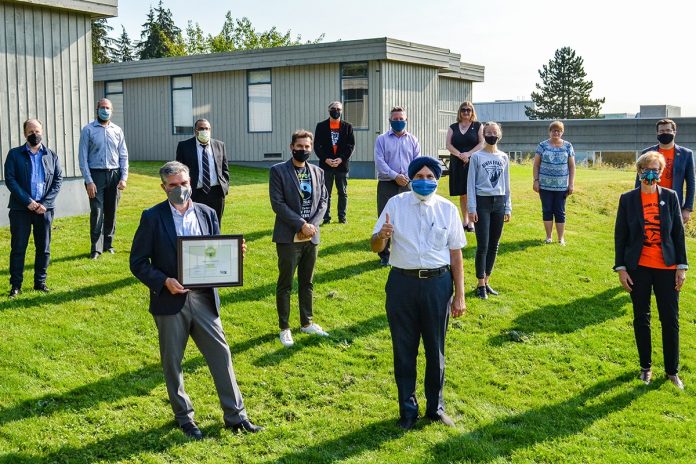
SFU has been recognized by Fairtrade Canada and the Canadian Fair Trade Network as a Fairtrade Gold Campus. Fairtrade describes a partnership between consumers and farmers in the southern hemisphere that is based on “dialogue, transparency and respect.” The Peak interviewed Chief Commercial Services Officer Mark McLaughlin to discuss the achievement.  

McLaughlin explained that “Fairtrade is really about helping the farmers [and] their families in developing countries.” Goods are purchased mainly from smallholder or family farms at a fair price that provides “a decent wage and living conditions.” The Canadian Fair Trade Network notes that companies are required to pay producers and farmers a price that guarantees sustainable production. 

When companies purchase Fairtrade, McLaughlin also noted that they buy into a Fairtrade premium. This money is invested back into communities in the form of roads, transportation, hospitals, and schools. Beyond that, there is “regulation use against child labour [and] against use of pesticides.”

Fairtrade focuses on “empowering [farmers] and putting them more in control of their welfare.” This also includes gender equality policies which aim to recognize women in Fairtrade farming as much as men.

To achieve Gold Status, currently the highest level in the program, SFU started an active Fairtrade Ambassador program for students, attended annual international conferences, and supplied numerous Fairtrade products available for purchase on campus. The main challenge in the process of becoming Gold Status is product availability, according to McLaughlin. For instance, while bananas on campus are supplied by Discovery Organics, they perish quickly. 

SFU students can find Fairtrade coffee, tea, bananas, avocados, and chocolate in the Dining Hall. The SFU Bookstore also sells an array of Fairtrade cotton t-shirts, snacks, and accessories — Fairtrade roses are available during in-person convocation. 

On campus, Starbucks Coffee serves 90–95% Fairtrade coffee including all Fairtrade espresso, according to McLaughlin. In 2013, Starbucks agreed to source Fairtrade coffee beans for the campus branch. McLaughlin noted that since then, Starbucks made Fairtrade coffee available on campuses all across the country. Fairtrade coffee is also available at Mackenzie Café and Renaissance Coffee. 

McLaughlin expressed his disappointment with Tim Hortons. He noted his attempt to contact them in requesting Fairtrade coffee options but they have “refused to provide Fairtrade coffee to Canadian campuses” and stated that “they should be embarrassed.” In a previous interview with The Peak, McLaughlin noted that the coffee chain states that their coffee is ethically-sourced, however, they follow their own standard. 

McLaughlin noted that as students become “more aware of the challenges farmers face” in the southern hemisphere, they want to support them. He is also hoping that SFU will “be the first campus to pilot Tim Horton’s Fairtrade coffee [and that they] just have to keep working at it.”

Out of the Fairtrade movement, which originally began as a grassroots group of student lobbying administrators, the Fairtrade Ambassador program was created. It started three years ago and aims to spread awareness on campus and in the community as well as organizing trips to visit farmers and their families. 

Ambassadors “meet with the farmers to learn first hand the challenges that farmers face and the impacts of Fairtrade.” Fair Trade Canada first launched the campus movement eight years ago. According to McLaughlin, SFU was one of the first adopters of the program, but there are currently 44 Canadian education campuses participating. 

“There’s always more to do, there’s always more that needs to be done for farmers and their families,” McLaughlin said. He’s hoping that Fairtrade Canada “will come up with an even higher bar: Fairtrade platinum.” 

Rich man suddenly learns about climate change when silk-encased pillow is too hot

0
PHOTO: Becca Schultz / Unsplash

By: Serena Bains, Staff Writer

I woke up this morning beside my $800 Dyson Pure Cool Air Purifier and above my heated floors to utter, complete, absolute, outright disaster. My bed was too hot for my toesies.

To my horror, I had to endure something mildly uncomfortable for the first time in my life. Can you imagine how unbearable that was for me? How torturous? It was the first time I was powerless to change the climate — other than the times I use my private jet, invest in liquified natural gas exportation, make my mansion single-handedly light the entire city all on its own, et cetera, et cetera . . .

It had me thinking as I stared at my reflection in my 120” television, “is this why there’s such a fuss around so-called climate change?” I’ve never understood how it could be real — especially after that senator revealed to all of us that snow exists. 

But maybe, just maybe, there’s something more to it than senators who have been paid by the oil and gas lobbyists repeating their interests.

Imagine not being able to sell your first home on the coast when the sea levels rise, or move when the temperature rises above 22 degrees Celsius — a temperature that would melt the glue of my toupee. It’s tragic, really, that people have to endure these kinds of conditions for more than one day at a time. I literally cannot imagine having to endure the nightmare I went through for more than one night. My legs were too warm, for Christ’s sake. 

Think about if climate change caused some type of serious, long-lasting damage — like famine or refugee crises. Then we’d definitely all be taking action.

You know what? People deserve the dignity to be able to live comfortably . . . preferably just comfortably enough that they pay more taxes into my luxury of not having to pay any.

Why has no one ever explained climate change in this context before? This is a real issue. I would guess that I’m a pioneer for putting this knowledge into action. What an entrepreneur I am!

I’ve put all of my labour behind getting 3,000 employees that do my labour for me, and I imagine that’s exactly what I’ll do to combat climate change. I’m a business owner; coming up with original ideas that are completely my own is what I do. I’ll create an organization where thousands of people reduce their impact on the climate, as that would have a greater impact than a single wealthy person like myself committing to do the same. It’s simple math, really. I’ve taken ECON 101, so I know what I’m talking about. 

I have shared my knowledge with thousands who are eternally indebted to me for saving this precious planet from the irresponsible working class. This is for the people, so the work must be done by the people.

It’s only 10 a.m. and I’ve single-handedly solved climate change. No longer will people have to endure uncomfortable temperatures for their feet. I’ve accomplished so much and it’s only taken the gruelling hardship of a few hours in silk sheets. No need to thank me. I’m used to my work going unappreciated as a CEO.

The Bright-er Side: I would have never become a plant dad if it weren’t for quarantine

0
ILLUSTRATION: Siloam Yeung / The Peak

by Marco Ovies, Editor-in-Chief

When we shut everything down my work at The Peak quickly moved online. In addition, my part-time barista job at Starbucks had shut down as well. All of a sudden I was going from interacting with hundreds of people a day to just my mom, dad, and cat (who just so happened to be the most talkative of the bunch). 

That was when I discovered the joy of plants. With all of this free time on my hands I felt like it was the perfect opportunity to buy one and live out my cottagecore dreams. One plant quickly became five, and now I am the happy owner of 30 different plants that occupy nearly any open surface in my room. 

If it hadn’t been for quarantine, I don’t think I would have ever started taking care of plants. So while this pandemic has many downsides, this is one of the few things that have come of it. Now the next battle is just to make sure my cat stops eating them.

Board Shorts — October 2, 2020

0
Image: Irene Lo

Written by Karissa Ketter, News Writer

The Board discusses support of The First Nations Student Association (FNSA) after exclusion from Orange Shirt Day

A ceremony for the new First Peoples’ Gathering House was held on Orange Shirt Day, which aims to recognize “an ongoing commitment to reconciliation.” However, the FNSA was “not invited to this gathering,” according to SFSS At-Large Representative Balqees Jama. The FNSA responded by stating that this was “something disturbing.” 

The Board expressed their disappointments that on a day dedicated to the “spirit of reconciliation and hope, SFU chose to overlook Indigenous student leadership.” 

Furthermore, a statement released by the FNSA noted that on October 1 they “attended a consultative ‘workshop’ for the First Peoples Gathering House,” however, they did not receive an invitation for this event, either. The FNSA explained that they “feel [they] are not being consulted in a way that properly recognizes [their] place at SFU,” as the meeting discussed problematic subjects.

The FNSA expressed that without proper consultation, no matter how good the intentions of staff or students, SFU is still “working backwards” which “completely negates the purpose of the Gathering House.” SFSS president Osob Mohamed voiced that in the past, SFU has continued to  “[commit] this kind of [ . . . ] systemic exclusion of Indigenous students” and she finds it “particularly heinous” for this to happen on a day meant to encourage growth.  VP University Relations Gabe Liosis noted that SFU President Joy Johnson has discussed reconciliation, but stated that SFU is “truly lacking in any real actionable items.” 

The FNSA noted that if proper consultation had been conducted during the planning of the Gathering House, then it would have been clear that “putting the Gathering House in a public place is inconsiderate” because ceremonies are not meant to “be displayed for the curiosity of settlers.”

The Board expressed that this is “incredibly disappointing but not surprising coming from SFU,” according to Mohamed.

The FNSA statement concluded with a list of recommendations and the SFSS Board discussed what they can do to support the FNSA. The SFSS considered reaching out to administrators to ensure awareness of their errors in judgement as well as contacting the FNSA to ask how they can appropriately offer their support. 

Jama concluded by saying that she has high expectations for Johnson to have “serious commitment to serious action” in listening to Black and Indigenous students. She noted her thanks to the FNSA “for their constant advocacy and service and leadership within the community.”

The Board appointed new FNSA representative to the SFSS BIPOC Committee

FNSA representative Kianna James was appointed to the SFSS BIPOC Committee to fill the seat for the First Nations Student Association. 

Mohamed expressed that she is “looking forward to working with her in the near future.”

The Board agrees to allow clubs the option of creating their own constitutions

Previously, clubs at SFU followed a generic constitution. At-Large Representative Phum Luckkid approached the Governance Committee regarding his “concern around why clubs didn’t have the ability to create their own clubs constitutions or additional rules,” as expressed by Liosis.

Luckkid noted that this decision was made by the Member Services Advisory Committee (MSAC) to avoid the “bureaucratic hell” of having dozens of individual constitutions. Despite the lack of control clubs have had over their own operations, terms of references were still adopted. Clubs are required to ensure that their rules don’t conflict with the rules originally set by MSACs constitution or the SFSS mandate. 

Faculty of Science Representative WeiChun Kua, noted that he is “happy to see this change.”

Fiancés upset they can’t hold big wedding that would have ended in divorce six months later

0
PHOTO: Mulugeta Wold / Unsplash

By: Paige Riding, Humour Editor

SURREY, BC — After moving out from the rock they were living under, a couple is devastated to learn that a pandemic would be preventing them from hosting their planned 500-person wedding this fall.

In a Zoom interview with The Peak, partners Lisa Valice and Samuel Collier explained how devastating this news was for their relationship.

“I don’t think people understand how much we were putting into this wedding,” began Lisa. “Being legally tied together really means so much to us. It’s—”

“It’s everything,” Samuel piped in, causing Lisa to glare out the side of her eye at him.

“Yeah, that’s exactly what I was just about to say. Anyway, I was going to have my third cousins living in Peru come and visit for the wedding. I haven’t met them, if you can believe that.” She then continued to list the distant relatives and friends from middle school she had on the list on her phone, pausing every once in a while as she tried putting faces to names. Her repeated failure to do so resulted in shrugs and sighs about “if she could just see them in person, the memories would come flooding back.”

Samuel spoke up. “We were really holding out for this moment. Despite our bickering, despite our screaming at each other, despite that one time I accidentally locked my fiancée out of the house after she went to get the newspaper and told me she’d be right back and saying to ‘not lock this fucking door I swear to God I will break your kneecaps,’ despite me absolutely despising her mother, despite her hating all of my friends with a burning passion, despite—”

“Despite all that,” Lisa cut in, veins popping out on her neck in a gracious act of self-restraint, “we thought this wedding would remind us why we started going out in the first place all those months ago.”

The two started dating after Samuel watched Lisa trip up the Saywell stairs back in February and laughed instead of helping her when her elbow split open and blood got everywhere.

Samuel then noted that they planned to book the same place where a Spirit Halloween is currently set up in Surrey, but were shocked to find out they were not allowed.

“At first we thought it was because it would take a while for them to move out the $600 anamatronics from It and Trick ’r Treat — I’d be scared to move those too — but apparently the pandemic ‘doesn’t allow large gatherings.’ Sounds kinda stupid to me; I see huge parties in my . . . our neighbourhood, Guildford, all the time,” he noted with a frown.

When asked if they would have an intimate wedding, perhaps with some close friends and family, Lisa immediately shook her head fervently.

“No. No, we can’t do that. For one, the thought of Samuel inviting his best friend Jarin — ugh, what a name. God, I hate that guy — and me not having a 300-person buffer between him and me is unthinkable. Two, I need this moment to be big. Spectacular. The cake, my dress, the decorations . . . If it isn’t grand, it won’t do its job of bringing our families together.”

At this point, Samuel had zoned out and was scrolling through Instagram. We could see him liking other women’s posts through the reflection in his glasses. Lisa turned to him to grab his leg in support, noticed what he was doing, and turned back to the monitor like a robot about to self-destruct. It appeared she was not the only thing about to self-destruct.

“Anyway, we’re done.”

Samuel looked up, blinking a couple times in confusion. “What?”

“. . . The interview. We’re done here.”