Home Blog Page 385

The case of the missing EIC

0
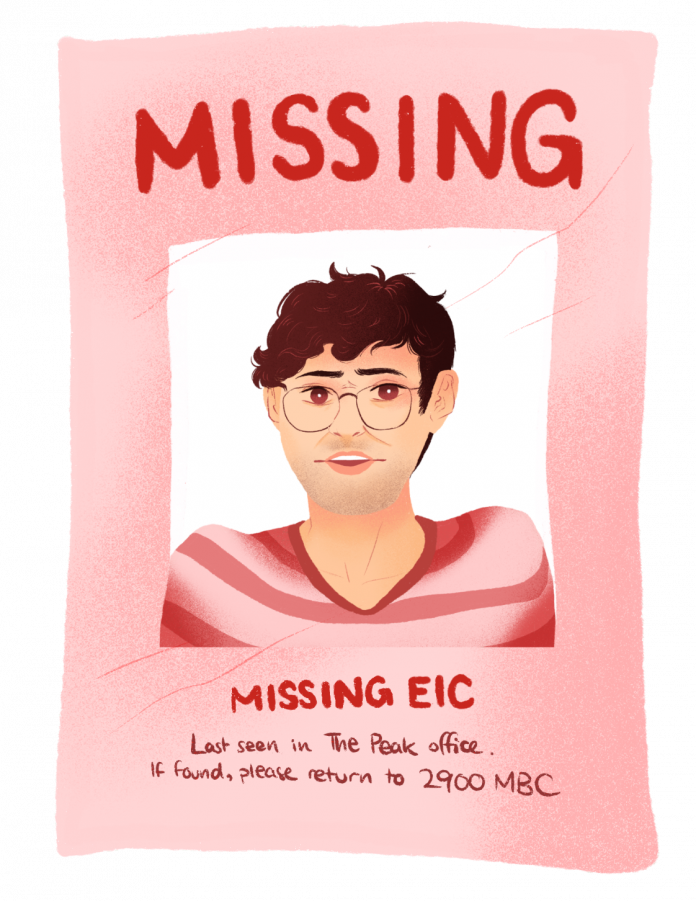
ILLUSTRATION: Tiffany Chan / The Peak

By: Paige Riding and Sara Wong

It was a dark and stormy night . . . no, no clichés here. This is just a public roast of our boss and us getting away with it — although, our story does begin at SFU, where the only “comprehensive” aspect about it is how wholly it destroys a student’s excitement to learn. Now that’s dark.

Anyway! Our story starts with a walk around the AQ when we stumbled across three free Renaissance Coffee coupons! Interesting. Why someone would let go of the Holy Grail of SFU coffee deals was beyond us, but nothing makes sense in this world anyway, so why not enjoy a cheeky little coffee.

On the way to the café, we texted Marco, The Peak’s Editor-in-Chief and resident iced coffee aficionado (yes, he looks exactly how you think someone with this title would look, thanks for asking). 

Sugar-free or regular vanilla syrup?” said the message left on read. In any other scenario, no one on planet Earth would be surprised that Marco didn’t take three seconds to respond to a message; however, Marco not replying to a message about iced coffee, one of his self-proclaimed personality traits (we let this guy run our paper?), was more questionable than the people who don’t just pick up a copy of this paper for the crossword.

Naturally, the first place to check was Marco’s office, where we’d likely find him hunched up listening to the same three Wallows songs on a loop while he desperately searched for pitch ideas. When we headed there, though, the place was empty. No Marcos here. If not here . . . then where?

“Do you two work here?” a voice murmured behind us. We whipped around.

In front of us stood our natural enemy: a smart-looking student in a UBC hoodie. 

“I work at The Ubyssey,” began the student. God, they really were our nemesis. “I wanted to speak with your EIC, but I see Marco isn’t here.”

We turn to each other. Convenient . . . The only other person in the office happens to be a person who wouldn’t mind if Marco and The Peak fell. UBC already has a relatively construction-free campus and like a billion students. Let us have something, please.

“Anyway,” the UBC student said warily as they noticed our passive-aggressive glares, “I was just visiting your campus with a coworker to report on SFU’s construction during the pandemic. Your Student Union Building is finally done, huh?” the student half-smiled, then turned to leave. “If you manage to find your EIC, please let him know we were looking for him. Thanks.”

The UBC student sashayed away. Remembering why we were in Marco’s office, we began looking for clues that would point to his whereabouts. There was nothing out of place, unless you count a giant framed copy of The Peak Fall 2019, Issue 10, which features Marco on the front cover — but us Peak employees are used to this type of shit, anyway. 

“There’s nothing on the computer. I guess it’s time to look elsewhere?”

“Yeah . . . hey, does this picture stick out to you?”

“It’s a blown-up picture of Marco’s face. What do you think?”

“No, I mean yes it stands out, but what I’m trying to say is that the gap between the frame and the wall seems . . . off.”

We removed the picture from the wall to discover the mouth of a tunnel, lined along the edges with mini potted plants that stretch into the distance as far as the eye can see. That can only mean one thing . . . Marco must be nearby.

A few minutes later, we arrived on the other side of the tunnel, entering an empty room. Walking out of the open door, there was a straight path ahead of us, but also two more corridors veering off in different directions. The procession of plants had come to an abrupt halt. 

“M . . . Marco?”

“. . . Polo . . .” said a weak voice from further in. Of course this guy would make a pun during a time like this. We ran ahead, passing the plants from cameos in ~artsy~ Instagram stories and plants Marco spent more time caring for than the Opinions section he briefly covered. 

We soon found Marco trapped under huge vines, unable to move. Little Shop of Horrors is quaking. Shock? Fear? A single ounce of remorse for this plant-obsessed, Bleachers-stanning H&M employee reject? All we could say was . . .

“. . . Looks like we need a new EIC.”
SFU’s Katayoon Yousefbigloo awarded the Audain Travel Award

0
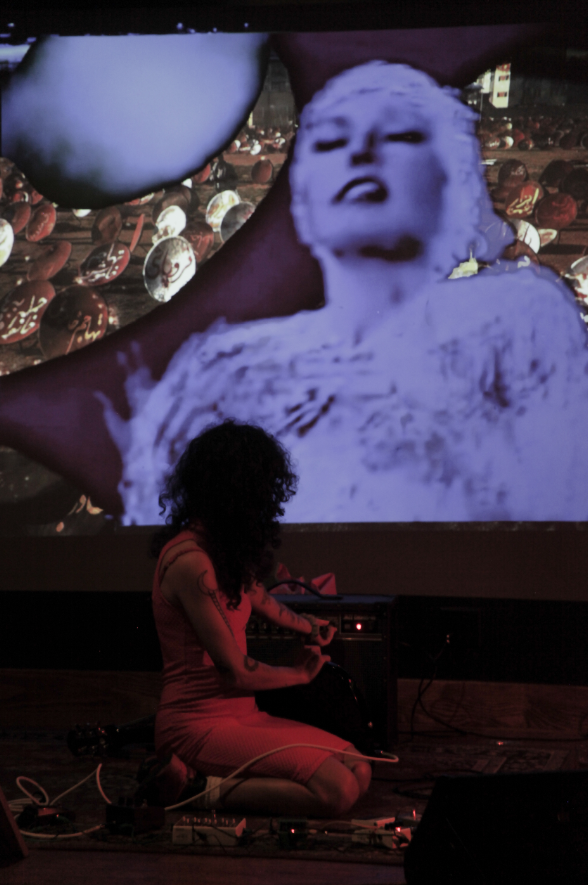
Yousefbigloo aims to create art that engages her audience. Courtesy of Nima Gholamipour

By: Charlene Aviles, Peak Associate

Intrigued by the adaptation of technology to create interactive art, multi-talented artist, musician, and MFA student Katayoon Yousefbigloo hopes to use the $7,500 Audain Travel Award she recently received to do just that. The award, which normally funds art students’ excursions to see art, will instead fund full-time students’ art projects to adhere to travel restrictions associated with the COVID-19 pandemic.

During an interview with The Peak, Yousefbigloo expressed her gratitude for her award and her excitement for SFU’s MFA program. Due to the program’s interdisciplinary nature, she has the opportunity to explore different mediums and collaborate with other artists.

Yousefbigloo mentioned that she would like to learn more about virtual reality and adapt it to a gallery setting. She explained the innovative and interactive virtual reality project proposed in her application.

“I proposed a multi-channel video installation made up of four isolated videos that will be collaged together to make one immersive, augmented reality that can be viewed with a headset or on your phone.” 

Yousefbigloo’s project, while impressive, requires flexibility. She admitted that the project entails addressing and reducing the technological barriers of creating and experiencing the installation. 

The installation looks at how we historicize events through media by recreating an event pulled from John Brunner’s novel The Sheep Look Up in an immersive video experience. I’m exploring themes of transparency, digital authority, and how the fragmentation of time as a result of a constant access to a disembodied past has hindered our ability to clearly situate our current experience in historical terms.

Yousefbigloo contrasted virtual reality with other forms of traditional media and acknowledged virtual reality’s potential for the live performance component she is planning for her installation.

In contrast to traditional media that has “no sensory elements [and] no agency in it,” virtual reality is not confined to the same limits, enhancing artists’ creative freedom and audience interaction.

“The cool thing about augmented reality and immersive video is that there’s some kind of movement and some kind of interaction. That appeals more broadly in my practice [ . . . ] Having some kind of audience participation and having some kind of agency in the audience member [will help them] create a narrative and to create something of their own out of the art.”

Yousefbigloo takes a unique approach to art because she prefers to follow her interests by exploring different mediums. While she understands that there can be pressure for artists to pigeonhole themselves into one medium in order to corner a niche, she rejects the need for categories in her own work.

I don’t see myself as someone who fits into those institutional or the normal categories [ . . . ] that are made for artists [ . . . ] I think that if I want to leave one mark, it would be to [encourage others to] ‘Just [make] what you want and not what people want you to make.’

The Bright-er Side: A shoutout to stuck-at-home parental figures and guardians

0
ILLUSTRATION: Siloam Yeung / The Peak

by Juztin Bello, Copy Editor

The other day I was in my “office” (my bedroom) getting some work done. I hadn’t realized that time had slipped away from me and knew I would be late getting started on making my dinner. When I left my room to head down to the kitchen, I ran into my mom in the hallway, who has been working from home since quarantine began. She looked at me with apologetic eyes as she made her way from the bathroom to her office, and she said: “Sorry son, I was going to start on dinner for you but I’m caught up in a lot of meetings.” 

I was confused. Why was she apologizing? There was nothing for her to apologize for, I totally understand having a lot on your plate. Plus, I tend to make my own dinner, why did she feel obligated to make dinner for me? But reflecting on this later, I realized that her remorse for her inability to prepare dinner due to her workload came from the duality of her household presence. Not only is she a worker, but, more importantly to me, she’s a mom — a mom who is caught between mixing her work and home life in the midst of a pandemic. 

This moment, while miniscule, really had me thinking about the various people out there who are forced to work from home and also have responsibilities in their respective households. Not to mention those like my dad who, for the benefit of our household, continues to travel to his job downtown as an essential worker while also coming home to cook, clean, and watch after the dogs. It is at this time of uncertainty and need for support we should look inward and appreciate the people working within or outside our bubbles who keep a brave face and maintain peace day-to-day. Whether this be pet owners who have to take meetings while their dogs bark in the background, parental figures and/or guardians trying to balance making meals with working their 9-to-5 from home, or people who tend to the needs of grandparents and others who may require assistance, these people are themselves pillars of resilience in this trying time.

Regardless of who may be looking out for you or if you’re in a situation where you have multiple obligations at home, take this time to recognize that all guardians deserve extra love and appreciation for how they’ve handled balancing work and home life during this pandemic.

Student believes they left last scrap of serotonin underneath the rainbow parachute in grade three gym class

0
PHOTO: Bev / Pixabay

By: Kyla Dowling, SFU Student

I remember that day so clearly. 

Fourth period meant that it was time for gym class. Normally, I’d be nauseous from the anxiety of playing dodgeball against the eight-year-old Olympians, but our teacher opted to lead us outside, instead. Who needed our brand-new gymnasium that steered funds away from replacing our textbooks from 1967, anyway?

I don’t know what I was expecting. Maybe we’d play Four Square, or “Slurp Tag,” a messed up version of tag where you had to lick your hand before tagging someone. Ah, what class. This was the beauty of pre-pandemic times: bonding via wiping your saliva on some kid’s shoulder. 

Ms. Williamson went to the supply closet that my third-grade boyfriend Dylan swore was haunted, and to everyone’s delight, she pulled out . . .

The coveted rainbow parachute. 

It was a marvellous invention. It was more beautiful than Sam from Totally Spies — which, if you knew how gay my eight-year old self was, says a lot.

“Grab a handle,” said Ms. Williamson, and we obliged, eager to take part in the blessed (cult?) ritual. We lifted it up and down, more synchronized than Mariah Carey lip-syncing on New Year’s Eve 2016 (which really isn’t that hard to do, but still.) Finally, we pulled it over our heads, settling underneath it. We blocked the world out and thrived underneath a nylon rainbow sky. 

That, my dear reader, was the last time I ever felt happy.

When we went inside for lunch afterwards, Dylan — my third-grade boyfriend, if you recall — immediately broke up with me. He dumped me in fear that holding hands would get me pregnant. That was the first incident in a miserable series of events, often headed by stupid men, that brought my cynical ass here today. Such events included: dating a guy who said he was a pilot but was really a sad stamp collector and then staying with him for three years, choking on a hotdog because I was trying to show off my deep-throating skills to a different guy, and getting high and writing a song you all should know but don’t called “Friday.” I’m coming for you, Rebecca Black. It should have been me who had a glamourously gay TikTok comeback.

Underneath that rainbow parachute was the last time I have ever felt an ounce of serotonin light up my sad, smooth brain. My therapist says that I’m “severely depressed” and “need to stop falling for toxic men just because they look vaguely like Owen Wilson, but specifically Owen Wilson when he was on That 70s Show because it was the only time he was ever attractive,” but I know the truth, Susan. One day I will return to Our Lady of Holy Trinity Saint Jesus Elementary School. I will find that rainbow parachute, and I will find happiness again. I wonder if Dylan is still hanging around there.

Site C Dam to reroute Peace River this fall

0

Written by: Karissa Ketter, News Writer

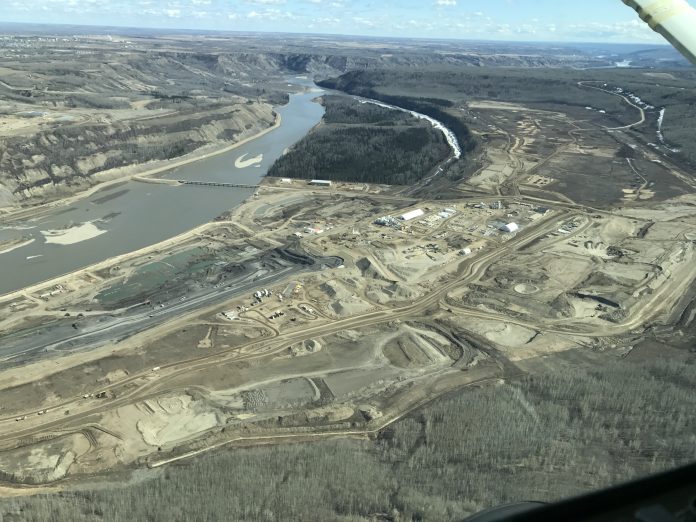
BC Hydro recently announced that they are diverting Peace River this fall in the process of constructing the Site C Dam to meet BC’s growing energy demand.

As British Columbia’s population grows and “we see more and more vehicles switch from diesel and gasoline to electric, [there is going to be a] significant increase in the energy demand,” according to SFU Resource & Environmental Management professor Zafar Adeel. This demand for energy will be met by the construction of Site C. Upon completion it will provide energy to around 450,000 homes a year. 

COVID-19 caused the construction to be temporarily suspended. BC Hydro released a statement noting that the “delays have presented further cost pressures on the budget.” They resumed construction as of April 2020 and the Peace River diversion is “scheduled to take place in fall 2020 over a period of several weeks.” 

The Peak spoke with Adeel to discuss the environmental implications of the project. He explained that the construction began in 2015. Since then, there has been a set of permits issued to eradicate and relocate fish habitats and beaver dams, along with the capture of various amphibians. Relocating animals upsets the balance of the natural ecosystem in the place they’re taken from and where they are moved to. This can have major environmental consequences, such as going extinct, not being able to recover, or harming life in the area they are moved to.  

Opting for alternative renewable power is difficult and can be more costly than a hydroelectric dam, according to Adeel. Currently, 86% of BCs energy comes from hydroelectric power; alternative renewable power sources, such as wind power or biomass power, contributing a total of 8%. The preference for hydroelectric power can be explained by its flexibility: “Within literally a matter of minutes, you can switch on [additional hydroelectric] turbines to meet an expanded [energy demand]. However, “With wind power, with solar, you have to actually store the energy somewhere so that when the demand goes up you’re able to tap into it,” according to Adeel. Because of this, the capital cost to store energy can cause those alternatives to be too expensive. He concluded that hydropower remains the cheapest renewable source of power. 

Site C has a complicated history, according to Adeel. He noted that the environmental reviews done in 1983 by the BC Utilities Commission did not recommend the construction of Site C. In the early 1990s, construction was revisited once again by BC Hydro but decided that it was “environmentally unacceptable,” as noted by Adeel. In 2010, the BC legislature removed the BC Utilities Commission review.

Indigenous peoples have also noted that the construction project is “an infringement on [their Treaty Rights.” According to Raven Trust, an organization for Indigenous justice, “there are alternatives to Site C that do not infringe upon our Treaty Rights [or] destroy the Peace River Valley.”

Site C’s reservoir would submerge “old growth forests in the area that have to be removed.” This includes Indigenous land that includes culturally significant “heritage and archaeological sites,” according to Adeel. Some have noted that amongst the land remains Indigenous burial grounds, farmland, “and the last intact section of the Peace River Valley still available for Treaty 8 members to engage in traditional practices.” More specifically, the project would damage  “moose calving grounds, medicine harvesting and berry picking, and spiritual practices.” Indigenous activist Helen Knott expressed that by building the dam and destroying the way Indigenous peoples practice their culture, “[BC Hydro is] stealing from future generations, both Indigenous and non-Indigenous.” 

The Union of British Columbia Indian Chiefs expressed that “the federal and provincial governments acted irresponsibly when they granted approval for construction of the massively destructive dam.” They also stated that the United Nations condemned the construction and “and called for an immediate halt.”

Adeel noted BC Hydro’s decision to flood 128 kilometres of the Peace River, including “prime agricultural land” will severely impact the communities along the river. However, BC Hydro claims that over 13 Indigenous groups have “confirmed that they have been adequately consulted and accommodated,” according to a statement released in May 2018. 

Adeel added that there are many proposals to build dams elsewhere. For example, there is a proposal to discontinue the construction of Site C and opt for building 17 additional smaller power units on Bute Island that would produce around 1,000 megawatts, equal to Site C. BC Hydro maintains that the project would provide “the best combination of financial, technical, environmental, and economic development attributes for the amount of energy and dependable capacity.”

BC Hydro declined to comment.

The Crown Tundra revives hope for Pokémon’s immersive sense of adventure

0
Sword & Shield's Crown Tundra was released on October 22 and might be a sign of their redemption. Courtesy of The Pokemon Company

By: Zach Siddiqui, Peak Associate

“Find me where the wild things are,” I hear myself quoting just minutes into the snowbound frontier of my latest digital adventure: Pokémon Sword and Shield’s most recent downloadable content (DLC), The Crown Tundra

Pokémon’s eighth generation of games has been controversial from the start. I myself have tilted back and forth in my stance on the current state of the franchise. Living out the adventures of the Tundra revitalized my excitement for future instalments. Part of that I owe to the DLC’s advertised selling points: Dynamax Adventures, quests for Legendary Pokémon, and an expanded Pokedex catalogue to fill. Yet these factors are just part of the greater sense of adventure that the DLC has channelled — a sense that has been somewhat absent from the Pokémon world lately. 

Wintry scenes abound in The Crown Tundra. Courtesy of The Pokemon Company

As novel as Sword and Shield was in some ways, and as fun as I found it on a first playthrough, I soon started to realize just how formulaic, how impersonal, the base game could start feeling. Easy battle after easy battle; wild Pokémon encounters that largely start and end the same way; biking aimlessly about to hatch Egg after Egg. Combined with system tricks like weather manipulation, the game loses the spice and spontaneity that affords a combat role-playing game its realism. Playing through The Crown Tundra, however, I felt a glimmer of the kind of inspired, immersive development choices that the games have lacked for some time. 

After riding the rails south to the tundra’s main station, you’re quickly greeted by the father-daughter Trainer duo, Peony and Nia, who’ve travelled here for two very different holidays: Peony’s got a whole itinerary of expeditions for Legendaries planned, while poor Nia just wants to battle rare Dynamax Pokémon and take some time off from her well-meaning, overbearing, Steel-type expert of a father. In short order, Nia hits you with the biggest hustle of all time: she’s going to spend her vacation relaxing at the Max Lair, while you are going to keep her dad busy with his list of quest memos. Thus is born the affectionately-named Peony Exploration Team.

Courtesy of The Pokemon Company

Despite getting totally finessed into tagging along with Peony’s plans, I soon realized I had no regrets over dropping millions of Pokedollars on trendy new holiday threads and hundreds of Ultra Balls. Peony and Nia, already entertaining characters on the surface, also surprise us with a link to the storyline of the base Sword and Shield games that retroactively fleshes out some of its weaker characters. 

The first quest sequences, to restore the “King of Bountiful Harvests,” were simplistic but charming, involving some borderline Zelda-esque tasking. That vibe quickly spilled into every Memo I cleared for Peony: documenting the faint footprints of the Swords of Justice, carefully analyzing the migration data needed to find them; chasing the Galarian Birds across landmass after landmass and finding the right tactics to outmanoeuvre them; looking for sacred sites based on old drawings and the fleeting memories of a deposed king. Not to mention the part where we humiliate our opponents with our unproblematic fave, Compound Eyes Sleep Powder Butterfree!

Galarian Star Tournament. Courtesy of The Pokemon Company

Amidst each of these quests, The Crown Tundra feels like a proof-of-concept for gameplay that recenters the mainline Pokémon games not on battle, but on adventure. Pokémon brawls still play a part, yes — most notably in the Dynamax Adventures capture minigame and the Galarian Star Tournament — but for the first time, tracking and catching Pokémon across the wilds teeters on the edge of echoing what the experience might really feel like for a Trainer. 

Small as it objectively was, sparse as the new additions to the Pokedex actually were, the Tundra somehow still felt like a space into which I could disappear as I completed the adventures. The frosty, remote ambience they created was bolstered by a phenomenal music score and a cohesive repertoire of landscapes. I won’t pretend that the Tundra was some all-redeeming paradise — there’s notably little to do after beating its main campaign — but it was the perfect wintry holiday to draw me back into sync with my gaming self. 

Right now, there’s no telling what’s next on the agenda for the mainline Pokémon games. With the advent of The Crown Tundra, though, I’m excited to find out. 

This Sounds Serious: Grand Casino bets on a pitch-perfect parody podcast

0
This self-reflexive podcast parodies true crime conventions but also keeps you hooked. Courtesy of Kelly&Kelly

By: Emma Jean, Staff Writer

If you’ve stumbled onto any podcast streaming service in the last five years, you’re bound to have seen a variety of podcasts with ominous names investigating true crime cases. With the abundance of nervous journalists questioning reluctant sources in series like Serial or Someone Knows Something, it’s easy to pick apart the cliches of the genre. 

This Sounds Serious, produced by Vancouver podcast studio Kelly&Kelly, concentrates those tropes to create a tremendously accurate parody of investigative podcasts while combining laugh-out-loud humour with genuinely gripping storytelling. Each season concentrates on a different mystery being investigated by Gwen Radford, a dedicated investigative journalist played impeccably by Carly Pope.

Full disclosure, I loved the first two seasons of This Sounds Serious. I’ve been eagerly awaiting the third since I binge-listened to the second, Missing Melissa, and found it one of the most creative and compelling pieces of narrative fiction I’d ever heard. That season featured the mysteriously and hilariously intertwined cases of a chronically missing person, the longest recorded hostage situation, and a small-town mayor. Before I knew it, I was yelling questions at my earbuds. Needless to say, I had high expectations for the third season. 

Subtitled Grand Casino, with the eighth and final episode released digitally on October 20, the latest installment feels different from the first two. Rather than having Gwen dig into unsolved cases, she’s working to unravel a seemingly closed case from nearly 30 years ago involving now-imprisoned con-man Kirk Todd, voiced by co-creator Pat Kelly. Allegedly, Kirk frauded Hollywood executives into funding and premiering a movie, the titular Grand Casino, that he never actually made — and which the industry tried to bury all record of. The more Gwen starts to investigate, however, the more questions emerge around what really happened. 

Grand Casino doesn’t try to achieve the ambitious feat of tying three stories together the way Missing Melissa does, but it does string together events separated by time. As always, it’s fascinating to hear Gwen work out the case and her thought process, but the case’s generally distant nature doesn’t create the same urgency. As a result, the ending doesn’t live up to the incredible pay-off of the prior seasons, but it still wraps up the season in an unexpected and interesting way that had me saying “WHAT?” until the last second. 

The show also shines in its production, edited to a perfect pastiche of all of the quirks and techniques used in narrative podcasts. The meta of it all is taken to another level when Gwen consults the goofy hosts of a fictional film comedy podcast who make fun of what they know of Grand Casino, and a satire-within-a-satire is born. For fans of the Vancouver comedy scene, there will be no shortage of recognizable voices in Grand Casino. One of those will likely be the standout performance from Caitlin Howden, whose excellent work as a naïve French actress is played with earnestness and well-timed camp, and is cleverly utilized as her seemingly smaller role grows as the plot thickens.

The series is highly researched in its parody, and it shows. Throughout the third season, references to real-life cons and the podcasts based on them are sprinkled throughout — subtle enough to sound like smart details to newcomers and knowing nods to experts. The plot twists and devices used occasionally seem too elaborate to be plausible, but, as co-writer and director Dave Shumka’s Twitter source thread proves, they are often identical to real-life cons. A mark of good satire is that it highlights the absurdity of its source material, and Grand Casino knocks that out of the park. 

The premise of This Sounds Serious revolves around true crime and those invested in the genre will get a kick out of those details, but anyone who listens can get something out of the latest season. Just be open to a good story and let Gwen take it away. 

This Sounds Serious: Grand Casino can be bought ad-free for $4.99 on their website and all three seasons can be streamed for free on Apple Podcasts, Spotify, or wherever podcasts are found.

Need to Know, Need to Go from November 2 to 8

0
Illustration of a blue calendar, with "Need to Know, Need to Go" written on top
Arts & Culture events to catch around the city. Image courtesy of Brianna Quan

By: Charlene Aviles, Peak Associate

c̓əc̓əwitəl̕ | Helping Each Other | ch’áwatway | Museum of Vancouver | September 16 to December 9 | $10 for adults or free for individuals self-identifying as Indigenous

The c̓əc̓əwitəl̕ | Helping Each Other | ch’áwatway exhibit, presented by the YVR Art Foundation and the Museum of Vancouver (MOV), will showcase the artwork of  the 2019 YVR Art Foundation Emerging and Mid-Career Artist Scholarship recipients. This exhibition’s themes include “resilience, memory, and identity, through reconnection with ancestral knowledge and lands.” Tickets can be purchased on MOV’s website. Physical distancing measures will be in effect.

Heart of the City Festival | Online via Zoom and in-person at various venues | October 28 to November 8 | FREE (donations encouraged)

The Vancouver Moving Theatre Society presents the 17th Annual Downtown Eastside Heart of the City Festival. This year’s theme is “This Gives Us Strength,” which represents the Downtown Eastside community’s resilience. The festival will host online events via Zoom and in-person events at viewing rooms or screening outposts throughout Vancouver. At venues, COVID-19 safety protocols will be implemented, and face masks are encouraged. Enjoy several events ranging from spoken word, opera, music, to film screenings. Excluding events with mandatory tickets, most events are free with donations encouraged.

The Polygon’s Third Realm Filmmaking Workshop (online) | November 3 to 6 | Free

Industry professionals will teach participants the basics of the short film production process with The Polygon Gallery’s Third Realm exhibition as the primary source of inspiration. Participants will create a one-to-three-minute short film that will premiere at the Polygon Gallery’s Special Showcase Event. The workshop sessions require access to “a smartphone with a working camera and a computer capable of downloading and running Filmora9 video editor.” Participants will receive a free version of Filmora9. Prospective participants who lack the required technology may e-mail [email protected] for assistance. Registration will occur through the gallery’s Eventbrite page.

Remembering New Westminster During WWII (online) | November 7 at 10 a.m. | Free 

The New Westminster Museum Gallery invites guest speaker Gordon Whitney to reflect on his adolescence in New Westminster. During the WWII Japanese-Canadian internment camps, Whitney lost contact with his friend Kazumi Shintani. After years of separation, Whitney and Shintani reconnected with each other. Whitney reflects on his time away from Shintani and the lessons he learned from it.

Myths about veganism shouldn’t stop people from choosing it

1
PHOTO: Pxfuel

by Naaz Sekhon, SFU Student

I remember when my sister surprised my entire family with the news that she was going vegan. As is typical for a Punjabi family, the majority of our diet included dairy, so it was no shock that my sister received tremendous backlash. Despite my parents’ adverse reactions, my sister persevered and managed to convince us all that the vegan lifestyle really is worth the change. Her journey in becoming vegan inspired me to do further research on the topic, leading me to realize that there are many misconceptions that surround it that should be dispelled. 

People who follow a vegan diet are surely asked if they get enough protein more times than they can count. The common thought is that we gain protein from animal products, which is entirely untrue as protein is found in all plant foods. Not to mention, animals consumed as a source of protein are fed plant-based diets. Being vegan just means consuming protein directly from the source instead of consuming excess injected hormones that come with animal protein. This idea that vegans don’t consume enough protein is especially misplaced because, according to HealthLink BC, vegan diets containing soy products, grains, nuts, and seeds are more than sufficient in fulfilling your body’s protein needs.

There is no denying that protein is an essential nutrient in the way our bodies function; however, we do not need high quantities. Research even suggests that having a high animal-based protein diet can actually have dangerous effects. Adults who consume animal-based products in very high amounts are “four times more likely to die of cancer and 75 percent more likely to die from any cause.” This just proves that animal-based protein isn’t entirely healthy and shouldn’t be favored over a vegan diet. 

I can’t tell you how many times I’ve heard people say that veganism is unhealthy, and use it as a reason for why they won’t go vegan, when it’s completely the opposite. Not only are you less likely to suffer from heart disease and have lower cholesterol levels, being vegan also helps improve your immune system and can improve your skin. Another common myth is that being vegan leads to malnutrition. As long as your diet is well balanced and you are consuming enough nutrients, the benefits of being vegan are endless!

Veganism is widely associated with solely food, and this may be the case for some, but it doesn’t stop there. People who generally follow veganism make it a whole lifestyle to only purchase cruelty free products, along with making conscious efforts to be sustainable and environmental friendly. This lifestyle is inspiring and should be taken into consideration as it’s no secret that we are currently in a crisis when it comes to our planet. Since we are utilizing Earth’s natural resources far faster than they are replenishing, it is causing the planet to go through serious changes. Embracing veganism helps the environment far beyond we can comprehend and improves your health as well. 

Although it may seem like a drastic change, what I have learned from my sister’s journey into veganism is that becoming vegan is completely worth it. Many people believe the myths about veganism easily, but not only is it healthier, it is also good for our planet. Being vegan means you are living a cruelty free life, and what could be better than that?

What Grinds Our Gears: Courses meant for online learning shouldn’t be as disorganized as the newly adapted ones

0
PHOTO: JESHOOTS.COM / Unsplash

by Paige Riding, Humour Editor

Distance education courses — not to be confused with the shitshow in-person classes now taught online — are intended to be delivered remotely. Lessons and resources appear on Canvas for the student’s convenience. In theory, the professor should have some sort of grasp on communicating the course’s goals. So why do I feel more lost in my Romantic English online course than my courses that moved online for the first time this Fall semester?

This course is an absolute disaster — and that’s coming from someone who cries nightly (and daily) to Keshi. Discussions are facilitated by students for students, and I have no idea if my contributions are fruitful. It’s week eight and I have received no feedback at all.

For our most recent assignment, the class was so confused about the expectations that the due date was extended because that many people were lost. Then, it got pushed again because no further explanations were provided and complaints were made.

I haven’t gotten my mark back (not surprised), so I still don’t know if I integrated a poem analysis, a secondary source on everyone’s favourite Romantic, Blake, and my own response to these things (yes, we had to use the first-person. I’m still shaking) within the four pages allotted. Those four pages aged me. As a fourth-year English major, four pages should take less effort than a BuzzFeed math quiz.

With no Zoom calls for questions, transparency on Canvas is critical. Was the TA confused and therefore couldn’t elaborate on the expectations? Who knows. But can students have a bit of organization during this already stressful time? As a treat?