Home Blog Page 345

jooj two: an experimental pop album that explores the nature of grief and loss

0
Sook-Yin Lee, an icon in the Canadian arts industry. Photo courtesy of Take Aim Media

By: Kaila Bhullar, Peak Associate

Editor’s note: Answers have been edited for length and clarity.

New music alert! Toronto interdisciplinary artist Sook-Yin Lee, originally from North Vancouver, has an upcoming album,  jooj two, created by her and her “creative mischief maker,” Adam Litovitz. Approaching its release date of April 9, 2021, jooj two is a unique and captivating fusion of deep trance-eletronica with ambient, soft-pop elements. Lee and Litovitz’s work is a dynamic transition through an array of emotions pertaining to the nature of human connection and existence. The album explores the heavy impact of music in dealing with grief, as it was made throughout the pandemic and was completed by Lee following the unexpected passing of Litovitz. jooj two offers an escape into Lee’s emotion-driven, hypnotic, and thought-provoking world. The Peak sat down (virtually) with Lee to discuss the album, and how it stands as a permanent marker of Litovitz’s musical talents.

The Peak: Tell us a little bit about yourself and the album. 

Lee: I really began my journey as a teenager, loving art because it enabled me to communicate all kinds of things that I wasn’t able to verbally. Art and expression really helped to save me in so many ways. When I discovered music, it was a profoundly huge moment for me. I always loved singing as a kid, but when I actually found an extended family of musicians growing up in Vancouver, and put together a band, it was very exciting for me. And that brings us to what I’m most excited about: my newest project. It’s an album that my late partner, Adam Litovitz, and I began a couple years ago. When he passed, I knew I wanted to finish the album because it was something we were very excited about and proud of. There’s just so much work that he left behind, that it is such a passion of mine to share his work. He was a great writer, a great thinker, and also my partner in making music. And I’m so happy to be able to release this album that we made together.

P: How would you personally describe your sound and artistic style? 

Lee:  Well, that’s very hard to say.  I don’t think Adam and I necessarily approach music from a very mainstream place — our ears are probably much more left of centre than most people — but we really felt like this was a big pop album. There are elements of experimentalism, but they’re very toetapping, with very hooky and propulsive beats. So I really think of it as an experimental pop album.

P: In what ways do you hope that this album will continue to represent Adam? 

Lee:  Well it just does, you know? I mean, this is his mind, and his physicality, his fingers playing a piano and a guitar. This is his expression in spirit, embodied in this artifact that is music. He has such a purity of vision, beautiful vision, very innocent and simple, open vision in his art. So I think as a body of work,  people can listen to this particular album and hear those elements mixed with my spirit as well. It’s infused in the notes, infused in the artwork, infused in the songs.

P: What do you think is important for listeners to know about the album? 

Lee:  We’ve all been through this paradigm-shifting experience of the global pandemic and lockdown. I certainly haven’t experienced anything like this in my life. Losing Adam happened before the pandemic, and that was like my own personal 9/11. It was very devastating. And when the pandemic happened, in many ways I thought, “Well, this is difficult. But it’s a cakewalk in comparison to losing Adam.” But I realized that while locked down, everyone was experiencing a loss: the loss of the world that we know, the loss of lives, the loss of loved ones. So we collectively move and live with loss. Though this is a very personal album in many ways, it’s also very specific and universal. And I hope to convey whatever that is: the beauty and adversity of life, the heartbreak, and how we are able to just hug all of that messy stuff. And hopefully, you know, just continue to be, as best as we can.

Dancer Jessica McMann details the experience of practicing performance art in a pandemic

0
McMann represents Indigenous dance in this year’s Re-Centering/Margins showcase. Photo courtesy of Tet M Photography

By: Dev Petrovic, Staff Writer

Spring has sprung and so has the dance festival season, so if you’re hoping to get your arts on, now is the time. Made in BC – Dance on Tour is continuing this year, despite the tour aspect of the showcase being a little different. One upcoming event happening in April, Re-Centering/Margins, will be performed by local BIPOC artists-in-residence — including multi-talented SFU alum, Jessica McMann. The Peak got the chance to speak with McMann about her experience as an artist-in-residence and how this year’s presentation has been produced. 

McMann comes from a Cree background and works as a flute musician, dancer, and choreographer. She completed her MFA in Contemporary Arts at SFU and, pre-pandemic, focused her attention on the dance company Wild Mint Arts, where she is a co-founder and co-director. She started her residency with Made in BC in 2020. The work that will be seen from McMann has been entirely choreographed, performed, and composed by her. 

Margins is a dance residency, but it’s not in residence now because of COVID,” clarified McMann. “Normally we spend 50% of our time in Vancouver and then 50% of our time here, in Calgary.” 

Due to the pandemic, the artists-in-residence have not been able to travel back to BC. McMann explained that this has made the residency more challenging, as she lived in Vancouver when she got accepted with Made in BC but has since moved to Alberta. 

“When the Re-Centering/Margins residency came up, I was really excited because it wasn’t age-driven, which is [sic] really nice. It wasn’t like you have to be 25 or under and as an Indigenous artist, I don’t fall into those young emerging artist categories,” explained McMann. 

Adding to that, McMann said she’s been grateful to have the creative freedom, as well as “the time and space and support to do the work that [she] want[s] to do” instead of being limited to a specific residency theme.

She explained SFU has been giving her support as an alum by providing her with studio spaces in Vancouver. As well, she’s been building her professional connections with SFU and Made in BC. 

After the initial lockdown last year, plans for the artists-in-residence shifted. “So we were going to come [to BC], but then we didn’t, so it’s filmed at [a theatre in Alberta],” McMann said, adding that she wanted to be in BC to film at the SFU Goldcorp Centre for the Arts, but couldn’t due to work obligations in Calgary.  “I’m not really quite sure what the other people are working on because we haven’t had as much time to really connect with each other as we would have been in a more traditional residency,” she expressed. 

[For] myself, as I can only speak for myself, this pandemic has given me an opportunity to actually do land-based work,” said McMann. “So instead of trying to figure out how to bring a land-based thing into the studio, now I have the freedom to actually do land-based stuff and film it and do it where it should be done.” This new artistic space will also allow her to freely film and edit her work as she pleases.

She reminisced about how her work is intended to be done on the land of her ancestors and explained that using online art platforms will make showing her art easier. “I’m circling back to where I first started a dance practice,” she said, “which was not in studios, which was not in theatres because I didn’t have access to those bases. So it was parks outside, art galleries that would let me get those spaces for an hour.”

Yet residency, in its untraditional form, has been difficult. McMann is from the Vancouver area, so not being able to continue her work in BC was disappointing, as well as the disconnect with the residency being all online. “I got so comfortable always being a studio, but my practice is land-based so it’s time to go back,” she said. 

The project honours BIPOC artists and delves in the artistic representations of what these struggles look like. “But there are only three slots available for artists,” reflected McMann. “When you have four supposed categories to fit everybody in, how do you honour those struggles of individual people? So I cannot speak for anybody else but Indigenous people and even then, only myself. Because each Indigenous person’s experience is going to be completely different.”

McMann’s work is supported by Indigenous methodologies and is “created from an Indigenous body with the Indigenous mind.” She explained that her work comes within a base of Indigenous knowledge, “meaning [she] learned to do powwow dancing first before [she learned] how to do and incorporate other dance styles.”

Reflecting on how her style of dance works within and around the margins, McMann described how “looking at that from an Indigenous worldview changes the expectation that [she had] to move in a certain way in front of the camera for it to be dance.

“And [with] Western dance people [ . . . ] it becomes other labels and different types of dancing. Pedestrian movement and terms like that don’t sit the same way in the way that I view how I move and work,” she said.

Re-Centering/Margins will be showcasing their work from April 2–7. The event is free, but donations are suggested. Registration is required through Eventbrite.

Club Ilia permanently closes at UniverCity

0

Written by: Emma Jean, Staff Writer

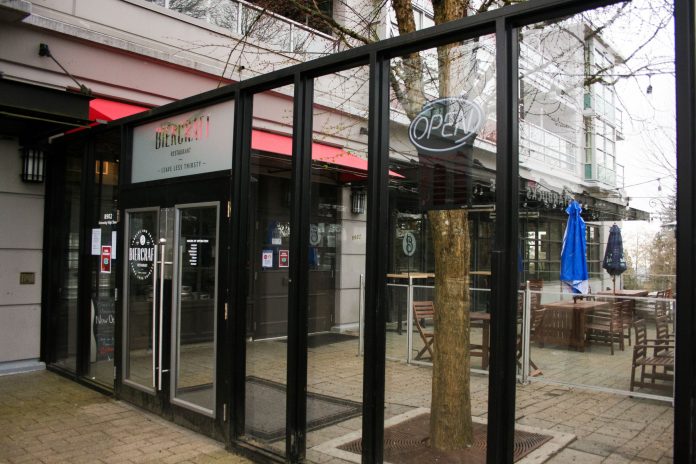
Club Ilia, the restaurant on SFU’s UniverCity strip, has permanently closed. This comes after a year of forced closure due to the COVID-19 pandemic. In its former location, the local pub chain BierCraft opened in early March.

In an interview with The Peak, Club Ilia’s owner Fred Soofi said the closure was “a little bit heartbreaking” and wouldn’t have happened without the COVID-19 pandemic, which resulted in the restaurant’s inability to operate since March 2020. 

“[When] I opened Club Ilia 10 years ago, I could see the future. I knew I could not make money right away, but I was looking for a future with community growth. Financially, I subsidized [the restaurant] all these years. I never made any money there. I was hoping that when the community [grew], [if] all the buildings are there, then I could make it,” Soofi said. He added that after waiting for 10 years, he closed for renovations in 2019 — but once COVID-19 forced the restaurant to close down, he lost his business. 

He said he has no plans to reopen the location or any other restaurant under the Club Ilia brand. Instead, he plans to focus on his other restaurant on the SFU campus, Pasta Polo Express

“I’m 70-years-old. I might do different things [ . . . ] At my age, I want to contribute to the community. If people want consultation for opening something, I’m willing to do that — but not [for] myself to be involved except in the MBC food court, which I want to concentrate on and make really outstanding.”

Soofi said many former Club Ilia employees have found steady employment elsewhere, some being able to remain in UniverCity, “I keep in touch with my staff to make sure they are good.” 

The management of Club Ilia spoke last July to The Peak about the financial toll that the pandemic had taken on business. At the time, they wished to reopen for the Spring 2021 semester. 

Soofi discussed having to finance up to a million dollars of his own money into the restaurant. He said he faced a drastic increase in the property’s rental leasing price and a lack of transparency about the foot traffic available in the area. 

BierCraft assistant manager Courtney Cameron told The Peak the location had undergone a “construction” period. It has been open since March 2021 and has been redesigned with references to the SFU community in the decor and wall colours.

“It’s really important to us to connect to the school in that way, so having the ability to bring a bit of SFU into our restaurant and then also giving back to the school through sponsorships or live-streaming the sports games [ . . . ] one day down the line.” 

Cameron, who is an SFU undergraduate student, stressed the connections they wish to make with the SFU community. 

“When it comes to the school, a lot of our goals are to create some sort of sponsorship with clubs or associations or sports teams at SFU.” 

Regarding its interactions with Club Ilia, they have been minimal. According to Cameron, they no longer have any role in the property and no former staff have been hired as part of the new restaurant. 

“When it comes to the staff, I’ve had a lot of [former Club Ilia] staff come ask me if we’re hiring for front of house and back of house, but once the staff started reaching out to me, we already had our team built. 

“I’m definitely not opposed to having past staff work with us,” she continued. “I think it would be beneficial because they’ve already created that connection to the guests and I’m sure it would be nice for the locals to see that familiar face, but I think it’s something that we will look into more as the business grows.” 

President of Students of Caribbean & African Ancestry removed due to negligence

0

Written by: Jaymee Salisi, News Writer 

On March 12, 2021 former president of SFU Students of Caribbean and African Ancestry (SOCA) Tim Maruti was removed for failure to fulfill his presidential duties throughout 2020 and 2021. 

Upon removal, Maruti posted a statement on the SFU Undergrads Facebook page claiming SOCA handled decisions undemocratically. 

His argument centred around his request for SOCA to wait for more information before releasing a statement about the arrest of a Black alumnus. The arrest, which occurred last fall, drove conversations around racial profiling and police brutality on campus. 

Maruti said his actions were “met with resistance from executives. 

“I found it important to draft [my] statement on the organization’s official letterhead for credibility and designative purposes,” he told The Peak in an email interview. He said he needed to use the club’s resources in his announcement to reflect his position as president.

SOCA president-elect and Simon Fraser Student Society (SFSS) at-large representative Balqees Jama told The Peak that club members found issue in the undemocratic process that went into posting Maruti’s statement. 

Jama said the use of unauthorized club resources — such as the logo and letterhead — put their name to “this narrative that was not true.” SOCA disavowed the release and outlined the recollection of events which led to Maruti’s dismissal.

Maruti’s failure to call general meetings was one factor. On July 3, 2020, he addressed this and apologized, saying his lack of communication was due to the online transition. Since the discussion, he attended three out of five meetings. When in attendance, Maruti debriefed members on the progress of his assigned projects.

Jama said she did not witness Maruti conducting presidential duties, such as providing strategic focus for the organization, and “representing SOCA to the SFSS and university administration [ . . . ] If it did happen, it wasn’t enough,” she said.  

According to Jama, the executive team took on Maruti’s unfulfilled responsibilities with most of the labour falling on Black women.

Maruti explained his absences, telling The Peak, “I travelled to my home country in Kenya — in East Africa — to spend time with my family for two months. While away, I notified the executive team through the official WhatsApp group that I was in Kenya at the time and [said] I would still be able to attend meetings.”

Due to the 10-hour time difference, he suggested meetings be held at 12:00pm PST or earlier, to accommodate Canadian and East African time zones. According to Maruti, a new meeting time was spoken about, but not arranged. 

“Being in Kenya in December does not validate absence during September–November,” read SOCA’s motion.

Allegedly, Maruti ignored executive requests for stating pronouns during meetings, held events without approval, and was difficult to reach. SOCA executives drafted a letter to Maruti in December 2020 and January 2021, calling for his resignation as president. 

Executives warned in the letter that they would “go public about [Maruti’s] act of violence [and his] speech against the Black community on campus,” if their requests were not handled. 

At the meeting on February 26, 2021, Maruti said he had not seen any SOCA emails, as they went to his spam folder.

Members referred to his opposition to the release of a statement about the arrest and personal conversations within the organization’s WhatsApp group chat. The conversations are not available to anyone outside the organization. 

They discussed the need for clearer communication and Maruti’s alleged anti-Black sentiment. The motion stated that Maruti said “it is natural that this person would be physically removed” in regards to the arrest. Club members said this outlook appears to give police the right to regulate Black people, though acknowledged this may be “a personal opinion rather than community sentiment.”

SOCA drafted a motion for Maruti’s removal due to lack of communication and work effort. There was also a vote to charge him for anti-Black sentiment, which failed.

In his statement, Maruti said, “If your views do not align with their manifesto and ideology, they will attempt to remove and replace you with an individual of their choice.” He also claimed exclusive meetings were called for members to “conspire to remove [him] as SOCA president.

“‘SFU [Progressives] — a student-led political party — have taken SOCA hostage,” read his statement. 

“The statement itself had actually painted a false narrative of SOCA, me, and several other people listed,” Jama said. 

Before the SFU Progressives existed, Jama said they “came out of SOCA members, who were resisting the eviction of SOCA by the SFSS and initially mobilized the Black Spaces Matter campaign.” 

Therefore, Jama said she did not understand what Maruti meant by stating SOCA was being held hostage by members of SFU Progressives within the SFSS.

She said most people who learned about the incident were unaware of the organization’s initiatives. As a result, she believes Maruti’s statement incited tokenization outside the SOCA community. She said this is harmful as it results in “cherry picking a voice from a marginalized community that confirms your views.

“Some folks have been holding up the former president’s word without caring for what SOCA’s stance actually is,” Jama said.

The Peak asked Maruti to expand on his statement regarding the use of Black suffering as political leverage. He declined, explaining, “I do not think it is constructive for the finer details of these statements to be initially discussed through this article.” 

Moving forward, Maruti hopes to see student-led organizations and SFU administration stay consistent with student engagement to create an inclusive campus community. 

“Coming to a communal resolution on the matter within SOCA is an initiative that I would happily endorse and participate in,” Maruti said. 

Jama encouraged people to support the Black community by sharing Black student resources and respecting SOCA’s and the Black community’s privacy, “including [that of] the former president.” Doing so could “alleviate the burden off Black people and SOCA at the moment.”

More information can be found in SOCA’s outline and website, as well as Maruti’s statement

Board Shorts — March 12, 2021

0
Image: Irene Lo

Written by: Karissa Ketter, News Writer 

The Board voices support for Braided Warriors Indigenous youth after arrest

Content warning: Mention of and link to video footage of police violence against Indigenous youth 

Science faculty representative WeiChun Kua and at-large representative Balqees Jama presented an open letter to the SFSS board to hold RCMP accountable for their arrest of the Braided Warriors youth on February 19, 2021. 

According to Kua, “They were protesting peacefully with sit-ins, doing their ceremony” when roughly 70 VPD officers removed and arrested the individuals. “Those who sustained medical injury were not given medical attention until after they were released from their holding.”

Kua said “they were being pulled by the hair, drums were thrown on the ground — and that’s very disrespectful of their Indigenous culture and ceremonies.”

The protestors occupied the building of an American International Group (AIG) office, which protects the Trans Mountain Pipeline. Kua explained that the protestors focused on “putting pressures on insurers [ . . . ] to stop insuring the Trans Mountain Pipeline.”

Jama said “as an advocacy body, the [SFSS] recognizes that protesting has always been a critical part of mobilizing — especially for meaningful societal outcomes for marginalized people.”

President Osob Mohamed said, “If you have the capacity, check out the videos because the extent at which these folks were subjected to violence is completely, in my opinion, over-escalated and unnecessary.” 

She also voiced disdain that the VPD have not reacted similarly to anti-mask protests. 

The motion to sign the open letter was passed unanimously. 

The Board receives presentation for Climate Emergency Declaration open letter 

SFU student and member of SFU350 Brennan Strandberg-Salmon said SFU should declare a climate emergency and adopt a set of recommendations. He brought forth an open letter to be signed by SFU student organizations, students, faculty, and staff. 

“For universities, the declaration doesn’t have a legal basis as it might with governments who declare a state of emergency. Its purpose is to signal that the university has committed to accelerate sustained and meaningful action to avoid catastrophic climate change,” explained Strandberg-Salmon. 

SFU350 recommended “decarbonizing operations, divesting from fossil fuels, raising awareness, and amplifying issues surrounding climate change — such as reasserting its position to the Trans Mountain Pipeline,” said Strandberg-Salmon. Other goals include creating a climate hub for students that would work alongside the sustainability office. 

Over 1,900 national and local governmental jurisdictions in 30 countries have declared climate emergency. In those areas, 600 post-secondary institutions — including UBC in 2019 — have declared, said Strandberg-Salmon. 

“[This is] not a purely symbolic act, we want SFU to remain accountable to us [ . . . ] Without immediate and drastic action to reduce emissions, our planet’s climate could reach tipping points — which essentially makes global warming irreversible in human time scales — which would disrupt economic stability, global trade, and increased inequality globally.”

Data suggests women face structural obstacles which has led to less representation in politics

0
PHOTO: Marco Oriolesi / Unsplash

Written by: Nancy La, SFU Student 

In commemoration of Women’s History Month and International Women’s Day, The Peak spoke with Dr. Eirini Kotsovili, a lecturer in the department of humanities, to discuss the role of women in politics and their representation in the political scene.

“The fact that we don’t see more than [21%] of women in power as leaders or in parliament speaks volumes about the wide range of obstacles, across the globe, that women are being presented with,” said Kotsovili. She added change is slow and there are “important legacies to acknowledge in terms of who speaks for women — women are not a homogenous group.”

The data Kotsovili referenced came from a UN Women report that revealed women’s representation in governments across the globe — the report stated there are 21% of women in parliamentary positions and 14 countries which achieved 50% or more women in their cabinets. 

Kotsovili said there are structural obstacles to women actively participating in politics. She emphasised two major intersectional barriers women face while striving for political participation: education and safety against violence. 

“We have to talk about basic rights in terms of education. If we want to see women really becoming members of political parties, the opportunities are not there for them.” 

Kotsovili explained violence against women needs to be addressed so they can be represented within politics. She said factors such as law and reforms play a role in women’s opportunities. In speaking of violence, Kotsovili referenced the recent case of Sarah Everard whose disappearance and murder lead to outcry in the UK about violence against women.

She said different global and local initiatives can help the public understand these obstacles by raising awareness, encouraging self-education, and identifying women’s struggles can aid in reducing barriers.  

“I’m focusing on these young women emerging — that is very promising — and social media allowing for more visibility for individuals in remote areas to speak, regardless of ability, race, or class.” 

Kotsovili’s research involves the study of contemporary culture, modern Greek autobiographical literature, and women’s freedom through autobiographical literature. Her teaching interests lie in women and gender issues, along with reflections on memory and trauma. 

First Nations Health Authority reports 16,000 Indigenous peoples vaccinated

1

Written by: Karissa Ketter, News Writer

First Nations Health Authority (FNHA) vice-president of public health response team Katie Hughes reported as of February 16, 2021 they have vaccinated nearly 16,000 people in Indigenous communities. This includes peoples in just over 90 communities. The FNHA is aiming to ensure that all 203 Indigenous communities “have access to vaccines as soon as possible.”

Chief medical officer Dr. Shannon McDonald reported the FNHA aimed to have the first dose of the vaccine administered to those who want one by the end of March 2021 in all remote communities. 

McDonald said, “After the holidays, we saw a significant spike in active cases — we were up over 1,000 active cases at the time. Sadly, we have suffered many losses.” There had been a total of 68 deaths.

“In the context of vaccine shortage, we have not been able to completely meet the goals we have set, but we have used every single dose that we have been given to vaccinate as many people as possible — starting with our most remote communities,” added McDonald. 

FNHA has been primarily administering Moderna vaccines at this time. Moderna vaccines do not require ultra-cold temperatures like Pfizer-BioNTech vaccines do, making them easier to administer in remote locations. 

McDonald confirmed one of the FNHA’s “biggest challenges has been the amount of vaccines.”

Chief nursing officer Dr. Becky Palmer said the FNHA has been working “alongside our communities to roll out a very intentional, strength-based, culturally safe, whole-community approach to ensure that our people get the vaccine they need, should they choose to take it.”

McDonald said, “I know that the province’s goal is to maximize the number of people that can be vaccinated, but we also want to make sure that the people who walk in the door are happy with what happened while they were in the doors.” She noted her concern that mass vaccination sites in urban locations may be overwhelming for Indigenous elders. 

McDonald said, “Leaders are coming back to us and saying they have responsibility for all of their members no matter where they live. Unfortunately, in the context of vaccine shortage, there have been extreme limitations as to how and where we can provide vaccines.”

The Ministry of Health and regional health authorities are working in partnership with the FNHA to focus on the planning of the mass vaccine rollouts.

Part of implementing cultural safety and meaningfulness “is that we have ceremony around it, that we’re blessing the vaccine in advance, that those teachings that have been held so dear are brought forward.” Palmer explained she wants to ensure this is a transformative experience for Indigenous peoples — not strictly transactional.

“We are sitting on tables with the province to share what we know, to share our learnings thus far to build on the strengths from our communities,” said Palmer. “Folks aren’t going to come through the door if they don’t feel like it’s a trusted, safe place to do so.”

She added it is important to reinforce this process by telling “a different story — one that [Indigenous peoples] can own themselves and their own health and wellness journey.”

Dr. Nel Weiman recognized the great deal of stress and uncertainty everyone is currently experiencing. She reminded everyone that until public safety guidelines are lessened, it is important to continue to respect them. 

“Despite the vaccine rolling out, we need to maintain those public health measures that we’ve been talking about from the beginning: wear[ing] a mask, being physically distant, staying in our immediate household bubbles for now, washing your hands regularly,” said Weiman. 

What Grinds Our Gears: The U-Pass BC website glitch

0
The U-Pass system has been controversial over the years. PHOTO: Gudrun Wai-Gunnarsson / The Peak

by Tiffany Chang, Peak Associate

Many students at SFU have the U-Pass — a flat-fee transit option for those attending university in BC. While I appreciate the convenience it has given us, the website where U-Pass holders reload their card has not been working properly. More specifically, the initial step to reload the card, which requires selecting a school from a drop-down menu, can’t be accessed. It’s been over three months since the site began experiencing issues and I’m surprised no one has been able to figure out why.

Although the problem has a temporary solution — calling in and having the U-Pass manually reloaded — I am still disappointed. TransLink is a large organization that surely has access to personnel who would be able to solve the glitch quickly. I’m sure their staff is doing something about it, but I miss being able to just go online at any time to reload my pass, instead of waiting for TransLink’s office to be open to call in. 

It was recently announced that SFU is seriously considering returning to in-person classes for the upcoming fall semester. So, for the sake of the 88% of SFU’s student population who use public transportation, TransLink really needs to get a handle on this situation before then.

SFU security guard can’t tell if person entering building is a student or raccoon

0
ILLUSTRATION: Danielle Ragas / The Peak

By: Dev Petrovic, Staff Writer

That’s the best you can do, SFU? You gave me a plastic folding table to sit at while ensuring the university’s security? 

I’m in the AQ, a building once infested by students but now abandoned. Well, so I thought. It started with tapping noises at the entrance. Could it be what they call an SFU student? No way. No one’s seen one of those up here for ages. It was probably another raccoon situation. I took out my phone, ready to speed-dial pest control. At this point, the tapping escalated to a loud banging and shrieking.

“Who’s there?” I cautiously asked, receiving no response. I told myself it was probably nothing and went back to scrolling through r/birdswitharms on Reddit. 

The banging continued. Annoyed by the interruption, I went to inspect the situation. Right in front of me, there it was: an unidentifiable figure clawing at the door. I took out my Raccoon or SFU Student Security Guard Handbook. This seemed serious now.

“Can I see some ID?” I asked apprehensively, trying desperately to flip through the pages.

The being stared at me, completely shocked. I compared the handbook’s raccoon picture with the creature standing before me. Dark circles around the eyes? Yes. Furry complexion? Definitely. Secretive/invasive behaviour? Absolutely.

“I can’t let you into the building without a student ID,” I said.

“I— I just need to get to the trash can,” the creature squeaked at me. 

Ha! Sounds just like something a procyonidae would say. You’re not fooling me. And yet, I see a morally and physically ambiguous dark coat, long and sharp nails, and a confused facial expression. If I didn’t know any better I would say these aren’t human intentions, but that may be judgmental of me. Wait! No! That’s my job!

“You aren’t by any chance going to dig through this trash can, are you?” 

“Um . . . no?”

That wasn’t a question, critter! Okay it was, but I was still not convinced! I could not risk having a raccoon in my territory, at least not on my watch. I looked it straight in the eyes, analyzing every inch of its stenchy disposition. Maybe if I stared long enough it would go away. I intensified my glare, holding back baring my teeth — that would be a little too much.

“Okay. . . so, can I come in?” 

Unbelievable. I laughed, nay, cackled, with disbelief. It really thought it could get through me. No way. I am no raccoon advocate. If I risked letting it in, I would risk getting my eyes clawed at or worse, a case of second-hand raccoon funk. Besides, I take my job very seriously and I needed that to be absolutely clear.

“I don’t take situations like this lightly,” I said while pushing my chest out to prove authority. That’s what real guards do. Although, standing on my hind legs was definitely a challenge. I’m not very tall.

“Oh, um, ok. Well, I’m a student living in Residence.” 

Now that was a lie. I have connections with some inhabitants near the garbages there, and they never talked about this character.

“I think I have my SFU ID on me. I can show you.”

It dug through its raccoon sack with its filthy raccoon paws, scavenging for raccoon evidence. I scoffed at it, knowing this was just to deter me from the real problem at hand. 

“Here,” it passed me a piece of identification from SFU. Sure enough, the picture matches. No one told me SFU let animals take classes, but I don’t get paid enough to deal with that. 

“Ok,” I sighed, “clearly you are a student here. I already called pest control, though, so you’re going to have to stay put until they get here.” Well, this may have been hasty, being a raccoon myself . . .

Opinions in Dialogue: Are local businesses good?

0
Vancouver’s urban areas are seeing more small businesses pop up. Photo courtesy of Joe Mabel via Wikimedia Commons

by Meera Eragoda, Sara Wong, with introduction by Madeleine Chan

Small and local businesses have been hit hard during this pandemic, increasing rally cries to support them. But are answering these calls the solution? Students Sara Wong and Meera Eragoda discuss the intricacies of this topic.

Sara: To start off, buying local can be expensive. But if you have the budget to purchase a latte from Starbucks daily, I don’t see why you can’t support an independent coffee shop instead. This “support local” message can also be directed at people who spend a lot of money on beauty products, home accessories (like candles), and fast food items.

Meera: There are many local businesses that I support, and I do still think they’re a much better alternative than buying from places like Amazon and Starbucks, if people can afford it. Your point about how expensive local businesses are is a good one, but the conversation around small business often leaves out that they can be gentrifying forces. Often, small businesses set up in working class neighbourhoods because rent is cheaper. This ends up increasing the value of those neighbourhoods and pushing out working class residents who rely on the cheaper living cost. The influx of places like Downlow Chicken, Umaluma, and even Moja (one of my favourites) are undoubtedly contributing to the gentrification of  Commercial Drive and the Downtown Eastside.

Additionally, I’ve noticed how the “support local” message that has been especially pervasive during COVID-19 flattens any real activism, and posits the solutions to crises as “buy more.”

Sara: You’re absolutely right about how small businesses can contribute to gentrification. The last time I was in Chinatown, I noticed a DALINA — a high end café. I’m more mad about Tim Hortons being in the area though. At least with small businesses, they care about the community they’re a part of. Sticking to the Downtown Eastside, there’s one coffee shop I really love, Coastal Eden Café, that provides job opportunities for folks who have had trouble finding work due to past struggles with addictions. Tim Hortons, meanwhile, has a history of discrimination, such as racially profiling Indigenous customers and refusing to serve people with disabilities.

Also, there are many ways to support local that don’t involve spending money! You can write nice reviews, promote small businesses’ activities (e.g. new takeout menus or special product launches) on social media, or connect with industry-led organizations.

Meera: I do think you’re right about small businesses tending to care more about their community than large businesses or chains. The troubling thing about that is often their care only goes as far as what doesn’t hurt their bottom line because ultimately, even though they’re small capitalists, they’re still capitalists. Small businesses have less money which makes them less likely to provide their employees with proper benefits, safe working conditions, and appropriate wages. Focusing the conversation on small businesses takes it away from worker rights.

On the point about addiction, I’m glad to hear that Coastal Eden Café provides those opportunities and I would love to see more small businesses implementing policies like these. But on the whole, small businesses are more likely to align themselves along pro-police and anti-crime lines. Most Business Improvement Areas in Vancouver and elsewhere rely on the police, which not only contributes to gentrification but is also detrimental to unhoused people, BIPOC, and drug users. With the Strathcona tent city, for example, the Strathcona Business Improvement Association (BIA) was a huge voice advocating for NIMBYism (not in my backyard) and city intervention. This means that even though they support the ideals of housing for everyone, they don’t want unhoused people in their neighbourhood. 

Sara: Sadly, this is the first I’m hearing about the Strathcona BIA’s NIMBYism. It’s disheartening, especially after reading their president’s statement about wanting to build “lasting connections between the often disparate groups that make up a community like Strathcona.” Analyzing the Strathcona BIA even more, I noticed that a majority of its staff members are visibly white and none own or operate small businesses like the ones we’ve been discussing. With these points in mind, I think the overarching issue is a lack of representation. 

I’m also glad you brought up workers’ rights. Although I see more has been done in recent years to make working in a restaurant environment more inclusive — like having values-based hiring practices, clear commitments to diversity, and gender-neutral spaces — I wouldn’t say the industry has been revolutionized yet. I’m not sure I agree with you about the “support local” movement taking away from the fight for workers’ rights though. My takeaway is that we need to pay closer attention to the practices of small businesses and hold them accountable when they do not uphold social responsibilities. 

Meera: Yes! That’s it exactly. I’m not against small businesses but I do think it’s important to be aware of how they operate within capitalism and hold them accountable not on an individual basis, but across the board. For Strathcona BIA, I don’t think they’re the exception to the rule, unfortunately. As The Tyee reported, “The Canadian Federation of Independent Businesses represents more than 100,000 members who operate small businesses across Canada [ . . . ] In recent years, the CFIB has lobbied against increasing the minimum wage and against guaranteed personal leave for workers, among other causes.” 

Because of their precarious position, they are often the ones who run ideological cover for big business, fighting for conservative policies that place workers in precarious positions. For organizations like the Strathcona BIA, I agree that representation is important, but it can also turn into tokenism — which includes hiring people of colour who will uphold conservative ideals.

You make a fair point about how conversations about worker and small business rights can happen in tandem. Sadly, the conversations that were happening in the beginning of the pandemic about mutual aid have been mostly flattened due to highly circulated social media graphics about small businesses to support.

Sara: Again, you’ve brought up some excellent points that I haven’t considered before. I think it goes to show that supporting local in the long term will require much more than spending money or re-posting a cute infographic. But while the pandemic is ongoing, small businesses need all the help they can get. These businesses, as previously discussed by Saman Dara at The Peak regarding a lecture by Jeremy Stone, “provide people with the ability to grow, learn skills, and experience successful mentorship, all the while serving different demographics, trades, and geographic communities.” If they disappear, it will be that much harder to improve things such as workers’ rights and fair representation. 

Meera: Small businesses need help to get through the pandemic, and we should support them (especially BIPOC-owned ones). As I mentioned earlier though, more times that we’d like to think, small businesses are at the forefront of eroding workers’ rights. I think what’s needed generally is for conversations surrounding unions and legislation to be much more prominent than they are right now. 

Small businesses are a far better alternative to big business and I love supporting the creativity of locals. But it’s also important to remember that they are far from perfect and to reiterate a point you made, we need to hold them accountable.