Home Blog Page 338

Monday Music: Songs to question your gender to

0
"Monday Music" in giant yellow block letters with a red background
Monday Music: your weekly themed playlist. Image courtesy of The Peak.

By: Carter Hemion, Staff Writer and Genderfuck

With gender in the spotlight this Pride Month, music often reflects the experiences we have as gender-diverse and questioning people. These artists express their complicated relationships with gender, and sometimes that is just what we need to hear as we find our own gender identities and expressions.

“I / Me / Myself” by Will Wood

Image courtesy of Say-10 Records

Do you ever get the feeling your gender is harmlessly but aggressively running in circles, like a little hamster in a wheel? Yeah, me too. Reflecting on his own experiences questioning his gender, Will Wood sings to us that “it’s been a point of contention between myself and this body that they stuck me in.” In an extravagant, avant-pop style, he declares: “you’d wish I could be your girlfriend, boyfriend.” Meanwhile, you just wish you knew what you wanted your identity to be.

Gender feeling like an emo throwback? Check out “Love, Me Normally” by Will Wood

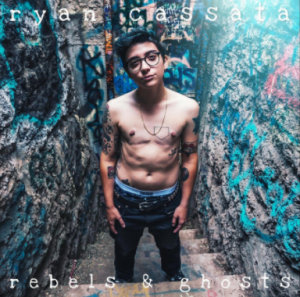
“Gender Binary (Fuck You)” by Ryan Cassata

Image courtesy of Ryan Cassata

There should be no requirements to fit any gender, and stereotypes about any identity are frustrating. Ryan Cassata’s opening lines say it simply: “I’m gonna wear girls clothes when I want to / I’m gonna wear boys clothes when I please.” There’s no need for you to express yourself in any certain way to prove yourself. Hell, wear anything that fits your body. Just try to stay away from fedoras, please.

Gender feeling like a ghost? Check out “The Witches Made Me Do It” by Ryan Cassata

“Genderfuck!” by Elmo Sexwhistle

Image courtesy of Elmo Sexwhistle

For anyone whose gender experience is far too vast for the binary, the feral energy of “Genderfuck!” is for you. Elmo Sexwhistle is an indie industrial rock artist with a queer touch. With lyrics as exasperated with gender as I am, the artist sings, “I am a genderfuck / I’m a boy, I’m a girl, I just make it up.” If that doesn’t describe the fight some of us have with gender labels, I don’t know what does. Have no gender! Collect genders like a crow collects shiny things! Nothing matters!

Gender feeling like a handful of sand? Check out “Boxes” by Elmo Sexwhistle

“I Think I Finally Love Myself” by She/Her/hers

Image courtesy of 808465 Records DK

Maybe you’ve been questioning for a while, or you’re questioning again. Let this song fill the air around you as She/Her/hers belts out, “I may always harbor some doubts / but mostly I feel fine / fuck that I feel fantastic.” Hold on to the parts of yourself that feel right. While “no one really gets to choose the person they are,” you are finding yourself and there is no timeline for learning about your gender. Besides, gender isn’t everything.

Gender feeling like a hunk of concrete? Check out “Gender Is Boring” by She/Her/hers

Need to Know, Need to Go: June 21–27

0
Illustration of a blue calendar, with "Need to Know, Need to Go" written on top
Arts & Culture events to catch around the city. Image courtesy of Brianna Quan

By: Gurleen Aujla, Peak Associate

An Anti-Racist Approach to Media Literacy | June 23, 1:00 p.m.–2:00 p.m. | By donation | Online 

Join Bakau Consulting, an equity, inclusion, and anti-racism consulting firm based in Vancouver, for an online media workshop. As 70% of the mediascape in Canada is controlled by four companies, this webinar will tackle the question: “How does this shape what we see about the world?” Bakau Consulting will discuss approaching both traditional news and social media using an intersectional lens centred in anti-racism. This includes navigating “biased algorithms, racist conspiracy theories, election interference, and performative online allyship.” The event is open to all and tickets can be purchased online by donation. 

SFSS Out on Campus Picnic Social | June 25, 2:00 p.m.–3:00 p.m. | FREE | Online on Discord

Simon Fraser Student Society’s Out on Campus is hosting a virtual picnic social. SFU and FIC LGBTQIA2S+ students and allies are welcome to join the Out on Campus Discord server on the fourth Friday of each month from June to August and socialize with others. Enjoy your favourite foods and spend time outdoors! 

Should a Just Recovery Include a Basic Income for BC? | June 25, 12:00 p.m.–1:15 p.m | FREE | Online

SFU Public Square and SFU Labour Studies join to present the fourth event in the 2021 Community Summit Series: Towards Equity. The event will examine the Final Report of the British Columbia Expert Panel on Basic Income and centre the discussion on whether a just recovery would include a basic income for all in the province. The presenters include Chuka Ejeckam, David Green, and Kaitlyn Matulewicz, and the event will be moderated by Kendra Strauss. Registration is required through Eventbrite.

TESSEL: a short film highlighting Black Canadian excellence from coast to coast

0
14 artists team up for this innovative new project. Image courtesy of Felix Russell and Tony Tran

By: Tiffany Chang, Peak Associate

I always appreciate art that initiates dialogue about representation. It is an impactful way for people to express themselves, and it creates continuous learning opportunities for audiences. TESSEL, a powerful short film by esteemed choreographer Esie Mensah, does just this. The piece discusses the unique experiences of Black Canadians while referencing history. It considers how long-standing, but evolving, perceptions of their worth have influenced their lives in modern society.

From racism and social change to self-love and mental health struggles, TESSEL encompasses all of these topics. The 14 featured Black Canadian artists each showcase emotive body movement — using different styles of dance like tap and hip-hop — and engage in reflective narration. This combination makes for a hard-hitting video that shows how much the artists have to offer. It also emphasizes why their voices matter when addressing the need for a diverse cultural landscape.

Not only are the performers conveying their individuality and key messages through choreographed routines, TESSEL’s strategic cinematography also draws attention to the broader connotations behind its symbolism. A particularly compelling moment early on is when Yvon “Crazy Smooth” Soglo looks out into the distance, slowly making a fist, while a narrator says, “what I used to tolerate, I don’t anymore.” From this action, a sense of anguish, as well as a strong determination to be seen and heard, can be felt. Simultaneously, it helps set the tone for a raw, honest compilation of artistic and emotional expression.  

The film’s theme of resilience is beautifully demonstrated, and it is undertaken in both direct and unexpected ways. A meaningful example is the generational significance of “resting,” which is a topic I had never come across until now. The artists explain how slavery meant resting was not an option for Black people. Therefore, taking the time to rest is what their ancestors would have wanted for themselves and what the following generations deserve to have. The resiliency in this respect is profound. These artists inform the rest of Canada how they absolutely have the right to claim something that has been historically and repeatedly stolen from them.

TESSEL encompasses so many arguments, emotions, and creative pieces in a 15-minute video. Viewers will see a refreshingly authentic take on the social climate for individuals in the Black Canadian community, proving that current activism efforts are just the beginning.

Food for Thought: Dumplings and dragon boats

0
Celebrating Duanwu Jie and its origins with zongzi. Illustration: Alyssa Marie Umbal / The Peak

By: Nancy La, Staff Writer

In June, my family celebrates a special festival called Duanwu Jie in Mandarin. Known in English for its common name, the Dragon Boat Festival, Duanwu Jie is a day to celebrate an ancient story with dragon boating and the consumption of a special glutinous rice dumpling called zongzi

Vancouver’s Concord Pacific Dragon Boat Festival at False Creek is home to one of the biggest paddling competitions in North America, and I was one of the youth racers during my high school days. Though I’ve paddled on a dragon boat team for three years, I’m embarrassed to say I had never delved into the festival’s history. I know the origin story of the festival involves a water spirit and rice being thrown into a river, but for more information, I consulted the person I think knows the topic best: my father. 

My dad told me the festival came from the Warring States period in China. A young politician named Qu Yuan was exiled by the emperor of Chu after proposing a plan the emperor didn’t like. Several years later, the empire of Chu lost a war to its neighbour, the Qin, and had to surrender. Qu Yuan, hearing the devastating news, drowned himself in a river. 

To appease Qu Yuan’s spirit, the people threw rice into the water to feed him. Unfortunately, there was a dragon in the water who would intercept before Qu Yuan could get to it. After several centuries of this, Qu Yuan got annoyed and came back to the people — in his spiritual form — and taught them how to wrap rice in leaves or bamboo stalks. This was so the dragon couldn’t steal the food. Zongzi then became a common food to eat during the festival. 

There are many ways to prepare zongzi — one can boil them until they’re cooked, or take a modern approach and use a pressure cooker. They also vary by region: Shanghai has its own take on zongzi using different soy sauces, or there’s lye water zongzi with its delicious chewiness. Zongzi can house various combinations of filling, such as pork belly, mung beans, and cured egg yolk. There are also sweet zongzi stuffed with red bean paste or Chinese dates. Its ubiquitous greenish, glutinous rice and wrapping made of leaves are iconic in Southeast and East Asian cuisine. 

Zongzi can be consumed year-round, but there is a very special feeling to consuming them as you watch racers speed to the finish line to the sounds of rhythmic drumming on False Creek’s water. 

There are several explanations for dragon boat racing during the festival. One is that dragon boating was a form of military training — trust me, paddling is more exhausting than it looks. Another is that it was a way for the people to ask the dragon god to watch over their rice crops. Either way, dragon boat paddling and zongzi became intertwined with Qu Yuan and his story, and it is an integral part of the Duanwu Jie East and Southeast Asian communities celebrate today.

Dakota Ray Hebert and Kliph Nesteroff talk about humour as a way of healing

0
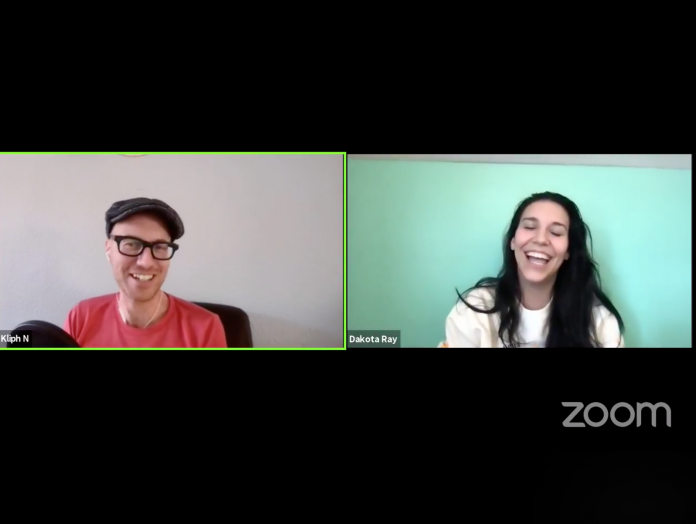
Check out the Laughter as Medicine in Indigenous Comedy event. Screenshot courtesy of Vancouver Public Library via Facebook

By: Kelly Chia, Staff Writer

Content warning: Racial trauma, genocide

The Vancouver Public Library featured Dakota Ray Hebert and Kliph Nesteroff in a discussion of Indigenous comedy history in North America. Hebert is a long-time Indigenous comic from Saskatoon, co-hosting the show Crazy Like a Lynx on the Aboriginal Peoples Television Network. Nesteroff came into this conversation with Hebert as a comedic historian, having just published the book We Had a Little Real Estate Problem. The book is a thorough history of Indigenous peoples’ work in comedy, hoping to shine a light on their legacy and influence. 

Hebert and Nesteroff discussed Hebert’s experiences as an Indigenous comic and the immense history of Indigenous comedy as a way to heal and expose colonialism. 

Having watched a lot of stand-up comedy as a kid, Herbert was particularly inspired by Craig Lauzon. Hebert would watch the Indigenous comic on the Turtle Island Festival, an Indigenous comedy festival airing on television. Lauzon was the first comic she saw that incorporated both acting and comedy, which made her believe comedy was a truly viable dream. “He was pretending to be a wrestler, dressed in his Indigenous garb, and he was telling the story about the stereotypes [of Indigenous peoples] in Hollywood.” 

Eventually, Hebert became close friends with Lauzon, who inspired her to talk authentically in her work about her experiences as an Indigenous person.

When Hebert began performing as a comic in Saskatoon, her approach was one of confidence. Her attitude was: “I feel ready, so therefore I am ready.” According to Hebert, “In comedy, [that’s] not always true.” Hebert did a few open mics where her friends attended. Hebert joked she felt successful because she didn’t know whether her friends were laughing at her or with her. 

Hebert’s experience in comedy has also required fighting against stereotyping of Indigenous peoples. She criticized comedians like Don Burnstick, who infamously used racial slurs in his work and played into these stereotypes. Hebert recalled the harm of these stereotypes in her early life. As a 10-year-old, she needed to get headgear. When her white friends found out it was mostly covered by her Status card, they ostracized her for it. Experiences like this pushed Hebert to internalize a lot of racism growing up. 

“I think [this humour] doesn’t serve anything other than to make crappy white people feel better about their own racism, and it doesn’t help further our work in trying to be seen as human beings,” she said.

Nesteroff added We Had a Little Real Estate Problem sucker punches the reader in the beginning. “It is a book about comedy, but it starts off talking about things like the doctrine of discovery and colonization [ . . . ] It gets into that idea of comedy being a counterbalance, or a way to transcend the most tragic of things,” he explained. 

The two lingered on how necessary and appropriate comedy was in heavy moments about history and colonization, especially with the discovery of children’s remains at the Kamloops residential school. 

“I think [comedy] is 100% necessary to heal and to move on,” Hebert said. The news was overwhelming, but she also found it fueled her motivation to continue her comedy to buck against the government’s incompetency. 

While Hebert said “there isn’t any humour in genocide,” she says there is humour found when considering the “bumbling” people that continue to make calls and remain in power.

The event can be viewed on Facebook Live. Dakota Ray Hebert and her work can be found on Facebook and other social media platforms. We Had a Little Real Estate Problem by Kliph Nesteroff can be ordered from Indigo and other bookstores across Canada.

My journey with imposter syndrome

0
ILLUSTRATION: Ariel Davis / The New York Times

by Kelly Chia, Staff Writer

“I don’t know enough to be good at this job.”

“There are so many things wrong with this. They’re all going to think I’m a fraud.”

“You should know better by now. How do you make the same mistake over and over again?” 

Phrases like this litter my mind constantly, and it’s tiring. I harboured these feelings for a long time before I learned they were symptoms of imposter syndrome — a psychological pattern where people fear being exposed as a fraud because they doubt their skills and accomplishments. 

I worry that I can never produce something as good as what I have made in the past. Because most of the work I do is creative, I always fear I can’t execute the ideas I have in my head. I get stuck feeling like I’ve failed myself and my peers by not being good enough.

I never feel confident that I deserve my school or work positions. I find it difficult to submit my work to another person because they’d surely notice all the mistakes I think are in it. 

In reality, the people who read my work often reassure me that I’m doing alright, and that it’s never as bad as I think it is. But it doesn’t stop me from going through the same process each time.

I constantly think I should be more capable. It feels like I shouldn’t need to ask for help because I should have the experience to handle things independently by now. It’s an exhausting mental process that I go through every time I start a new assignment or job, despite knowing I’ve made it through to the other side before.

There are a few reasons why I think this started happening: I was a high achiever in a competitive academic environment, and my self-worth depended on me consistently doing the best I could. This overwhelming pressure made it difficult to start assignments because I was too afraid of making mistakes. I felt the need to constantly prove myself to myself and to others

A skewed understanding of how skilled I was coupled with a habit of being self-deprecating, ultimately hurt my self-image.

I’m trying to be kinder to myself these days, but I find this hurdle particularly difficult to get over. I feel if I don’t write that perfect draft or understand my tasks quickly, I don’t deserve to progress as far as I do. 

Incidentally, I spent a while figuring out how to write this article because I doubted whether I had the experience to write it, then realized that was exactly why I had to write it. I can’t present a solution, but I can talk about the steps I’ve taken to feel more in control in the hopes they will resonate with someone else, too. 

The first thing was learning the name for this feeling. This wasn’t just random bouts of anxiety, but a pattern I could recognize and find resources for. By naming it, I judged myself less harshly because I knew it was a symptom of a common problem, not just a problem I made up to avoid my work. 

From there, I started talking to others about it and found people who felt the same way about their work. This didn’t truly reassure me that I was capable in my lane though. People could have problems with their work, but they were still capable enough that they knew they weren’t a fraud.

By contrast, I didn’t feel good enough to admit I had a problem recognizing my skills. The problem with imposter syndrome is that you set up your pedestal. Everyone’s expectations of themselves seem irrelevant in comparison. Still, knowing that capable peers around me were going through the same thing pushed me to consider how much my poor self-image factored into my skills and talents. 

Remember when I said I had a problem with looking back at my work earlier? I found I had to be a lot more comfortable with my mistakes, so I’ve started reading my old assignments and articles. The critic inside of me would pipe up as I noticed every flaw, but I’ve found myself cringing less as I find my strengths as well. It sometimes helped to write down three strengths and one thing I could improve on in my work to have something visual to focus on. 

Most importantly, I’ve tried to veer away from my need to be perfect and towards rewiring my brain to recognize when I make progress. This means that I ask for more help when I’m stuck in my head thinking about the perfect way to do something. I feel so vulnerable because it always feels like I’ve done less than what was expected. But once I get the help I need, I feel relieved. 

I also try to accept that failure isn’t an end, but a chance to improve. Failure was so scary for me growing up that treating it as a learning opportunity has been difficult. I’m now trying to unlearn the ingrained belief that I’m only as valuable as the work I put out and to embrace that there will always be an opportunity to do better. 

Recognizing imposter syndrome as what it is — a pattern — helps me rationalize and think about the times I have succeeded and why. I know I need more reassurance from my loved ones that I am doing okay some days more than others. I’ll even have times now where I move through my work smoothly. I accept that imposter syndrome is a hurdle in my journey of trying to be kinder to myself, and I’ll certainly falter along the way. But maybe understanding why it happens instead of blaming myself will help me improve my inner monologue.

SFU researcher leads team for lunar rover exploration mission

0
PHOTO: Neven Krcmarek / Unsplash

Written by: Harvin Bhathal, Peak Associate

The Canadian Space Agency (CSA) announced plans for future lunar exploration. On May 26, 2021, the CSA declared a team of researchers from SFU, the University of Manitoba, and McGill University will develop the micro-instruments to be used by a newly-designed Lunar Roving Vehicle (LRV).

Led by associate professor Dr. Behraad Bahreyni from SFU’s School of Mechatronic Systems Engineering, the project aims to expand upon existing knowledge about the moon’s seismicity (earthquake activity) and address unanswered questions regarding its geophysical properties. 

According to Dr. Bahreyni, “The most valuable geophysical data regarding the subsurface structure of a planetary body are obtained from seismic and gravity measurements.” 

These measurements will be done by miniaturized seismometers, which detect and respond to movements in the ground, and gravimeters, which measure the downward acceleration of gravity. These instruments will be integrated into a hybrid gravimeter and seismometer system developed by Dr. Bahreyni’s team. He describes this as “a key differentiator” in comparison to previous LRV projects. They will be mounted onto the rover.

SFU’s 4D LABS will produce the prototypes, and SFU’s Centre for Natural Hazard Research (CNHR) will develop new approaches to measure and monitor geophysical hazards on the moon.

Through “the joint measure and modelling of seismic and gravity signals,” scientists will be able to accurately image subsurface structures.

The data they aim to collect includes “moon tides, mantle/core dynamics, active fault structures, gas/liquid reservoirs, mineral deposits, hydrothermal systems, and volcanism.

“Besides deepening our knowledge about the moon and its seismicity, we will learn about the mineral composition of its crust,” he said. “In the long term, similar methods may be used on Mars or other planets in search of resources needed for [habitation] (e.g. water ice).”

When considering the geophysical properties essential for human settlement, a critical factor is access to water sources. Dr. Bahreyni added, “The devices developed through this project can help with identification of water ice reservoirs beneath the surface of planetary bodies.”

Previous LRV missions studying the geophysical properties of the moon were limited by “the size and weight of conventional [instruments that] have prohibited their use in space missions.” In addition, “remote measurements of gravitational forces have limited spatial resolution and mostly provide information on topography.

“Once these devices are fabricated, we need to spend time calibrating them against standard equipment and also include measures to ensure they survive launch [ . . . ] We are glad that we could bring together the necessary expertise from across Canada to address these multitude of challenges,” said Dr. Bahreyni.

He and his team are working with seismologists and space scientists including SFU professor and co-director of CNHR, Dr. Glyn Williams-Jones. University of Manitoba’s Dr. Pooneh Maghoul and Dr. Philip Ferguson, and McGill University’s Dr. Yajing Liu will also join Dr. Bahreyni. Along with the doctors, eight postgraduate researchers from across Canada will join the team.

The CSA’s plans for lunar exploration include putting a rover on the moon by 2026.

“We are hoping to be a part of that mission, but we are also cautious that conducting leading edge research brings with itself uncertainties.” 

SFU announces Greg Younging Endowment Award for Indigenous students

0
PHOTO: Mikołaj / Unsplash

Written by: Jaymee Salisi, News Writer

The Greg Younging Endowment Award has been introduced by SFU Publishing for Indigenous students pursuing a Master of Publishing (MPub) degree. Named in recognition of Dr. Gregory Younging, the award honours him as the first Indigenous graduate from the MPub program. Dr. Younging is the author of Elements of Indigenous Style: A Guidebook for Writing By and About Indigenous Peoples. He also worked as the assistant director of research for Canada’s Truth and Reconciliation Commission.

Over the next three years, this award will create a “fully funded opportunity for an Indigenous student” to complete the MPub Degree at SFU. Penguin Random House Canada announced a three-year $45,000 donation commitment to the endowment. The first recipient will be awarded in Fall 2025.

Alexandra Krilow, recipient of the award’s undergraduate counterpart, spoke with The Peak about the endowment. She said she views it as an opportunity to take the financial burden off Indigenous students pursuing the program, and hopes it will “remind them that there is a place for them in advanced academic settings.”

Krilow cited a Statistics Canada report that said 48% of Indigenous peoples in Canada have post-secondary qualification. 

This endowment is a message for Indigenous students, that their voices not only matter but are incredibly valued — especially in publishing” — Alexandra Krilow

Many Indigenous peoples are the first generation of their family to attend university, which can mean their educational support system might not be the strongest. This endowment is a message for Indigenous students, that their voices not only matter but are incredibly valued — especially in publishing,” she said.

Indigenous peoples have faced intergenerational trauma from colonization and residential schools. As a result, Indigenous peoples have learned to “repress the different aspects of their culture,” Krilow explained. “It is no secret that Indigenous voices have been silenced throughout history.

“Telling our stories can be a way to help put a stop to this pattern. Art, music, writing, and other related industries to publishing allow for these stories not only to be shared, but to express some of the deep rooted feelings Indigenous peoples have.”

A 2013 report by Queen’s University said when Canada faced a financial deficit in 1996–98, the federal government limited core program funding to Indigenous elementary and secondary school education. 

The report showed continued underfunding of First Nations schools by approximately $3,000 compared to other provincial/private schools from 2003 to 2010.

This lack of funding along with the intergenerational effects of colonialism resulted in Indigenous communities facing social, health, and economic challenges today, which “undermine potential progress on First Nations education.”

Although Indigenous peoples face barriers to education, Krilow said she has seen an increase in Indigenous publications. She said the Greg Younging Endowment Award will contribute to the growth of Indigenous representation within the publishing industry.

“Formal education and the ability for industry connections to be made will allow Indigenous peoples in publishing to flourish,” Krilow said.

Founded 25 years ago, the MPub is an 18-month program and applications close on February 1 every year. Learn more about the program here.

SFU department of history hosts a conversation on Liu Xiaobo

0
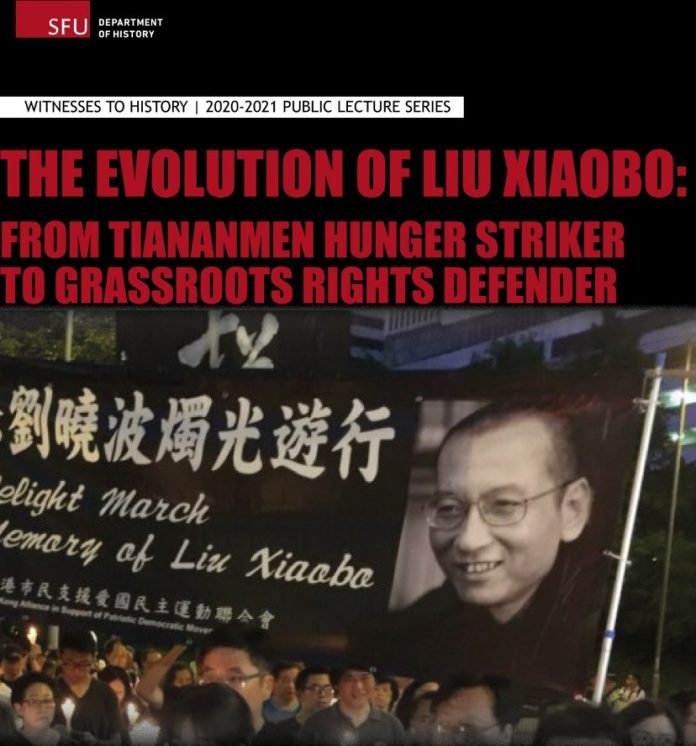
Photo Courtesy of SFU

Written by: Kelly Chia, Staff Writer

On May 27, 2021, SFU hosted an event featuring professors Jeremy Brown and Perry Link in a conversation. They discussed Link’s forthcoming biography, co-authored by Wu Dazhi. It is about Liu Xiaobo, a figure of political liberation in China. Liu won a Nobel Peace Prize in 2010 for his defense of human rights and died in 2017 while serving eleven years of imprisonment for subverting state authorities. 

This is the final lecture in the series Witnesses to History — the SFU department of history’s annual public lecture series. The series “focuses on eyewitness accounts and testimonies, and their importance of telling the stories of the past.”

“Liu Xiaobo is bigger than this world generally gives him credit for,” Link said. “He came up with a non-violent philosophy for bringing about social and political change that — in my view — ranks with Martin Luther King and Mohandas Gandhi.” Link said Liu’s goal was to change the regime through society by looking at “ordinary people with daily life problems.” He explained it was different from dialogue in the ‘80’s, as people wanted societal change among government authorities.

Co-author Wu Dazhi knew Liu personally. “They started working together in the early 2000s on what they called [ . . . ] Charter 08,” Link explained.

Charter 08 was a manifesto that advocated for “the gradual shifting of China’s political and legal system in the direction of democracy.” It called for a constitutional amendment that guaranteed human rights as “China’s successive political disasters have all been closely related to the disregard for human rights by the ruling establishment.” 

It was signed by 10,000 dissidents and human rights activists in and outside of China. Liu’s involvement resulted in his arrest in 2008

When Link approached Wu, he did not know enough to write the biography. Similarly, Wu did not know enough English for the project. Thus, Wu sent Link chapters to translate and edit. “She was the content provider and I was the carpenter, if I can put it that way,” Link said.

After criticizing China’s one-party system, Liu served two years in a labour camp and exited in 1999, where his friends said he became decidedly more empathetic. “This is reflected in his philosophy, where his goal is to change the regime.” 

Link noted the landscape for opposition is worse than it was a decade ago because of heavy surveillance culture. “The budget for maintaining what’s called — or maintaining stability — in China is bigger than the national defense budget. 

“If you started to cause trouble, for example, if you signed Charter 08 even though you weren’t a ‘mover or shaker,’ this system would come to you and the police [would] invite you to tea.” The police would then ask people to consider their safety and their family’s safety. Otherwise, they would be at risk of imprisonment, Link explained.

“There are no opposition ‘parties’ in China,” Link said in an interview with The Peak. He explained, “the current top leader, Xi Jinping, is using old means of repression” to stop opposition early on. He added that old repression referred to Mao, and new repression takes the form of technology. 

Link and Wu hope that with the release of the biography, people will uphold Liu as a leader of thought. Link and Wu are considering naming the biography Long March Toward Freedom. This is “an echo of Nelson Mandela’s book, Slow Walk to Freedom.” Replacing “to” with “toward” showed how Liu didn’t get to freedom as Mandela did, they explained.

Link, professor emeritus of East Asian studies at Princeton University has authored several books on Chinese language, literature, popular culture, and dissidence. The interview and lecture can be viewed here on YouTube.

Cecelia Reekie discusses mourning in the Indigenous community after discovery at Kamloops

1
Photo courtesy of Cecilia Reekie

Written by: Karissa Ketter, News Writer

Content warning: descriptions of residential school abuse, anti-Indigenous racism, and genocide 

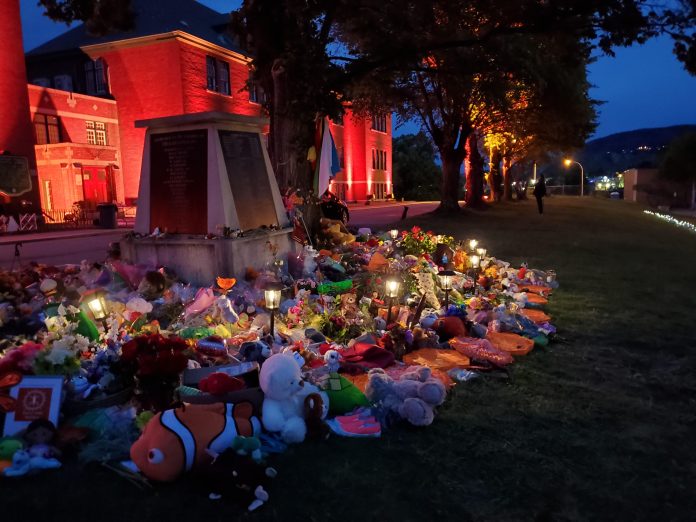
The remains of 215 Indigenous children were found near a residential school in Kamloops on May 27, 2021. Their identities are not yet known. While experts said it is difficult to “pinpoint with certainty the causes of death,” the findings revealed these are “missing Indigenous children who were unaccounted for in the known death toll” of the residential school system.

“When the news broke — and we were seeing it everywhere on social media — I was just heartbroken. And the grief is so intense,” said Cecelia Reekie, a Haisla Nation cultural presenter for the Langley School District. 

According to the Indian Residential School History and Dialogue Centre, the Kamloops school was the largest residential school in Canada. It was opened in 1890 by the Roman Catholic Church and was active until July 31, 1978.  

The residential school system was funded by the Canadian government. Catholic, United, and Anglican churches ran over 130 schools from the 1870s until the last school closure in 1996. 

“The purpose was to get rid of the ‘Indian problem,’” described Reekie. “We were in the way of the land. We were in the way of the resources.” 

In 1920, the Deputy Minister of Indian Affairs in Canada stated the objective was “to continue until there is not a single Indian in Canada” who had not been assimilated into the population. The Union of Ontario Indians explained that assimilation was “deemed to be the most effective way to ‘civilize’ the Indians.” Facing History explained that European imperialism inspired colonizers to force Indigenous peoples to conform to European society

The Canadian Encyclopedia estimates 150,000 Indigenous children attended residential schools. The estimated number of deaths is still unknown. The previous death toll for the Kamloops Indian Residential School had been 52 — the discovery of 215 remains demonstrated that the majority of childrens’ deaths went unreported and unregistered across BC.

“It was just heartbreaking. I was just so sad and felt so heavy, and they’re babies. They were somebody’s babies. I try to word it that way because I think that helps people understand,” said Reekie. She believes calling them “children” makes the discovery “too easy” for Canadians to accept. Understanding the victims as somebody’s babies helps to show people the devastation felt by families and communities, when their babies were never returned, Reekie explained.

While Canada acknowledges residential schools as cultural genocide, some have asked for them to be reclassified as a genocide. The United Nations defines “forcibly transferring children of the group to another group” as a form of genocide. While the Truth and Reconcillation Comittee (TRC) has already condemned residental schools as cultural genocide, “there is ample evidence” in reports that state “intentions, legislation, actions and legacies of genocide,” according to The Conversation

At the schools — which some consider to be internment camps — girls were forced into housekeeping tasks such as cooking, cleaning, and laundry. Boys were forced into labour such as carpentry, maintenance and agriculture. 

There are widespread reports of severe malnourishment, excessive punishment, neglect, physical abuse, sexual abuse, and mental torment. Disease outbreaks such as tuberculosis, influenza, smallpox, and measles were common due to malnourishment and overcrowding. 

“There will be many more babies across this country who need to be brought home. There wasn’t just 215,” said Reekie. “The truth must come out. We have to do all we can to ensure that every child who died in residential school has a name.”

Children ages four to 16 were forcibly removed from their parents to be taken to residential schools. They were given European names in effort to assimilate them with Europeans. Children were punished if they used their Indigenous names. Minister of Aboriginal Affairs Stephen McNeil told the CBC, “Their name, like much of their identity, was taken away from them.”

“This is a very pivotal time in Canada right now,” explained Reekie. “Around the world people are going to be watching Canada to see what we do.” 

Political leaders at all levels and the Catholic, United, and Anglican churches in Canada, “need to have difficult conversations about who they are and what they are and what they represent,” said Reekie. 

Vancouver Catholic girls’ school, Little Flower Academy (LFA), was opened in 1927 by the Roman Catholic Church as a residential school. LFA students called on the Roman Catholic Church to apologize for their participation and to stop “glorifying colonization.” 

In a statement released by LFA, they said, “It is our responsibility to teach the truth about the residential school system; to deepen our collective understanding of the intergenerational harm that the residential school system caused; to acknowledge the role of the Catholic Church within these schools.”

According to Reekie, it will be these difficult conversations where Canadians will be able to “break down those barriers, the same way schools need to break down their systemic racism.

“They have to be conversations and they have to be out in the open, so that, as Indigenous people, we can see those conversations happening, and we need to be a part of those conversations,” said Reekie.

For Reekie, a key part of this process is first giving Indigenous peoples space to grieve. “We need to stand with the Indigenous communities as they come to terms with this [ . . . ] We need everybody to stand with them, not just flying flags, not just wearing orange shirts.

“For those who already think they know the history, we need to continue to learn. We need to continue to understand. We need to have compassion, empathy with each other. I’m sure there’s many non-Indigenous people who are also feeling that the country that they thought they understood, maybe they didn’t understand as well,” said Reekie.

Reekie noted her disappointment in Justin Trudeau’s response to the uncovering of Indigenous children. “I would have thought that there would have been much more significant action than just words the last week. Words are wonderful, but it’s going to be the action that is really determinant in [ . . . ] what our country is going to look like.”

Justin Trudeau recently released a statement regarding Missing and Murdered Indigenous Women, Girls, and Two-Spirit People. After new policy recommendations, Reekie asked, “Why hasn’t this happened before? Why wasn’t it important before last Friday? Maybe we need to ask ourselves that — maybe we as Canadians need to ask ourselves, why has it taken 215 babies to get us moving?”

Reekie believes it is important for all levels of government to consider the 94 Calls to Action that the TRC published in 2015. These call on the federal, provincial, and territorial governments to reduce harm being done to Indigenous populations across a wide scope: child welfare, education, language and culture, health care, justice, and reconciliation. 

Reekie said it is crucial for the government to “find space for our people to have that voice and to be able to move [this country] in a direction that it’s not wanted to go, but it needs to go now.”

The Calls to Action in child care include ensuring social workers are well educated and trained in culturally appropriate environments for young children. It includes the understanding between the connection of the foster system and residential schools, and aims to keep Indigenous families together as often as is safe to do so.

Developing a culturally-sensitive education curriculum, honouring existing Treaties, and closing health gaps such as infant mortality, suicide, addiction, and chronic diseases between Indigenous and non-Indigenous peoples are also components of the 94 Calls to Action.

“A life lesson my dad taught me is to walk softly, and maybe we all need to just walk softly right now,” said Reekie.

Starting next week and spanning the remaining issues of this semester, The Peak will be publishing each of the 94 Calls to Action of the Truth and Reconciliation Commission.

Resources: