
SFU alum co-creates new app encouraging cafés and consumers to go green

By: Nancy La, Staff Writer
Bringing your own (BYO) cup to cafés to reduce waste is already a great act of sustainability, but two climate activists have created an online platform to make it even more rewarding. Founded by SFU alum and former chair of Embark Sustainability Priscilla Lam and UBC student Angelica Tso, the BYO app aims to develop a more sustainable café culture by decreasing the usage of disposable cups. Through the app, users are encouraged and rewarded for bringing their own reusable cups to participating stores.
I downloaded the app and tried using it myself. The app is built by students, and while there are pauses during the loading process, the app runs smoothly when scanning barcodes. I visited one of BYO’s two partner cafés, Teaspoon & Co (the other being Kind Cafe in Mount Pleasant), and got a free topping for using the app. Instead of paying 5 cents extra for drink toppings, the money went towards the Eden Reforestation Projects. Every five scans equals a tree planted. This exemplifies the mentality of “every small act matters” that Lam and Tso built into the project itself.
The app’s purpose “is to bring visibility to a practice that is normally invisible,” Lam said. “We saw that there was no centralized platform or centralized place for people to bring their own cup and feel comfortable doing it. The whole point is to normalize bringing your own cup so that the default is not disposable cups, the default is reusables.”
Paper cups have long been regarded as the greener alternative to plastic cups used at cafés, yet according to Lam and Tso, the truth is much more complicated.
“The outside part [of the paper cup] is made of paper [ . . . ] but the inside always has some sort of waterproof, plastic lining,” preventing the cup from disintegrating, Tso said.
“That’s why the recycling process also gets complicated because that means, when it does get recycled, they would have to separate that lining. And often, that process is so much more energy-consuming/time-consuming, and it just ends up being thrown in the landfill because it’s not worth it for recycling companies to have to go through that process,” Tso explained.
Instead of going for paper cups, Lam and Tso want consumers to shift towards a “reuse” culture.
“There’s a reason why recycling is at the bottom [ . . . ] it’s really intensive,“ Lam said, pointing to the three Rs — reduce, reuse, and recycle.
As the BYO app illuminated in an Instagram post, a July 2020 report from an international panel of health experts stated “reusable systems can be used safely by employing basic hygiene.” However, many cafés have continued suspending reusable cup programs due to COVID-19. BYO’s goal is to continue raising awareness about Vancouver’s disposable waste problem and encourage reusable solutions whenever possible.
You can download the BYO app on Google Play or through Testflight for iOS. More information can be found on their website.
Monday Music: Burn my blues

By: Vrinda Kapadia, SFU Student
I dedicate these songs to those who are internally screaming for a real connection. Whether you’re scorning the prevalence of online dating apps or dealing with friends who are incapable of truly understanding you, these songs aptly describe the wretched moments when you feel alienated, helpless, and miserable.
1. “Cigarette Daydreams” by Cage the Elephant
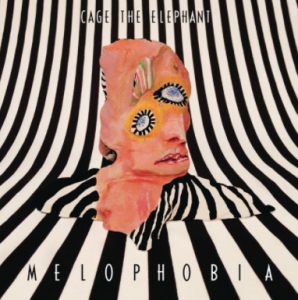
The melody of this song is pieced together by beautiful instrumentals and the youthful voice of the singer. Lyrics such as “You were only 17 / Soft speak with a mean streak / Nearly brought me to my knees” suggest the speaker is reminiscing about his high school crush. This song is very relatable and dear to my heart. What can make you more miserable than the nostalgia of your high school days and young love?
2. “Apocalypse” by Cigarettes After Sex
This song expresses a certain weariness. The monotonous, repetitive rhythm and terse verses are tediously drawn out. The lyrics suggest the speaker feels empty without his love and reflects he is “locked in there forever / And [he] just can’t say goodbye.” This song is like a hefty, miserable cloud that makes you feel devoid of emotion. Despite the gloomy atmosphere, this song provides me comfort in my dark moments.
3. “Can I Call You Tonight?” by Dayglow

The essence of this song is the disorienting feeling you get when you’ve been in your head so much that the boundary between reality and imagination is blurred. The lyrics suggest the speaker’s state of mind is anxious and confused. In the chorus, he exclaims, “I hear your voice on the phone / Now I am no longer alone / Just how I feel.” This song conveys the hesitancy one faces when reaching out to friends after months of isolation during the COVID-19 pandemic.
We should be more cautious of the delta variant

By: Michelle Young, News Editor
BC is bolting into its reopening plan. At stage three, we can have personal gatherings, organized gatherings at half capacity, and national travel. BC only has 52% of the population fully vaccinated. With concerns surrounding the delta variant, we still need to be cautious and continue to integrate pandemic guidelines such as masking, distancing, and being mindful of ventilation.
While the large majority have received their first dose, they still have about a 20–50% chance of contracting the original strain of COVID-19. It is still unknown how vaccines will protect against variants; the delta variant has already infected fully vaccinated individuals. With findings showing it is the most contagious among all the variants — spreading during the early stages of infection and potentially taking up to four days to detect — I’m not sure why there isn’t more concern. Emphasis on vaccinations also disregards those who are unable to be vaccinated due to underlying medical conditions.
COVID-19 cases are declining in BC; however, some aren’t considering that the pandemic is still ongoing. There was a huge street party on Commercial Drive following the Italy win of Euro 2020 — where people were crammed together and largely unmasked. I’m not sure how so many people could have ever thought it would be a good idea to gather so unsafely.
It’s well-known that COVID-19 is a sneaky virus. In countries where the pandemic response has been praised, places like Seoul are now struggling with lockdowns due to the delta variant — with more cases and heavier measures than previously recorded.
We have been in this pandemic for over a year now, and I’m just as eager to sit in a café without worrying about COVID-19 as the rest of us. We’re simply not there yet.
I don’t understand why we wouldn’t be more cautious when experts have been warning us for months to be wary of variants, especially when the large majority of current COVID-19 cases are made up of variants. Even SFU is gearing up for a full reopening without the requirement of masks in all areas — largely ignoring the needs of immunocompromised students.
BC guidelines have relaxed mask regulations, making them a recommendation for those who aren’t fully vaccinated. However, it is nearly impossible to know who actually has their second dose. I’m not sure why we’re opening up the air to be so full of germs again, because frankly, I’m not excited to be breathing the same dirty oxygen as the rest of you.
Taking all of this into account, I think we should be concerned about our reopening. At this crucial point in the pandemic, all of our progress can quickly be thwarted by pure carelessness. Jumping into our routines again isn’t something to take lightly. It should be done mindfully. If we don’t, it could cost lives.
Need to Know, Need to Go: July 26–August 1

By: Sara Wong, Arts & Culture Editor
Vancouver Pride Festival | Now until August 3 | Cost varies | Online and various in-person locations
This year’s hybrid festival includes over 60 events, from pride-themed picnics to the first annual Posh Ball. While a majority of the festivities are free, some events like Stanley Park Brewing’s pride lounge and Fairmont Waterfront’s drag brunch are ticketed. Visit Vancouver Pride Society’s website for more details and a full list of activities.
Author Spotlight | July 28, 4:30 p.m. | FREE with registration | Online
The World Languages and Literatures Student Union is hosting a writing and publishing conference for SFU and FIC students. The guest speakers include SFU students Harvin Bhathal, Belle Villar, and Isabella Wang and alum Rhiannon Wallace. These featured authors will share their experiences, and answer questions from the audience. Registration for this event is required through Eventbrite.
Aura | Ongoing | FREE | The Amazing Brentwood
Split into six separate installations, Aura is transforming this renovated Burnaby mall once more. The multi-coloured, semi-transparent panels that make up Aura are powered by sunlight, so throughout the day viewers can watch the exhibit transform. These natural light murals were designed precisely for Instagram. Pledging up to $5000, the Amazing Brentwood will donate $1 to Coast Mental Health for every Instagram post tagging @the.amazing.brentwood and using #UnleashYourAura.
Flickering Storm’s pop culture-themed creations give back to communities in need
By: Carter Hemion, Staff Writer
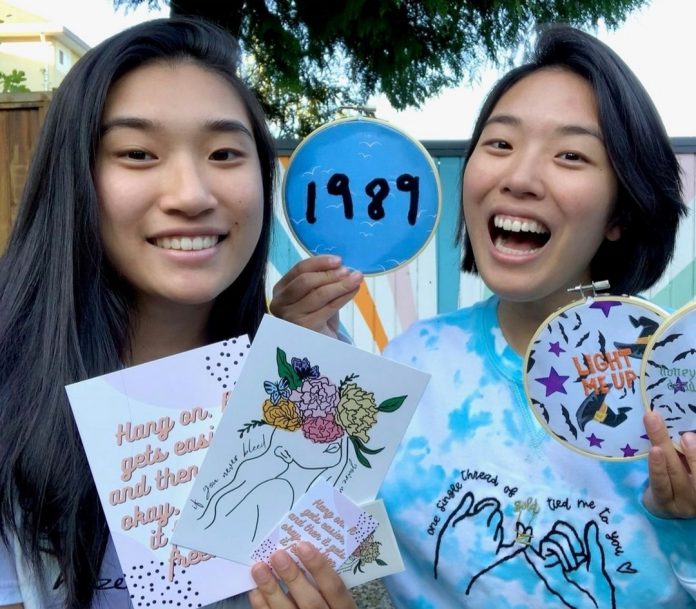
SFU student Bernice Mau and alum Brianna Mau created Etsy shop Flickering Storm almost one year ago. The sisters embraced art when the COVID-19 pandemic started, with Bernice designing prints and stickers and Brianna taking on embroidery.
Brianna said she and her sister initially started the business “out of our love for Taylor Swift.” The sisters’ art was mostly inspired by Swift’s lyrics, tours, and music videos. Now, the business has expanded to include art based on other parts of pop culture they enjoy, like Olivia Rodrigo, Gilmore Girls, and more.
Bernice grew up doing art and taking art classes in school, but she started taking it more seriously in 2020. Quarantine provided her a chance to get more into digital drawing. “It’s just a lot of fun because there’s just so many different things that you can do with it; there’s endless possibilities,” she said.
This transformed into her part of the business: creating stickers and art prints. The design process can take Bernice anywhere from days to weeks to develop. From there, she said, “Once I can clearly see it in my mind, I can normally draw it out pretty fast.”
Staking out the embroidery side of Flickering Storm is Brianna. She had been interested in the craft for some time. Inspired by friends, she took the leap in Summer 2020 and taught herself. She said embroidery is “a way for me to express some of my artsy side.” Her designs are often inspired by trips to fabric stores and browsing different patterns.
Embroidery usually takes between one to three sessions of work for Brianna to complete. She begins by choosing a font for quotes, and if there is a more complicated design aspect, she gets Bernice to create it digitally. Brianna then traces it onto her fabric and starts embroidering.
The intention of the business was less for a personal profit than to use their hobbies to help others. Brianna said, “I personally really believe in redistributing funds as much as possible.”
Flickering Storm donates half of their profits monthly and Brianna explained part of the reason to donate funds was starting the business during the COVID-19 pandemic. “There is so much need in the world, and so many things were exacerbated by COVID.”
For the month of July, donations will go to the Black & Indigenous Self-Care and Healing Fund, Braided Warriors, and giniw collective.
Flickering Storm is offering a 15% off discount code on their Etsy shop for readers of The Peak. The code “FSTHEPEAK15” is available until August 31, 2021.
Food for Thought: Boodle Fight

By: Charlene Aviles, Peak Associate
Many of my family members live in different countries, so there are few occasions where we can all gather together. Whenever I visit my parents’ hometowns in the Philippines, my relatives always greet us with food to celebrate our family being reunited. One food experience on my bucket list is a boodle fight, or kamayan feast.
A boodle fight is a Filipino feast served on banana leaves and traditionally eaten with one’s bare hands. Depending on the region, food served at boodle fights varies, but it usually consists of steamed rice and a type of protein (like fish or pork), incorporating Chinese or Western influences.
This feast, originating in the military and arranged on one long table, encouraged soldiers from all ranks to mingle with each other instead of branching off into separate cliques. This tradition later became popular among tourists.
Since typhoons are common in the Philippines, boodle fights are also a time to count one’s blessings. Coming from a family that sells rice, I recognize the time and dedication involved in cultivating rice crops. During typhoons, many farmers struggle to salvage their crops, so boodle fights are often a time to be grateful for one’s health, safety, and family.
The boodle fight is on my bucket list because it would allow me to taste more authentic Filipino food. Since I have not visited the Philippines in 10 years, food brings back comforting memories of my last visit. Some ingredients, like fresh banana leaves, are scarce in Canadian grocery stores, making me look forward to my first boodle fight even more.
How to prepare your own boodle fight, according to Great Big Story on YouTube:
- Cover the table in one layer of clean, fresh banana leaves.
- Place rice in the middle of the table.
- Add your protein on top of the rice.
- Evenly distribute vegetables.
- Prepare a bowl of vinegar or other dipping sauces for each individual.
- Enjoy!
If you’re looking to try a boodle fight in the Lower Mainland, check out Grandt Kitchen by SFU Surrey.
SFU’s convocation traditions faces mixed reactions
Written by: Jaymee Salisi, News Writer
Content warning: mention of residential schools
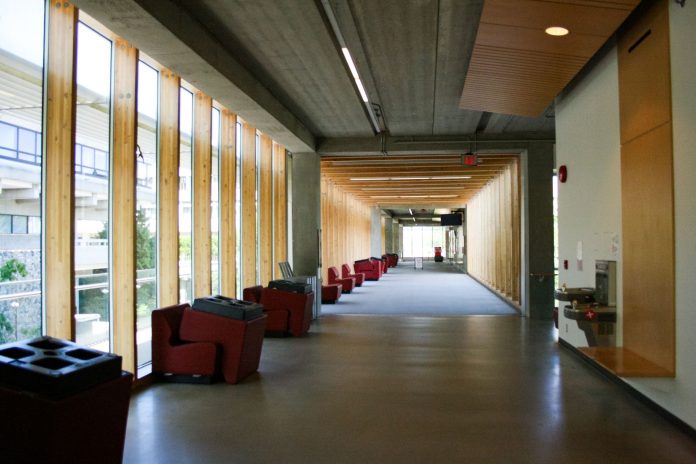
From June 24 to 29, SFU held virtual convocation ceremonies for the June 2021 graduates. “If you tune into SFU’s Virtual Convocation this June, you’ll notice a set of updated convocation traditions stemming from SFU’s ongoing commitment to reconciliation,” SFU said in a news release.
Their new practices include xʷməθkʷəy̓əm (Musqueam) ceremonial drumming and singing during the opening ceremony, a Coast Salish welcome message, redesigned regalia for the chancellor and president, and a land acknowledgement. These traditions were followed by the Canadian national anthem.
This was met with controversy online.
Under the #CancelCanadaDay tag, SFU Students of Carribean and African Ancestry president Balqees Jama tweeted, “Stomach feeling twisted when I hear the Canadian national anthem sung at SFU convocation amidst all the collective grief Indigenous people are dealing with at the hands of colonial Canada.” SFSS Science Representative WeiChun Kua said, “Was really unsettling to have the national anthem played and then have [Joy Johnson] talk about residential schools.”
The Peak reached out to the First Nations Student Association for their thoughts on the subject.
A board member who asked to remain anonymous said, “My answers are my own opinion. I am Indigenous but I do not represent the opinions of all Indigenous peoples. The following is my reflection based on my personal experience and family history. I strongly encourage readers to get to know the Indigenous peoples and the history of their region.”
She said the Canadian national anthem — as well as all other anthems — are colonial to an extent, as it celebrates the country’s history. Ultimately, she believes the national anthem’s meaning is “vague and open to interpretation.”
The board member explained that, before the anthem, “Alec Dan shared a beautiful drum song, the Paddle song. In addition, Elder Margaret prayed all before the SFU choir sung the Canadian national anthem. This is similar to having an Indigenous flag hanging higher than the Canadian flag.”
She added, “The paddle song and prayer were beautiful. If Alec Dan and Elder Margaret are reading this, marsii, thank you for sharing your song and for the prayer.”
In regards to the anthem itself, she said, “We must remember that SFU was in a very tight spot. Any and all action would be seen as controversial [ . . . ] SFU was being political in their choice.”
Director, media relations and public affairs Tiffany Akins said in a statement that SFU is devoted to reconciliation, which includes “examining the truths of our past and present. Some convocation traditions have carried on through the years.”
The board member added, “The opening ceremonies were not perfect and they could have done more. SFU is, after all, a Canadian institution — they are bound to rules, funding, political sway, and more factors than we as students are aware of.”
Akins said the new traditions have been added to “pay respect to the peoples on whose unceded traditional territories our campuses are situated. SFU’s Ceremonies and Events team hired Nicole Taylor-Sterrit as manager of Indigenous event protocols.
Taylor-Sterrit’s responsibilities include finding ways to integrate Indigenous practices in university events and traditions. She wrote on SFU News, “Indigenizing convocation gives us an opportunity to educate, incite questions and foster dialogue around the history of Indigenous peoples in Canada, Indigenous protocols, ceremonies and reconciliation with our community.”
“Reconciliation is about healing.” The FNSA board member added, “Listening and acting according to Indigenous voices are key to healing.
“We will still be here in seven generations, but our wounds should not take seven generations to heal.
“SFU needs to have ongoing communication and a continuous open dialogue with Indigenous peoples including students and the surrounding communities.” She suggested giving Indigenous presenters the same amount of time as SFU board members during meetings. For example, she said the university should include Indigenous people in conversations about university developments such as the First Peoples’ Gathering House.
“A stamp of approval on the products of a working group is not reconciliation. We need to be present at every step,” she said.
Find out more about SFU’s steps towards reconciliation on their website.
SFU study finds overall bee population decline exaggerated
Written by: Carter Hemion, Staff Writer
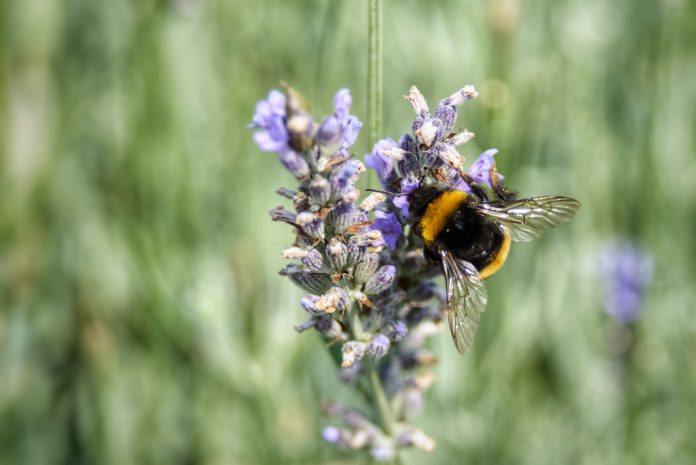
While some bee populations are in danger, average population declines have been exaggerated, according to a new SFU study. Where some studies have shown rapid and severe decline in many species, the situation is not as dire as previously thought, and research may help focus bee conservation on the species most in need, like the endangered Bombus bohemicus.
Researchers Dr. Laura Melissa Guzman, Dr. Leithen M’Gonigle, Dr. Arne Mooers, and PhD candidate Sarah Johnson documented information about bee populations with a new research model.
Lead author Guzman said she read a study last year that showed bee populations dropping drastically, and her team was curious about how the data was collected. “We decided to do the simulations to figure out whether different modeling decisions could affect or bias your results.”
In the SFU study, data was collected from observations in bees’ natural habitats. The information on what species were observed, when they were seen, and where they lived came from museum data, historical records, and citizen science observations — such as apps like Bumble Bee Watch and iNaturalist.
Where the initial study observed species in North America and Europe, not all species were observed in their native habitats. Some North American species had been observed in Europe and vice versa, which may have affected results, according to Guzman. Some of the first study’s data may also have been inaccurate from counting no bees present when the bees were likely unobserved on that particular day, Guzman explained.
Guzman noted it’s particularly important to identify “which species are declining and why.” The team collected data where species could naturally be found, and compiled data from what had been observed elsewhere.
While the initial study saw a 46% loss of North American bee populations in the last century, the SFU study found that only 5% of the total population had been lost with their observations.
While some species saw declines, others remained unchanged. Bombus bohemicus — a parasitic bumble bee — had one of the largest observed declines due to a decrease in its hosts, according to Guzman. Other species, like bombus cryptarum, increased their populations from taking advantage of environmental changes. With these observations on various species, more at-risk species can be prioritized in finding solutions, according to Guzman.
“It’s really important to focus on bee conservation.” She said we depend on pollinators like bees to “pollinate up to 75% of all our crops,” which keeps our food system healthy. Pollinators are especially important in BC for plants like blueberries and tomatoes. According to Guzman, bee decline may be a result of climate change, pesticide use, lack of host species, and other factors. Models like her team’s study can help discover and address these concerns.
To support conservation efforts, it is important bees have enough floral resources. They need floral diversity, enough habitat space, and areas without pesticides. Planting native plants and pollinator strips in an effort to support pollinators may be a solution to some issues.
Though some bee species are struggling, this study observes that not all bees are in as much danger as previously thought. Guzman said, “There are some species that are able to take advantage of some of the agricultural changes that we’ve had, and so it doesn’t mean that it’s doom and gloom for every single species.”
SFU improves ventilation across campus to reduce COVID-19 transmission
Written by: Jaymee Salisi, News Writer
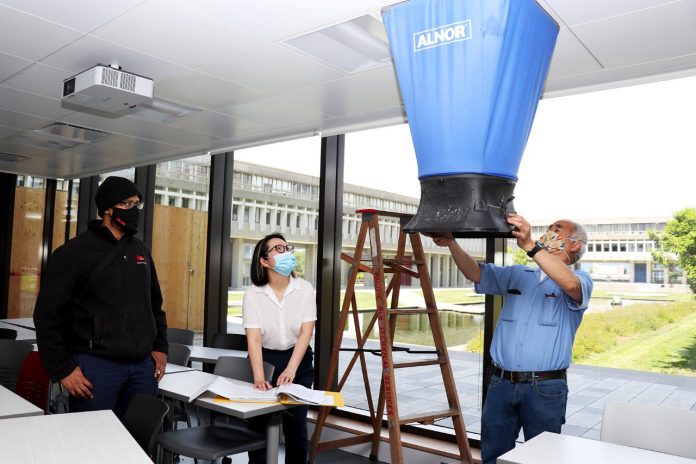
As SFU prepares to reopen campus in the fall, Facilities Services is improving the university’s heating, ventilation, and air-conditioning (HVAC) systems. This is to meet indoor air quality standards set by the American Society of Heating, Refrigeration, and Air-Conditioning Engineers (ASHRAE).
Developed with guidance from the Provincial Health Office, Ministry of Advanced Education and Skills Training, WorkSafeBC, and ASHRAE, SFU’s new ventilation measures include:
- Regularly reviewing standard ventilation measures and maintaining HVAC systems
- Replacing centralized HVAC system filters with the highest filter compatible with the building’s existing infrastructure
- Reducing pollutants by air flushing in buildings two hours prior to occupancy each day
- Circulating fresh air whenever possible
“In areas where ventilation could be improved, solutions have included programming changes, minor equipment maintenance, modification of equipment design, and implementation of reduced occupancy while a long-term solution is developed,” associate director, building grounds Dan Cooper said in an interview with The Peak.
According to Mayo Clinic, outdoor air circulation lessens the chances of breathing droplets or aerosols containing COVID-19. SFU aims to mitigate the spread of COVID-19 by ensuring an adequate supply of fresh air is maintained across the university.
Indoor spaces where people are in close proximity may increase COVID-19 transmission.
According to Cooper, proper ventilation “is only effective in conjunction with all other public health measures.” This refers to vaccinations and isolating when feeling unwell. Cooper said SFU aims to update measures according to COVID-19 provincial public health authority guidelines.
The improvements were initiated in May 2020 when SFU Facilities Services began an audit of the air ventilation quality throughout campus to be completed by the end of Summer 2021.
Learn more about the university’s campus ventilation plans on their website.


