Second-year SFU student Luke Kee was surprised after being voted the winner of an international award for culinary excellence on July 25.
“Man, I don’t know,” Kee said to The Peak in an exclusive interview. “This whole thing just got way out of hand. I was on Grindr trying to score an easy fuck, and I claimed to be a chef. It was a joke. I was trying to make a pun about “cook” sounding like “cock” — I’ve never learned to cook in my entire life.”
Taking us for a tour of what food critics worldwide are venerating as hallowed ground, Kee pointed out the areas of his kitchen that contributed to his success.
“Like, over here, I’d gotten some milk, but I forgot it on this counter. A few days later, it was midterms season, and I just didn’t have time to put it away. My date came over for the dinner I promised to cook, and I was so nervous that I accidentally knocked the carton over. It spilled all over the place, but there were some chunks in it — they looked alright and weren’t on the ground for over five seconds, so I figured they were good.”
Reaching over, Kee picked up a battered-looking pot, which he described as the source of what critics are calling perfectlyal dente spaghetti.
“The chunks went in here with some noodles,” he told us. “I forgot to make sure they were cooked properly, but I think I was able to cover it by bringing out the burgers. Which, if I’m being honest, kind of caught me off guard. I thought burger was a type of meat, but it turns out you have to actually make them.
“My family had given me a steak because they were worried I wasn’t eating properly, so I cut it up with the cheese grater and added in whatever that yellow bit of the egg is called — I fucked up on the cracking and it was all I could salvage after I spilled the rest of the egg on the counter. I put in some of those pepper packets they give you at McDonald’s and put it in the oven. Of course, it wasn’t until my date got here that I realized I hadn’t actually turned the oven on. At that point it was too late to turn back, so I just served them as is.”
Kee’s date, Sal Minella, had this to say: “I wouldn’t have trusted this guy to know which end of the fork to use, but I’ve got to admit, he really showed me that you can’t trust first impressions. He looks like a mess, but he turned out a cacio e pepe like I couldn’t believe, and that steak tartare was unrivaled.
“I asked him if I could keep some of the meal, whereupon I sent it into the competition. The judges were floored, and the meal won first place by a landslide. He asked me later if I’d be willing to help him get some meat in the Avocado. He phrased it kind of weirdly, but he’s clearly a culinary expert and knows what he’s doing — I told him to call me anytime.”
By: Kyla Dowling, Humour Editor and Local Astrology Bitch
It started with the new moon in Cancer.
TikTok astrologers, who are obviously very trustworthy because they say words like “exalted” and “decan,” said that whatever Cancer placements I had in my astrological chart would tell me what I need to focus on during the new moon. I pulled up my chart on cafeastrology.com — one of my favourite websites, second only to the one true God that is Google Docs — and began reading.
I had one Cancer placement. Only one. Thank god. My North Node was in Cancer, and your North Node is your destiny or, like, who you’re meant to be or something. Basically, if your South Node is Miley Cyrus, your North Node is Hannah Montana. That makes sense, right?
It was decided. On this new moon, I would evolve into my true self — like a Pokémon but less nerdy. I put jars of water outside with a sigil that looked weirdly like Pac-Man on the lids. I put crystals in every crevice in my room. I bathed in the moonlight and howled at the night sky. I turned my phone on Do Not Disturb and spent two hours trying to get my phone to send “shut the fuck up” whenever anyone messaged me on any platform. That’s self-care, baby.
Mere hours later, I had ascended. I was one with the moon, the Earth, and the guy blasting Cardi B and revving his engine as he drove down my street. Thanks to the Lush bath bomb I bought called Intergalactic Mermaid Angel Sex Birth Death, my skin was glittery like I was Alice Cullen. (You thought I’d say Edward, huh? I’m insulted that you think I don’t give off Alice vibes. I modelled my entire personality after hers for three years of my life.)
It was only when I checked my phone that I realized something was horribly wrong. I had hundreds of notifications from Facebook Messenger, of all things.
For a moment I thought it was my Great-Aunt accidentally sending me the same “Which Minion are you?” quiz over and over again, but that was only one message— that my phone had responded to with “shut the fuck up.” Yeah, family dinner on Sunday is gonna be fun.
The other messages? They were all from my group-chat for ECON 101, a course I only took so random men would stop mansplaining the stock market to me. (It didn’t work, but that was kind of my fault — I should really stop asking why we don’t just print more money when obviously no one is going to consider my genius suggestion.) The texts my classmates were sending made no sense to me: “Question 3 was really easy,” “The short essay killed me inside,” and “Wait, y’all got a numerical value for question 5? I thought the answer was capitalism.”
It took me a moment to scroll. Their conversation interspersed with my automated pleas for them to shut up, and then I realized: our midterm had been tonight. I had missed the test that was worth 40% of my grade.
I felt sick. I felt horrified. And then, I felt outraged. How dare this professor schedule an exam the night of an important astrological event? They probably had their sun in the 5th house — so self-centered. Immediately, I began typing out an email, beginning only with “Hi” because the professor didn’t deserve to have their name acknowledged by me.
Hi,
It has come to my attention that I missed the midterm tonight. As someone with a Cancer North Node and a fourth house moon, I was busy celebrating and honouring the new moon in Cancer. Yeah, new moons last for a few days, but every TikTok astrologer worth their Himalayan salt lamp knows that the first day of a new moon is totally the most important. Also, Mercury just moved into Cancer, which says that though communication is poor you should be empathetic towards me, especially because my natal Mercury is in retrograde, even though it’s my chart ruler . . .
Burnaby Mountain — whose base is named Lhuḵw’lhuḵw’áyten by the Squamish people in reference to its groves of Arbutus trees — hosts a variety of life. Currently designated as a conservation area, Burnaby Mountain is recognized as both provincially and ecologically significant.
Each plant listed here has a range that spans the traditional territories of numerous Indigenous nations, and so is known by many different names. In this article, we will use the common English names and the relevant binomial nomenclature. It should be noted that the majority of human interaction with these plants throughout history has been under different identifications than those used here.
I am neither a botanist nor a doctor, so please use your discretion, and respect the plants if you choose to interact with them. Medicinally, it should also be noted that, just because people throughout history have supported certain traditions, this does not validate them. Put quaintly by the weed science department of Purdue University: “There are historical reports of ancient Romans eating [horsetail]’s tender young shoots for medicinal purposes; however, the Romans also thought lining their aqueducts with lead was a good idea.”
With this all said; let’s learn about some plants.
Sword Fern (Polystichum munitum):
ILLUSTRATION: Shaheen Virk / The Peak
The sword fern is an incredibly old and prolific species. Despite being considered a weed by most industrial agriculturalists, the fact remains that the sword fern is exclusively native to the coastal areas of North America. Its range extends along the coastline of Alaska down to just above Mexico.
This plant can be identified by its long fronds, stretching up to 1.5 meters from the base. Leaves are attached by a small stem and grow in an alternating pattern. These fronds typically live for several years. The leaves (known on ferns as pinnae) are attached by a small stem in an alternating pattern, with a small protrusion resembling a sword hilt — hence the name.
The rhizomes (a type of underground structure from which the plant can grow underground roots or stems, like a ginger root) are difficult to access and prepare, but they have been cooked and peeled as a starvation food source by many Indigenous peoples. Its fronds are plentiful and have a naturally non-stick coating, leading to their historical use in beddings, basket linings, cooking pits, and as food preparation areas. Medicinally, its rhizomes, stems, and young leaves have been selectively eaten or distilled to reduce pain — ranging in severity from sore throats to childbirth — as well as a remedy to diarrhea. Its spores have been used to treat burns and the itch caused by stinging nettles.
Paper Birch (Betula papyrifera):
ILLUSTRATION: Shaheen Virk / The Peak
Paper Birch can be most easily recognized by their distinctive bark — whitish in hue, and generally smooth and flaky. The trees grow moderately quickly and reach maturity at around 70 years of age, whereupon their bark begins to peel into paper-like sheets.
During the fall, the many leaves of birch trees turn a bright yellow and make for a delightful fall ambiance.
Paper birches are considered “pioneer” species, which means they are among the first to grow after an area has been cleared. In this case, they are replacing the sections of Burnaby Mountain that were clear-cut in the 1940s.
Paper birch trees are a staple of the ecosystem and offer a number of uses. The leaves they shed in the fall serve to enrich the soil and make it more tenable for other plant life. Although low in nutrition, the sheer number of leaves they produce make the birches an important food source for deer and moose throughout their range. Their bark is eaten by Luna moth caterpillars, beavers, and porcupines. Various birds are drawn to the seeds and the nesting potential offered by the tree cavities.
The paper-like bark, from which they get their name, has been used to carry written messages by people throughout history and has been used to build lightweight and robust canoes, leading to the paper birch’s other name — the canoe birch.
Paper birches are susceptible to damage and bleed great quantities of sap when cut. This sap can be reduced to a syrup and has also been used in the past to make birch beer.
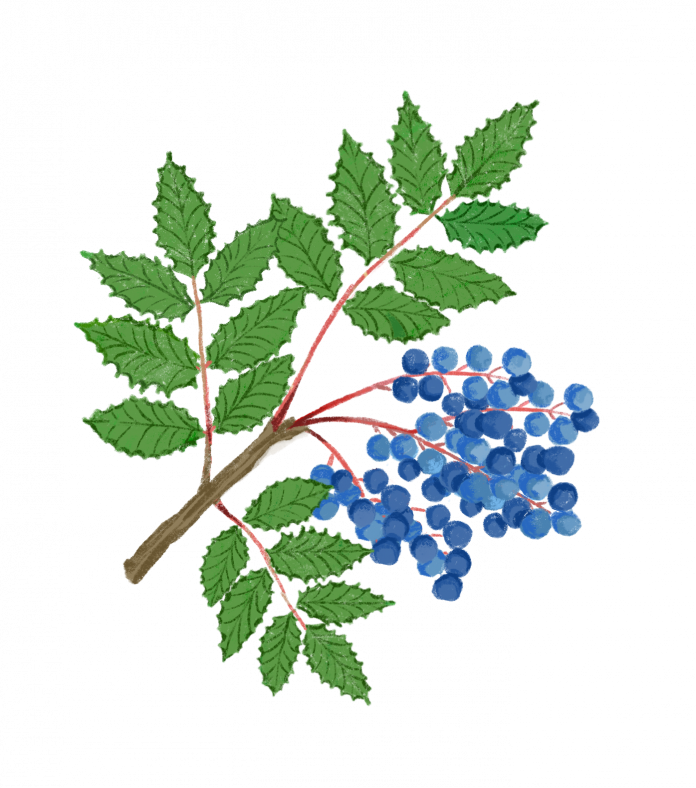
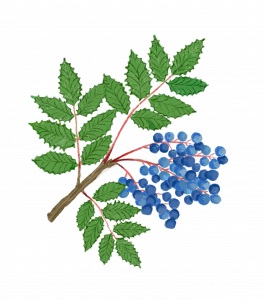
Holly-Leaved Barberry (Mahonia aquifolium):
ILLUSTRATION: Shaheen Virk / The Peak
If you keep your eyes open near the Diamond Alumni Centre, you might notice clusters of blue berries tucked around thorny leaves. These are holly-leaved barberry plants, also known as Oregon Grapes. While they are technically edible, students in need of a snack might be disappointed. The berries are very acidic in flavour and contain large seeds.
The plant itself is often grown ornamentally. Although it is evergreen, its appearance changes dramatically throughout the seasons. In the spring, it flowers brightly in yellow clusters, which ripen in the summer to the blue berries. The leaves finish with a deep burgundy in the fall, a colour which they carry throughout the winter.
Pollinators find food in this plant’s springtime flowers, while birds and other wildlife eat the berries (which have been described as being excellent for making jellies). The berries can be used to make a purple dye, and the inner bark of the larger stems & roots yield a yellow dye.
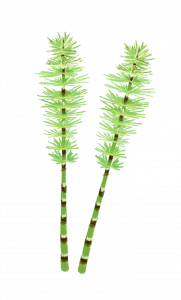
Horsetail (Equisetum arvense):
ILLUSTRATION: Shaheen Virk / The Peak
Horsetails are incredibly common, old, and widespread. They’re considered “living fossils,” meaning they’ve remained relatively unchanged for hundreds of thousands of years. Fossil records show they were the dominant form of plant life during the Devonian era, predating the existence of fish, insects, reptiles, and mammals. Turns out it’s the ancestors of horsetails that have turned into the coal we use today.
Horsetails have a distinctive appearance — a tall segmented stem, with rays of hair-like leaves branching out. It is a prolific and resilient grower, often found in large clusters. Because of this, it’s often considered a weed, despite being fairly forgiving to other plants. With decent soil, water and proper drainage, most other plants can still establish themselves and grow alongside horsetail, meaning issues over a horsetail infestation are mainly an aesthetic concern.
Practically, horsetail has a huge number of uses. It’s comprised of over 35% silica, giving it a crusty sort of texture, making it particularly well-suited as an abrasive. Hikers and others have used it as a cleaning brush for cookware, woodworkers used it to sand projects, and it’s been used to polish pewter and other metals, leading to one of its many colloquial names; pewterwort.
Its shoots have been cooked in soups and stir fries by Indigenous and Japanese people, but its safety as a food source is under some controversy. Horsetail is a diuretic, contains nicotine, and breaks down thiamine (Vitamin B), potentially leading to a deficiency and permanent liver damage. Medicinally, its high silica content can be used to promote the healing and strengthening of connective tissues, as well as promote bone growth.
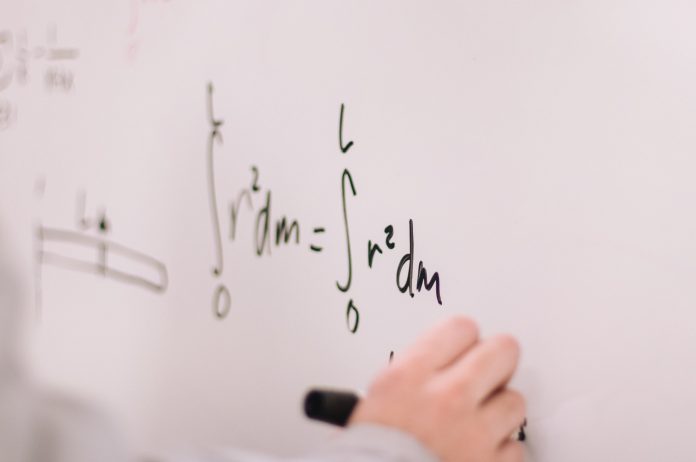
If we don’t change how we teach math, the resentment of the subject will just continue to grow.
PHOTO: Jeswin Thomas / Unsplash
By: Jacob Mattie, Peak Associate
Math is among the most common topics in education worldwide, yet it is a favoured subject of complaint among students. Math slander is common in advertisements, the media, and even in conversations (where lack of mathematical ability can sometimes seem like a point of pride).
Why is this?
Either there is some genuine fault in the subject that renders it widely inaccessible — which is doubtful, given how old and widely-spread mathematics have been throughout history — or there is some flaw in how it is currently being taught.
I am convinced that it is the latter.
Elementary, middle, and high schools teach addition, subtraction, multiplication, and division, as well as their extensions (hello exponents and logarithms). A few detours into geometry and graphs seem to round out the knowledge, but by and large, math education primarily focuses on attaining that “holy grail” of mathematics: calculus. Here lies the problem.
While there is value in calculus, it’s far from representative of math as a field. 3D animation and CAD (computer-aided design) software are built entirely on linear algebra, which is about as separate from calculus as painting is from music (although both fall under the umbrella term of “art”). Formal logic is another topic which, despite being the subject of some people’s entire lives of study, is lucky to get a week’s practice in introductory math courses.
Formal logic, or learning how to accurately phrase a question, reduces a concept to its bare essentialsand recognizes when said essentials are missing. These are pillars of mathematics typically neglected in favour of getting just a bit more practice with the quotient rule (finding the derivative of a function that is the ratio of two different functions).
The inability of our number system to divide by zero is generally disregarded under a statement of “just trust me,” ignoring the entire field of number theory which gives a solid explanation as to why this is so.
It’s no surprise students become jaded and frustrated with math. We spend too much time working towards an arbitrary goal and forget about the diversity of math as a topic. Pages of tedious worksheets and pressure to memorize formulae make it difficult to appreciate the material, and a lack of perspective squashes any interest that may have remained. I make a plea that we slow down and teach the full breadth of math at an introductory level first.
There is so much more to math than computation and calculus, and until our current curriculums reflect this, mathematic vitriol and apathy will continue to grow.
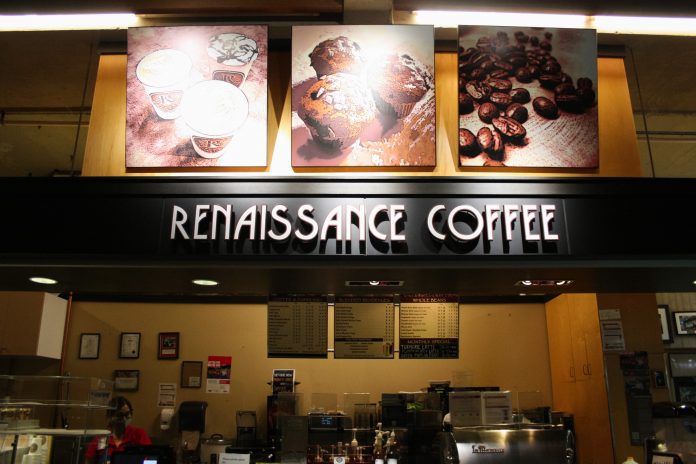
As September and the return to campus approaches, local vendor Renaissance Coffee plans to upgrade the shop in preparation for campus reopening. The shop closed briefly last year due to COVID-19, but reopened in September 2020.
The Peak spoke with the store owner, Parminder Parhar, for an update on the business and its plans for the upcoming term.
“I’m really dying to see the energy back on the campus,” Parhar said. He added Renaissance Coffee plans to renovate, “look fresh and ready for reopening, and improve our menu.”
They also have a new marketing team led by marketing students. They were responsible for establishing the business’ new social media presence on Facebook and Instagram.
“They were looking for [a] project, so we joined hands and we are helping each other out,” Parhar said. “I’m really excited about this and exploring the opportunity.”
Due to low traffic over the summer, the shop has limited menu offerings of coffee, bagels, and baked goods. They are also serving lunch items including sandwiches, butter chicken, chana masala (chickpea curry), rice, and naan.
Although business has been slow, Parhar said he was happy to see people support the shop when they came to campus.
“As the new added energy comes back to the campus, we’re going to get better,” Parhar said. He also aims to make the shop’s full menu available again in September.
According to Parhar, the pandemic has caused some shop losses. “Hopefully that is behind us. Majority of the people are vaccinated and things are looking great from here on.
“We take a lot of pride in our food and we do a fantastic job on that and we will keep doing that. At this point in time, I really need support from the community.”
At the moment, the shop operates in full staff service to reduce potential COVID-19 touch points. All staff are required to wear masks on duty. Following SFU’s COVID-19 guidelines, customers are expected to practice social distancing and masks are recommended. To protect staff and customers, the shop also has limited seating and uses protective barriers.
Stay connected with Renaissance Coffee on their Instagram and Facebook and find them at SFU Burnaby campus at AQ 3000.
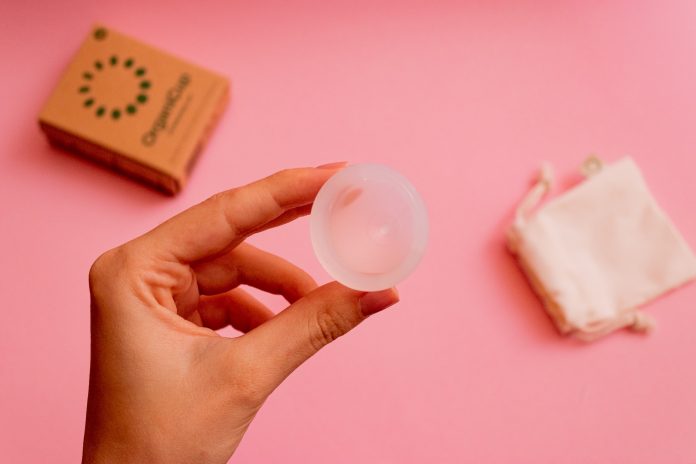
Menstrual cups are an affordable option to reduce your plastic waste.
PHOTO: Oana Cristina / Unsplash
By: Charlene Aviles, Peak Associate
There are a variety of menstrual products and brands to choose from, but the majority of what’s sold in stores are single-use. These disposable products, such as tampon applicators and menstrual pads, are made up of 90% plastic. If we were to transition to eco-friendly menstrual products, we would reduce the amount of plastic waste we produce by about 12 billion pads yearly.
The average menstruating person uses approximately 11,000 tampons in their life, and the accumulating waste from menstrual products poses a concern for ocean health.
Sustainable use of menstrual products goes beyond ingredient lists and packaging, as customers must also responsibly dispose of their products. Despite the fact that tampons should not be flushed, consumers continue to do so. According to the London Assembly, “1.5–2 billion menstrual items are flushed down Britain’s toilets each year,” which leads to blocked pipes and pollution. In Canada, between 3,000–3,500 tampon applicators end up on Canadian beaches annually. In addition to menstrual pads and tampon applicators polluting oceans and prompting beach closures, they can take up to 800 years to decompose.
When creating eco-friendly menstrual products, manufacturers should consider all stages of the product’s lifespan, from manufacturing to disposal. Alternatives like the DivaCup offer customers in Canada and the United States the opportunity to recycle their cups through their Diva Recycling Program. Through this program, DivaCups’ materials are turned into playgrounds, flooring tiles, field covers and athletic tracks.
Reusable menstrual products may save consumers money in the long term. In contrast to boxes of tampons, which can range anywhere from $3 to $11, reusable silicone menstrual cups may cost $38 and are replaced yearly.
The transition to eco-friendly menstrual products does not require consumers to compromise health standards. Due to health concerns, some period products like plastic tampon applicators are single-use only, but there is a wide range of product alternatives that are durable, eco-friendly, and sanitary.
When taken care of, menstrual cups can last for years. However, consumers should also be aware that menstrual cups have a low risk of Toxic Shock Syndrome (TSS), similar to tampons. For those with sanitary or TSS concerns, there are also biodegradable pads that only take 18-24 months to decompose.
I realize each person has their own budget, preference, and comfort level for period products. Given how consumers “[menstruate] for about 7 years during their lifetime,” people should be aware of the environmental impacts of their purchases. My hope is, after reading this article, you will think more critically about what period products you use and the environmental impacts they have.
ARIES: You might think ordering one of the many different kinds of fruity Starbucks Refreshers is a good idea, but most people forget those things are loaded with caffeine. I know you’re going to order one of these anyway, but trust me when I say your sociable personality is already a lot to handle before all this caffeine. Take that as a compliment if you want.
TAURUS: Since you’re ruled by Venus, the planet of love and beauty, your perfect summer drink is the Tequila Sunrise. You can admire how beautiful the drink is, despite it basically being an unmixed Shirley Temple that tastes worse. I will personally give you $5 if you know what grenadine syrup is.
GEMINI: You’re fast, you’ve got places to be, you’re channelling big #girlboss energy, and you’re doing it with your black iced coffee with three extra shots of espresso. You’re drinking it so fast that you could get this drink from any coffee shop — you’re hardly tasting it anyway.
CANCER: Being ruled by the moon, you are not quite as fast as some of the other signs. So enjoy your herbal tea, grandpa. Just don’t spend too much time drinking it, or else you’ll be late for your 3 p.m. game of Scrabble with the boys.
LEO: You’re the leader of the group, so take initiative and order whatever $15 specialty drink the bar is serving. Sure, it’ll only amount to a couple of sips, but all eyes will be on you when everyone sees how elaborate it is (and when the bill comes).
VIRGO: There is only one drink always guaranteed to be made right, and that drink is water. But I’m sure you will find something wrong with it anyway.
LIBRA: A caramel macchiato is the yin and yang of coffee. Bitter espresso with sweetened milk, one relying on the other, always in balance. Wait! Don’t just drink the milk at the bottom of the cup first. I don’t care what TikTok told you. You need to mix the drink before drinking it.
SCORPIO: You don’t need to rely on fancy drinks or party tricks to impress people, Scorpio. Instead, order a beer. Piss warm. Drunk straight from the can. You don’t need to worry about anyone making fun of you for your drink choice . . . well, except for me. I’m making fun of you a little bit.
SAGITTARIUS: For these horoscopes, I usually have to look up stereotypes for each star sign. But guess what? I literally don’t care. I’m a Sagittarius, and I want an iced coffee with vanilla in it. Oh, that’s not what you want to drink? Fuck you. I’m the main character.
CAPRICORN: I know you won’t be satisfied with whatever I suggest for you. Nothing will ever compare to the espresso you ordered from that “hole in the wall” café when you went to Italy on your school band trip. Trust me, we all know. You won’t stop talking about it.
AQUARIUS: I should preface this with the fact that bubble tea is actually very good. But what you call “bubble tea,” Aquarius, is something else entirely. Enjoy your Brown Sugar Crème Brûlée BTS Collaboration Milk Tea with cheese foam mixed with the saliva of Jungkook and the ashes of a burnt print-out of that selfie of Olivia Rodrigo with Joe Biden.
PISCES: It would be too easy and predictable to give you just water (and we already stuck Virgo with that throwaway option), so why not try adding a little bit of spice and giving sparkling water a chance? It’s everything you love about water, except spicy.
While students are asked to plan ahead, it is made impossible because there are no course outlines.
PHOTO: Michelle Chiang / The Peak
By: Lubaba Mahmud, Peak Associate
“Here we go again,” I sighed as I openedthe email about my enrolment appointment last month. I scrolled through the Fall 2021 list to see what courses were available. Of course, mySchedule wasn’t ready until June 28, even though enrolment would begin on July 5. As a visual planner and a full-time co-op student with limited time, this was already frustrating.
But that was just the beginning. I looked for an upper-division required course and was surprised to see the name of the professor and course syllabus were still missing from the course’s description. Okay, move on, let’s see some electives. There were very few that fit my schedule and applied for my concentration. I found a rare course that seemed really interesting — but it had no grading scheme again! Fabulous.
It’s really difficult to choose courses without the grading scheme. Without it, students have limited options to play to their strengths and keep up their GPA. I, for one, try to steer clear of exams with a lot of weight attached to them, especially after remote learning difficulties. I prefer assignments and essays since they actually help improve vital skills like research and writing.
We’re just asking for some basic information, SFU. It’s ironic that we’re always told to plan ahead as students, when we don’t have access to a lot of important information required for said planning.
I can’t count the school days I missed growing up because of my disabilities. Gastrointestinal issues like GERD (gastroesophageal reflux disease), IBS (irritable bowel syndrome), and functional dyspepsia (recurring signs of indigestion with no obvious cause), alongside my anxiety and depression, kept me from participating in my classes. I had so many absences in high school, my school threatened court hearings to investigate my missed days. Even when I was made fun of for my OCD’s “quirks” and I hardly socialized at all, I didn’t consider myself to be functionally impacted by any conditions because I was often adored by teachers for being quiet and reorganizing their things.
In just about every sport and PE class I participated in since I was 12 years old, I’ve required accommodations and breaks to manage my chronic pain and fatigue. By the end of high school, I was showing up to practices with four braces, a splint, and medical tape all over me. Still, I shook the idea that I could be disabled. It was a word I was raised to believe could never describe me, and one that was cloaked in shame and distress — or so I had been taught.
I have had disabilities most of my life, and it took until I started university for me to really acknowledge them and unlearn the shame with which I was raised. Now that I have embraced my disabilities as part of me, I’ve realized just how inseparable being disabled is from the rest of my identity.
When I came to SFU, I had to leave my then-team of supporters. This included my therapist, two clinics of physiotherapists, an orthopedic surgeon, and the family clinic that had all gotten to know me well. Then I found my new support team. As I developed new conditions and my older conditions remained, I was still hesitant to consider myself disabled. It wasn’t until connecting with other disabled people through SFU and the greater disability community, and recognizing the ableist barriers I face, when I really understood I have a place in the disabled community.
In my first year of university, I began experiencing more severe symptoms of what has now been diagnosed as borderline personality disorder and bipolar I disorder. I also had traumatic experiences before moving and during my first year which exacerbated symptoms to dangerous points. By my second year at SFU, I saw rapid changes in my inner ear condition, Ménière’s disease, which further impacts my hearing and causes me unpredictable episodes of severe vertigo, sudden falls, and poor balance. Watching myself lose more and more functionality over the years was a wake-up call — I could no longer hold onto the discomfort I had. Why would I be uncomfortable admitting I need some support or that I’m limited in what I can manage in a day? Why should anyone be ashamed of their disabilities?
In some ways, my disabilities are tied to the ableism that closely follows them and to the systemic barriers I face. Some healthcare providers, professors, and even my peers have taken them as a reason to treat me with little respect. While I do struggle with how others may treat me based on some of my disabilities, I know there is much more to being disabled than the trauma we sometimes live through. While being disabled has meant, for me, experiencing ableism, my disabilities are much more intertwined with the love I have for my community than the barriers we face. Disabled people are everywhere, and we are worthy of respect and love.
I no longer think of my disabilities as something that went wrong like I internalized growing up. This is who I am, and whether I was born with disabilities or developed them later, they are a part of me, and I embrace them. I still struggle to manage many of my symptoms and can never live a totally symptom-free life; however, that does not make me worth any less. These parts of me are just that: integral to the way I view and interact with the world around me.
Since accepting chronic conditions as a part of my life, I’ve become more confident in myself. I have learned to use a cane some of the time to manage my balance, pain, and fatigue. Buying my first cane was not the scary experience a younger version of me might have thought; it feels freeing to embrace something that makes me more confident in safely moving around, and I even painted fun colours on it to express myself!
As I embrace my disabilities, I am more comfortable fighting against the barriers I’ve faced my whole life. I have learned to coax pride out of myself and wear it everywhere, more like a blanket than armour.
Growing up, I may never have imagined that I would be disabled, but I also never imagined the amazing community I would find or the journey I would go on because of my disabilities. I am proud of who I am, disabilities and all.
So there I was, scrolling through Disney+ forliterally anything to watch, when I stumbled upon The Simpsons. I had never watched it before, so I thought I would give it a shot. Hell, it’s been running since 1989, so it has to be good . . . right?
I pressed play. The face of Homer Simpson, looking straight at the camera (is it a camera if it’s a cartoon?), filled my screen. He stared for a couple of seconds, long enough for me to check if I had accidentally clicked pause.
“Marco Ewald Ovies,” he said, still looking directly at the camera.
The remote fell with a clatter to the floor. God, what a terrible middle name I was given. Ewald? Thanks, Mom and Dad. Like my last name didn’t already sound like ovaries. You just wanted to guarantee I was bullied, huh?
“I am talking to you, my child,” Homer said, blinking slowly. “Judgment Day has come.”
He wasn’t looking at the camera. He was looking at me. I quickly moved to turn the TV off, but the remote wasn’t working.
“I am as old as time itself,” Homer continued, “Tempting mortals for long before you were born. I am the serpent in the Garden of Eden. I am Pandora’s box. I am the last bit of ice cream you knew was not yours because you ate your share at 2 a.m. crying while watching Monsters, Inc. after a breakup.”
“Hey! I was making a lasagna with . . . lots of onions. That’s why I was crying,” I said.
“There is no time for toxic masculinity, child. Not when death awaits you for your crimes.”
A mustard yellow hand reached out from the television and grabbed my living room table. Homer started to pull himself out of the television like that creepy demon thing with the long black hair from that movie I can’t remember the name but am too scared to watch.
Startled, I pushed the living room table back with my feet so it would slam against the TV stand. “What crimes?!” I yelled, watching the TV fall forward onto the table.
“You knowingly chose to watch a show that has hints of racism,” he said, lifting the television up and finally crawling completely out. “You know full well that Apu Nahasapeemapetilon is voiced by a white man.”
“No!” I exclaimed, scrambling up from the couch and beelining towards the door. “That can’t be why! Bo Burnham dressed up as Aladdin when he was 17; where were you when I watched his new special Inside?”
Homer grabbed my ankle as I was trying to make my escape, pulling me down to the floor.
“Well, Bo Burnham is my favourite comedian. I mean, did you seehow good he looked in that sexting bit?” Homer said casually as he pulled me in closer. “You had to have seen how big his dic—”
Summoning a burst of strength, I kicked Homer in the face and he let go of my ankle. I got up quickly and turned around to take one last look at him. His dots for corneas had turned a deep red.
“You can’t just give him a pass because he’s your fave!” I shouted as I left.
It’s been three days and I’m still on the run. Every time I think I’ve gotten away, he always appears right around the corner. People always say The Simpsonsis great at predicting the future, and I guess sometimes they’re right. But not for me — I’m in charge of my own destiny now.
About the author: Marco Ovies died minutes after submitting this piece by running into traffic at the sight of the yellow M&M’s mascot. He requested a GoFundMe be set up in the event of his death, but he never specified what the money would be for. So we did not do that.