Home Blog Page 15

How monuments shape public spaces

0
PHOTO: Maya Barillas Mohan / The Peak

By: Maya Barillas Mohan, Staff Writer

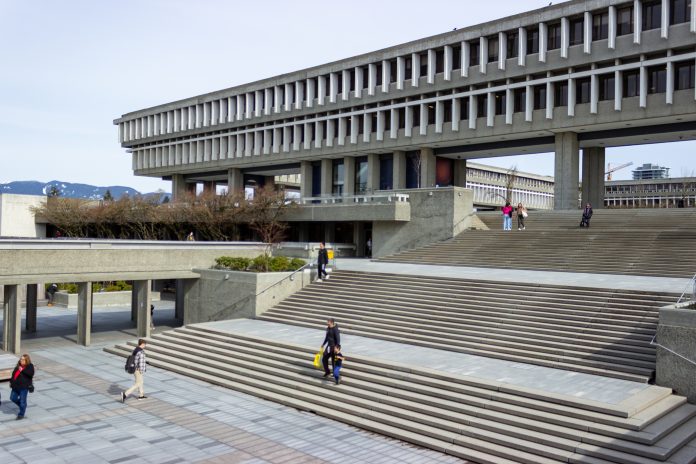
SFU’s Harbour Centre campus is not unlike an art gallery; it’s a silent, cool, and dimly lit retreat from the frenzy of West Hastings. It was at Harbour Centre that I attended a free public lecture taught by Dr. Efrat El Hanany, an art history and gender studies professor at Capilano University. She covered landmarks dispersed around the globe. Amsterdam’s “Absorbed by light” is a neat, interactive criticism of smartphone prevalence. Most of the lecture, however, was focused closer to home. 

El Hanany urged the audience to touch or caress sturdy, exposed monuments, and even knock on them to see how the brass is hollow. As commemorative structures, many monuments are placed on pedestals to separate the statue from the public (and sometimes, to deter touching), while others are placed much closer to the ground to share space with the viewer. El Hanany used the Angel of Victory as an example. The statue is lifted on a pedestal but the public have had a record of marring it with litter from nearby breweries. El Hanany told the audience that when Steamworks Brewing created a label parodying the statue by replacing the soldier in the angel’s arms with a beer bottle, it was met with considerable backlash, as it was seen as disrespectful due to the memorial’s intention of commemorating those who died in World War I. Though the statue is beautiful to look at, the was monument was commissioned by the Canadian Pacific Railway, who had exploited Chinese migrants and Indigenous land. This tension is fundamental to understanding Canada’s history and is a reminder of who gets to be honoured here.   

BC Place has a succession of Terry Fox statues in ascending size rooted right into the asphalt. The first one, representing the beginning of his journey, is life-size. The last commemorates the end of his journey and is nearly twice the size. I visited this set of statues as a result of attending the lecture and felt everything El Hanany promised I would in its presence: admiration and awe. I gazed at them and reflected on a quote by Andreas Huyssen that was presented at the lecture: “Remembrance is a vital human activity, shaping our links to the past. How we remember defines the present.” I can’t say it’s what Terry Fox wanted for his legacy, but many of my memories of SFU’s AQ courtyard have Fox in the periphery. His non-prosthetic foot is positioned forward at SFU, but El Hanany notes that Vancouver artist Doug Coupland’s version inverts this practice by placing his prosthetic in front instead. This was done to spotlight what is often hidden, and acknowledge the pain Fox endured in his Marathon of Hope. Coupland faithfully reproduced Terry’s stride, showing off his signature gait. Running with a prosthetic leg can come with its own challenges, such as more core strength for balance, a higher risk of chafing or blisters, and increased risk of injury due to strain.  

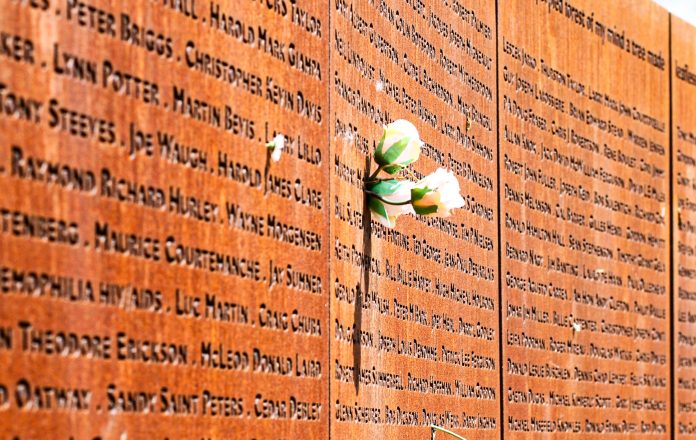
The last stop on my tour was the Sunset Beach AIDS Memorial. It’s a large, winding iron ribbon engraved with 800 names of lives lost to AIDS. Per El Hanany’s guidance, I put my hand on the oxidized metal. It was made rough from years of salt air and Vancouver rain, but the names remained clean incisions in the material. Some had white carnations or ribbons poked through. El Hanany had explained that the negative space forming each letter reified living with the presence of absence. Sunset Beach, spiky summer grass, and low-rise apartments flank the monument. To view every angle, I stalked up a path trodden into the hill by other visitors. There is a presence of others around this monument in the grass and woven into the monument itself; putting this memorial between the city and the beach drops the heavy feeling of loss right in the middle of an undeniably alive intersection. It’s about tranquility too, El Hanany had said. At about 60 feet long, the monument stirs something a lot larger than the 20 megapixels I tried to capture it with.

One of the most valuable takeaways in El Hanany’s lecture is the lesson to engage with art as a conversation. Art often references art, but it also often references ideas or events the viewer might disagree with. Reading plaques can apply more context and facilitate a meaningful dialogue. In a time of overwhelming advertisement saturation, El Hanany asked the audience if public monuments have lost their power. After the lecture, the answer should surely be no.

As advertisements and art compete for attention in our urban environment, I think about the strength contemplation holds.

El Hanany had urged listeners to take note of the overlooked by infusing stories of creation into the monuments. Knowing what to look for is one thing, but I understood that knowing how to look is just as important.


Need to Know, Need to Go: Events for an active summertime

0
PHOTO: Raghav Khera / Pexels

By: Jen Westling, SFU Student

Open level ballet class

UBC Life Building, Room 26

Every Monday, 5:00 p.m.6:30 p.m. (May 11August 24)

Drop-in, $5 cash or card at door

Five, six, seven, eight! UBC’s Ballet Club is hosting weekly ballet classes every Monday this summer, running from May 11 to August 24. Each class is tailored to match the experience of attendees with different instructors leading throughout the season. Whether you are trying ballet for the first time or already familiar, at only $5 per class, this is a fun and affordable activity to enjoy with friends. While no registration is required, I would recommend arriving early as class sizes are capped at 25 people. Bring your ballet shoes (or a pair of socks) and be ready to plié!

Ryan’s forest walks

Various locations throughout Vancouver

Various events run throughout the summer

Register at https://www.ryanforestwalks.ca, free (unless otherwise stated)

If dancing is not your forte, check out the local Forest Walk tours hosted by Ryan Regier! A forest educator, research librarian, and member of the Nature Vancouver Botany Committee, Regier has multiple walking tours coming up in May and June on their website (all of which are free!) with more to come. Just as a note, these are not your basic run of the mill forest walks — get ready to wander, ask questions, and learn about the world around you on these high-energy tours. Upcoming events in May include a Forest History Walk of the Pacific Spirit Regional Park and Coyote Night at Jericho Beach Park.

Mini golf and train

Bear Creek Park, Surrey

April–May: WednesdaysSundays, 10:00 a.m.5:00 p.m.

June–August: Every day, 10:00 a.m.–5:00 p.m.

 $7 plus tax per person, or $10 mini golf and train combo

Enjoy an 18-hole mini golf course at Bear Creek Park in Surrey for $7 per person, or a $10 combo ticket which includes a ride on the park’s train. The course takes around 3045 minutes to complete, depending on the group size, featuring unique obstacles and challenges at every hole. If the greens aren’t for you, you can still enjoy a walk around the gardens, visit the outdoor pool, or ride the train around the park. There’s even a challenge at the end of the course: hit a hole-in-one on the final hole, and you’ll receive a certificate to play again for free! 


Stephen Harper: a man looking for love

0
ILLUSTRATION: Jackie Peng / The Peak

By: Anonymous

Justin Trudeau and Katy Perry’s glamorous Coachella fling has captured headlines across the world. It’s also got us at The Peak thinking about how Canada’s other, albeit slightly forgotten, political heartthrob is yet to find that special someone on the red carpet. With ice-cold blue eyes and a passion for austerity, I’m of course talking about Stephen Harper. To address this injustice, I’ve compiled a list of five wonderful partners who could be the rose to Stephen’s thorn and get the ultimate bachelor (but not really, because he’s married. We’ll be sure to sort that out before the knot is tied). Perhaps he can even attend the MET Gala next year . . . 

The Hamburglar 

Harper’s “tough on crime” policy approach mixed with the Hamburglar’s naughty, thieving personality could give these two lovebirds a dynamic mirrored by Batman and Catwoman . . . a real steamy and saucy love/hate relationship could be on the cards here. 

Hillary Clinton 

Hillary Clinton and Stephen Harper would be a true Romeo and Juliet story. Stephen, from Canada, Hillary from the US; the most recent Conservative prime minister and an establishment Democrat. Despite their differences, I could see these two having a romantic stroll by the Rideau Canal, giggling about their shared distrust for Bernie Sanders, and whispering sweet, neoliberal nothings. 

Judge Judy

Judge Judy interrupting one of Stephen’s stammering drawls about fiscal policy with an “I’m speaking now, sir” would elicit more of an emotional reaction out of him than the 2008 recession. These two are perfect for each other. It’s giving two Karen’s going after each other in a Karen-off.  

Katy Perry

Steve never got his revenge for Trudeau absolutely destroying him in the 2015 federal election. He cost him his job, honour, prestige, and ego boost. The ultimate form of payback? Stealing Trudeau’s gal. To be honest, he’d need a lot of rizz to fulfill this one. Sorry, Harpie Warpie. We backtrack on our recommendation. 

While Trudeau might be nabbing the front pages of the tabloids now — and making it onto your FYP on TikTok in scenes of steamy edits — Canada shouldn’t forget about our silver fox waiting in the wings for his turn in the spotlight. Beneath all of the tax breaks for the wealthy and privatization of our nations’ natural resources, Stephen Harper is just a simple guy looking for love, just like the rest of us. 


Exclusive interview with David Eby

0
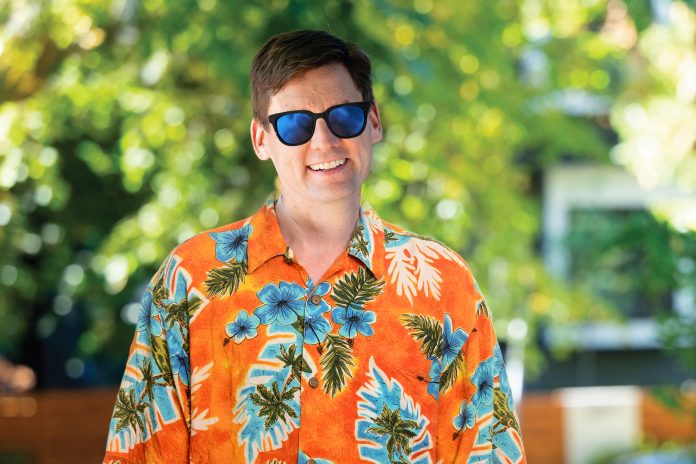
David Eby wearing a Hawaiian shirt and sunglasses.
PHOTO: BC NDP / Wikimedia Commons

By: Kyle Monroe, Legislative Correspondent

Last month, Premier David Eby stirred up controversy after threatening to suspend parts of the Declaration on the Rights of Indigenous Peoples Act (DRIPA). He then withdrew his threat. Then, he brought it up again. Then, he backtracked again . . . for now

Concerned citizens and literally anyone concerned about human rights are worried that suspending parts of DRIPA could remove the rights of Indigenous Peoples to consultation and debate about major projects conducted on unceded land. 

Following his perplexing stunt, the premier announced the BCNDP’s new slogan: say nothing, do nothing, moderate to attract centrist voters. We sat down with the premier to learn more about his plan to regain popularity. 

The Peak: Mr. Premier, why this new slogan? What does this mean for the BCNDP?

David Eby: Well, thanks for speaking to me. Well, the idea came while I was watching my daughter’s favourite movie, K-Pop Demon Hunters — is that still relatable to voters? 

The Peak: I guess? 

David Eby: Magnificent. Well, I was sitting there, right? And I thought: what are you doing with your life, Dave? People hate you everywhere you go. If I keep on going down this route, the BCNDP will lose the next election. So I had to do something about it. 

The Peak: But your new slogan is a little concerning —

David Eby: No. It’s underwhelming. It’s safe. And safe is the route we need to go. Our new slogan: say nothing, do nothing, moderate to attract centrist voters shows voters that I don’t want to step on anyone’s feathers anymore. I’ll just . . . do nothing. 

The Peak: Well, surely you can’t do that. Your party is government —

David Eby: Well, I’ve been doing it for years. Now, it’s a public statement. Nothing’s changed. I’m still good old Dave — the tallest dude in the legislature. 

The Peak: Gotcha . . . well, what do you say to people who think your handling of the DRIPA situation is extremely dangerous? That you’re taking away the right to free, prior, and informed consent for Indigenous Nations? 

David Eby: Say nothing, do nothing. 

The Peak: Pardon? 

David Eby: Say nothing, do nothing. How hard is it for you to understand, Kyle? We love the status quo, for fuck’s sake. 

The Peak: OK . . . I’m going to turn gears now to talk about affordability. Some people are criticizing your government for not taxing the province’s ultra-wealthy, reinvesting that revenue in public programmes, and thus offsetting the rising costs of living. Can you explain what your government is doing to alleviate these hard times for British Columbians?

David Eby: Look, Kyle. I promise. And look deep into my eyes for this one. I promise. I promise to — say nothing and do nothing. 

The Peak: But Mr. Premier . . . how do you expect to defeat the BC Conservatives without offering a bold vision for voters — 

David Eby: Look, Kyle. Those guys suck. To win their voters, I have to take a card from my formidable predecessor, Christy Clark. Say nothing and do nothing. 

At this point in the interview, Premier Eby adjusted his aviators and proceeded to storm out of the room. 

With support dwindling for Eby’s government, many progressives are flocking to the BC Green Party for proper representation. “What the fuck is this guy doing?” Rob Botterell, house leader for the BC Greens, asked us. “Well, at least the trees have some more huggers, I guess.” 

A recent poll conducted by Angus Reid has the BC Conservative Party beating the Eby’s BC New Democratic Party by 10-points. Not sure if his plan is . . . going to plan

The premier’s office did not respond to our request for a follow-up on what Valariete said. Instead, we got a YouTube link to “Don’t Worry Be Happy” by Bobby McFerrin.

Joy Johnson reacts to communist positivity on campus

0
PHOTO: Mason Mattu / The Peak

By: Aiden Krysciak, PR coordinator for president Joy Johnson 

The following is a letter from the desk of SFU president Joy Johnson, delivered to The Peak by her majesty’s propaganda ministry — we mean PR team.   

Strung out, I was, deep as that very night when the visitation occurred. I stopped and watched in terror as the sky broke open and the light reflecting off the moon and stars were again diffused in this miasma which had materialized in the AQ-green. Soon, foreign and equally terrifying vocalizations filled the air and slowly. As I walked closer, pulled by that freakish leash of fate, these vocalizations formed words and “laughter.”

Upon the glacis rested a smoky apparition: some students, surely possessed by that communist poison — “marijuana.” I watched from the shadows for fear of my life and was, therefore, too far to hear really any of what they were saying. I can only deduce that what must have been spoken was threatening to me, this noble school, and to Simon Fraser himself, who bravely followed the River Fraser for the glory of the white man. It was surely communistic sentiment expressed by those sinister upward turnings of the mouths and revolting dimpled contortions each youngster wore upon their face. If not that, then full-blown revolutionary conspiracy. 

Well I’ll tell you, gentle reader, and I’ll tell you better than you’ve ever been told before. Believe you me that I followed these goddamn hippie agitators in their goddamn realtree hoodies and their goddamn sailor caps and goddamn sneaker shoes — and I saw those fucking scoundrel ne’er-do-wells paint upon the walls of our already-compromised-by-communistic-interpretation-architecture words that I have never before seen or heard. These etchings made in chalk on our concrete walls elicited such nightmarish meanings: “You’ve got this!”; “Stay positive?” Messages that mocked our school such as: “Concrete?” OF COURSE IT’S CONCRETE you absolute — anyways. 

I could hardly comprehend the filthy and fucking straight up disgusting “socialization” rituals of this evil-ass sect of Anglo-American culture. It makes me, the provost, and this monument to our glorious imperial forefathers genuinely want to RIP OUR EYES OUT OF OUR SKULLS. I wish I were fucking jokin’, but no; I just hate my students that much. If academia wasn’t so sensitive, I’d have already used all of these children as target practice for our first annual Simon Fraser battle simulator/LARPing sesh. 

It’s now been three days since I saw these two abominations on campus, and I still cannot bring myself to leave this office. I sit here as I feel my last caffeine pill wear away and my mind drift farther from reality . . . and closer towards lofty thoughts of heaven. Oh, to be free from this misery of having to justify every decision to the lousy press! To no longer have to bear the malfeasances of these wretched children! These may be my last words, and if so, may they empower the few students with some actual gumption to fight this scourge of communism.

Long Story Short: Paving a non-linear academic path

0
An illustration of a studious yet worried elephant in a lecture hall sitting among human students. The elephant has a pile of books in front of them. The elephant has imposter syndrome.
ILLUSTRATION: Cliff Ebora / The Peak

By: Marie Jen Galilo, Staff Writer

Before starting university, my peers and I started planning our careers. Everyone around me had such big dreams — my friends wanted to be doctors, lawyers, or engineers. Having always cared about my grades and academic success, my teachers, friends, and family would comment on how I would likely establish a respectable career that reflected my intellect. I felt compelled to choose a career path which reflected my efforts and fit their expectations. Another factor for me was family — as the daughter of immigrant parents who left their homes, careers, and loved ones behind, I felt pressured to establish a career that honoured their sacrifices in their hopes of giving me a better future. 

I loved subjects in the arts because they allowed for the intermingling of creative and analytical thoughts, but I also liked learning about topics in the sciences. While I did well in subjects across the board, my family and peers saw me as someone who particularly excelled in social sciences. In my social circle, becoming a lawyer was perceived as the main “respectable career,” so I pushed my interest in science aside, and decided I was going to pursue an arts degree to eventually become a lawyer. 

Because SFU’s breadth requirements include a certain number of science units, I thought, why not try taking a biology course to fulfill that? In this course, I found myself looking forward to lectures, enveloping my brain in learning about cellular processes and animal physiology. I started to consider the possibility of transferring to the faculty of science and majoring in biological sciences because it sparked my interest like no other subject. In biology, you’re taught the basics, given a problem, and asked to piece your knowledge together using creativity to come up with logical solutions. It’s truly rewarding when you understand the course concepts, and are able to apply that knowledge.

Bringing up the topic of transferring faculties and switching my major when I was going into my second year wasn’t an easy conversation to have with my family because it seemed like a big jump from my pre-law trajectory.

Their hesitation became intertwined with my own. I couldn’t help but feel like I had let people down. Deep down, I knew I had chosen the pre-law path because I thought it represented my potential.

It took a lot of courage to break out of the box I had placed myself in with walls that had been reinforced by the opinions of people who mattered most to me. 

A 2025 study examining the developmental histories of top-level performers in various areas found that those who explored a variety of disciplines early in life were more successful than those who quickly specialized, in fields including science, music, sports, and chess. This challenges the long-held idea that those who want to succeed should narrow their efforts, instead suggesting the importance of exploring and embracing different opportunities. For instance, Dr. Harold Varmus, who obtained a degree in English literature, went on to become a medical doctor and scientist. “There is still time to make decisions about the way you are going to conduct your careers,” said Varmus on the iBiology Science Stories podcast. Varmus addressed the perceived gap between the arts and sciences, saying that “not every scientist is a math whiz” and “there are lots of ways to become a scientist.”

I realized I didn’t need to choose between my interests, choosing to major in biological sciences and minor in English to fuse my interests in science, writing, and literary analysis. I initially kept the transition from arts to science a secret because I was experiencing imposter syndrome. Imposter syndrome is defined as feeling unworthy of successes despite your efforts and achievements, and is accompanied by the fear that you’ll eventually be seen as a fraud. Even though I was studying for hours on end and did well in my classes while being involved in extracurriculars, I downplayed my achievements and viewed them as a result of chance rather than my capabilities. I had always been perceived as an arts person, and I felt like people would perceive me as trying to change who I was by going into science.

There’s also a divide between the arts and sciences — in my experience, you rarely see a science major with an arts minor or vice versa. In my English courses, I felt like the elephant in the room, often being the only biology major in a room full of arts majors. In science courses filled with pre-meds, minoring in English seemed like a random decision. I’d often get asked, “Why?” or, “What’s the point in that?” But it was not a random decision for me — minoring in English was a way of letting the part of me that loved the arts live on.

Navigating my academic journey was accompanied by stress, exhaustion, self-doubt, and burnout. Despite these challenges, there was a lot of growth. I’m learning to accept that we’re all on our own journeys of self discovery, and there’s no single cookie-cutter pathway. I’ve developed a stronger sense of personal autonomy in making this decision. It’s given me a sense of purpose; I’ve chosen to get involved in my community and pursue a career with a focus on health-care and writing. My family’s hesitancy was replaced by support after seeing me excel in my passion. They’re now far more understanding of how they can be my strongest support system in this new field, which was different from the field they had initially imagined. I’m also learning to break away from imposter syndrome and be more compassionate towards myself, reframing my mindset to view my achievements as results of my capabilities rather than pure luck. 

If you’ve ever experienced feelings of imposter syndrome, I hope you know that you do not need to prove your “worth” to anyone. You’re enough as you are, and you can give yourself the credit for everything you’ve achieved and everything that you’re going to achieve as you pave your own path at SFU and beyond.

SFU community members sound alarm on new investment policy draft

0
PHOTO: Gudrun Wai-Gunnarsson / The Peak

By: Lucaiah Smith-Miodownik, News Writer

SFU’s Responsible Investment Policy has become a serious topic of discussion in recent years.

Specifically, SFU community members have raised ongoing concerns regarding the university’s investment in companies embedded in the military industrial complex. In March 2024, SFU’s Faculty for Palestine (F4P) released a petition asking SFU to divest from the arms industry, featuring over 1,300 signatures. In response to these community pressures, SFU committed to reevaluating its investment policy on May 30, 2024. On June 7, the SFU Faculty Association passed two motions that were proposed to them by F4P, one of which further pressured SFU to divest from military arms producers. 

For many, the most recent draft policy has left much to be desired. The Peak corresponded with F4P, as well as the university, for more information on the decision making processes behind the policy, and the future of the university’s investments.

F4P released a letter on April 2, 2026 expressing concerns regarding proposed changes to the outline. “As documented in the Custodial Statement of Endowment Investments, SFU holds or has held shares” in BAE Systems, Booz Allen Hamilton, and CAE. F4P notes they are “corporations that derive the vast majority of their revenue from military equipment and  services.

“The weapons and services of these corporations have collectively facilitated the killing, maiming, or displacement of tens of millions of individuals, primarily in the Global South. These are not abstractions — they are lived realities.” They specified, “Many SFU students are here in Canada because of war.”

The faculty group noted that the revisions include “no reference to military arms production, no screening criteria applicable to weapons manufacturers, and no process for evaluating or acting on the community’s democratically expressed position.” The Peak could not access SFU’s draft policy.

“SFU has committed to the United Nations Sustainable Development Goals, including reducing poverty and gender inequality, promoting environmental sustainability, and  promoting peace,” the letter continued. “The university’s own strategic plan declares it a community working to ‘make a difference in the world’ and ‘address humanity’s most complex problems.’ Investments in arms production and other military services are fundamentally incompatible with these commitments.”

Since the letter, “there has been no reply from the Board,” F4P told The Peak.

“After two years of waiting, they produced a draft policy that not only disregarded the concerns of a great many faculty, students, staff, and alumni, but they are poised to hollow out whatever matters in the current investment policy” 

— SFU Faculty for Palestine 

When The Peak asked about investments in weapons manufacturers, SFU stated that “the defence sector is multifaceted, encompassing companies that support national security, peacekeeping, disaster response, and technological innovation,” adding that “SFU’s investment managers assess companies for human rights risks, political instability, and social issue related concerns.” The university also explicitly stated that it “does not have any investments in arms manufacturers.”

The university’s 2025 endowment investment report features both Booz Allen Hamilton Holding Company and CAE. While not a producer of tanks, Booz Allen Hamilton develops military engineering and technology used for weapons. Similarly, CAE provides military services through training and simulations. SFU has not released their investment report for 2026.

“[SFU] may have traded out of a couple of these recently, but the SFU admin is completely disingenuous in this regard. If not, why not ban these investments in the so-called responsible investment policy?” 

“SFU’s Responsible Investment Policy should include a clear and enforceable screen excluding corporations that derive significant revenue from military arms production and military services,” reads the April letter. “This commitment should be anchored in the policy itself — not left to administrative discretion — and should be accompanied by a transparent timeline for  implementation. 

“It is long past time for the Board to act on these democratically expressed positions.” 


Langara journalism program faced with potential closure

0
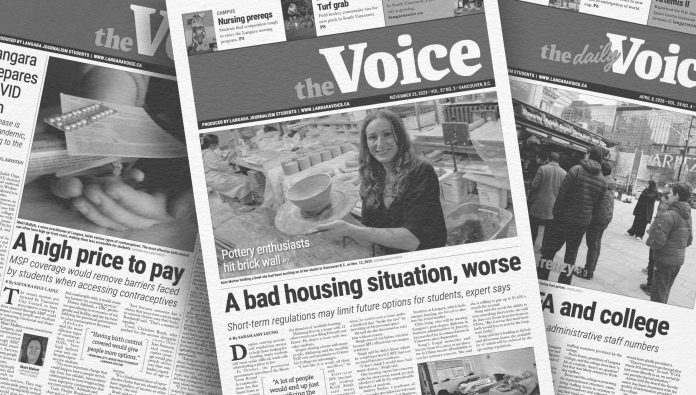
Black-and-white photo of three issues of The Langara Voice. The issue in the center features a large image of a young woman holding her pottery. The article underneath reads “A bad housing situation, worse.”
IMAGES: Courtesy of The Langara Voice

By: Maya Barillas Mohan, Staff Writer

Interest in student journalism has faced a steep decline, journalism instructor Barry Link told CTV News. Steep enough that Langara’s journalism program is in danger of closing after 60 years of running. The Peak reached out to Link, who chairs the program, to learn more.

The Langara Voice is produced by the journalism program with responsibilities split in two courses: the reporter course, and the editor course. These courses are trim, with enrollment between 12 and 25 students per class. “We set The Voice up as a real, working newspaper,” Link tells The Peak. Covering the Langara and South Vancouver communities, The Voice narrates going-ons in “a whole range” of geographical areas across the campus and beyond.

The Voice reflects storytelling done by students.”

– Barry Link, journalism program instructor and chair at Langara College

The Voice itself represents the diversity of the campus.” 

Students in the program are trained to be working journalists, developing teamwork, responsibility, and accountability. They also develop practical skills for the industry like reporting, interviewing, and fact-checking. Link expresses that digging into stories, going places, and taking interviews is part of the essential effort journalists take to parse facts and report to the public.

Journalism and entertainment may overlap, but Link remarks that nothing is fictional in journalism. “We aren’t cherry picking facts, we aren’t distorting reality,” Link says. He observes there are “changes in what people regard as journalism,” and “the industry has not kept up with how society processes and shares information.” He continues that “what journalism has not figured out is how to pay for itself,” and further, the advertising that kept broadcast stations afloat disappeared because of the internet, replacing the media landscape of 30 years ago. 

There is “less reporting than we had 20, 30 years ago,” Link reflects. He identifies a reduction in newspapers and radio outlets, supplanted by an influx of influencers without media training. Link laments that efforts to “make it work as best we can” are overruled by the college’s belief that “there’s no room” for the journalism program. 

According to Link, Langara has been concerned with enrollment and financial challenges for some time. “The biggest change for the college is the pretty big financial difficulties it’s having now, which most post-secondary institutions are having now, and that’s directly tied to the drop off in international student enrollment,” says Link. He shares that the lack of income from tuition means program cuts inevitably follow. 

“Journalism still has value in our society, and I think that’s an important role for post-secondary institutions to fulfill,” Link says. Supplemented by recent media attention, Link also notes that there are a lot of people “very concerned” about what this closure means for journalism. Optimistically, “there is public concern about this, and that reflects public demand and need for a solution.”

BC’s overdose crisis crosses 10 year mark

0
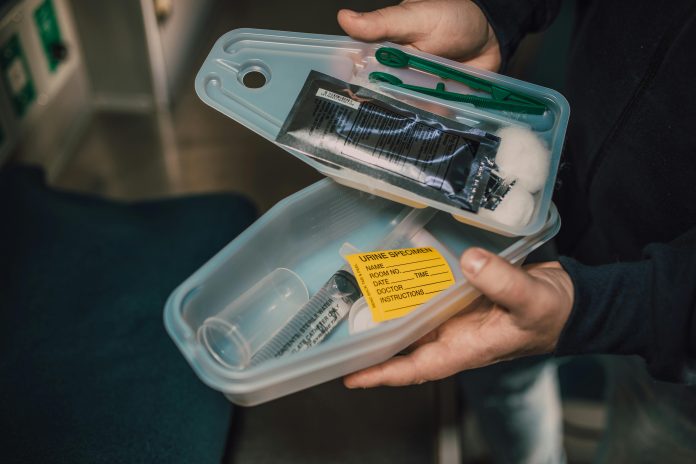
Image of someone holding a small open portable medical kit containing cotton swabs, tongs, and a catheter, among other items
PHOTO: RNDE Stock Project / Pexels

By: Jonah Lazar, Staff Writer

In 2016, the BC government declared overdoses a public health emergency due to the 474 reported overdose deaths that occurred in the province the year prior. In the 10 years that followed this declaration, BC used a series of policies to combat this crisis, including the expansion of supervised consumption sites, take home naloxone programs, the implementation of the safer supply program, and the decriminalization pilot program, with mixed results. The Peak spoke to SFU’s Dr. Kora DeBeck, distinguished professor of substance use and drug policy, to learn more about the effects these policies have had on the overdose crisis. 

In tackling this crisis, BC has adopted programs aimed at adequately preparing to respond to overdoses. Part of this has been an expansion of supervised consumption sites, which provide opiate users with safe, supervised places to use their own drugs in the presence of professionals to prevent accidental overdoses. Despite what she noted to be a large amount of drug consumption sites being introduced to the province, DeBeck said, “I didn’t think it met the full needs of everybody in the communities, everybody that was at risk.” While the first drug consumption site was introduced in the province in 2003, this program was significantly expanded across the province following the public health emergency. 

Another program the BC government has undertaken is the distribution of naloxone, a medication administered in order to reverse the effects of an opiate overdose. Naloxone kits have been made available at pharmacies and widespread take home naloxone sites without the need for a prescription since the pilot program in 2012, to distribute this life saving medication to people who are likely to witness overdoses or experience one themselves. DeBeck said “naloxone distribution has been very impressive” and “has made a huge amount of difference and saved a lot of lives.” 

Another facet of BC’s approach has been an attempt to control the substances being used by people in the safer supply program. Since 2017, BC has been expanding the prescription of less dangerous opiate alternatives such as hydromorphone for people with opiate use disorder. This program has fallen under scrutiny for its reach; at safe supply’s peak, it was treating approximately 5,000 people of the estimated 100,000–200,000 people in the province with an opiate use disorder. However, the program only treated people with opiate use disorder, when “the majority of people who are dying of a toxic drug poisoning did not have an opiate use disorder and were not using opiates on a daily basis” and therefore remain unaided by this particular program, DeBeck said. This led DeBeck to describe safe supply’s reach as “a drop in the bucket” for what is needed.

Despite BC’s policy reform, the crisis is still in full swing. In 2025, BC’s annual death toll from drug overdoses climbed to 1,833; over three times the toll from 2014. DeBeck attributes this in part to BC’s refusal to abandon a criminalization approach, which views the consumption and possession of illegal drugs as a criminal offence.

“The police have never been a good tool for [combatting] drug use.”

— Kora DeBeck, SFU professor of substance use and drug policy

In January 2026, BC decided not to renew the three-year long decriminalization pilot program which commenced in 2023. The program allowed for the personal possession of up to 2.5 grams of controlled substances such as cocaine, methamphetamines, and opioids like heroin and morphine. The program’s expiry means illegal drug possession, once again, is subject to criminal enforcement, with punishments ranging from seizure of the drugs to months in prison. DeBeck warned, “From an evidence-based public health perspective, [criminalization] is absolutely the wrong approach to take around substance use and the overdose crisis.”

The Peak reached out to BC’s minister of health, Josie Osborne, for a statement, but did not receive a response by the publication deadline. 


Post-secondary education funding is mishandled

0
SFU International student advising office
PHOTO: Prerita Garg / The Peak

By: Jonah Lazar, Staff Writer

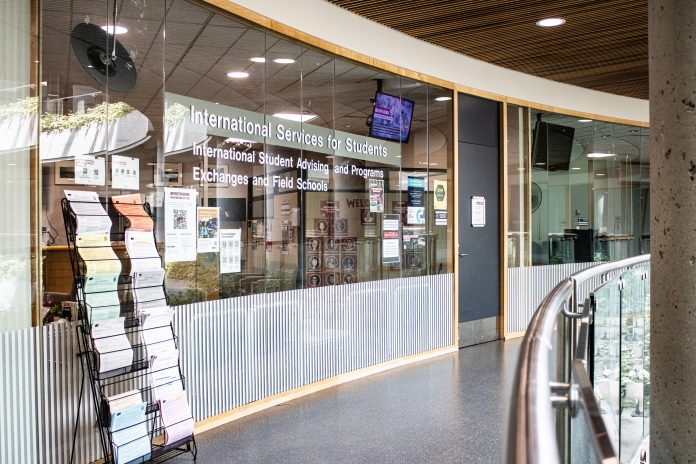
Studying in BC is more inaccessible than ever before, especially if you’re an international student. In 2024, federal limitations on study permits led to a 66% drop in permit approvals for international students. In 2023, 456,690 international student permits were granted federally; this number shrunk to just 50,370 for the first nine months of 2025. Post-secondary institutions should never have relied so much on the funding that comes from international students to begin with.

Public funding for post-secondary education in BC has dropped 41% since 2000, and doesn’t look to be rising anytime soon — despite BC launching a review of post-secondary institutions’ stability, post-secondary education minister Jessie Sunner ruled out the possibility of increased funding. This double-whammy of the international student cap and cutback of public funding has led to nearly 200 programs being cut or suspended from BC’s post-secondary institutions, and over 1,300 staff layoffs, with many institutions in the Vancouver area among the most affected. Langara and SFU alone have been victim to over a quarter of these layoffs. At SFU, all interpretation programs, the football team, and SFU’s participation in the NCAA, have been cut, and could lead to the loss of other teams. 

In addition to programs being cut, universities are raising costs on students. At SFU, the fall 2026 meal plan will be $278 more than it was in the spring, climbing to an eye-watering $3,727 per term; residence fees are changing too, increasing around 4%–10% depending on the building. 

At SFU, domestic tuition fees for 30 credits over two terms is about $7,500 and for international students, it’s almost $37,500, with an extra $14,370 if these students are living in residence. International students are often paying five times as much as domestic students and that makes them a very profitable client for the university.

Funding for post-secondary institutions shouldn’t be reliant on milking international students for as much money as possible.

There is nearly an 89% reduction in international student permit approvals from 2023 to the first nine months of 2025. Further, there is a volatility in the international student market that shows that it should never have been relied upon in the first place. Regrettably, post-secondary institutions have been left with few alternatives over the past few decades, in the wake of reduced public support. 

While the international student cap has made many post-secondary institutions sound the financially-viable alarm, all this cap really has done is highlight the systemic lack of public funding made available to these institutions by the federal government over the years. SFU students have long raised the issue of affordability and international student exploitation. The federal government’s overzealous cutting of student visas has made everything worse. This lack of funding has led to post-secondary institutions seeking out new ways to raise revenue; with nowhere else to turn, this shortfall is being filled by firing staff and raising costs on students.