Home Blog Page 1222

Ten Manliest Movies

0

mary astor the maltese falcon 3

The Maltese Falcon

It would be sacrilege to snub Bogie on this list, and though Casablanca is my personal favourite of his, The Maltese Falcon trades the former film’s subtlety and beauty for hard-boiled detective story charm. Humphrey stars as Sam Spade, a saucy, snarling PI sent to investigate a murder and a missing artifact. There’s slippery flatfoots, femme fatales and plenty of razor sharp dialogue — the film is basically a perfect introduction to the film noir flair that the forties had in spades. For an equally thrilling ride, seek out Dashiell Hammett’s novel, on which the film is based.

Citizen Kane

Orson Welles’ 1941 masterpiece, which some have called the greatest film of all time, is a powerful parable about the dangers of fame, greed, and selfishness. It’s also one of the ballsiest flicks in history, not-so-subtly based on the life of media mogul William Randolph Hearst. Not only is Citizen Kane one of the most notable classics of the Golden Age of cinema — of which every man should have some knowledge — it’s also a complex and moving tale of one man’s gradual disillusionment and decay, one that will inspire you to live a better life and be a better man.

12 Angry Men

Sidney Lumet’s first feature film was an adaptation of a teleplay by Reginald Rose about twelve jurors arguing over whether or not the defendant — whom we never meet — is guilty. Starring Henry Fonda in one of his best roles as an unnamed juror who refuses to vote guilty, the film is required viewing for those who want to learn how to handle prejudice, and influence your peers. The entire film takes place in a single room, and as each character’s viewpoint gradually changes, you’ll gain a valuable message about courage, determination and goodwill towards your fellow man.

Die Hard

Action movies aren’t always the best guides to gentlemanhood — the protagonists swear, treat women like objects and generally communicate through violence rather than words. Though Die Hard doesn’t exactly break these tropes, it does bend them, featuring a main character who gets beat up enough to seem like an actual human being. The film, which was directed by action veteran John McTiernan, features an equally manly performance by Alan Rickman, as the leader of a dangerous terrorist group.

Raiders of the Lost Ark

Dum da dum dum, dum da dum… Raiders is the first and best entry of the Indiana Jones trilogy (Crystal Skull doesn’t count), featuring such classic sequences as the stone rolling through the tunnel and the Nazi face melting conclusion. Harrison Ford’s piss and vinegar performance as Indiana Jones is among the manliest of all film characters, one that continues to inspire men to wear fedoras, thinking they can recreate Indy’s suave adventurer charm. They can’t — and, most likely, neither can you — but that doesn’t make Raiders of the Lost Ark any less of an action adventure classic.

The General

Charlie Chaplin who? If you’re looking to get into silent films — a truly classy choice — there’s no better place to start than Buster Keaton’s magnum opus, The General. Released in 1926, the film was a flop with audiences and critics, although it’s hard to see why — Keaton’s astounding commitment to physical comedy and knack for simple storytelling make this one of the greatest films to come out of the silent era.

The Lord of the Rings

Believe it or not, some men still haven’t gotten around to seeing Peter Jackson’s awe-inspiring adaptation of J.R.R. Tolkien’s Lord of the Rings trilogy. Full of death-defying swordfights, family struggle, grandiose adventure, tests of friendship, and moments of sublime beauty, Jackson’s steady handed adaptation must be seen to be believed. However, I recommend searching out the extended versions — not only are they more faithful to the books, but they also work better as films, expanding the universe of Middle Earth and deepening the journeys of its characters.

The Civil War

Ken Burns’ epic documentary, which takes almost an entire waking day to watch in full, is well worth the time and effort. The film, which is made up entirely of photographs, period tunes, and interviews with historians and other experts, tells the full story of North America’s most devastating military conflict, one which divided our neighbour to the South and changed the face of the world as we know it. After hearing this film’s amazing true stories — from the bravery of the soldiers to the political genius of honest Abe — you’re bound to be inspired.

Raging Bull

A stark black and white portrait of anger, jealousy, and loneliness, Martin Scorsese’s masterful 1980 flick features Robert De Niro’s best and most memorable performance as Jake La Motta, an Italian-American middleweight boxer whose anger issues and abusive marriage lead him to a life of misery. Though this is hardly a film about boxing, the film’s scenes in the ring are among the most visually enthralling in cinema — never has bloodshed looked so beautiful.

Lawrence of Arabia

In the wake of Peter O’Toole’s death, Lawrence of Arabia is even more of a must watch. David Lean’s epic — and I mean epic — is a retelling of the life of T.E. Lawrence, the British Army hero who fought in the Middle East during World War I. O’Toole’s performance is emotionally complex and completely satisfying; his struggles with personal allegiance and the horrors of war is both unique and universal. Lean’s filmmaking is equally fantastic: the scene where Lawrence slowly morphs from a speck in the desert to a full-grown man is a grand reminder of what filmmaking can accomplish.

How to tie a bow tie

0

BowTie-ChenChen-01

Step One: Drape the bow tie around your neck and hold both the ends. Make sure the right end is about an inch longer than the left.

BowTie-ChenChen-02

Step Two: Cross the long end over the short end so that the two pieces are touching at the thinnest part of the bow tie. Make sure to leave a little breathing room.

BowTie-ChenChen-03

Step Three: Pull the longer end around, making a loop between the two. The longer end should still be slightly longer than the short one. This process should make a knot.

BowTie-ChenChen-04

Step Four: With the shorter end, make a fold to the side so that the large middle section of the end is folded and to the side. Hold the loop between your shirt’s collar point.

BowTie-ChenChen-05

Step Five: Place the other end of the bow tie overtop of the folded end. Make sure it’s running along the middle of your shirt.

BowTie-ChenChen-06

Step Six: Use the folded end to pinch the dangling end. Make sure you have a good hold on the long end and that the two pinched sides of the folded end are equal.

BowTie-ChenChen-07

Step Seven: Feed the long end through the knot you made in step three.

BowTie-ChenChen-08

Step Eight: Tighten the bow tie by pulling on the front and back of both ends equally. Keep doing this until it’s as tight and as even as you like it.

BowTie-ChenChen-09

Step Nine: Walk out the door looking classy as fuck.


5 in-class craft cocktails

0

So, you tanked your first semester and, given the GPA priority on enrolment dates, you got last pick of courses for the spring. You got stuck with what no one else wanted: the 8:30 am tutorial, the three-hour break at the Surrey campus, the Friday evening class that runs until 10:30 pm. The gap between your classes Tuesday night and Wednesday morning is so slight that you’re considering spending the night on the benches in the Rotunda instead of dragging yourself to Burquitlam and back again.

In short: you need a drink. Only problem is, thanks to your $250 textbook for Intro to Macroeconomics, you’re temporarily light on boozing money. Never fear: these simple and cheap cocktails — easy to make with readily available on-campus ingredients — will keep you both steadily inebriated and fiscally solvent.


The Ides of March

>  4 packets White Spot ketchup

>  1 packet pepper

>  1 packet salt

>  1/2 cup water

>  1 oz. vodka


The perfect liquid courage for your midterm exams. Cover rim of plastic Triple-O’s cup with salt. Add water and stir in packets of ketchup, one at a time. It’s not quite Clamato, but it will do. Add vodka and season with pepper to taste. For garnish, ask the cashiers for one of those pickles they usually drape over the wrapped burgers. If they refuse, tell them you know the ingredients of their secret sauce.


The President Petter

>  3 oz. bourbon

>  1 oz. water


Drink what the big boss drinks. This cocktail takes the edge off of early morning finance meetings, faculty interactions, and those tedious Convocation speeches. Serve in an “Engage SFU” coffee mug. You could garnish with a lime wedge, but garnish is for vice-presidents.


The Five Corners

>  1/2 oz. Renaissance drip coffee

>  1/2 oz. Higher Grounds drip coffee

>  1/2 oz. Nature’s Garden drip coffee

>  1/2 oz. Tim Horton’s drip coffee

>  1/2 oz. Starbucks drip coffee

>  2 oz. Bailey’s


When served warm, this drink is a great way to ward off the chill of foggy SFU mornings. Or, serve over ice for a cool, refreshing variation. Given the difficulty of finding ice on campus, you might have to settle for room temperature. Cheers!


The Virgin Petter

>  4 oz. water


A gentler version of the classic for those who can’t quite fill the big man’s shoes.


The White Mowafaghian

>  1 oz. Tim Horton’s “espresso”

>  3 packets of CoffeeMate powdered creamer/sweetener

>  1 oz. dark rum

>  1 oz. vodka

>  1 oz. milk


Stir CoffeeMate and rum vigorously into the rapidly congealing espresso until mixture thickens. Pour the syrup over ice stolen from the faculty lounge, and add vodka and milk. Stare into the abyss.

Abbotsford vs. Homeless

0

Society is reflected in how it treats its poorest citizens, the most vulnerable who could often use a hand up when they’re knocked down by the trials of life.

Abbotsford has been the subject of much disapproval and speculation due to the recent behaviour of its government, police force, and certain residents this past holiday season. Christmas is a time for giving, a time to be spent safe and warm, yet Abbotsford seems to be edging some of its citizens away from what little luxuries they have created for themselves.

On December 20, the BC Supreme Court announced that the homeless camp set up in Jubilee Park had to vacate by Saturday the 28. Each night this park became a shelter for 30 to 40 homeless men and women, with their tents and wooden barricades protecting them from the harsh winter elements.

The decision to take down the camp came after the lawyer for the city stated that there is ample space for these citizens inside shelters. City officials cited health and safety concerns to justify forcing the camp to be vacated.

However, ample space doesn’t mean that these people will all accept shelters as their place of residence during the holiday season. Furthermore, the lawyer representing the homeless camp has publicly questioned whether or not there truly is enough space for all of these displaced Abbotsford citizens, especially during the busy Christmas season.

This is not the first time that the city of Abbotsford has challenged its homeless population. This past summer, city workers attempted to rid the park of its residents by spraying chicken manure at the homeless camp, leading to a lawsuit filed in November by residents and activists. Two weeks after this event, residents of the area alleged that police slashed and bear-maced tents assembled in the camp.

After forcing these people out, who is going to help them? The average person doesn’t want to get involved, either out of fear or simple disregard. Perhaps gatherings like these hit too close to home for some. By witnessing these large groups together, people are forced to truly see the homeless that are around them on a daily basis. This challenges the barrier many put up, making it more difficult to keep the homeless population a distant background thought as opposed to the very real occurrence that is homelessness in the lower mainland.

This attitude of “not in my backyard” isn’t going to solve anything. The members of the community, the local government, and the police force should be working together to find a solution or a space for the homeless, rather than constantly displacing them. An “out of sight, out of mind” mentality does not solve anything.

BuildSFU: SUB Site Selected

0

After a detailed site selection phase, the site for SFU’s Student Union Building was determined. Simon Fraser University’s SUB will be built at the “Crossroads” site. An interview with Marc Fontaine (BuildSFU General Manager) discovers why this site will be an ideal location for the SUB.

Summary of proposed changes to the Peak Constitution

1

A legal document such as the Peak Publications Society can be a daunting thing to read, particularly when you’re looking for differences between two versions. Here is a simple summary of the proposed changes. Your suggestions, objections, and other thoughts are invited in the comments below, or at <david at the-peak dot ca>.

The Big Changes

Formal recognition of an Editor-in-Chief.

Bylaw 5 of the current constitution leaves the structure of The Peak‘s editorial board entirely in the hands of the Peak Collective, defined as “all members of the Society who have been listed in The Peak masthead in two (2) of the last five (5) issues of The Peak.” Although we currently have a Coordinating Editor who takes responsibility for the publication as a whole and acts in a leadership role, that position can be abolished at any time, and it has no disciplinary power whatsoever. In fact, if an editor were to be elected and either prove unable to fulfill their duties, refuse to do so, or simply produce a bad product, the only options are a recall vote of the Peak Collective (Bylaw 5.2.c), which is unlikely to succeed due to the small group of mostly friends who usually dominate the Collective, or a termination vote by the Board of Directors (Bylaw 4.2.d.ii), which can only be held for extreme transgressions such as sexual harassment or gross negligence.

The draft constitution devotes Bylaw 5.1 to the requirement that The Peak have an Editor-in-Chief. This person will be elected by the Peak Collective (which will include all Society Members who contributed to The Peak at least twice in the current semester). They will have power to write a binding editorial manual for The Peak, to distribute formal warnings at their discretion (with three warnings being sufficient for the Board of Directors to vote to terminate), and to investigate and respond to complaints. They will also sit on the Board of Directors, sit on the committee that hires the rest of the Editors, and have a veto over proposed changes to the editorial structure of The Peak.

Editor hiring committees.

Bylaw 5.2.b requires that editors be selected in elections in which only Peak Collective members may vote. Despite the existence of voting, this is a profoundly undemocratic system. While the letter of the rule states that elections are held every semester, and indeed that is how it is done, in practice, only the first election is a challenge. Once an editor has won a single election, they are nearly guaranteed to hold on to the job until they quit. The small pool of voters is dominated by the editors, who do not want to offend their colleagues and usually vote for the incumbent; contributors are also allowed to vote, but rarely challenge the status quo. Contributors have often said that they would like to run for the editorial position of their favoured section, but don’t want to risk angering the incumbent. This also results in extremely long editorial tenures (as long as three years in a row in the past five years), and makes it difficult to dislodge under-performing editors. In practice, editor elections have not created a meritocracy, but a gerontocracy; in the past five years, with semesterly elections for between 10 and 15 positions, only once has an incumbent sought re-election and lost.

The draft constitution stipulates that editors will be selected once a semester by a three-member hiring panel consisting of the Editor-in-Chief, one member of the Board of Directors, and one former Peak editor selected by a vote of the Peak Collective. I expect that a three-member panel can be expected to take their responsibilities in selecting the editorial staff very seriously — more seriously than a group of largely uninterested voters, at least — and while it is possible that such a committee could make nepotistic decisions, it still seems to be an improvement over the current system, which almost guarantees it. Importantly, a small panel will be able to administer tests and consider writing samples as part of the selection process, which a larger voting group such as the Peak Collective simply can’t.

Board of Directors changes.

Like all legal societies, ours refers all major financial decision-making to a Board of Directors. Our current constitution specifies a seven-member board (plus a seat for the non-voting Business Manager of the Society). One member is the Alumni Representative, who is to be appointed by the SFU Alumni Association. In practice, those appointments have not been received, and that seat has been vacant for several years. Additionally, I do not see how SFU’s community of alumni are stakeholders in the Peak Publications Society.

The draft constitution removes the Alumni Representative from the board and replaces them with the Editor-in-Chief. I feel that it’s important that this position be given a clear leadership role in the organization, including a seat at the Board; this replacement also ensures that the Board will have an odd number of members, preventing tie votes.

Membership and quorum changes. (updated)

Currently, every fee-paying SFU student is a member of the Peak Publications Society. While it’s a nice arrangement for political purposes, it has two important practical problems. We currently can’t alter our constitution without a meeting of five five per cent of the membership, which last semester worked out to 1,504 people, which is for practical purposes impossible. We also can’t provide a complete list of our membership, since we don’t control or have access to those records, which could potentially cause us some legal problems in the future.

The new constitution makes it so that only directors, editors, collective members, and employees are members of the Society, and others can only be added with a vote of a Collective or a vote at a General Meeting. The chief advantage of this arrangement is that the size of the meeting required for major decisions and changes can be raised to 30% of the membership. I regret that it’s necessary to revoke the membership of the mass of SFU students, but in practice, this doesn’t reduce their privileges very much: all SFU students who are not disqualified by some other concern retain their ability to contribute to our publications and apply to become editors or employees, while every student remains able to seek refunds of their subscription fees. There are no formal provisions for the average SFU student to sit on the Board of Directors, but since new members can be added at every General Meeting, where At-Large members will be elected, there will be ample opportunity for interested students to get involved.

The minor changes

Recognition of the Graduate Student Society. The GSS was only formed in 2008, so our constitution still refers to “the SFSS” (the undergraduate student society) throughout. The new Constitution’s definitions section refers to the “Student Societies,” referring to the SFSS and GSS in aggregate. A side effect of this definitional change is that the three At-Large Members of the Board of Directors will now be elected by the “Student Societies” rather than the “SFSS,” guaranteeing one spot on the Peak Board of Directors to an SFU graduate student.

New Statement of Purposes. The current statement of purposes was written before the invention of the Internet, and reflects it. We also feel that it doesn’t adequately capture the goals of our organization. We have re-written a version that is more modern and more clear about the role that we see for The Peak in the SFU community.

New Code of Ethics. The current constitution outsources the Code of Ethics to the Canadian University Press, a national organization of student newspapers that we are not certain we want to continue our membership in. The draft constitution includes a new, homegrown Code of Ethics that covers the major points while removing the possibility that our operations could be influenced by ideologically-motivated changes made to CUP’s code in Toronto.

Closure of the “two semester loophole.” The  constitution defines membership in the society as expiring when the member has not taken any courses at SFU for two semesters. This creates a loophole allowing people to remain editors of The Peak for two semesters after they graduate. The draft constitution closes this loophole by removing the two semester grace period.

Non-eligibility of outside governors. The Peak is a newspaper, and the central concern of our society is journalism; as a result, our independence is of paramount importance. The current bylaws allow officers of the student societies and members of the university’s governing bodies to be editors or Board members at The Peak, which creates potential for conflicts of interest. The new constitution prevents such people from being Editor-in-Chief, At-Large or Collective members of the Board of Directors, or Editors.

A Look Back at 2013

0

That’s right, 2013 is finally over — and after 365 days of international espionage, prime time twerking, and endless Rob Ford updates, most of you will probably be jumping for joy to think of the fresh new year ahead of you. But before we inevitably make the same mistakes in 2014 as we did last year, The Peak has compiled a list of the past year’s greatest hits, from Alice Munro’s Nobel Prize to water on the Red Planet.

Music

Kendrick Lamar gained “Control” A year after releasing the critically acclaimed good kid, m.A.A.d city, Kendrick Lamar made headlines for his verse on Big Sean’s “Control.” In it, he called out his contemporaries — including Drake, Pusha T, Tyler the Creator and A$AP Rocky — saying, “I got love for you all, but I’m tryna murder you niggas.” A call to arms and a celebration of hip-hop competitive spirit, Lamar’s verse stands as one of the best verses of the year.

It was the year of the comeback 2013 was the year of the musical comeback. Some, such as David Bowie, My Bloody Valentine, Justin Timberlake, Boards of Canada and Daft Punk, returned to critical and commercial fanfare — others, such as The Dismemberment Plan, Black Flag, the Pixies, Deltron 3030 and Lauryn Hill, fell flat. Either way, 2013 was all about listening to albums you never thought you’d hear, from a new Pixies EP to the first My Bloody Valentine release in 22 years.

Godspeed You! Black Emperor snuff the Polaris Prize The ultimate prize for Canadian music, the Polaris Prize, was awarded to idiosyncratic post-rockers Godspeed You! Black Emperor for their 2012 album ‘Allelujah! Don’t Bend! Ascend! The notoriously politically radical octet refused to attend, calling the ceremony “tone deaf” and “FUCKING INSANE” in an online statement. They pledged to use the money from the award to establish a program to provide prisoners in Quebec, the band’s native province, with access to musical instruments.

Kanye West was Kanye West Just like 2012, 2011 and basically every year since his debut, Kanye West dominated music news in 2013. Last year, he released his sixth studio album Yeezus, feuded publicly with Jimmy Kimmel, cancelled two concerts in Vancouver, dubbed himself “the nucleus” in an interview with The New York Times, named his child North (get it? North West!), and rode a motorcycle with a topless Kim Kardashian. We love you, Kanye. Don’t ever change.

Pharrell became ubiquitous Before 2013, you could be forgiven for not knowing who Pharrell was. By now, you’d have to be living under a rock to be unfamiliar with the producer’s signature tenor. Last year, Pharrell provided vocals to the summer’s two biggest hits, “Blurred Lines” and “Get Lucky,” as well as producing tracks for Earl Sweatshirt, Beyoncé, Jay Z, and Miley Cyrus. He also made a 24 hour music video for his track “Happy” and wrote the music for Despicable Me 2, the second most successful film of the year.

Science and Medicine

We found out how particles acquire mass The scalar boson or Higgs boson particle was first theorised all the way back in the 1964, but its discovery wasn’t announced until 2012. The particle confirms the existence of the Higgs field, which is crucial to our understanding of the Standard Model of physics. In 2013, two of the scientists behind the particle’s discovery, François Englert and Peter Higgs, won the Nobel Prize in Physics. However, despite intensive analysis, many questions about the particle remained unsolved, such as why it is so light, and whether different types exist.

NASA’s Curiosity Rover found evidence of life on Mars After its first full year on the Red Planet, the Curiosity Rover’s studies of Martian soil and rock yielded traces of oxygen, carbon dioxide and — that’s right — water. The Rover also discovered that a particularly large crater on the planet, named the Gale Crater may well be an ancient lake bed, complete with all the minerals necessary to have made life on Mars a genuine possibility.

An asteroid exploded over Chelyabinsk, Russia On February 15, an asteroid entered the atmosphere above Russia at a speed of 18.5 km per second. The asteroid exploded midair, shattering windows and sending approximately 1500 people to the hospital with injuries. This was the largest natural object to have entered the Earth’s atmosphere in 105 years. Though the planet’s atmosphere absorbed most of the object’s impact, its original kinetic energy is estimated to have been over 20 times that of the atomic bomb.

Breakthroughs were made in the study of cancer immunotherapy In 2013, researchers studying cancer broke new ground. Instead of targeting tumours directly, cancer immunotherapy uses the human immune system to eliminate cancerous cells. The research has had positive results but is still in its experimental stages — though the academic journal Science awarded the research with its Breakthrough of the Year award, the journal’s news editor stressed “it’s important not to overstate the immediate benefits.”

The oldest DNA of a humanlike species was found Scientists have discovered the Homo heidelbergensis, an ancient humanlike species whose DNA is the oldest found by scientists not in permafrost. The remains were found in northern Spain, on a site called the Pit of Bones. Though the species are not our direct ancestors, they’re of the same genus, and the technique through which its DNA was discovered — by analyzing traces of mitochondrial DNA in bones — is likely to be used by scientists in the future.

Film and Television

Breaking Bad came to an end Whether or not you enjoyed Breaking Bad’s finale last year, it’s likely you were as glued to your TV as the rest of us — after five years of shocking plot twists, breathtaking New Mexican landscapes, and Bryan Cranston in his tighty whities, it’s no surprise Breaking Bad was so hard to say goodbye to. Though the final episode was the most discussed, the final season’s high point — and, arguably, that of the whole series — was “Ozymandias,” in which (spoiler alert!) Walter’s world finally came crashing down on him.

Matt Smith passed the torch as Doctor Who After five years as the eleventh Doctor, strong jawed ingenue Matt Smith is finally moving on — and leaving Peter Capaldi, the foul-mouthed curmudgeonly star of BBC’s The Thick of It, in his place. Though Smith had his highs and lows inside the blue police box, he’ll likely be remembered as one of the better actors to take on the role, inspiring countless debates as to whether or not he was better than David Tennant.

Blue is the Warmest Colour won the Palme d’Or and controversy La Vie d’Adèle, the 2013 French film adaptation of the graphic novel of the same name, focuses on a love affair between two young women. The film was unanimously voted to win the Palme d’Or, the highest honour of the Cannes Film Festival. The award, which is usually given to the director, was shared by the film’s two female stars. Many have since criticized director Abdellatif Kechiche for pushing his actresses too far, citing the film’s lengthy simulated sex scenes.

Netflix ruled the world In 2013, Netflix went from a mostly innocuous DVD renting and streaming service to one of the biggest juggernauts in the TV business. Their earnings trampled expectations, their streaming service put competitors to shame, and Netflix original programs like Orange is the New Black and House of Cards stood up to televised counterparts, with the latter being the first web only series to win a major Emmy Award. Also, they helped bring Arrested Development back to life. What more can we ask?

12 Years a Slave tackled the trans-Atlantic slave trade Steve McQueen’s third feature tells the true story of the violinist-turned-slave Solomon Northup in unflinching detail, it’s hard to ignore its status as — potentially — the first film to successfully tackle the prickly topic of slavery in North America. Though the film isn’t without its issues, its stark portrait of institutional racism has more than its fair share of present parallels. It’s still the frontrunner for the Academy Award for Best Picture — deserving or not, it’s certainly better than Argo.

Politics

Rob Ford made us all ashamed to be Canadian In what might be Canada’s biggest political scandal since the King–Byng Affair, Rob Ford — Toronto’s incurably obnoxious mayor — admitted to smoking crack cocaine while in office. Ford further incriminated himself and ostracized Torontonian voters through a series of PR disasters, the most notable being his use of the phrase “eating pussy” to deny a claim of sexual harassment. Ford has since had many of his mayoral powers stripped by city council.

Civil war raged on in Syria Now in its third year, Syria’s harrowing and destructive civil war saw its most devastating year in 2013. The conflict arose out of the Arab Spring protests, and is currently being fought between the Syrian government and a unified group of oppositional forces, the latter of whom have received aid from Turkey, Saudi Arabia, and the United States. Last year, chemical weapons — which have been banned by the UN — were confirmed to have been used by Syrian government forces. Though this has increased foreign intervention into the conflict, by all accounts the war seems to be far from over.

The United States government stopped working Unable to reach an agreement on how to curtail the nation’s debt and plan for the 2014 fiscal year, the United States government was forced to shut down for over two weeks last October. Though Democrats and Republicans eventually reached a solution, the two opposing parties have ceded very little ground since. Along with the fumbled rollout of President Barack Obama’s health care website, 2013 was a difficult year for politics down south.

The Senate spending scandal spilled into 2013 Beginning in late 2012, the Canadian Senate’s ongoing expenses scandal dominated national news throughout the year. The scandal arose when four Canadian Senators falsely claimed travel and housing expenses, leading to an extended government investigation. One Senator, Mac Harb, announced his retirement in August, while the remaining three have been suspended without pay. Many political commentators have since demanded that the Senate be reformed or even abolished, and Canadians have been left with no clear solution heading into the new year.

Edward Snowden opened Pandora’s Box Beginning in late 2012, Edward Snowden, a former contractor for the United States’ National Security Agency, began contacting journalists and documentarists in order to leak classified documents and other information to the public. After he fled the country in May 2013, the leaked information began to spread, and within months the global surveillance tactics used by the NSA and its international partners became common knowledge. The year’s biggest news story was the revelation we all suspected but hoped would not be true: We’re all being watched.

Literature

Alice Munro won the Nobel Prize in Literature Feminists, Canadians and short story lovers all rejoiced when the 2013 winner of the Nobel Prize in Literature was announced as Alice Munro, the beloved Canadian author of such short stories as “Carried Away” and “The Bear Came Over the Mountain,” the latter of which was adapted as the film Away From Her in 2007. Munro has been writing short stories since 1950, and has been compared to such literary giants as Anton Chekhov and John Updike. She’s also won the Man Booker Prize, and been awarded the Governor General’s Award for fiction thrice.

Hyperbole and a Half took on depression Long known and beloved as one of the most irreverent webcomics on the internet, Allie Brosh’s crudely drawn Hyperbole and a Half tackled mental illness in “Adventures in Depression Part 2,” a follow up to a 2011 comic in which the artist first delved into her struggles with the disorder. Equal parts crudely funny and genuinely insightful, Brosh’s lengthy comic was eventually reprinted, along with Part 1 and several new stories, in an October print collection which was named an NPR Book of the Year.

Morrissey published his autobiography Cleverly titled Autobiography, the former Smiths singer’s long-awaited memoir chronicles his experiences in the indie pop quartet and as a solo performer. He’s surprisingly kind to his former bandmates, although not so towards the music industry bigwigs. Though the book received mixed reviews, it was notably illuminating on the topic of Morrissey’s sexuality, which he has since described as humansexual. Upon being published in the US, much of the book’s gay content was edited out, begging the question: are there homophobic Morrissey fans?

Boston bomber nabs Rolling Stone cover In a move that elicited controversy and proved people still read Rolling Stone, the magazine chose to feature Dzhokhar Tsarnev — the chief suspect in the Boston Marathon bombing case — on their cover. The cover of the Rolling Stone, which has long been a goal for up-and-coming musical acts, was argued to be unfit for Tsarnev’s innocuous portrait, which Slate went so far as to call “dreamy.” Whether or not the magazine made the right call morally, they certainly did economically — the issue doubled in sales amidst media backlash.

The Man Booker Prize goes to Canadian-born Eleanor Catton Proving again that our literature doesn’t suck, thank you very much, Canadian-born New Zealander Elizabeth Catton won the coveted Man Booker Prize — an award that, until 2013, was reserved for members of the British Commonwealth. Competing during the first year in which Americans became eligible, Catton wiped away the competition with her novel The Luminaries, which has the distinction of being organized around the movements of the Sun and Moon.

Culture

Twerking and selfies Every year, we learn to accept new words into our ever expanding cultural lexicon. Think YOLO or bromance. Last year taught us many new words, but the two most notable have got to be twerk and selfie. The former refers to the butt-jiggling dance that gained prominence after Miley Cyrus’ infamous performance at the MTV Video Music Awards, while the latter is meant for pictures of oneself posted on social media sites like Instagram or Facebook. Both have existed in one way or another for decades, and last year they were finally added to the Oxford Dictionary.

Super Pope In March 2013, Pope Benedict XVI retired from the papacy. His successor, Pope Francis, was born in Argentina, and worked as a nightclub bouncer before joining the seminary. Francis quickly distanced himself from his predecessor’s conservative reputation, spending time hanging out with children, making friends with rabbis and sneaking out at night to lend a hand to the poor. He’s criticized homophobia, income inequality, and radical religiosity. His mantra: “Who am I to judge?”

Feminism was embraced, publicly and privately Though feminism has too often been considered a dirty word in our society, 2013 was a pretty good year for gender equality. Malala Yousafzai preached nonviolent resistance, Wendy Davis stood for reproductive rights on the Texas Senate Floor, Robin Thicke’s sexist “Blurred Lines” was met with severe backlash, and Grimes took to Tumblr with an anti-sexist manifesto. There’s still a long way to go, but all things considered, 2013 gave feminists a lot to be proud of.

LGBT rights took two steps forward, one step back 2013 saw seven American states, as well as nations such as Brazil, France and Uruguay, legalize gay marriage. Kathleen Wynne became the first openly gay Canadian premier, Ukraine had its first LGBT Pride march, Jason Collins and Robbie Rogers became the first active pro sports athletes to come out, and Harvey Milk got his own postage stamp. On the other hand, Russia also enacted its infamous anti-gay propaganda legislation, leading some to encourage the boycott of the 2014 Olympics in Sochi.

Phil Robertson, Paula Deen and the year of controversy 2013 was all about scandals — no, not that Scandal. I’m talking about Paula Deen’s N-word debacle, Alec Baldwin’s PR fiascos, Julianne Hough’s ill advised blackface Halloween costume, Saturday Night Live’s whitewashed cast, Miley Cyrus in general, Manti Te’o’s fake girlfriend, and Justin Bieber’s hope that Anne Frank “would have been a Belieber.” Duck Dynasty patriarch Phil Robertson’s recent anti-gay comments in GQ are the cherry on top of the controversy cake. Overall, 2013 was the year to get your knickers in a twist.

Build SFU selects SUB site

0

WEB-Crossroads massing image-buildSFU

After months of deliberation and consultation with students, Build SFU has chosen the Crossroads site as the location of the new Student Union Building.

The SFSS Board of Directors recommended the Crossroads location to the Joint Steering Committee on Dec. 4 after considering the responses of 4,166 undergraduate students to the online survey, distributed in September. Marc Fontaine, Build SFU general manager, commented on the decision, saying, “We’re really excited about the site selection and agree with students that the Crossroads site makes the most sense for our campus. It is right in the middle of campus and as close as possible to the majority of classrooms and lecture theatres.”

The initial project proposal for the SUB was presented to undergraduate students in Spring 2012. Last summer, the SFSS, along with architects from Perkins+Will, began investigating three potential sites for the student union building, which were narrowed down to two in November: Crossroads (located between the AQ and MBC) and Main Street (located above the Transportation Centre bus stop).

From the survey, it was concluded that students preferred the Crossroads location primarily based on its proximity to classes, as it is located further east than both Treehouse (the first site eliminated, located at the old Shell station) and Main Street. Forty-six per cent of respondents indicated that they spend a majority of their time on the east side of campus in the AQ and the Applied Sciences Building. Only 25 per cent said they spend most of their time on the west side in WMC, while 29 per cent prefer to hang out in the library, MBC, and the rotunda.

Comments on the centrality of Crossroads occurred often in the survey, with students labelling it as “the heart of SFU,” a convenient and frequented location, and “near the centre of everything.” Only 3.5 per cent of respondents commented that the SUB should provide a respite away from campus, affirming the belief that the majority desire an accessible, central location.

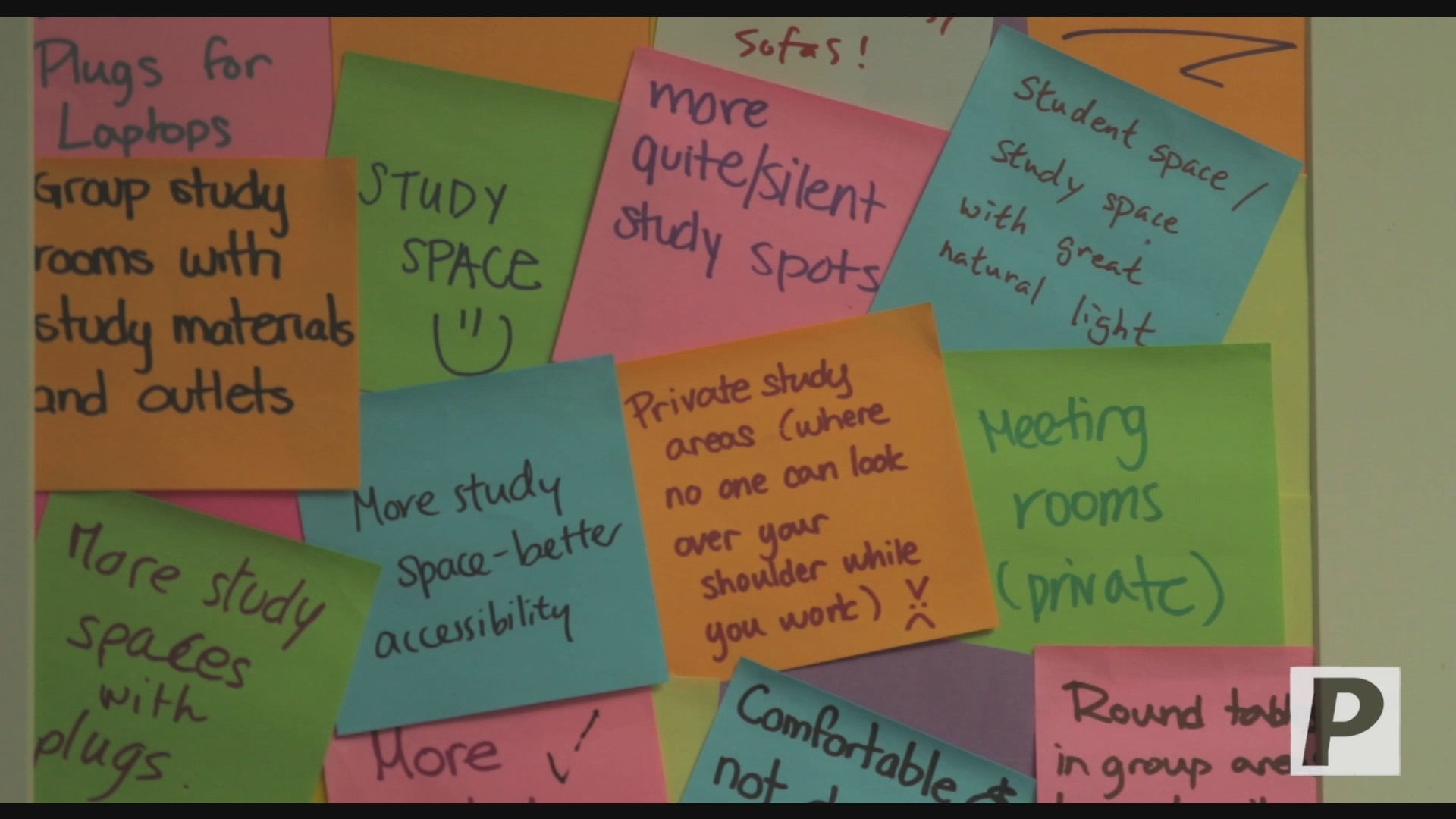
Fontaine stressed that the Build SFU architects also valued student opinion when deciding how to allocate space in the new SUB. The survey showed the lack of study space, lounge space, and affordable food as the main issues that prevent students from spending more time on campus.

To remedy these issues, the space programming draft — a potential floor plan for the SUB — has designated one third of the space for lounge space; one third for student organizations, clubs, and DSUs; one quarter for meeting and multi-purpose rooms; and the remaining space for food and SFSS admin offices.

Despite napping space being described as something that would entice students to spend more time on campus, Fontaine is reluctant to allocate lounge space for that purpose. “We’re not quite sure how to make that happen. Going into the selling of sheets and things gets complicated,” shuddered Fontaine. “It’ll probably be really comfortable couches.”

Regarding the space assigned for meeting and multi-purpose rooms, “Mostly it will be group study areas, rather than individual study cubicles,” explained Fontaine. “The building is intended to be a lively, active place where people can interact and make connections.”

There is less space allocated for food services in Crossroads than in the plans for Main Street, however Fontaine feels that connecting the MBC food court to the new SUB will prove satisfactory. “I think this site allows the existing food vendors to thrive and to improve their services,” said Fontaine.

While this decision ends the site selection phase of the Build SFU project, the next step is to refine the space program for the site. Once this is finalised, the architects will move into the design phase of the building, which is expected to be completed December 2014.

New years resolutions? Meh.

0

How long will your resolution to workout last?

So you’re standing in a room surrounded by several of your friends, drink in hand, and grinning from ear to ear. Perhaps you’ve taken in some fireworks, or even had a special New Year’s kiss. There is something about the atmosphere on New Year’s Eve that inspires hope, and many decide to make resolutions to make themselves better people. The “New Year, New Me” Facebook statuses start rolling in, along with emphatic goals that are broadcasted to the world: “I’m going to lose ten pounds!” or “I’m really going to start being on time for things,” or “This year, I will eat healthier and exercise more!”

While admirable in theory, this tradition really results in shallow resolutions for which people quickly lose motivation. Most goals I see people set in order to “better” themselves are superficial, usually focused on improving physical appearance. Accordingly, the number of people who actually keep their resolution beyond the first couple weeks into January is pretty close to zilch. A year is a long time to work on a goal and one that is associated with shallow crap isn’t going to cut it. This is precisely what makes New Year’s resolutions so meh…they are made in naive hope and are then quickly forgotten.

Why does this resolve to change only come around during New Year’s anyway? Shouldn’t we strive to be our best every day of the year? To live while we’re dying, and, as Oprah says, to live our best life? Why do we settle for creating clichéd goals that are based on wispy fantasies of what we want to achieve but are too lazy to pursue?

Resolutions in themselves are completely unnecessary. For the people who make them and say, “new year, new me,” I say, well of course! So much can change in a year — you’ll be meeting new people, visiting new places, having new experiences. Most of this newness is unplanned and spontaneous — much like life in general.

Improving oneself is a combination of conscious decision and a subconscious response to the events that have taken place in one’s life. Learning from whatever life throws at you is the best way to become a better person.

The only resolution that should be made is to resolve to have the best year possible by riding through life’s ups and downs. That’s truly the best way to ring in the year.

The top 10 films of 2013

0

Gravity

10. Gravity dir. Alfonso Cuaron

A big-budget passion project of this level is no small event, and in a way it’s disarming that Gravity, Alfonso Cuarón’s four-years-in-the-making sci-fi opus, is so thematically simple. But on a level of craftsmanship, it’s insanely complex, and finds Cuarón and cinematographer Emmanuel Lubezki at the absolute peak of their game. Dr. Ryan Stone’s journey through open space, floating from one wreck to another, is not only a moving ode to the will to live, but one of the greatest special effects achievements in cinema history. And if you didn’t manage to catch it in 3D — where those thousands of debris flecks, space station corridors, and the surface of a helmet line the z-axis with perfect compositional confidence — well, you blew it.

atberkeley

9. At Berkeley dir. Frederick Wiseman

Long a chronicler of the institution, Frederick Wiseman’s study of  The University of California, Berkeley finds him in his most comprehensive and daring mode. At Berkeley is a self-consciously slow and detailed film, one that demands a near-interactive commitment from its audience to yield its best rewards. But when that commitment is made, details and connections between its scenes slowly surface, all culminating in a massive sequence detailing both a student protest for free tuition (among an incoherent slew of other demands) and the institutional response to it. Wiseman’s conclusions may surprise you.

Redbud_Day32 (949 of 325).cr2

8. To the Wonder dir. Terrence Malick

The Tree of Life was just about as seminal an arthouse phenomenon as they come, and most any follow-up was bound to have its flaws put under a microscope. To the Wonder isn’t another rewriting of the narrative ruleset, but it is another work of astounding and emotional craftsmanship. Terrence Malick has placed more faith in the emotional power of elliptical editing than ever, and that in conjunction with his customarily sweeping, swirling visuals and expressionist sound design gives a sense of love’s dance between intimacy and estrangement, and the faith needed to survive that struggle.

comp_chess

7. Computer Chess dir. Andrew Bujalski

A film whose budget and production scale is low enough to circumvent much of the studio system’s infernal apparatus is always appreciated, especially when it uses its means to such unusual and invigorating ends. In the guise of an 80s pseudo-documentary shot with black and white video cameras from the 60s, Computer Chess follows a national competition held in a hotel conference room, where the often eccentric or maladjusted competitors face irrational breakdowns in both their computers and their day-to-day lives. It’s an Altman-esque ensemble comedy that isn’t afraid to get weird, and when it does, it’s equal parts funny and profound.

Before-Midnight

6. Before Midnight dir. Richard Linklater

The third film in a series now spanning three decades, Before Midnight ambles back into a day and night in the life of a couple who met in Vienna in 1995, and finds that their lives and relationship are more complicated than ever. The series’ usual high-minded intellectual dialogue is present, as is its skill of embedding in that dialogue conflicts and backstories that explode in the climax. But Midnight excels on a different level than its predecessors, as middle age brings Céline and Jesse to a new place in the trilogy (for now), where fleeting decisions of love and family are now for keeps.

the act of killing

5. The Act of Killing dir. Joshua Oppenheimer, Christine Cynn, Anonymous

The Indonesian killings of 1965-1966 — an act of total political retribution involving political executions, mass extortion, and genocide — have long remained nationally underexposed. Like the great Holocaust documentary Shoah, The Act of Killing evokes the past not with archival footage or photos, but by examining its effect on the present. Director Joshua Oppenheimer invited former members of a notorious death squad to stage filmed re-creations of the atrocities, to which they enthusiastically agreed. The result is more surreal, more damning, and more complex a study of perpetrators as human beings than anyone could have expected.

Wolf-of-Wall-Street

4. The Wolf of Wall Street dir. Martin Scorsese

As black as comedy comes, Scorsese’s biopic of ultra-hedonist stockbroker con-man Jordan Belfort is one of the most formally alive films in years, in the truest sense, hyperactively leveraging its conceits to remind and engage us with its structure. The Wolf of Wall Street fires off unreliable narration, battling voiceovers, chronology switch-ups, and more, constantly calling attention to Belfort’s performative charisma. Even the three-hour length, utterly exhausting given the insane pace, is a tool to exhaust us and make the last hour’s less-entertaining fall from grace as unromantic as possible. And any doubt of whether Scorsese condemns Belfort’s ilk is erased by the gut punch of a final shot.

side-effects

3. Side Effects dir. Steven Soderbergh

It comes as no small joy that Side Effects is the most complex and difficult work of Steven Soderbergh’s career; one that’s been long marked by genre dissection and structural gamesmanship. The coup of Side Effects’ Hitchcockian shift (more Vertigo than Psycho, really) is that the seemingly divergent narrative tones work so well on their own terms. Side Effects betrays our sympathies and expectations, to be sure, but it’s so much more than the sum of its parts: its move from takedown of the pharmaceutical system to a psychological thriller about obsession is not just a nifty trick, but a comparing of bureaucratic systems with personal motives that grows richer the further past its surface you dig.

leviathan

2. Leviathan dir. Lucien Castaing-Taylor and Véréna Paravel

At least as recognizable as “horror” as it is “documentary,” Leviathan builds upon the sheep-watching splendour of Sweetgrass,  co-director Castaing-Taylor’s previous film, with an intense and surreal view of offshore fishing. Leviathan’s endless visions of gulls, spilled fish guts, and the gruelling tedium of seamanship are harrowing enough on their own, but its up-close visuals lift GoPro cameras to expressionist heights that are matched by the film’s overwhelming sound design. Leviathan feels like the most furied and complete response to the ever-expanding possibilities offered by consumer cameras, creating a sensory experience unlike any other documentary.

THE-PRISONERS

1. Prisoners dir. Denis Villeneuve

Prisoners is first and foremost a straightforward thriller, more in the vein of hardboiled detective novels than the realist police procedurals that earn so much more praise these days. That might belie its allegorical power; Prisoners is far from the lousy kidnapped-kid cash-grab that trailers suggested. It subtly reveals itself as a savagely powerful investigation of torture and undue process. Condemnation and sympathy often emerge in the same breath. But what makes the film really astounding is its superlative craftsmanship, particularly its astounding visual splendour and metaphor, which marks both a career-best for world-best cinematographer Roger Deakins, and a major breakthrough for Canadian auteur Villeneuve.