Home Blog Page 1173

Meet the New Boss

0

WEB-Jaques Chapdelaine-Mark Burnham

Jacques Chapdelaine first came to Burnaby as a starry-eyed 18-year old some time ago. He returns as the SFU football team’s new head coach this year, almost 34 years after first stepping onto Terry Fox Field.

Then, he was a slotback for the Clan — and things were quite different in 1980. Mount St. Helens had just erupted, Quebec barely remained part of Canada, and you could still smoke on an airplane.

“I remember sitting in the non-smoking area, which was immediately behind the smoking section,” says Chapdelaine, of his first trip to both Simon Fraser University and the West Coast. “I was thinking how, in a plane going some 700 miles per hour, is smoke not coming into the non-smoking section?”

Chapdelaine ended up on that plane after committing to SFU without ever having visited the campus. “It was an interesting process,” says the Sherbrooke, Quebec native. “I went to an evaluation camp with the [CFL’s] Montreal Alouettes way back in the day, put together [to showcase] players as a recruiting tool.

“The only school that contacted me was Simon Fraser, and that was all I needed to hear.”

“The only school that contacted me was Simon Fraser, and that was all I needed to hear.” – Jacques Chapdelaine

Chapdelaine freely admits it took longer than he would’ve liked for his college career to get going: “The first few games I didn’t play, so that wasn’t so good,” he laughs. “But when I finally got on the roster, it was [better]. It was a great decision at the time, and I’ve never regretted it.”

He has little reason to. After starring as a receiver for SFU, he was drafted fifth overall by the BC Lions in the 1983 Canadian Football League (CFL) draft. Despite an up-and-down playing career, he excelled on the sidelines as a coach of several teams at varying levels.

Chapdelaine has over 20 years of CFL coaching experience, but in 1999, as head coach of the University of Laval Rouge-et-Or, Chapdelaine took the school — now one of the premier programs in Canadian Interuniversity Sport (CIS) — to its first Vanier Cup title. He also has three Grey Cups to his name, the most recent as offensive coordinator of the BC Lions in 2011, a position he held from 2010-13.

Needless to say, winning is something Chapdelaine has grown accustomed to.

The same can’t be said for the team he joins, however. The Clan football program is at a precarious point in its development, having stagnated somewhat last season after exceeding expectations in 2012. Dave Johnson, who Chapdelaine is replacing, had gone just 20–44–1 in seven seasons as the Clan’s head coach, split between the NCAA and CIS.

Clan fans are hungry for a winning season and Chapdelaine believes this year could be the year. “I really think we have the ability to have a winning record,” he says, cautiously. “I think we can challenge and compete to be at the top of the conference, but so many things have to fall into place for that to happen. [We] have to have a little luck on our side.

“It doesn’t help when we get 11 guys to run at each other and see who’s going to come out healthy.”

He’s not speaking out of hand, either. Chapdelaine studied the Clan thoroughly throughout the hiring process, and is familiar with the type of competition his squad will face. For instance, BC Lion linebacker Adam Bighill, who joined the Lions during Chapdelaine’s tenure with the team, is a two-time CFL all-star and played for Central Washington University, one of the Clan’s biggest conference rivals.

Clan fans are hungry for a winning season and Chapdelaine believes this year could be the year.

“Throughout the process, I had a fairly solid understanding of the calibre of the conference, of the skill that’s here at SFU [. . .] and perhaps even some of the things I’d look at changing,” he says.

Members of the SFU football program have been preaching a need for change for a long while. Chapdelaine’s winning experience could be the life raft for a program that’s been treading water for too long, but it was a loss that spurred on the decision.

Chapdelaine’s Lions’ season ended in a 29–25 defeat at the hands of the Saskatchewan Roughriders during the West Semi-Final in Regina. “We were chartering back to BC [after the loss], and actually an SFU alum, [TSN’s] Farhan Lalji, was sitting right behind me [. . .] He told me the SFU job had opened up, and he knew I had an interest in college jobs in the past, so I took some time to think about things.”

The Lions’ last game was on Nov. 10. Three-plus weeks later, and Chapdelaine had left the club. On Feb. 4, Chapdelaine was hired as head coach of the Clan.

Apparently, there’s something about this guy and fateful flights out West.

Clan impress at GNAC Championships

0

While Burnaby Mountain was hit hard with snow last weekend, the Clan track and field teams were hard at work in Nampa, ID representing Simon Fraser at the Great Northwest Athletic Conference (GNAC) Indoor Championships.

The Clan would come home with two GNAC titles after the two-day competition, as well as a fifth-place team finish for the men, and a seventh-place finish for the women.

The men’s distance medley relay (DMR) team got things started for SFU, as Travis Vugteveen, Daniel Kelloway, Cameron Proceviat and James Young ran for the event title, in just 10:07.79.

On the women’s side, Rebecca Bassett, Kayla Leanna, Sarah Sawatzky and Kirstin Allen’s combined time of 12:16.58 was good enough for second place.

On the field, Dkay Ayivor was the Clan men’s next top finisher on day one as the sophomore finished third in the long jump with a season’s best of 6.77m, while senior Mercedes Rhode came in sixth in the women’s long jump competition.

Day two yielded even better results, highlighted by Sawatzky, who maintained her first-place seed in the 800m event, coming out on top in a time of 2:08.57. Sawatzky’s winning time also improved her ranking in the NCAA Division II to second place, where she still sits two weekends away from the NCAA Championships.

Natasha Kianipour had a top finish in her first GNAC appearance with a third place finish in the women’s 60m dash, while sophomore Emma Chadsey had her first podium finish for the Clan with a third place run in the 3,000m in a time of 10:25.40. In the mile, SFU’s Kirstin Allen and Rebecca Bassett finished fourth and seventh respectively.

SFU’s male sprinters also had an excellent weekend at the championships.  Kelloway followed up his DMR title with a third-place finish in the 400m in 49.10 seconds. Fellow freshman Joel Webster had success in his first conference championship with fourth- and sixth-place finishes in the 200m and the 400m.

Vugteveen and Proceviat earned more all-conference honours after their DMR victory: Proceviat finished fourth in the 800m final while Vugteveen earned a fifth-place finish in the mile. James Young followed his teammate finishing eighth in the mile and freshman Oliver Jorgensen nabbed the eighth spot in the men’s 3,000m final.

The Clan women also had three athletes earn all-conference honours in the triple jump, a first in program history. Freshman Ella Brown was SFU’s top finisher in second place, followed by Kye Fedor in fourth and Robyn Broomfield in fifth.

Luca Molinari placed sixth in the weight throw competition as the Clan’s sole thrower attending the championships.

The Clan have one more weekend of indoor competitions as they hope to qualify for the NCAA Division II Indoor Championships held in early March.

Meet CLIVE: an environmental fortune teller

0

WEB-CLIVE_Chen

Combining 3D game engines and spatial data, researchers from SFU and the University of Prince Edward Island (UPEI) have developed an interactive geo-visualization tool that illustrates the geographical past and predicts future impacts of rising sea levels and coastal erosion.

Coastal Impact Visualization Environment, or CLIVE, allows its audience to virtually fly around PEI and view coastlines from 1968, 2010, and their projected locations for 2100. CLIVE can be viewed on computers, HD TVs, and even smartphones.

The tool predicts that if the patterns of erosion and rising sea levels continue, up to 1,000 homes on PEI could be destroyed within the next 90 years.

What began as a summer research position in PEI for SFU environmental science student Alex Chen resulted in the creation of the first three-dimensional platform for presenting the raw evidence and impacts of climate change to the general public.

Adam Fenech of UPEI recognized Chen’s keen interest and skillset and urged him to combine the high-resolution spatial data of PEI’s coastlines with a game engine called Unity 3D, creating the foundation for CLIVE.

In order to predict the future effects of rising sea levels and erosion on PEI’s coastlines, the team of two students and two professors analyzed elevation images and climate models, and conducted a great deal of research in international and local climate change studies.

According to co-developer Nick Hedley, director of SFU’s Spatial Interface Research Lab, “[CLIVE] literally provides an interface between scientific models and citizens in society […] providing a way to see and explore the data, without dumbing down the science.”

By allowing citizens and stakeholders to actually see the impact of climate change on their coastlines in a 3D environment — rather than just hearing about it through the news and in environmental reports — the creators of CLIVE hope to engage more people in dialogue and stimulate preventative action.

Hedley urges his students to combine good spatial analysis with gaming technology: “If you take out the guns and sci-fi, replace them with good data, put them in a 3D game engine environment, you’ve got a very powerful environment in which to represent 3D spatial phenomena, and then interact with them.”

The tool was recently presented to officials from both the provincial and municipal governments in PEI, with the hopes that they might utilize it as an educational and planning tool.

CLIVE has been designed as a “modular conduit”: when equipped with regional data, it should be able to foresee the future of any coastline. Although the first version of CLIVE only encompasses PEI, Chen and Hedley are currently attempting to identify the most suitable, high-definition spatial data of BC’s coastlines.

BC’s expansive and relatively diverse geology, compared to PEI’s much smaller and majorly sandstone coastlines, will require some slight customization to the next version of CLIVE.

Fraternity hosts Rock Paper Scissors tournament

3

WEB-rock paper scissors-Mike Hua

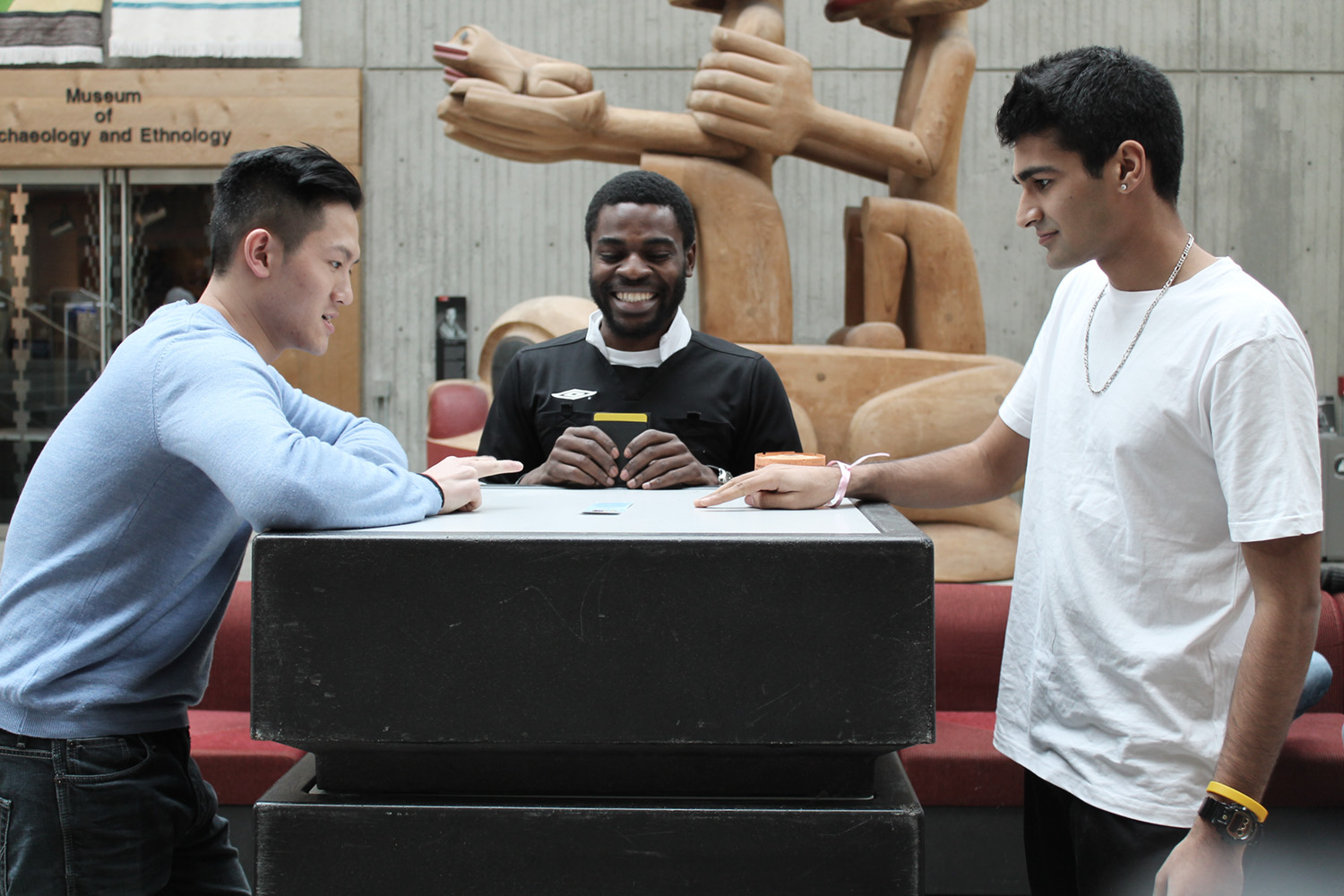
The university’s first Rock Paper Scissors tournament was held over Feb. 24 and 25 and aimed to promote a message of anti-bullying.

SFU’s Alpha Kappa Psi, aided by Tau Kappa Epsilon and the Latin American Student’s Association, hosted the event in conjunction with anti-bullying week, with funds going to the Red Cross.

Players could enter the competition by donation and then had the chance to play for a cash prize of $50. The tournament was broken down into multiple rounds and players were placed into a bracket, battling it out until a winner emerged.

According to organizers, one of the goals of the event was to bring out the “inner child” and break down the sort of negative thinking that breeds harmful stereotypes — to make the point that it isn’t “uncool” to play games and have fun. The tournament was meant to be a fun and unique way to send an important message.

Alpha Kappa Psi president Kayode Fatoba explained, “It’s easier to have a pub event, to party and get a lot of people to come out that way,” but the club wanted to try something different.

Fatoba spoke to how it is easy for people to be negative about an event such as this: “We had individuals who initially would come and be like, ‘This is so stupid.’ Well, that’s really what we’re trying to change, and then they’d be like ‘Oh, makes sense! This is pretty awesome.’”

The Peak caught up with the tournament’s champion, Amrit Jawanda, who said, “It was nice to do something a bit out of the ordinary. [. . .] I didn’t know something as simple as [rock paper scissors] could actually get people together and [be] so much fun.”

The tournament was meant to be a fun and unique way to send an important message.


He also shared his personal strategy that won him the game: “Get in people’s heads. Mess them up.”

As part of the awareness component of the tournament, organizers from Alpha Kappa Psi wore pink ribbons and white shirts on which people could write their own comments about bullying.

Pia Fresnido, the club’s service chair, said that people “could write anything, from insults that have been thrown at them, to positive things like how they can overcome the bullying.”

Organizers were surprised and pleased with the turnout of between 20 and 30 students. They were able to raise $25 in donations. Fatoba said, “While that isn’t much, we figured we’d have to match it. Our hope was just that people would come out and have fun.”

He continued, “It’s about promoting a culture whereby any aspect of student life -— whether it be video game tournaments or card game tournaments — should be seen as exciting [. . .] [and about] reaching out to all sorts of people at SFU.”

Viktor Yanukovych quits public life

0

KIEV — After going missing for several days following his embarrassing and highly publicized removal from office, Viktor Yanukovych has announced that he is hereby “quitting public life.”

The decision, which has been compared to other recent statements from Hollywood celebrities like Shia Labeouf and Alec Baldwin, is apparently a result of Yanukovych’s exhaustion from the pressures of the media, fans, and enraged protesting citizens.

“It’s all too much, the cameras in your face 24/7, the people outside your window every night, the never ending barrage of molotov cocktails,” he explained in his final public address on Ukrainian national television. “I just want to live my life.”

“I’m not going to go on TV anymore or do magazine interviews, and most importantly I’m not going to International Court”

– Viktor Yanukovych

While Yanukovych would later clarify that by “life” he meant “life as the all-powerful dictator of Ukraine,” he confirmed that no matter what happens to his career he will no longer make any public appearances or even talk about his private affairs.

“I’m not going to go on TV anymore or do magazine interviews, and most importantly I’m not going to International Court, that place is sure to be a media-shitstorm,” Yanukovych clarified. “It’s over, I’m done with all of it, I’d just like to get my palace back and then fade back into obscurity like everyone else.”

Although Yanukovych’s has been called out by some as performing a “publicity stunt” and by others as being “a despicable tyrant who I will kill with my bare hands if I ever see him,” from all accounts he seems excited about his new life.

“God, it’s stressful here, I might try to get away from the country completely for a little while,” Yanukovych reportedly told reporters following his final media address. “Maybe I’ll leave and go to the United States to become an actor or something, that’d be a nice change of pace.”

Porno Death Cult: faith and faithlessness

0

Porno death cult1

Everyone believes in something — it’s how we survive life and deal with existence. “We’re all dealing with the same things, we just use different tools to cope,” said Tara Cheyenne Friedenberg.

Whether you’re Christian, Bhuddist, athiest, or none of the above, you’ll find something to relate to in Friedenberg’s new dance-theatre work Porno Death Cult. The show is about faith, what that means, and figuring out what you believe in.

Friedenberg, an SFU Contemporary Arts alumna, has been interested in these types of themes for a long time. Her previous work, Highgate, also dealt with death, but in a much different way. This time around she’s more interested in the abstract side of things versus whether or not the coffin will be the right size.

The inspiration for this show came as she was walking the Camino de Santiago in Spain, an 800km pilgrimage that is older than Christianity.

She found it very interesting that people have been walking that same route for thousands of years as a means to connect with faith. Of course there are Catholics walking the trail, but Friedenberg said that there were also people of many other religions and nationalities.

“They became more muscular and there was this rock star looking guy on a cross.”

– Tara Cheyenne Friedenberg, choreographer and writer

“It made me interested in what we do to cope with life and existence,” said Friedenberg. “The show explores the idea of faith and faithlessness — it’s a continuum, and it changes for most of us.”

The title for the work emerged during this pilgrimage, before she’d even thought of creating the piece. She was charmed by the little towns and cathedrals, and noticed that the statues of Jesus along the way began to get better and better lookingw. “They became more muscular and there was this rock star looking guy on a cross.”

They also got bloodier: “The Spanish really go in for that sort of thing,” she laughed. Friedenberg noticed that the majority of the people in the cathedrals were women, and she thought: “This is like a porno death cult,” and the name stuck.

“The central character, Maureen, is lonely,” explained Friedenberg, “she’s going through an archetypal journey to find faith and what she believes; to find salvation and how to act the right way.” Maureen draws on Christianity, yoga, Bhuddism, and revivalist faiths in order to try to find what she believes in.

“It’s comic at times, but it’s a tragic journey,” said Friedenberg. “There are glimpses of the exaggerated Vancouver or California yoga teacher, and there’s a little bit of sexy Jesus,” she laughed.

While some might wonder if this show will offend, Friedenberg assures that she is not making fun of any religion, but exploring the idea of faith in general. “I’m not lampooning, but there is humour,” she said, “you’ve gotta have a sense of humour.”

Along with choreographing the show, Friedenberg also wrote the textual element, and her husband, Marc Stewart is the composer. “He’s pulling from all kinds of spiritual practice and ideas like chanting and spiritual music,” she said.

Another element that adds to the show is the visual art exhibition in the Firehall Arts Centre Gallery. Alice Mansell, the show’s costume designer, and Mickey Meads, the set designer are presenting PDC: In Progress which showcases photos from the show and mixed media. This is a rare occasion when the art in the Firehall Gallery directly relates to the show in the theatre.

As Friedenberg said, “The show starts as you enter the lobby.”

Free textbooks for popular courses

0

WEB-textbook-flickr-cassidy curtis copy

VANCOUVER [CAPILANO COURIER] – BCcampus and the provincial government are collaborating on an initiative that will give students free access to online textbooks for some high demand classes.

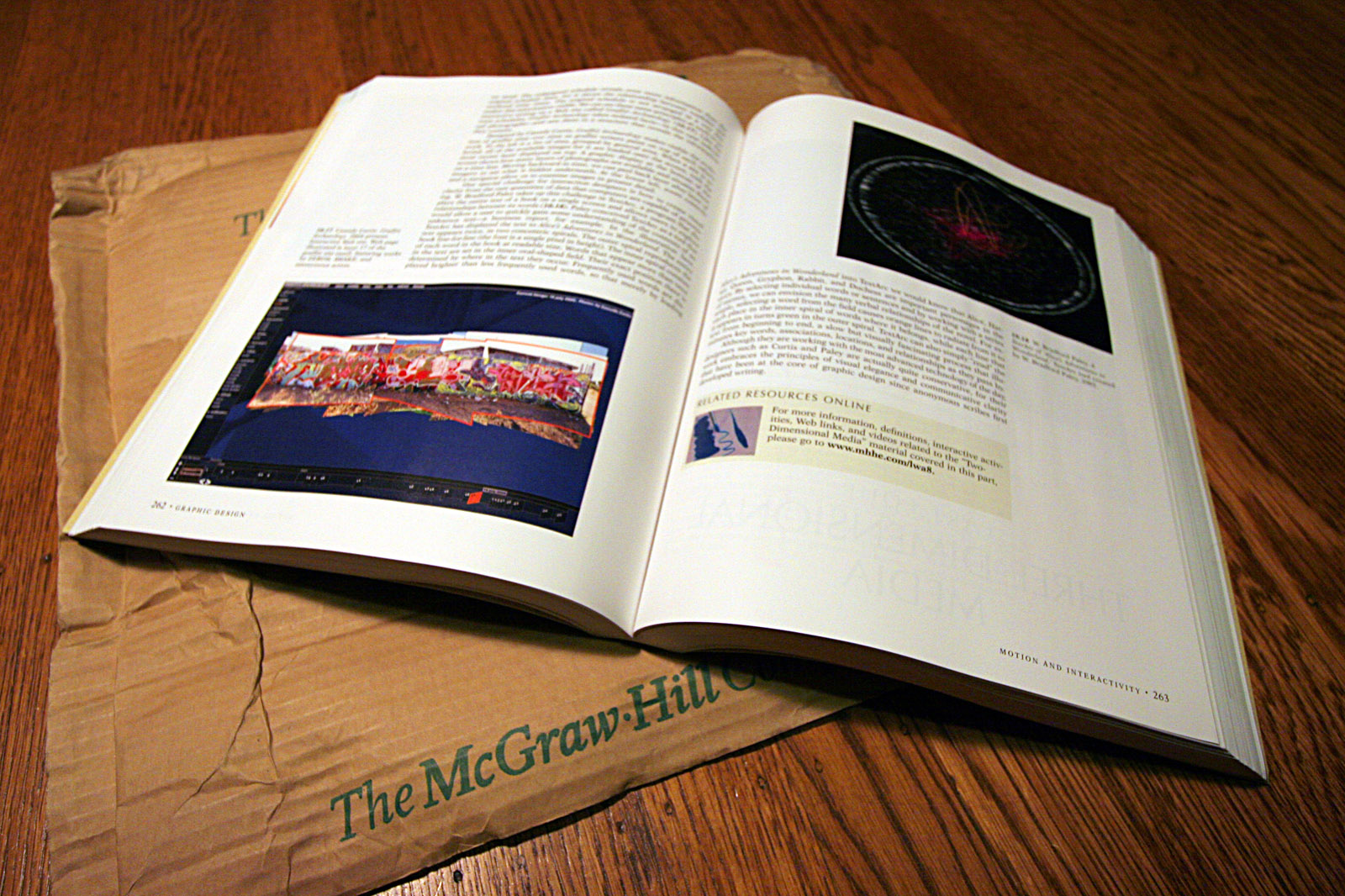
Textbooks are one of the most pricey, but essential, elements of post-secondary schooling, and BC’s Open Textbook Project is welcome news to both students and professors alike. Nearly 300 students have already reaped the benefits of the open textbook initiative, each saving about $146 compared to their regular textbook fees.

The BC Open Textbook Project is an initiative that was launched by the Ministry of Advanced Education and BCcampus. Their goal is to provide free open textbooks for the 40 highest enrolled first- and second-year courses in BC.

There are three phases to the processing of the project. Phase one involves the reviewing of existing open textbooks, phase two is the adaptation of existing open textbooks and finally, phase three creates new open textbooks.

Some of the notable early results of the Open Textbook Project include a collective savings of $11,220 for physics students at Kwantlen Polytechnic University, where each of the 60 students saved $187. A database management class at Douglas College consists of 35 students who saved a total of $5,600 through Open Textbook, each of the 40 students in a statistics class at the Justice Institute of British Columbia saved $100, and $2,060 was saved by 20 management students at Northwest Community College.

Capilano University professor Rajiv Jhangiani didn’t notice any particular drawbacks to open textbooks; students who aren’t accustomed to using online texts are always able to print PDF copies of the book, which only cost a small fraction of the softcover hard copy.

“The good news, I suppose, is since then, around December of last year, BCcampus uploaded my revision into their online repository and they have an agreement with SFU that means that SFU will provide a print, bound softcover version,” Jhangiani said.


“It’s certainly possible for an open textbook to have higher quality.”

– Rajiv Jhangiani, Capilano University professor

He added that this printed version will not just be a simple coiled, spiro-bound text, but a proper bound version: “To any student who wants it at-cost, the 300-page textbook that I co-authored currently costs students about $13.”

Faculty members are still more inclined to use textbooks released by major educational publishers; according to Jhangiani, the extra resources provided by publishers make traditional textbooks attractive to teachers.

“I think there are some very good reasons why faculty choose to adopt traditional textbooks from the large educational publishers like Pearson or McGraw-Hill,” he explained. “Part of the reason is the quality of the product, part of it [is] the test banks and research manuals that comes with that.”

Despite this, Jhangiani believes that open textbooks will soon be capable of providing further resources. “It’s certainly possible for an open textbook to have higher quality, or even give it higher quality because you are able to revise it much quicker than a traditional textbook’s five-year review cycle; you’re able to keep up to beat in terms of cutting edge research,” Jhangiani said.

He continued, “I think the ministry is now funding programs that allow for development of ancillaries and so on, so I think eventually we’re going to get to a point where I don’t see a good reason why faculty members would stick to traditional textbooks — if the only difference is the cost to the students.”

BC Open Textbook aims to finish the original 40-subject area this year. Many of the textbooks under revision are US-centric and faculties are working to revise them into Canadian editions.

Commuter survey explores transit tactics

0

WEB-Tricycle-SFU creative services

“Have mercy, been waiting for the bus all day;” this lyric was true for ZZ Top in the ‘80s, and is true for students today. Beginning next week, SFU Facilities Services will launch an online survey which will ask students for the details of their daily commutes.

Students answering the survey will have the opportunity to explain how they travel to campus and why they choose to do so in that manner.

Facilities Services, which is co-sponsoring the survey with SFU’s Sustainability’s Office and the Pacific Institute for Climate Solutions, anticipates that students will mention challenges such as bus pass-ups and the commute length, among many others.

This survey will provide a baseline for ways in which SFU can improve its transit situation as well as intercampus connections.

The idea originally grew out of the BC government’s initiative to reduce carbon emissions by 33 per cent below 2007 levels by 2020. Since the Burnaby campus is primarily a commuter campus, transportation to and from the main campus contributes significantly to greenhouse gas emissions (GHG), explains SFU’s Sustainability Office’s website. As part of the desire to create a more sustainable culture, the office pegged transportation as a key area for improvement.

However, in order to make those improvements, there had to be some sort of empirical backing. “How can we prove anything if we don’t have good data?” Elizabeth Starr, campus planner, Facilities Services, explained.

Facilities Services had previously conducted traffic surveys about road capacity, parking situations, and traffic demand, but had never specifically addressed energy use. Starr said, “The type of data we have gathered before did not tell us about commuter GHG emissions.”

Furthermore, one of Facilities Services’ responsibilities is campus planning and development; therefore, they felt it was important to understand how students arrived at and travelled between SFU’s three campuses.

“We need to know what will serve our students best,” said Starr.

Students might even see the statistics from this survey in the classroom; according to Sustainability Consultant Justin Bauer, the Geography Department could eventually use the data in their Spatial Interface Research Lab. “So [students] are not only answering the survey, but then they get to do the analysis on something that is local and important,” explained Bauer.

The data from the survey will identify the age of participants using certain types of transit, as well as the location of those participants. Bauer imagines this will help SFU target distinct populations who face different transportation and mobility issues.

Although Starr was hesitant to claim that the survey would solve all of students’ transit issues, she did say it could provide avenues for improvement: “The data will help to identify transit and transportation issues and help to plan for the future, but its not about promising immediate change.”

The survey will be launched on Mar. 10, to close on Apr. 6. Students will be contacted to respond to the survey via their SFU Connect emails. After crunching the numbers, SFU Institutional Research and Planning and Facilities Services will jointly publish the results.

Lean times as opportunity for reform in Venezuela

0

WEB-Maduro-flickr-chavezcandanga

For 14 years, Hugo Chavez drove Venezuela down the path towards “Bolivarian Revolution” which sought to retract the country from the neoliberal mould that American influence had long pressured Latin America into accepting. Robust additions to welfare programs, price controls, and foreign aid to socialist neighbours were made in order to achieve these ideals.

And, for over a decade, it worked (sort of). The Venezuelan poor, after years of neglect, now had a champion catering to their needs, their desires, their aspirations. And all this was channeled through the incredibly charismatic mouthpiece that was Chavez. It is more than understandable why such a constituency would cast aside cautious incremental progress in favour of Chavez’s outlandish dreams.

But the piper must be paid. Over the course of Chavez’s presidential tenure, Venezuela’s oil exports dropped by nearly half while spending promises for populist goodies skyrocketed.

Unsurprisingly, the economic fallout has been acute. Inflation for 2014 has averaged around 40 per cent, according to a report by Scotiabank Economics, down from 56.2 per cent in 2013, according to Business Insider, all part of a much longer trend.

Necessity is the great destroyer of ideology.

The very Venezuelans that the Bolivarian Revolution sought to protect — the poor — are now suffering from it, and the right-leaning middle-classes even more so. No longer can the government afford to insulate its citizenry from the faltering economy.

Chavez’s successor Nicolás Maduro is facing the bulk of the blame. But let’s not fool ourselves that it is his fault alone. For over a decade the Venezuelan citizenry has accepted sugary populism in lieu of achievable reforms. Voters ultimately deserve the people they elect and support.

And while Chavez chipped away at Venezuela’s democratic integrity through media censorship and tolerance of his supporters’ voter intimidation techniques, the country never completely left the orbit of democracy. Chavez’s political ambitions sprouted from a soil of legitimate popularity. Ultimately, it was ordinary Venezuelans who went along with the Bolivarian Revolution, and they bear responsibility for it alongside their wayward leaders.

Beset by the protests of the vengeful middle-classes, Maduro has lost much of his mandate and will have a hard time governing from now on. While it’s likely his people will retain power for another election or two, they have lost their political mandate to transform the country in their image. Bold moves that characterized the Chavez administration will no longer be palpable with the general population, and Maduro will have to be cautious.

Whether this is good or bad remains to be seen. It is an old mantra that lean times beget good policies, as fat times beget the bad. Crises leave less room for political theatre and necessitate pragmatism. But they also accentuate political differences, which can obstruct governments from feeding their nations the harsh medicine they may need.

Maduro is a committed disciple of the Bolivarian Revolution — he would not have been Chavez’s handpicked successor otherwise. But necessity is the great destroyer of ideology. Economic and political realities will force Maduro’s hand towards economic reform, regardless of how fervent the anti-government protests remain.

Tippy Top Ten: Midterms

0

Here are the Tippy Top Ten signs you failed your midterms last week…

10. Answered every question with “C” on oral exam

9. Tutorials were cancelled this week but only for you

8. Apparently Marshall McLuhan isn’t the Green Lantern’s alter-ego

7. Instead of a smiley face, your test had a barfing emoji

6. Accidently used a number 3 pencil on scantron

5. Professor keeps telling you about assignments you’ll be doing next semester

4. This is the first time you’re hearing about any midterms

3. You plagiarized from the washroom’s hand-washing instructions

2. Started off essay with phrase “Listen dude”

1. Turns out the kid you cheated off of was only half-Asian